Annexes
171 articles for reading the essay: the theories of its authors, the history of Christianity and of Europe, the disciplines it draws on, the Greek myths it assumes the reader knows. They are reading notes, written without quotations; they do not replace the sources. In the text, terms underlined with dots link to them.
Theories of the authors
Plato's philosophy: Forms, soul, city, the GoodTheories of the authors
Plato (428/427-348/347 BCE), a disciple of Socrates and the founder of the Academy, wrote some thirty dialogues in which almost all later philosophy found its questions. The essay is concerned above all with the Laws, the Republic and the Euthyphro; here is the framework within which these texts take their place.
The Forms and the intelligible world
Socrates asked what courage, piety and justice are, without being content with examples. Plato answers that these definitions aim at realities: the Ideas or Forms, the Beautiful itself, the Just itself, the Equal itself, unchanging, intelligible, distinct from the sensible things that participate in them and bear their name. The sensible world, changing and imperfect, is the image of an intelligible world that the soul contemplated before birth and that it recollects: to learn is to remember. At the summit of the Forms stands the Good, which the Republic compares to the sun: it gives the Forms their being and the soul its capacity to know them, and it is itself beyond essence. The allegory of the cave describes education as the liberation of a prisoner who turns round from the shadow towards the light. The Parmenides and the Sophist, late dialogues, subject the theory of Forms to objections that Plato does not entirely resolve, and the Neoplatonists will draw their system from them.
The soul
The soul is immortal, and Plato gives several proofs of this: in the Phaedo through the kinship of the soul with the Forms, in the Phaedrus and the Laws through the fact that it moves itself and that a principle of motion cannot perish. The Republic divides it into three parts, reason, spirit and appetite, whose harmony under the government of reason is justice. The Phaedrus compares it to a team of horses; the Timaeus situates it within the cosmos, the work of a demiurge who shaped the sensible world by looking at the intelligible model and endowed it with a world soul. The salvation of the soul passes through philosophy, which is an exercise in dying, a separation of soul from body, and through contemplation.
The city
The Republic builds the just city on the model of the soul: three classes, producers, guardians, philosophers, and the rule of philosopher-kings, the only ones who know the Good. Education is controlled there, the poets expelled for having attributed vices to the gods, and a purified theology taught. The Laws, the last dialogue, describe a second-best city, more achievable, governed by laws each of which is preceded by a persuasive preamble; Book X deals with impiety, refutes three forms of it, atheism, the denial of providence and the belief that the gods can be swayed, punishes them with imprisonment and, for repeat offenders, with death, and entrusts the guarding of the doctrine to the nocturnal council. In the Euthyphro Plato raises the question whether the pious is loved by the gods because it is pious, or pious because it is loved by the gods.
What the essay assumes
The essay reads Book X of the Laws as the pure case of its criterion and the ancestor of the Grand Inquisitor, and the Republic as the first name of spirituality, the conversion of the soul towards the Good; it sees between these two Platos a tension that is its own. It takes as known the theory of Forms, the hierarchy of the Good beyond essence, which Murdoch will take up, the proof from the self-moving soul and the place of the Euthyphro in the debate on morality without God. It sets Plato against Lucretius and Rousseau in constructed confrontations, and recalls Popper's reading.
In the essay: Plato · Rousseau · Dostoevsky · Iris Murdoch
Further reading: Plato, République (c. 375 BCE) ; Timée (c. 360 BCE) ; Lois (c. 348 BCE) ; Luc Brisson and Jean-François Pradeau, Le Vocabulaire de Platon (1998) ; Monique Dixsaut, Plato (2003) ; André Laks, Médiation et coercition. Pour une lecture des Lois de Platon (2005)
Aristotle's philosophy: act and potency, causes, the unmoved mover, virtue, contemplationTheories of the authors
Aristotle (384-322 BCE), a pupil of Plato for twenty years and then founder of the Lyceum, left lecture treatises covering logic, physics, biology, metaphysics, ethics, politics and poetics. The essay reads above all books Λ, E and A of the Metaphysics and the tenth book of the Nicomachean Ethics; here is their context.
The concepts of physics and metaphysics
Against Plato's separate Ideas, Aristotle holds that forms are in things: each individual substance, this horse, this man, is a compound of matter and form. To conceive change, he distinguishes act and potency: the acorn is an oak in potency, the oak is the act of the acorn; motion is the passage from potency to act. Every complete explanation draws on four causes, material, formal, efficient and final, and nature acts for the sake of an end. Logic, set out in the Organon, invents the syllogism and the theory of demonstration. The Metaphysics, a title given by the editors to the books placed after the Physics, seeks the science of being qua being and of first principles; being is said in several senses, the first of which is substance. Book Λ crowns the whole with theology: the eternal motion of the heavens requires an eternal, immobile substance, pure act without matter, which moves as an object of love and whose life is thought thinking itself.
The soul and knowledge
The treatise On the Soul defines the soul as the form of a natural body having life in potency, and distinguishes the nutritive, sensitive and intellective functions. The intellect that thinks all things must be separate and impassible; the famous passage on the agent intellect, which brings intelligibles into act as light brings colours, will feed the debates of Alexander of Aphrodisias, Avicenna, Averroes and Thomas on the immortality and unity of the intellect. Knowledge begins with sensation, passes through experience and is completed in the grasp of principles.
Ethics and politics
The Nicomachean Ethics asks what the highest good for man is: happiness, eudaimonia, an activity of the soul in accordance with virtue in a complete life. The moral virtues, courage, temperance, justice, liberality, are dispositions acquired by habit and consist in a mean determined by practical wisdom; the intellectual virtues are science, art, practical wisdom, intellect and wisdom. The tenth book places at the summit the contemplative life, theôria, the most continuous, the most self-sufficient and the most divine, and invites man, as far as possible, to immortalize himself, athanatizein, by living according to what is highest in him. The Politics makes man a political animal, examines regimes and their corruptions, and prescribes a common education. The Poetics defines tragedy by the purgation of the passions, catharsis.
What the essay assumes
The essay takes as known the doctrine of act and potency, the theory of causes, the definition of the first mover and of thought thinking itself, which it makes the God of the philosophers of the three monotheisms, and the place of contemplation at the summit of ethics, which it reads as a spirituality of exercise without worship. It also retains the passage of Λ 8 on the myths added to persuade the multitude, the ancestor of the elitist reading, and the definition of first philosophy as theological, the source of Heidegger's onto-theology.
In the essay: Aristotle · Heidegger · Transition (part one) · Why is there something rather than nothing? A constructed debate
Further reading: Aristotle, Métaphysique (4th century BCE) ; Éthique à Nicomaque ; Physique ; De l'âme ; Pierre Aubenque, Le Problème de l'être chez Aristote (1962) ; Jonathan Barnes, Aristotle (1982) ; Pierre Pellegrin, Le Vocabulaire d'Aristote (2001)
The philosophy of Epicurus: atoms, canonic, pleasure and the remedy for fearsTheories of the authors
Epicurus (341-270 BCE), born on Samos, founded the Garden in Athens in 306, a school open to women and slaves, where people lived as friends according to a doctrine that makes philosophy a therapy of the soul. Of his three hundred scrolls only three letters, two collections of maxims and some fragments remain, and Lucretius's poem is the fullest exposition of his doctrine.
Canonic and physics
The canonic is the theory of the criterion of truth: sensations are always true, errors come from judgement; to them are added the preconceptions, concepts formed by the repetition of sensations, and the feelings of pleasure and pain. The physics takes up the atomism of Democritus: the universe is made of atoms, indivisible, eternal bodies, infinite in number, and of the void, through which they fall; everything else, worlds, souls, gods, is composed of atoms and dissolves. Epicurus adds to Democritus the swerve, Lucretius's clinamen: a tiny, uncaused deviation of the atoms in their fall, which explains their encounters and grounds freedom against fate. Celestial and meteorological phenomena admit several explanations, all acceptable provided they exclude divine intervention. The soul is bodily and mortal; death is nothing to us, for while we are, it is not, and when it is, we are no longer.
The gods and religion
Epicurus is not an atheist. The gods exist, as common evidence attests; they live in the intermundia, blessed and incorruptible, indifferent to human affairs, concern for which would disturb their bliss. The impious man is not the one who denies the gods of the crowd, but the one who attributes to the gods the opinions of the crowd: anger, favour, providence. Popular religion, with its fears of punishment and its hopes of reward, is the main source of disturbance, and knowledge of nature frees us from it. The gods nonetheless remain models of the happy life, whom the sage contemplates and honours.
The ethics of pleasure
Pleasure is the beginning and the end of the happy life, but it is defined negatively: the absence of pain in the body, aponia, and of disturbance in the soul, ataraxia. Epicurus classifies desires as natural and necessary, natural and unnecessary, neither natural nor necessary, and prescribes satisfying the first, moderating the second and fleeing the third. Prudence is worth more than philosophy itself, friendship is the greatest of goods, and the sage lives hidden, away from politics. The Letter to Menoeceus sums up the whole, and later Epicureans condensed it into the fourfold remedy, tetrapharmakos: the gods are not to be feared, death is not to be dreaded, the good is easy to obtain, evil easy to endure. The school lasted until the fourth century CE, opposed by the Stoics and the Christians, and was reborn in the seventeenth century with Gassendi.
What the essay assumes
The essay assumes familiarity with atomism, the mortality of the soul, the doctrine of the gods of the intermundia and the therapeutic meaning of the knowledge of nature. It places Epicurus in the regime of error while stressing his piety and his spiritual dimension, ataraxia as an exercise, and judges that Onfray inherits only half of him. Hume discusses Lucretius, and the trilemma of evil attributed to Epicurus returns in the Dialogues.
In the essay: Epicurus and Lucretius · Hume
Further reading: Epicurus, Lettres et maximes, trans. Marcel Conche (1987) ; Diogenes Laertius, Vies et doctrines des philosophes illustres, book X ; Jean-Marie Guyau, La Morale d'Épicure (1878) ; Jean Salem, Tel un dieu parmi les hommes. L'éthique d'Épicure (1989) ; Pierre-Marie Morel, Épicure. La nature et la raison (2009)
Lucretius and the De rerum natura: nature explained against religionTheories of the authors
Titus Lucretius Carus (c. 98-55 BCE) is the author of a single book, the De rerum natura, On the Nature of Things, a poem in six books and more than seven thousand hexameters that sets out the physics and ethics of Epicurus to a Roman, Memmius. Almost nothing is known of his life; the legend of a love potion and a suicide comes from Jerome, four centuries later. Cicero is said to have revised the poem after his death.
The poem
Book I invokes Venus, the generative power of nature, then sets out the principles: nothing is born from nothing, nothing returns to nothingness, everything is atoms and void. Book II deals with the motion of atoms, their swerve, the clinamen, and the plurality of worlds; Book III with the soul, material and mortal, and with death, which is nothing to us; Book IV with sensation, simulacra and love, which Lucretius satirizes; Book V with the origin of the world, of living beings and of civilization, in a history of humanity without providence, from the first humans to cities, language and the arts; Book VI with celestial and terrestrial phenomena, lightning, volcanoes, the magnet, and it ends with the plague of Athens. The poem is a lesson in physics with a moral aim: knowing the causes frees us from the fear of the gods and of death, which is the source of the passions and of crimes.
The critique of religion
The De rerum natura is one of the most violent ancient texts against religion. From Book I onwards, Lucretius celebrates Epicurus as the Greek who first dared to raise his eyes against the religion that crushed humankind, trampled it underfoot and, by his victory, made us equal to heaven; he then recounts the sacrifice of Iphigenia by Agamemnon at Aulis, to conclude that religion could prompt so many evils. Book V explains the birth of belief in the gods by the visions of dreams, by ignorance of the causes of celestial phenomena and by fear, and shows men prostrating themselves before altars without finding peace there. Lucretius does not deny the gods, blessed and distant; he denies that they govern the world and that they are to be feared. True piety is to contemplate all things with a mind at peace.
Legacy
Little read in the Middle Ages, the poem is rediscovered in 1417 by Poggio Bracciolini in a German monastery, printed in 1473, and read by Montaigne, who quotes it abundantly, by Gassendi, who rehabilitates Epicurus, by the libertines, by Diderot and d'Holbach, by Hume, by Marx, whose dissertation deals with Democritus and Epicurus, and by Bergson, who published extracts from it. It has become the emblem of a materialist critique of religion, and the line on the evils of religion one of the most quoted formulas of ancient literature.
What the essay assumes
The essay quotes the lines of Book I on religion trampled underfoot, on the victory that makes us equal to heaven, in which it sees a divinization of man that announces Feuerbach, and on Iphigenia. It assumes familiarity with the plan of the poem, with the explanation of belief by fear and ignorance, which Hume, Freud, and Norris and Inglehart will rediscover, and with the fact that Lucretius, like Epicurus, leaves religion without leaving the divine, which the essay calls the first form of its paradox.
In the essay: Epicurus and Lucretius · Hume · Norris and Inglehart · Montaigne
Further reading: Lucretius, De rerum natura (c. 55 BCE), trans. Alfred Ernout (1920) and José Kany-Turpin (1993) ; Pierre Boyancé, Lucrèce et l'épicurisme (1963) ; Stephen Greenblatt, Quattrocento (The Swerve, 2011) ; Alain Gigandet, Lucrèce. Atomes, mouvement (2001)
The philosophy of Plotinus: the hypostases, procession and conversionTheories of the authors
Plotinus (205-270), born in Egypt, a pupil of Ammonius Saccas in Alexandria, taught in Rome from 244 before a circle of disciples and senators. His fifty-four treatises, written late in life and with no concern for style, were arranged by his disciple Porphyry into six groups of nine, the Enneads. He sees himself as a mere interpreter of Plato; the moderns call him the founder of Neoplatonism.
The three hypostases
Reality is ordered into three principles, or hypostases. At the summit is the One, or the Good, absolutely simple, beyond being and thought, of which nothing can be said except what it is not; Plotinus derives it from the Good beyond essence of the Republic and from the first hypothesis of the Parmenides. From the One proceeds, without the One losing anything or willing it, like light from the sun, Intellect, Nous, which thinks itself and contains all the Forms, true being: it is Aristotle's god, placed in the second rank. From Intellect proceeds Soul, which contemplates Intellect and produces the sensible world, in which it unfolds as World Soul and as individual souls. Matter, the lowest degree, is privation and darkness, what Plotinus calls evil, without making it a principle. This system, procession, descends by degrees from unity to multiplicity; conversion, epistrophê, climbs back along the reverse path.
The ascent of the soul
The human soul, having descended into a body, keeps a part of itself in the intelligible. Philosophy is the itinerary of its return: purification through the virtues, detachment from the sensible, dialectic, contemplation of the Forms in Intellect, and finally union with the One, in which the soul ceases to think and to distinguish itself from what it reaches. Porphyry reports that Plotinus knew this union four times during the years he spent with him. This experience, which the moderns call ecstasy, is not a gift coming from elsewhere: it is obtained through an exercise, cutting away everything that is not the One, and the last sentence of the Enneads describes it as a flight of the alone to the alone. Plotinus has neither revelation, nor Church, nor cult; he refuses to sacrifice to the gods and writes against the Gnostics, who despise the sensible world, a treatise in which he defends the beauty of the cosmos.
Posterity
Porphyry, then Iamblichus and Proclus, who multiplies the intermediaries and reintegrates theurgic rites, hand the system down to the last pagans; Augustine reads it in the Latin translations of Marius Victorinus and finds in it the Word without the Incarnation; Pseudo-Dionysius Christianizes it and passes it on to the whole of medieval mysticism, Eriugena, Eckhart; Ficino translates it in the Renaissance; Hegel, Bergson and Bréhier reread it; Hadot, in 1963, makes it the model of a spirituality of the simplicity of vision.
What the essay assumes
The essay takes as known the doctrine of the three hypostases, procession and conversion, the negative theology of the One, which it places at the origin of the regime of experience, and Porphyry's account. It makes Plotinus the consummate example of a spirituality that might not have become religion, religious in James's sense, the ancestor of the spiritualities without God that Hadot describes, and notes that the sacrifice criterion does not apply to him. Levinas, in A Religion for Adults, targets him by name, an attested response: to the Plotinian soul that goes towards nothing other than itself, he opposes a real transcendence.
In the essay: Plotinus · Meister Eckhart · Pierre Hadot
Further reading: Plotinus, Ennéades, trans. Émile Bréhier (1924-1938) and Luc Brisson and Jean-François Pradeau (2002-2010) ; Porphyry, Vie de Plotin (c. 301) ; Pierre Hadot, Plotin ou la simplicité du regard (1963) ; Jean Trouillard, La Procession plotinienne (1955) ; Dominic O'Meara, Plotin. Une introduction aux Ennéades (1992)
The philosophy of Averroes: the Commentator, the intellect, the reply to al-Ghazali, Latin AverroismTheories of the authors
Abû l-Walîd Muhammad ibn Rushd (1126-1198), Averroes to the Latins, born in Cordoba into a family of jurists, was qadi of Seville and of Cordoba, physician to the Almohad caliph and commentator on Aristotle at the prince's request. Disgraced in 1195 and exiled for a time, he dies in Marrakesh. His work has had two destinies: almost forgotten in Islam, it shaped Latin philosophy.
The Commentator
Averroes commented on almost the whole of Aristotle, in three formats: the epitomes, the middle commentaries and the long commentaries, which follow the text sentence by sentence. Dante calls him the one who made the great commentary, and scholasticism names him simply the Commentator. His project is to restore Aristotle freed from the Neoplatonic additions of Avicenna: he rejects emanation and the Avicennian distinction between essence and existence, and defends the eternity of the world, natural causality and God's knowledge of himself as the principle of all things. In the Long Commentary on the De anima, he holds that the material intellect, the receptacle of intelligibles, is one and eternal for the whole of humanity, like the agent intellect: human beings think by joining it, and personal immortality cannot be demonstrated by reason. This is the thesis of the unity of the intellect, or monopsychism, which Thomas Aquinas will combat.
The defence of philosophy
Against al-Ghazali, who in The Incoherence of the Philosophers had condemned twenty theses of the falsafa, Averroes writes The Incoherence of the Incoherence, a point-by-point refutation that defends causality against occasionalism and the necessity of the laws of nature. The Decisive Treatise, a short juridical treatise, establishes that the revealed Law commands philosophical study for those capable of it, that truth does not contradict truth, that the passages of the Qur'an whose apparent meaning clashes with demonstration must be interpreted, and that this interpretation must not be divulged to the common people, whom it would disturb: human beings fall into demonstrative, dialectical and rhetorical classes, and each must receive the truth in the form that suits it. The Exposition of the Methods of Proof criticizes the theologians of the kalam. Averroes also commented on Plato's Republic, since he did not have the Politics.
Latin Averroism
Translated into Latin from the 1220s, in Toledo and then in Sicily, Averroes enters the University of Paris with Aristotle. Masters of arts, Siger of Brabant and Boethius of Dacia, teach the eternity of the world and the unity of the intellect as necessary conclusions of reason while professing the faith; Thomas Aquinas writes On the Unity of the Intellect (1270) against them, and in 1277 Bishop Étienne Tempier condemns two hundred and nineteen propositions, accusing these masters of holding that a thing can be true in philosophy and false in theology, the double truth, which none of them formulated in those terms. Averroism continues in Padua until the sixteenth century, with Pomponazzi, and in 1852 Renan devotes his thesis to it, Averroès et l'averroïsme, which makes it an ancestor of free inquiry. The Guide for the Perplexed of Maimonides, his contemporary and compatriot, answers neighbouring questions.
What the essay assumes
The essay assumes familiarity with the role of the Commentator, the quarrel with al-Ghazali, an attested response, the doctrine of the three classes of people and of reserved interpretation, and the legend of the double truth born of the condemnations of 1277. It concludes that Averroes neither leaves nor founds anything, but divides, and finds this solution again in Spinoza, Comte, Renan and Leo Strauss; the essay constructs a confrontation with Spinoza, who did not read The Decisive Treatise but targets the same arrangement when he attacks Maimonides in the Theological-Political Treatise, and Voegelin grants Averroes a point.
In the essay: Averroes · Maimonides · Leo Strauss · Islam before the exit from religion
Further reading: Averroès, Discours décisif, trans. Marc Geoffroy (1996) ; L'Incohérence de l'incohérence, trans. Simon Van den Bergh (1954, in English) ; Grand Commentaire du De anima, trans. Alain de Libera (1998) ; Alain de Libera, Averroès et l'averroïsme (1991) ; Ali Benmakhlouf, Averroes (2000) ; Dominique Urvoy, Averroès. Les ambitions d'un intellectuel musulman (1998)
The thought of Maimonides: the Guide for the Perplexed, the Mishneh Torah, prophecyTheories of the authors
Moses ben Maimon (1138-1204), Rambam for the Jewish tradition, Maimonides for the Latins, is born in Cordoba, flees the Almohad persecution, passes through Fez and Palestine and settles in Cairo, where he is physician to Saladin's vizier and head of the Jewish community. Jurist, philosopher and physician, he writes his philosophical works in Arabic and his code of the law in Hebrew.
The code and the law
The Commentary on the Mishnah (1168) contains the thirteen principles of faith, the first creed of Judaism, which affirm the existence, unity and incorporeality of God, prophecy, the superiority of Moses, the Torah as coming from heaven and immutable, retribution, the Messiah and the resurrection. The Mishneh Torah (c. 1180), in fourteen books, is the first complete code of Jewish law, written in clear Hebrew, without discussion or citation of sources: it is meant to make the law knowable without going through the Talmud, an ambition that earns it criticism. Its first book, the Book of Knowledge, places at the beginning of the law the knowledge of God through physics and metaphysics.
The Guide for the Perplexed
The Guide (c. 1190), written in Arabic for a disciple trained in philosophy and troubled by the letter of Scripture, the perplexed, aims to show that the Torah rightly read agrees with the science of Aristotle. The first part explains the terms of the Bible that seem to attribute a body or passions to God: they are homonyms, words with several meanings, whose bodily sense must be set aside. It develops the doctrine of negative attributes: one cannot say of God what he is, but only what he is not, and silence is the most fitting praise; the positive attributes of Scripture describe his actions, not his essence. The second part demonstrates the existence, unity and incorporeality of God from the principles of Aristotle, discusses the eternity of the world, which Maimonides judges indemonstrable either way and decides in favour of creation on the strength of revelation, and presents prophecy as a natural perfection of the intellect and the imagination, which God may withhold, Moses being the exception. The third deals with evil, with providence, proportioned to the intellect, with the book of Job, and with the reasons for the commandments: the sacrifices, in particular, are a pedagogical concession to people accustomed to pagan worship, intended to turn them away from it little by little. The introduction warns that the book contains deliberate contradictions, meant to hide from the vulgar what does not suit them.
Legacy
The Guide, translated into Hebrew as early as 1204 and into Latin in the thirteenth century, is read by Thomas Aquinas and by Eckhart, who cites Rabbi Moyses, and provokes within Judaism a century-long controversy over philosophy. Spinoza criticizes it in the Theological-Political Treatise, Leo Strauss makes it the model of esoteric writing, and Levinas finds in it a theology of attributes in the imperative.
What the essay assumes
The essay assumes familiarity with the addressee of the Guide, the method of homonyms, the negative theology of attributes, which it treats as an anticipation of the regime of experience, the historical explanation of the sacrifices, which it says is separated by a narrow step from an explanation without God, and the seventh cause of contradiction, Strauss's source. It confronts Maimonides, in a constructed confrontation, with Feuerbach, for whom negative theology is a subtle atheism, and holds that each is right for a different audience.
In the essay: Maimonides · Averroes · Leo Strauss · Levinas
Further reading: Maimonides, Le Guide des égarés, trans. Salomon Munk (1856-1866) ; Mishné Torah (c. 1180) ; Leo Strauss, Persecution and the Art of Writing (1952) ; Maurice-Ruben Hayoun, Maimonides (1987) ; Herbert A. Davidson, Moses Maimonides. The Man and His Works (2005) ; Pierre Bouretz, Lumières du Moyen Âge. Maïmonide philosophe (2015)
The thought of Meister Eckhart: detachment, the birth of God in the soul, the trialTheories of the authors
Eckhart of Hochheim (c. 1260-1328), a Thuringian Dominican, twice master of theology in Paris, provincial of his order in Saxony, preacher in Strasbourg and Cologne, left a Latin body of work, scholastic in form, and a German one, sermons and treatises addressed to nuns and to lay people, which made him the father of Rhineland mysticism and of German philosophical prose.
God, the Godhead, being
In the Latin works, Eckhart comments on Scripture with the tools of scholasticism and holds that God is being itself, esse est Deus, and that creatures, in themselves, are pure nothingness, having only received being. In the German sermons he goes further: beyond God as he reveals himself in three persons and relates to creatures, there is the Godhead, Gottheit, a groundless ground, a desert, where there is neither Father nor Son nor Spirit, and where God and the soul are one. He takes up the negative theology of Dionysius and of Maimonides, whom he cites as Rabbi Moyses, and pushes it so far as to pray God to rid him of God, that is, of every representation of God that would still be a creature.
Detachment and the birth of God in the soul
The practical teaching comes down to one word, Abgeschiedenheit, detachment, to which Eckhart devotes a treatise: to empty oneself of every image, every will of one's own, every attachment, even to God as an object, so that God may be born in the soul. For there is in the soul a ground, a spark of the soul, Seelenfünklein, uncreated and uncreatable, where the Father begets his Son eternally, and what he begets is the soul itself become Son. Sermon 52, on the poor in spirit, defines true poverty: to will nothing, to know nothing, to have nothing, not even a place within oneself where God could act. The treatise On the Noble Man, Gelassenheit, the letting-be that follows from detachment, and the without-why of life, which lives because it lives, an image Silesius would take up with the rose, express the same doctrine, which does not despise action: Eckhart prefers Martha to Mary.
The trial
In 1326 the archbishop of Cologne opened inquisitorial proceedings against Eckhart, who defended himself, protested his orthodoxy and appealed to the pope. He died before the end of the trial, probably early in 1328. The bull In agro dominico of John XXII, dated 27 March 1329, condemned twenty-eight propositions drawn from his works, seventeen as heretical and eleven as suspect, noting that Eckhart had retracted before his death anything that might give rise to error. His work, read by Tauler and Suso, then by Nicholas of Cusa, was rediscovered in the nineteenth century by the Romantics and Franz Pfeiffer, and edited critically from 1936 onwards.
What the essay assumes
The essay assumes familiarity with sermon 52, the prayer to be rid of God, the bull of 1329 and the word Gelassenheit. It distinguishes two readings of Eckhart, negative theology pushed to its limit and the ancestor of spiritualities without God, and follows the second line in Schopenhauer, who hails him as a brother of the sages of India, in Heidegger, who displaces Gelassenheit, and in Simone Weil, whose decreation resembles his teaching. It notes that Feuerbach has the same form and the opposite conclusion.
In the essay: Meister Eckhart · Arthur Schopenhauer · Simone Weil
Further reading: Meister Eckhart, Sermons, trans. Jeanne Ancelet-Hustache (1974-1979) ; Traités et sermons, trans. Alain de Libera (1993) ; Josef Quint (ed.), Die deutschen Werke (1936-) ; Alain de Libera, Eckhart, Suso, Tauler et la divinisation de l'homme (1996) ; Kurt Flasch, Maître Eckhart. Philosophe du christianisme (2010)
The thought of Philo of Alexandria: Genesis read with PlatoTheories of the authors
Philo (c. 20 BCE-c. 45 CE), a Jew of Alexandria from a rich and influential family, is the principal witness to a Greek-speaking Judaism that read the Bible in the Septuagint translation and thought with Plato and the Stoics. In 39-40 he led the embassy of the Jews of Alexandria to Caligula, after the pogrom of 38, and left an account of it.
The work and the method
Some fifty treatises survive, almost all commentaries on the Pentateuch: the Allegorical Commentary, including the Legum allegoriae, which follows Genesis verse by verse; the Exposition of the Law, which runs from the De opificio mundi, on the creation, to the lives of the patriarchs and the particular laws; the Questions on Genesis and Exodus; and philosophical or historical treatises, including the De vita contemplativa, which describes the Therapeutae, a community of Jewish ascetics near Alexandria devoted to study and prayer. The method is allegorical exegesis, inherited from the Stoic interpreters of Homer and already practised by Alexandrian Jews: the text has a literal sense, which Philo does not reject and whose observance he maintains, and a deeper sense, in which the characters and events represent the powers of the soul, the virtues and the journey towards God. Abraham is the soul that learns, Isaac the soul that possesses virtue by nature, Jacob the soul that acquires it through exercise.
God, the Logos, the world
God is Being, he who is, according to Exodus read in Greek, transcendent, without name or quality, knowable only in his existence; his relation to the world passes through his powers, the creative and the royal, and above all through the Logos, the divine Reason, at once God's thought, the place of the Ideas, the model of the world, the instrument of creation and the mediator between God and humankind, which Philo calls firstborn, image of God and, once, second God. The De opificio reads the Genesis account with the Timaeus: God first conceived the intelligible world, then fashioned the sensible world in its image. Man created in the image of God is so through his intellect, the image of the Logos. Philo's ethics is that of an ascent of the soul, through virtue, contemplation and sober ecstasy, towards the vision of God.
Legacy
Rabbinic Judaism did not preserve Philo; it was the Christians, Clement of Alexandria, Origen, Eusebius, Ambrose, who copied, quoted and transmitted him, to the point that legend made him a Christian. His doctrine of the Logos supplied the prologue of John and the apologists with a vocabulary, and his allegory supplied the method of Alexandrian exegesis. Modern scholars have seen in him the first to attempt the synthesis of biblical revelation and Greek philosophy that Justin, Augustine, Maimonides and Averroes would each take up for their own tradition.
What the essay assumes
The essay assumes familiarity with the reading of Genesis with the Timaeus, the doctrine of the Logos as intelligible world and second God, the link with the prologue of John, the two-level allegory that foreshadows Averroes, the Therapeutae, and the fact that Philo was transmitted by Christians and not by rabbinic Judaism. It places him in a regime of allegory prior to any critique: Philo does not criticize religion, he translates it into philosophy, and refounds nothing.
In the essay: Philo of Alexandria · Justin Martyr
Further reading: Philon d'Alexandrie, Œuvres, ed. Roger Arnaldez, Jean Pouilloux and Claude Mondésert (1961-1992) ; Émile Bréhier, Les Idées philosophiques et religieuses de Philon d'Alexandrie (1908) ; Harry A. Wolfson, Philo (1947) ; Mireille Hadas-Lebel, Philon d'Alexandrie. Un penseur en diaspora (2003) ; Carlos Lévy (ed.), Philon d'Alexandrie et le langage de la philosophie (1998)
Paul of Tarsus: the letters, justification, the Law and the new perspectiveTheories of the authors
Paul (c. 5-c. 64), a Jew from Tarsus in Cilicia, a Pharisee trained in the Law, a Roman citizen according to Acts, a persecutor of the first disciples of Jesus, is converted around 33 on the road to Damascus and becomes the apostle to the nations. His letters, written roughly between 50 and 60, are the oldest Christian texts, earlier than the Gospels, and his theology has shaped Christianity.
The letters
The New Testament contains thirteen letters under his name. Critical scholarship holds seven to be authentic: the first to the Thessalonians, the two to the Corinthians, and those to the Galatians, the Philippians, Philemon and the Romans. The others, Ephesians, Colossians, the second to the Thessalonians and the pastoral letters to Timothy and Titus, are attributed to disciples. The authentic letters respond to concrete situations in communities founded by Paul around the Aegean Sea; they contain the oldest testimonies to the death and resurrection of Jesus, including the received formula of 1 Corinthians 15, and to the Last Supper. The Acts of the Apostles, written by Luke a generation later, recount his missionary journeys, his speech before the Areopagus in Athens and his arrest; his death in Rome under Nero is attested only by tradition.
The theology
At the centre stands Christ crucified and risen, foolishness to the Greeks and a stumbling block to the Jews, whose death has reconciled humankind with God and whose return is near: Paul expects the end of time within his own lifetime. Man is justified, that is, made or declared righteous before God, by faith in Christ and not by the works of the Law; the Law of Moses, holy in itself, reveals sin without delivering from it, and converted Gentiles need not submit to it, nor to circumcision, a question that sets him against Peter and James and that the assembly of Jerusalem settles around 49. The baptized person dies and rises with Christ, lives in the Spirit, and the Church is the body of Christ, in which there is neither Jew nor Greek, neither slave nor free, neither male nor female. The letters also contain moral instructions, on marriage, meat sacrificed to idols, obedience to the authorities, and the hymn to charity.
The readings
Augustine reads Paul against Pelagius and finds in him grace and original sin; Luther finds in him justification by faith alone and makes the opposition of faith and works the heart of the Reformation; Nietzsche makes him the inventor of Christianity, who betrayed the Gospel of Jesus. Since E. P. Sanders in 1977, the new perspective on Paul has contested the Lutheran reading: first-century Judaism was not a religion of merit, and Paul's problem is not the justification of the anxious individual but the entry of the Gentiles into the people of God. Contemporary philosophers, Taubes, Badiou, Agamben, have reread Paul as a thinker of the universal and of the event.
What the essay assumes
The essay assumes familiarity with the list of the seven authentic letters, the testimony of Galatians 1, 19 on James the brother of the Lord, Paul's eschatology as Schweitzer established it, Sanders's new perspective, and the readings of Engels and Nietzsche. It retains from Romans 12, 1 that Paul spiritualizes sacrifice instead of abolishing it, and sees in this the birth certificate of a religion that will be able to demand the whole offering.
In the essay: Paul of Tarsus · Nietzsche
Further reading: E. P. Sanders, Paul and Palestinian Judaism (1977) ; Albert Schweitzer, Die Mystik des Apostels Paulus (1930) ; Simon Légasse, Paul apôtre (1991) ; James D. G. Dunn, The Theology of Paul the Apostle (1998) ; Daniel Marguerat, Paul de Tarse. L'enfant terrible du christianisme (2023)
Justin and the apologists of the 2nd century: Christianity as philosophyTheories of the authors
The name apologists is given to the Christian writers of the second century who, in treatises addressed to the emperors or to the educated public, defend Christianity against the accusations aimed at it and present it as the true philosophy. Justin, who died a martyr in Rome around 165, is the most important of them, and the first to think through the relation of Christianity to Greek reason.
Justin
Born at Flavia Neapolis in Samaria, into a pagan family, Justin relates at the beginning of the Dialogue with Trypho his journey through the schools, Stoic, Peripatetic, Pythagorean, Platonist, up to his meeting with an old man who reveals to him the prophets and Christ. He keeps the philosopher's cloak and opens a school in Rome. His First Apology, addressed around 153 to Antoninus Pius, refutes the accusations of atheism, immorality and subversion, describes the baptism and eucharist of the Christians, and maintains that Christ is the Logos, the divine Reason, in which all men have a share: those who lived according to the Logos, Socrates, Heraclitus, were Christians before Christ. The Second Apology develops the doctrine of the seminal Logos, and asserts that everything that has been well said belongs to the Christians. The Dialogue with Trypho, a two-day discussion with a learned Jew, argues from the prophecies that Jesus is the Messiah and that the Law is abolished, and contains the first formulations of Christian anti-Jewish polemic. Justin also takes over from the Alexandrian Jews, Aristobulus and Philo, the idea that Plato had read Moses, the theft of the Greeks. Denounced, he is tried by the prefect of Rome and beheaded with six companions.
The other apologists
Aristides of Athens, around 125, is the earliest. Tatian, a disciple of Justin, writes an Address to the Greeks of radical hostility to pagan culture. Athenagoras of Athens, around 177, addresses to Marcus Aurelius a Plea that refutes with philosophical method the three accusations of atheism, Thyestean banquets and incest. Theophilus of Antioch, the Epistle to Diognetus and Melito of Sardis complete the Greek series. In Carthage, Tertullian (c. 155-c. 220), jurist and rhetorician, writes around 197 an Apology in the tone of a courtroom plea and, in the De praescriptione, opposes Athens to Jerusalem and rejects philosophy as the mother of heresies, while reasoning as a Stoic. Clement of Alexandria (c. 150-c. 215), at the opposite pole, makes Greek philosophy a preparation for the Gospel given by God to the Greeks as the Law was given to the Jews, and describes the true gnostic, the perfect Christian, in Platonic terms; his pupil Origen will continue along this path.
What is at stake
The apologists respond to a legal situation, the condemnation of Christians for the name itself, and to an intellectual situation, the contempt of the educated. Their response commits Christianity to the path of a rational theology: the Logos of John becomes the Logos of the philosophers, the God of the Bible the transcendent God of Middle Platonism, and faith a philosophy. Celsus, around 178, will answer them that this philosophy is a plagiarism.
What the essay assumes
The essay takes as known the account of Justin's conversion, the doctrine of the seminal Logos, with its double face of openness and annexation, the Dialogue with Trypho, the theft of the Greeks, Tertullian's saying on Athens and Jerusalem, and Justin's martyrdom, of which it says that it is Rome that demands the sacrifice.
In the essay: Justin Martyr · Celsus and Origen
Further reading: Justin, Apologies, ed. Charles Munier (2006) ; Dialogue avec Tryphon, ed. Philippe Bobichon (2003) ; Henry Chadwick, Early Christian Thought and the Classical Tradition (1966) ; Bernard Pouderon, Les Apologistes grecs du IIe siècle (2005) ; Éric Osborn, Justin Martyr (1973)
Celsus and the True Doctrine: the first philosophical critique of ChristianityTheories of the authors
Celsus is a pagan philosopher of the second half of the 2nd century, author c. 178 of a treatise against the Christians, the True Doctrine, Alèthès logos, entirely lost but three-quarters reconstructed thanks to the quotations Origen makes from it in his refutation, seventy years later. It is the oldest comprehensive critique of Christianity, and almost all its arguments have had a long afterlife.
The man and the book
Nothing is known of Celsus apart from his book. Origen takes him for an Epicurean, but the text shows a Middle Platonist, steeped in Plato's Timaeus and Letters, believing in a supreme, transcendent God, who governs the world through subordinate gods and daemons, to whom the cities owe their worship. He knows Judaism, the Gospels, which he has read, and the divisions among Christians, including the Gnostics. The True Doctrine is built in two stages: Celsus first gives the floor to a Jew who attacks Jesus and the Christians from the point of view of the Law; then he speaks in his own name, from the point of view of philosophy and the Empire.
The arguments
Jesus, according to Celsus's Jew, was born of an adulteress and a soldier named Panthera, learned magic in Egypt, gathered disciples of low condition, was abandoned and executed as a criminal; his resurrection rests on the testimony of a hysterical woman. The Christians, according to Celsus, ask people to believe without examining and recruit among the ignorant, slaves, women and children, whom they forbid to listen to the wise; what is good in them, the idea of a single and good God, the immortality of the soul, judgement, they stole from Plato and the Greeks, distorting it; what is their own, the incarnation of a God in a mortal body, the resurrection of the flesh, the idea that God takes a particular interest in human beings, is absurd and unworthy of God; finally, they refuse the gods of the city, the service of the emperor and of the army, and thereby undermine the order of an Empire that tolerates them. Celsus invites them to join the common worship and to help the emperor, for if everyone did as they do, the Empire would fall into the hands of the barbarians. He never denies that Jesus existed.
Afterlife
The book mattered enough for Origen to agree, c. 248, to refute it book by book. Porphyry, a century after Celsus, and the emperor Julian would take up its arguments; the libertines, Voltaire, Renan and Nietzsche would rediscover them without always knowing it, and the True Doctrine, translated in 1925 by Louis Rougier, has become a classic of anti-Christian critique. Modern historians read it above all as the testimony of a religious conservative anxious for the unity of the Empire.
What the essay assumes
The essay takes as known the date and the reconstruction of the True Doctrine, the four families of accusations, Jesus as magician, faith without reason, an audience of the ignorant, plagiarism of Plato, and the fact that Celsus does not doubt the existence of Jesus. It makes him a religious conservative, ancestor of Voltaire, Maurras and the late Onfray, who defends the gods of the city against the religion of slaves, and judges that neither of the two adversaries, Celsus or Origen, leaves religion.
In the essay: Celsus and Origen
Further reading: Celsus, Discours vrai contre les chrétiens, trans. Louis Rougier (1925, 1965) ; Origen, Contre Celse, ed. Marcel Borret (1967-1976) ; Pierre de Labriolle, La Réaction païenne (1934) ; Robert L. Wilken, The Christians as the Romans Saw Them (1984) ; Michael Frede, Celsus philosophus Platonicus, article (1994)
The thought of Origen: allegory, the pre-existence of souls, apocatastasisTheories of the authors
Origen (c. 185-c. 253), born in Alexandria into a Christian family, the son of a martyr, heads the catechetical school of his city while still young, studies philosophy under Ammonius Saccas, the teacher of Plotinus, then settles in Caesarea in Palestine around 232 after a conflict with his bishop. Tortured during the persecution of Decius, he dies from the effects of his wounds. He is one of the first great theologians and the first scholarly exegete of Christianity.
The exegete
His immense body of work is largely lost, because of posthumous condemnations. The Hexapla set out in six columns the Hebrew text of the Bible, its transliteration and four Greek translations, in order to establish the text of the Septuagint: it is the first work of biblical textual criticism. His commentaries and homilies cover almost the whole of Scripture. His method distinguishes three senses, corresponding to the body, the soul and the spirit: the literal or historical sense, the moral sense, and the spiritual or mystical sense, which only allegory reaches and which concerns Christ and the Church; certain passages, impossible or unworthy if taken literally, have no literal sense and oblige the reader to look higher. He inherits this method from Philo and Clement and bequeaths it to all ancient and medieval exegesis, which will develop it into four senses.
On First Principles
The Peri Archon, On First Principles, written around 230 and preserved mainly in Rufinus's softened Latin translation, is the first theological summa. It sets out the Trinity, with a Son subordinate to the Father, eternally begotten; the first creation of free and equal intelligences, whose fall, through the cooling of their love, explains the diversity of angels, humans and demons, and the creation of the material world as a place of education; free will, defended against the Gnostics and the astrologers; and the end of all things, when God will be all in all: the apocatastasis, a universal restoration in which all creatures, perhaps even the devil, will return to God, the punishments of the afterlife being medicinal and not eternal. Origen puts forward these theses as hypotheses for inquiry where the rule of faith is silent. Against Celsus, around 248, refutes the True Doctrine point by point and defends the rationality of faith, the moral superiority of Christians and their civic loyalty, while acknowledging that most of them believe without being able to demonstrate.
Origenism and its condemnation
Origen's disciples and continuators, Gregory Thaumaturgus, Pamphilus, Eusebius, then the Cappadocians, who compile an anthology of his texts, the Philocalia, make him the chief authority of the Greek East. But the pre-existence of souls, the apocatastasis and subordinationism provoke, from the end of the fourth century, an Origenist controversy, Epiphanius and Jerome against Rufinus, which leads in 543, under Justinian, to the condemnation of propositions attributed to Origen, confirmed by the Council of Constantinople of 553. His influence survives in Evagrius, Maximus the Confessor and Eriugena, and his rehabilitation by twentieth-century theologians, de Lubac, Daniélou, Balthasar, was one of the driving forces of the return to the Fathers.
What the essay assumes
The essay assumes familiarity with Against Celsus as the oldest attested response, with Origen's position on the faith of the simple and the demonstration of the learned, with the doctrine of the two cities that he sketches before Augustine, and with his Platonism. It retains that Origen opens up spiritual equality and closes off freedom of thought, and that he does not leave religion.
In the essay: Celsus and Origen · Philo of Alexandria
Further reading: Origène, Traité des principes, ed. Henri Crouzel and Manlio Simonetti (1978-1984) ; Contre Celse, ed. Marcel Borret (1967-1976) ; Henri Crouzel, Origen (1985) ; Henri de Lubac, Histoire et Esprit. L'intelligence de l'Écriture d'après Origène (1950) ; Pierre Nautin, Origène. Sa vie et son œuvre (1977)
Porphyry: the editor of Plotinus and the critic of the ChristiansTheories of the authors
Porphyry (c. 234-c. 305), born in Tyre in Phoenicia, a pupil of Longinus in Athens and then of Plotinus in Rome from 263 to 268, is at once the editor of his master, a philosopher and an encyclopaedic scholar, and the author of the most feared anti-Christian treatise of Antiquity. His very extensive work survives only in part.
The editor and the logician
Porphyry arranged the treatises of Plotinus into six Enneads and prefaced them with a Life of Plotinus, an almost unique source on the philosopher, which recounts his ecstasies, his refusal to let himself be painted, his remark about the gods who must come to him, and the crisis that Porphyry himself went through, when Plotinus turned him away from suicide by sending him to Sicily. His Isagoge, an introduction to Aristotle's Categories, translated into Latin by Boethius, was the logic textbook of the whole Middle Ages and raised, concerning genera and species, the question that would become the dispute over universals. He commented on Aristotle and Plato, wrote on abstinence from meat and on the cave of the nymphs in the Odyssey, interpreted allegorically, and composed for his wife a Letter to Marcella that sums up a philosophical piety: honouring God through silence and virtue rather than through sacrifices.
The religious thinker
The Philosophy from Oracles, a youthful work, collects and comments on oracles of Apollo and Hecate in order to find in them a way of salvation through rites; it is there that, according to Augustine, the gods declare Christ pious and immortal and the Christians defiled. Later, Porphyry shows himself reserved towards theurgy, which Iamblichus would defend against him in the De mysteriis, and places the salvation of the soul in philosophy. He is thus, within Neoplatonism, the representative of an inward and rational religion, and the last before the school's ritual turn.
Against the Christians
The treatise in fifteen books, written around 270 according to the most common dating, was banned and burned by Constantine, and again in 448; only fragments remain, quoted by those who refuted it, Eusebius, Methodius, Apollinaris, Jerome, Augustine, Macarius Magnes, and their attribution is often disputed. In it Porphyry applies philological and historical criticism to the Bible: he points out the contradictions between the gospels, the quarrel between Peter and Paul, the ignorance of the apostles, and above all he demonstrates, in Book XII, that the book of Daniel was written not in the 6th century by the prophet but in the 2nd, under Antiochus Epiphanes, by an author who told the past in the form of prophecy; modern exegesis has proved him right. He denies neither the existence nor the wisdom of Jesus, but accuses his disciples of having divinized him. Julian, a century later, would take up his arguments.
What the essay assumes
The essay takes as known Porphyry's connection with Plotinus and with Origen, whom he had met when young, the fragment on Daniel, in which it sees an anticipation of Spinoza and of David Friedrich Strauss, the passage of the Philosophy from Oracles quoted by Augustine, and the thesis of a wise Jesus betrayed by his disciples, which Renan and Nietzsche would take up. Augustine answers him in the City of God, and it is from this answer that the essay dates the form of Western theology.
In the essay: Porphyry and Augustine · Plotinus
Further reading: Porphyry, Vie de Plotin, ed. Luc Brisson et al. (1982-1992) ; Contre les chrétiens, fragments, ed. Adolf von Harnack (1916) ; Lettre à Marcella, ed. Édouard des Places (1982) ; Pierre Hadot, Porphyre et Victorinus (1968) ; Sébastien Morlet (ed.), Le Traité de Porphyre contre les chrétiens (2011)
The thought of Augustine: Confessions, City of God, grace, original sin, controversiesTheories of the authors
Aurelius Augustinus (354-430), born at Thagaste in Numidia, a rhetorician at Carthage, Rome and Milan, converted in 386, baptized by Ambrose, priest and then bishop of Hippo from 395 until his death, during the siege of the city by the Vandals, left a body of work of more than a hundred titles which shaped Latin theology, and through it Western thought, for more than a thousand years.
The itinerary and the Confessions
The Confessions (397-401), in thirteen books, recount to God, in the second person, Augustine's life up to his conversion: childhood, the theft of the pears, his studies, the reading of Cicero's Hortensius, which fired him with a love of wisdom, nine years among the Manichaeans, who set two principles against each other, good and evil, the scepticism of the New Academy, the discovery of the books of the Platonists, which led him to conceive an immaterial God and evil as privation, and finally the scene in the garden at Milan and the child's voice, take up and read. The last books meditate on memory, on time, which Augustine makes a distension of the soul, and on creation. The book is the first account of an inner life, and its formula, God more inward than my inmost self, founds Western interiority.
The City of God and the controversies
The De civitate Dei (413-426), written after the sack of Rome by Alaric in 410, answers the pagans who blamed Christianity for it: the first ten books refute Roman religion and philosophy, discussing above all the Platonists, the closest to the Christians; the twelve that follow tell the history of the two cities, the city of God and the earthly city, founded on two loves, the love of God to the point of contempt of self and the love of self to the point of contempt of God, intermingled until the judgement. Three controversies also structure the work. Against Manichaeism, Augustine defends the goodness of creation and free will. Against the Donatists, a schismatic Church of Africa that demanded the purity of its ministers, he holds that the validity of the sacraments does not depend on the holiness of the one who administers them, and ends by accepting imperial coercion to bring the schismatics back, invoking the Gospel's compel them to come in. Against Pelagius, a monk from Britain for whom man can avoid sin by his own strength, he elaborates the doctrine of grace and original sin: since Adam, humanity is a mass of perdition, no one can will the good without grace, and God predestines those whom he saves; Pelagianism is condemned in 418 and 431.
Knowledge and the Trinity
Against the sceptics, Augustine holds that whoever doubts exists, si fallor sum; seeks truth within the soul, where the inner teacher illuminates it; defines the method of believing in order to understand; and, in the De Trinitate, finds in memory, understanding and will the image of the Trinity. His theology of history, his doctrine of grace and his psychology nourished scholasticism, Luther, an Augustinian monk, Calvin, Jansenism and Pascal, Descartes and Heidegger.
What the essay assumes
The essay takes as known the narrative of the Confessions, in particular the reading of the Platonists, the plan of the City of God and its discussion of the Platonists in book VIII, the formula of interiority, the method of believing in order to understand, and the Donatist episode, which it cites without having reread it. It makes the Augustinian synthesis of the God of the philosophers and the God of the Bible the major fact of the intellectual history of the West, which Pascal and Heidegger undo, and sees in rational theology armed by the Christian emperors, for which Augustine supplied the justification against the Donatists, a strict refoundation.
In the essay: Porphyry and Augustine · Pascal · Descartes
Further reading: Augustine, Confessions (397-401) ; De civitate Dei (413-426) ; De Trinitate (c. 400-426) ; Peter Brown, La Vie de saint Augustin (1967) ; Étienne Gilson, Introduction à l'étude de saint Augustin (1929) ; Serge Lancel, Saint Augustin (1999) ; Goulven Madec, Introduction aux Révisions et à la lecture des œuvres de saint Augustin (1996)
The thought of Montaigne: the Essays, scepticism, custom, experienceTheories of the authors
Michel Eyquem de Montaigne (1533-1592), a magistrate in Bordeaux, then withdrawn into his library from 1571, mayor of Bordeaux from 1581 to 1585, a mediator between Henry of Navarre and Henry III during the Wars of Religion, wrote a single book, the Essays, published in 1580, enlarged in 1588 and after his death in 1595, and endlessly rewritten in the margins. A practising Catholic, he is the first to make himself the matter of his book.
The book
The Essays are not a treatise: a hundred and seven chapters of unequal length, on subjects drawn from his reading of Plutarch, Seneca and the historians, Of Cannibals, Of Friendship, devoted to La Boétie, Of Coaches, Of Vanity, Of Repentance, Of Experience, in which thought advances by digressions, quotations and returns upon itself. To essay is to weigh, to put one's judgement to the test on everything, and first on oneself, who changes at every instant: Montaigne does not portray being but passing. The book forms a single body with its author, consubstantial, and its sincerity, which does not exclude art, has made it the model of writing about the self.
Scepticism and faith
The Apology for Raymond Sebond, the longest chapter (II, 12), starts from the defence of a fifteenth-century Catalan theologian who claimed to demonstrate the faith by reason, and turns it into a demolition of reason itself: man is not superior to the animals, the senses deceive, the philosophers contradict one another, science is opinion, and we hold our religion only by birth and country, Christians in the same way as we are Perigordians or Germans. Montaigne takes up the tropes of the Pyrrhonism of Sextus Empiricus, which he has engraved in his library, and his motto, Que sçay-je ?, in the form of a question. This scepticism is not unbelief: it serves to humble reason so that faith may be received from God alone, a position called fideism and held by several Catholics of the time. But its effect is to make custom the sole explanation of belief, and Pascal, Bayle and Hume will each draw different consequences from it.
Custom, experience, wisdom
Custom is for Montaigne the queen of the world: it makes laws, morals and religions, and the wise man conforms to it outwardly while keeping his judgement free inwardly, in a back shop all our own. Faced with the civil wars, he condemns cruelty, torture, witch trials, and doubts that a man should be burned for a conjecture. The last chapter, Of Experience, proposes a wisdom of acceptance of the body, of pleasure and of the human condition: nothing is so fine as to play the man well and properly, and the greatest thing in the world is to know how to belong to oneself. This wisdom does without salvation and the beyond, without denying them.
What the essay assumes
The essay assumes familiarity with the structure of the Apology, the motto, the formulas on custom and on faith received by birth, the friendship with La Boétie, and the chapter Of Experience, which it reads as a spirituality without salvation. It holds Montaigne to be a sincere fideist and not a masked atheist, notes the unintended effect of his scepticism, Hume before Hume, and reports Pascal's attested response in the Entretien avec Sacy and the Pensées.
In the essay: Montaigne · Pascal · Hume
Further reading: Montaigne, Essais (1580, 1588, 1595), ed. Pierre Villey (1924) ; Hugo Friedrich, Montaigne (1949) ; Jean Starobinski, Montaigne en mouvement (1982) ; Richard Popkin, The History of Scepticism from Erasmus to Descartes (1960, expanded ed. to Spinoza 1979) ; Bernard Sève, Montaigne. Des règles pour l'esprit (2007)
The philosophy of Descartes: doubt, the cogito, God as guarantor of scienceTheories of the authors
René Descartes (1596-1650), educated at the Jesuit college of La Flèche, soldier, traveller, settled in the United Provinces from 1628 to 1649, who died in Stockholm at the court of Queen Christina, is regarded as the founder of modern philosophy. A mathematician, the inventor of analytic geometry, and a physicist, he sought to refound the whole of knowledge on a certain foundation.
Method and doubt
The Discourse on the Method (1637), a preface to three scientific essays, recounts in the first person the formation of a mind which, disappointed by letters and by the schools, resolves to accept as true only what it knows evidently, and sets down four rules: evidence, division, order, enumeration. The Meditations on First Philosophy (1641, in Latin), followed by the objections of Hobbes, Arnauld and Gassendi and by Descartes's replies, put the method to work. The first Meditation pushes doubt to the end: the senses deceive, dreaming cannot be told apart from waking, and an evil genius might deceive the subject even in mathematics. The second discovers the fixed point: whoever doubts thinks, and whoever thinks is, he is a thing that thinks; the cogito, formulated in the Discourse as I think, therefore I am, is the first certainty, grasped by the mind alone and not by the senses. The analysis of the piece of wax shows that bodies are known by the understanding and not by the imagination.
God, the world, man
The third Meditation proves God from the idea of the infinite: the subject finds in himself the idea of a perfect and infinite being, which cannot come from himself, a finite and doubting being, and whose cause must have as much reality as the idea contains; God therefore exists, and he is no deceiver. The fifth adds the ontological proof, existence belonging to the essence of the perfect being as the sum of its angles belongs to the triangle. God then guarantees the truth of what the mind conceives clearly and distinctly, and science becomes possible; error comes from the misuse of the will, which is infinite and judges beyond what the understanding conceives. The sixth Meditation establishes the existence of bodies and the real distinction between the soul, whose essence is thought, and the body, whose essence is extension: dualism, with the problem of their union, which Descartes locates in the pineal gland and treats in The Passions of the Soul (1649). The letters to Mersenne of 1630 add a singular thesis: the eternal truths, mathematics included, were freely created by God, who could have made them otherwise. Cartesian physics is mechanistic: matter is extension, animals are machines, and the world is explained by figures and motions.
Reception
The Meditations were placed on the Index in 1663; Cartesianism prevailed in the universities from the late seventeenth century, and the dispute over the cogito, circle or intuition, over the proof from the idea of the infinite and over the creation of the eternal truths has never ceased. Pascal reproaches Descartes for a useless and uncertain God, reduced to a flick of the finger; Spinoza starts from him; Leibniz objects that the possibility of God must first be proved; Kant dismantles his proofs; Husserl claims him as a forerunner; Heidegger sees in the Cartesian subject the beginning of modern metaphysics; Foucault places there the Cartesian moment, when truth ceases to require a transformation of the subject.
What the essay assumes
The essay assumes the reader knows the order of the Meditations, the cogito, the two proofs of God, the function of God as guarantor of science, the creation of the eternal truths and dualism. It retains the dedication to the Sorbonne, which argues from the social usefulness of belief, Pascal's response, Leibniz's attested response, and the difficulty Descartes poses for Foucault's Cartesian moment, since his contemplation of God remains an exercise. Descartes makes God a component of reason, which Kant will dismantle.
In the essay: Descartes · Pascal · Michel Foucault · Leibniz
Further reading: René Descartes, Discours de la méthode (1637) ; Meditationes de prima philosophia (1641) ; Principia philosophiae (1644) ; Martial Gueroult, Descartes selon l'ordre des raisons (1953) ; Ferdinand Alquié, La Découverte métaphysique de l'homme chez Descartes (1950) ; Jean-Luc Marion, Sur la théologie blanche de Descartes (1981)
The thought of Pascal: the three orders, the wager, JansenismTheories of the authors
Blaise Pascal (1623-1662), a precocious mathematician and physicist, inventor of the calculating machine, theorist of the vacuum and of probability, turns to religion after a first conversion in 1646 and the night of 23 November 1654, the account of which, the Memorial, he keeps on his person. Linked to Port-Royal, he defends the Jansenists in the Provincial Letters and dies at thirty-nine, leaving the fragments of an apology for Christianity, the Pensées.
Jansenism and the Provincial Letters
Jansenism takes its name from the Augustinus (1640) of Cornelius Jansen, bishop of Ypres, which takes up the Augustinian doctrine of grace in its strictest form: human nature is corrupt, efficacious grace is given to whom God wills, and man can do nothing without it. The abbey of Port-Royal, led by Mother Angélique Arnauld, and the solitaries attached to it, Antoine Arnauld, Nicole, Sacy, are its centre in France; the Jesuits, supporters of a sufficient grace offered to all and of an accommodating morality, its adversaries. Five propositions drawn from the Augustinus are condemned by Rome in 1653. When Arnauld is threatened with exclusion from the Sorbonne, Pascal publishes in 1656-1657, under a pseudonym, eighteen Provincial Letters, a masterpiece of irony that ridicules the casuistry of the Jesuits, the direction of intention, the sufficient grace that does not suffice, and turns public opinion. Placed on the Index, they do not prevent the persecution of Port-Royal, which will be destroyed in 1710.
The Pensées
The fragments found at Pascal's death, some of them sorted by him into bundles, were published from 1670 and re-edited in different orders, by Brunschvicg in 1897 by theme, by Lafuma and Sellier according to the copies. The apology was to start from the wretchedness of man without God, the disproportion between the two infinities, the impotence of reason, the diversion that turns us away from thinking about our condition, then show his greatness, the thinking reed, and explain this contradiction by the Fall, which only the Christian religion makes intelligible. Proofs of God from nature are set aside: God is hidden, and gives himself through the heart, which has its reasons that reason does not know, through the prophecies, the miracles and the figure of Christ. The fragment on the wager addresses whoever can neither believe nor decide: the infinite stake makes the choice of God reasonable, and practice, taking holy water, will give rise to belief. The doctrine of the three orders, of bodies, of minds, of charity, separated by an infinite distance, sums up the Pascalian hierarchy. In the Pensées the spirit of finesse is distinguished from the spirit of geometry, and Montaigne is at once their model and their adversary.
Legacy
Voltaire attacks the Pensées in 1734 as the work of a sublime misanthrope; the Romantics, Chateaubriand, Sainte-Beuve, author of Port-Royal, rehabilitate them; Nietzsche sees in Pascal the most instructive victim of Christianity; Kierkegaard, Unamuno, Shestov, Simone Weil, then the existentialists make him the father of a philosophy of existence set against the system.
What the essay assumes
The essay assumes familiarity with the Memorial, the Jansenist controversy, the hidden God, the wager in its practical reading, the heart and the opposition between the God of Abraham and the God of the philosophers, which it reads as a critique of religion in the name of faith, foreshadowing Heidegger and Marion. It places Pascal's attested response to Montaigne, the fragment on Descartes's flick of the finger, and the line of the exit from above, Kierkegaard, Barth, Weil.
In the essay: Pascal · Montaigne · Søren Kierkegaard · Do we have the right to believe? Clifford, James and analytic philosophy
Further reading: Blaise Pascal, Pensées, ed. Léon Brunschvicg (1897), ed. Louis Lafuma (1951), ed. Philippe Sellier (1976) ; Les Provinciales (1656-1657) ; Jean Mesnard, Pascal (1951) ; Henri Gouhier, Blaise Pascal. Commentaires (1966) ; Philippe Sellier, Pascal et saint Augustin (1970) ; Vincent Carraud, Pascal et la philosophie (1992)
Spinoza's philosophy: substance, attributes, modes, conatus, kinds of knowledge, the Theological-Political TreatiseTheories of the authors
Baruch Spinoza (1632-1677), born in Amsterdam into a family of Portuguese Jewish merchants, expelled from his community by the herem of 1656, a lens grinder, lives in Rijnsburg, Voorburg and The Hague, declines a chair at Heidelberg and dies at forty-four. In his lifetime he published under his own name only the Principles of Cartesian Philosophy (1663), and anonymously the Theological-Political Treatise (1670); the Ethics appears in his posthumous works.
The Ethics: God, the mind, the affects
The Ethics, demonstrated in geometrical order, by definitions, axioms, propositions and scholia, has five parts. The first establishes that there exists only one substance, infinite, cause of itself, God, of which everything that exists is a mode; thought and extension are two of its infinite attributes, among an infinity; God does not act by will or with ends in view, but by the sole necessity of his nature, and the appendix denounces the finalist prejudice and the asylum of ignorance. The second deals with the mind, the idea of the body, and with the parallelism of the two attributes, and distinguishes three kinds of knowledge: imagination, the source of error; reason, through common notions; intuitive science, or the third kind, which grasps singular things under the aspect of eternity. The third defines the conatus, the striving by which each thing perseveres in its being, and deduces from it the geometry of the affects, joy, sadness, desire and their compounds. The fourth, Of Human Bondage, shows the power of the affects and defines the good as one's own advantage, virtue as the power to act according to reason. The fifth, Of Human Freedom, leads to the intellectual love of God, to blessedness, which is virtue itself, and to the eternity of a part of the mind.
The Theological-Political Treatise
Written to defend the freedom to philosophize against the theologians, the Treatise founds the historical exegesis of the Bible: Scripture must be interpreted by itself, like nature, by studying its language and the history of each book and of its authors; Moses did not write the Pentateuch; the prophets had a vivid imagination, not a superior knowledge; miracles are natural events poorly understood; faith aims only at obedience and justice, and leaves philosophy free. The second part grounds the state in the pact, defends democracy as the most natural regime and concludes that in a free state everyone may think what he wishes and say what he thinks. The Political Treatise, unfinished, extends this theory. The book was banned in 1674 and Spinoza held to be an atheist for a century.
Posterity
Bayle judges him a systematic but virtuous atheist; Leibniz visits him and distances himself from him; the pantheism controversy (1785) revives him in Germany, where Lessing, Goethe, Herder, Schleiermacher and Hegel celebrate him; Nietzsche recognizes him as a precursor; Freud, Einstein, Deleuze, Comte-Sponville and Hadot claim him as their own; Leo Strauss sees in him the founder of the modern critique of religion.
What the essay assumes
The essay assumes familiarity with the structure of the Ethics, the doctrine of substance and attributes, the kinds of knowledge, the conatus, the Treatise's thesis on faith and obedience, and the critique of Maimonides in chapter VII. It makes Spinoza the major exception, the position of immanence, who keeps the name of God out of conviction, and discusses the objections of Hegel, of Leo Strauss in the eleventh part, and the one it formulates itself: Spinoza does not explain the need for error.
In the essay: Spinoza · Leo Strauss · André Comte-Sponville · Pierre Hadot
Further reading: Spinoza, Ethica (1677), trans. Bernard Pautrat (1988) ; Tractatus theologico-politicus (1670), trans. Jacqueline Lagrée and Pierre-François Moreau (1999) ; Martial Gueroult, Spinoza (1968-1974) ; Gilles Deleuze, Spinoza. Philosophie pratique (1981) ; Pierre-François Moreau, Spinoza et le spinozisme (2003) ; Steven Nadler, Spinoza. Une vie (1999)
The thought of Pierre Bayle: the comet, the Dictionary, tolerationTheories of the authors
Pierre Bayle (1647-1706), son of a pastor of the county of Foix, converted to Catholicism and then returned to Calvinism, professor at Sedan, a refugee in Rotterdam in 1681 after the closure of the Protestant academy, teaches there, edits the Nouvelles de la République des Lettres and composes a body of scholarly and polemical work that nourished the Enlightenment. His personal faith is the subject of a debate that still continues.
The Various Thoughts on the Comet
The comet of 1680 gives Bayle the pretext for a long anonymous treatise (1682, enlarged in 1683) against the belief that comets portend misfortune. The argument widens: the authority of tradition proves nothing, for an error handed down remains an error; human beings act not according to their principles but according to their passions, and convinced Christians commit every crime; idolatry, which attributes vices to the gods, is worse than atheism; and a society of atheists could subsist as well as a society of pagans, provided the laws punish crimes, for human justice makes the virtue of most people. These theses, which separate morality from religion, cause a scandal; the pastor Jurieu, Bayle's colleague in Rotterdam and long his protector, becomes his relentless adversary and in 1693 obtains his dismissal.
Toleration
The revocation of the Edict of Nantes in 1685 and his brother's death in prison lead Bayle to write the Philosophical Commentary on compel them to come in (1686-1688), a refutation of the Augustinian interpretation of the parable that justified religious coercion. Bayle argues in it that conscience, even when erring, has rights: whoever errs in good faith must follow his conscience, and no one can be compelled to believe, since coercion produces only hypocrisy; toleration must extend to all confessions, and even to atheists. He goes further than Locke, whose Letter Concerning Toleration (1689) excludes atheists and Catholics, and opposes Jurieu, who demands toleration for persecuted Protestants while refusing it to others.
The Dictionary
The Historical and Critical Dictionary (1697, 1702), an enormous work in which the text of the articles is submerged by remarks in small type, is at once an undertaking to correct the errors of earlier dictionaries and a laboratory of scepticism. The articles David, Manichaeans, Paulicians, Pyrrho and Spinoza, the longest, raise the problem of evil, conclude that reason cannot solve it and that one must rely on faith, a fideist position that his adversaries take for a ruse and that Leibniz sets out to refute in the Theodicy. The Dictionary was the bedside book of Voltaire, Diderot and Hume; the Enlightenment drew method and arguments from it, and the debate over Bayle, believing sceptic or concealed atheist, still sets Labrousse against Mori.
What the essay assumes
The essay assumes familiarity with paragraphs CXIV and CLXI of the Various Thoughts, the quarrel with Jurieu, an attested response, Bayle's position on toleration and the problem of evil, and Leibniz's response. It places Bayle among the five answers of the constructed debate on morality without God, morality holds through society, and confronts him with Ivan Karamazov: order against guilt.
In the essay: Bayle · Leibniz · A constructed debate · Dostoevsky
Further reading: Pierre Bayle, Pensées diverses sur la comète (1682-1683) ; Commentaire philosophique sur ces paroles de Jésus-Christ : Contrains-les d'entrer (1686-1688) ; Dictionnaire historique et critique (1697, 1702) ; Élisabeth Labrousse, Pierre Bayle (1963-1964) ; Gianluca Mori, Bayle philosophe (1999) ; Hubert Bost, Pierre Bayle (2006)
Leibniz's philosophy: monads, pre-established harmony, sufficient reason, theodicyTheories of the authors
Gottfried Wilhelm Leibniz (1646-1716), born in Leipzig, jurist, diplomat, librarian and historian of the dukes of Hanover, inventor of the infinitesimal calculus at the same time as Newton, founder of the Berlin Academy, pursued mathematics, logic, physics, theology, law and projects for the reunion of the Churches all at once. His philosophical work is scattered across short pieces, letters and two books, the New Essays, published posthumously, and the Theodicy.
The principles
Leibniz reasons from two great principles: the principle of contradiction, which governs truths of reason, which are necessary, and the principle of sufficient reason, which governs truths of fact, which are contingent, and according to which nothing happens without there being a reason why it is so rather than otherwise. To these are added the principle of indiscernibles, there are no two perfectly similar beings, and that of continuity, nature makes no leaps. Applied to the existence of the world, the principle of reason leads to God: the ultimate reason of contingent things must lie outside their series, in a necessary being, and the question why there is something rather than nothing, raised in the Principles of Nature and Grace, finds its answer there. God, who has in his understanding all possible worlds, chose to create the best of them, according to the principle of the best.
The monads
Against Descartes, who reduced matter to extension, Leibniz reintroduces force and substantial form. True substances are monads, set out in the Discourse on Metaphysics (1686) and the Monadology (1714): simple unities, without parts or windows, endowed with perception and appetition, each of which expresses the whole universe from its own point of view, with more or less distinctness, from bare monads to souls and minds. Bodies are well-founded phenomena resting on aggregates of monads. Since monads do not act on one another, their agreement, and that of soul and body, is explained by pre-established harmony: God created them in such a way that they correspond, like two clocks set together. The complete notion of each substance contains everything that will happen to it, which raises the problem of freedom, which Leibniz resolves by distinguishing inclination without necessity.
The Theodicy
The Essays on Theodicy (1710), the only book published in his lifetime, reply to Bayle, who held the problem of evil to be insoluble. Leibniz distinguishes metaphysical evil, the imperfection of every creature, physical evil, suffering, and moral evil, sin; God permits evil without willing it, because the best possible world contains some, a world without evil being either impossible or less good as a whole. Optimism, the name later given to this doctrine, was ridiculed by Voltaire in Candide after the Lisbon earthquake, and Kant judged that every philosophical theodicy fails. Russell saw in Leibniz's logic the key to his metaphysics; possible worlds have become a tool of modal logic.
What the essay assumes
The essay takes as known the principle of sufficient reason, the question of § 7 of the Principles of Nature and Grace, the doctrine of the best of worlds and of the three evils, the attested response to Bayle, Voltaire's response, and the visit to Spinoza in 1676. It judges that theodicy asks the individual to sacrifice his complaint, that Ivan Karamazov is its moral answer, and that Leibniz's question survives his answer.
In the essay: Leibniz · Why is there something rather than nothing? A constructed debate · Voltaire · Bayle
Further reading: G. W. Leibniz, Discours de métaphysique (1686) ; Essais de théodicée (1710) ; Monadologie and Principes de la nature et de la grâce (1714) ; Bertrand Russell, A Critical Exposition of the Philosophy of Leibniz (1900) ; Michel Fichant, Science et métaphysique dans Descartes et Leibniz (1998) ; Paul Rateau, La Question du mal chez Leibniz (2008)
The philosophy of Hume: empiricism, causation, miracles, the natural history of religionTheories of the authors
David Hume (1711-1776), a Scot from Edinburgh, a successful historian, diplomat and librarian, a friend of Adam Smith and of the Encyclopedists, never obtained a chair because of his reputation as an unbeliever. He is the most consistent of the empiricists and the Enlightenment philosopher who most lastingly shook natural religion, without professing atheism.
Empiricism and causation
A Treatise of Human Nature (1739-1740), which Hume said fell dead-born from the press, and then An Enquiry concerning Human Understanding (1748) ground knowledge in experience: all our ideas derive from impressions, and an idea without a corresponding impression is empty. The relation of cause and effect, on which all reasoning about matters of fact rests, comes neither from reason nor from the experience of a necessary connection: we observe only constant succession, and it is habit that makes us expect the effect and project a necessity onto things. Belief is a feeling, not a demonstration, and induction has no rational foundation. The self itself is only a bundle of perceptions. This scepticism is not a paralysis: nature makes us believe, act and play backgammon, and philosophy must take its rule from common life. The Enquiry contains the chapter on miracles: no testimony can establish a miracle, for it is always more probable that the witness is mistaken or lying than that the law of nature has been violated.
Morals and politics
Books II and III of the Treatise and An Enquiry concerning the Principles of Morals (1751) make reason the slave of the passions and ground morality in sentiment: we approve what is useful or agreeable, to ourselves or to others, through sympathy. Justice is an artificial virtue born of conventions. The Essays and the History of England (1754-1762) develop a moderate political thought, hostile to religious enthusiasm as well as to superstition.
Religion
The Natural History of Religion (1757) does not ask whether religion is true but where it comes from: not from the contemplation of the order of the world, but from fear and hope in the face of life's events; polytheism is the primitive religion, monotheism emerges from it through the progressive flattery of one god, and the two alternate in a flux and reflux; monotheism, more rational, is more intolerant. The Dialogues concerning Natural Religion, completed before his death and published in 1779, have three characters debate: Cleanthes, who defends the argument from design, Demea, who defends the a priori proof and an incomprehensible God, and Philo, the sceptic, who ruins both, poses the problem of evil in the form of Epicurus's trilemma and concludes, in an ambiguous twelfth part, that the cause of the order of the world probably bears some remote analogy to human intelligence, which grounds neither worship nor morality. Hume died serene, without religion, as Boswell observed with dismay.
What the essay assumes
The essay assumes familiarity with empiricism, the critique of causation, the chapter on miracles, the plan of the Natural History and of the Dialogues, and the three characters. It makes Hume the only one of the five Enlightenment authors to put nothing in the place of God, the sceptic of the series who replaces God with no capital letter but offers no way of life, and notes that Boyer, in a constructed confrontation, finds in him the faces in the moon, and Norris and Inglehart fear.
In the essay: Hume · A constructed debate · Norris and Inglehart · Tylor and Frazer
Further reading: David Hume, A Treatise of Human Nature (1739-1740) ; An Enquiry concerning Human Understanding (1748) ; The Natural History of Religion (1757) ; Dialogues concerning Natural Religion (1779) ; Michel Malherbe, La Philosophie empiriste de David Hume (1976) ; J. C. A. Gaskin, Hume's Philosophy of Religion (1978)
Voltaire: deism, the Infamous, tolerance, CandideTheories of the authors
François-Marie Arouet (1694-1778), known as Voltaire, poet, playwright, historian, storyteller and polemicist, imprisoned in the Bastille, exiled to England, courtier at Versailles and at Potsdam, then patriarch of Ferney on the Swiss border, was for half a century the most widely read writer in Europe and the symbol of the French Enlightenment. His religious thought is a combative deism.
Deism
Voltaire believes in a God who creates and orders, proved by the order of the world, the clock presupposing a clockmaker, and he holds atheism to be a philosophical error and a social danger: he writes against Spinoza, against d'Holbach and his System of Nature, and against the atheists of the coterie, to whom he objects in the Épître à l'auteur des Trois imposteurs (1769) that if God did not exist, it would be necessary to invent him. This God does not reveal himself, does not become incarnate and has no Church; he guarantees morality, common to all human beings, and justice, which kings must fear. The Philosophical Letters (1734), brought back from England, praise the tolerance of the English sects, Locke and Newton, are condemned and burned by the Parlement, and earn their author a lettre de cachet that makes him flee to Cirey. The Poem on the Lisbon Disaster (1756) and Candide (1759) break with the optimism of Leibniz and Pope: evil is real, Providence incomprehensible, and we must cultivate our garden.
The Infamous
From the 1760s onwards, Voltaire campaigns against what he calls the Infâme, the Infamous, fanaticism, superstition and the Church that upholds them, under the motto Écrasez l'Infâme with which he signs his letters. The Pocket Philosophical Dictionary (1764), the Treatise on Tolerance (1763), La Bible enfin expliquée, dozens of anonymous pamphlets attack dogmas, miracles, the contradictions of the Bible, persecutions. The affair of Calas, a Toulouse Protestant broken on the wheel in 1762 for a murder he had not committed, whose rehabilitation Voltaire obtains in 1765, then the Sirven and La Barre affairs, make him the defender of the victims of intolerance and the model of the writer who takes up causes. He nevertheless remains hostile to the education of the people, wishes servants and the tailor to keep a religion that restrains them, and practises Catholic worship at Ferney, building a church dedicated to God.
History and posterity
The Essai sur les mœurs (1756) writes the first universal history that does not start from the Bible and grants China, India and Islam their place; The Age of Louis XIV founds the history of civilization. Placed in the Panthéon in 1791, Voltaire became for the Republic the symbol of the struggle against clericalism, and for its adversaries the father of the Revolution, of which he saw nothing. Historians distinguish the sincere deist from the tactician, and debate how much social fear there is in his religion for the people.
The alexandrine of 1769
The line comes from the Épître à l'auteur du livre des Trois imposteurs (1769), in which Voltaire answers the Traité des trois imposteurs, a clandestine pamphlet that took Moses, Jesus and Muhammad for three frauds. He gives it after presenting belief in God as the bond of society and the curb on the wicked:
“Si Dieu n'existait pas, il faudrait l'inventer.” (If God did not exist, it would be necessary to invent him.)
It is a regular alexandrine of twelve syllables, with its caesura after “pas”. The line that follows fixes its scope: “Que le sage l'annonce, et que les rois le craignent.” (Let the wise man proclaim him, and let kings fear him.) The first has become a proverb and almost always circulates alone; the second recalls that this God must restrain the powerful as much as the people, and the rest of the epistle threatens with his judgement the kings who oppress the innocent. Voltaire was attached to the phrase, which he says in his correspondence he loves as a father loves his child.
What the essay assumes
The essay assumes that deism, the Infamous, the Calas affair, Candide and the Épître of 1769 are known; it makes the last the programme of the Grand Inquisitor and the example of an avowed refoundation, God invented as the sacred bond of society. It situates Voltaire's attested response to d'Holbach, Candide against Leibniz, and the attested exchange with Rousseau over the Lisbon disaster, and notes that Ivan Karamazov quotes the line from the Épître.
In the essay: Voltaire · Leibniz · A constructed debate
Further reading: Voltaire, Lettres philosophiques (1734) ; Candide ou l'Optimisme (1759) ; Traité sur la tolérance (1763) ; Dictionnaire philosophique (1764) ; René Pomeau, La Religion de Voltaire (1956) ; René Pomeau (ed.), Voltaire en son temps (1985-1994)
Rousseau's thought: state of nature, social contract, general will, EmileTheories of the authors
Jean-Jacques Rousseau (1712-1778), citizen of Geneva, self-taught, musician, contributor to the Encyclopédie and then adversary of the philosophes, author of the most widely read novel of the century, Julie, or the New Heloise, persecuted after 1762 and wandering until his death, thought about man, society, education and religion as a single whole, and his books nourished the Revolution as well as Romanticism.
Nature and history
The Discourse on the Sciences and Arts (1750) maintains against its century that the progress of enlightenment has corrupted morals. The Discourse on the Origin of Inequality (1755) goes back to a hypothetical state of nature in which man, solitary, healthy and limited, is neither good nor wicked, moved by self-love and pity; his perfectibility, property and the division of labour give rise to amour-propre, comparison, inequality and finally an iniquitous contract that legalizes the domination of the rich. Man is born good, it is society that depraves him: the thesis replaces original sin with a history, and Rousseau defends it against the Archbishop of Paris in the Letter to Christophe de Beaumont.
The contract and the general will
The Social Contract (1762) seeks a form of association in which each, uniting with all, obeys only himself. The solution is the total alienation of each to the community, which creates a sovereign body politic whose general will, distinct from the will of all, always aims at the common good; law is the expression of this will, the people alone are sovereign and the government is merely an executor. Whoever refuses to obey the general will shall be compelled to do so, which means, according to the famous formula, that he will be forced to be free. The last chapter, On Civil Religion, distinguishes the religion of man, Christian and pure, but which detaches one from the world, the religion of the citizen, national, and that of the priest, which divides; it prescribes a civil profession of faith whose dogmas, God, the life to come, the happiness of the just, the punishment of the wicked, the sanctity of the contract, and a single negative dogma, intolerance, are required of every citizen on pain of banishment, and of death for anyone who, having acknowledged them, behaves as if he did not believe them.
Education and the religion of the heart
Emile (1762) follows the education of a child according to nature, far from books and prejudices, up to manhood. Book IV contains the Profession of Faith of the Savoyard Vicar: a priest sets out a natural religion founded not on reasoning but on inner feeling, conscience, a divine instinct, the order of the world felt rather than demonstrated, and rejects both the materialism of the philosophes and the authority of revelations, which place so many men between God and the believer. The book is condemned in Paris and in Geneva. The Confessions and the Reveries of the Solitary Walker invent modern autobiography and the sentiment of existence.
What the essay assumes
The essay takes for granted the state of nature, perfectibility, the general will, the chapter on civil religion, which it regards as the text that most exactly illustrates its criterion, the Profession of Faith, taken up by Kant, and the letter to Voltaire of 1756 on the citizen's catechism. It ranks Rousseau among the strict refoundations, as one who left the Church through the heart and re-entered religion through the city, and sets him against Plato in a constructed confrontation.
In the essay: Rousseau · Plato · Durkheim · Assessment of the refoundations
Further reading: Jean-Jacques Rousseau, Discours sur l'origine et les fondements de l'inégalité (1755) ; Du contrat social (1762) ; Émile ou De l'éducation (1762) ; Les Confessions (posth., 1782-1789) ; Jean Starobinski, Jean-Jacques Rousseau. La transparence et l'obstacle (1957) ; Robert Derathé, Jean-Jacques Rousseau et la science politique de son temps (1950) ; Pierre-Maurice Masson, La Religion de Jean-Jacques Rousseau (1916)
D'Holbach: materialism, the Système de la nature, the militant atheism of the EnlightenmentTheories of the authors
Paul-Henri Thiry, Baron d'Holbach (1723-1789), a German from the Palatinate naturalized French, wealthy, a chemist and mineralogist, contributor of several hundred articles to the Encyclopédie, kept in Paris for thirty years the salon where Diderot, Grimm, Helvétius, Hume and foreign visitors gathered, the Holbachian coterie. Under borrowed names and false imprints, he published the first systematic atheist work of modern Europe.
The Système de la nature
The Système de la nature ou Des lois du monde physique et du monde moral (1770), which appeared under the name of an academician who had died ten years earlier, sets out in two volumes a complete materialism. Nothing exists but matter and motion, which is inherent in it; nature is a whole from which everything derives by necessary laws; man is a physical being, his soul a function of the body, his freedom an illusion, and his morality must be founded on enlightened self-interest and the common happiness. The second part attacks religion: ignorance of natural causes and fear engendered the gods, priests exploited that fear, and theology, by lending God contradictory attributes, describes an impossible being; Voltaire's deism is as fragile as Christianity. The atheist, who knows the laws of nature, is more virtuous than the devout, and a society has no need of God. The book is condemned to be burned by the Parlement, refuted by Voltaire and by Frederick II, and causes a scandal even among the philosophes, Diderot excepted, who may have collaborated on it.
The other writings
Le Christianisme dévoilé (1766), La Contagion sacrée (1768), the Histoire critique de Jésus-Christ (1770), Le Bon Sens (1772), a popular summary of the Système, and a Théologie portative attack revelation, miracles, the Bible, the clergy and the alliance of throne and altar; La Politique naturelle and the Système social (1773) develop a utilitarian and reformist politics, enlightened monarchy rather than revolution. D'Holbach takes from Lucretius the explanation of religion by fear, from Spinoza and Bayle certain arguments, and gives the whole a pedagogical and militant form that will make its fortune in the nineteenth century, among freethinkers and in the labour movement, and in the twenty-first among the new atheists.
The religion of Nature
The Système de la nature nonetheless ends with a prayer: d'Holbach addresses Nature, sovereign of all beings, and her adorable daughters, Virtue, Reason, Truth, asking them to be for ever our only divinities. Atheist materialism thus gives itself a cult, on the model of what it fights, and it is this reversal that Voltaire points out, and that the essay sets, by construction, beside Stirner's formula.
What the essay assumes
The essay assumes familiarity with the salon, the Système de la nature, the thesis that ignorance engenders the gods, the figure of the virtuous atheist and the final prayer to Nature. It places d'Holbach in the regime of error, sees in him a projection before Feuerbach, and classes him among the transfers of the sacred: a pious atheist before Stirner, who made Nature a divinity. Voltaire answers him in the article Dieu, dieux, an attested response.
In the essay: d'Holbach · Epicurus and Lucretius · Contemporary militant atheists
Further reading: Paul-Henri Thiry d'Holbach, Le Christianisme dévoilé (1766) ; Système de la nature (1770) ; Le Bon Sens (1772) ; Pierre Naville, D'Holbach et la philosophie scientifique au XVIIIe siècle (1943) ; Alan Charles Kors, D'Holbach's Coterie (1976) ; Jonathan Israel, Les Lumières radicales (2001)
Kant's philosophy: the three Critiques, the imperative, the postulates, religionTheories of the authors
Immanuel Kant (1724-1804), who was born and died in Königsberg, which he never left, professor at its university, brought up in Lutheran Pietism, published after the age of fifty-seven the three Critiques that displaced the whole of philosophy: the question is no longer what the world is, but what the mind can know, must do and may hope.
Theoretical reason
The Critique of Pure Reason (1781, revised in 1787) asks how synthetic a priori judgements are possible. The answer is the Copernican revolution: it is not knowledge that conforms to objects, but objects that conform to the forms of our knowledge. Space and time are the a priori forms of sensibility, the categories, among them causality, the a priori concepts of the understanding; knowledge results from their application to the data of the senses, and bears only on phenomena, never on things in themselves. Reason, which wants to go beyond, goes astray: the Transcendental Dialectic shows that the soul, the world and God, the objects of traditional metaphysics, cannot be known, and refutes the three proofs of the existence of God. God remains a regulative idea, and knowledge is limited in order to make room for faith.
Practical reason
The Groundwork of the Metaphysics of Morals (1785) and the Critique of Practical Reason (1788) ground morality on reason alone: an action is moral only if it is performed from duty, according to a maxim one can will to be raised into a universal law, the categorical imperative, another formula of which commands us to treat humanity always also as an end and never merely as a means. The moral law, a fact of reason, reveals freedom, and the will that gives itself its own law is autonomous; every morality grounded on God, happiness or feeling is heteronomous. Practical reason nevertheless postulates what theoretical reason could not know: freedom, the immortality of the soul and the existence of God, necessary so that virtue and happiness may be brought into accord in the highest good. Morality thus leads to religion. The Critique of the Power of Judgement (1790) deals with the beautiful, the sublime and the purposiveness of nature.
Religion and the Enlightenment
Religion within the Boundaries of Mere Reason (1793) defines religion as the recognition of our duties as divine commands, examines radical evil, the propensity of the will to subordinate the law to self-love, makes Christ the ideal of a humanity pleasing to God, whose historicity matters little, and contrasts the invisible Church, an ethical community, with the visible Churches; its fourth part denounces false worship, the fetishism of rites and Pfaffenthum, priestcraft, which earns Kant a reprimand from the King of Prussia. The short essay What is Enlightenment? (1784) defines Aufklärung as man's emergence from his immaturity, under the motto Sapere aude, and Toward Perpetual Peace (1795) proposes a federation of republics.
What the essay assumes
The essay takes as known the distinction between phenomenon and thing in itself, the refutation of the proofs, the categorical imperative, autonomy, the postulates and the content of the Religion of 1793. It holds that Kant dismantles Descartes's God and reinstalls him through morality, and reports the objections of Schleiermacher, of Hegel and of Nietzsche, for whom Kant sacralized morality, before noting that Habermas makes him the first example of a secularizing translation.
In the essay: Kant · Descartes · Friedrich Schleiermacher · Jürgen Habermas
Further reading: Immanuel Kant, Kritik der reinen Vernunft (1781, 1787) ; Grundlegung zur Metaphysik der Sitten (1785) ; Kritik der praktischen Vernunft (1788) ; Kritik der Urteilskraft (1790) ; Die Religion innerhalb der Grenzen der bloßen Vernunft (1793) ; Alexis Philonenko, L'Œuvre de Kant (1969-1972) ; Jean-Louis Bruch, La Philosophie religieuse de Kant (1968)
Schleiermacher's thought: the Speeches, the Glaubenslehre, hermeneuticsTheories of the authors
Friedrich Daniel Ernst Schleiermacher (1768-1834), son of a Reformed chaplain, educated among the Moravian Brethren, a pastor in Berlin, a friend of the Romantics, a professor at Halle and then at the University of Berlin, which he helped to found, and a translator of Plato, is regarded as the father of modern Protestant theology and one of the founders of hermeneutics. He sought to save religion by shifting it from doctrine to experience.
The Speeches on Religion
The Reden, On Religion: Speeches to Its Cultured Despisers (1799), were written in the circle of the Berlin Romantics, Friedrich Schlegel, Novalis, Henriette Herz, for whom the religion of the Churches was dead. Schleiermacher answers them that what they despise is not religion: its essence is neither metaphysics, which thinks, nor morality, which acts, but the intuition and feeling of the universe, the sense and taste for the infinite; each positive religion is an individual form of this intuition, and Christianity the highest, because its central intuition is mediation. Scripture is only the mausoleum of living religion, Spinoza is one of its saints, and a religion without God can be worth more than a badly conceived religion. The book marks the birth of religious Romanticism and of the regime of experience.
The Glaubenslehre
Der christliche Glaube (1821-1822, recast in 1830-1831), The Christian Faith, is the dogmatics of his maturity. Piety is defined there as the feeling of absolute dependence, schlechthinniges Abhängigkeitsgefühl, and God as the whence of this feeling; dogmas are the conceptual expression of the states of Christian religious consciousness, and theology a science of faith as it is lived in a community. Christ is the man in whom God-consciousness was perfectly powerful, and redemption the communication of this consciousness. The Trinity is relegated to an appendix, and miracles and prophecies lose their role as proofs. Hegel, in the preface to Hinrichs (1822), mocks the dog, which would be the best Christian if religion were dependence; Feuerbach and Barth will say that this theology of human consciousness leads to anthropology.
Hermeneutics, Plato, ethics
Schleiermacher founds general hermeneutics, the art of understanding any discourse from its two sides, grammatical and psychological, and sets out the circle of the whole and the parts. His translation of Plato, unfinished, remains in use in German. His Soliloquies and his ethics develop a philosophy of individuality in which each person expresses humanity in his own way, and his Dialectic a theory of knowledge. He also played a part in the Union of the Lutheran and Reformed Churches in Prussia and an educationalist.
What the essay assumes
The essay assumes familiarity with the Reden, the definition of the feeling of absolute dependence, the Romantic circle and Schleiermacher's Plato. It makes him the first name of the regime of experience and the first attempt to leave instituted religion without leaving lived religion, and formulates against him the weakness of this whole regime: experience proves that one feels, not what one feels. Hegel, Feuerbach and Otto answer him in attested responses, and Barth draws the conclusion.
In the essay: Friedrich Schleiermacher · Rudolf Otto
Further reading: Friedrich Schleiermacher, Über die Religion. Reden an die Gebildeten unter ihren Verächtern (1799) ; Monologen (1800) ; Der christliche Glaube (1821-1822, 1830-1831) ; Hermeneutik und Kritik (posth., 1838) ; Wilhelm Dilthey, Leben Schleiermachers (1870) ; Friedrich Schleiermacher, Discours sur la religion, trans. Bernard Reymond (2004) ; Christian Berner, La Philosophie de Schleiermacher (1995)
The philosophy of Hegel: dialectic, the Phenomenology, Absolute Spirit, religion and conceptTheories of the authors
Georg Wilhelm Friedrich Hegel (1770-1831), a fellow student of Hölderlin and Schelling at the Tübingen seminary, private tutor, journalist, headmaster of a grammar school, professor at Heidelberg and then at Berlin, where he reigned over German philosophy, built the last great system: a thought of totality in which the real is rational, history has a meaning and religion finds its truth in philosophy.
The dialectic and the Phenomenology
Hegel's method is the dialectic: every finite determination contains its negation, and the movement by which a position passes into its opposite and is then resolved into a higher unity, which both cancels and preserves it, Aufhebung, is at once the law of thought and the law of being. The Phenomenology of Spirit (1807) follows this movement through the history of consciousness, from sense-certainty to absolute knowledge, by way of famous figures: the dialectic of master and slave, in which the master depends on the slave who works; the unhappy consciousness, divided between itself and an unchanging beyond, a figure of medieval Christianity; the Enlightenment against faith; the beautiful soul. The Science of Logic sets out the categories of pure thought, from being to the concept, and the Encyclopaedia of the Philosophical Sciences (1817) the whole system: logic, philosophy of nature, philosophy of spirit, subjective, objective, absolute.
Objective Spirit and history
The Elements of the Philosophy of Right (1821) set out Objective Spirit, abstract right, subjective morality and ethical life, family, civil society, State, the modern State being the realization of freedom; the preface states that what is rational is actual and that the owl of Minerva takes its flight at dusk. The lectures on the philosophy of history make world history the progress of the consciousness of freedom, accomplished by the cunning of reason through the passions of great men.
Religion and the concept
Absolute Spirit manifests itself in art, religion and philosophy, which have the same content, the absolute, in three forms: intuition, representation, concept. Religion tells the truth in the form of images and narratives; philosophy sublates it into concept, and thus preserves Christianity by going beyond it. The young Hegel had written critical texts on the positivity of the Christian religion; Faith and Knowledge (1802) ends on the feeling that God himself is dead and on the speculative Good Friday; the Lectures on the Philosophy of Religion, delivered four times in Berlin, present Christianity as the absolute religion, in which God reveals himself as Spirit, and read the Trinity and the Incarnation in concepts. After his death, the school splits between a right, which holds philosophy to be the ally of faith, and a left, Strauss, Bauer, Feuerbach, Marx, which draws from it the critique of religion.
What the essay assumes
The essay assumes familiarity with the dialectic, Aufhebung, the distinction between representation and concept, Faith and Knowledge, the Lectures and the quarrel with Schleiermacher, an attested response. It holds Hegel's argument to be sound and his conclusion false, philosophy becoming the higher religion of the wise, and follows Kierkegaard's attested response and the critique of the Hegelian left, as well as Löwith's genealogy, which places Hegel within secularized eschatology.
In the essay: Georg Wilhelm Friedrich Hegel · Søren Kierkegaard · Karl Marx and Friedrich Engels · Karl Löwith
Further reading: G. W. F. Hegel, Phänomenologie des Geistes (1807) ; Wissenschaft der Logik (1812-1816) ; Enzyklopädie der philosophischen Wissenschaften (1817, 1830) ; Grundlinien der Philosophie des Rechts (1821) ; Vorlesungen über die Philosophie der Religion (posth., 1832) ; Jean Hyppolite, Genèse et structure de la Phénoménologie de l'esprit (1946) ; Bernard Bourgeois, Hegel (1998)
David Friedrich Strauss: The Life of Jesus, myth, The Old Faith and the NewTheories of the authors
David Friedrich Strauss (1808-1874), a pupil of the Tübingen seminary and of Ferdinand Christian Baur, and a tutor there, published at twenty-seven a Life of Jesus that deprived him for ever of any chair and made him, in Germany, the symbol of learned unbelief. A journalist, a biographer, a deputy in 1848, he ended as a bourgeois freethinker, mocked by Nietzsche.
The Life of Jesus
Das Leben Jesu, kritisch bearbeitet (1835-1836), in two volumes, examines the gospel narratives one by one and applies to them a new alternative. The rationalists, like Paulus, explained the miracles by misunderstood natural causes; the supernaturalists held them to be true; Strauss maintains that neither is right, because these narratives are myths: not impostures, but unintentional creations, absichtslos, of the early Christian community, which clothed Jesus in the features expected of the Messiah according to the Old Testament, virgin birth, miracles, transfiguration, resurrection. The concept of myth, borrowed from the study of antiquity and already applied to the Old Testament, is thus extended to the New, and the Gospel of John loses all historical value. There remain a historical Jesus, a Galilean preacher of whom little is known, and a philosophical conclusion of Hegelian inspiration: the predicates the Church attributes to Christ, the union of the divine and the human, death, resurrection, do not belong to an individual but to the idea of the human species; humanity is God made man. The French translation is by Littré, the English by George Eliot.
What followed
After the controversies, Strauss published Die christliche Glaubenslehre (1840-1841), a Christian dogmatics that shows the dogmas dissolving through their own history, lost a chair at Zurich before he had even taken it up, wrote biographies, Ulrich von Hutten, Voltaire, and a Life of Jesus for the German People (1864) in reply to Renan. His last book, Der alte und der neue Glaube, The Old Faith and the New (1872), answers four questions: are we still Christians? no; do we still have a religion? yes, a feeling of dependence on the universe; how do we understand the world? through Darwin and science; how do we order our lives? through common morality, the nation and the classics, Lessing, Goethe, Beethoven. Nietzsche, in 1873, made him the type of the Bildungsphilister, the cultivated philistine, who has given up God without changing anything in his life.
Legacy
Strauss opened the way to the whole criticism of the gospels, Baur, Renan, Bultmann, and his idea of myth without an author distinguishes his position from that of Bauer, for whom the evangelists invented consciously, and from that of the mythicists of the twentieth century, who deny the existence of Jesus. His conclusion about the human species is Feuerbach's starting point.
What the essay assumes
The essay assumes familiarity with the thesis of unintentional myth, the conclusion that humanity is God made man, in which it sees Feuerbach's starting point, the role of George Eliot, The Old Faith and the New and Nietzsche's attested response. It ranks Strauss among the transfers of the divine onto humanity, and places his position between that of Bauer and that of the mythicists.
In the essay: David Friedrich Strauss and Bruno Bauer · Did Jesus exist? The Jesus of history and the mythicist thesis · Ludwig Feuerbach
Further reading: David Friedrich Strauss, Das Leben Jesu, kritisch bearbeitet (1835-1836), trans. Émile Littré (1839-1840) ; Die christliche Glaubenslehre (1840-1841) ; Der alte und der neue Glaube (1872) ; Albert Schweitzer, Geschichte der Leben-Jesu-Forschung (1906) ; Horton Harris, David Friedrich Strauss and His Theology (1973) ; Jean-Marie Paul, D. F. Strauss et son époque (1982)
Bruno Bauer: the critique of the Gospels, the Berlin Free Ones, the Jewish questionTheories of the authors
Bruno Bauer (1809-1882), a Hegelian theologian in Berlin, first placed on the right of the school, moves in a few years to the most radical critique of the Gospels and of the Christian state, loses his chair in Bonn in 1842, leads the Berlin circle of the Free Ones and ends as a conservative publicist. He is the teacher, then the adversary, of Marx, and the ancestor of the mythicist thesis.
From the Hegelian right to the Hegelian left
Bauer makes his name in 1835-1836 with a hostile review of Strauss's Life of Jesus, in the name of speculative orthodoxy. His own critique of the Gospel of John (1840), then of the Synoptics, the Critique of the Gospel History of the Synoptics (1841-1842), tips him over: against Strauss, for whom myth is the unconscious work of the community, Bauer maintains that the Gospels are conscious literary compositions, Mark having invented the narrative that Matthew and Luke developed; the self-consciousness of the writer, not tradition, is the source. He comes to doubt that there is any historical Jesus beneath these texts, and his last books, Christus und die Caesaren (1877), have Christianity born in the second century, under the emperors and without a founder, from the meeting of Seneca's Stoicism and Philo's Alexandrian Judaism. In 1841 he publishes anonymously The Trumpet of the Last Judgement against Hegel the Atheist and Antichrist, the Posaune, a pamphlet in which, feigning the voice of an indignant pietist, he shows that Hegel's philosophy, properly understood, dissolves religion and the state into self-consciousness; Marx was to collaborate on its sequel. In 1842 the Prussian ministry withdraws his right to teach.
The Free Ones and the Jewish question
With his brother Edgar, Stirner, Köppen and others, Bauer forms in Berlin the circle of the Free Ones, die Freien, where critique becomes an end in itself: pure critique, standing above the mass and its illusions. In The Jewish Question (1843), he argues that Jews cannot be emancipated as Jews and that political emancipation requires the renunciation of all religion; Marx replies in On the Jewish Question that political emancipation leaves religion in place within civil society and that human emancipation is needed. The Holy Family (1845) and The German Ideology, by Marx and Engels, take as their target Saint Bruno and his critical criticism. After 1848, Bauer draws closer to the conservatives and writes antisemitic works.
Legacy
Engels, in 1882, pays tribute to him for having raised the question of the origins of Christianity as a historian, while judging that he went too far; Albert Kalthoff, Arthur Drews and the mythicists claim him as their forerunner; Albert Schweitzer devotes an admiring chapter to him; Marx, in 1844, starts from the observation that the critique of religion is complete, which he owes to Bauer's circle.
What the essay assumes
The essay assumes familiarity with the difference between Strauss and Bauer over the author of the myth, Bauer's doubt about the existence of Jesus, Engels's text of 1882, the circle of the Free Ones in which Stirner writes The Ego and Its Own, and Marx's polemic against Saint Bruno. It places Bauer at the origin of the mythicist path, which Drews, Couchoud and, according to the essay, the late Onfray take up.
In the essay: David Friedrich Strauss and Bruno Bauer · Did Jesus exist? The Jesus of history and the mythicist thesis · Max Stirner
Further reading: Bruno Bauer, Die Posaune des jüngsten Gerichts über Hegel den Atheisten und Antichristen (1841) ; Kritik der evangelischen Geschichte der Synoptiker (1841-1842) ; Die Judenfrage (1843) ; Christus und die Caesaren (1877) ; Friedrich Engels, Bruno Bauer und das Urchristentum (1882) ; Douglas Moggach, The Philosophy and Politics of Bruno Bauer (2003)
Ernest Renan: the Life of Jesus, science, the nationTheories of the authors
Ernest Renan (1823-1892), a Breton from Tréguier and a seminarian at Saint-Sulpice, leaves the Church in 1845 for philology, becomes one of the first orientalists of France, is suspended from the Collège de France in 1862 for having called Jesus an incomparable man, then dismissed in 1864, returns in 1870 and becomes its administrator. Historian of religions, essayist, moralist, he embodied for two generations faith in science and elegant scepticism.
The break and science
The Recollections of My Youth (1883) recount the crisis of 1845: it is the historical criticism of the Bible, learned together with Hebrew, and not philosophy, that takes away his faith; he leaves the seminary keeping the morality and the sensibility of the priest. The Future of Science, written in 1848 and published in 1890, professes that science, and first of all philology, the science of the products of the human mind, will replace religion and organize humanity; the preface of 1890 admits to illusions. Renan remains to the end an idealist for whom the universe tends towards God, who is not but becomes, and a smiling sceptic in the Philosophical Dialogues and the Philosophical Dramas.
The Life of Jesus
The first volume of the History of the Origins of Christianity, the Life of Jesus (1863) is written after a journey to Galilee, whose landscapes seem to him a fifth gospel. It applies the German methods, Strauss, Baur, while softening them, and makes Jesus a man, a young Galilean prophet of exquisite gentleness, preacher of a religion of the heart, who lets himself be drawn little by little towards messianism, wonder-working and death, and whose cult, says the last page, will be endlessly renewed. The book, written like a historical novel, sells hundreds of thousands of copies, is translated everywhere, condemned from the pulpit, and provokes a war of pamphlets. The six following volumes, The Apostles, Saint Paul, The Antichrist, The Gospels, The Christian Church, Marcus Aurelius, follow Christianity to the end of the 2nd century, then the History of the People of Israel goes back to the sources.
The nation, races, the moralist
The lecture What Is a Nation? (1882) defines the nation by consent, a daily plebiscite, against the criteria of race and language of the Germany victorious in 1870. Renan nevertheless wrote, in his works on the Semitic languages, pages on the inferiority of the Semitic mind that postcolonial criticism, Edward Said, has pointed out, and on the superiority of the European races. The Prayer on the Acropolis, in the Recollections, expresses his religion of Greek beauty. He was one of the masters of the Third Republic, and his statue in Tréguier was unveiled in 1903 despite Catholic protests.
What the essay assumes
The essay takes for granted the crisis of 1845, the positivist method of the Life of Jesus, the fifth gospel, the last page on the cult that will be renewed, and Renan's place in the history of the quests for the historical Jesus. It sees in him an exit that preserves religion as a cult of the great man, reports the attested responses of Nietzsche, for whom Renan remained a priest in his entrails, and of Dostoevsky, and notes his contemporary heirs.
In the essay: Ernest Renan · Did Jesus exist? The Jesus of history and the mythicist thesis · Nietzsche
Further reading: Ernest Renan, Vie de Jésus (1863) ; Histoire des origines du christianisme (1863-1883) ; Souvenirs d'enfance et de jeunesse (1883) ; Qu'est-ce qu'une nation ? (1882) ; L'Avenir de la science (1890) ; Jean-Pierre van Deth, Renan (2012) ; Laudyce Rétat, Religion et imagination religieuse. Leurs formes et leurs rapports dans l'œuvre d'Ernest Renan (1977)
Feuerbach's thought: The Essence of Christianity, the species, love, natureTheories of the authors
Ludwig Feuerbach (1804-1872), son of an eminent Bavarian jurist and a student of Hegel in Berlin, was denied a university career after his first book. He lived in retirement at Bruckberg, in Franconia, on the income of his wife's porcelain factory, and there wrote the books that made him, for the whole Hegelian left, the liberator. He died poor, a member of the Social Democratic Party.
From death to religion
The Thoughts on Death and Immortality (1830), published anonymously, deny personal immortality: only the human species is eternal, the individual dies entirely, and belief in the hereafter turns people away from life. Once the author was identified, the book closed the university to him. There followed a history of modern philosophy, a Bayle, a Leibniz, and a critique of Hegel (1839) charging the system with being nothing but a disguised theology.
The Essence of Christianity
Das Wesen des Christentums (1841) applies to religion a method he calls genetic or critical: showing what the religious object is made of. Religion is man's relation to his own essence, taken for another being: God is the human essence, reason, will, love, infinite in the species, projected outside man and worshipped; the consciousness of God is man's self-consciousness, and theology is anthropology. The first part reads each dogma as a human truth: the Trinity is the life of the species, the Incarnation the love of God for man, that is, of man for man, the miracle the fulfilment of a wish, prayer the dialogue of the heart with itself. The second part denounces the contradictions of theology, which separates God from man and sacrifices morality to faith, essentially intolerant. The remedy is not to abolish religion but to turn it around: man must take back what he gave to God, and the love of man for man must become religion.
The philosophy of the future and nature
The Provisional Theses for the Reform of Philosophy and the Principles of the Philosophy of the Future (1843) extend the critique to speculative philosophy, whose secret is theology: subject and predicate must be reversed, the starting point must be sensuous man, the body, the I and the Thou, whose unity is God, and man must be made the supreme being for man. The Essence of Religion (1846) and the Heidelberg Lectures, given to students in 1848-1849 during the revolution and published in 1851, shift the emphasis: before being the projection of the human essence, religion is a feeling of dependence on nature, and desire is its origin. In 1845 Feuerbach replies to Stirner, who accuses him of having deified Man, and turns the epithet of pious atheist back against Stirner. Marx, who owes him his break with Hegel, criticizes him in the Theses of 1845 for an abstract man and a contemplation without practice; Engels, in 1886, for a cult of love.
What the essay assumes
The essay takes as known the method of projection, the Gattung, the formulas of 1841 and 1843, the reply to Stirner and the naturalist turn of 1846 and 1851. It devotes its pivotal section to Feuerbach, sees in him the textbook case of soft refoundation and of the need to consecrate, and follows his readers: Stirner, Marx, Engels, Barth, who grants him that he is right all along the line, and Freud and Durkheim, whom the essay, by construction, reads as his transpositions.
In the essay: Ludwig Feuerbach · Max Stirner · Karl Marx and Friedrich Engels · Barth · Freud
Further reading: Ludwig Feuerbach, Gedanken über Tod und Unsterblichkeit (1830) ; Das Wesen des Christentums (1841), trans. Jean-Pierre Osier (1968) ; Vorläufige Thesen zur Reform der Philosophie and Grundsätze der Philosophie der Zukunft (1843) ; Das Wesen der Religion (1846) ; Vorlesungen über das Wesen der Religion (1851) ; Henri Arvon, Ludwig Feuerbach ou la transformation du sacré (1957) ; Marx W. Wartofsky, Feuerbach (1977)
Max Stirner and The Ego and Its Own: the Ego against the spectresTheories of the authors
Johann Caspar Schmidt (1806-1856), known as Max Stirner because of his high forehead, a teacher at a girls' boarding school in Berlin and a member of the circle of the Free Ones around the Bauer brothers, wrote a single book, Der Einzige und sein Eigentum, The Ego and Its Own (dated 1845, published at the end of 1844), then translated Adam Smith and Say, ran a dairy, knew debtors' prison and oblivion, before being rediscovered by the anarchists and by Nietzsche, who may have read him.
The book
The Ego and Its Own opens and closes with the line from Goethe that sets its cause on nothing. The first part, Man, tells human history as that of the individual: the Ancients, realists, who live in the world; the Moderns, idealists, who since Christianity have lived in the spirit; and the Free Ones, political, social and humane liberals, who believe they have overcome Christianity and have merely replaced God with the State, Society and Man. Every idea placed above the individual, to which he must sacrifice himself, is a spectre, a Spuk, a fixed idea, and whoever is possessed by it has a screw loose; the sacred is what is alien to the individual and what he respects. The second part, I, sets against all these spectres the Unique One: not a concept, but the one who speaks, who acknowledges no vocation, no duty, no essence, and who holds everything, others included, as his property to the extent of his power. The Ego is a creative nothing, the nothing from which he draws everything. Revolution, which changes institutions, is opposed to insurrection, which refuses to let itself be arranged; society, to the union of egoists, a revocable association of individuals who make use of it. Stirner's egoism is not greed but self-enjoyment, and his style, piling up wordplay, parodies the Bible and Hegel.
The receptions
Feuerbach, Szeliga and Hess replied as early as 1845, and Stirner answered them in Stirner's Critics. Marx and Engels devoted to him the greater part of The German Ideology (1845-1846), unpublished until 1932: Saint Max has merely substituted for the domination of ideas that of one idea, the Unique One, and ignores that the individual is produced by real social relations. The book disappeared until its rediscovery by Mackay in 1898; it then became a reference for individualist anarchism, a supposed precursor of Nietzsche, a case for psychoanalysis, and for Camus, in The Rebel, the point where metaphysical rebellion turns into nihilism.
What the essay assumes
The essay assumes familiarity with Goethe's line, the theory of spectres, the sentence on our atheists as pious people, the fear of Man as a modified form of the fear of God, theological insurrections, and the replies of Feuerbach, Marx and Camus. It makes Stirner the author of the law of the whole series, the law of refoundations or Stirner's law, which Stirner himself does not escape, since the Unique One installs itself in the place of God, and it ranks the Ego among the transfers of the sacred.
In the essay: Max Stirner · Ludwig Feuerbach · Camus · Assessment of the refoundations
Further reading: Max Stirner, Der Einzige und sein Eigentum (1844), trans. Robert L. Reclaire (1900), Henri Lasvignes (1900), Pierre Gallissaires and André Sauge (1972) ; Recensenten Stirners (1845) ; John Henry Mackay, Max Stirner. Sein Leben und sein Werk (1898) ; Henri Arvon, Aux sources de l'existentialisme. Max Stirner (1954)
The thought of Marx: historical materialism, alienation, ideology, fetishismTheories of the authors
Karl Marx (1818-1883), born in Trier to a Jewish lawyer converted to Protestantism, doctor of philosophy with a dissertation on Democritus and Epicurus, journalist on the Rheinische Zeitung, exiled to Paris, Brussels and then, from 1849, London, where he lives on Engels's subsidies and works in the British Museum, founded with Engels the socialism that bears his name and dominated the political thought of the following century.
The critique of religion and of Hegel
The early texts start from Feuerbach and the Hegelian left. The Introduction to the Critique of Hegel's Philosophy of Right (1844) regards the critique of religion as completed in Germany and as the presupposition of all critique: religion is the consciousness of an inverted world, the expression of real distress and the protest against it, the sigh of the oppressed creature, the opium of the people; one must therefore criticize the world that needs illusions, and the critique of heaven turns into the critique of earth. The Manuscripts of 1844 analyse the alienation of labour: the worker is dispossessed of his product, of his activity, of his species-being and of other human beings, and communism is the reappropriation of the human essence. The Theses on Feuerbach (1845) break with contemplation: the human essence is the ensemble of social relations, and the philosophers have only interpreted the world, the point is to change it. The German Ideology (1845-1846), unpublished until 1932, founds historical materialism: the production of material life determines the forms of consciousness, and ideology, religion, morality, philosophy, is the inverted reflection of real relations, in which the ruling ideas are those of the ruling class.
History and Capital
The Communist Manifesto (1848), written with Engels, tells history as the history of class struggles, hails the revolutionary work of the bourgeoisie, which has dissolved religious fervour in commercial calculation, and announces the victory of the proletariat. Capital, of which only the first volume appears in Marx's lifetime (1867), analyses the commodity, value, the surplus value extorted from wage labour, accumulation and the laws of development of capitalism, which produce their own negation. The chapter on the fetishism of commodities shows relations between people taking the form of relations between things, and compares this inversion with the religious world, of which Christianity, the cult of abstract man, is the form suited to commodity society. Communist society, in which the associated producers regulate their exchanges in full consciousness, will no longer need this religious reflection.
Readings
Marxism has been read as a science of history by Engels and the Second International, as a humanism by the readers of the Manuscripts, and as an epistemological break by Althusser; Löwith saw in it a secularized eschatology, Ricoeur one of the three masters of suspicion, Aron and Voegelin a secular religion, Michel Henry a philosophy of life. Marx wrote little on religion after 1846; it is Engels who developed the historical study of Christianity.
What the essay assumes
The essay assumes familiarity with the complete text of the opium passage, including the Protestation, the Theses on Feuerbach, fetishism and the cult of abstract man, the transparent society, and the readings of Löwith and Blumenberg. It judges that Marx dismissed the sacred without dismissing salvation, but that he remains right against the sages through the Protestation, and in its conclusion seeks to hold Spinoza and Marx together.
In the essay: Karl Marx and Friedrich Engels · Ricoeur · Karl Löwith · The sigh without a heaven
Further reading: Karl Marx, Zur Kritik der Hegelschen Rechtsphilosophie. Einleitung (1844) ; Ökonomisch-philosophische Manuskripte (1844) ; Marx and Engels, Die deutsche Ideologie (1845-1846) ; Manifest der Kommunistischen Partei (1848) ; Das Kapital, Book I (1867) ; Michel Henry, Marx (1976) ; Gareth Stedman Jones, Karl Marx. Greatness and Illusion (2016)
Engels: dialectical materialism, the history of early Christianity, the reckoning with FeuerbachTheories of the authors
Friedrich Engels (1820-1895), the son of a Pietist industrialist from Barmen, in the Rhineland, self-taught, a partner in the family firm in Manchester, was Marx's companion for forty years, his financial support, co-author of the Manifesto and of The German Ideology, editor of volumes II and III of Capital and, after 1883, the intellectual guide of European social democracy. On religion, he wrote more than Marx.
The young Engels and lost faith
Brought up in the Pietist revival of the Wupper valley, Engels lost his faith around 1839 through reading Strauss, then Hegel and Feuerbach, and recounted this crisis in his letters to the Graeber brothers. His Letters from Wuppertal describe the poverty of the workers and the hypocrisy of the pious manufacturers. The Condition of the Working Class in England (1845), the fruit of his stay in Manchester from 1842 to 1844, followed shortly after his decisive meeting with Marx in Paris, in August 1844.
Materialism and history
Anti-Dühring (1878), a refutation of a Berlin professor, became the manual of Marxism: it sets out the dialectics of nature, the three laws, the passage from quantity to quality, the interpenetration of opposites, the negation of the negation, and the materialist conception of history, then socialism become a science; its extract, Socialism: Utopian and Scientific, was the most widely circulated Marxist book. The Origin of the Family, Private Property and the State (1884), following Morgan, recounts the passage from the society of the gens to the State. Ludwig Feuerbach and the End of Classical German Philosophy (1886) takes stock of the Hegelian left: the fundamental question of philosophy is the relation of thought to being; Feuerbach restored materialism but remained an idealist in morality and religion, seeking to complete religion with a cult of love instead of abolishing it; the 1888 pamphlet edition publishes Marx's Theses on Feuerbach as an appendix.
The history of early Christianity
Engels wrote three studies of Christianity: The Peasant War in Germany (1850), which reads Thomas Müntzer's revolt of 1525 as a class struggle in religious garb; Bruno Bauer and Early Christianity (1882), which salutes the radical critic while placing the birth of Christianity in the crisis of the Roman Empire; and On the History of Early Christianity (1894-1895), which compares the first Christians to the modern workers' movement: a religion of slaves, freedmen, the poor and subject peoples, promising a salvation which, failing to be earthly, was placed in the beyond, and of which the Apocalypse of John, dated to 68-69, is the oldest document. Engels does not doubt that Jesus existed, and he sees in Christianity a revolutionary movement led astray.
What the essay assumes
The essay assumes familiarity with the 1886 critique of Feuerbach, which supplies it with the distinction between soft refoundation and strict refoundation, with the 1894 text on Christianity as a movement of the oppressed, which it cites in connection with Paul and emancipation, and with the 1882 article on Bauer. It takes note that revolutionary emancipation inherits, according to Löwith and Blumenberg, the function of religion, and that Engels, like Nietzsche, took the existence of Jesus for granted.
In the essay: Karl Marx and Friedrich Engels · Paul of Tarsus · Ludwig Feuerbach
Further reading: Friedrich Engels, Der deutsche Bauernkrieg (1850) ; Anti-Dühring (1878) ; Der Ursprung der Familie, des Privateigentums und des Staats (1884) ; Ludwig Feuerbach und der Ausgang der klassischen deutschen Philosophie (1886) ; Zur Geschichte des Urchristentums (1894-1895) ; Tristram Hunt, The Frock-Coated Communist (2009) ; Georges Labica, Le Marxisme-léninisme (1984)
Kierkegaard's thought: the stages, anxiety, despair, Abraham, the attack on ChristendomTheories of the authors
Søren Aabye Kierkegaard (1813-1855), the son of a melancholy and pious Copenhagen merchant, a student of theology and the author of a dissertation on irony, broke off his engagement to Regine Olsen in 1841 and devoted the fourteen years left to him to a torrential body of work, published partly under pseudonyms and partly under his own name, which attacks Hegel, established Christendom and the forgetting of what it means to exist.
The pseudonyms and the stages
Either/Or (1843), by Victor Eremita, sets the aesthetic stage, that of the seducer who lives in the instant and in the possible, against the ethical stage, that of the husband and of Judge Wilhelm, who chooses and commits himself. Fear and Trembling (1843), by Johannes de Silentio, meditates on the sacrifice of Abraham: the knight of faith suspends the ethical by a leap that no one can understand or justify, and gets Isaac back by virtue of the absurd; this is the religious stage, higher than the ethical and incommensurable with it. The Concept of Anxiety (1844), by Vigilius Haufniensis, describes anxiety as the dizziness of freedom before the possible, bound up with sin. The Philosophical Fragments (1844) and the Concluding Unscientific Postscript (1846), by Johannes Climacus, contrast Socrates, for whom the truth lies within man, with Christ, for whom it comes from outside in the instant, and posit that subjectivity is truth: faith is the infinite passion of inwardness holding fast to an objective uncertainty, and Hegel's system, which claims to complete existence in the concept, forgets that the existing individual is in becoming. Stages on Life's Way (1845) takes up the triad again. The Sickness unto Death (1849), by Anti-Climacus, analyses despair as the sickness of the self that does not will to be itself, or wills to be itself without God, and in which sin is the contrary not of virtue but of faith.
The discourses and the attack
In parallel, Kierkegaard published under his own name Upbuilding Discourses and religious works, Works of Love (1847), Practice in Christianity (1850). In 1854-1855, after the death of Bishop Mynster, who had been praised as a witness to the truth, he launched in the press, then in his own sheet, The Moment, a frontal attack on the Danish state Church: Christendom, where everyone is Christian by birth, has abolished Christianity by making it flourish; the New Testament demands suffering and a break with the world, and the civil-servant pastors make a comfortable living from it. He died in the midst of the polemic, refusing the sacraments from a priest.
Legacy
Widely translated into German at the beginning of the twentieth century, Kierkegaard nourished the dialectical theology of Barth, who borrowed from him the infinite qualitative difference, the existentialism of Jaspers, Heidegger and Sartre, and the critique of Camus, who sees in his leap a philosophical suicide. He is also, with Pascal, the source of the critique of religion in the name of faith.
What the essay assumes
The essay takes as known the stages, the leap, the thesis of subjectivity, the Postscript and The Moment. It sees in Kierkegaard a reversal of Stirner, established religion as a humanism in disguise, an exit from above after Pascal and before Barth, Bonhoeffer and Weil, and objects that he provides no internal criterion between God and the idol: a limit case.
In the essay: Søren Kierkegaard · Barth · Camus
Further reading: Søren Kierkegaard, Enten-Eller (1843) ; Frygt og Bæven (1843) ; Begrebet Angest (1844) ; Philosophiske Smuler (1844) ; Afsluttende uvidenskabelig Efterskrift (1846) ; Sygdommen til Døden (1849) ; Øieblikket (1855) ; Jean Wahl, Études kierkegaardiennes (1938) ; Joakim Garff, Søren Kierkegaard. Biographie (2000)
The thought of Comte: law of three stages, sociology, religion of HumanityTheories of the authors
Auguste Comte (1798-1857), a student of the École polytechnique expelled in 1816, secretary to Saint-Simon, from whom he parted in 1824, examiner and then tutor at the École polytechnique, removed from the first post in 1844 and from the second in 1851, then lives on subscriptions from his disciples. He invented the word sociology, the word altruism, positivism itself, and founded a religion of which he was the high priest.
The Cours and the law of three stages
The Cours de philosophie positive, sixty lectures published from 1830 to 1842, starts from the law of three stages: each branch of knowledge passes through a theological stage, fetishist, polytheist and then monotheist, in which things are explained by supernatural wills; a metaphysical stage, in which they are explained by abstract entities; and a positive stage, in which causes are given up in favour of seeking the laws of phenomena through observation and reasoning. The sciences have followed one another in this order according to their increasing complexity, mathematics, astronomy, physics, chemistry, biology, and the last, social physics or sociology, which Comte founds in the final volumes, must in its turn become positive. Sociology comprises a statics, order, and a dynamics, progress. Positivism rejects metaphysics as it rejects theology, but it is not a materialism: it ranks the sciences, defends the unity of knowledge and subordinates science to its social end, to foresee in order to be able to act.
The subjective turn and the religion of Humanity
In 1844 Comte meets Clotilde de Vaux, who dies in 1846; from this year of unrequited passion dates the second career, in which feeling takes precedence over intelligence. The System of Positive Polity (1851-1854) and the Catechism of Positive Religion (1852), conversations between a woman and a priest of Humanity, found the positive religion: its object is the Great Being, Humanity, made up of the dead, the living and those yet to be born; its motto, Love as principle, Order as basis, Progress as end; its worship, private, domestic and public, includes sacraments, nine of them from presentation to incorporation, a calendar of thirteen months dedicated to great men, festivals and temples; its clergy, positivist philosophers with Comte as high priest; its morality, altruism, living for others. Religion is defined as what regulates the individual and rallies human beings together. Littré and the scientific positivists then part from Comte, while the religious disciples, Laffitte and later the Brazilian positivists, who inscribe Ordem e Progresso on their flag, carry on the cult.
Posterity
Positivism shaped Taine, Renan, Durkheim, who keeps its sociology and rejects its religion, the Third Republic and its schoolteachers, John Stuart Mill, who admired and then fought it, and logical positivism, which kept only its name. Löwith sees in it a history of salvation in three ages; Hayek, a source of scientism.
What the essay assumes
The essay assumes the reader knows the law of three stages, the classification of the sciences, the subjective turn, the content of the Catechism and the formula about destroying only what one replaces. It takes Comte to be the avowed strict refoundation, the proof by fact of Stirner's law, the believing version of the Grand Inquisitor, the example of an exit from religion that refounds one with all its parts, and it reports Durkheim's attested criticism of artificial cults.
In the essay: Auguste Comte · Karl Löwith
Further reading: Auguste Comte, Cours de philosophie positive (1830-1842) ; Discours sur l'esprit positif (1844) ; Système de politique positive (1851-1854) ; Catéchisme positiviste (1852) ; Henri Gouhier, La Jeunesse d'Auguste Comte et la formation du positivisme (1933-1941) ; Mary Pickering, Auguste Comte. An Intellectual Biography (1993-2009) ; Michel Bourdeau, Les Trois États. Science, théologie et métaphysique chez Auguste Comte (2006)
Schopenhauer's philosophy: the Will, suffering, compassion, the denial of the willTheories of the authors
Arthur Schopenhauer (1788-1860), son of a Danzig merchant and of a novelist, who took his doctorate at Jena, living on private means in Frankfurt for nearly thirty years after the failure of his lectures in Berlin, where he had scheduled them at the same hours as Hegel's, knew fame only after 1851. He built a unique system, pessimistic and atheist, nourished by Kant, Plato and the Upanishads, which shaped Wagner, Nietzsche, Freud, Thomas Mann and Wittgenstein.
The world as representation and as will
The World as Will and Representation (1819, enlarged in 1844) starts from Kant: the world is my representation, subject to the forms of the subject, space, time, causality, which Schopenhauer reduces to the principle of sufficient reason, studied in his dissertation. But the thing in itself, which Kant declared unknowable, is accessible to us by a path Kant did not see: our own body, which we know from within as will. The thing in itself is the Will, a blind willing, one, without reason and without end, which objectifies itself at every level of nature, in gravity as in the animal and in man, where it becomes the conscious will to live; the world of individuals is the veil of Maya, the illusion of multiplicity. Since all willing arises from a lack and every satisfaction opens another, life swings between suffering and boredom: this is pessimism, which Schopenhauer supports with history, biology and the observation of human beings. Art, and first of all music, the direct expression of the Will, temporarily suspends willing in the contemplation of the Ideas.
Morality and the denial of the will
On the Basis of Morality (1840) rejects Kant's imperative as a disguised theology and grounds morality in compassion, Mitleid, through which the individual recognizes in the suffering of another his own essence, through the veil of individuation. Final deliverance is the denial of the will to live, which Schopenhauer describes in the fourth book in the words of the Christian mystics, Eckhart, Madame Guyon, and of the sages of India: asceticism, chastity, poverty, resignation, up to nirvana, where this very real world, with all its suns, is nothing. He holds authentic Christianity, pessimistic and ascetic, to be superior to optimistic Judaism and Protestantism, and Buddhism to be the truest religion, because it is without God.
The Parerga and religion
The Parerga and Paralipomena (1851), the collection of essays that made his fame, contain the Aphorisms on the Wisdom of Life and the dialogue On Religion, between Demopheles, who defends religion as the metaphysics of the people, the allegorical garment of a truth the crowd cannot receive naked, and Philalethes, who demands the unveiled truth and denounces the crimes of religions; the dialogue reaches no conclusion. Schopenhauer professes a serene atheism, without a substitute cult, and a misogyny his readers have not forgotten.
What the essay assumes
The essay assumes familiarity with the doctrine of the Will, pessimism, compassion, the denial of the will to live and the dialogue of Demopheles and Philalethes, a Grand Inquisitor without the tragedy. It judges that Schopenhauer left God without leaving the religion of salvation, credits him with being the first to read India and the mystics outside theology, and follows the attested break of Nietzsche, for whom pity is the practice of nihilism.
In the essay: Arthur Schopenhauer · Nietzsche · The Buddhism of the philosophers · Meister Eckhart
Further reading: Arthur Schopenhauer, Die Welt als Wille und Vorstellung (1819, 1844), trans. Auguste Burdeau (1888) and Christian Sommer (2009) ; Über die Grundlage der Moral (1840) ; Parerga und Paralipomena (1851) ; Clément Rosset, Schopenhauer, philosophe de l'absurde (1967) ; Rüdiger Safranski, Schopenhauer et les années folles de la philosophie (1987) ; Christopher Janaway, Schopenhauer (1994)
Dostoevsky's work: the Karamazovs, Demons, polyphonyTheories of the authors
Fyodor Mikhailovich Dostoevsky (1821-1881), the son of a Moscow army doctor, trained as an engineer and famous as a novelist from Poor Folk (1846) onwards, was sentenced to death in 1849 for his part in the Petrashevsky circle, reprieved before the firing squad and sent to four years of hard labour in Siberia. He came back converted to Orthodox Christianity and to the Russian people, and in twenty years wrote the novels that made him, with Tolstoy, one of the two greatest Russian novelists and, for philosophers, a thinker.
The great novels
Notes from Underground (1864) invents the voice of the underground man, who out of caprice rejects reason and the crystal palace of progress. Crime and Punishment (1866) follows Raskolnikov, the student who kills a moneylender to prove that he belongs among the extraordinary men to whom everything is permitted, and whom conscience brings back to confession. The Idiot (1868-1869) brings into Petersburg society Prince Myshkin, a perfectly good, Christlike man, who fails. Demons, long translated as The Possessed (1871-1872), a political novel inspired by the Nechayev affair, stages Stavrogin, the empty seducer, Pyotr Verkhovensky, the nihilist conspirator, Shatov, who believes in Russia without believing in God, and Kirillov, the engineer who wants to kill himself to prove that man is god. The Brothers Karamazov (1879-1880), completed a few months before his death, is the novel of a parricide: Fyodor Pavlovich, the ignoble father, and his sons, Dmitri the passionate, Ivan the atheist intellectual, Alyosha the novice, and the bastard Smerdyakov, who kills the father by taking Ivan at his word. Book V contains Ivan's rebellion, in which he returns his ticket to God in the name of tortured children, and the legend of the Grand Inquisitor; Book VI, the life and conversations of the elder Zosima, Alyosha's master, an answer to Ivan by example, not by argument.
Polyphony and ideas
In 1929 Mikhail Bakhtin described the Dostoevskian novel as polyphonic: its characters are full consciousnesses whose voices are not subordinated to the author's, and ideas live in it like characters, tested to the very end. This is why the atheism of Ivan and Kirillov is as strong in it as Zosima's faith, and why the novel could be read by believers and unbelievers alike. Dostoevsky knew Feuerbach and Strauss through Belinsky, read Renan, and in A Writer's Diary (1873-1881) waged the polemics of a Slavophile publicist, nationalist, at times antisemitic, hostile to the Catholic and socialist West, which seemed to him to promise the anthill. His Pushkin speech of 1880 was his triumph.
The readers
Nietzsche discovered him in 1887, in French translations, and regarded him as the only psychologist from whom he had learned anything; Freud devoted Dostoevsky and Parricide to him in 1928; Shestov, Berdyaev, Gide, Camus, who adapted The Possessed for the stage and discussed Kirillov in The Myth of Sisyphus and Ivan in The Rebel, Bakhtin, and René Girard, whose second book is Dostoïevski, du double à l'unité, made him a philosopher in spite of himself.
What the essay assumes
The essay assumes familiarity with the structure of the Karamazovs, the characters of Ivan, Alyosha, Zosima and Smerdyakov, the figure of Kirillov in Demons, polyphony as Bakhtin understands it, the indirect reception of Feuerbach and Strauss, and the Diary. It makes the Grand Inquisitor the centre of gravity of its question and its touchstone, points out that the formula everything is permitted never appears as such, and follows the readings of Nietzsche, Camus and Freud.
In the essay: Dostoevsky · Camus · Sartre · A constructed debate
Further reading: Fyodor Dostoevsky, Les Frères Karamazov (1879-1880), trans. Henri Mongault (1952) and André Markowicz (2002) ; Les Démons (1871-1872) ; Journal d'un écrivain (1873-1881) ; Mikhail Bakhtin, Problèmes de la poétique de Dostoïevski (1929, 1963) ; Joseph Frank, Dostoevsky (1976-2002) ; Jacques Catteau, La Création littéraire chez Dostoïevski (1978)
The philosophy of Nietzsche: tragedy, genealogy, will to power, eternal return, overmanTheories of the authors
Friedrich Nietzsche (1844-1900), son of a Lutheran pastor from Röcken, in Prussian Saxony, a prodigiously gifted philologist appointed professor at Basel at twenty-four, the friend and then the adversary of Wagner, ill, pensioned off from 1879, wandering between the Engadine, Nice and Turin, sinks into madness in January 1889 and survives eleven years in the care of his mother and then of his sister, who will fabricate The Will to Power. His work, aphoristic and polemical, called morality, truth and religion into question at their root.
From tragedy to genealogy
The Birth of Tragedy (1872) opposes in Greek art the Apollonian, form and measure, to the Dionysian, intoxication and dissolution, and accuses Socrates and rationalism of having killed tragedy; the book ruins his career as a philologist. The Untimely Meditations (1873-1876) attack Strauss and history, and celebrate Schopenhauer and Wagner. The so-called positivist period, Human, All Too Human (1878), Daybreak (1881), The Gay Science (1882), practises a demystifying psychology of ideals; The Gay Science announces the death of God through the mouth of the madman and introduces amor fati. Thus Spoke Zarathustra (1883-1885), a prose poem, preaches the overman, the meaning of the earth, the death of God, the will to power and the eternal return of the same, an abysmal thought which demands that one will each instant as if it were to return eternally. Beyond Good and Evil (1886) and On the Genealogy of Morality (1887) analyse the origin of values: the morality of masters, which says good and bad, was overturned by the morality of slaves, which says good and evil out of ressentiment; bad conscience is born of instinct turned against oneself; the ascetic ideal gives a meaning to suffering, and science is its last form. The writings of 1888, Twilight of the Idols, The Antichrist, Ecce Homo, radicalize the attack on Christianity, a religion of pity and ressentiment, invented by Paul, and oppose Dionysus to the Crucified.
The concepts
The will to power is not the thirst for domination but the ground of every living thing, which wants to grow, to interpret, to impose forms on itself; truth is an interpretation useful to a type of life, and science still rests on a faith. Nihilism is the state in which the highest values devalue themselves, a consequence of the death of God, which Nietzsche wants to pass through by a revaluation of all values. The overman is the man who creates his values without a world behind the world; the eternal return, the ordeal that selects him; amor fati, his attitude towards fate. Nietzsche refuses to be a founder of religion and wants no believers.
The readings
Falsified by his sister and annexed by Nazism, Nietzsche was restored by the Colli-Montinari edition. Heidegger makes him the last metaphysician, who completes Platonism by overturning it; Löwith, Jaspers, Bataille, Deleuze, Foucault and Girard have proposed opposing readings of him; Camus sees in amor fati the moment when revolt turns into total consent.
What the essay assumes
The essay assumes familiarity with § 108, 125, 276 and 344 of The Gay Science, the third essay of the Genealogy, The Antichrist on Jesus and Paul, the overman, the eternal return and Heidegger's readings. It makes Nietzsche an exception of attitude, unstable, who escapes Stirner's law because he knows where his fire comes from, and reports his attested responses to Schopenhauer, Strauss, Kant and Renan, as well as his constructed confrontations with Dostoevsky.
In the essay: Nietzsche · Heidegger · Marcel Gauchet · Weber
Further reading: Friedrich Nietzsche, Die Geburt der Tragödie (1872) ; Die fröhliche Wissenschaft (1882, 1887) ; Also sprach Zarathustra (1883-1885) ; Jenseits von Gut und Böse (1886) ; Zur Genealogie der Moral (1887) ; Der Antichrist and Ecce homo (1888, publ. 1895 and 1908) ; Karl Löwith, Nietzsche. Philosophie de l'éternel retour du même (1935) ; Gilles Deleuze, Nietzsche et la philosophie (1962) ; Patrick Wotling, Nietzsche et le problème de la civilisation (1995)
Durkheim's sociology: the social fact, anomie, the Elementary FormsTheories of the authors
Émile Durkheim (1858-1917), the son of a rabbi from Épinal, a graduate of the École normale supérieure who passed the agrégation in philosophy, professor at Bordeaux and then at the Sorbonne, founder of L'Année sociologique (1898) and of the French school of sociology, sought to make sociology an autonomous science, with its own object and method, and to give the Third Republic a secular morality. His last book is devoted to religion.
The method and the first books
The Rules of Sociological Method (1895) defines the social fact: ways of acting, thinking and feeling that are external to the individual and endowed with a power of coercion; they must be treated as things, and the social must be explained by the social, not by psychology. The Division of Labour in Society (1893) distinguishes the mechanical solidarity of traditional societies, founded on likeness and a strong collective consciousness, from the organic solidarity of modern societies, founded on interdependence; the passage from one to the other produces pathological forms, among them anomie, the absence of rules. Suicide (1897), the first great statistical study, shows that the suicide rate varies with the integration and regulation of groups, and distinguishes egoistic, altruistic, anomic and fatalistic suicide: Protestants kill themselves more than Catholics, the unmarried more than the married. Durkheim took part in the Dreyfus affair, theorized secular morality and education, and conceived collective representations as a reality in their own right.
The Elementary Forms
The Elementary Forms of Religious Life (1912) studies the totemism of the Australian Aborigines, taken to be the simplest religion, in order to reach religion in general. Religion is defined there as a system of beliefs and practices relating to sacred things, set apart and forbidden, which unite into one Church all those who adhere to them; the sacred, opposed to the profane, is the fundamental category. The totem is the emblem of the clan, and the force it represents is society itself, experienced in the effervescence of gatherings and projected onto a symbol; rites, negative and positive, periodically remake the group. The categories of thought, time, space, genus, cause, have a social and religious origin. There are therefore no false religions, and religion will not die, since society will always need to think and celebrate itself; new ideals will be born from hours of creative effervescence. The French Revolution, which made the Fatherland and Reason sacred, is the example.
Legacy
The Durkheimian school, Mauss, Hubert, Halbwachs, Granet, dominated the French social sciences; Lévi-Strauss, Bourdieu, Parsons, Goffman, Mary Douglas and Hervieu-Léger are its heirs. Criticism has targeted the choice of totemism, the reduction of religion to the social, contested by Bergson, Malinowski and Evans-Pritchard, and the supposed conservatism of a sociology of order.
What the essay assumes
The essay assumes familiarity with the definition of religion by the sacred and the Church, the thesis of the god as hypostasized society, effervescence, the critique of Comte's artificial cults and the pages on the Revolution. It regards Durkheim as one of the two strongest objections to its thesis, one does not leave the sacred, one changes it, and reports his attested dialogues with James and Bergson.
In the essay: Durkheim · Bergson · William James · Why do people believe? A constructed debate
Further reading: Émile Durkheim, De la division du travail social (1893) ; Les Règles de la méthode sociologique (1895) ; Le Suicide (1897) ; Les Formes élémentaires de la vie religieuse (1912) ; Steven Lukes, Émile Durkheim. His Life and Work (1973) ; Marcel Fournier, Émile Durkheim (2007) ; Raymond Aron, Les Étapes de la pensée sociologique (1967)
Weber's sociology: ideal types, rationalization, charisma, value neutralityTheories of the authors
Max Weber (1864-1920), a jurist and economist from Erfurt, professor at Freiburg and Heidelberg, his career interrupted by a depression from 1898 to 1903, then a private scholar, editor of the Archiv für Sozialwissenschaft, a participant in German political life and in the Weimar Constitution, is, with Durkheim, the founder of modern sociology. His work, unfinished and scattered, deals with Western rationality and its religious origins.
The method
Weber founds an interpretive sociology: the object of the social sciences is meaningful human action, which must be understood in order to be explained. Its instrument is the ideal type, a construction that accentuates certain features of reality, capitalism, bureaucracy, charisma, to serve as a yardstick for concrete cases, without claiming to describe them. The scholar must observe value neutrality, Wertfreiheit: he may study values, not prescribe them from his lectern, for no science can decide between the gods. Economy and Society, a posthumous work, systematizes these concepts: the types of action, instrumentally rational, value-rational, affective, traditional; the types of legitimate domination, legal, traditional, charismatic; the forms of community, of law, of the city, of religion.
Religion and rationalization
The Protestant Ethic and the Spirit of Capitalism (1904-1905) shows how the inner-worldly asceticism of the Puritans, fed by the anxiety about salvation that Calvinist predestination created, produced a methodical conduct of life, work as a calling, Beruf, and accumulation without enjoyment, an elective affinity with the spirit of capitalism, which then lost its religious mainspring to become a casing hard as steel. The studies of Confucianism, Hinduism, Buddhism and ancient Judaism ask why economic and scientific rationalization took place only in the West, and build a comparative sociology of religions: ethical and exemplary prophecy, religions of virtuosos and of the masses, theodicies of suffering, ascetic and mystical paths of salvation, flight from the world or mastery of the world. The guiding thread is rationalization, a long-term process that disenchants the world, Entzauberung, by eliminating magic, begun by the prophets of Israel and completed by science. Charisma, the extraordinary gift of the prophet or the leader, is the revolutionary force that breaks routine, before becoming routinized in its turn.
The two lectures
Science as a Vocation, delivered in 1917 and published in 1919, and Politics as a Vocation (1919) draw the consequences: the disenchanted world no longer knows prophets, science gives no meaning, ultimate values are at war, polytheism, and each must choose his god; the politician must hold together the ethic of conviction and the ethic of responsibility. Weber dies in June 1920 of pneumonia following the Spanish flu.
What the essay assumes
The essay assumes that the ideal type, value neutrality, the thesis of the Protestant Ethic, the casing hard as steel, rationalization and disenchantment, the polytheism of values and the sacrifice of the intellect are known. It makes Weber the second representative of the regime of social function, confronts him with Durkheim on the return of the gods, notes that he had read Nietzsche and that the convergence with the Genealogy is not fortuitous, and wonders whether he is not the last Puritan.
In the essay: Weber · Norris and Inglehart · Marcel Gauchet · Assessment of Part Eight
Further reading: Max Weber, Die protestantische Ethik und der Geist des Kapitalismus (1904-1905, 1920) ; Wissenschaft als Beruf and Politik als Beruf (1919) ; Wirtschaft und Gesellschaft (posth., 1921-1922) ; Gesammelte Aufsätze zur Religionssoziologie (1920-1921) ; Raymond Aron, La Sociologie allemande contemporaine (1935) ; Catherine Colliot-Thélène, Max Weber et l'histoire (1990) ; Joachim Radkau, Max Weber (2005)
The thought of William James: pragmatism, psychology, religious experienceTheories of the authors
William James (1842-1910), son of a wealthy Swedenborgian theologian and elder brother of the novelist Henry James, trained as a physician, professor of physiology, of psychology and then of philosophy at Harvard, who emerged from a severe depressive crisis through a decision to believe in free will, is the founder of American psychology and, with Peirce and Dewey, of pragmatism.
Psychology
The Principles of Psychology (1890), twelve years in the making, describe mental life as a stream of consciousness, continuous and selective, and not as an association of ideas; they put forward the theory of the emotions that bears his name, according to which we are sad because we cry; they analyse habit, attention, the self and the will. In them James refuses to reduce the mind to the brain while describing their correlations, and leaves the metaphysical question open.
Pragmatism and radical empiricism
Pragmatism, a name borrowed from Peirce and set out in the lectures of 1907, is first a method: the meaning of an idea lies in its practical consequences, and two ideas that have no different consequences are the same idea. It is then a theory of truth: an idea is true if it works, if it leads us successfully through experience; truth happens to ideas, it is a process of verification. Its adversaries, Russell and Moore, saw in this a confusion of truth with utility; James replied that he was describing the way truths are actually accepted. Radical empiricism, set out in posthumous essays, holds that relations are given in experience as much as the terms they relate, and that pure experience is prior to the distinction between subject and object; Bergson, with whom James corresponded, and Whitehead are close to it. A Pluralistic Universe (1909) defends an unfinished, open world against the absolute monism of Bradley and Royce.
Religion
The Will to Believe, a lecture of 1896 collected in a volume in 1897, answers Clifford: when an option is living, forced and momentous and reason cannot decide it, we have the right to let our passional nature decide, at our own risk. The Varieties of Religious Experience, the Gifford Lectures given in Edinburgh in 1901-1902, ground the psychology of religion on personal documents, conversions, saints, mystics, defining religion as the feelings, acts and experiences of individuals in their solitude, in relation to whatever they consider divine. James rejects medical materialism, which explains an experience by its pathological origin, judges religions by their fruits, distinguishes healthy-minded souls from sick souls, describes mysticism by four marks, ineffability, noetic quality, transiency, passivity, and concludes, in his own name, with an over-belief: religious experience puts us in contact with something wider, of which the subconscious is the door, and God is real since he produces real effects. He was also interested in psychical research and in mediums.
What the essay assumes
The essay takes as known pragmatism, the individual definition of religion, set against Durkheim's in an attested dialogue, medical materialism, fruits and roots, the two types of soul, the four marks of mysticism and The Will to Believe. It makes James the representative of the regime of experience and the ally of its thesis in the order of belief, not an exception, and combines his answer to Clifford with Clifford's own demand.
In the essay: William James · Do we have the right to believe? Clifford, James and analytic philosophy · André Comte-Sponville
Further reading: William James, The Principles of Psychology (1890) ; The Will to Believe and Other Essays (1897) ; The Varieties of Religious Experience (1902) ; Pragmatism (1907) ; Essays in Radical Empiricism (posth., 1912) ; Ralph Barton Perry, The Thought and Character of William James (1935) ; Stéphane Madelrieux, William James. L'attitude empiriste (2008)
Rudolf Otto and The Idea of the Holy: the numinous, the wholly other, comparative mysticismTheories of the authors
Rudolf Otto (1869-1937), Lutheran theologian, professor at Göttingen, Breslau and then Marburg, traveller in North Africa, India, China and Japan, liberal deputy in the Prussian parliament, wrote in 1917 one of the most widely read books of twentieth-century theology, Das Heilige, which gave the phenomenology of religion its central concept, the numinous.
The Idea of the Holy
The book starts from an observation: theology and the philosophy of religion have treated the divine through rational concepts, goodness, omnipotence, personality, and have missed what makes up the proper object of religion, an irrational element, in the sense of non-conceptual, which Otto calls the numinous, from the Latin numen, to distinguish it from the holy, already charged with moral meaning. The numinous is not defined, it is awakened: Otto invites the reader who has never felt a religious emotion not to read on. It is described through its moments. The Kreaturgefühl, creature-feeling, is the echo in the subject of a reality that surpasses it, and Otto thereby corrects Schleiermacher: dependence is not primary, it presupposes the object. The mysterium tremendum combines awe, majesty and energy; the mysterium is the wholly other, ganz Andere, which fits into no category; the fascinans attracts, enraptures and promises bliss. The numinous is an a priori category of the mind, as in Kant and in Jakob Fries, whose philosophy of religion Otto follows; it is schematized in history through rational concepts, and Christianity, in which the numinous is fully moralized without being lost, is for Otto the most accomplished religion. The book follows the manifestation of the numinous in the Old Testament, the Gospels, Luther, the mystics, art and music.
Comparative mysticism and India
In Marburg Otto founds a collection of world religions and a Religious League of Mankind. Mysticism East and West (1926) compares Eckhart and Shankara, the master of non-dualist Vedanta, to show common structures and fundamental differences; India's Religion of Grace and Christianity (1930) brings Vaishnava bhakti close to Lutheranism. These works make him, with Söderblom and Heiler, a founder of the comparative history of religions on a phenomenological basis, which Van der Leeuw and Eliade will pursue.
Legacy
The numinous has passed into everyday vocabulary; Jung takes it up to define religion, Eliade for the sacred, Barth rejects it as a human experience, Levinas combats it as violence. Critics have pointed to the circularity of the method, which addresses only those who have already had the experience, and to the ranking of Christianity as the summit.
What the essay assumes
The essay assumes familiarity with the numinous and its moments, the warning to the reader, the correction of Schleiermacher and the critique of James, which are attested responses, and the a priori category, from which it draws the conclusion that one cannot get out of the numinous but only let it lie fallow or cultivate it. It sees in Otto the paradoxical source of spirituality without a Church, places the oceanic feeling as a pure fascinans, and reports Levinas's response.
In the essay: Rudolf Otto · Levinas · Jung
Further reading: Rudolf Otto, Das Heilige (1917), trans. André Jundt, Le Sacré (1929) ; West-östliche Mystik (1926) ; Die Gnadenreligion Indiens und das Christentum (1930) ; Reich Gottes und Menschensohn (1934) ; Philip C. Almond, Rudolf Otto. An Introduction to His Philosophical Theology (1984) ; Todd A. Gooch, The Numinous and Modernity (2000)
Freud's psychoanalysis: the unconscious, Oedipus, Totem and Taboo, illusion, MosesTheories of the authors
Sigmund Freud (1856-1939), a Viennese neurologist of Jewish origin, a student of Charcot, inventor of psychoanalysis in the 1890s, head of an international movement from 1910, who was driven out by the Anschluss in 1938 and died in London, transformed the conception of the mind and gave the critique of religion the regime of illusion.
The discovery of the unconscious
The Studies on Hysteria (1895), with Breuer, then The Interpretation of Dreams (1900) establish the method and the theory: symptoms, dreams, slips of the tongue and bungled actions have a meaning, and this meaning points to unconscious wishes, repressed because they cannot be reconciled with moral conscience. Repression, the return of the repressed, transference and free association are the concepts of the cure. The Three Essays on the Theory of Sexuality (1905) describe an infantile sexuality; the Oedipus complex, sketched as early as 1900 and named in 1910, desire for the parent of the other sex and rivalry with the parent of the same sex, is resolved by the formation of the superego. The second topography (1923) distinguishes the id, reservoir of the drives, the ego and the superego; Beyond the Pleasure Principle (1920) introduces the death drive alongside the life drives.
Religion
Freud wrote on religion in every period of his life. Obsessive Actions and Religious Practices (1907) compares rites to the ceremonials of neurotics. Totem and Taboo (1913) grounds religion, morality and society in an original murder: the sons of the primal horde killed and ate the father who kept the women, then, seized by remorse, deified him as a totem and forbade themselves incest; the totemic meal is the first sacrifice, and Christianity, in which the Son atones, is its avowal. The Future of an Illusion (1927) explains belief by infantile helplessness and the need for a father's protection, defines illusion by the wish that commands it, makes religion the universal obsessional neurosis, and wagers on education to reality and on reason, our god Logos. Civilization and Its Discontents (1930) answers Romain Rolland on the oceanic feeling, which it traces back to primary narcissism, and describes culture as a renunciation of drives that is a source of guilt. Moses and Monotheism (1939) makes Moses an Egyptian killed by his people, whose monotheism would be the return of the repressed.
Dissent and readings
Jung breaks away in 1913 over libido and religion, Adler before him, Rank and Reich afterwards; Pfister, a pastor, answers Freud with The Illusion of a Future. Lacan, Ricoeur, who counts him among the masters of suspicion, Marcuse, Girard, who turns Totem and Taboo around, and the critics of the scientific status of psychoanalysis, Popper, Grünbaum, have carried the debate further.
What the essay assumes
The essay takes as known the unconscious, repression, the Oedipus complex, Totem and Taboo, the definition of illusion, the universal obsessional neurosis, the god Logos and Rolland's letter. It holds Freud to be the representative of the regime of illusion, turns § 344 of The Gay Science against him and judges that he refounds a god, Logos, while granting both Freud and Rolland a share of the truth: religion without a father, but not without a mother.
In the essay: Freud · Jung · Girard · Ricoeur
Further reading: Sigmund Freud, Die Traumdeutung (1900) ; Totem und Tabu (1913) ; Die Zukunft einer Illusion (1927) ; Das Unbehagen in der Kultur (1930) ; Der Mann Moses und die monotheistische Religion (1939) ; Peter Gay, Freud. Une vie (1988) ; Paul Ricœur, De l'interprétation. Essai sur Freud (1965) ; Élisabeth Roudinesco, Sigmund Freud en son temps et dans le nôtre (2014)
Bergson's philosophy: duration, intuition, the élan vital, the Two SourcesTheories of the authors
Henri Bergson (1859-1941), a graduate of the École normale supérieure of Jewish origin, a lycée teacher and then professor at the Collège de France, where his lectures drew fashionable Paris, a member of the Académie française, Nobel laureate in literature in 1927 and a diplomat during the Great War, was the most famous philosopher of his time. Drawn towards Catholicism at the end of his life, he refused to convert so as to remain among the persecuted, and died in Paris under the Occupation.
Duration and memory
Time and Free Will (1889) distinguishes two orders: space, homogeneous and measurable, where intelligence and science cut up and count, and pure duration, the qualitative succession of interpenetrating states of consciousness, which is grasped by intuition. Clock time is space; freedom is the act that issues from the deep self in duration, and determinism rests on a confusion. Matter and Memory (1896) applies the distinction to the relation of soul and body: the brain is an organ of action, not a store of images; pure memory is distinct from habit memory, and the past is preserved in itself. Laughter (1900) analyses the comic as something mechanical encrusted on the living.
The élan vital
Creative Evolution (1907) extends duration to life: evolution is neither mechanistic nor finalist, it is the work of an élan vital, a creative impulse that passes through matter and divides into divergent lines, plants, instinct, intelligence. Intelligence is made to act on inert matter and to manufacture tools; it misses life and duration, which intuition, instinct become disinterested and conscious of itself, can grasp again. Metaphysics becomes possible again as the intuition of duration, and the book, which discusses Darwin, Spencer and Kant, criticizes the idea of nothingness as a pseudo-idea: nothing cannot be thought, and the question why there is something rather than nothing is a false problem. Bergson sees God in it as unceasing life, action, freedom.
The Two Sources
The Two Sources of Morality and Religion (1932), twenty-five years after Creative Evolution, distinguishes two sources. Closed morality is social pressure, obligation, which binds the individual to the group and the group against others; static religion, produced by the fabulating function, is a defensive reaction of nature against the dissolving power of intelligence and against the representation of death. Open morality is the call of heroes and saints, which aims at the whole of humanity; dynamic religion is mysticism, whose fulfilled examples are the great Christian mystics, Paul, Teresa, Joan of Arc: they rejoin the élan vital at its source, God is love and the object of love, and the universe is a machine for making gods. The closed society and the open society, and the supplement of soul that mechanism calls for, conclude the book, which answers Durkheim in the name of the second source and discusses Lévy-Bruhl, James and Delacroix.
Legacy
Bergsonism marked Péguy, Proust, Maritain, Jankélévitch, Merleau-Ponty, Deleuze, who reread it in the 1960s, and Popper, who borrows the open society from it. It was criticized by Russell, Politzer, Benda and Thomism, and placed on the Index in 1914.
What the essay assumes
The essay assumes familiarity with duration, intuition, the élan vital, the critique of nothingness, the fabulating function, the two moralities and the two religions, and the machine for making gods. It reports Bergson's attested response to Durkheim and his constructed responses to Freud and to Nietzsche, the superman is the mystic, and judges that Bergson escapes the divinization of man by a narrow margin, at the price of a metaphysics of life.
In the essay: Bergson · William James · Why do people believe? A constructed debate
Further reading: Henri Bergson, Essai sur les données immédiates de la conscience (1889) ; Matière et mémoire (1896) ; L'Évolution créatrice (1907) ; Les Deux Sources de la morale et de la religion (1932) ; Vladimir Jankélévitch, Henri Bergson (1931, 1959) ; Gilles Deleuze, Le Bergsonisme (1966) ; Frédéric Worms, Bergson ou les deux sens de la vie (2004)
Ricoeur's philosophy: symbol, suspicion, text, narrativeTheories of the authors
Paul Ricoeur (1913-2005), a war orphan brought up in Reformed Protestantism, agrégé in philosophy, a prisoner in Germany from 1940 to 1945, where he translated Husserl, professor at Strasbourg, at the Sorbonne, at Nanterre, of which he was dean in 1969, and at Chicago, built a body of work in which phenomenology passes through hermeneutics and through dialogue with the human sciences, psychoanalysis, linguistics, history, exegesis.
The will and the symbol
The Philosophy of the Will begins with a phenomenology of the voluntary and the involuntary (1950), then, in Finitude and Guilt (1960), approaches evil through man's fallibility and through The Symbolism of Evil: fault is expressed first neither in concepts nor in pure experiences, but in symbols, defilement, sin, guilt, and in myths, among them the Adamic myth; the symbol gives rise to thought, and philosophy must pass through the interpretation of symbols in order to recover, beyond criticism, a second naivety. This detour grounds the hermeneutic graft on phenomenology.
Suspicion and conflict
Freud and Philosophy: An Essay on Interpretation (1965) reads psychoanalysis as a hermeneutics of suspicion, which reduces the apparent meaning to the economy of the drives, and contrasts it with the hermeneutics of the restoration of meaning, that of Eliade's phenomenology of religion, which listens to the symbol; Marx, Nietzsche and Freud form the school of suspicion, masters who taught us to doubt consciousness, and Ricoeur holds that faith must pass through this critique instead of refusing it. The Conflict of Interpretations (1969), which includes Religion, Atheism, and Faith, adds that the idols must be allowed to die, the god of accusation and the god of consolation, in order to hear the symbols, and maintains that the rival hermeneutics, structuralism, psychoanalysis, phenomenology of religion, cannot be reduced to one another and that reflective philosophy must arbitrate between them without abolishing them. Ricoeur kept his philosophy separate from his faith, set out in articles of exegesis and biblical theology, while letting them answer each other.
The text, the narrative, the self
The Rule of Metaphor (1975) shows that metaphor creates meaning and redescribes reality; the theory of the text distinguishes the world of the text, opened up in front of it, from the intention of the author. Time and Narrative (1983-1985) maintains that human time becomes thinkable only when narrated, through emplotment, in history as in fiction, and that identity is narrative. Oneself as Another (1990) develops a hermeneutics of the self, between the exaltation of the cogito and its Nietzschean humiliation, and a little ethics: aiming at the good life, with and for others, in just institutions. Memory, History, Forgetting (2000) and The Course of Recognition (2004) complete the journey.
What the essay assumes
The essay takes for granted the school of suspicion, the distinction between the two hermeneutics, the second naivety, the symbol that gives rise to thought and the text Religion, Atheism, and Faith on the two gods rightly destroyed. It holds Ricoeur right on method and wrong about the object, the three regimes of suspicion remaining distinct, reports the objection that the second naivety might be merely a first naivety giving itself a clear conscience, and classes Ricoeur among the believing exceptions, prudent and unstable.
In the essay: Ricoeur · Jürgen Habermas · Freud
Further reading: Paul Ricœur, Philosophie de la volonté (1950-1960) ; De l'interprétation. Essai sur Freud (1965) ; Le Conflit des interprétations (1969) ; La Métaphore vive (1975) ; Temps et récit (1983-1985) ; Soi-même comme un autre (1990) ; François Dosse, Paul Ricœur. Les sens d'une vie (1997) ; Jean Greisch, Paul Ricœur. L'itinérance du sens (2001)
Tylor and Frazer: animism, survivals, The Golden BoughTheories of the authors
Edward Burnett Tylor (1832-1917) and James George Frazer (1854-1941) are the two great names of English evolutionist anthropology, which sought, in Darwin's wake, to write the natural history of religion on the basis of so-called primitive societies. Their books supplied two generations with the vocabulary of the critique of religion, before fieldwork refuted them.
Tylor and animism
The son of Quakers, without a university degree, a traveller in Mexico, Tylor published Primitive Culture in 1871, which opens with the first anthropological definition of culture, that complex whole which includes knowledge, belief, art, morals, law and custom. Culture evolves everywhere through the same stages, from savagery to civilization, and incomprehensible modern customs are explained as survivals of earlier states. Religion, defined minimally as belief in spiritual beings, arises from animism: the first humans, to explain dreams, fainting and death, conceived of a soul separable from the body, then attributed it to animals, plants and things, and from there came spirits, gods and finally the one God. This primitive philosophy is reasonable but false, and the science of culture, says the last page, is a reformer's science, which marks out harmful survivals for destruction. In 1896 Tylor obtained the first chair of anthropology at Oxford.
Frazer and The Golden Bough
A Cambridge Hellenist and editor of Pausanias, Frazer never did fieldwork. The Golden Bough, published in two volumes in 1890 and expanded to twelve by 1915, starts from a riddle: why did the priest of the grove at Nemi have to be killed by his successor? The answer mobilizes the whole of humanity: divine kings put to death before their strength declines, vegetation gods who die and are reborn, Adonis, Attis, Osiris, scapegoats laden with the ills of the community, taboos, fire festivals. Frazer orders this compilation according to a law of three stages: magic, which believes it can compel nature through similarity and contact, sympathetic magic, and which is the bastard sister of science; religion, which implores higher beings when magic has failed; science, which rediscovers the idea of law. The book, which places Christ among the dying gods in pages that the third edition relegates to an appendix, nourished the mythicists, Freud in Totem and Taboo, and literature, Eliot, Joyce, Lawrence. Frazer regarded his friend William Robertson Smith, who had placed communion sacrifice at the centre of Semitic religion, as his master.
The refutations
Durkheim objects that a universal, everyday illusion would not be one, and that religion is a social fact, not an individual error; Malinowski, that the succession of stages is not found in the field; Wittgenstein, in his Remarks on Frazer's Golden Bough, that Frazer is more savage than his savages, because he takes for mistaken theories rites that express; Evans-Pritchard sums up these criticisms in 1965. Anthropology has kept the definition of culture, the universality of belief in invisible beings, and a few themes taken up by Girard and by Descola.
What the essay assumes
The essay assumes familiarity with animism, survivals, the reformer's science, the sequence of magic, religion, science, and the scapegoats of The Golden Bough. It places Tylor and Frazer in the regime of error in its evolutionist form, notes that they explain the birth of beliefs and not their persistence, and reports the refutations by Durkheim, by Wittgenstein, an attested response, and by Malinowski.
In the essay: Tylor and Frazer · Wittgenstein · Boyer
Further reading: Edward B. Tylor, Primitive Culture (1871) ; James G. Frazer, The Golden Bough (1890, 3rd ed. in twelve volumes 1906-1915 ; abridged 1922) ; Robert Ackerman, J. G. Frazer. His Life and Work (1987) ; George W. Stocking, Victorian Anthropology (1987) ; E. E. Evans-Pritchard, Theories of Primitive Religion (1965)
Malinowski: fieldwork, functionalism, magic, science and religionTheories of the authors
Bronisław Malinowski (1884-1942), a Pole from Kraków, doctor in physics and philosophy, converted to anthropology by reading The Golden Bough, a student at the London School of Economics, is in New Guinea when the war of 1914 breaks out; an Austrian subject, he is allowed to remain and spends two years in the Trobriand Islands. He brings back from them a method, extended fieldwork, and a theory, functionalism, which founded British social anthropology.
Fieldwork and the Trobriands
Argonauts of the Western Pacific (1922) describes the kula, a circuit of ceremonial exchanges of necklaces and armbands between the islands, and formulates in its introduction the method of participant observation: living among the natives, speaking their language, recording the imponderabilia of everyday life, and grasping the native's point of view on his world. There follow Sex and Repression in Savage Society (1927), which disputes the universality of the Oedipus complex in a matrilineal society, The Sexual Life of Savages (1929), Coral Gardens and Their Magic (1935), on agriculture and magic, and essays on law and kinship. The private diary published in 1967, with its admissions of boredom and hostility, has troubled the image of the founder. Malinowski teaches in London from 1922 to 1938, trains Evans-Pritchard, Firth, Leach and Fortes, and dies at Yale.
Functionalism
Against the evolutionism of Tylor and Frazer, which classified customs as survivals of a reconstructed past, and against diffusionism, Malinowski holds that every institution must be understood through its function in the present culture, and that every culture answers, through its institutions, the biological and derived needs of human beings: food, reproduction, safety, and the needs for cohesion, education and meaning. Radcliffe-Brown will propose a structural version of it, based on the maintenance of the social structure rather than on individual needs.
Magic, science and religion
The essay of 1925 argues that the Trobrianders possess empirical and rational knowledge, a science, for everything that technique controls; magic comes in only where uncertainty and danger prevail, in deep-sea fishing and not in the lagoon, and it serves to ritualize optimism, to give confidence when knowledge is no longer enough. Religion, distinct from magic in that it is not a means to an end, answers the crises of life, and first of all death: funeral rites affirm the desire to live against decomposition and reintegrate the survivors; its source is individual before it is collective, against Durkheim. Myth (1926) is neither an explanation nor an allegory but a charter, myth as the charter of institutions, which founds and justifies rights, rites and rules by linking them to a sacred past.
What the essay assumes
The essay assumes familiarity with the Trobriand fieldwork, the distinction between the lagoon and the open sea, the formula of ritualizing optimism, death as the source of religion, and myth as a charter. It regards Malinowski as solid, infers from him that belief recedes with uncertainty and not with knowledge, which Norris and Inglehart measure, and notes his responses to Tylor, to Frazer and to Durkheim.
In the essay: Malinowski
Further reading: Bronisław Malinowski, Argonauts of the Western Pacific (1922) ; Magic, Science and Religion (1925) ; Myth in Primitive Psychology (1926) ; A Diary in the Strict Sense of the Term (posth., 1967) ; Michael W. Young, Malinowski. Odyssey of an Anthropologist (2004) ; Raymond Firth (ed.), Man and Culture (1957)
Jung's psychology: archetypes, collective unconscious, individuation, Answer to JobTheories of the authors
Carl Gustav Jung (1875-1961), son of a Swiss Reformed pastor, psychiatrist at the Burghölzli asylum in Zurich, Freud's designated heir from 1907 to 1913, and after their break the founder of analytical psychology, built a depth psychology in which religion is no longer a neurosis to be cured but a function of the soul to be understood. His influence extends from psychotherapy to the history of religions and to mass culture.
The break with Freud
Wandlungen und Symbole der Libido (1912) widens Freud's libido into a general psychic energy and reads myths as expressions of the unconscious; Freud sees in it a desertion, and the break is consummated in 1913. Jung then passes through a crisis lasting several years, of which the Red Book, calligraphed and painted, published in 2009, preserves the trace, and from which his concepts emerge. Psychological Types (1921) distinguishes introversion and extraversion and four functions, thinking, feeling, sensation, intuition, from which personality tests derive.
Archetypes, collective unconscious, individuation
Beneath the personal unconscious, made of repressed contents, Jung posits a collective unconscious, inherited and common to the species, structured by archetypes, empty and universal forms filled by the images of each culture: the shadow, the anima and the animus, the great mother, the wise old man, the child, the hero, and the Self, centre and totality of the psyche, whose symbol is the mandala. The task of psychic life is individuation, the process by which the ego integrates the shadow and the other figures and enters into relation with the Self; the second half of life is devoted to it, and religions have been its traditional paths. Jung seeks evidence for these structures in his patients' dreams, in myths, in gnosis, in alchemy, which he reads as a projection of the process of individuation, in yoga and in the I Ching. Synchronicity, set out in 1952 in a volume shared with the physicist Pauli, posits meaningful coincidences without causal connection.
Religion
Psychology and Religion (1938), the Terry Lectures given at Yale, defines religion as the scrupulous observation of the numinosum, in the manner of Cicero and Otto, and asserts that the psyche has a natural religious function whose denial makes one ill. Jung refuses to make any statement about God in himself and speaks only of the image of God in the soul; asked on the BBC in 1959 whether he believes in God, he answers that he knows. Answer to Job (1952) reads the Bible as the drama of an unconscious God whom Job, through his moral consciousness, surpasses, and who must become incarnate in order to become conscious; the dogma of the Assumption, defined in 1950, seems to him the most important religious event since the Reformation. Buber reproaches him in 1952 with reducing God to the psyche and reviving gnosis. The article Wotan (1936) describes Nazism as the awakening of an archaic god in the German soul, and Jung's conduct in the 1930s remains debated.
What the essay assumes
The essay takes as known the break with Freud, the archetypes, the Self, individuation, the definition of religion of 1938, the answer given on the BBC, Answer to Job and the controversy with Buber. It sides with Buber, judges that Jung makes religion necessary without making it true, Durkheim transposed to the psyche, and reproaches him with having believed that the religious disposition was in itself a wisdom.
In the essay: Jung · Freud · Rudolf Otto
Further reading: C. G. Jung, Wandlungen und Symbole der Libido (1912) ; Psychologische Typen (1921) ; Psychology and Religion (1938) ; Antwort auf Hiob (1952) ; Ma vie. Souvenirs, rêves et pensées (1962) ; Das rote Buch (publ. 2009) ; Deirdre Bair, Jung. A Biography (2003) ; Sonu Shamdasani, Jung and the Making of Modern Psychology (2003)
René Girard's mimetic theoryTheories of the authors
Mimetic theory is the overall hypothesis that René Girard (1923-2015) developed over half a century, from literary criticism to anthropology, then to the reading of the Bible and the theory of history. It starts from an observation about desire and claims to explain the origin of culture, religion and institutions. The essay retains only its anthropological level; this article presents the whole edifice.
Mimetic desire
The first book, Deceit, Desire and the Novel (1961), reads Cervantes, Stendhal, Flaubert, Proust and Dostoevsky. Their heroes do not desire spontaneously: they desire what a model desires, and the novel unmasks this mediation, which the romantic illusion of autonomy conceals. When the model is out of reach, mediation is external and peaceful; when he shares the subject's world, it is internal, and the model becomes a rival, an obstacle, then an obsession. Girard later extends the hypothesis to psychology, with the psychiatrist Jean-Michel Oughourlian, and to Shakespeare (A Theater of Envy, 1990).
The crisis and the surrogate victim
Violence and the Sacred (1972) carries mimetic desire over into stateless societies. Rivalry spreads by contagion, the differences that hold the community together are effaced, and reciprocal violence becomes a mimetic crisis. It is resolved by the spontaneous convergence of all against one, designated by some arbitrary sign: the collective murder of the scapegoat restores peace, and the community, unaware of what it has done, attributes the crisis and then the reconciliation to the victim, whom it divinizes. From this mechanism, according to Girard, derive the sacred, the sacrificial rite that repeats it, the prohibitions that forestall the crisis, the myths that recount it from the crowd's point of view, and even institutions: kingship would be a victim whose sacrifice is deferred, domestication and hunting forms of sacrifice. Things Hidden since the Foundation of the World (1978) makes the victimary mechanism the driving force of hominization itself.
The biblical revelation
The same book and The Scapegoat (1982) argue that the biblical texts, from Joseph to the Psalms and the suffering servant, and then the Gospels, recount the lynching from the victim's point of view and proclaim his innocence, unveiling what the myths conceal. Once unveiled, the mechanism loses its efficacy: Christian societies can no longer reconcile themselves over a victim in good conscience, hence the modern concern for victims, but also the loss of the brake that the sacred placed on violence. I See Satan Fall Like Lightning (1999) names Satan the principle of accusation; Battling to the End (2007) reads in the escalation to extremes of modern war an apocalypse without transcendence.
Extensions and criticisms
The theory has spread beyond its field: Jean-Pierre Dupuy and André Orléan apply it to economics (money, speculative bubbles as mimetic contagion), Dupuy to nuclear deterrence and catastrophe, theologians such as Raymund Schwager and James Alison to Christology, and neuroscientists have sought support for it in mirror neurons. An annual conference, the Colloquium on Violence and Religion, has been devoted to it since 1990. Anthropologists raise three objections: the hypothesis of the founding murder is unverifiable; sacrifice, in many societies, is a gift or a meal rather than a lynching; a theory that makes its own religion the key to all the others is open to the suspicion of circularity. Walter Burkert, in the same year 1972, had proposed a related origin of sacrifice in Palaeolithic hunting, without the revelation.
What the essay assumes
The essay sets out the theory in its section on Girard, connects it with Frazer, Freud, Durkheim and Nietzsche, and makes it the anthropological foundation of its sacrifice criterion, leaving aside the apologetics. It assumes familiarity with the vocabulary (mediation, double, undifferentiation, misrecognition) and with the breadth of the applications, from the novel to economics, which make mimetic theory a system and not a single thesis on religion.
In the essay: Girard · Part Nine · Assessment of the refoundations · What the exceptions have in common
Further reading: René Girard, Mensonge romantique et vérité romanesque (1961) ; La Violence et le sacré (1972) ; Des choses cachées depuis la fondation du monde (1978) ; Le Bouc émissaire (1982) ; Achever Clausewitz (2007) ; Jean-Pierre Dupuy, La Marque du sacré (2008)
Ernest Becker: the denial of death, the heroic system, the escape from evilTheories of the authors
Ernest Becker (1924-1974), an American cultural anthropologist, an unsettled teacher driven out of several universities for his independence, who died of cancer at forty-nine, two months before receiving the Pulitzer Prize for The Denial of Death, proposed a synthesis of psychoanalysis, Kierkegaard and anthropology in which the fear of death is the hidden mainspring of culture and religion. The essay reads him by paraphrase, not having consulted the original text.
The denial of death
The Denial of Death (1973) starts from a paradox: man is an animal that knows it will die, and this awareness, unbearable, must be repressed for life to be possible. Becker borrows from Otto Rank, Freud's dissident disciple, the idea that the fundamental anxiety is not sexual but existential, and from Kierkegaard the description of man as a synthesis of angel and worm, a spirit shut up in a body that rots. The repression of death works through the vital lie of character, an armour of defences that gives each person a sense of his own worth, and through the causa sui project, the effort to be one's own cause, to escape contingency and make oneself immortal. Culture supplies the means of this project: it is a heroic system, a set of roles, rites and narratives that allows each person to feel important, to take part in something greater than himself and to last symbolically beyond his death. Religion is the vastest of these systems, and Becker, a reader of Kierkegaard and Tillich, holds it to be the most honest answer, since it faces the creature in its finitude; psychoanalysis itself, romantic love and science are substitute heroic systems, often less lucid.
The escape from evil
Escape from Evil (1975), completed on his deathbed, draws the social consequences: heroism needs enemies, and evil in history comes less from wickedness than from the will to triumph over death by inflicting it on others; sacrifice, war, the scapegoat and nationalism are the forms through which human beings buy their symbolic immortality at the price of victims. Here Becker joins Rank, Norman O. Brown and, without citing him, Girard.
The experimental legacy
From 1986, three social psychologists, Greenberg, Solomon and Pyszczynski, drew from Becker terror management theory: cultural worldviews and self-esteem serve as a buffer against death anxiety, and reminders of death should strengthen attachment to one's own worldview and hostility to others. Hundreds of experiments have supported it; preregistered replications, among them Many Labs 4 in 2022, have not found the basic effect, and the theory is now disputed.
What the essay assumes
The essay assumes familiarity with the denial of death, the causa sui project, the heroic system, Rank and Kierkegaard, Escape from Evil and the experimental fate of the theory. It retains the idea that refoundations are substitute heroic systems, reproaches Becker for confusing the need for meaning, which is universal, with the need for immortality, and notes that the spiritualities of exercise, which accept death without a system, put his theory to the test.
Further reading: Ernest Becker, The Birth and Death of Meaning (1962, 1971) ; The Denial of Death (1973) ; Escape from Evil (posth., 1975) ; Otto Rank, Psychology and the Soul (1930) ; Sheldon Solomon, Jeff Greenberg and Tom Pyszczynski, The Worm at the Core (2015) ; Daniel Liechty (ed.), The Ernest Becker Reader (2005)
Berger and Luckmann: the social construction of reality and the sociology of religionTheories of the authors
Peter Berger (1929-2017), a Viennese émigré to the United States and a Lutheran, and Thomas Luckmann (1927-2016), Slovene by origin, professor in Frankfurt and then in Konstanz, both students of Alfred Schütz at the New School in New York, wrote together in 1966 a book that has become a classic and then, each on his own, two books on religion that shaped the sociology of the 1960s and 1970s.
The social construction of reality
The Social Construction of Reality (1966) applies Schütz's phenomenology of the lived world to the sociology of knowledge: what we take to be self-evident reality is produced socially, through a three-stage process, externalization, human beings produce a world through their activity, objectivation, this world faces them as a thing, internalization, they take it in through socialization. Institutions arise from typified habit and are legitimated by narratives and theories, and symbolic universes, religion among them, crown legitimation by integrating the whole of experience into an order of meaning. Man produces society and society produces man. The book, written in plain language, founded social constructionism, and its authors later distanced themselves from the relativist uses that were made of it.
Berger: the sacred canopy and after
The Sacred Canopy (1967), translated into French as La Religion dans la conscience moderne, applies the scheme to religion: every society builds a nomos, an order of meaning that protects against chaos, and religion is the sacred canopy that relates it to a cosmos; it holds through plausibility structures, and theodicy makes suffering bearable by giving it a meaning. The second part analyses secularization as an effect of pluralism and of Christianity itself, whose transcendent God disenchanted the world, and predicts the privatization of religion. Berger later qualified this, A Rumor of Angels (1969) looking for signals of transcendence in ordinary experience and The Heretical Imperative (1979) describing modernity as the obligation to choose, and in 1999 retracted the secularization thesis: the world is as furiously religious as ever, Western Europe and intellectuals being the exception. He also wrote on capitalism, development and humour.
Luckmann: the invisible religion
The Invisible Religion (1967), the English version of a German book of 1963, defines religion by its anthropological function, the transcendence of biological nature through a universe of meaning, and argues that this function, once performed by the Churches, is now performed by private systems of meaning, assembled from themes available on a market, self-realization, family, sexuality, mobility; secularization is therefore not the end of religion but its migration out of institutions. Luckmann also contributed to the sociology of language and communication.
What the essay assumes
The essay assumes familiarity with social construction, the nomos, the canopy, plausibility structures, the retraction of 1999, the remark that a choice does not have the authority of a world, and the invisible religion. It draws two terms from them, the shelter of meaning, which does not disappear, and the institution, which can recede, and judges that Luckmann's definition, by encompassing everything, no longer distinguishes what the sacrifice criterion seeks to distinguish.
In the essay: Berger and Luckmann · Hervieu-Léger · Charles Taylor
Further reading: Peter L. Berger and Thomas Luckmann, The Social Construction of Reality (1966) ; Peter L. Berger, The Sacred Canopy (1967) ; A Rumor of Angels (1969) ; The Heretical Imperative (1979) ; Peter L. Berger (ed.), The Desecularization of the World (1999) ; Thomas Luckmann, The Invisible Religion (1967) ; Peter L. Berger, La Religion dans la conscience moderne (trans., 1971)
Danièle Hervieu-Léger: religion as memory, the pilgrim and the convertTheories of the authors
Danièle Hervieu-Léger (b. 1947), a sociologist, director of studies and then president of the École des hautes études en sciences sociales, for many years director of the Archives de sciences sociales des religions, is the leading French theorist of religious modernity. Trained in the Durkheimian and Weberian tradition and a reader of Berger and Luckmann, she has proposed a definition of religion that makes it a matter of memory and transmission.
Religion as memory
Vers un nouveau christianisme ? (1986) describes the charismatic communities and the emotional revival of the 1970s as responses to secularization rather than as survivals. La Religion pour mémoire (1993) poses the problem of definition: substantive definitions, by the supernatural, miss religions without God, and functional definitions, by meaning, take in everything, like Luckmann's invisible religion. Hervieu-Léger proposes defining religious believing by a specific mode of legitimation: a believing is religious when it draws its authority from a tradition, that invokes the continuity of a believing lineage going back to founding witnesses, and that a chain of memory, an ideological, practical and symbolic apparatus, sustains and controls. Modernity is then a society of fragmented, amnesiac memory, where the chains break, not because people stop believing but because transmission no longer takes place; in return it produces recompositions, utopias, substitute memories, among them the nation and the revolution.
The pilgrim and the convert
Le Pèlerin et le Converti (1999) describes two figures of contemporary religiosity, which replace the regular churchgoer: the pilgrim, whose believing is mobile, individual, à la carte, made up of an itinerary and of experiences, validated by felt authenticity rather than by conformity; and the convert, who chooses a lineage instead of inheriting it, and whose intense commitment may be a change of religion, a return, or the affiliation of someone without religion. The validation of believing shifts from the institution to the individual, the group and the elective community. La Religion en miettes (2001) applies the analysis to sects and new movements, and Catholicisme, la fin d'un monde (2003) shows that the Church in France has lost, along with practice, its capacity to organize the common culture: the exculturation of Catholicism.
Method and debates
Hervieu-Léger works through qualitative surveys, interviews and monographs, and through the history of the social sciences of religion; she discusses Gauchet, whose diagnosis of the exit from religion she shares while insisting on recompositions, and the thesis of the religious market, which she judges ill-suited to Europe. Her definition has been criticized for leaving spiritualities without lineage outside religion, a consequence she accepts.
What the essay assumes
The essay assumes familiarity with the definition by the believing lineage, amnesiac modernity, the pilgrim, the convert and exculturation. It infers from them that the convert touches on the sacrifice criterion, that there are substitute lineages, Nation, Revolution, Civilization, and that a spirituality without lineage escapes refoundation but is not passed on: the modern pilgrim has no lineage, he has a library.
In the essay: Hervieu-Léger · Berger and Luckmann
Further reading: Danièle Hervieu-Léger, Vers un nouveau christianisme ? (1986) ; La Religion pour mémoire (1993) ; Le Pèlerin et le Converti (1999) ; La Religion en miettes ou la question des sectes (2001) ; Catholicisme, la fin d'un monde (2003) ; Danièle Hervieu-Léger and Jean-Paul Willaime, Sociologies et religion. Approches classiques (2001)
Pascal Boyer: religion explained by cognitionTheories of the authors
Pascal Boyer (b. 1951), a French anthropologist trained in Paris and Cambridge, who did fieldwork among the Fang of Cameroon, professor at Washington University in St. Louis, is one of the founders of the cognitive science of religion. His 2001 book, Religion Explained, translated into French as Et l'homme créa les dieux, is its most widely read exposition.
From anthropology to cognition
Boyer's early work deals with oral tradition and transmission: why do some representations spread better than others? In the line of Dan Sperber's epidemiology of representations, he answers that transmission is selective and that the constraints of the human mind filter what is retained and communicated. The Naturalness of Religious Ideas (1994) applies this approach to religious concepts and formulates the thesis of violations of intuitive expectations.
Religion Explained
The 2001 book rejects the classical explanations, religion consoles, it explains the world, it founds society, not because they are false but because they do not say why religion takes the forms it takes. The human mind is equipped with specialized inference systems, products of evolution, which handle effortlessly physical objects, living things, persons, cooperation, contamination. Religious concepts are minimally counterintuitive concepts: they violate one expectation of an ontological category, a person without a body, an object that listens, and respect all the others, which makes them memorable and usable. Gods and spirits are, moreover, supernatural agents endowed with full strategic information, that is, they know everything that matters to social interactions, who cheated, who lied, and that is why they are relevant to morality, ritual and cooperation, not because they found morality, but because moral intuition pre-exists and recruits them. Rituals exploit the systems of precaution against contamination; religious specialists form guilds that defend their monopoly; theological doctrines, learned explicitly, differ from the intuitive representations that believers actually use, which Justin Barrett calls theological correctness, a notion Boyer takes up, as opposed to actual religion. Religion is thus a by-product of faculties that have other functions, and neither an adaptation nor a need; it is natural in the sense that it is easy to think, and science, which demands that intuitions be corrected, is unnatural.
Later work and debates
Minds Make Societies (2018) extends the method to social institutions as a whole. Boyer has been challenged by the adaptationists, for whom religion was selected for cooperation, by anthropologists, who reproach him for neglecting history and texts, and by philosophers, who ask whether explaining the causes of a belief says anything about its truth, the genetic fallacy, which Dennett sometimes forgets and which Boyer, according to the essay, avoids better.
What the essay assumes
The essay takes as known inference systems, minimally counterintuitive concepts, agents with strategic information, the by-product and the phrase about science being unnatural. It holds that Boyer adds no new regime of critique but explains why gods are easy to think, that he refutes the idea of an empty place of the exact shape of God, and objects to him, besides the genetic fallacy, that he explains beliefs and not exercises.
In the essay: Boyer · Hume · Tylor and Frazer
Further reading: Pascal Boyer, Tradition as Truth and Communication (1990) ; The Naturalness of Religious Ideas (1994) ; Religion Explained (2001), trans. Et l'homme créa les dieux (2001) ; Minds Make Societies (2018) ; Scott Atran, In Gods We Trust (2002) ; Justin L. Barrett, Why Would Anyone Believe in God? (2004)
Norris and Inglehart: existential security, the World Values SurveysTheories of the authors
Pippa Norris (b. 1953), a British political scientist at Harvard, and Ronald Inglehart (1934-2021), an American political scientist at the University of Michigan, founder and long-time director of the World Values Survey, proposed in Sacred and Secular (2004) a theory of secularization based on existential security and supported by the largest opinion surveys ever conducted. The essay makes it the empirical arbiter of its ninth part.
The World Values Surveys
As early as 1977, in The Silent Revolution, Inglehart had formulated a theory of value change: generations raised in prosperity and peace move from materialist values, economic and physical security, to postmaterialist values, self-expression, quality of life, autonomy. To test it, he launched from 1981, as an extension of the European Values Study, the World Values Surveys, repeated in waves in a growing number of countries, nearly a hundred today, on political, moral, family and religious attitudes. The resulting cultural map of the world sets two axes against each other, traditional values against secular-rational values, survival values against self-expression values, and shows that countries shift with development while keeping the imprint of their religious heritage, Protestant, Catholic, Orthodox, Islamic, Confucian.
Sacred and Secular
The 2004 book starts from a paradox: secularization is advancing in almost all advanced industrial societies, and yet the world has more believers than ever. The theory of existential security explains it: religiosity answers the need for certainty and protection, and it recedes where illness, poverty and violence are held at bay by development and the welfare state, generation after generation; it persists where existence remains precarious. Since poor and religious countries have higher fertility, the share of believers in humanity increases: this is the demographic paradox. Scandinavia, the most secure, is the most secularized; the United States, rich but unequal and offering little protection, remains religious, which according to the authors refutes the religious market theory of Stark and Finke, for whom competition among churches explains American vitality. Religion's Sudden Decline (2021), Inglehart's last book, observes that between 2007 and 2020 religiosity declined in most of the countries studied, the United States included, and attributes this to security, to the fall in fertility, which makes religious norms on sexuality unnecessary, and to individualization.
Criticisms
The objections bear on measurement, standardized questions translated into dozens of languages, on causality, security possibly being as much effect as cause, on the exceptions, and on the evolutionist inheritance of modernization theory. The sociologists of the religious market and the proponents of the return of religion, Berger, Casanova, contest its scope.
What the essay assumes
The essay assumes familiarity with the world surveys, existential security, the demographic paradox, the comparison between Scandinavia and the United States, and the 2021 book. It makes them the arbiter of the debate on the causes of belief, proving Lucretius, Hume, Freud and Becker right and the Enlightenment wrong, since it is not critique that secularizes but health insurance, and concludes from them that exits from religion presuppose a security that only institutions guarantee.
In the essay: Norris and Inglehart · Malinowski · Why do people believe? A constructed debate
Further reading: Ronald Inglehart, The Silent Revolution (1977) ; Modernization and Postmodernization (1997) ; Pippa Norris and Ronald Inglehart, Sacred and Secular. Religion and Politics Worldwide (2004, 2nd ed. 2011) ; Ronald Inglehart, Religion's Sudden Decline (2021) ; Rodney Stark and Roger Finke, Acts of Faith (2000) ; Phil Zuckerman, Society without God (2008)
The thought of Heidegger: Dasein, Being and Time, the turn, technology, 1933Theories of the authors
Martin Heidegger (1889-1976), son of a Catholic sexton in Messkirch, a seminarian, a student of Husserl, professor at Marburg and then at Freiburg, rector of that university in 1933-1934 under the Nazi regime, barred from the university from 1945 to 1951, dominated twentieth-century continental philosophy through a single question, that of the meaning of being, and left a body of work, the complete edition, of more than a hundred volumes.
Being and Time
Sein und Zeit (1927), unfinished, starts from the observation that the question of being has been forgotten by metaphysics, which has thought only beings. To raise it again, one must analyse the being that asks the question, man, whom Heidegger calls Dasein, being-there, to avoid the words subject and consciousness. Dasein is being-in-the-world, always already thrown into a situation, busy among things and with others; its being is care. It mostly exists in the inauthenticity of the they, idle talk and curiosity; anxiety, which has no object, brings it face to face with its own being, and being-towards-death, the resolute anticipation of its ownmost possibility, restores it to authenticity. Temporality, the future first, is the meaning of the being of Dasein, and historicity follows from it. The method is a hermeneutic phenomenology, and the destruction of the history of ontology was to follow.
The turn
After 1930 comes the Kehre, the turn: Heidegger no longer starts from Dasein but from being itself, which gives itself and withdraws in a history whose epochs are the figures of metaphysics, from Plato to Nietzsche, the last metaphysician, in whom the will to power completes the overturning of Platonism. Metaphysics is onto-theology: it thinks beings in general and the supreme being, and forgets the ontological difference between being and beings. Modern technology, whose essence is the Gestell, the enframing that summons every thing to stand available as standing-reserve, is the accomplishment of this forgetting, and only a god can still save us, as the interview given to Der Spiegel in 1966 and published in 1976 will say. Thought must then prepare another beginning by listening to the poets, Hölderlin first, and to the Presocratics, and by practising Gelassenheit. The Letter on Humanism (1947) answers Sartre that existentialism remains metaphysical.
1933 and the Black Notebooks
Heidegger joins the Nazi party in May 1933, gives a rectorial address that places the university at the service of the movement, resigns in 1934 and remains a member until 1945. The debate on the link between his philosophy and this commitment, opened as early as 1946, was revived by Farias in 1987 and by the publication, from 2014 onwards, of the Black Notebooks, notebooks containing antisemitic passages tied to the history of being. Heidegger never expressed public regret.
What the essay assumes
The essay assumes familiarity with onto-theology, the death of God as the end of metaphysics, the causa sui, Gelassenheit, the waiting for a god, the rectorship and the Black Notebooks, and warns that it quotes Heidegger from no printed edition. It judges that Heidegger refounds, waiting for a god within an empty absolute whose priest is the thinker, while granting him that the critique of the God of the philosophers is not the critique of God, a point Marion will turn around.
In the essay: Heidegger · Marion · Why is there something rather than nothing? A constructed debate · Jaspers
Further reading: Martin Heidegger, Sein und Zeit (1927) ; Was ist Metaphysik? (1929) ; Brief über den Humanismus (1947) ; Holzwege (1950) ; Identität und Differenz (1957) ; Schwarze Hefte (publ. 2014-) ; Jean Greisch, Ontologie et temporalité (1994) ; Rüdiger Safranski, Heidegger et son temps (1994) ; Peter Trawny, Heidegger et l'antisémitisme (2014)
Wittgenstein's philosophy: the Tractatus, language games, ethics and the mysticalTheories of the authors
Ludwig Wittgenstein (1889-1951), son of one of the richest men in Vienna, engineer, pupil of Russell at Cambridge, volunteer soldier in 1914, village schoolteacher, architect, gardener in a monastery, then professor at Cambridge from 1939 to 1947, wrote two philosophies, that of the Tractatus and that of the Investigations, and published only one book of philosophy in his lifetime. He read the Gospels and Tolstoy, thought of entering holy orders, and said that his thought was religious without his being so.
The Tractatus
The Tractatus Logico-Philosophicus (1921), completed during the war, in 1918, sets out in seven numbered propositions a theory of language and the world: the world is the totality of facts, the proposition is a picture of facts, and logic shows the form common to language and the world without being able to say it. What can be said are the propositions of natural science; logic is tautology; metaphysics, ethics, aesthetics, which want to say what can only show itself, are nonsense, but nonsense that matters: the sense of the world must lie outside the world, God does not reveal himself in the world, it is not how the world is that is the mystical, but that it is, and one must keep silent about what one cannot speak of. The Vienna Circle saw in it an antimetaphysical charter; Wittgenstein wrote to his publisher that the essential part of the book was the unwritten part, ethics. The Lecture on Ethics (1929) says that ethics runs against the limits of language and names its experiences: wondering at the existence of the world, feeling absolutely safe.
The Investigations
Having returned to philosophy in 1929, Wittgenstein undoes his first doctrine. The Philosophical Investigations, Philosophische Untersuchungen, published in 1953, replace the single picture of language with a multiplicity of language games, rule-governed activities interwoven with forms of life, whose meaning is use; concepts hang together through family resemblances; there is no private language, and following a rule is a practice. Philosophy explains nothing, it describes and dissolves the confusions born of grammar; it leaves everything as it is. The Remarks on Frazer's Golden Bough argue that rites are not theoretical errors but expressions, and that Frazer is more savage than his savages; the lectures on religious belief treat faith as a picture that regulates a life, not as a hypothesis; On Certainty, notes from 1949-1951 published in 1969, examines the propositions that form the bedrock, beyond doubt, of our language games.
Posterity
The Tractatus nourished logical positivism, the Investigations ordinary language philosophy, Anscombe, Malcolm, Cavell, and a philosophy of religion, Phillips, Winch, that has been called fideist in spite of itself; Bouveresse and Monk have given the standard French and biographical readings of it.
What the essay assumes
The essay assumes that propositions 6.4 to 7 of the Tractatus, the Lecture on Ethics and the Remarks on Frazer, an attested response, are known. It makes Wittgenstein the silent and strictest version of its exceptions, a mystic without God and without doctrine, a refusal to let an answer occupy the place of the question, and applies propositions 6.371 and 6.372 to science itself.
In the essay: Wittgenstein · Why is there something rather than nothing? A constructed debate
Further reading: Ludwig Wittgenstein, Tractatus logico-philosophicus (1921) ; Philosophische Untersuchungen (posth., 1953) ; Lecture on Ethics (1929, publ. 1965) ; Remarques sur Le Rameau d'or de Frazer (1931-1948, publ. 1967) ; Leçons et conversations sur l'esthétique, la psychologie et la croyance religieuse (publ. 1966) ; Ray Monk, Wittgenstein. Le devoir de génie (1990) ; Jacques Bouveresse, Wittgenstein. La rime et la raison (1973)
Barth's theology: the Römerbrief, dialectical theology, the Church DogmaticsTheories of the authors
Karl Barth (1886-1968), a Swiss from Basel, a student of Harnack and Herrmann, pastor in Safenwil from 1911 to 1921, professor in Göttingen, Münster and Bonn, driven out of Germany in 1935 and professor in Basel until 1962, is the most important Protestant theologian of the twentieth century. He broke with the liberal theology of the nineteenth century and put revelation back at the centre, in a work of thirteen volumes that remained unfinished.
The break and the Römerbrief
The war of 1914 and the manifesto of the German intellectuals, signed by his teachers, convince Barth that the theology which grounded faith in experience, culture and history had handed God over to man. His commentary on the Epistle to the Romans, the Römerbrief, whose second edition of 1922 is entirely rewritten, has, in Karl Adam's phrase, the effect of a bomb in the world of theologians: God is God, man is man, and between them lies Kierkegaard's infinite qualitative difference; revelation comes vertically from above, as the tangent touches the circle, and judges every religion, every culture, every ethics, Christian ones included. With Gogarten, Thurneysen, Brunner and Bultmann, Barth leads dialectical theology in the 1920s, so called because it can speak of God only by affirming and denying, around the journal Zwischen den Zeiten; the group breaks up after 1933.
The Church Dogmatics
From 1932, Barth undertakes the Kirchliche Dogmatik, the Church Dogmatics, a systematic exposition of the faith on the basis of the Word of God alone, in four parts: the doctrine of the Word, of God, of creation and of reconciliation, the part on redemption never having been written. § 17 of volume I/2 (1938) defines religion as unbelief, the concern of godless man, man's effort to take hold of God, and only revelation can raise religion up. Barth rejects the Catholic analogia entis and all natural theology, there being no knowledge of God outside Christ, which earns him a controversy with Brunner, to whom he replies in 1934 with a resounding No!, and with Przywara. His doctrine of election, Christocentric, makes Christ the elect and the reprobate for all, and leans towards a universal hope. Anthropology, ethics and creation are thought in it on the basis of the covenant. Barth drafts most of the Barmen Declaration (1934), the foundation of the Confessing Church, refuses the oath to Hitler and after 1945 takes positions against rearmament and the Cold War.
Legacy and critiques
Barth trained generations of pastors, influenced Bonhoeffer, who reproached him with a positivism of revelation, and the Catholicism of Balthasar and of Küng, and drew the critiques of Tillich, for whom he neglected culture, of Bultmann, and of those who, like Glasse, object that a theology intelligible only from inside faith cannot answer Feuerbach, whom Barth had nevertheless declared right all along the line in an essay of 1927.
What the essay assumes
The essay assumes familiarity with the Römerbrief, the infinite qualitative difference, § 17 on religion as unbelief, the 1927 lecture on Feuerbach, an attested response, and the refusal of natural theology. It sees in Barth the exact inverse of Stirner, the pious man is godless, retains his critique of the appropriation of transcendence, and leaves him within revelation, without making him an exception.
In the essay: Barth · Bonhoeffer · Friedrich Schleiermacher
Further reading: Karl Barth, Der Römerbrief (1919, 2nd ed. 1922) ; Nein! Antwort an Emil Brunner (1934) ; Die Kirchliche Dogmatik (1932-1967) ; Die protestantische Theologie im 19. Jahrhundert (1947) ; Eberhard Busch, Karl Barth. Sa vie d'après ses lettres et ses écrits autobiographiques (1975) ; Henri Bouillard, Karl Barth (1957) ; Hans Urs von Balthasar, Karl Barth (1951)
The thought of Bonhoeffer: The Cost of Discipleship, the Ethics, the prison lettersTheories of the authors
Dietrich Bonhoeffer (1906-1945), son of a Berlin psychiatrist, doctor of theology at twenty-one, pastor in Barcelona and London, a student in New York, a lecturer in Berlin until he was banned, director of the Confessing Church's clandestine seminary at Finkenwalde, a member of the conspiracy against Hitler, arrested in April 1943 and hanged at Flossenbürg camp on 9 April 1945, left an interrupted body of work whose prison letters have become a classic of twentieth-century theology.
The Church and discipleship
The two dissertations, Sanctorum Communio and Act and Being, defended in 1927 and 1930, conceive the Church as Christ existing as community and confront revelation with philosophy. After 1933, Bonhoeffer is among those who, from the very first day, reject the Aryan paragraph in the Church and join the Confessing Church. Nachfolge (1937), Discipleship, translated into French as Le Prix de la grâce, opposes cheap grace, forgiveness without repentance, baptism without discipline, which has ruined German Protestantism, to costly grace, the grace that calls one to follow Christ, and comments on the Sermon on the Mount as an order to be carried out. Life Together (1939) describes the rule of Finkenwalde. Having returned from America in 1939 to share the fate of his people, Bonhoeffer enters the Abwehr resistance through his brother-in-law Hans von Dohnanyi and takes part in preparing the assassination attempt.
The Ethics
The Ethics, written between 1940 and 1943 and published in 1949 by his friend Eberhard Bethge, rejects an ethics of abstract principles: the question is not how to be good, but how the reality of God, revealed in Christ, becomes real among human beings; one must act responsibly, accept guilt, and the mandates, work, marriage, government, Church, structure common life. Tyrannicide is conceived as a guilty responsibility.
The prison letters
Widerstand und Ergebung, Letters and Papers from Prison, published by Bethge in 1951, collects the letters written from Tegel prison. From April 1944, Bonhoeffer sketches in them a new theology: the world has come of age and does without God as a working hypothesis; religion, understood as metaphysics and inwardness, which made God a stopgap at the limits of knowledge and distress, is coming to an end; Christianity must become non-religious, interpret the Bible in a worldly sense, and speak of a God who lets himself be pushed out of the world onto the cross, powerless and weak, and who helps by his weakness. He writes that before God and with God we live without God. Barth put a positivism of revelation in the place of religion, Bultmann remained a liberal; what is needed is an arcane discipline and a life for others. These fragments have nourished death of God theology, the political theology of Moltmann and Metz, and contradictory readings, secular and evangelical.
What the essay assumes
The essay draws only on the prison letters of 30 April, 16 and 18 July 1944, and takes as known Bonhoeffer's resistance and death, while stating that it has not verified the phrase religionless Christianity. It sees in them the reversal of Feuerbach, Marx and Nietzsche, a weak God being no longer a projection but a dispossession, and concludes that there is an exit, on condition of not leaving Christ: Bonhoeffer remains within revelation.
In the essay: Bonhoeffer · Simone Weil · Assessment of Part Ten
Further reading: Dietrich Bonhoeffer, Nachfolge (1937), trans. Le Prix de la grâce ; Gemeinsames Leben (1939) ; Ethik (posth., 1949) ; Widerstand und Ergebung (posth., 1951), trans. Résistance et soumission ; Eberhard Bethge, Dietrich Bonhoeffer. Theologe, Christ, Zeitgenosse (1967) ; Ferdinand Schlingensiepen, Dietrich Bonhoeffer 1906-1945 (2005) ; André Dumas, Une théologie de la réalité. Dietrich Bonhoeffer (1968)
The thought of Simone Weil: attention, affliction, decreation, rootednessTheories of the authors
Simone Weil (1909-1943), a graduate of the École normale supérieure, agrégée in philosophy, a pupil of Alain, a lycée teacher, a trade-union activist, a factory worker at Alsthom and Renault in 1934-1935, a volunteer in Spain in 1936, touched by Christ at Assisi and at Solesmes in 1937-1938, an exile in Marseille, New York and London, where she dies of tuberculosis and exhaustion at thirty-four, having refused to eat more than the people of occupied France, published only articles in her lifetime. Her friends drew from her notebooks a posthumous body of work that has become one of the most widely read of the twentieth century.
Work, force, affliction
The Réflexions sur les causes de la liberté et de l'oppression sociale (1934) criticize Marx and every revolutionary hope in the name of an analysis of oppression through the division between those who command and those who carry out, and propose a civilization of work in which the worker would understand what he does; the Journal d'usine, in La Condition ouvrière, describes the ordeal of the assembly line, which branded her soul like a slave's. The Iliad, or the Poem of Force (1940) reads the epic as the picture of force, which turns into a thing whoever undergoes it and whoever wields it. Affliction, distinct from mere suffering, is the state in which the soul is crushed, uprooted, degraded, and in which God seems absent; Weil sees in it the condition in which supernatural love, if it survives, reaches its purity.
Grace, attention, decreation
The Cahiers, from which Gustave Thibon extracted Gravity and Grace (1947), develop a religious metaphysics: gravity governs everything in the soul as in matter, except grace, which descends; God created by withdrawing, and the creature must respond by decreating itself, by renouncing being something, so that God may be through it; one must love God through affliction, consent to necessity without justifying it, and one must have no consolation. Attention, which the Réflexions sur le bon usage des études scolaires make the aim of school, is the empty and disinterested waiting that lets truth and others enter into us; prayer is its highest form. Waiting for God (1950) gathers her letters to Father Perrin, in which she explains why she remains on the threshold of the Church, out of solidarity with everything it excludes, and her essays on the love of God and affliction. Weil holds Greece, the Upanishads and the Cathars to be centres of truth, and reproaches Israel and Rome with the idolatry of the collective, Plato's Great Beast.
The Need for Roots
The Need for Roots (1949), written in London for Free France, starts from the needs of the soul, order, liberty, obedience, responsibility, truth, rootedness, and describes modern uprootedness, of workers, of peasants, of the nation; it proposes a spiritual refoundation of France through work and sets duties against rights. Albert Camus, who published it in his Espoir collection, Iris Murdoch, who borrows attention from her, Bataille, who put her into a novel, and Levinas, who fought her, form her first posterity; Giorgio Agamben and Emmanuel Gabellieri reread her today.
What the essay assumes
The essay assumes that decreation, attention, affliction, the two atheisms one of which is a purification, religion as consolation being an obstacle to faith, and praying while thinking that God does not exist are known. It holds Weil to be the principal believing candidate for the rank of exception, the most radical, because she refuses consolation and gives no meaning to affliction, holds the Nietzschean objection of the ascetic ideal to be partly right but judges that it misses the essential point, since Weil refuses any meaning to affliction, and turns Marx and Feuerbach around in constructed confrontations.
In the essay: Simone Weil · Iris Murdoch · Bataille · The sigh without a heaven
Further reading: Simone Weil, La Pesanteur et la grâce (1947, ed. Gustave Thibon) ; L'Enracinement (1949) ; Attente de Dieu (1950, ed. Joseph-Marie Perrin) ; La Condition ouvrière (1951) ; Cahiers (1951-1956) ; Œuvres complètes (Gallimard, 1988-) ; Simone Pétrement, La Vie de Simone Weil (1973) ; Miklos Vetö, La Métaphysique religieuse de Simone Weil (1971)
Bataille's thought: expenditure, the accursed share, sovereignty, the College of SociologyTheories of the authors
Georges Bataille (1897-1962), converted to Catholicism at seventeen and out of the faith around 1920, archivist-palaeographer, librarian at the Bibliothèque nationale and then in Carpentras and Orléans, the driving force behind journals, Documents, Acéphale, Critique, and a novelist under pseudonyms, built, away from the university, a thought of excess, transgression and the sacred without God that marked Foucault, Derrida and the whole of French thought after 1960.
Documents, expenditure, Acéphale
In Documents (1929-1930), Bataille sets against Breton's surrealism a base materialism, which looks at what idealism sets aside, the big toe, the formless, waste. The Notion of Expenditure (1933), read through Mauss's The Gift and the potlatch, argues that societies are governed not by utility and accumulation but by unproductive expenditure, luxury, mourning, war, cult, play, sacrifice, and that the bourgeoisie, ashamed to spend, has broken the link between wealth and glory. Contre-Attaque (1935) attempts a riposte to fascism on its own ground; Acéphale (1936-1939), a journal and a secret society, seeks to found a religion without God or leader, Nietzschean, centred on sacrifice, and the College of Sociology (1937-1939), with Caillois and Leiris, applies Durkheim and Mauss to a sacred sociology of the present, of power and of festival, in the hope of reactivating the sacred against disenchanted society.
Inner experience and the Summa
During the war, Bataille writes the Atheological Summa, Inner Experience (1943), Guilty (1944), On Nietzsche (1945): a mysticism without object, a method of ecstasy through anguish and non-knowledge, which borrows from the Christian mystics and from yoga and refuses all salvation; Sartre sees in it a new mystic who keeps the corpse of God. The novels, Story of the Eye (1928), Madame Edwarda (1941), Blue of Noon (1935, published in 1957), in which Simone Weil appears in the guise of Lazare, stage the same experience through eroticism and abjection.
General economy and the sacred
The Accursed Share (1949) extends expenditure to a general economy: the energy received from the sun always exceeds what a living system can use to grow, and the surplus must be spent, gloriously or catastrophically; Aztec sacrifice, Islam, Lamaism, the Reformation and the Marshall Plan are its successive solutions. Sovereignty is the moment when man consumes without regard for the future, outside the servitude of the project. Theory of Religion (posthumous, 1973) describes sacrifice as the restoration to the intimacy of the sacred world of what labour has reduced to the state of a thing, and Erotism (1957) makes the transgression of the prohibition, which confirms it, the heart of sacred experience as of erotic experience: eroticism says yes to life even in death. Critique, founded in 1946, remains his journal.
What the essay assumes
The essay assumes familiarity with expenditure, the College of Sociology, Acéphale, Inner Experience, Sartre's attested response and the portrait of Weil, and states that it has read no extract of Theory of Religion. It holds Bataille to be a crucial witness, not an exception, since he refounds a sacred of transgression and confirms Durkheim, and notes that Onfray takes up the word atheology in another sense.
In the essay: Bataille · Sartre
Further reading: Georges Bataille, La notion de dépense (1933) ; L'Expérience intérieure (1943) ; La Part maudite (1949) ; L'Érotisme (1957) ; Théorie de la religion (posth., 1973) ; Denis Hollier (ed.), Le Collège de sociologie (1979) ; Michel Surya, Georges Bataille, la mort à l'œuvre (1987) ; Jean-Michel Besnier, La Politique de l'impossible (1988)
Sartre's philosophy: being-in-itself, being-for-itself, freedom, bad faith, commitmentTheories of the authors
Jean-Paul Sartre (1905-1980), a graduate of the École normale supérieure, a lycée teacher, a reader of Husserl in Berlin in 1933-1934, a prisoner in 1940, a playwright, a novelist, founder of Les Temps modernes in 1945, a fellow traveller of the Communist Party from 1952 to 1956, who refused the Nobel Prize in 1964 and kept company with the Maoists after 1968, was for thirty years the very figure of the committed philosopher and of French intellectual atheism.
Phenomenology and Being and Nothingness
The early essays, The Transcendence of the Ego (1936) and The Imaginary (1940), apply phenomenology to consciousness, which is nothing other than its relation to the world, and Nausea (1938) makes Roquentin feel the raw contingency of existence before the root of a chestnut tree. Being and Nothingness (1943), an essay in phenomenological ontology, distinguishes two regions of being: being-in-itself, the being of things, full, opaque, identical with itself; being-for-itself, consciousness, which is what it is not and is not what it is, a nothingness at the heart of being, and therefore freedom. Man is condemned to be free, and he flees this freedom in bad faith, which plays at being a thing, the café waiter, or at being nothing but freedom. The gaze of the other constitutes me as an object and grounds the conflict of consciousnesses, the hell-is-other-people of No Exit. The desire to be God, in-itself-for-itself, the foundation of oneself, is man's useless passion. An ethics that was announced was never written; the Notebooks for an Ethics are posthumous.
Existentialism and commitment
Existentialism Is a Humanism (1946), a lecture that became a manifesto, sums up: existence precedes essence, there is no human nature because there is no God to conceive it, man makes himself through his choices and commits all humanity, and one must draw all the consequences of a coherent atheist position, Dostoevsky having written that if God did not exist everything would be permitted. What Is Literature? (1948) defines the committed writer. The Critique of Dialectical Reason (1960) attempts to ground Marxism, the unsurpassable horizon of our time, in an anthropology of praxis, scarcity, the group in fusion and the practico-inert. The existential biographies, Baudelaire, Saint Genet, The Family Idiot on Flaubert, apply existential psychoanalysis.
The Words and religion
The Words (1964) tells of a childhood in which writing took the place of God: brought up in a family half Catholic and half Protestant, Sartre loses his faith around the age of twelve without drama and understands late that atheism is a cruel and long-term undertaking, and that his religion of literature was its heir. He argued with Gabriel Marcel and the Christian existentialists, broke with Merleau-Ponty, and his quarrel with Camus in 1952, in Les Temps modernes, concerned The Rebel and the violence of history. Heidegger answered him as early as 1947 that existentialism remained a humanist metaphysics.
What the essay assumes
The essay assumes familiarity with being-in-itself and being-for-itself, freedom, bad faith, the 1946 lecture, the formula attributed to Dostoevsky and turned into a task, The Words and Heidegger's attested response. It treats Sartre as a lucid witness for the prosecution, not as an exception, without a spiritual remainder, a man of the marketplace of § 125, whose religion of writing is avowed, and it sides with Camus on substance and with Sartre on a point of method in the quarrel of 1952.
In the essay: Sartre · Camus · Iris Murdoch
Further reading: Jean-Paul Sartre, La Nausée (1938) ; L'Être et le Néant (1943) ; L'existentialisme est un humanisme (1946) ; Critique de la raison dialectique (1960) ; Les Mots (1964) ; Annie Cohen-Solal, Sartre (1985) ; Francis Jeanson, Le Problème moral et la pensée de Sartre (1947) ; Vincent de Coorebyter, Sartre face à la phénoménologie (2000)
The thought of Camus: the absurd, revolt, the cyclesTheories of the authors
Albert Camus (1913-1960), born in Algeria into a poor family, a war orphan, a pupil of Jean Grenier, a journalist at Alger républicain, a member of the Resistance and editor-in-chief of Combat, novelist, playwright, Nobel laureate in literature in 1957, killed in a car accident, built his work in cycles, each made up of a novel, an essay and plays, and thought as a moralist about the condition of a man without God in the face of injustice.
The cycle of the absurd
The Stranger (1942), The Myth of Sisyphus (1942), Caligula and The Misunderstanding form the first cycle. The absurd arises from the confrontation between the human call for meaning and the silence of the world; it justifies neither suicide, which abolishes one of the terms, nor the leap into faith or hope, a philosophical suicide for which Camus reproaches Kierkegaard, Shestov and Jaspers. One must live the absurd by maintaining it, in revolt, freedom and passion, and the essay ends on Sisyphus rolling his rock, whom one must imagine happy. Meursault, who refuses to lie about his feelings and dies without God, is its fictional hero. Nuptials (1939) had expressed, in the light of Tipasa, the sensual harmony with the world that underlies everything.
The cycle of revolt
The Plague (1947), The Rebel (1951), The State of Siege and The Just Assassins form the second. Revolt is the movement by which a man says no and, through this no, affirms a value common to all: I revolt, therefore we are. The Rebel retraces its history: metaphysical revolt, from Sade to Nietzsche by way of Stirner, Ivan Karamazov and surrealism, which contests creation; historical revolt, from the regicides of 1793 to the deicides and the State terrorism of the twentieth century, which ends by divinizing history and killing in the name of the future; the nihilism in which both end when they forget their origin. Against this drift, the thought of noon, a thought of limit and measure inherited from Greece and the Mediterranean, refuses divinity in order to share the common struggles and destiny. The book earns Camus the attack of Francis Jeanson in Les Temps modernes and the break with Sartre in 1952: Sartre reproaches him for his moralism and his refusal of history, Camus reproaches the intellectuals for their indulgence towards the camps. Doctor Rieux, in The Plague, embodies revolt without God, and Father Paneloux faith before the death of a child.
The last texts
The Fall (1956), the monologue of Clamence, judge-penitent, turns irony against good conscience; Exile and the Kingdom, the Reflections on the Guillotine (1957), the Chroniques algériennes (1958), the Stockholm sentence about his mother, preferred to justice, and The First Man, unfinished, published in 1994, close the work. Camus never ceased to engage in dialogue with Christianity, whose hope he rejects, without hostility, and his 1936 dissertation dealt with Plotinus and Augustine.
What the essay assumes
The essay takes as known the absurd, philosophical suicide, Sisyphus happy, revolt as cogito, the divinization of history, the thought of noon, the 1952 quarrel and the critique of Jaspers, an attested response. It ranks Camus among the exceptions of attitude, unstable like Nietzsche, sees in the Mediterranean an aesthetic myth, the most discreet form of refoundation, a reservation that does not remove him from the exceptions, and borrows from him its answer to the sigh without a heaven, on condition that the we remains horizontal.
In the essay: Camus · The sigh without a heaven · Jaspers · Max Stirner
Further reading: Albert Camus, L'Étranger (1942) ; Le Mythe de Sisyphe (1942) ; La Peste (1947) ; L'Homme révolté (1951) ; La Chute (1956) ; Le Premier Homme (posth., 1994) ; Olivier Todd, Albert Camus, une vie (1996) ; Jean-Yves Guérin (ed.), Dictionnaire Albert Camus (2009)
Levinas's philosophy: the other, the face, ethics as first philosophy, the TalmudTheories of the authors
Emmanuel Levinas (1906-1995), born in Kaunas in Lithuania into a Jewish family, a student in Strasbourg and then in Freiburg under Husserl and Heidegger, whose phenomenology he introduced into France as early as 1930, a prisoner of war in a stalag while his family in Lithuania was massacred, director of the École normale israélite orientale, professor at Poitiers, Nanterre and the Sorbonne, made ethics first philosophy and the relation to the other the place where God comes to mind.
From phenomenology to ethics
The first books, On Escape (1935), Existence and Existents (1947), Time and the Other (1948), start from the experience of anonymous being, the there is, a nocturnal rustling from which the subject tears itself away by positing itself, and seek in time, fecundity and the other what delivers it from the solitude of being. Levinas breaks with Heidegger, whose ontology he judges a philosophy of power and of the neuter, without forgetting what he owes him, and in 1961 publishes Totality and Infinity: Western philosophy has been a thought of totality, which reduces the other to the same; the idea of the infinite, which Descartes found in himself without being able to produce it, designates on the contrary a relation in which the other overflows every idea, and this relation is the face-to-face with the face of the other, who speaks to me, commands me not to kill and institutes me as responsible prior to any freedom. Ethics precedes ontology, it is an optics, and justice is born with the third party.
Otherwise than Being
Otherwise than Being or Beyond Essence (1974) radicalizes the break with the language of being, which Derrida had reproached Totality and Infinity for retaining: subjectivity is described there as sensibility, exposure, substitution, the self as hostage of the other, responsible to the point of persecution, and the Saying as prior to the Said. God is neither a being nor a theme: he comes to mind in the trace left by the face, in illeity, and Of God Who Comes to Mind (1982) gathers the texts in which Levinas thinks a transcendence that cannot be thematized without being lost. Phenomenology is thus led to its limits, and Janicaud saw in this the beginning of the theological turn.
The Jewish writings
Levinas kept his confessional writings separate from his philosophy. Difficult Freedom (1963) gathers essays on Judaism as a religion for adults, which has disenchanted the world and refuses the numinous sacred as a violence, on Heidegger, Gagarin and pagan rootedness, on the Torah loved more than God, and on Simone Weil, an adversary. The Talmudic readings, given every year from 1960 at the colloquia of French-speaking Jewish intellectuals and published in several volumes, comment on pages of the Talmud as a philosopher would, and show the rabbinic source of Levinasian ethics. Maimonides, Rosenzweig and Buber, with whom he debates reciprocity, are his Jewish interlocutors.
What the essay assumes
The essay takes as known the face, ethics as an optics, substitution and the hostage, the religion for adults, the attested response to Heidegger and what the essay reads as a response to Otto, the dialogue with Buber and the Torah loved more than God. It sets Levinasian asymmetry against Feuerbach's symmetry, hesitates over the verdict and leans towards a believing exception, Levinas not falling under the criterion, though the author is not entirely sure of it.
In the essay: Levinas · Rudolf Otto · Assessment of Part Ten
Further reading: Emmanuel Levinas, De l'existence à l'existant (1947) ; Totalité et infini (1961) ; Difficile liberté (1963) ; Quatre lectures talmudiques (1968) ; Autrement qu'être ou au-delà de l'essence (1974) ; De Dieu qui vient à l'idée (1982) ; Marie-Anne Lescourret, Emmanuel Levinas (1994) ; Catherine Chalier, Levinas. L'utopie de l'humain (1993)
The philosophy of Jean-Luc Marion: the idol and the icon, givenness, the saturated phenomenonTheories of the authors
Jean-Luc Marion (b. 1946), a graduate of the École normale supérieure, a pupil of Derrida, Althusser and Beaufret, a historian of Descartes, professor at the Sorbonne and in Chicago, a member of the Académie française since 2008, a Catholic engaged in the journal Communio, has pursued at once a body of work as a historian of metaphysics, a phenomenology of givenness and a theology that seeks to think God outside being. He extends Heidegger and Levinas in French thought about God.
The historian of Descartes
Sur l'ontologie grise de Descartes (1975), Sur la théologie blanche de Descartes (1981) and Sur le prisme métaphysique de Descartes (1986) reread Descartes in the light of the Heideggerian question of onto-theology: the creation of the eternal truths lets Descartes escape the univocity of being, but the causa sui, the metaphysical name of God, brings him back to it, and Cartesian metaphysics presents a double figure, the ego as the ground of thought and God as the ground of being. These works renewed Cartesian studies and gave Marion his thesis on the constitution of modern metaphysics.
God Without Being
The Idol and Distance (1977) and God Without Being (1982) distinguish two ways of aiming at the divine. The idol is an invisible mirror: the gaze stops and settles on it, and the god it sees there is made to the measure of that gaze; the icon, on the contrary, lets the invisible pass through the visible and reverses the gaze, so that it is the visible that looks at me. The concepts of God, supreme being, causa sui, moral God, are conceptual idols, and the death of God announced by Nietzsche is the death of these idols; Heidegger, by subjecting God to the question of being and making the divine god the one before whom one can dance, sets up a second idolatry. God is not said first in terms of being, but of love, agape, and of distance, and Marion writes the word God crossed out. The book provokes a debate with the Thomists, and in 1995 Marion acknowledges that the Thomist esse is not that of metaphysics.
The phenomenology of givenness
Reduction and Givenness (1989), Being Given (1997) and In Excess (2001) construct a phenomenology that goes further than Husserl's reduction to the object and Heidegger's reduction to being: the reduction to givenness, so much reduction, so much givenness. Every phenomenon gives itself, and some give themselves in excess of what intuition can receive and the concept contain: the saturated phenomena, the event, the idol in the sense of the painting, the flesh, the icon of the face, and, combining them all, revelation, thought as a phenomenological possibility and not as a fact of faith. The subject is no longer constituting but gifted, the one who receives himself from what he receives. Janicaud denounces a theological turn; Marion replies that description does not presuppose faith. The Erotic Phenomenon (2003) continues with a meditation on love as the first reduction, and works on Augustine and on faith complete the whole.
What the essay assumes
The essay assumes familiarity with the idol and the icon, the conceptual idol with its definition by site, function and causa sui, the reversal of Heidegger and of the Zurich seminar, and the partial retraction before the Thomists; it does not draw on the phenomenology of givenness. It closes the Marion section with an assessment of twentieth-century Christianity, at once a victory and a capitulation, purified faith having renounced knowing, consoling, founding and instituting, so that what remains of it, according to the essay, is only a spirituality that atheists also claim.
In the essay: Marion · Assessment of Part Ten
Further reading: Jean-Luc Marion, L'Idole et la Distance (1977) ; Dieu sans l'être (1982) ; Sur la théologie blanche de Descartes (1981) ; Réduction et donation (1989) ; Étant donné (1997) ; De surcroît (2001) ; Le Phénomène érotique (2003) ; Dominique Janicaud, Le Tournant théologique de la phénoménologie française (1991)
Carl Schmitt's thought: decisionism, friend and enemy, political theologyTheories of the authors
Carl Schmitt (1888-1985), a Catholic jurist from Westphalia, professor of public law at Bonn, Berlin and Cologne, an adviser in the last years of Weimar, who joined the Nazi Party in May 1933 and was the regime's crown jurist until his fall from favour in 1936, barred from the university after 1945, living in retirement in Plettenberg until his death, is one of the most controversial political thinkers of the twentieth century, read on the right as on the left for his critique of liberalism.
Decision and the exception
Political Theology (1922) opens with the sentence: sovereign is he who decides on the state of exception. Against the normativism of Kelsen, for whom law is a system of norms closed upon itself, Schmitt maintains that the legal order rests on a decision that derives from no norm, and that the situation of exception, in which the norm is suspended, reveals the true sovereign: this is decisionism. The third chapter states that all the significant concepts of the modern theory of the state are secularized theological concepts, by their history and by their structure, the sovereign corresponding to God and the exception to the miracle; deism, which banishes the miracle from the world, corresponds to the constitutional state, which banishes the exception. Schmitt claims the counter-revolutionaries as his own, de Maistre, Bonald and above all Donoso Cortés, who had understood, in the aftermath of 1848, that the hour of decision against anarchy had come, dictatorship against discussion.
The political
The Concept of the Political, Der Begriff des Politischen (1927, revised in 1932), defines the political by the specific criterion of the distinction between friend and enemy: the political is not one domain among others but the degree of intensity of an association or dissociation of human beings, whose extreme case is war; the enemy is public, hostis, not private, inimicus, and a world without the possibility of war would be a world without politics. Liberalism, which seeks to dissolve the political into economics and discussion, is mistaken about human nature, and parliamentary democracy rests on a fiction. Political Romanticism (1919) and The Crisis of Parliamentary Democracy (1923) prepare these theses, Dictatorship (1921) and Constitutional Theory (1928) develop them. Leo Strauss, in his review of 1932, objects that Schmitt remains a prisoner of the liberalism he combats.
1933 and after the war
In 1934 Schmitt justifies the murders of the Night of the Long Knives in an article entitled The Führer Protects the Law, organizes a conference on Jewry in legal science, and is pushed aside by the SS in 1936. Interned in 1945, he refuses denazification. The Nomos of the Earth (1950) traces the spatial order of European international law and its dissolution; the Theory of the Partisan (1963) and Political Theology II (1970), a reply to Erik Peterson, who held political theology to be impossible in Trinitarian Christianity, and to Blumenberg, bring his work to a close. His influence extends to Kojève, Koselleck, Böckenförde, Agamben, Mouffe and the New Right.
What the essay assumes
The essay assumes familiarity with the sentence on the sovereign, the theorem of secularized theological concepts, the analogy between the exception and the miracle, which it has not verified textually, Donoso Cortés, the commitment of 1933 and the correspondence with Blumenberg. With Hebekus, it reads Schmitt as a truth to be embraced rather than a denunciation, and ranks him among the strict refoundations, the limit case of refoundation in the sole form of authority.
In the essay: Carl Schmitt · Hans Blumenberg · Assessment of the quarrel
Further reading: Carl Schmitt, Politische Theologie (1922) ; Der Begriff des Politischen (1927, 1932) ; Politische Romantik (1919) ; Der Nomos der Erde (1950) ; Politische Theologie II (1970) ; Jean-François Kervégan, Que faire de Carl Schmitt ? (2011) ; Reinhard Mehring, Carl Schmitt. Aufstieg und Fall (2009) ; Heinrich Meier, Carl Schmitt, Leo Strauss et la notion de politique (1988)
Karl Löwith's thought: from Hegel to Nietzsche, history as secularized eschatologyTheories of the authors
Karl Löwith (1897-1973), a native of Munich of Jewish origin, wounded in 1915 on the Italian front, a pupil of Husserl and of Heidegger, whose close friend he was before becoming his most lucid critic, driven out of Marburg in 1934, exiled to Rome, to Japan, where he taught at Sendai, and then to the United States, back in Heidelberg in 1952, is the historian of philosophy who showed what the modern thought of history owed to theology.
From Hegel to Nietzsche
Nietzsche's Philosophy of the Eternal Recurrence of the Same (1935) reads the doctrine of recurrence as the attempt to recover, after the death of God, an ancient, cosmic and cyclical vision of the world, and is one of the first serious engagements with Nietzsche against the Nazi annexations. Von Hegel zu Nietzsche (1941), From Hegel to Nietzsche, retraces the revolutionary break in nineteenth-century thought: after Hegel's system, which reconciled reason and Christianity, mediation comes apart among the Young Hegelians, Feuerbach, Ruge, Marx, Stirner, Bauer, Kierkegaard, and ends in Nietzsche's radical critique of the bourgeoisie, of culture and of Christianity. The book, written in Japan, remains the great history of the Hegelian left and brings to light the series of authors whom the essay rereads as accusing one another of having remained religious.
Meaning in History
Meaning in History (1949), translated into German as Weltgeschichte und Heilsgeschehen, world history and salvation history, and into French as Histoire et salut, goes back in time from Burckhardt to the Bible: Marx, Hegel, Proudhon, Comte, Condorcet, Turgot, Voltaire, Vico, Bossuet, Joachim of Fiore, Augustine, Orosius. The thesis is that the modern philosophy of history, which attributes to history a meaning, a direction and an end, was born not of reason but of biblical eschatology, whose structure, the expectation of a final fulfilment, it has preserved, replacing providence by progress: it is a secularized eschatology. The Greeks, who thought in terms of the cosmos and the cycle, knew nothing of this question; Christianity, which hopes for a beyond of history, has no philosophy of history; the moderns, in seeking to realize Christian hope in the world, produced a hybrid form, unstable and dangerous, of which Marxism, Jewish messianism and prophetism transposed, and Comte's positivism, which ends in the founding of a religion, are the examples. Löwith concludes in favour of a withdrawal: neither faith nor progress, but a sceptical and Stoic wisdom before the cosmos, which Habermas called the Stoic withdrawal from historical consciousness.
Heidegger and the legacy
Löwith wrote Heidegger, Thinker in a Destitute Time (1953), the first book to link the commitment of 1933 to the philosophy of existence, and recounted in My Life in Germany Before and After 1933 his meeting in Rome with Heidegger wearing the party badge. Blumenberg made Meaning in History the target of The Legitimacy of the Modern Age; Voegelin and Taubes are close to him; his thesis remains the reference point of every discussion of secularization.
What the essay assumes
The essay takes as known From Hegel to Nietzsche, Meaning in History, the reading of Marx and of Comte, the Stoic withdrawal and the debate with Blumenberg, an attested response. It holds Löwith to be the best historical support for its thesis and an ambiguous ally, who refounds nothing but proposes no way of living, and specifies that its criterion owes more to Stirner than to Löwith.
In the essay: Karl Löwith · Hans Blumenberg · Assessment of the quarrel
Further reading: Karl Löwith, Nietzsches Philosophie der ewigen Wiederkehr des Gleichen (1935) ; Von Hegel zu Nietzsche (1941) ; Meaning in History (1949), French trans. Histoire et salut (2002) ; Mein Leben in Deutschland vor und nach 1933 (posth., 1986) ; Enrico Donaggio, Una sobria inquietudine. Karl Löwith e la filosofia (2004) ; Jürgen Habermas, Karl Löwith. Le retrait stoïcien devant la conscience historique (1963)
The thought of Hans Blumenberg: the legitimacy of the modern age, metaphorology, work on mythTheories of the authors
Hans Blumenberg (1920-1996), born in Lübeck to a Jewish mother, excluded from the universities under Nazism, interned in 1945, professor at Hamburg, Giessen, Bochum and Münster, withdrawn from academic life in his last decades, left an immense and winding body of work, at once history of ideas, phenomenology and anthropology, of which the 1966 book on modernity is the most discussed.
Metaphorology
The Paradigms for a Metaphorology (1960) argue that certain metaphors, naked truth, light, the book of the world, shipwreck with spectator, are not ornaments translatable into concepts but absolute metaphors, which answer questions that the concept cannot handle, and whose history sheds light on the history of thought. Die Lesbarkeit der Welt (1981), Shipwreck with Spectator (1979) and Höhlenausgänge (1989) are applied metaphorologies, and the theory of nonconceptuality is their culmination.
The legitimacy of the modern age
Die Legitimität der Neuzeit (1966) attacks the secularization theorem, in Löwith, Schmitt and the theologians, according to which modern ideas, progress, autonomy, the State, are secularized Christian contents, hence illegitimate, unpaid debts to their origin. Blumenberg shows that this thesis presupposes an identity of substance between the Christian idea and the modern idea, which it cannot establish; what is identical is the function, the place in a system of questions, and modernity has reoccupied, Umbesetzung, positions left empty by theology by putting new answers in them, often required to answer inordinate questions, such as that of the meaning of history as a whole, which it would not have asked of itself. The legitimacy of modernity comes from its self-assertion, Selbstbehauptung, a response to the theological absolutism of late medieval nominalism, which had made God an arbitrary will and withdrawn every guarantee from the world: man had to take charge of himself through science and technology. Modernity is also the second overcoming of Gnosticism, after Augustine's, which had left the problem of evil in the creature. Schmitt replies in Political Theology II (1970), and the second edition in turn answers Löwith, Schmitt and Gadamer.
The Copernican world and myth
The Genesis of the Copernican World (1975) follows the reception of Copernicus as a history of the self-consciousness of decentred man. Arbeit am Mythos, Work on Myth (1979), argues that myth is not a stage surpassed by logos but a lasting response to the absolutism of reality, the anxiety before an unmastered world, which it keeps at a distance by naming and narrating; the myth of Prometheus, from Hesiod to Goethe and Kafka, is its thread. The posthumous works, among them the Beschreibung des Menschen (2006), develop a phenomenological anthropology.
What the essay assumes
The essay takes as known the secularization theorem and its critique, reoccupation, self-assertion, theological absolutism, the second overcoming of Gnosticism and the attested responses to Löwith and Schmitt. It concedes to Blumenberg that the extensive version of its thesis proves too much, makes the sacrifice criterion its answer, and regards Blumenberg as an unexpected ally, in the order of history.
In the essay: Hans Blumenberg · Assessment of the refoundations · Assessment of the quarrel
Further reading: Hans Blumenberg, Paradigmen zu einer Metaphorologie (1960) ; Die Legitimität der Neuzeit (1966, 2nd ed. 1973-1976), trans. La Légitimité des Temps modernes (1999) ; Die Genesis der kopernikanischen Welt (1975) ; Arbeit am Mythos (1979) ; Die Lesbarkeit der Welt (1981) ; Höhlenausgänge (1989) ; Jean-Claude Monod, Hans Blumenberg (2007) ; Rüdiger Zill, Der absolute Leser. Hans Blumenberg (2020)
The thought of Eric Voegelin: political religions, gnosticism, order and historyTheories of the authors
Eric Voegelin (1901-1985), born in Cologne, raised in Vienna, a pupil of Kelsen, whose adversary he became, professor in Vienna, driven out by the Anschluss and an émigré to the United States, where he taught in Louisiana from 1942 to 1958, back in Munich from 1958 to 1969 to found the institute of political science there, then professor at Stanford, sought all his life to understand the totalitarianisms as religious phenomena and to refound political science on a philosophy of order.
The political religions
Die politischen Religionen (1938), ready in Vienna in April 1938, seized after the Anschluss and republished in Stockholm at the end of the same year, argues that National Socialism and communism are not only ideologies but religions, intramundane ones, which divinize a reality of this world, the people, the race, the class, the State, and take over the structure of the sacred: hierarchy, ekklesia, apocalypse, kingdom. Voegelin goes back from Akhenaten and Egypt to the medieval religions of empire, to Hobbes and the modern State, to show that the political has always been religious and that secularization has only displaced the divine towards the world. He would later regret the word religion, too vague, and speak of experiences of order and their symbolizations.
The New Science of Politics and gnosticism
The New Science of Politics (1952), lectures given in Chicago, is his most widely read book. Political science must once again become a science of order, founded on the experience of transcendence that the Greeks and Christianity articulated. Christianity, by divesting the world of the divine, created a tension that many found unbearable, and the history of the West since Joachim of Fiore, with his three ages, is that of a relapse into gnosticism: the claim to certain knowledge of the meaning of history and to salvation through human action, the immanentization of the Christian eschaton. Puritanism, the Enlightenment, progressivism, Comte's positivism, Marxism, Nazism are gnostic movements, and totalitarianism is the final form of progressive civilization. Averroes, he says, had seen something. Science, Politics and Gnosticism (1959) refines the notion, and Voegelin would later extend it by speaking of egophany and of the refusal of the question.
Order and History
Order and History, five volumes from 1956 to 1987, covers Israel and revelation, the world of the polis, Plato and Aristotle, the ecumenic age and the search for order, to show how societies symbolize their experience of order and transcendence, from cosmological myth to philosophical and revealed differentiation; the fourth volume breaks with the linear plan. Voegelin was in dialogue with Strauss, Arendt, Aron, Kelsen, who answered him in a posthumous book, Secular Religion, and Blumenberg, who holds the modern age to be a victory over gnosticism, not a relapse.
What the essay assumes
The essay assumes that the political religions of 1938, the immanentization of the eschaton, gnosticism, the sentence on totalitarianism and the remark about Averroes are known. It ranks these religions among the most massive cases of the criterion, holds Kelsen and Blumenberg to be right against Voegelin's gnostic genealogy and wrong against the function that Aron describes, and distinguishes secular religion in the functional sense, which it finds indispensable, from the Voegelinian genealogy, which proves everything.
In the essay: Voegelin and Aron · Assessment of the quarrel
Further reading: Eric Voegelin, Die politischen Religionen (1938), trans. Les Religions politiques (1994) ; The New Science of Politics (1952), trans. La Nouvelle Science du politique (2000) ; Order and History (1956-1987) ; Wissenschaft, Politik und Gnosis (1959) ; Autobiographical Reflections (1989) ; Thierry Gontier (ed.), Politique, religion et histoire chez Eric Voegelin (2011)
The thought of Raymond Aron: critical philosophy of history, secular religions, the opium of the intellectualsTheories of the authors
Raymond Aron (1905-1983), a normalien and fellow student of Sartre, trained in Germany, where he discovered Weber and phenomenology and watched the rise of Nazism, editor in London of La France libre during the war, journalist at Le Figaro and then at L'Express, professor at the Sorbonne and at the Collège de France, was for forty years the liberal sociologist and commentator of French political life, against the commitments of his contemporaries.
The critical philosophy of history
The Introduction to the Philosophy of History (1938), a thesis defended before a hostile jury, asks what historical knowledge can achieve: against positivism, which believes in brute facts, and against the philosophies of history that claim to know its meaning, Aron, a reader of Dilthey, Rickert and Weber, shows that history is understood from a present and from questions, that it admits a plurality of legitimate interpretations, and that its total meaning is not given: man is in history without mastering it, and choice, political and moral, remains open. This position, called probabilist, underlies his whole work: there are no laws of history, and prudence is the virtue of action.
Secular religions
In two articles in La France libre in 1944, L'avenir des religions séculières, Aron gives this name to the doctrines that occupy, among his contemporaries, the place left empty by faith and that locate the salvation of humanity in a social order to be built here below: communism and National Socialism, which have their dogmas, their prophets, their liturgies and their inquisitions, and whose disappearance does not follow from the end of the war, since they answer a need. The Opium of the Intellectuals (1955) applies the analysis to the French intellectuals of the left, who forgive the proletariat and History with a capital H everything: the myths of the left, of revolution and of the proletariat, the idolatry of history, the cleric who turns worshipper of a secular Church; the end of the ideological age is announced. The title turns Marx around, the opium now being the Marxism of the clerics. The book earned him Sartre's hostility, and the saying that it was better to be wrong with Sartre than right with Aron.
The sociologist and the commentator
Main Currents in Sociological Thought (1967) presents Montesquieu, Comte, Marx, Tocqueville, Durkheim, Pareto and Weber, and has trained generations of students; the lectures on industrial society, Eighteen Lectures on Industrial Society, La Lutte de classes, Democracy and Totalitarianism, compare regimes on the basis of their common infrastructure; Peace and War (1962) founds the theory of international relations; Clausewitz: Philosopher of War (1976) and the Memoirs (1983) complete the work. Aron was the reader of Weber, the interlocutor of Voegelin, the friend of Kojève and of Jaspers, and the constant critic of Sartre, with whom he was reconciled in 1979.
What the essay assumes
The essay takes as known the 1944 definition of secular religions, which it paraphrases, The Opium of the Intellectuals, the critical philosophy of history and the opposition to Sartre. It distinguishes secular religion in Aron's functional sense, which it finds indispensable for separating modest reoccupations from sacrificial absolutes, from Voegelin's gnostic genealogy, and holds Kelsen and Blumenberg wrong against the function that Aron describes.
In the essay: Voegelin and Aron
Further reading: Raymond Aron, Introduction à la philosophie de l'histoire (1938) ; L'avenir des religions séculières (1944) ; L'Opium des intellectuels (1955) ; Les Étapes de la pensée sociologique (1967) ; Mémoires (1983) ; Nicolas Baverez, Raymond Aron. Un moraliste au temps des idéologies (1993) ; Serge Audier, Raymond Aron. La démocratie conflictuelle (2004)
The thought of Leo Strauss: natural right, esotericism, Athens and JerusalemTheories of the authors
Leo Strauss (1899-1973), a Jew from Hesse, a student of Cassirer who attended the lectures of Husserl and Heidegger, a researcher at the Academy for the Science of Judaism in Berlin, who emigrated in 1932 to Paris, London and then New York, and taught at the New School and above all at Chicago from 1949 to 1968, founded a school of reading classical texts and put the theologico-political problem, the quarrel between reason and revelation, back at the centre of political philosophy.
Spinoza, Maimonides and the theologico-political problem
Spinoza's Critique of Religion (1930) examines whether the modern critique of revelation, from Spinoza to the Enlightenment, has refuted orthodoxy, and concludes that it has not: reason cannot demonstrate the impossibility of a mysterious and omnipotent God, and Spinoza won by laughter and mockery, not by proof; the 1965 preface recounts the path of Strauss, a young Zionist, through this theologico-political predicament. Philosophy and Law (1935) discovers in Maimonides and the falasifa a forgotten position, philosophy under the revealed law, in which revelation founds the city and philosophy inquires freely within that framework. Hence the thesis set out in Persecution and the Art of Writing (1952): philosophers living under threat wrote on two levels, an exoteric teaching in keeping with opinion and an esoteric teaching reserved for attentive readers, and one must read between the lines of Maimonides, Halevi and Spinoza, but also of Plato, Xenophon and Machiavelli.
Natural right and history
Natural Right and History (1953) contrasts classical natural right, Plato, Aristotle, Aquinas, founded on a hierarchy of ends and knowledge of the best regime, with modern natural right, Hobbes, Locke, Rousseau, founded on the rights of the individual, and with historicism, which denies all natural right and leads to nihilism, Weber and Heidegger included. In a late essay, The Three Waves of Modernity (1975), Strauss describes modernity as built in three waves, Machiavelli, Rousseau, Nietzsche, each lowering the ends in order to ensure their realization. The quarrel of the Ancients and the Moderns must be reopened, and Strauss takes the side of the Ancients, not to return to them but to recover the questions they asked. Athens and Jerusalem, philosophy and revelation, are the two roots of the West, and neither has refuted the other: their tension is the secret of its vitality, and the philosopher must live within this open question.
The school and the controversies
At Chicago Strauss trained disciples, Bloom, Jaffa, Mansfield, Pangle, and the adjective Straussian designates both a method of reading and, since the 2000s, a supposed influence on American politics, which his students dispute. His 1932 review of Schmitt's The Concept of the Political and his correspondence with Löwith, with Kojève, around On Tyranny, and with Voegelin are major documents of the century's political thought.
What the essay assumes
The essay assumes familiarity with the 1930 thesis and its 1965 preface, philosophy under the law, the art of writing, which it judges fragile in its general use, classical and modern natural right, Athens and Jerusalem, and the review of Schmitt. It regards Strauss as the adversary of the very idea of leaving religion, neither a refounder nor an exception, whose objection is not lifted: the exit is not an accomplished event but a question that remains open, and the Spinozist exception rests on an indemonstrable decision.
In the essay: Leo Strauss · Spinoza
Further reading: Leo Strauss, Die Religionskritik Spinozas (1930), trans. La Critique de la religion chez Spinoza (1996) ; Philosophie und Gesetz (1935) ; Persecution and the Art of Writing (1952) ; Natural Right and History (1953) ; What Is Political Philosophy? (1959) ; Jewish Philosophy and the Crisis of Modernity (1997) ; Heinrich Meier, Leo Strauss and the Theologico-Political Problem (2006) ; Daniel Tanguay, Leo Strauss. Une biographie intellectuelle (2003)
Marcel Gauchet's thought: the disenchantment of the world, the exit from religion, democracyTheories of the authors
Marcel Gauchet (b. 1946), historian and philosopher, a student of Claude Lefort, co-founder with Pierre Nora of the journal Le Débat in 1980, and director of studies at the École des hautes études en sciences sociales, proposed in The Disenchantment of the World a political history of religion that makes Christianity the religion of the exit from religion, and devoted his subsequent books to the democracy that this exit makes possible and fragile.
The Disenchantment of the World
The 1985 book takes up Weber's word while shifting it: disenchantment is not only the retreat of magic, it is the exhaustion of the reign of the invisible as the organizing principle of societies. Religion in its pure form, that of the stateless societies studied by Pierre Clastres, is heteronomy: the law comes from an untouchable founding past, people do not think of themselves as the authors of their order, and this dispossession protects them from division and from power. The appearance of the State, then of the great religions with a transcendent God, in Jaspers's axial age, breaks into this structure: the further God withdraws, the more the world is left to human beings. Christianity, through the incarnation of a God who enters history and through its absolute transcendence, carries this movement to its end: it makes thinkable an autonomous world, a State that detaches itself from the Church, an individual who relates directly to God, and thus produces the conditions of its own effacement. Democratic modernity is the fulfilment of this dynamic, not its negation. The exit from religion is completed around 1700, according to Gauchet, and we live in its aftermath.
Democracy and the religious after religion
La Révolution des droits de l'homme (1989), La Révolution des pouvoirs (1995) and L'Avènement de la démocratie, in four volumes from 2007 to 2017, trace the constitution of modern autonomy, the State, law, history, and its crises, from totalitarianism to the democracy of individuals. La Religion dans la démocratie (1998) specifies that the exit from religion does not mean the exit from religious belief: religion persists as identity and as private choice, and French laïcité changes meaning when the Church ceases to be a rival of the State. La Condition historique (2003), a book of interviews, sums up the trajectory; Le Religieux après la religion (2004), a dialogue with Luc Ferry that the essay says it has not read, sets two readings of what remains against each other. Gauchet has also written on schooling, on psychiatry, with Gladys Swain, on the unconscious and on the crisis of transmission.
Debates
Historians have discussed the dating, sociologists the absence of fieldwork, theologians a reading of Christianity that makes it the instrument of its own end; Pierre Manent, Charles Taylor and Hans Joas have engaged in dialogue with him, and the 1985 book remains the reference work of the French debate on secularization.
What the essay assumes
The essay takes as known heteronomy, the religion of the exit from religion, the role of the incarnation, the 1998 distinction between the exit from religion and the exit from belief, and the dialogue with Dumont. It brings Gauchet together with the third essay of Nietzsche's Genealogy, § 27, with § 357 of The Gay Science and with Girard, in constructed confrontations, uses him against Onfray's Décadence, and holds him to be the historian of the exit, not the thinker of what remains.
In the essay: Marcel Gauchet · Nietzsche
Further reading: Marcel Gauchet, Le Désenchantement du monde. Une histoire politique de la religion (1985) ; La Révolution des droits de l'homme (1989) ; La Religion dans la démocratie. Parcours de la laïcité (1998) ; La Condition historique (2003) ; L'Avènement de la démocratie (2007-2017) ; Le Religieux après la religion, with Luc Ferry (2004)
The thought of Charles Taylor: the sources of the self, the secular age, recognitionTheories of the authors
Charles Taylor (b. 1931), a Quebec philosopher, a Catholic, educated at Oxford, professor at McGill and at Oxford, a social democratic candidate in federal elections in the 1960s, co-chair in 2007 of a commission on reasonable accommodation in Quebec, winner of the Templeton and Kyoto prizes, has built a philosophy of modern identity, recognition and secularization in dialogue with Hegel, Heidegger, Wittgenstein and the social sciences.
Modern identity
After a thesis against behaviourism and a major book on Hegel (1975), Taylor published Sources of the Self (1989), a genealogy of modern identity: the inner self, from Plato to Augustine and Descartes, the affirmation of ordinary life, of work and the family, which comes from the Reformation, and the voice of nature, from Romanticism; behind every identity stand constitutive goods, moral sources, which naturalist modernity cannot articulate without borrowing from the theism or the Romanticism it believes it has left behind. The Malaise of Modernity (1991) defends the ideal of authenticity against its individualist degradations, and The Politics of Recognition (1992) grounds multiculturalism in the need of identities to be recognized, in the wake of Hegel and Herder. Taylor belongs to the so-called communitarian current, with Sandel, MacIntyre and Walzer, although he rejects the label.
A Secular Age
A Secular Age (2007), eight hundred pages drawn from the Gifford Lectures of 1999, asks how we passed from a society in which it was virtually impossible not to believe in God, in 1500, to a society in which belief is one option among others, often the hardest one. Taylor distinguishes three senses of the secular: the withdrawal of religion from institutions, the decline of practice, and the change in the conditions of belief, which alone interests him. Against subtraction stories, which see in secularization the unveiling of a human nature rid of illusion, he narrates the construction of an exclusive humanism, first through the Reformation and the discipline of morals, then through providential deism, finally through an immanent frame in which the world is understood without transcendence; the porous self of enchanted societies has become a buffered self, and the nova effect has multiplied spiritual positions. Belief persists, weakened and transformed, and Taylor argues, as a believer, for a fullness that exclusive humanism also seeks without naming it. Varieties of Religion Today (2002) rereads James; there followed debates with Habermas on religion in the public sphere and with sociologists on the empirical basis of the thesis.
What the essay assumes
The essay assumes familiarity with the three senses of the secular, belief become an option, subtraction stories, the immanent frame, exclusive humanism and the nova effect, which it paraphrases. It shares the rejection of subtraction stories, which joins its own rejection of a total exit, but not Taylor's believing conclusion, and it regards him as a loyal believing adversary: Stirner turned around, you have built something else, answer for it.
In the essay: Charles Taylor · Jürgen Habermas
Further reading: Charles Taylor, Hegel (1975) ; Sources of the Self (1989) ; The Malaise of Modernity (1991) ; Multiculturalism and the Politics of Recognition (1992) ; Varieties of Religion Today (2002) ; A Secular Age (2007), trans. L'Âge séculier (2011) ; Ruth Abbey, Charles Taylor (2000) ; Michael Warner et al. (eds.), Varieties of Secularism in a Secular Age (2010)
Jürgen Habermas's thought: communicative action, public sphere, postmetaphysical reason, post-secular societyTheories of the authors
Jürgen Habermas (b. 1929), Adorno's assistant in Frankfurt, professor at Heidelberg, Frankfurt and Starnberg, heir and critic of the Frankfurt School, is one of the most influential German philosophers of the postwar period, at once the theorist of communicative reason and a public intellectual engaged in the debates of the Federal Republic, from the historians' dispute to Europe and genetic engineering.
The public sphere and critical theory
The Structural Transformation of the Public Sphere (1962) traces the birth in the eighteenth century of a bourgeois public sphere in which private persons reason about common affairs, and its decline in mass society. Knowledge and Human Interests (1968) distinguishes three knowledge-constitutive interests, technical, practical and emancipatory. The Theory of Communicative Action (1981), in two volumes, is the major work: against the instrumental reason that Adorno and Horkheimer had made the fate of the Enlightenment, Habermas distinguishes strategic action, oriented towards success, from communicative action, oriented towards mutual understanding, in which participants raise validity claims, to truth, rightness and sincerity, that they can justify with reasons; rationality lies in this structure of language. The lifeworld is colonized by systems, the economy and the administration, and critical theory must defend its communicative resources. Discourse ethics, developed with Apel, grounds norms in the possible agreement of all those concerned; Between Facts and Norms (1992) applies the model to the constitutional state.
Postmetaphysical thinking and religion
Postmetaphysical Thinking (1988) accepts that philosophy can no longer ground a total worldview and must become fallible and procedural, cooperating with the sciences. Describing himself, according to an often reported formula, as religiously unmusical, Habermas has taken religion seriously since the address Faith and Knowledge, delivered in Frankfurt on 14 October 2001: in a post-secular society, where religious communities persist in a secularized environment, secular reason must recognize its limits and translate into a language accessible to all the moral intuitions that religious traditions have preserved, such as creatureliness in the face of genetic engineering; a secularization that does not annihilate is accomplished in the mode of translation. The dialogue with Cardinal Ratzinger (2004), Between Naturalism and Religion (2005) and Also a History of Philosophy, Auch eine Geschichte der Philosophie (2019), in two volumes, which traces the genealogy of postmetaphysical thinking from the axial age onwards and the constellation of faith and knowledge, develop this position. Taylor, Rawls and theologians have discussed the asymmetrical burden that translation places on believers.
What the essay assumes
The essay takes as known communicative reason, the public sphere, postmetaphysical thinking, the 2001 address and translation, and specifies that it has read neither the dialogue with Ratzinger nor the 2019 history of philosophy. It sees in Habermas a third way between Löwith and Blumenberg, one that translates only normative contents and does not say how the individual lives without religion, and notes that for him Kant is the first example of a secularizing and saving deconstruction.
In the essay: Jürgen Habermas · Kant · Charles Taylor
Further reading: Jürgen Habermas, Strukturwandel der Öffentlichkeit (1962) ; Theorie des kommunikativen Handelns (1981) ; Nachmetaphysisches Denken (1988) ; Faktizität und Geltung (1992) ; Glauben und Wissen (2001) ; Zwischen Naturalismus und Religion (2005) ; Auch eine Geschichte der Philosophie (2019) ; Stefan Müller-Doohm, Jürgen Habermas. Eine Biographie (2014)
The thought of Pierre Hadot: ancient philosophy as a way of lifeTheories of the authors
Pierre Hadot (1922-2010), ordained a priest in 1944 and having left the Church in 1952, a philologist, a historian of ancient philosophy and of Latin patristics, director of studies at the École pratique des hautes études and then professor at the Collège de France from 1982 to 1991, elected with Foucault's support, transformed the reading of ancient philosophies by showing that they were first of all ways of life, and gave contemporary spiritualities without God their historical point of reference.
From the philologist to the spiritual exercises
His early work concerns Marius Victorinus, Porphyry and Plotinus; Plotinus or the Simplicity of Vision (1963), a short book written for a general readership, presents Plotinus's experience as an inner transformation that can be described. The article Spiritual Exercises (1977), included in Exercices spirituels et philosophie antique (1981), formulates the thesis: in antiquity, philosophy was not a theoretical discourse but a way of life, a choice of life that discourse justifies and that exercises make effective: meditation, examination of conscience, premeditation of evils, attention to the present, the view from above on human affairs, learning to die, reading, dialogue. The term spiritual exercises comes from Ignatius of Loyola, but the thing comes from the philosophers, Christianity having presented itself as a philosophy before reversing the debt. In this light Hadot also reads Wittgenstein, on whom he had published the first French articles as early as 1959, and Goethe.
Ancient philosophy as a way of life
What Is Ancient Philosophy? (1995) develops the thesis as history: from Socrates to the Hellenistic schools, Epicureans, Stoics, Sceptics, Cynics, Platonists, each school offers a form of life, and theory, physics, logic, ethics, serves that form; in the Middle Ages, philosophy becomes the handmaid of theology and is reduced to discourse, and the moderns inherited this reduction, with some exceptions: Montaigne, Spinoza, Nietzsche, Bergson. The Inner Citadel (1992) reads the Meditations of Marcus Aurelius as written exercises, not as the confidences of a melancholy emperor, structured by the three disciplines of Epictetus's Stoicism: judgement, desire, action. The Veil of Isis (2004) follows the history of the idea of nature, between the Promethean attitude, which unveils through technology, and the Orphic attitude, which contemplates. N'oublie pas de vivre (2008) meditates on Goethe and the tradition of the exercises.
The debate with Foucault
Foucault read Hadot and made use of him in his last lectures on the care of the self. Hadot, in two texts written after Foucault's death, expressed both his esteem and his disagreement: the Foucauldian culture of the self, in which the subject constitutes itself as a work, seems to him too aesthetic, a new form of dandyism, whereas the ancient exercises aimed at going beyond oneself towards the Whole, universal reason, the cosmos, and not at cultivating a self. Hadot himself professes a spirituality of the oceanic feeling, of wonder before existence, without a personal God or a Church, close to Spinoza and to Marcus Aurelius.
What the essay assumes
The essay assumes familiarity with the thesis of the spiritual exercises, the debt reversed from Ignatius to the philosophers, the list of exercises, the attested disagreement with Foucault, the Whole as a horizon of lucidity and not as an object of adoration, and the 1963 reading of Plotinus. It places Hadot, together with Spinoza, among the exceptions, in the position of immanence, and holds his historical description to be the most exact account of the spirituality of exercise that the conclusion defends.
In the essay: Pierre Hadot · Michel Foucault · Plotinus · What the exceptions have in common
Further reading: Pierre Hadot, Plotin ou la simplicité du regard (1963) ; Exercices spirituels et philosophie antique (1981, expanded ed. 2002) ; La Citadelle intérieure. Introduction aux Pensées de Marc Aurèle (1992) ; Qu'est-ce que la philosophie antique ? (1995) ; Le Voile d'Isis (2004) ; La Philosophie comme manière de vivre (interviews, 2001) ; Arnold I. Davidson (ed.), Pierre Hadot. L'enseignement des antiques, l'enseignement des modernes (2010)
Foucault's thought: archaeology, power, care of the self, parrhesiaTheories of the authors
Michel Foucault (1926-1984), a graduate of the École normale supérieure, agrégé in philosophy, trained as a psychologist, professor at Clermont-Ferrand, Tunis and Vincennes, then at the Collège de France from 1970 until his death, and an activist for prisoners and minority struggles, renewed the history of knowledge, of power and of the subject, and devoted his last years to Antiquity and to the techniques of the self, where he encounters the question of spirituality.
The archaeology of knowledge
History of Madness (1961) shows how the great confinement of the seventeenth century constituted madness as an object before psychiatry medicalized it. The Birth of the Clinic (1963), The Order of Things (1966), an unexpected success, and The Archaeology of Knowledge (1969) describe epistemes, historical configurations that make possible the knowledge of an age, Renaissance, classical age, modernity, and announce that man, a recent invention, might be erased like a face drawn in sand. This archaeology seeks neither the authors nor the truth of statements, but the rules of their formation; it was classed with structuralism, which Foucault rejected.
The genealogy of power
With The Order of Discourse (inaugural lecture of 1970, published in 1971) and Discipline and Punish (1975), Foucault moves, in Nietzsche's wake, to genealogy: modern power is not only repressive and sovereign, it is disciplinary, it produces docile bodies through surveillance, examination and the norm, of which Bentham's panopticon is the diagram, and it runs through forms of knowledge, power-knowledge. The Will to Knowledge (1976), the first volume of the History of Sexuality, overturns the repressive hypothesis: sex has been put into discourse, and biopower manages populations. The Collège de France lectures, Society Must Be Defended, Security, Territory, Population, The Birth of Biopolitics, forge the notion of governmentality, the conduct of conducts, and analyse Christian pastoral power and liberalism.
The care of the self and parrhesia
The last volumes, The Use of Pleasure and The Care of the Self (1984), and Confessions of the Flesh, posthumous (2018), shift the inquiry to Antiquity and the first Christian centuries: how does the subject constitute itself through techniques of the self, practices of ascesis, examination and confession? The Hermeneutics of the Subject (lectures of 1982) contrasts the care of the self, epimeleia heautou, with the precept know thyself, defines spirituality as the transformations the subject must carry out on itself in order to gain access to truth, and places at the Cartesian moment the separation of philosophy from spirituality. The last lecture courses, The Government of Self and Others and The Courage of Truth (1984), study parrhesia, courageous truth-telling, from Athenian democracy to the Cynics, whose scandalous life is a manifestation of truth. Hadot, whom Foucault had read, would criticize him for an aesthetics of existence too close to dandyism.
What the essay assumes
The essay takes as known the definition of spirituality of 6 January 1982, the care of the self, the Cartesian moment, which it paraphrases for want of a reliable page, parrhesia and the attested disagreement with Hadot. It borrows the definition from Foucault and the description from Hadot, notes that Foucault does not say what the true is or whether it goes beyond the subject, and uses the Cartesian moment to explain why modern critique targeted religion as belief.
In the essay: Michel Foucault · Pierre Hadot
Further reading: Michel Foucault, Histoire de la folie à l'âge classique (1961) ; Les Mots et les Choses (1966) ; Surveiller et punir (1975) ; Histoire de la sexualité (1976-1984, 2018) ; L'Herméneutique du sujet. Cours au Collège de France 1981-1982 (2001) ; Le Courage de la vérité (2009) ; Didier Eribon, Michel Foucault (1989) ; Frédéric Gros, Michel Foucault (1996)
The philosophy of Karl Jaspers: psychopathology, existence, philosophical faith, the Axial AgeTheories of the authors
Karl Jaspers (1883-1969), a psychiatrist in Heidelberg who moved to psychology and then to philosophy, professor at Heidelberg, dismissed in 1937 because his wife was Jewish and he refused to separate from her, reinstated in 1945, emigrated to Basel in 1948, friend and then adversary of Heidegger, teacher of Hannah Arendt, founded with Heidegger the German philosophy of existence and proposed a philosophical faith between revealed religion and unbelief.
From psychiatry to existence
General Psychopathology (1913), constantly revised, introduces into psychiatry the method of understanding of Dilthey and Weber, distinguishes understanding from explaining, and remains a classic. Psychology of Worldviews (1919) describes attitudes and pictures of the world and introduces limit situations, death, suffering, struggle, guilt, in which man runs up against what he cannot change and in which existence awakens. Philosophy (1932), in three volumes, Philosophical World Orientation, Illumination of Existence, Metaphysics, sets out the system: objective knowledge does not exhaust being; existence, Existenz, is what man is in freedom, in communication with others, in historicity and in limit situations; transcendence is given only in failure, Scheitern, and through ciphers, Chiffern, scripts that one deciphers without ever possessing them. The Encompassing, das Umgreifende, developed in Reason and Existenz (1935) and Von der Wahrheit (1947), names the modes of the being that encompasses us, world, consciousness, spirit, existence, transcendence.
Philosophical faith and history
The Question of German Guilt, Die Schuldfrage (1946), distinguishes criminal, political, moral and metaphysical guilt and calls on the Germans to examine themselves. Philosophical Faith (1948) defines a faith without revelation, without dogma and without Church, which holds transcendence to be real without knowing it, and Philosophical Faith in the Face of Revelation (1962) confronts it with Christianity: revelation freezes the cipher into an objective reality, and Jaspers, in his debate with Bultmann on demythologization (1954), defends myth against its translation. The Origin and Goal of History, Vom Ursprung und Ziel der Geschichte (1949), proposes the Axial Age, Achsenzeit, between 800 and 200 BCE, in which China, India, Iran, Israel and Greece independently discovered man and transcendence, the axis of a universal history that would not be Christian. The Great Philosophers (1957) and political essays, on the atomic bomb, on the Federal Republic, complete the work.
Debates
Camus sees in Jaspers's leap a philosophical suicide and the absurd become god; Barth reproaches him with a transcendence without content; Heidegger, whose correspondence with Jaspers has been published, shares according to the essay the structure of expectation, without the communication that saves Jaspers; Arendt, Ricoeur and Jeanne Hersch made him known in France and in the United States.
What the essay assumes
The essay takes as known limit situations, the Encompassing, ciphers, failure, philosophical faith, the attested debate with Bultmann, the Axial Age and Camus's attested critique. It ranks Jaspers among the cautious believing exceptions, judges Camus's critique sound in logic but not with regard to the criterion, since the leap leads to no obedience, and expresses a reservation about the inflation of ciphers.
In the essay: Jaspers · Assessment of Part Ten
Further reading: Karl Jaspers, Allgemeine Psychopathologie (1913) ; Psychologie der Weltanschauungen (1919) ; Philosophie (1932) ; Die Schuldfrage (1946) ; Der philosophische Glaube (1948) ; Vom Ursprung und Ziel der Geschichte (1949) ; Der philosophische Glaube angesichts der Offenbarung (1962) ; Jeanne Hersch, Karl Jaspers (1978) ; Hans Saner, Karl Jaspers (1970)
The thought of Iris Murdoch: the novels, the Good, attentionTheories of the authors
Iris Murdoch (1919-1999), born in Dublin, educated at Oxford, a civil servant at the Treasury during the war and then at the United Nations working with refugees, later at Cambridge, where she met Wittgenstein, a philosophy tutor at Oxford from 1948 to 1963, and the author of twenty-six novels, among them the Booker Prize winner The Sea, the Sea, pursued side by side a body of fiction and a moral philosophy which, against the analytic philosophy and the existentialism of her time, puts the Good, attention and vision back at the centre.
Against the will-centred subject
Her first book, Sartre, Romantic Rationalist (1953), is the first English study of Sartre and already a critique: existentialism makes man a naked will choosing its values in a void. Oxford moral philosophy, Hare, Hampshire, shares this picture in another form, reducing morality to choices and public acts. Murdoch objects that moral life is played out mostly before the choice, in the way we see the world and others, and that this vision is clouded by the fat, relentless ego, which projects its fantasies and its consolations. Moral progress is an effort of attention, a word she borrows from Simone Weil, a just and loving gaze directed upon an individual reality; the example of the mother-in-law who learns to see her daughter-in-law differently, without any act changing, illustrates it. Art, and the great novel in particular, Tolstoy, is the school of this disinterested attention, and the example of the kestrel, glimpsed through the window, in which the self forgets itself, is that of unselfing.
The sovereignty of the Good
The Sovereignty of Good (1970), three essays, argues that the Good, taken from Plato and the image of the sun in the Republic, is the centre of moral life, transcendent, unique, unrepresentable, necessarily real, and that it has taken the place God used to occupy: an object of attention that transforms the one who looks at it, of which it can be said that it judges the world without blessing it, and towards which a prayer without an addressee remains possible. The Fire and the Sun (1977) discusses Plato's hostility to artists. Metaphysics as a Guide to Morals (1992), the Gifford Lectures, a summa of more than five hundred pages, takes up the whole through Plato, Kant, Schopenhauer, Wittgenstein, Heidegger, Derrida and Buddhism, defending a religion without a personal God, centred on the Good, attention and the death of the self.
The novels
From Under the Net (1954), a picaresque comedy, to Jackson's Dilemma (1995), Murdoch's novels, The Unicorn, The Bell, The Black Prince, The Sea, the Sea, stage enchanters, false prophets, contingent loves and characters caught in their fantasies, and give flesh to her philosophy: the real resists the self, and love in them is the difficult discovery that something other than oneself is real. Suffering from Alzheimer's disease, she died in 1999; her husband John Bayley told the story of this end.
What the essay assumes
The essay assumes familiarity with the critique of Sartre and of analytic philosophy, the fat ego, attention borrowed from Weil, an attested debt, unselfing, the kestrel, the Good in the place of God, the prayer without an addressee, which it knows from a reference-work entry, and the constructed objection to Comte-Sponville. It classes Murdoch among the exceptions, the position of transcendence without God, an absolute that demands nothing but attention, and notes her weakness, a morality of vision before which Marx would ask what one does.
In the essay: Iris Murdoch · Simone Weil · Plato
Further reading: Iris Murdoch, Sartre, Romantic Rationalist (1953) ; Under the Net (1954) ; The Sovereignty of Good (1970) ; The Fire and the Sun (1977) ; The Sea, the Sea (1978) ; Metaphysics as a Guide to Morals (1992) ; Peter J. Conradi, Iris Murdoch. A Life (2001) ; Justin Broackes (ed.), Iris Murdoch, Philosopher (2012)
The thought of Comte-Sponville: materialism, wisdom, spirituality without GodTheories of the authors
André Comte-Sponville (b. 1952), a graduate of the École normale supérieure, agrégé in philosophy, lecturer at the Sorbonne until 1998, member of the National Consultative Ethics Committee, is one of the most widely read French philosophers of his generation. Brought up a Catholic and having left the faith at eighteen, he defends a non-dogmatic materialism, a morality without foundation and a spirituality without God, in the tradition of Epicurus, Spinoza and Montaigne.
Despair and beatitude
The Traité du désespoir et de la béatitude (1984-1988), in two volumes, Le Mythe d'Icare and Vivre, sets out the theses: materialism, everything is matter or depends on it, and thought is only a function of the body; despair, not as sadness but as the renunciation of hope, which in Spinoza is an anxious sadness; beatitude, joy in what is, in the present, without expectation. Comte-Sponville calls himself a materialist in knowledge and a spiritualist in practice, and reads Epicurus, Lucretius, Spinoza, Montaigne, Pascal and the Eastern wisdoms as philosophies of salvation without God. Une éducation philosophique (1989) and Valeur et vérité (1994) clarify the relation between knowledge, which is not a value, and morality, which is not knowledge.
Morality and the virtues
A Small Treatise on the Great Virtues (1995), an international success, reviews eighteen virtues, from politeness, which is not one but prepares them, to love, which dispenses with them, by way of fidelity, prudence, justice, compassion, gentleness and humility, and proposes a morality without metaphysical foundation, which holds through fidelity to what civilization has handed down to us: one can be an atheist and faithful to Christian values, because they are not Christian but human. Le Capitalisme est-il moral ? (2004) distinguishes four orders, the technical and economic, the legal and political, the moral, and the ethical, whose confusion produces ridicule and tyranny. The Présentations de la philosophie (2000) and the Dictionnaire philosophique (2001) set out the whole for a wide public.
L'Esprit de l'athéisme
L'Esprit de l'athéisme (2006) answers three questions. Can we do without religion? Yes, but not without communion, fidelity and love: fidelity is what remains of faith once it has been lost, and the faithful atheist keeps what Christianity taught him. Does God exist? Probably not: no proof holds, and evil, human mediocrity and the all too desirable character of the hypothesis tip the balance, but atheism is a belief, not knowledge. What spirituality for atheists? A spirituality of immanence, grounded in the mystical experience of the All, the oceanic feeling of Romain Rolland, which Comte-Sponville knew one night in a forest: fullness, simplicity, eternity, acceptance, in which the Kingdom is here and now. La Sagesse des Modernes (1998), a dialogue with Luc Ferry, sets this Spinozist acceptance against Ferry's Kantian transcendence.
What the essay assumes
The essay assumes the reader knows the materialism, the fidelity, the three questions of 2006, the oceanic feeling taken over from Rolland, the formulas about the Kingdom and about the universe that suffices, the quarrel with Ferry and Hausemer's criticism concerning the disappearance of evil. It holds that Comte-Sponville refounds no sacrificial absolute and tends towards the position of immanence of Spinoza and Hadot, but that his oceanic experience consoles without protesting: he lacks Marx's Protestation, and he does not refound without being an exception.
In the essay: André Comte-Sponville · Comte-Sponville and Ferry · Spinoza
Further reading: André Comte-Sponville, Traité du désespoir et de la béatitude (1984-1988) ; Petit traité des grandes vertus (1995) ; Présentations de la philosophie (2000) ; Dictionnaire philosophique (2001) ; L'Esprit de l'athéisme (2006) ; Le Goût de vivre (2010) ; André Comte-Sponville and Luc Ferry, La Sagesse des Modernes (1998)
The thought of Luc Ferry: transcendental humanism, the Man-God, the revolution of loveTheories of the authors
Luc Ferry (b. 1951), agrégé in philosophy and in political science, professor at Caen and then at Paris VII, chair of the Conseil national des programmes, Minister of National Education from 2002 to 2004, columnist and best-selling author, has built since the 1980s a philosophy of Kantian inspiration that he calls transcendental humanism, and has devoted several books to what becomes of the meaning of life after religion.
Humanism against the thought of 68
With Alain Renaut, Ferry published in 1985 La Pensée 68, an attack on Foucault, Derrida, Bourdieu, Lacan and Althusser, accused of antihumanism, of dissolving the subject and of contempt for democracy; there followed Système et critique, Heidegger et les Modernes (1988) and a Philosophie politique in three volumes, which defend, in the line of Kant and Fichte, a free subject, capable of tearing itself away from nature and history, the foundation of human rights. Homo Aestheticus (1990) traces the invention of taste and of the modern individual; Le Nouvel Ordre écologique (1992) criticizes deep ecology as an antihumanism that sacralizes nature. The constant thesis is that of a transcendence within immanence: values are neither founded in God nor reducible to nature and society; they impose themselves on consciousness as coming from elsewhere, and human freedom is this capacity to exceed everything that conditions it.
The Man-God
L'Homme-Dieu ou le Sens de la vie (1996) describes a double movement of modernity: the humanization of the divine, by which Christianity became ethics and love, and the divinization of the human, by which man has become the object of the sacred; people now die for freedom, for their loved ones, for human rights, and these devotions, which reason does not command, bear witness to a horizontal transcendence, in other human beings. The sacred has not disappeared, it has moved, and post-traditional identity must take on this meaning without tradition. Qu'est-ce qu'une vie réussie ? (2002) and Apprendre à vivre (2006), a history of philosophy for everyone, make philosophy a doctrine of salvation without God, which answers the question of death otherwise than religions do. La Révolution de l'amour (2010) sees in the love match and the modern family the source of a new sacredness and of a politics. Ferry has held dialogues with Comte-Sponville in La Sagesse des Modernes (1998), Spinoza against Kant, and with Gauchet in Le Religieux après la religion (2004).
Criticisms
Agnès Antoine asked whether the title Man-God was not naive or perverse, Serge Cantin whether a transcendence lodged in consciousness still deserved the name; opponents of La Pensée 68 reproached the authors with conflating different philosophies.
What the essay assumes
The essay takes for granted transcendental humanism, the double movement of L'Homme-Dieu, horizontal transcendence, post-traditional identity, philosophy as a doctrine of salvation without God, the attested criticisms by Antoine and Cantin, and the dialogues with Comte-Sponville and Gauchet, the latter not read. It concludes that this is a soft refoundation, consecrating without demanding, the most liberal form of refoundation, and opposes Ferry's transcendence without God to Comte-Sponville's acceptance without transcendence.
In the essay: Luc Ferry · Comte-Sponville and Ferry · Ludwig Feuerbach
Further reading: Luc Ferry and Alain Renaut, La Pensée 68 (1985) ; Luc Ferry, Homo Aestheticus (1990) ; Le Nouvel Ordre écologique (1992) ; L'Homme-Dieu ou le Sens de la vie (1996) ; Qu'est-ce qu'une vie réussie ? (2002) ; Apprendre à vivre (2006) ; La Révolution de l'amour (2010) ; Luc Ferry and Marcel Gauchet, Le Religieux après la religion (2004)
The thought of Mohammed Arkoun: the critique of Islamic reason, the unthought, applied IslamologyTheories of the authors
Mohammed Arkoun (1928-2010), a Kabyle from Taourirt-Mimoun, educated at the lycée of Oran and at the Sorbonne, agrégé in Arabic, professor of the history of Islamic thought at the Sorbonne nouvelle from 1972 to 1992, sought to apply to Islam the human sciences of his time, history, anthropology, linguistics, semiotics, in order to reopen a tradition he judged closed in on itself. The essay knows him at second hand, through Tauil and Demorgon.
Arab humanism and closure
Arkoun's thesis, L'Humanisme arabe au IVe/Xe siècle (1970), studies Miskawayh and his circle, the century of Baghdad in which philosophers, theologians, men of letters and jurists debated freely, the Mu'tazilites included: an Arab humanism existed before being repressed. La Pensée arabe (1975) and Lectures du Coran (1982) trace the formation of what he calls Islamic reason, the system of thought constituted between the eighth and the eleventh centuries, which fixed the Qur'an as a closed official corpus and the religious sciences as orthodoxy, and excluded whatever did not conform to them. This dogmatic closure, of which the profession of faith of al-Qadir is a milestone, produced a sphere of the unthought and the unthinkable: the unthought is what the tradition has not yet thought, the unthinkable what it has forbidden itself to think, the lost debates, the abandoned possibilities, the question of the historicity of the sacred text.
The critique of Islamic reason
Pour une critique de la raison islamique (1984), a collection of articles, gives the programme its name: to subject Islamic reason to historical and anthropological critique, as Kant criticized pure reason and as biblical criticism treated Scripture, in order to distinguish the Qur'anic fact, the event of the prophetic word, from the Islamic fact, its construction by the following generations, and to free Muslims from dogmatism without handing them over to positivism. Arkoun gives the name applied Islamology to this discipline, which does not merely describe Islam from outside, as Orientalism does, but intervenes in its debates; he speaks of a plural, emergent reason, which would go beyond both Islamic reason and the reason of the Enlightenment. His vocabulary, closure, the unthought, archaeology, is indebted to Foucault, Bourdieu and Derrida. He argued for the teaching of the history of religions, for laïcité and for a Mediterranean of learning.
Reception
Little read in the Arab world during his lifetime, where his work, written in French, was translated late and judged too Western, contested by Islamists as well as by certain Orientalists, Arkoun influenced Abdou Filali-Ansary, Rachid Benzine and contemporary reformists, and his name remains attached to the idea that Islam can reappropriate its own history. He is buried in Casablanca.
What the essay assumes
The essay takes as known Islamic reason, dogmatic closure, the unthought and the unthinkable, the Mu'tazilites as a lost possibility and the vocabulary borrowed from French thought, while stating that it has read none of Arkoun's books. It concludes that Arkoun leaves the closure, not religion, on the side of Spinoza and Ricoeur, and ranks the closure of al-Qadir among the strict refoundations.
In the essay: Islam before the exit from religion · Averroes
Further reading: Mohammed Arkoun, L'Humanisme arabe au IVe/Xe siècle (1970) ; La Pensée arabe (1975) ; Lectures du Coran (1982) ; Pour une critique de la raison islamique (1984) ; Ouvertures sur l'islam (1989) ; The Unthought in Contemporary Islamic Thought (2002) ; Humanisme et islam (2005) ; Ursula Günther, Mohammed Arkoun. Ein moderner Kritiker der islamischen Vernunft (2004)
The thought of Abdennour Bidar: self islam, leaving religion, man as khalîfTheories of the authors
Abdennour Bidar (b. 1971), a graduate of the École normale supérieure, agrégé and doctor in philosophy, raised by a French mother who had converted to Islam and initiated into Sufism, a secondary-school teacher, then an adviser at the French Ministry of Education and a member of the Observatoire de la laïcité, has proposed a reform of Islam through the individual and a philosophy of the exit from religion that keeps from the religious the idea of a human superpower. The essay knows him at second hand, through Tauil and Demorgon.
Self islam
Self islam (2006), an autobiographical narrative and a manifesto, defends a personal Islam: each Muslim must reappropriate his faith in conscience, choose what he keeps of the tradition and become the author of his relation to God, against communal Islam and the authority of the doctors of the law. L'Islam sans soumission (2008) gives this programme its philosophical foundation, a Muslim existentialism: rereading Iqbal, the Indo-Pakistani thinker of The Reconstruction of Religious Thought in Islam, Bidar argues that the Quran calls man to become khalîf, God's lieutenant on earth, heir to his attributes, creative and free, and that submission, the meaning of the word islam, must be understood as the fulfilment of this vocation and not as obedience; God withdraws so that man may take over, and faith becomes confidence in human superpower.
Comment sortir de la religion
Comment sortir de la religion (2012) widens the question to the West and enters into dialogue with Gauchet: the exit from religion is not complete, because modern man has kept the need for the infinite without having a place for it, and because renouncing the gods remains a psychically unbearable sacrifice. What is needed, then, is an exit from above, which inherits from religion its aim at the infinite by transferring it to man, and a secular spirituality that cultivates this capacity for self-surpassing; the Histoire de l'humanisme en Occident (2014) looks to the Renaissance, the Enlightenment and Romanticism for the milestones of such a divinization of the human. The Lettre ouverte au monde musulman, written in October 2014, widely reread after the attacks of January 2015, published as a book the same year and translated into several languages, asks Muslims to face the sickness of their civilization instead of blaming it on the West, and the Plaidoyer pour la fraternité (2015) proposes a spiritual humanism common to believers and unbelievers. Bidar runs meditation and fraternity workshops and takes part in the debate on laïcité.
Reception
Hailed in the French media as the voice of a liberal Islam, Bidar has been criticized by Islamicists for an unhistorical reading of the Quran, by Muslims for a reform they consider corrosive, and by philosophers for the ambiguity of a human superpower inherited from God.
What the essay assumes
The essay takes as known self islam, man as khalîf, superpower, the dialogue with Gauchet and the sentence on the psychically unbearable sacrifice, while stating that it has read none of Bidar's books. It concludes, cautiously and by way of a constructed confrontation, that Bidar falls under the criterion, on the side of Feuerbach and Kirillov, and that the exit from religion is first of all Christian but not only Christian.
In the essay: Islam before the exit from religion · Luc Ferry
Further reading: Abdennour Bidar, Self islam. Histoire d'un islam personnel (2006) ; L'Islam sans soumission. Pour un existentialisme musulman (2008) ; Comment sortir de la religion (2012) ; Histoire de l'humanisme en Occident (2014) ; Lettre ouverte au monde musulman (2015) ; Plaidoyer pour la fraternité (2015) ; Leïla Tauil, Féminismes arabes and works on Islamic reason, and Jacques Demorgon, review of Comment sortir de la religion (second-hand sources cited by the essay)
The thought of Michel Onfray: hedonism, Traité d'athéologie, Décadence, Théorie de JésusTheories of the authors
Michel Onfray (b. 1959), son of a Norman farm labourer, brought up in a Salesian orphanage, a doctor of philosophy, a teacher at a technical secondary school in Caen until 2002, founder of the Université populaire de Caen, an omnipresent media polemicist and the author of more than a hundred books, defended a materialist and libertarian hedonism before moving towards a defence of Judaeo-Christian civilization that surprised his readers.
Hedonism and the Contre-histoire
The first books, Le Ventre des philosophes (1989), L'Art de jouir (1991), La Sculpture de soi (1993), winner of the Prix Médicis for non-fiction, propose a hedonist morality, to enjoy and give enjoyment without harming, nourished by Epicurus, Lucretius, Nietzsche and the libertines, and an aesthetics of existence. La Politique du rebelle (1997) extends it into a Nietzschean anarchism. The Contre-histoire de la philosophie, in twelve volumes from 2006 to 2020, drawn from the lectures of the Université populaire de Caen, founded in 2002 against the rise of the Front national, rehabilitates the philosophers whom the idealist tradition is said to have obscured, Cyrenaics, Epicureans, Montaigne, Gassendi, libertines, d'Holbach, Helvétius, Bentham, Feuerbach, Nietzsche, Bataille, Camus, against Plato, Descartes, Kant and Hegel.
The Traité d'athéologie
The Traité d'athéologie (2005), which sold several hundred thousand copies and was translated throughout the world, is the manifesto of French New Atheism. Taking the word atheology from Bataille in the opposite sense, Onfray attacks the three monotheisms as death drives, hatred of reason, of the body, of women and of pleasure, and deconstructs the figure of Jesus, a conceptual character rather than a historical man; he denounces in the philosophers a Christian atheism, which keeps the values of Christianity while abandoning God, and calls for a post-Christian atheism. The book drew responses from René Rémond, Matthieu Baumier and Irène Fernandez, and a Spanish critique, by Jaime Alvar, which turns the charge of Christian atheism back against its author.
Décadence and Théorie de Jésus
After Cosmos (2015), a materialist ontology and a celebration of nature, Décadence (2017) tells of the birth, greatness and death of Judaeo-Christian civilization, from Jesus, who did not exist, to Islam, which would replace it: it is religion that produces a civilization, and ours is dying with its own. In 2020 Onfray founded the review Front populaire, and in 2021 he defended the Latin Mass against the pope as liturgical heritage, declaring that his world is the one made possible by the God of the Christians. Théorie de Jésus (2023) takes up the mythicist thesis: Jesus is a concept, manufactured by Paul and the evangelists from the prophecies, and his historical existence matters little. The trajectory, from libertarian hedonist to defender of Christian civilization, is the object of many criticisms, which point to errors of scholarship and to the contradiction between atheology and the defence of the Church.
What the essay assumes
The essay assumes familiarity with the Traité d'athéologie, Christian atheism, Bataille's atheology turned around, Décadence, the 2021 text in Le Figaro and Théorie de Jésus, which it connects with Strauss's gesture and Bauer's path. It sees in Onfray an inverted Marx, a contemporary Grand Inquisitor, for whom religion is false and necessary, a Christian atheist in a different way from Comte-Sponville, a Church without spirituality, and the contemporary case of Stirner's law: Onfray refounds a collective absolute, Civilization, and has taken the step from soft refoundation to strict refoundation.
In the essay: Contemporary militant atheists · André Comte-Sponville
Further reading: Michel Onfray, Le Ventre des philosophes (1989) ; La Sculpture de soi (1993) ; Traité d'athéologie (2005) ; Contre-histoire de la philosophie (2006-2020) ; Cosmos (2015) ; Décadence (2017) ; Théorie de Jésus (2023) ; Jaime Alvar, review of the Traité d'athéologie, Dialogues d'histoire ancienne 32/2 (2006)
Bible: the texts
Biblical passages cited in the essayIndex
The 25 passages of the Bible that the essay quotes or designates by their reference, in the order of the books, with the section where they appear and the annexe that explains them.
Biblical chronology: the time of the story and the time of the writingBible: the texts
The Bible tells a story that runs from the creation of the world to the first Churches, but it was written in a different order and much later than the events it reports. Distinguishing these two times is the first step of historical reading.
Two clocks
The table sets side by side what the books narrate, with the dates historians accept when they can be verified, and the moment when the texts took shape according to most exegetes. Dates in the story earlier than the tenth century BCE correspond to no external evidence: they are the dates the story assumes, not established facts.
| What the story narrates | When, according to the story or to history | When the text takes shape |
|---|---|---|
| Creation, Flood, Babel (Gn 1 to 11) | outside history | Persian period, 6th and 5th centuries BCE, on older traditions |
| Abraham, Isaac, Jacob, Joseph | the story places them around the 2nd millennium; no external trace | cycles gathered between the 8th and the 5th century |
| Exodus from Egypt, Sinai, wilderness | the story, c. 13th century; no archaeological trace | founding composition between the 8th and the 5th century |
| Settlement in Canaan, Judges | 12th and 11th centuries, gradual settlement according to archaeology | Deuteronomistic history, late 7th century, reworked during the exile |
| David and Solomon | c. 1000 and 950; house of David mentioned c. 840 at Tel Dan | same Deuteronomistic history |
| Schism, kingdoms of Israel and Judah | c. 930; fall of Samaria c. 722 | first prophetic collections, Amos, Hosea, Isaiah |
| Capture of Jerusalem, exile in Babylon | 587 to 538 | Jeremiah, Ezekiel, Second Isaiah, first major redactions of the Torah |
| Return, Second Temple, Ezra and Nehemiah | 538, Temple dedicated c. 515, 5th century | Torah essentially fixed, Chronicles, Job, Qoheleth |
| Persecution of Antiochus, Maccabees | 167 to 164 | book of Daniel, c. 165 |
| Jesus of Nazareth | crucified c. 30, under Pontius Pilate | oral traditions, then gospels |
| Paul and the first Churches | conversion c. 33, death c. 64 to 67 | authentic letters, 50 to 60; Acts, c. 80 to 90 |
| Life of Jesus narrated | Mark c. 70; Matthew and Luke c. 80 to 90; John c. 90 to 100 | |
| End of time, heavenly Jerusalem | still to come for the story | Revelation, c. 95; 2 Peter, c. 120 to 150 |
What the gap means
Three consequences follow. First, the stories oldest in subject are often the most recent in composition: the creation in the first chapter of Genesis is written after the exile, by priests who had seen the Temple fall. Second, each book also speaks of its own time: Exodus is reread by a deported people awaiting a new return, Daniel speaks of Antiochus under the features of Nebuchadnezzar, the gospels speak of communities separated from the synagogue. Finally, the order of the books in the Bible is not the order of their composition: Paul's letters, placed after the gospels and Acts, are the oldest Christian texts.
Schools sometimes differ by a century on these dates; the gap itself is a matter of consensus, and it says nothing about the religious value of the texts, only about where they speak from.
What the essay assumes
The essay works with this gap without presenting it. It reports that Porphyry dated the composition of Daniel to the years 167 to 164 BCE, as modern exegesis does; it makes Spinoza's Theological-Political Treatise the book that asks for Scripture to be read according to the history of each book; it takes Paul's seven letters to be earlier than all the gospels and places Mark c. 70, at the threshold of the series. Part Two, which recounts the birth of Christianity, assumes the reader knows that the texts of the New Testament are spread over nearly a century.
In the essay: Part Two · Spinoza · Porphyry and Augustine
Further reading: Israel Finkelstein and Neil Asher Silberman, La Bible dévoilée (2001) ; Thomas Römer, Jean-Daniel Macchi and Christophe Nihan (eds), Introduction à l'Ancien Testament (2004) ; Daniel Marguerat (ed.), Introduction au Nouveau Testament (2000) ; Mario Liverani, La Bible et l'invention de l'histoire (2003)
The Bible: books, canons and languagesBible: the texts
The word Bible comes from the Greek ta biblia, the books, in the plural: what goes by that name is a library composed over nearly a millennium, not a book written in one stroke. Almost all the authors of the essay, from Philo to Spinoza and Leo Strauss, relate to this library, but they read it neither in the same version nor in the same language.
The Tanakh and its three parts
The Hebrew Bible, which Judaism calls the Tanakh after the initials of its three parts, comprises the Torah, the Prophets and the Writings. The Torah, which the Greeks called the Pentateuch, the five scrolls, runs from Genesis to Deuteronomy and tells of the creation, the patriarchs, the exodus from Egypt and the giving of the Law. The Prophets bring together the historical books, from Joshua to Kings, and the prophets proper, from Isaiah to the twelve minor prophets. The Writings run from the Psalms to Chronicles, with Job, Qoheleth and Daniel. The Jewish canon numbers twenty-four books by the traditional count; its closure is gradual, the Torah being regarded as fixed from the Persian period, while some of the Writings were still debated at the beginning of the common era.
The Septuagint and the Vulgate
In Alexandria, from the third century BCE, the Greek-speaking Jewish community translates the Torah, then the other books: this is the Septuagint, named after the legend of its seventy-two translators. It contains books absent from the Hebrew Bible, Tobit, Judith, Wisdom, Sirach, Baruch and the two books of Maccabees: Catholics call them deuterocanonical, Protestants apocryphal. Philo reads it, and the New Testament quotes it most often. At the end of the fourth century, Jerome retranslates the Old Testament into Latin from the Hebrew and revises the Gospels; his version, which became the Vulgate, is the Bible of the medieval West, and the Council of Trent declares it authentic in 1546.
Four canons
The confessions do not agree on the extent of the Old Testament. The Protestant canon follows the Hebrew Bible, thirty-nine books by its count, Luther having set the deuterocanonical books apart; the Catholic canon numbers forty-six; the Orthodox Churches accept a few more, among them the third book of Maccabees and Psalm 151. The major confessions agree on the twenty-seven books of the New Testament, whose list was settled in the fourth century.
The languages
The Old Testament is written in Hebrew, with a few chapters in Aramaic in Daniel and Ezra; several deuterocanonical books survive only in Greek. The New Testament is entirely in common Greek, the koine, whereas Jesus spoke Aramaic.
Composition and critical reading
Most exegetes date the writing of the texts between the Israelite monarchy, in the ninth and eighth centuries BCE, and the Hellenistic period, with a decisive moment in the Persian period, after the exile in Babylon, when the Torah takes its written form. The setting down in writing is late: apart from two small silver amulets from Ketef Hinnom, c. 600 BCE, which bear the priestly blessing, the oldest biblical manuscripts are the Qumran scrolls, from the third century BCE to the first century CE. The documentary hypothesis, formulated in the nineteenth century, explains the doublets and variations of the Pentateuch by the combination of several sources; its current forms and its critics are presented in the article on readings of the Bible.
What the essay assumes
The essay recalls that Philo reads the Bible in the Greek translation of the Septuagint and comments on it alongside the Timaeus; it presents the Theological-Political Treatise as the book in which Spinoza subjects Scripture to historical criticism, against Maimonides' method of reading, and says that the exit from religion begins there with a quarrel between readers; it places the birth of Christianity between Athens and Jerusalem, following Tertullian, and gives this subtitle to Leo Strauss, for whom revelation and philosophy do not refute each other. It therefore assumes it known that there are several Bibles, in several languages, and that the question of who wrote it and how to read it comes before any critique of religion.
In the essay: Part Two · Spinoza · Leo Strauss
Further reading: Thomas Römer, Jean-Daniel Macchi and Christophe Nihan (eds.), Introduction à l'Ancien Testament (2004) ; Marguerite Harl, Gilles Dorival and Olivier Munnich, La Bible grecque des Septante (1988) ; Pierre Gibert, L'Invention critique de la Bible (2010) ; Jean-Louis Ska, Introduction à la lecture du Pentateuque (2000)
Genesis 1 to 3: the creation, Adam and Eve, the fallBible: the texts
The first three chapters of Genesis open the Bible and tell of the creation of the world, the forming of the first couple and its disobedience. Few pages have been commented on so much, from Augustine's original sin to human dignity in Habermas.
The first narrative: the seven days
Gn 1, 1 to 2, 4a tells how God creates in six days, by his word alone, by separating: light from darkness, the waters above from the waters below, the land from the sea; then he fills these spaces with stars, fish and birds, and land animals. On the sixth day he creates the human being in his image, male and female, and entrusts to it dominion over living things (Gn 1, 27). Each stage is declared good; on the seventh day God rests and hallows the sabbath.
The second narrative: the garden
Gn 2, 4b to 25 starts again differently. The Lord God fashions the man, adam, from the dust of the ground, adama, and breathes into him the breath of life; he plants a garden in Eden, with the tree of life and the tree of the knowledge of good and evil, whose fruit he forbids; he forms the animals, which the man names, then the woman, taken from the side of the sleeping man. Tone, vocabulary and the order of creation differ: since the eighteenth century criticism has seen here two sources, Priestly for the first narrative, Yahwist for the second, combined by a redactor.
The disobedience and the expulsion
Gn 3 tells how the serpent persuades the woman that the forbidden fruit makes one like God; she eats of it and gives some to the man; their eyes are opened and they discover that they are naked. God questions them, each puts the blame on the other, and the sentences fall: the serpent will crawl, the woman will give birth in pain, the man will toil on a cursed soil and return to dust. God drives them out of the garden, whose entrance cherubim guard. The word sin does not appear in the chapter, and the woman receives the name Eve only at the end.
Composition and readings
Most exegetes date the Priestly narrative to the exile or the return, in the sixth or fifth century BCE, and the garden narrative to an older tradition, with no agreement on its date. Judaism reads Gn 3 as the story of a fault and an exile, not of a hereditary corruption: it knows no original sin. Paul, in Rm 5, contrasts Adam, through whom sin and death entered the world, with Christ, through whom grace comes. Augustine, against Pelagius, draws from it the doctrine of original sin transmitted by generation, an expression not found in Genesis. Creation out of nothing is not stated by Gn 1 either, which opens on a watery chaos; it appears in 2 M 7, 28, then among the Fathers, against the eternal matter of the Greeks. Philo, before them, reads the narrative together with Plato's Timaeus. The Reformation keeps Augustine; the moderns, from Kant to Ricoeur, read Adam as a symbol of the human condition rather than as an ancestor.
What the essay assumes
The essay draws on these chapters from several sides. In the section on Habermas, Gn 1, 27, man created in the image of God, is the example of a religious content that secularization must translate, into dignity and into the prohibition on making a human being the product of another's design. In Philo, Genesis and the Timaeus say the same thing, man made in the image of God is made after the Logos, and the Garden of Eden becomes, allegorically, virtue. The constructed debate on existence rather than nothing notes that the Greeks had no idea of absolute nothingness and that creation ex nihilo was needed for the question to take its modern form. Finally, the section on Augustine recalls that The City of God argues with the Platonists about the creator God, a legacy that Part Eleven follows into the quarrel over secularization.
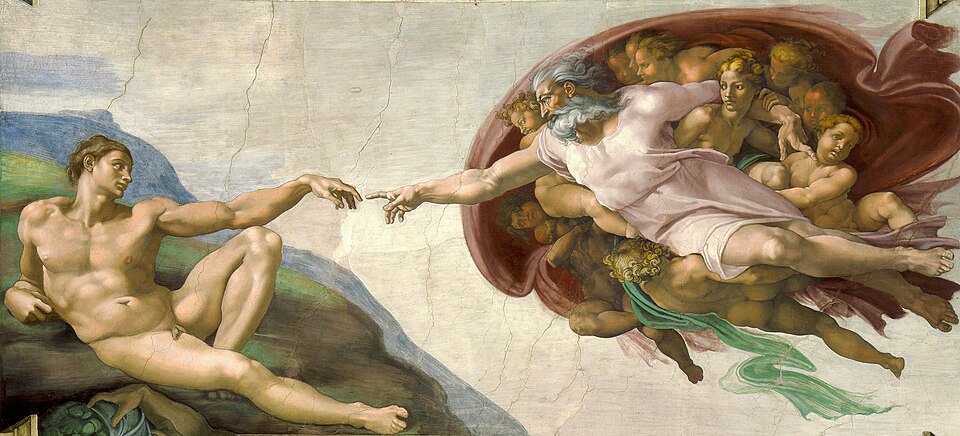
In the essay: Jürgen Habermas · Porphyry and Augustine · Why is there something rather than nothing? A constructed debate · Part Eleven · Philo of Alexandria
Further reading: Gerhard von Rad, Das erste Buch Mose, Genesis (1949) ; Paul Ricœur, La Symbolique du mal (1960) ; Jean Delumeau, Une histoire du paradis (1992) ; Thomas Römer, Jean-Daniel Macchi and Christophe Nihan (eds.), Introduction à l'Ancien Testament (2004)
From Cain to Babel: the fratricide, the Flood, the towerBible: the texts
Between the expulsion from the garden and the calling of Abraham, Gn 4 to 11 tells of the earliest times of humankind: a murder, a universal flood, an unfinished tower. These chapters, the primeval history, pose in narrative form the question of human violence and excess, and the moderns still draw their figures from them.
Cain and Abel
The narrative relates that Eve gives birth to Cain, a tiller of the soil, then to Abel, a shepherd. Each brings an offering, the fruits of the ground for the one, the firstborn of the flock for the other; God accepts Abel's and not Cain's. Cain leads his brother out into the field and kills him. Questioned, he answers that he is not his brother's keeper; the blood cries out from the ground, Cain is cursed and condemned to wandering, but God puts a mark on him so that no one will kill him. Cain settles east of Eden and builds the first city, which he names after his son Enoch.
The generations and the Flood
Ten generations lead from Adam to Noah through Seth, the son born after Abel's death; Gn 6 relates briefly that sons of God unite with the daughters of men and beget giants. Faced with human wickedness, God decides to blot them out; Noah alone finds favour. He receives the order to build an ark of wood and to bring into it his family and a pair of every species. The rain falls for forty days, the waters cover the mountains, everything perishes. Noah releases a raven, then a dove that returns with an olive branch. Having come out of the ark, he offers a sacrifice; God promises never again to curse the ground, makes a covenant with every living creature and gives as its sign the bow in the cloud.
The Tower of Babel
Gn 11 relates that the whole earth has one language. People settle in the plain of Shinar and decide to build a city and a tower whose top reaches the heavens. God comes down to see, confuses their language and scatters them over the whole earth; the city is given the name Babel, linked to the Hebrew verb meaning to confuse. The text is aimed at Babylon and its stepped towers, the ziggurats.
Parallels and composition
Mesopotamian texts shed light on the composition. The Epic of Gilgamesh contains a flood narrative in which Utnapishtim builds a boat, releases birds and offers a sacrifice; the older poem of Atrahasis explains the flood by the noise of humans, which keeps the gods from sleeping. Most exegetes regard the biblical narrative as a rereading of these traditions, composed during or after the exile in Babylon, in the 6th century BCE, in two interwoven strands whose doublets, the number of animals, the duration of the waters, preserve the trace. No geological evidence attests a universal flood.
Readings
Augustine, in Book XV of The City of God, makes Cain the founder of the earthly city and Abel the pilgrim of the city of God. Girard sees in Cain and Abel the founding murder from which culture and the city are born, told for once from the point of view of the victim, whose blood cries out. Among the moderns Babel becomes the figure of political excess, and the tower painted by Bruegel in 1563 fixes its image.
What the essay assumes
The essay does not set out these chapters; it uses their figures. The section on Girard takes from them the point that the Bible tells the lynching from the point of view of the victim and that the title of the 1978 book comes from the things hidden since the foundation of the world; the Girardian reading of Cain is presupposed there. In the section on Voegelin and Aron, Bruegel's The Tower of Babel illustrates the immanentization of the eschaton, salvation carried from heaven into history. Part Two recalls that Origen distinguishes two cities and that Augustine gives this idea its finished form; finally, two literary boxes take up Cain: the one in the section on Leibniz, with Byron's Cain, who rejects inherited guilt, and another with Hugo's La Conscience, in which an eye open in the sky pursues him even into the tomb.
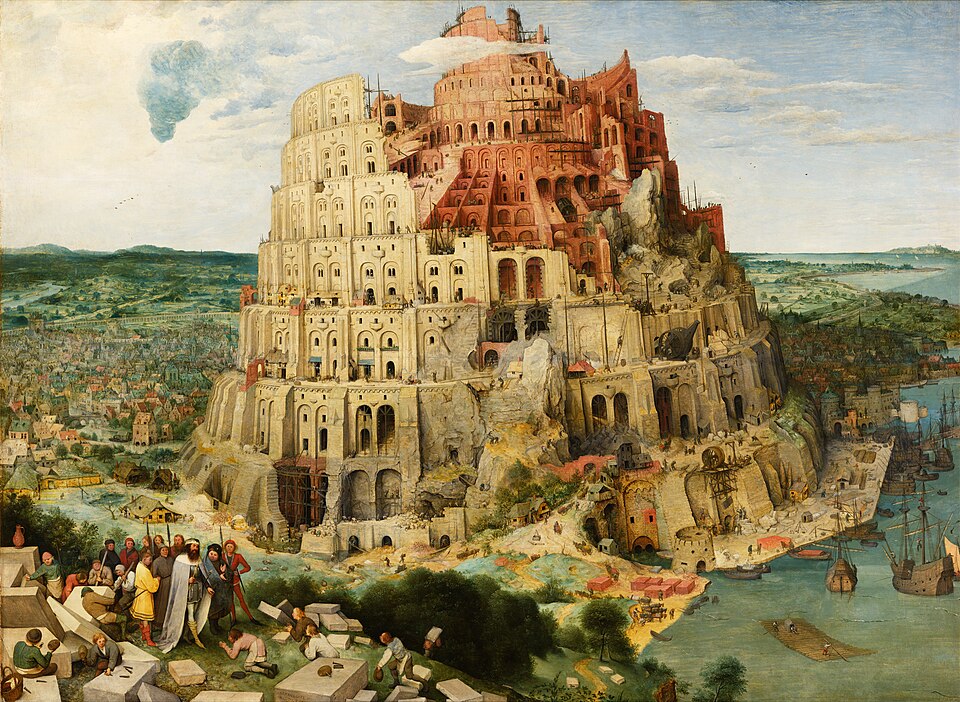
In the essay: Girard · Voegelin and Aron · Part Eleven
Further reading: Jean Bottéro, Naissance de Dieu : la Bible et l'historien (1986) ; Jean Bottéro and Samuel Noah Kramer, Lorsque les dieux faisaient l'homme (1989) ; René Girard, Des choses cachées depuis la fondation du monde (1978) ; Augustine, La Cité de Dieu (413-426)
The patriarchs: Abraham, the sacrifice of Isaac, JacobBible: the texts
Gn 12 to 50 tells the story of a family, Abraham, Isaac, Jacob and his twelve sons, whom tradition calls the patriarchs. It is to their God that Pascal appeals in the Memorial, and the sacrifice of Isaac gave Kierkegaard and Girard their decisive scene.
Abraham: the promise and the covenant
The narrative relates that God commands Abram to leave his country for a land that he will show him, and promises him descendants and a blessing for all the families of the earth (Gn 12). Abram sets out with his wife Sarai and his nephew Lot. God makes a covenant with him, first through the rite of the divided animals (Gn 15), then by changing his name to Abraham and instituting circumcision as its sign (Gn 17). Sarah, who is barren, gives him her servant Hagar, mother of Ishmael, who is sent away into the desert with her son after the birth of Isaac. Abraham bargains with God over the fate of Sodom, from fifty righteous men down to ten; the city is destroyed.
The binding of Isaac
Gn 22, which Judaism calls the Aqedah, the binding, relates that God puts Abraham to the test: he asks him to take his only son and offer him as a burnt offering on a mountain in the land of Moriah. Abraham sets out with Isaac and two servants; on the third day he leaves the servants behind, lays the wood on Isaac and carries the fire and the knife. Isaac asks where the lamb is; Abraham answers that God will provide. He builds the altar, binds his son, lays him on the wood and stretches out his hand. The angel of the Lord stops him, and a ram caught by its horns in a thicket is offered in his place. The text is silent about Abraham's thoughts and about Isaac's reaction.
Jacob
Isaac marries Rebekah, who gives birth to twins, Esau and Jacob. Jacob buys the birthright for a dish of lentils and obtains his blind father's blessing by deceit. While fleeing, he sees in a dream a ladder between earth and heaven. In the house of his uncle Laban he serves fourteen years for Leah and Rachel. On the night before he meets Esau again, left alone at the ford of the Jabbok, he wrestles until dawn with a stranger who puts his hip out of joint and renames him Israel (Gn 32). His twelve sons give their names to the tribes; Joseph, sold by his brothers, becomes Pharaoh's minister in Egypt, where the whole family joins him: the Exodus follows on.
Composition and readings
No external source attests the patriarchs; most exegetes see them as ancestral figures carried by distinct cycles, Abraham in the south, Jacob in the north, brought together between the eighth and the fifth centuries BCE. Judaism reads the Aqedah as the merit of the fathers, invoked in the liturgy of the New Year; Christianity sees in it a figure of Christ carrying the wood; the Qur'an relates it without naming the son. Kierkegaard, in Fear and Trembling (1843), makes it the paradox of faith, a suspension of the ethical that cannot be justified before others. Girard reads it as the moment when human sacrifice is suspended and replaced by the animal. Caravaggio and Rembrandt painted the instant when the angel stays the hand.
What the essay assumes
The essay cites Pascal's Memorial, the God of Abraham, Isaac and Jacob set against the God of the philosophers and the scholars, and reads in it a critique of religion made in the name of faith, the true God being the God of a history; Rembrandt's The Sacrifice of Abraham illustrates the section, and the transition of Part Two says that Pascal appeals to the God who came before the Greek translation. The section on Kierkegaard opens with Delacroix's Jacob Wrestling with the Angel, an image of faith as a singular ordeal; Fear and Trembling is not analysed there, but is named later among the books that marked Iris Murdoch. In Girard, Caravaggio's The Sacrifice of Isaac is a key moment of his reading of the Bible. The section on Maimonides, finally, reads the Bible as a text whose anthropomorphisms call for interpretation: the stories of the patriarchs are full of them.
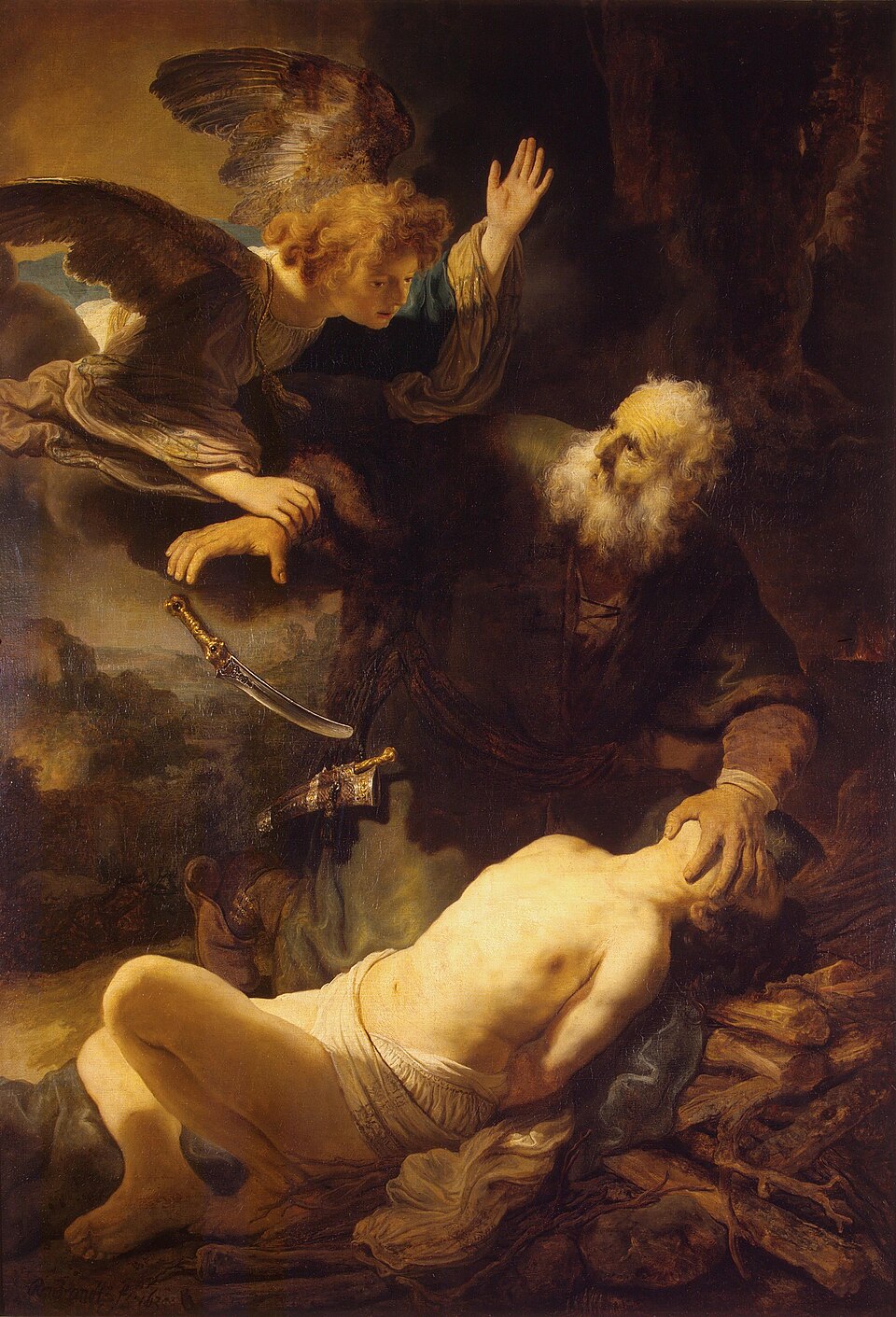 The Sacrifice of Isaac (1635, Saint Petersburg, Hermitage): the God of Abraham and Isaac, whom the Memorial sets against the God of the philosophers
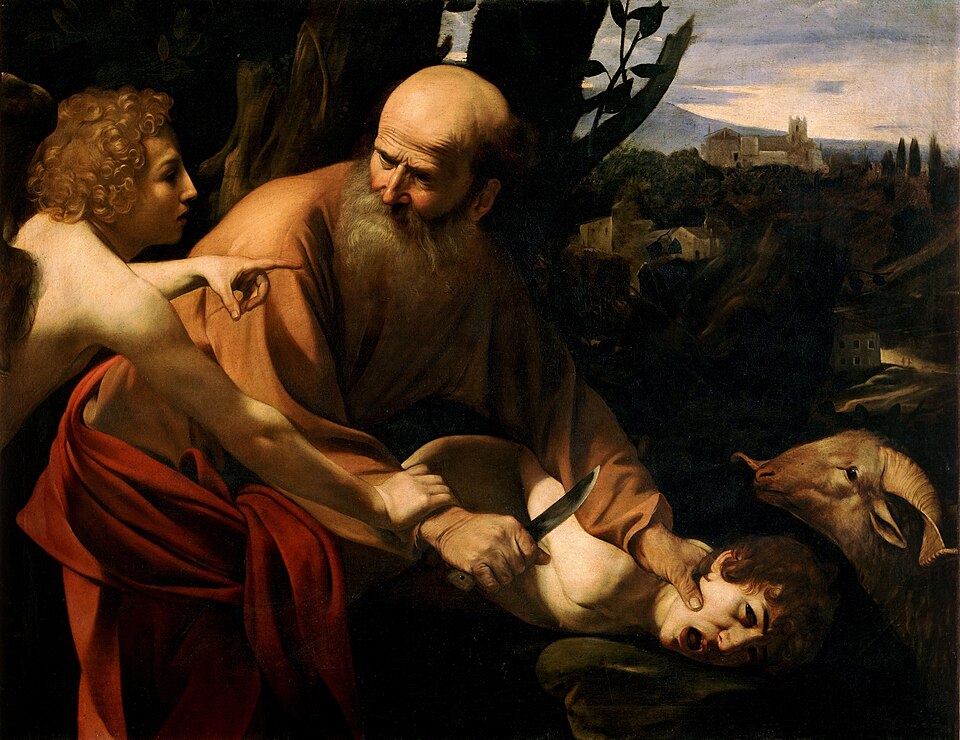 The Sacrifice of Isaac (c. 1603, Florence, Uffizi Gallery): human sacrifice suspended and replaced by the ram (Gn 22), a key moment in Girard's reading of the Bible
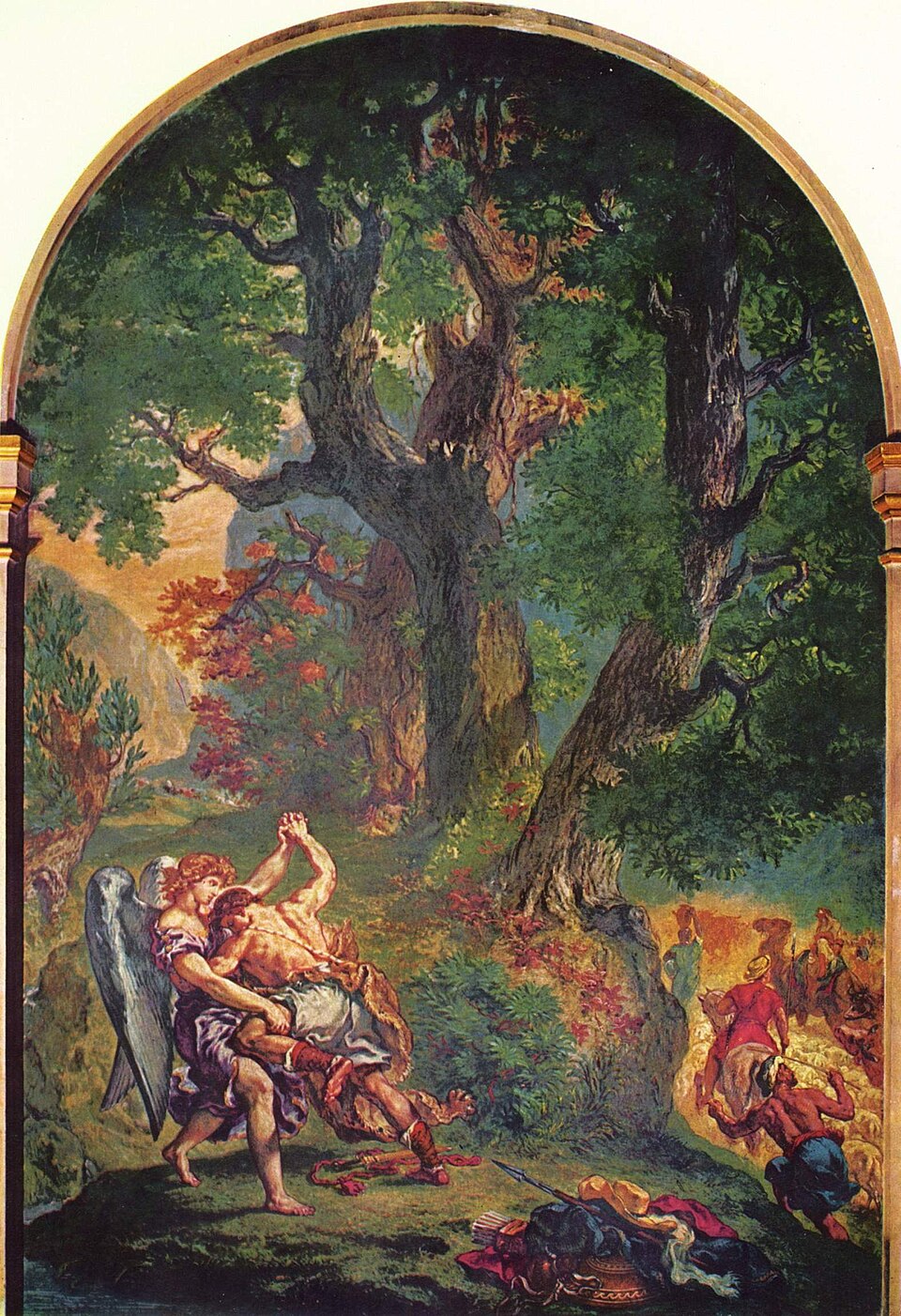 Jacob Wrestling with the Angel (1854-1861, Paris, church of Saint-Sulpice, Chapel of the Holy Angels): the night struggle of Gn 32, 25-33, an image of faith as a singular ordeal before God
In the essay: Pascal · Søren Kierkegaard · Girard · Part Three · Maimonides
Further reading: Søren Kierkegaard, Crainte et tremblement (1843) ; Shalom Spiegel, The Last Trial (1967) ; Thomas Römer, L'Invention de Dieu (2014) ; Jean-Louis Ska, Introduction à la lecture du Pentateuque (2000)
Exodus: Moses, the departure from Egypt, Sinai and the LawBible: the texts
Exodus, the second book of the Pentateuch, tells of the liberation of the Hebrews from Egypt and the giving of the Law at Sinai; the following books continue it up to the death of Moses. It is the founding narrative of Israel, which the Jewish Passover commemorates every year.
From oppression to the burning bush
The narrative tells how the descendants of Jacob are reduced to servitude by a Pharaoh who orders the newborn boys to be drowned. A Levite child is hidden in a basket on the Nile, taken in by Pharaoh's daughter and named Moses. As an adult he kills an Egyptian and flees to the land of Midian. Near Horeb he sees a bush that burns without being consumed; God calls him from it and answers the request for his name with an enigmatic formula, often rendered as I am who I am (Ex 3).
The plagues, the Passover, the sea
Pharaoh refuses to let the people go; ten plagues strike Egypt. On the night of the last, each family slaughters a lamb and marks its door with the blood: this is the Passover. Pharaoh gives way, then gives chase; the sea opens before Israel and closes over the chariots (Ex 14). In the desert, God feeds the murmuring people with manna.
Sinai and the Law
At Sinai, God utters the ten words, the Decalogue: no other gods, no image, respect for the name and for the sabbath, the honour due to parents, the prohibitions of murder, adultery, theft, false witness and covetousness (Ex 20). Deuteronomy gives a second version, which grounds the sabbath differently (Dt 5). The covenant code follows, civil and ritual laws; Moses then goes up the mountain for forty days.
The golden calf and the broken tables
In his absence, the people ask Aaron for gods to go before them; Aaron melts down the gold rings into a calf, which the people acclaim as the god who brought them out of Egypt (Ex 32). Coming down with the tables written by the finger of God, Moses sees the dancing and breaks the tables. He intercedes, is allowed to see God only from behind (Ex 33) and cuts two new tables. Leviticus then regulates sacrifices and purity; Deuteronomy rereads the history in the discourses of Moses, with the Shema, the call to love a single God, and tells of his death on Mount Nebo, in sight of a land he does not enter.
History and readings
No Egyptian source or archaeological trace attests a mass departure; most historians regard the narrative as a founding composition elaborated between the eighth and the fifth century BCE, some admitting a historical core, a small group come from Egypt. Maimonides explains the sacrifices as a divine pedagogy adapted to a people accustomed to idolatrous cults (Guide for the Perplexed, III, 32). Freud, in Moses and Monotheism (1939), makes Moses an Egyptian close to Akhenaten, killed by his people, and monotheism the return of this repressed murder. The golden calf has become the very image of idolatry.
What the essay assumes
The section on Maimonides sets out the thesis of the Guide III, 32, the sacrifices transferred to the name of God rather than abolished, like the detour through the desert (Ex 13, 17-18); its illustration, Rembrandt's Moses, recalls that it is debated whether he is breaking the tables or presenting them, and reads in the God seen from behind (Ex 33, 23) only the attributes of action of the Guide I, 54. In the section on Feuerbach, Poussin's The Adoration of the Golden Calf figures projection, man adoring what he has made. Philo makes the exodus the departure of the soul from the body. The section on Freud keeps to The Future of an Illusion and Civilization and Its Discontents, without discussing the book on Moses; Part One asks what becomes of the revealed Law when a philosopher reads it, and Part Two situates the birth of Christianity between a God of the Law come from Jerusalem and a God of reason come from Athens.
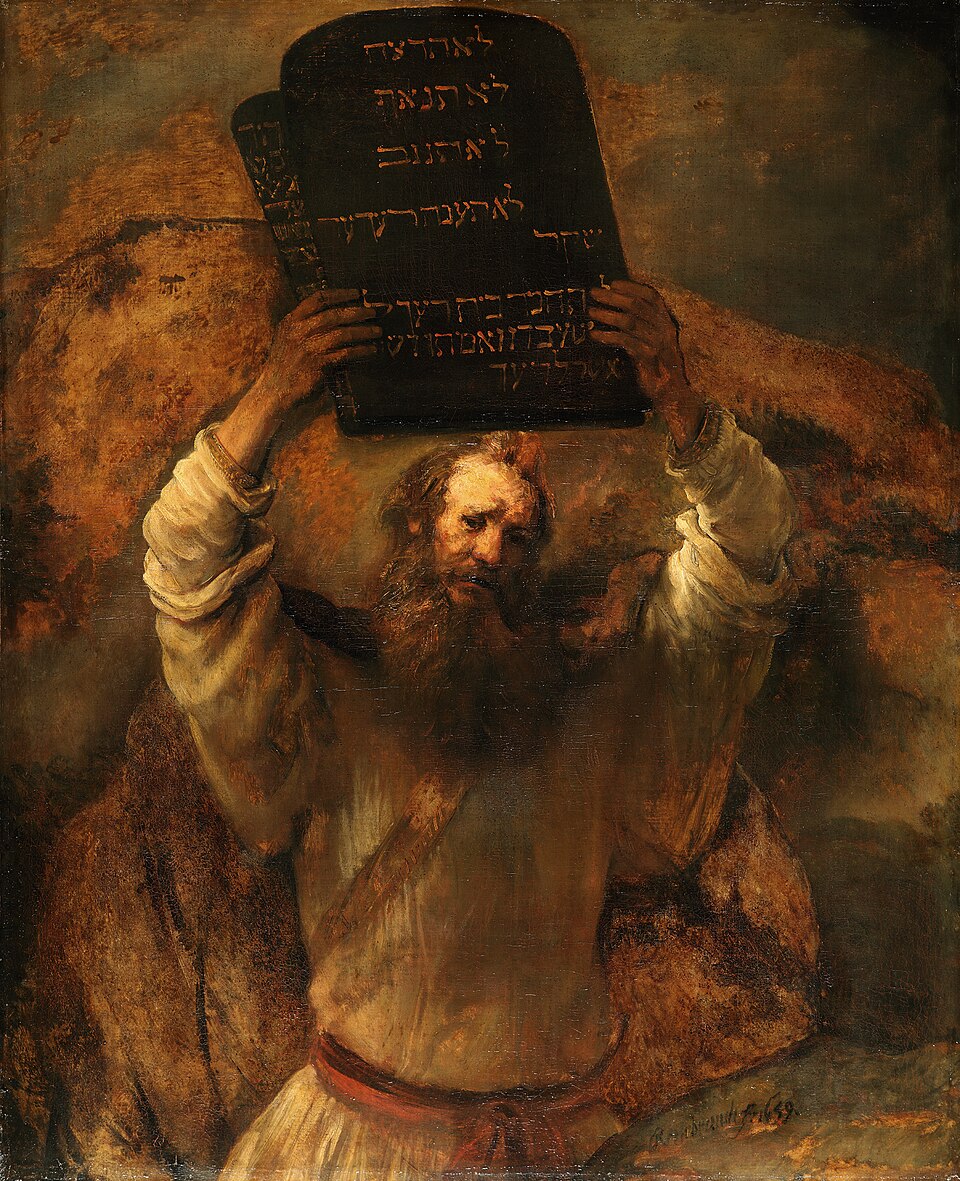 Moses Breaking the Tablets of the Law (1659, Berlin, Gemäldegalerie): it is debated whether he is breaking them (Ex 32, 19) or presenting them to the people; Moses is the prophet to whom God shows only his back (Ex 33, 23), that is, according to the Guide for the Perplexed (I, 54), only his attributes of action
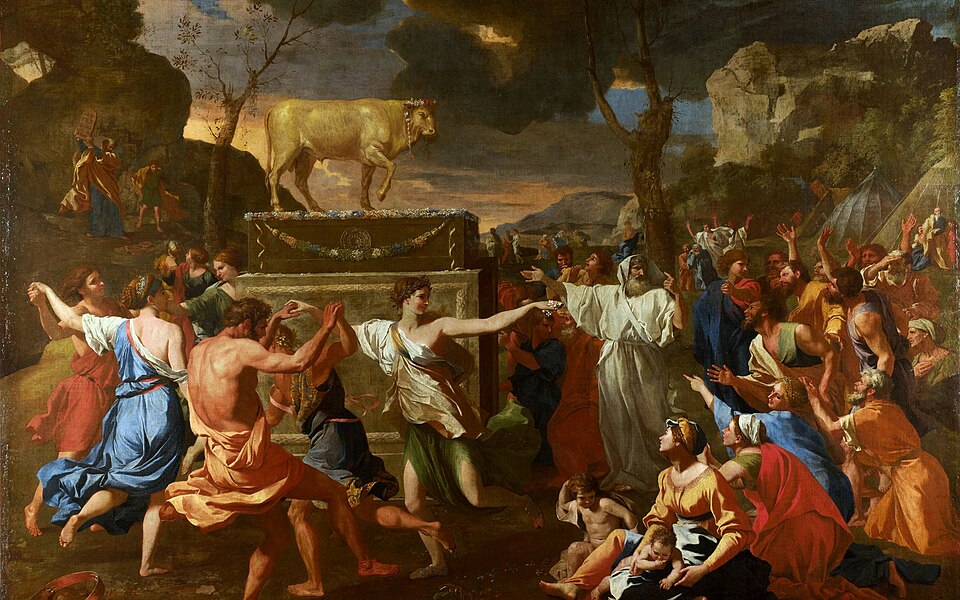 The Adoration of the Golden Calf (c. 1633-1634, London, National Gallery): the god made by human hands (Ex 32), an ancient figure of what Feuerbach generalizes: in God, man worships what he has himself projected
In the essay: Maimonides · Ludwig Feuerbach · Freud · Part One
Further reading: Thomas Römer, Moïse : lui que Yahvé a connu face à face (2002) ; Israel Finkelstein and Neil Asher Silberman, La Bible dévoilée (2001) ; Jan Assmann, Moïse l'Égyptien (1997) ; Sigmund Freud, L'Homme Moïse et la religion monothéiste (1939)
From the Judges to the Kings: Samuel, Saul, David and Goliath, Solomon and the TempleBible: the texts
The books of Joshua, Judges, Samuel and Kings tell the history of Israel from the entry into Canaan to the destruction of Jerusalem by the Babylonians. They gave the West its royal figures par excellence, David and Solomon, and gave Christianity the idea of a messiah who is the son of David.
From the conquest to the Judges
The book of Joshua relates that the tribes, led by the successor of Moses, cross the Jordan, take Jericho, then subdue the land and divide it among themselves. Archaeology does not confirm this picture: Jericho appears uninhabited at the supposed period, and most specialists describe a gradual settlement of populations originating in Canaan itself, around the twelfth century BCE. The book of Judges then presents a period without a king, punctuated by a cycle: the people abandon their God, are handed over to an oppressor, cry out to him, and a deliverer arises, Deborah against Sisera, Gideon against Midian, Samson against the Philistines.
Samuel, Saul and the demand for a king
Samuel, the last of the judges and a prophet, is asked for a king, such as all the nations have. The narrative of 1 S 8 gives him a speech of warning: the king will take their sons for his chariots, their daughters for his kitchens, a tenth of their harvests. God nevertheless consents, and Samuel anoints Saul. After Saul's disobedience, Samuel secretly anoints a young shepherd of Bethlehem, David, the youngest of the sons of Jesse.
David
Chapter 17 of 1 Samuel tells of the combat against Goliath: a Philistine champion of gigantic stature defies the army of Israel for forty days; David, who has come to bring provisions to his brothers, refuses Saul's armour, steps forward with his sling and five stones from the brook, fells the giant with a stone to the forehead and cuts off his head with his own sword. There follow the friendship with Jonathan, Saul's jealousy, the flight and the death of the king at Gilboa. David reigns seven years at Hebron over Judah, then takes Jerusalem, makes it his capital and brings the ark of the covenant there. Then David takes Bathsheba, wife of Uriah the Hittite, and has the husband placed in the front line so that he will die; the prophet Nathan tells him the parable of the rich man who steals the poor man's only ewe lamb, and David condemns himself before understanding that it is about him. Bathsheba will later give birth to Solomon. The end of the reign is marked by the revolt of Absalom.
Solomon, the Temple and the schism
Solomon asks God for wisdom rather than riches, and shows it by deciding between two women who claim the same child. He builds the Temple of Jerusalem in seven years (1 R 6 to 8), where the ark rests. The narrative reproaches him for his foreign wives, who draw him towards their gods. At his death, around 930, the northern tribes break away: Israel, with Samaria as its capital, and Judah, around Jerusalem. The books of Kings follow them until the capture of Samaria by the Assyrians around 722 and that of Jerusalem in 587 by Nebuchadnezzar, who destroys the Temple and deports the elites to Babylon.
Composition and reading
Since Martin Noth (1943), criticism has seen in the whole stretching from Joshua to Kings a Deuteronomistic history, composed under King Josiah at the end of the seventh century, then reworked during the exile to explain the catastrophe by the infidelity of the kings. The historical David remains debated: the Tel Dan stele, discovered in 1993, mentions around 840 a house of David, but the Jerusalem of the tenth century looks modest to the excavators. The genealogies of Matthew and Luke make Jesus descend from him.
What the essay assumes
The essay takes as known the Davidic descent of the messiah when, in Part Five, it sets out how Strauss explains the birth in Bethlehem and the descent from David by the faith of a community awaiting a Messiah; it opposes, with Tertullian and then Leo Strauss, Jerusalem to Athens, the revealed Law to Greek reason; and, in the section on Girard, it draws on Frazer's sacrificed kings and on the biblical texts that give the victim a voice, among them the Psalms attributed to David.
In the essay: Part One · Part Five · Ernest Renan · Leo Strauss
Further reading: Israel Finkelstein and Neil Asher Silberman, La Bible dévoilée (2001) ; Thomas Römer, La Première Histoire d'Israël (2007) ; Baruch Halpern, David's Secret Demons (2001) ; Mario Liverani, La Bible et l'invention de l'histoire (2003)
The prophets of Israel, the exile and the book of DanielBible: the texts
The prophets occupy a whole section of the Hebrew Bible, and their books are among those most often cited by the New Testament. Isaiah, Jeremiah, Ezekiel and the twelve minor prophets, to whom the Christian Bible adds Daniel, shaped the ideas of covenant, judgement and messiah.
What a prophet is
In the Bible, the prophet is not first of all a soothsayer but a spokesman: he speaks in the name of God, often against the king, the priests and the people. A distinction is drawn between court prophets, such as Nathan before David, and the so-called writing prophets. Elijah and Elisha, in the ninth century, wrote nothing; the books of Kings recount Elijah's challenge to the prophets of Baal and his being taken up in a chariot of fire.
From the eighth century to the exile
Amos denounces the luxury of Samaria and the oppression of the poor: worship without justice displeases God. Hosea depicts the covenant as a marriage betrayed by the wife. Isaiah of Jerusalem preaches trust in God alone and announces to King Ahaz the birth of a child named Emmanuel (Is 7). Jeremiah preaches submission to Babylon, sees Jerusalem fall in 587 and announces a new covenant written on hearts. Ezekiel, deported as early as 597, prophesies in Babylon through visions. The exile (587 to 538) is the crucible of the Bible: the deportees gather their traditions together. Cyrus authorizes the return in 538; the Second Temple is dedicated around 515.
The three Isaiahs and the suffering servant
Since Bernhard Duhm (1892), criticism has distinguished three blocks in the book of Isaiah: chapters 1 to 39, for the most part from the prophet of the eighth century; chapters 40 to 55, an anonymous Second Isaiah who speaks to the exiles and hails Cyrus as God's anointed; chapters 56 to 66, a Third Isaiah after the return. Second Isaiah contains four songs of the servant, the last of which (Is 52 and 53) describes a despised man, struck for the faults of others, whose suffering obtains the justification of many. The same block affirms that God hides himself (Is 45).
Messianism
The word messiah means anointed and first designates the reigning king. After the end of the monarchy, hope shifts to a descendant of David yet to come who would restore justice.
Daniel
The book of Daniel presents itself as the work of a Jewish sage at the court of Babylon in the sixth century. Its first part recounts court episodes: Nebuchadnezzar's dreams interpreted, the three companions in the furnace, Daniel in the lions' den. The second part contains visions: four beasts rising from the sea, then an Ancient of Days and, coming on the clouds, one like a son of man who receives eternal kingship (Dn 7); a succession of empires told with increasing precision up to the reign of Antiochus IV Epiphanes, the Seleucid king who profanes the Temple in 167; and finally the announcement of a resurrection of the dead. Porphyry, in the third century, had noticed that the precision stops at Antiochus, and concluded that the book, written under this king, told the past in the form of prediction. Modern exegesis likewise dates its final redaction to the years 167 to 164, during the Maccabean revolt.
Composition and Christian rereading
The prophetic books are collections of oracles supplemented over several centuries by disciples and redactors. The first Christians read them as announcements of Christ: Matthew cites the Emmanuel of Is 7 from the Septuagint, which translates the Hebrew word for young woman as virgin; the Passion is told with the features of the servant of Is 53.
What the essay assumes
The essay draws on Porphyry, dating Daniel to the time of Antiochus Epiphanes, as an ancestor of critical exegesis; it cites in Pascal the verse of Isaiah on the hidden God, which the Pensées turn into a thesis; it places, in Girard, the suffering servant, Job and the Psalms among the texts that proclaim the innocence of the victim; and it presents, with Schweitzer and Sanders, Paul's Christianity as an eschatology, an expectation of an imminent end for which Daniel and the prophets of the exile supplied the images.
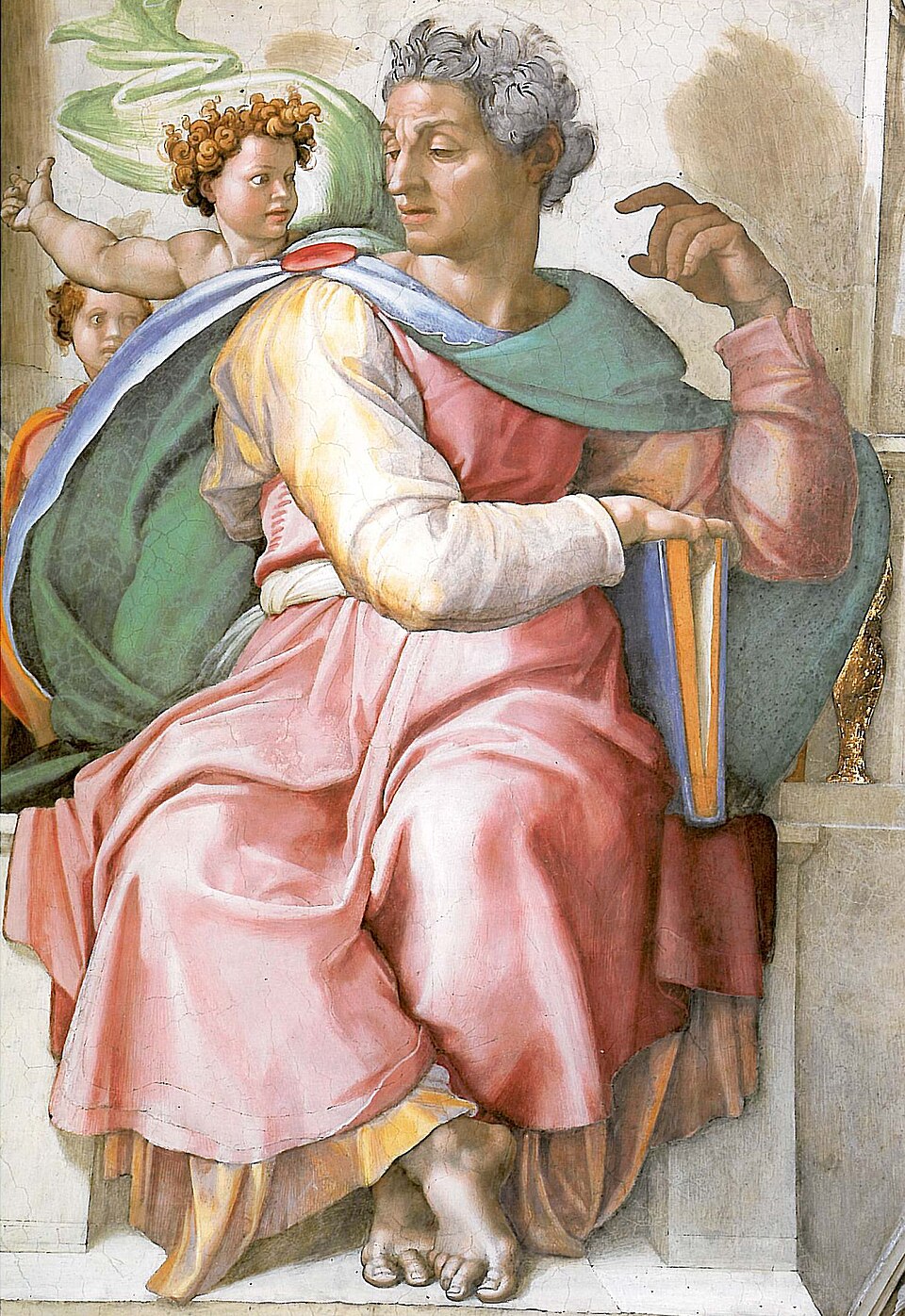 the prophet Isaiah, Sistine Chapel ceiling (1508-1512): Isaiah is the prophet of the hidden God, Deus absconditus (Is 45, 15), at the heart of the Pensées
 The Virgin and Child and a prophet pointing to a star, Catacomb of Priscilla (Rome, 3rd century CE), plate from Joseph Wilpert, Die Malereien der Katakomben Roms (1903)
In the essay: Porphyry and Augustine · Pascal
Further reading: Joseph Blenkinsopp, Une histoire de la prophétie en Israël (1983) ; André Neher, L'Essence du prophétisme (1955) ; John J. Collins, The Apocalyptic Imagination (1984) ; Thomas Römer, Jean-Daniel Macchi and Christophe Nihan (eds.), Introduction à l'Ancien Testament (2004)
Psalms, Job, Qoheleth and the wisdom booksBible: the texts
The poetic and wisdom books form the heart of the Writings, the third part of the Hebrew canon after the Law and the Prophets. Less narrative than the others, they give voice to prayer, to lament and to reflection on the human condition.
The Psalms
The Psalter gathers one hundred and fifty poems. Since Hermann Gunkel, exegetes have classified them by genre: hymns of praise, supplications, thanksgivings, royal psalms. Nearly half bear the name of David, whom tradition holds to be their author; criticism sees in them a collection formed over several centuries, from the monarchy to the Persian period. They became the daily prayer of Christian monks and the book of the Old Testament most often quoted in the New.
Proverbs
Attributed to Solomon, Proverbs collects maxims of practical wisdom. The first nine chapters stage personified Wisdom, begotten before the world: a figure that the Jewish and Christian traditions would later associate with the Torah and with the Logos.
Job
The Book of Job raises the problem that Proverbs seemed to solve, that of retribution. A prose prologue relates that Job, an upright man, is put to the test following a wager between God and the Satan: he loses his flocks, his children, his health, and refuses to curse God. Three friends come to console him and maintain that he must have sinned since he suffers; Job protests his innocence, accuses God of injustice and asks to plead his case. A fourth, Elihu, intervenes. God finally answers out of the whirlwind (Jb 38-41), not with an explanation but with a series of questions about creation; Job falls silent and retracts. The epilogue vindicates Job against his friends and restores to him twice his former goods. The question of the suffering of the righteous remains open.
Qoheleth and the Song
Qoheleth, in Greek Ecclesiastes, presents himself as son of David and king in Jerusalem. He repeats that all is vanity, vapour, a chasing after wind; that there is a time for everything; that the wise man and the fool die the same death; and he advises eating, drinking and enjoying one's labour, for such is man's portion. The Song of Songs is a collection of love poems between a young woman and her beloved, with no mention of God; the rabbis and then the Fathers read it as the allegory of the love between God and Israel, or between Christ and the Church. The Wisdom of Solomon and Sirach are deuterocanonical, absent from the Hebrew Bible.
Composition and readings of Job
Criticism dates Job and Qoheleth to the Persian or Hellenistic period; the dialogue of Job may have been inserted into an older tale. Gregory the Great makes it, in the Moralia, a moral allegory; Maimonides, in the Guide III, 22 and 23, sees in it a parable on providence in which the friends represent philosophical opinions; Leibniz counts it among the sources of the Theodicy; Kant, in 1791, contrasts Job's sincerity with the speeches of his friends; Jung, in Answer to Job (1952), reads in it a God unaware of his own shadow, morally surpassed by his creature; Girard, in Job, the Victim of His People (1985), sees in Job the scapegoat of a unanimous community whose spokesmen are the friends.
What the essay assumes
The essay sets out Jung's reading, for whom Job becomes morally superior to the God who crushes him to win a wager, and compares it with Ivan Karamazov siding with the child against universal harmony; it presents Leibniz's Theodicy and the best of all possible worlds as a way of thinking that asks the individual to sacrifice his complaint; it places Job, in Girard's reading, among the biblical texts that proclaim the innocence of the victim; and it notes, in the debate on wonder, that Schelling quotes Qoheleth, the old book according to which all is toil under the sun, before raising the question of being.
In the essay: Jung · Leibniz · Dostoevsky · Why is there something rather than nothing? A constructed debate
Further reading: Jean Lévêque, Job et son Dieu (1970) ; Gerhard von Rad, Israël et la Sagesse (1970) ; Hermann Gunkel, Introduction aux Psaumes (1933) ; Jean Bottéro, Naissance de Dieu (1986)
The short books: Ruth, Esther, Jonah, Tobit, Judith, Lamentations, Ezra and NehemiahBible: the texts
Between the great collections of the Law, the Prophets and the Psalms, the Bible contains short books, often narrative, which have had a considerable fortune in liturgy, art and literature. Most date from the Persian or Hellenistic period and raise, each in its own way, the question of the faithfulness of a scattered people.
Ruth
In the time of the Judges, a famine drives a family from Bethlehem into Moab. The men die; Naomi returns, and her Moabite daughter-in-law, Ruth, refuses to leave her and adopts her people and her God. She gleans in the field of Boaz, a kinsman of her husband, who marries her according to the custom of redemption. Their son is the grandfather of David. The book, dated by many to the Persian period, makes a foreign woman the ancestor of the king, at a time when other texts forbid mixed marriages. It is read at the Jewish feast of Weeks.
Jonah
God sends Jonah to preach against Nineveh, the Assyrian capital; the prophet flees by ship, is thrown into the sea during the storm, swallowed by a great fish and cast up on the shore three days later. He preaches at last, Nineveh repents, and God forgives, to the great vexation of Jonah, to whom he teaches the lesson of a castor-oil plant that withers. A story with a didactic aim rather than a chronicle, probably from the Persian or Hellenistic period, it opens mercy to the nations. The gospels make the sign of Jonah a figure of Jesus's three days in the tomb.
Esther
At the court of the Persian king, a young Jewish woman, Esther, who has become queen without revealing her origin, foils with her uncle Mordecai the plan of the minister Haman to exterminate the Jews of the empire; Haman is hanged on the gallows he had set up, and the Jews take revenge on their enemies. The Hebrew text never names God; the Greek version adds prayers. The book founds the feast of Purim, and critical scholarship sees in it a diaspora story from the Persian or Hellenistic period, without historical support.
Tobit and Judith
These two books, absent from the Hebrew Bible, are deuterocanonical. Tobit tells of a pious Jew of the deportation, struck blind, whose son travels in the company of the angel Raphael, heals his father and marries Sarah, delivered from a demon: a tale of family piety and almsgiving. Judith, a widow of Bethulia besieged by Holofernes, general of Nebuchadnezzar, goes to his camp, seduces him and cuts off his head; the town is saved. The anachronism, Nebuchadnezzar as king of Assyria, signals an edifying story from the time of the Maccabees. Judith and Holofernes have become a major subject of painting, from Caravaggio to Artemisia Gentileschi.
Lamentations, Ezra and Nehemiah
Lamentations are five poems of mourning over Jerusalem destroyed in 587, four of which are acrostics; tradition attributes them to Jeremiah, critical scholarship to anonymous authors of the exile. Ezra and Nehemiah recount the return under the Persian kings, the rebuilding of the Temple and then of the walls, the public reading of the Law by Ezra and the sending away of foreign wives. Ezra, priest and scribe, became in Jewish tradition the second Moses, the one who restored the Torah; Spinoza, following Ibn Ezra, would later make him the probable compiler of the Pentateuch. Chronicles retells the history from Adam to the exile, centred on David and the Temple.
What the essay assumes
The essay cites none of these books. They nevertheless shed light on two of its threads: Part One, which asks what becomes of the Law when a philosopher reads it, and the section on Maimonides, which distinguishes the apparent sense of Scripture, for the multitude, from the sense reserved for the sage; Ezra, restorer of the Torah according to tradition and compiler of the Pentateuch according to Spinoza, stands at the meeting point of the two. Above all, these books show how the Bible tells the survival of a people without king or land, a question that precedes that of the exit from religion.
In the essay: Part One · Spinoza
Further reading: Thomas Römer, Jean-Daniel Macchi and Christophe Nihan (eds.), Introduction à l'Ancien Testament (2004) ; André LaCocque, Subversives ou un Pentateuque de femmes (1992) ; Pierre Grelot, Introduction à la Bible (1961) ; Shaye J. D. Cohen, From the Maccabees to the Mishnah (1987)
Between the two Testaments: the Maccabees, Enoch, Qumran and apocalyptic expectationBible: the texts
Between the last books of the Hebrew Bible and the first Christian writings stretch nearly four centuries that tradition calls intertestamental. Today they are seen as the matrix from which rabbinic Judaism and Christianity emerge.
The period
Alexander conquers Judaea in 332 BCE. The country passes to the Ptolemies and then, around 200, to the Seleucids. In 167, Antiochus IV Epiphanes forbids Jewish practices and installs a pagan cult in the Temple; the revolt led by Mattathias and his sons, the Maccabees, leads to the purification of the Temple in 164, and then to independence under the Hasmoneans. In 63, Pompey enters Jerusalem; Rome installs Herod the Great (37 to 4 BCE), then Roman prefects govern Judaea, among them Pontius Pilate (26 to 36). The revolt of 66 ends with the destruction of the Temple in 70.
The books
The books of the Maccabees, Tobit, Judith, the Wisdom of Solomon, Sirach and Baruch are received in the Septuagint and in the Catholic and Orthodox canon, where they are called deuterocanonical, but not in the Hebrew Bible nor among Protestants. Other writings, called pseudepigrapha because they are attributed to ancient figures, enter no canon except in Ethiopia: the Book of Enoch, which tells of the fall of the angels, the patriarch's heavenly journeys and the judgement by a Son of Man; Jubilees; the Testaments of the Twelve Patriarchs; the Psalms of Solomon, which await a messiah son of David.
The currents
The historian Flavius Josephus, at the end of the first century, distinguishes three schools that he compares to philosophies: the Pharisees, masters of the oral tradition, who believe in the resurrection; the Sadducees, a priestly aristocracy bound to the Temple, who accept only the written Law and deny the resurrection; the Essenes, a community of shared goods and purity living apart. He adds a fourth philosophy, that of the Zealots, who acknowledge no master but God.
Qumran
In 1947, a Bedouin shepherd finds scrolls in a cave near Qumran, on the shore of the Dead Sea; eleven caves will yield some nine hundred manuscripts. About a quarter are biblical texts, among them a complete scroll of Isaiah, a thousand years older than the Hebrew manuscripts known until then; the rest comprises writings already known, such as Enoch, and texts specific to one community: the Community Rule, the Damascus Document, the Hymns, commentaries that read the prophets as the announcement of their own time and of a persecuted Teacher of Righteousness. Most specialists identify this community with Josephus's Essenes, a hypothesis still debated. The manuscripts show the plurality of ancient Judaism, the expectation of two messiahs, a priest and a king, and a biblical text still fluid before its fixing by the Masoretes. They mention neither Jesus nor the Christians.
Apocalyptic expectation and the Septuagint
From the Book of Daniel to Enoch and Qumran, a worldview called apocalyptic takes shape: the present age is evil and dominated by hostile powers; God will soon intervene to judge; the dead will rise; a heavenly envoy or a messiah will establish the reign of God. John the Baptist, Jesus and Paul speak this language, and historians see in it the matrix of Christianity. In parallel, the diaspora of Egypt translates the Bible into Greek in Alexandria from the third century onwards: the Septuagint is the Bible of Philo, of Paul and of the first Christians.
What the essay assumes
The essay presents Philo as a Jew of Alexandria who reads the Bible in the Septuagint and comments on it by allegory, without having heard of Jesus; it recalls that Paul calls himself a Jew of the elite, more advanced in Judaism than his contemporaries, and places him, with Sanders, within the Judaism of his time; it adopts, with Schweitzer, Sanders, Meier, Fredriksen and Ehrman, the image of Jesus as an apocalyptic prophet awaiting the imminent end of the world. These three points assume familiarity with the Greek diaspora, the currents of Judaism and eschatological expectation.
In the essay: Philo of Alexandria · Paul of Tarsus
Further reading: Geza Vermes, Les Manuscrits du désert de Juda (1953) ; André Paul, Qumrân et les esséniens (2008) ; John J. Collins, The Apocalyptic Imagination (1984) ; Marcel Simon and André Benoit, Le Judaïsme et le christianisme antique (1968)
The New Testament: twenty-seven books, their dates and their authorsBible: the texts
The New Testament brings together twenty-seven books written in Greek between about 50 and 150, which the churches gradually recognized as Scripture. Their order in the Bible is not the order in which they were written, and almost none bears the name of its real author.
Four genres, twenty-seven books
Four Gospels, Matthew, Mark, Luke and John, tell the life, death and resurrection of Jesus; the Acts of the Apostles, the sequel to Luke; twenty-one letters, thirteen under the name of Paul, an anonymous one to the Hebrews, seven called catholic; and finally the Revelation of John. The word gospel, good news, first designates the message, then the books.
The order of composition
The oldest texts are the letters of Paul, written between about 50 and 60: seven are held to be authentic by almost all specialists (Romans, the two to the Corinthians, Galatians, Philippians, the first to the Thessalonians, Philemon); the others are thought to come from disciples. Mark is the oldest Gospel, written c. 70; Matthew and Luke c. 80 to 90; John c. 90 to 100. The Pastoral Epistles, the second letter of Peter and a few others reach down to the beginning or the middle of the second century.
Authors and attributions
The Gospels are anonymous; the titles according to Matthew, according to Mark were added in the second century. The traditional attributions go back to Papias of Hierapolis, c. 120 to 130, who says that Mark put Peter's recollections into writing and that Matthew composed the sayings in the Hebrew language, then to Irenaeus of Lyon, c. 180, who names the four evangelists. Critical scholarship judges these testimonies late and partly incompatible with the texts, since Matthew is written in Greek and depends on Mark.
Language, manuscripts, variants
The New Testament is written in koine, the common Greek of the eastern Mediterranean. The oldest witness is a papyrus fragment of the Gospel of John, P52, usually dated to around 125 to 150; the first complete manuscripts, the Sinaiticus and the Vaticanus, date from the fourth century. The thousands of Greek manuscripts present countless variants, which textual criticism compares in order to reconstruct the oldest text. Two famous passages are missing from the best witnesses: the longer ending of Mark and the episode of the woman taken in adultery in John 8.
The synoptic problem
Matthew, Mark and Luke are called synoptic because they can be read in parallel columns: they share the order of episodes and often the same words, whereas John differs. Explaining these agreements and divergences is the synoptic problem. The dominant solution since the nineteenth century is the two-source hypothesis: Mark was used by Matthew and by Luke; these two also drew on a collection of sayings of Jesus now lost, designated by the letter Q; each finally has material of its own, such as the infancy narratives. The priority of Mark is very widely accepted.
What the Gospels are
The Gospels are not biographies in the modern sense but narratives of faith, composed forty to seventy years after the events, from oral traditions. Historians use them with criteria: embarrassment, that is, what Christians would not have invented, such as the baptism by John or the crucifixion; multiple attestation; coherence with the Judaism of the time. An article in these annexes is devoted to this exegesis.
What the essay assumes
The essay states that Paul's seven authentic letters, written between 50 and 60, are the oldest Christian texts, earlier than all the Gospels; for the existence of Jesus it relies on Paul, on the elements of the Gospels that embarrassed the first Christians, on Josephus and on Tacitus; it sets out the notion of myth in Strauss, a narrative produced without intent to deceive by the faith of a community, and Bauer's thesis that the Gospels are the conscious literary work of one author, the evangelist Mark, on whom the others depend. This last point assumes familiarity with the priority of Mark.
In the essay: Part Two · Did Jesus exist? The Jesus of history and the mythicist thesis · David Friedrich Strauss and Bruno Bauer
Further reading: Raymond E. Brown, Que sait-on du Nouveau Testament ? (1997) ; Daniel Marguerat (ed.), Introduction au Nouveau Testament (2000) ; Bart D. Ehrman, The New Testament (1997) ; Bruce M. Metzger, The Text of the New Testament (1964)
The Gospel of Mark: the oldest accountBible: the texts
The shortest of the four Gospels is also, according to almost all exegetes, the oldest. In sixteen chapters, at a hurried pace, it tells of Jesus' activity in Galilee, his journey up to Jerusalem and his death, and it stops before an empty tomb.
An anonymous text, around 70
The tradition that attributes it to Mark goes back to Papias, bishop of Hierapolis at the beginning of the second century, quoted by Eusebius: Mark is said to have been Peter's interpreter and to have written down his recollections, without order. Historians regard this notice as uncertain and speak of an anonymous Greek-speaking author, writing for non-Jewish readers to whom he explains customs and translates Aramaic words. The most common dating places it around 70, just before or just after the capture of Jerusalem by Titus, since the discourse of chapter 13 announces the ruin of the Temple. The place, Rome according to tradition, or Syria, remains disputed.
The plan
The narrative opens with neither infancy nor genealogy, with John the Baptist in the desert, the baptism of Jesus in the Jordan and the temptation in a single sentence. Galilee follows: the calling of the disciples, exorcisms, healings, meals with tax collectors, controversies with the Pharisees over the sabbath and purity, parables of the Kingdom, the multiplication of the loaves. At the centre of the book, at Caesarea Philippi (Mc 8, 27-30), Peter recognizes Jesus as the Messiah; Jesus orders him to be silent and immediately announces that the Son of Man must suffer. The journey up to Jerusalem is punctuated by three predictions of the Passion, each time misunderstood. The Passion narrative (Mc 14 and 15) takes up nearly a third of the book. On Easter morning, women find the tomb open; a young man in white tells them that Jesus is risen and sends them to Galilee; they flee, seized with fear, and say nothing to anyone (Mc 16, 8). There the text of the oldest manuscripts stops. The longer ending (Mc 16, 9-20) is a second-century addition.
Distinctive features
Mark's Jesus acts more than he speaks; the adverb immediately recurs dozens of times. He is fully human: he grows angry, is astonished, does not know the day of the end, prays in anguish at Gethsemane and dies crying out his abandonment by God. His disciples understand nothing and all desert him. He calls himself the Son of Man, a title drawn from Daniel 7, and imposes silence on the demons, on those he heals and on Peter. William Wrede, in 1901, named this feature the messianic secret and saw in it a construction of the evangelist meant to explain why Jesus had not been recognized as Messiah in his lifetime; the hypothesis, though disputed, left its mark on twentieth-century exegesis.
Composition and reading
Mark assembles units first transmitted orally, which he links with summaries and indications of place. The two-source theory, dominant since the nineteenth century, makes him the common source of Matthew and Luke, who take over most of his text while correcting it. Long held to be an abridgement of Matthew, as Augustine claimed, it was rehabilitated by German criticism, which saw in its priority the way of access to the Jesus of history, before Wrede showed that it too is a work of faith and Schweitzer, in 1906, drew from its eschatology a Jesus who was a prophet of the end.
What the essay assumes
In the section on the existence of Jesus, the essay places Mark, around 70, at the threshold of the series of Gospels running from Mark to John, and recalls that these are texts of faith composed for communities. It sets out the thesis of Strauss, for whom the Gospel narratives are myths formed without intention in a community awaiting the Messiah, and that of Bauer, who on the contrary makes the evangelist Mark the conscious author on whom the others depend. It quotes Renan seeing Galilee as a fifth Gospel and recovering, through the narratives of Matthew and Mark, a human figure. It takes for granted the order in which the Gospels were composed and the fact that Mark has neither an infancy narrative nor an appearance of the risen Jesus.
In the essay: Ernest Renan · David Friedrich Strauss and Bruno Bauer
Further reading: Camille Focant, L'Évangile selon Marc (2004) ; Raymond E. Brown, Que sait-on du Nouveau Testament ? (1997) ; Daniel Marguerat (ed.), Introduction au Nouveau Testament (2000) ; William Wrede, Das Messiasgeheimnis in den Evangelien (1901)
Matthew and Luke: the infancy, the Sermon on the Mount, the parablesBible: the texts
Matthew and Luke, written a generation after Mark, take over the substance of his narrative and enrich it with sayings of Jesus, infancy narratives and parables that have become the best-known pages of the Gospels. They give two distinct portraits of him, one turned towards Israel, the other towards the Greek world.
Two books built on Mark
Historians date both Gospels to the years 80 to 90. They are anonymous: the attribution to Matthew, the tax collector who became an apostle, and to Luke, the companion of Paul, comes from the tradition of the second century. According to the two-source theory, each used Mark, keeping his order and most of his text, and a collection of sayings now lost, which exegetes call Q, from the German Quelle, the source of the Beatitudes, the Lord's Prayer and the love of enemies. Each adds material of his own.
Matthew, the Gospel of Israel
Matthew writes for Christians of Jewish origin, probably in Syria, after the break with the synagogue. He opens with a genealogy going back to Abraham, tells of the visit of the magi, the massacre of the children of Bethlehem and the flight into Egypt, and shows at every stage that the Scriptures are being fulfilled. He groups the teaching of Jesus into five great discourses, like the five books of the Law. The first is the Sermon on the Mount (Mt 5 to 7): the Beatitudes, which call blessed the poor in spirit, the meek, the merciful, the peacemakers, the persecuted; a rereading of the Law that radicalizes its demands; the love of enemies; prayer in secret, with the Lord's Prayer. The last discourse culminates in the judgement scene (Mt 25), in which the Son of Man separates the nations according to what they did to the least. The book ends with the sending of the disciples to all nations.
Luke, the Gospel of the poor and of the nations
Luke, a cultivated Greek writer, opens with a historian's preface. His infancy narrative centres on Mary: the annunciation, the Magnificat, in which God casts down the mighty and lifts up the lowly, the birth in a manger, the shepherds. Luke alone reports the Good Samaritan, who makes a despised foreigner the model of the neighbour, the prodigal son welcomed by his father, Lazarus and the rich man, the good thief. The poor, women and sinners hold a place there that they do not have in the other Gospels. Luke is also the author of the Acts of the Apostles, the second volume of a single work, which carries the proclamation from Jerusalem to Rome.
The temptations in the wilderness
Matthew and Luke develop into three scenes the temptation that Mark mentions in a single sentence (Mt 4, 1-11 ; Lc 4, 1-13). After forty days of fasting, the devil proposes that Jesus turn the stones into bread, throw himself down from the top of the Temple so that the angels will bear him up, and receive all the kingdoms of the world in exchange for a prostration. Each time Jesus answers with a verse from Deuteronomy and refuses bread, wonder and power.
Composition and reading
The infancy narratives do not agree, with two genealogies, magi on one side and shepherds on the other: criticism sees in them theological compositions, which say who Jesus is rather than what happened. The sayings common to the two Gospels, on the contrary, are held to be one of the oldest points of access to the preaching of Jesus.
What the essay assumes
Dostoevsky's Grand Inquisitor, whom the essay regards as the centre of gravity of its question, comments on the three temptations: the cardinal reproaches Christ for having refused bread, miracle and power in the name of freedom; the essay illustrates this with Duccio's panel of the temptation on the mountain. It takes for granted, in Kierkegaard, the gap between the demanding Christianity of the New Testament and the Christendom that abolished it by flourishing; in Engels, the reading of early Christianity as a movement of slaves and the poor, for which Luke's Beatitudes, which call the poor blessed without further qualification, are the usual support; in Simone Weil, who commented on the Lord's Prayer in Waiting for God, a prayer made while thinking that God does not exist.
 The Temptation of Christ on the Mountain (1308-1311, New York, Frick Collection), a panel from the Siena Maestà: the temptations that the Grand Inquisitor takes up
 Ivan Kramskoy, Christ in the Desert (1872, Moscow, Tretyakov Gallery)
In the essay: Dostoevsky · Søren Kierkegaard · Karl Marx and Friedrich Engels · Simone Weil
Further reading: Raymond E. Brown, The Birth of the Messiah (1977) ; Pierre Bonnard, L'Évangile selon saint Matthieu (1963) ; François Bovon, L'Évangile selon saint Luc (1991-2009) ; Daniel Marguerat (ed.), Introduction au Nouveau Testament (2000)
The Gospel of John: the Word made fleshBible: the texts
The fourth Gospel differs from the other three in its language, its plan and its theology: it begins before creation, with the Word beside God, and presents a Jesus who says openly who he is. It is through this Gospel that the Greek vocabulary of the Logos entered the Christian faith.
A milieu, successive stages
The text claims the authority of a witness, the disciple whom Jesus loved, never named, whom the tradition of the second century identifies with the apostle John, writing at Ephesus in his old age. Historians prefer to speak of a Johannine milieu, a community whose founding figure this disciple would have been, and distinguish several stages of composition, of which chapter 21 is an appendix. The final redaction is placed around 90 to 100; a papyrus copied in Egypt in the first half of the second century shows that the book circulated early.
The prologue
Eighteen verses open the book like a hymn. In the beginning was the Word, the Logos; he was with God, he was God; all things were made through him; in him was life, and the life was the light of men (Jn 1, 1-5). Then the Word became flesh and dwelt among us (Jn 1, 14). The vocabulary meets that of personified Wisdom in the wisdom books and that of Philo of Alexandria, for whom the Logos is the intermediary between God and the world; the affirmation of the incarnation has no equivalent in either.
Signs and discourses
John reports neither parables nor exorcisms, but seven signs chosen for their meaning: the water changed into wine at Cana, the multiplication of the loaves, the man born blind, the raising of Lazarus (Jn 11), which leads the authorities to resolve on his death. The signs come with long discourses: to Nicodemus on being born from above, to the Samaritan woman on living water, to the crowd on the bread of life, to the Pharisees on the good shepherd. In the I am sayings, Jesus declares himself the bread of life, the light of the world, the resurrection and the life. The farewell discourse (Jn 13 to 17) promises the Spirit.
The Passion and the appearances
The Johannine Jesus remains master of events: he gives himself up, carries his cross alone, entrusts his mother to the disciple and dies saying that all is accomplished. The dialogue with Pilate concerns kingship and truth. On Easter morning, Mary Magdalene finds the tomb empty, then recognizes Jesus when he calls her by name. In the evening he appears to the disciples; Thomas, who is absent, declares that he will not believe without putting his finger into the wounds. Eight days later Jesus invites him to do so; Thomas confesses him as his Lord and his God, and Jesus calls blessed those who believe without having seen (Jn 20, 24-29).
Composition and reading
Compared with the synoptics, John spreads the ministry over three Passovers, places the cleansing of the Temple at the beginning rather than the end, has Jesus die on the eve of Passover, at the hour when the lambs are slaughtered, and gives the teaching a meditative rather than proverbial form. Clement of Alexandria called it the spiritual Gospel. The gnostics were the first to comment on it, Origen and Augustine made it the book of the theology of the Word, Bultmann read a gnostic milieu in it; recent scholarship stresses its Jewish roots.
What the essay assumes
The essay quotes Jn 1, 1 and Jn 1, 14 in the section on Philo: the concept of the Logos was available to the Jewish philosopher, but the sentence on the Word made flesh is what Philo could never have written, and it is through this encounter that Christianity entered philosophy. In the section on Hume, Caravaggio's painting of the incredulity of Thomas illustrates the faith that demands proof, set against the question of testimony to miracles. Part Ten, which opposes the God of the philosophers to a God before whom one can pray and dance, takes for granted that it was from John's Word that the Fathers united biblical faith with the Greek vocabulary of being.
In the essay: Philo of Alexandria · Hume · Part Ten · Heidegger
Further reading: Raymond E. Brown, The Gospel According to John (1966-1970) ; Rudolf Bultmann, Das Evangelium des Johannes (1941) ; Xavier Léon-Dufour, Lecture de l'Évangile selon Jean (1988-1996) ; Jean Zumstein, L'Évangile selon saint Jean (2007-2014)
The Passion and the Resurrection: the four accounts and what history retainsBible: the texts
The four Gospels converge in their final part: a week in Jerusalem, an arrest at night, a trial, a crucifixion, a tomb found empty. It is the oldest core of the Christian tradition and the point at which history and faith part most clearly.
The week
Jesus enters Jerusalem before Passover, riding a donkey, acclaimed by pilgrims. He drives the merchants out of the Temple. On the Thursday evening he takes a last meal with the Twelve, the Last Supper: in the Synoptic Gospels, he breaks the bread and passes the cup, identifying them with his body and his blood, a gesture that Paul already reports around 55 (1 Co 11, 23-25); John puts the washing of the feet in its place. In the garden of Gethsemane he prays in anguish while the disciples sleep; Judas arrives with a troop and points him out with a kiss. The disciples flee; Peter denies knowing him three times. Before the Sanhedrin, Jesus is questioned about the Temple and his messianic claim, then taken in the morning to Pontius Pilate, prefect of Judaea. Pilate offers to release a prisoner, the crowd demands Barabbas. Jesus is scourged, then crucified at Golgotha between two robbers, under an inscription that calls him king of the Jews. The words on the cross differ: Mark and Matthew keep only the cry of Psalm 22 about being forsaken by God, Luke the forgiveness of the executioners, John the completion. Joseph of Arimathea lays the body in a tomb closed with a stone.
The Easter accounts
On Sunday at dawn some women, Mary Magdalene at their head, find the stone rolled away and the tomb empty; one or two messengers announce to them that Jesus has risen. Mark stops there, on their flight and their silence. Matthew places the appearances in Galilee, Luke in Jerusalem, with the disciples at Emmaus, John in the garden and then before Thomas. The witnesses, the places and the duration do not agree; the four accounts agree on the empty tomb, on the women as the first witnesses and on a presence that the disciples do not at first recognize.
What history retains
Historians, whatever their convictions, hold it as established that Jesus was crucified in Jerusalem on the orders of Pontius Pilate, around 30, during a Passover festival. Tacitus reports it around 116, Josephus around 93, and crucifixion, a punishment for slaves and a mark of infamy, is not one of those facts that a community invents for its Messiah. The cross is a Roman punishment; the Gospels, written after the break with the synagogue, shift the responsibility towards the Jewish authorities and the crowd. The resurrection belongs to another order: the historical method can record a tomb found empty, experiences of appearances and the birth of a faith, without being able to pronounce on their cause. The oldest testimony is not a Gospel but a formula that Paul says he received and that he passes on around 55: Christ died for our sins according to the Scriptures, he was buried, he was raised on the third day, he appeared to Cephas, then to the Twelve (1 Co 15, 3-5).
What the essay assumes
The essay retains, in the section on the existence of Jesus, the crucifixion under Pontius Pilate as the consensus of historians, attested by Tacitus, who gives Pilate an inaccurate title, and by Josephus, and it takes the formula of 1 Co 15 as the oldest testimony to the content of the faith. In Hegel, it reads in Faith and Knowledge (1802) the sentence on the death of God himself, which Hegel will connect with the Lutheran hymn only in his lectures, and the speculative Good Friday as a death of God followed by a resurrection in the concept. In the section on Dostoevsky, Holbein's dead Christ (1521-1522), a copy of which hangs in Rogozhin's house, is the painting before which Prince Myshkin says, in The Idiot, that one could lose one's faith. In Girard, the Passion is a unanimous lynching, in which even the disciples fail, but told by those who know the victim to be innocent. In Nietzsche, the essay quotes the sentence from The Antichrist about the only Christian, who died on the cross.
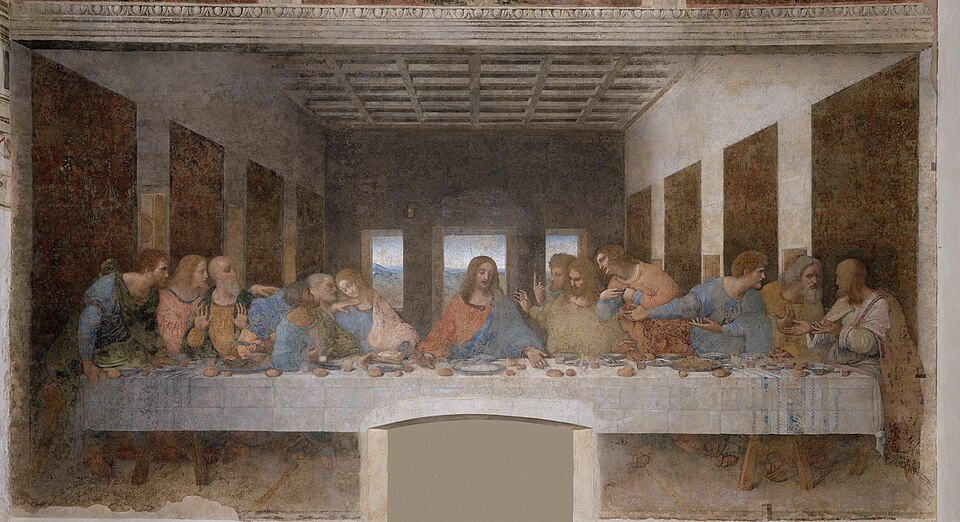 The Last Supper (1495-1498, Milan, refectory of Santa Maria delle Grazie): the bread and the wine, which the last pages of Das Wesen des Christenthums restore to their natural and human meaning
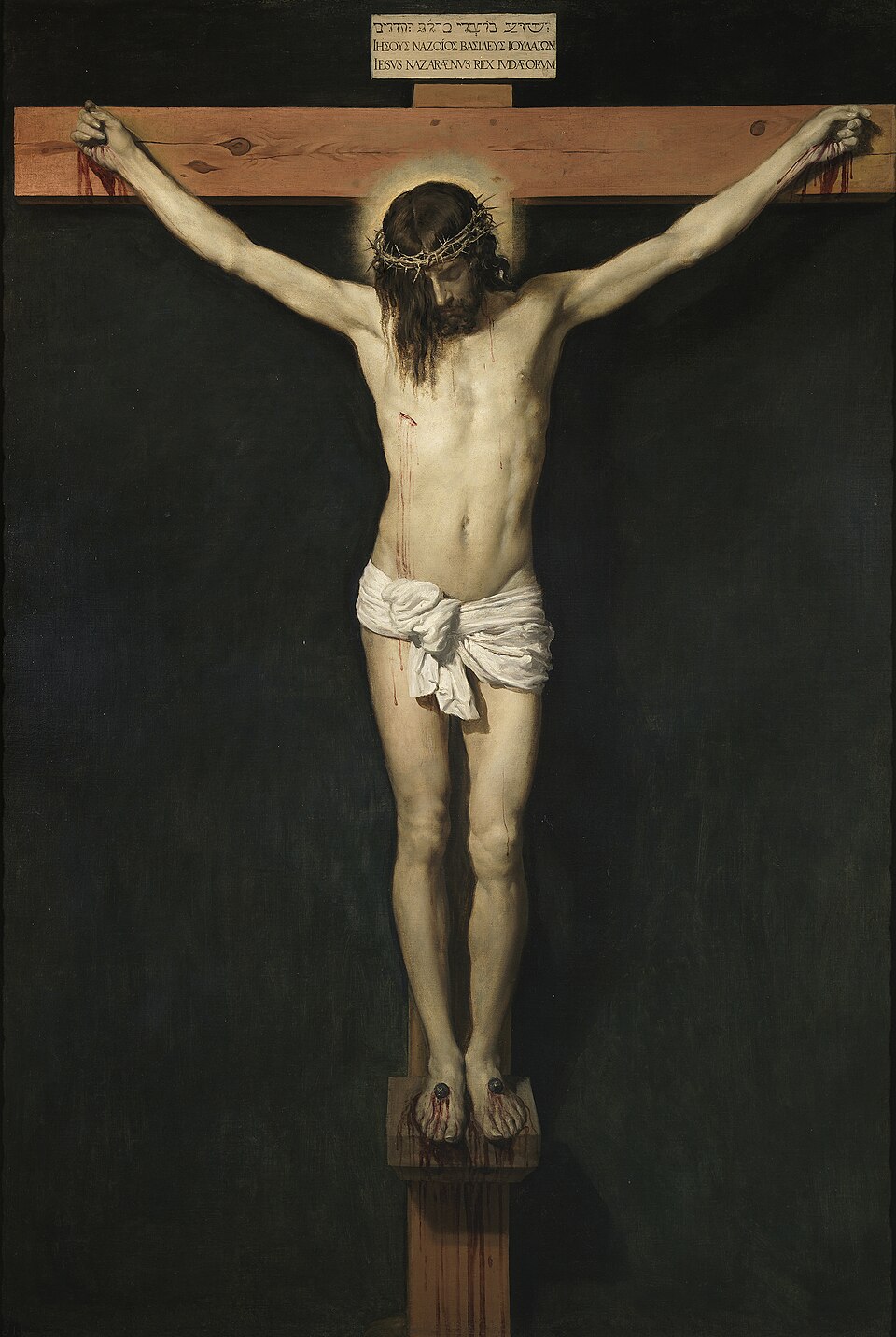 Christ Crucified (c. 1632, Madrid, Prado): the speculative Good Friday, in which Hegel takes up the “Gott selbst ist tot” of the Lutheran hymn
 The Body of the Dead Christ in the Tomb (1521-1522, Basel, Kunstmuseum): before a copy of this painting in Rogozhin's house, Prince Myshkin says, in The Idiot (1868-1869), that it could make one lose one's faith
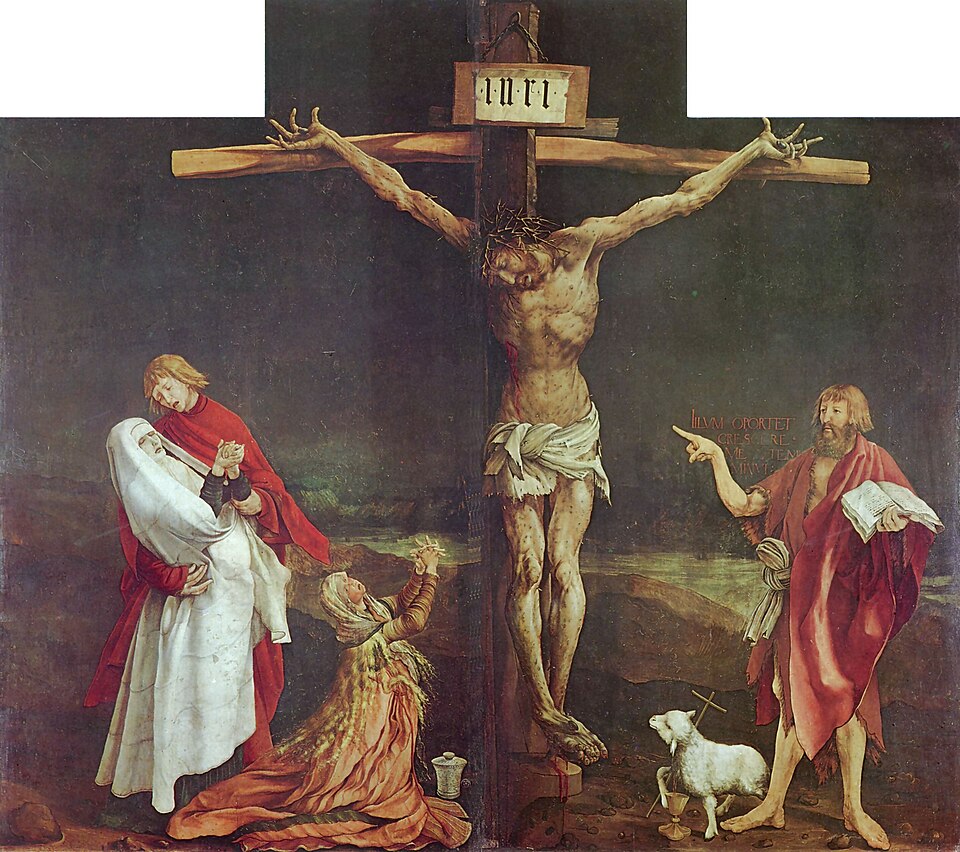 the Crucifixion from the Isenheim Altarpiece (1512-1516, Colmar, Musée Unterlinden): Karl Barth kept a reproduction of this panel above his desk, and the outstretched index finger of John the Baptist served him as a figure of witness
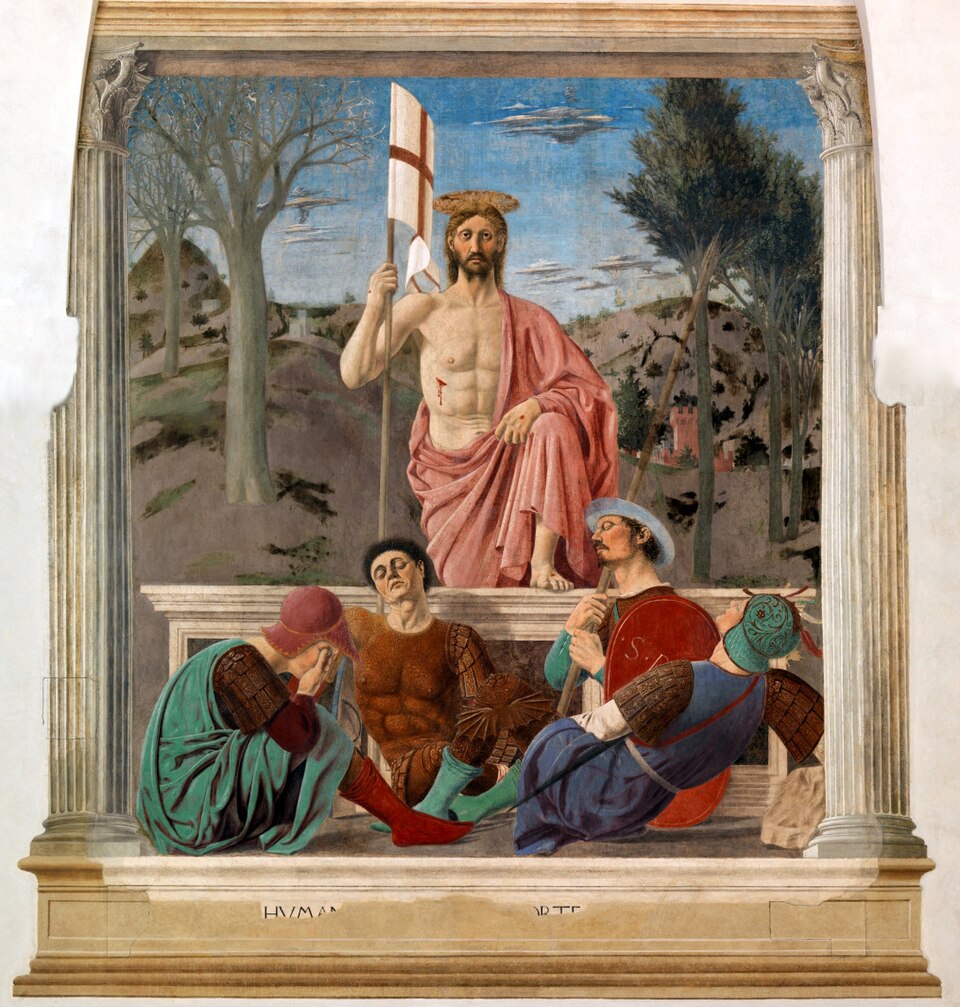 The Resurrection (c. 1463-1465, Sansepolcro, Museo Civico): the Christ of Easter faith, whom historical research distinguishes from the Jesus of history
 The Magdalen with the Smoking Flame, known as the Terff Magdalen (c. 1640-1645, Paris, Musée du Louvre): the skull, the books and the flame, a meditation on death that joins the ancient spiritual exercise in Hadot's sense
In the essay: Did Jesus exist? The Jesus of history and the mythicist thesis · Georg Wilhelm Friedrich Hegel · Dostoevsky · Girard · Nietzsche
Further reading: Raymond E. Brown, The Death of the Messiah (1994) ; Simon Légasse, Le Procès de Jésus (1994-1995) ; Paula Fredriksen, Jesus of Nazareth, King of the Jews (1999) ; Dale C. Allison, Resurrecting Jesus (2005)
The teaching of Jesus: the Kingdom, the parables, the miraclesBible: the texts
Before being the Christ of the creeds, Jesus is, in the Gospels, an itinerant preacher from Galilee who proclaims the Kingdom of God, speaks in parables, heals and eats with the excluded. These notes summarize what the first three Gospels report of his teaching and the way historians read it.
John the Baptist and the Kingdom
The Gospels begin Jesus' activity with his baptism in the Jordan, received from John, an ascetic prophet who announces an imminent judgement and calls for repentance, and whom Josephus also knows. After John's arrest, Jesus preaches in Galilee that the Kingdom of God has come near (Mc 1, 15); Matthew writes Kingdom of Heaven out of respect for the divine name. The Kingdom is not a place but the reign of God that is coming: one prays for its coming in the Lord's Prayer, and yet it is said to be already present in the exorcisms and in the midst of the listeners. Historians have been divided for a century: Albert Schweitzer (1906) sees in it the expectation of an imminent end of the world, which did not happen; C. H. Dodd (1935) a realized eschatology, the Kingdom already there in the person of Jesus; most today hold the two aspects together.
The parables
Jesus teaches in parables, short stories taken from the life of fields, houses and markets: the sower, the mustard seed that becomes a tree, the tares left until the harvest, the hidden treasure, the talents, the labourers of the eleventh hour paid like the first. The parable does not define the Kingdom; it gives a glimpse of it through a comparison that surprises and overturns expectation, and it leaves the listener to decide.
The miracles
The Gospels report healings, exorcisms, raisings of the dead and nature miracles. Historians observe that the reputation of healer and exorcist is one of the best-attested traits, acknowledged even by adversaries, who explain it by magic, like Celsus, or by the prince of demons, like the scribes in Mark; they leave the interpretation of the facts open. In the Gospels, the miracles are signs of the Kingdom rather than proofs, and Jesus refuses to give any to those who demand them.
The meals, the Law, the enemies
Jesus eats with publicans, tax collectors in the service of Rome, and with sinners, which scandalizes the Pharisees; women follow him and support him. He does not reject the Law but discusses it from within: the sabbath is made for man, purity comes from the heart, the greatest commandment is the love of God and of one's neighbour. He calls for love of one's enemies and for forgiveness without limit. He most often calls himself the Son of Man, an expression that can mean simply a human being, but which also refers to the figure coming on the clouds in Daniel 7, to whom an everlasting kingdom is given.
Composition and reading
These materials come from Mark and from the sayings source shared by Matthew and Luke; John replaces them with signs and discourses. Each age has drawn from them a different Jesus, a teacher of morality, a gentle Galilean, a prophet of the end.
What the essay assumes
The essay draws on this teaching through its readers. Kant makes Christ the ideal of humanity well-pleasing to God, which reason carries within itself and recognizes in the Gospel narrative, so that historicity becomes indifferent. Renan holds miracle to be impossible to establish, because no wonder-worker has ever performed before a commission of scientists, and rediscovers in Galilee a human figure in the narratives of Matthew and Mark. Nietzsche, in The Antichrist, describes a Jesus without resentment or dogma who lives in an inner kingdom without preaching it. The section on the existence of Jesus retains Schweitzer's apocalyptic prophet, taken up by Meier and Fredriksen. Simone Weil, finally, is cited for her refusal of consolation; attention, which Murdoch borrows from her, is for her a religious category, in its highest degree identical with prayer.
In the essay: Kant · Ernest Renan · Nietzsche · Did Jesus exist? The Jesus of history and the mythicist thesis · Simone Weil
Further reading: E. P. Sanders, Jesus and Judaism (1985) ; John P. Meier, A Marginal Jew (1991-2016) ; Joachim Jeremias, Les Paraboles de Jésus (1947) ; C. H. Dodd, The Parables of the Kingdom (1935)
The Acts of the Apostles: from Jerusalem to RomeBible: the texts
The Acts of the Apostles is the only book of the New Testament that narrates what follows the death of Jesus: the birth of a community in Jerusalem, then the spread of the message as far as Rome. The second volume of the Gospel of Luke, it was composed c. 80 to 90 by an anonymous author whom tradition identifies with the physician who was Paul's companion.
Jerusalem: the Spirit and the community
The narrative opens with the Ascension: forty days after Easter, the risen Christ is taken up into heaven and promises the Spirit (Ac 1). At Pentecost, a Jewish feast celebrated fifty days after Passover, the Spirit descends on the disciples in the form of tongues of fire; pilgrims who have come from the whole diaspora each hear them in their own language (Ac 2). Peter preaches and baptizes. Luke then describes the Jerusalem community in idealized tableaux: prayer, the breaking of bread, and believers who sell their goods and lay the proceeds at the apostles' feet, so that no one is in need (Ac 2 and 4). This community of goods has its reverse side: Ananias and Sapphira, who keep back part of the price of their field while claiming to give everything, fall dead (Ac 5). Seven men, among them Stephen and Philip, are chosen to serve the Greek-speaking widows; Stephen, after a speech that rereads the history of Israel as a series of refusals, is stoned before the eyes of a young man named Saul (Ac 6 and 7).
Saul, Cornelius and the assembly of Jerusalem
The conversion of Saul on the road to Damascus is told three times, by the narrator and then by Paul himself (Ac 9, 22 and 26): a light, a voice, three days of blindness, baptism. Peter, warned by a vision, baptizes the centurion Cornelius, the first pagan received without circumcision (Ac 10). The question of the pagans is settled at the assembly that tradition calls the Council of Jerusalem, c. 48 or 49: Peter, James and Paul agree not to impose circumcision on converts from the nations, asking them instead to abstain from meat sacrificed to idols, from blood and from sexual immorality (Ac 15).
Paul's journeys and the road to Rome
The second half follows Paul: Asia Minor, Philippi, Athens, where he delivers before the Areopagus a speech on the unknown god (Ac 17), Corinth, Ephesus. Back in Jerusalem, he is arrested in the Temple and held for two years at Caesarea. As a Roman citizen, he appeals to Caesar; the crossing ends in a shipwreck on Malta. The book closes on Paul preaching in Rome; his death is not narrated.
History and apology
Historians compare Acts with Paul's letters, which are older and direct. The agreements are many, such as the proconsul Gallio, whom an inscription at Delphi dates to c. 51, but so are the discrepancies: in the letter to the Galatians, Paul insists on his independence from Jerusalem, where Luke shows him compliant; the conflict at Antioch between Peter and Paul is passed over in silence; the speeches are the author's compositions, after the custom of ancient historians. Luke writes an apologetic history: a unanimous Church, led by the Spirit, harmless to Rome, whose magistrates always release the Christians.
Readings
Engels, in 1894, rereads the first communities as a movement of the oppressed comparable to the workers' movement; the community of goods in Ac 2 and 4 nourished, from Thomas More to the Christian socialisms of the nineteenth century, the idea of an original communism, which historians reduce to a local and short-lived practice. The Athens speech served as a model for the apologists of the second century, Justin first among them, who present the faith in the language of the philosophers.
What the essay assumes
The essay reads Paul through his letters and treats Acts, written a generation later, as a narrative to be handled with caution; it draws on the Areopagus speech, which it takes to be Luke's composition, as the scene in which Athens laughs at the resurrection, and on Engels's formula about early Christianity. It takes as known the setting of Paul's mission, and martyrdom as the refusal of a cult, of which Stephen is the first case.
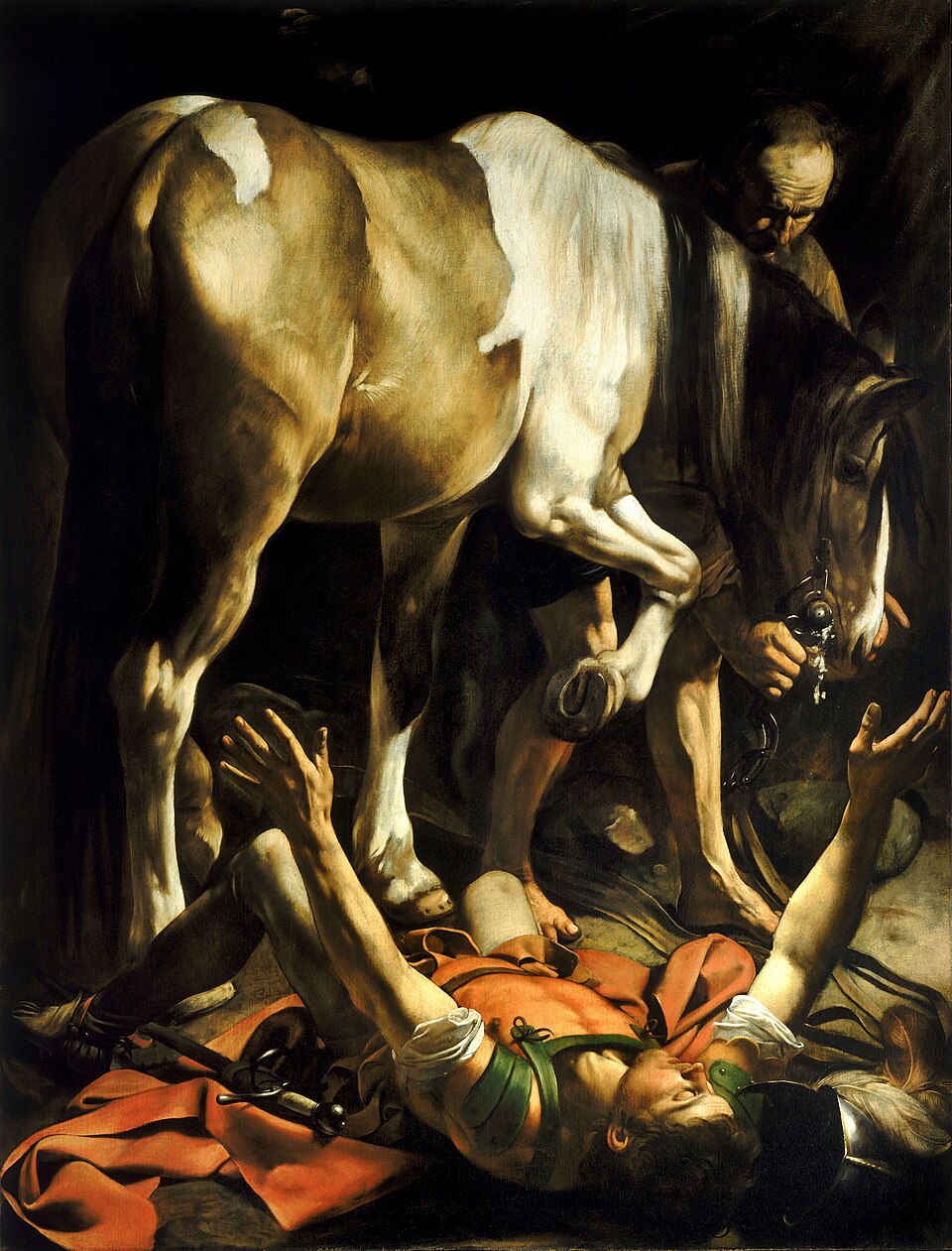 The Conversion of Saint Paul (1600-1601, Rome, Santa Maria del Popolo, Cerasi Chapel): Paul, the “Dysangelist” of Der Antichrist
In the essay: Paul of Tarsus · Justin Martyr · Karl Marx and Friedrich Engels · Auguste Comte
Further reading: Daniel Marguerat, La Première Histoire du christianisme. Les Actes des apôtres (1999) ; Jacques Dupont, Études sur les Actes des Apôtres (1967) ; Ernst Haenchen, Die Apostelgeschichte (1956) ; Richard I. Pervo, Acts. A Commentary (2009)
The letters of Paul: Romans, Corinthians and the othersBible: the texts
The letters of Paul, written around 50 to 60, are the oldest surviving Christian writings. Addressed to particular communities, they have become the foundation of Christian theology and the object of its greatest quarrels.
The corpus
Thirteen letters bear Paul's name. Critical scholarship holds seven to be authentic: the First Letter to the Thessalonians, the oldest, c. 50; Galatians; the two letters to the Corinthians; Philippians; the note to Philemon; Romans, c. 56 to 58. Three are disputed and called deutero-Pauline: Colossians, Ephesians, 2 Thessalonians, perhaps written by disciples. The three pastoral epistles, 1 and 2 Timothy and Titus, addressed to leaders and concerned with Church organization, are held to be late, from the beginning of the second century. The Letter to the Hebrews is no longer attributed to Paul. The letters, dictated to a secretary, are read to the assembly and exchanged between Churches.
Romans
The longest and most carefully constructed letter, addressed to a community that Paul did not found. All, Jews and Greeks, are under sin; the justice of God is manifested through faith in Christ, independently of the works of the Law (Rm 3 and 4); Adam and Christ correspond to each other (Rm 5); the divided self does not do the good it wants (Rm 7). Chapters 9 to 11 deal with Israel: Paul affirms that the gifts and the calling of God are irrevocable and that all Israel will be saved. Then comes the exhortation: to offer one's body as a living sacrifice, a reasonable or spiritual worship depending on the translation (Rm 12, 1), then submission to the authorities, which come from God (Rm 13).
Corinthians, Galatians, Philippians
The First Letter to the Corinthians deals with the divisions between partisans of Paul, of Apollos and of Cephas, and sets the folly of the cross against the wisdom the Greeks seek and the signs the Jews demand (1 Co 1); then with marriage, with the Lord's supper, of which it transmits the oldest account (1 Co 11), with the body of many members (1 Co 12), with love, which never passes away (1 Co 13), and with the resurrection of the dead, with the received creed and the list of appearances (1 Co 15). Galatians is a letter of anger against those who impose circumcision: Paul's calling, the meeting with Cephas and James, the Law as a pedagogue, neither Jew nor Greek. Philippians, written in prison, is a letter of joy; its chapter 2 quotes a hymn, probably earlier than Paul, in which Christ, being of divine condition, empties himself, takes the condition of a slave even unto death on the cross, and is then exalted: this is kenosis, from the Greek kenôsis, emptying.
The great readings
Augustine reads Rm 7 and 9 in the Pelagian controversy and draws from them grace and predestination. Luther finds in Rm 1, 17 justification by faith alone; the Reformation is born of a reading of Romans. Barth, in 1919 and then 1922, breaks with liberal theology through his Römerbrief. Nietzsche, in The Antichrist, makes Paul the inventor of Christianity, who replaced the practice of Jesus with the cross and the resurrection. Since Sanders (1977), a body of research often called the new perspective places Paul back within the Judaism of his time: justification concerns the admission of the Gentiles, not a religion of performance; philosophers (Taubes, Badiou, Agamben) have reread Paul as a thinker of the universal.
What the essay assumes
The essay adopts the consensus on the seven letters, the dating between 50 and 60, the creed of 1 Co 15 and the meeting of Ga 1, 19 as testimonies about Jesus, the folly of the cross of 1 Co 1, 22-23 as the formula of the impossible meeting of Athens and Jerusalem, Sanders's reading against the Lutheran image, and Rm 12, 1 as the text in which bloody sacrifice becomes self-offering. It reads Barth through the Römerbrief and the infinite qualitative difference, Nietzsche through paragraph 42 of The Antichrist, and Weil through decreation, a God who renounces being everything, which is compared with the hymn of Philippians.
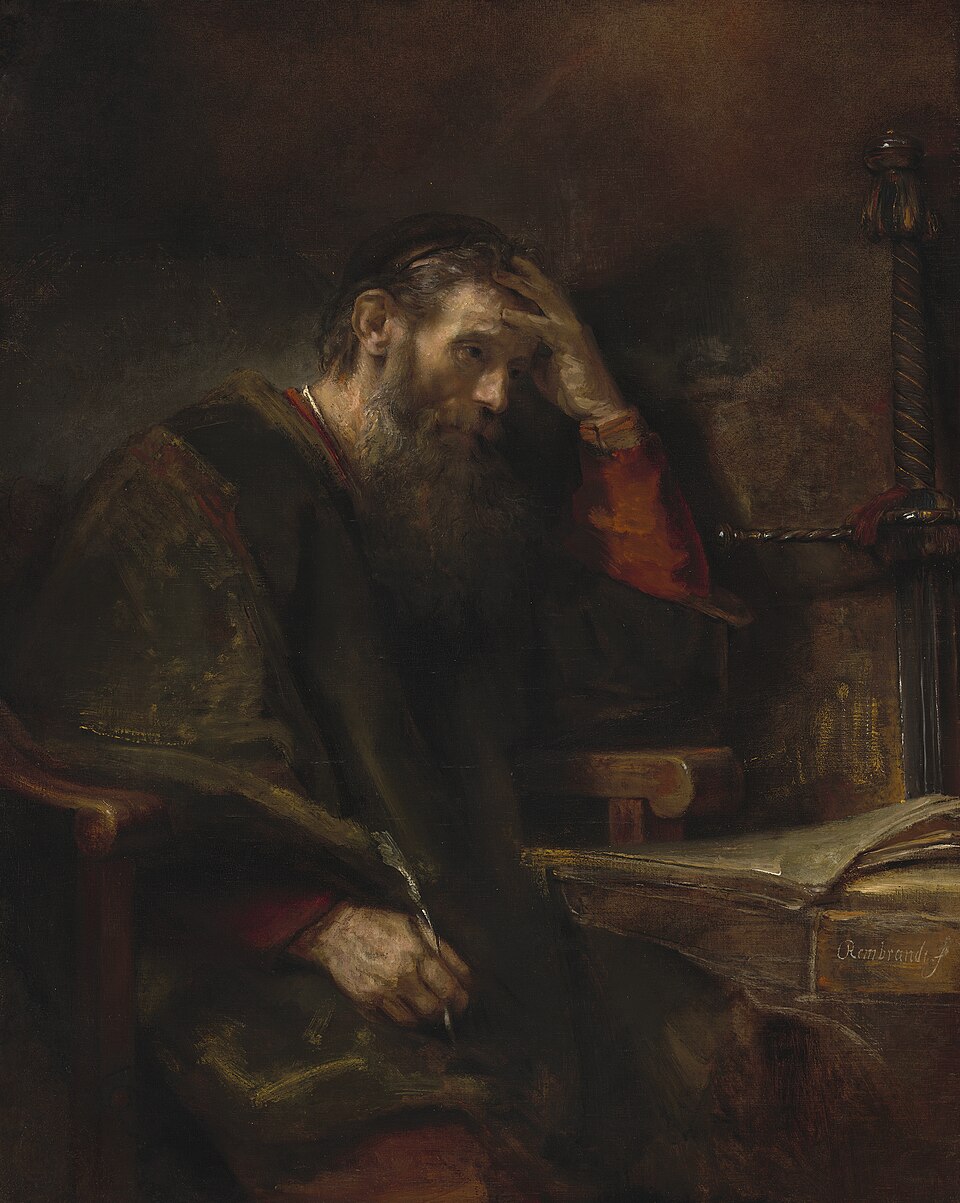
In the essay: Paul of Tarsus · Barth · Nietzsche · Simone Weil
Further reading: E. P. Sanders, Paul and Palestinian Judaism (1977) ; Simon Légasse, Paul apôtre (1991) ; Jacob Taubes, La Théologie politique de Paul (1993) ; Daniel Marguerat (ed.), Introduction au Nouveau Testament (2000)
Hebrews, James, Peter, John, Jude: the other lettersBible: the texts
Alongside the gospels and the letters of Paul, the New Testament contains eight shorter and less read letters. Seven of them have been called, since Eusebius, the Catholic Epistles, that is, universal, because they are addressed to all the Churches and not to a single community; the eighth, the Epistle to the Hebrews, was long counted among Paul's.
Hebrews: Christ the high priest
The text is anonymous; Origen already said that God alone knows who wrote it. It is a learned homily, in the most polished Greek of the New Testament, composed before 95, the date at which Clement of Rome quotes it. Its thesis is that Christ surpasses all the former mediators: the angels, Moses, the priests of the line of Levi. He is high priest according to the order of Melchizedek, the priest-king whom Genesis has meet Abraham and whom Psalm 110 evokes, and he has entered once for all into the heavenly sanctuary with his own blood. This single sacrifice renders unnecessary the sacrifices that the Temple repeated every year (He 7 to 10) and inaugurates the new covenant announced by Jeremiah. Chapter 11 unfolds the gallery of the ancients who believed without seeing the promise.
James: faith without works
Attributed to James, whom tradition identifies with the brother of the Lord, the epistle is a series of wisdom exhortations close to the Sermon on the Mount: trial, the poor given preference in the assembly, the tongue that sets ablaze, the stolen wages of the harvesters. Its second chapter maintains that faith without works is dead and that Abraham was justified by works, which seems to contradict Rm 3 and 4; many see in it a response to a distorted reading of Paul. Luther, in 1522, judged it an epistle of straw compared with the writings that preach Christ, and relegated it to the end of his New Testament together with Hebrews, Jude and Revelation.
Peter, John, Jude
The First Epistle of Peter is addressed to the elect strangers scattered through Asia Minor: exile, unjust suffering in the image of Christ, and the royal priesthood of the baptized (1 P 2, 9). The Second Epistle of Peter, which takes up Jude, is the latest text of the canon, from around 120 to 150: it answers the scoffers who ask where the promise of the Lord's coming is, and recalls that a thousand years are to him as one day. The three letters of John, close to the fourth gospel, affirm that God is love, denounce antichrists who have gone out from the community and require that Christ be confessed as come in the flesh. Jude, brief and vehement, quotes the book of Enoch.
Pseudepigraphy
Writing under the name of a master was common in Jewish and Greek antiquity: the Pythagorean schools, Daniel, Enoch. That 1 and 2 Peter, James or Jude are probably pseudepigraphical tells us about their date and milieu; it does not imply that their content is worthless or that their traditions are late. Ehrman nonetheless judges the practice closer to forgery than classical criticism admits.
Readings
The quarrel over faith and works set, in the sixteenth century, the Lutheran reading of Romans against James, which the Council of Trent invoked in its decree on justification (1547). Girard, in Things Hidden since the Foundation of the World (1978), rejected Hebrews as the text that reintroduced a sacrificial reading of the Passion; he went back on this judgement in the 1990s and admitted that the epistle conceives sacrifice in a new sense, that of the gift of self which puts an end to sacrifices.
What the essay assumes
The essay reports that Girard long refused to call the Passion a sacrifice, then accepted the word in a new sense after his exchange with Raymund Schwager: the vocabulary at stake is that of Hebrews, which the essay does not name. It reads in Paul, in Rm 12, 1, the spiritualized sacrifice; in Weber, a Puritanism that abolishes the sacraments as means of salvation; in Barth, religion defined as an attempt to justify oneself by works, rites and thoughts.
Further reading: Albert Vanhoye, Prêtres anciens, prêtre nouveau selon le Nouveau Testament (1980) ; Raymond E. Brown, Que sait-on du Nouveau Testament ? (1997) ; Bart D. Ehrman, Forgery and Counterforgery (2013) ; Ceslas Spicq, L'Épître aux Hébreux (1952)
The Revelation of John: visions, the beast and the heavenly JerusalemBible: the texts
The last book of the New Testament, the Revelation of John is also the strangest: a series of coded visions announcing the fall of an empire and the descent of a heavenly city. Its Greek title, apokalupsis, means unveiling, and it is from this book that the word took on its sense of catastrophe.
A genre and an author
Apocalyptic is a Jewish genre born in the second century BCE, with the book of Daniel and the books of Enoch: a seer receives visions, an angel interprets them, empires are beasts, numbers have a meaning, and the present crisis is the prelude to a divine intervention. The author names himself John, exiled on Patmos, and presents himself as a prophet, not as an apostle. Justin and Irenaeus identify him with the apostle, the son of Zebedee; as early as the third century, Dionysius of Alexandria distinguishes the seer from the evangelist on grounds of style, and most critics follow him. The most commonly accepted date is c. 95, under Domitian, on the testimony of Irenaeus; some place it under Nero or Vespasian.
The structure
The book opens with seven letters to the Churches of Asia, from Ephesus to Laodicea (Ap 2 and 3). Then the seer is carried before the throne of God; only the slain Lamb is worthy to open the sealed book (Ap 4 and 5). Three series of seven plagues follow one another: the seals, the first four of which release the horsemen, the trumpets, the bowls. At the centre, a woman clothed with the sun gives birth to a child whom the dragon seeks to devour (Ap 12); a beast rises from the sea, another from the earth, and the number of the beast, 666, corresponds in Hebrew letters to Nero Caesar according to the most common reading (Ap 13). Babylon the great, a harlot seated on seven hills, falls (Ap 17 and 18). The rider named the Word of God wins the battle; Satan is bound for a thousand years while the risen martyrs reign with Christ (Ap 20), the passage from which millenarianism comes; there follow the judgement before the book of life, then a new heaven and a new earth, and the heavenly Jerusalem coming down from God, without a temple, where every tear is wiped away (Ap 21 and 22).
Aim and reception
The book consoles Churches exposed to the imperial cult and to local persecutions, and denounces Rome under the name of Babylon; it calls for the endurance of the martyrs, not for armed revolt. Its reception was difficult in the East, where Eusebius ranks it among the disputed books; it was accepted early in the West. Augustine, in book XX of The City of God, reads the thousand years as the present time of the Church and puts an end to the literal millenarianism that Papias, Justin and Irenaeus had professed. Luther, in 1522, denies it apostolic character; Calvin did not comment on it.
Political and philosophical legacy
Millenarianism revives in the Middle Ages: Joachim of Fiore, who died in 1202, divides history into three ages, of the Father, of the Son and of the Spirit, and announces for the last a spiritual Church; the Franciscan Spirituals, the Taborites, Thomas Müntzer and the Anabaptists of Münster (1534-1535) await the reign of the saints on earth, movements that Norman Cohn traced in The Pursuit of the Millennium (1957). Hence the twentieth-century debate on the secularization of eschatology: Löwith and Voegelin see in the philosophies of history the end of time transposed into history; Blumenberg replies that the apocalyptic end breaks in from outside, whereas modern progress is immanent.
What the essay assumes
The essay uses the words eschatology, eschaton, end of time and imminent expectation without describing the book they come from: in Löwith, the philosophy of history is Christian eschatology minus God; in Voegelin, the genealogy runs through Joachim; in Blumenberg, three conditions are lacking for speaking of a transfer. In the section on the existence of Jesus, it retains from Schweitzer a Jesus who is an apocalyptic prophet awaiting the imminent end of the world, and in Paul an expectation of Christ's return within the lifetime of his readers.
In the essay: Karl Löwith · Voegelin and Aron · Hans Blumenberg · Part Eleven
Further reading: Pierre Prigent, L'Apocalypse de saint Jean (1981) ; Norman Cohn, The Pursuit of the Millennium (1957) ; Elisabeth Schüssler Fiorenza, The Book of Revelation. Justice and Judgment (1985) ; Jean Delumeau, Mille ans de bonheur (1995)
The apocryphal gospels: Thomas, Peter, Mary, Judas and the othersBible: the texts
The name apocryphal gospels is given to the narratives or collections of sayings of Jesus that the Churches did not receive into their canon. The Greek word apokryphos means hidden: it first designates books reserved for initiates, a sense some gnostics claimed, then, among the Fathers, books not read in the assembly and of suspect origin.
The main families
The sayings gospels have no Passion narrative. The most important is the Gospel of Thomas, 114 sayings attributed to Jesus, known from Greek fragments found at Oxyrhynchus since 1897 and from a complete Coptic version discovered at Nag Hammadi in 1945; half of its sayings have a parallel in the synoptics, the other half have an ascetic and gnosticizing colouring. Its date divides the schools, from 60 to 150, depending on whether it is held to be independent of the canonical Gospels or dependent on them. The Gospel of Peter, a fragment of which was found at Akhmim in 1886, tells the Passion with a cross that speaks; around 200, Bishop Serapion of Antioch forbade its reading. The gnostic gospels have the risen Jesus speak to a few disciples: the Gospel of Mary, in which Mary Magdalene receives a revelation that Peter contests; the Gospel of Philip, a Valentinian collection on the sacraments; the Gospel of Judas, in Coptic, published in 2006, in which Judas is read now as the disciple who understands, now as a demon. The infancy gospels fill the silences: the Protevangelium of James, from the second century, tells of the birth of Mary, of her parents Anne and Joachim, of her presentation in the Temple, of old Joseph the widower, and it is the source of several Marian feasts and of their iconography; the Infancy Gospel of Thomas shows a child Jesus bringing clay birds to life. The Jewish-Christian gospels, of the Hebrews, of the Nazarenes, of the Ebionites, are known only through quotations in Clement, Origen, Jerome and Epiphanius. Marcion, around 140, had retained only an abridged Luke. To these are added the agrapha, sayings of Jesus quoted outside the Gospels, as in Ac 20, 35, and the Egerton papyrus, around 150.
What they contribute
On the Jesus of history, little: historians date these texts to the second and third centuries, and only Thomas is debated, some looking in it for a few independent sayings. On second-century Christianity, a great deal: the diversity of currents, the conflicts of authority between Peter and Mary or Thomas, popular piety and its taste for the marvellous, the sources of Christian iconography, the ox and the ass of the crib, the descent into hell, Veronica, which come from yet other apocrypha.
Why outside the canon
These writings are later than the four Gospels, tied to particular currents, gnostic or encratite, without wide liturgical use, and held to be non-apostolic despite the names they bear. The Churches retained the books read everywhere and for a long time, in conformity with the rule of faith; the rest was copied in the margins, translated, read in private, and sometimes buried, as at Nag Hammadi.
Modern readings
Strauss, in 1835, works on the four canonical Gospels and draws nothing from the apocrypha; nor does Bauer, who looks for the conscious author behind the synoptics; Renan barely cites them. The discoveries of Nag Hammadi and the publication of Judas have fed a contemporary fascination, of which The Da Vinci Code (2003) is the example, for gospels hidden by the Church; historians, Ehrman among them, reply that these late texts teach nothing new about Jesus and a great deal about his readers.
What the essay assumes
The essay reasons on the canonical sources, the letters of Paul, the Gospels from Mark around 70 to John at the end of the first century, Josephus and Tacitus, and does not mention the apocrypha; it takes from Ehrman the consensus on the existence of Jesus, and from Celsus a polemic, Jesus son of a soldier named Panthera, which circulates outside the Gospels. When it opposes Strauss's collective myth to Bauer's conscious author, or describes in Onfray a Jesus as concept, it takes for granted this profusion of second-century gospels, which shows how the life of a founder was written at the time.
In the essay: Celsus and Origen · David Friedrich Strauss and Bruno Bauer
Further reading: François Bovon and Pierre Geoltrain (eds.), Écrits apocryphes chrétiens (1997-2005) ; Bart D. Ehrman, Lost Christianities (2003) ; Elaine Pagels, The Gnostic Gospels (1979) ; Jean-Daniel Kaestli and Daniel Marguerat (eds.), Le Mystère apocryphe (1995)
How the canon was formed: criteria, lists and excluded textsBible: the texts
The canon of the New Testament, that is, the list of the twenty-seven books that the Churches hold to be Scripture, was not fixed by a decision but by a usage of more than two centuries, which lists later recorded. The Greek word kanôn designates the mason's rule, then the norm, then the catalogue.
The stages
Paul's letters circulated very early from one Church to another and were gathered into a collection before the end of the first century; the second letter of Peter already counts them among the Scriptures. Around 150, Justin reports that on Sundays the memoirs of the apostles, that is, the gospels, are read alongside the prophets. The first to draw up a closed list is Marcion, c. 140: a single gospel, an abridged Luke, and ten letters of Paul, excluding the whole Old Testament; his gesture forces the Churches to say what they receive. Irenaeus of Lyon, c. 180, asserts that there can be only four gospels, as there are four winds, against the Gnostic writings. The Muratorian Canon, a Latin fragment published in Milan in 1740 and dated by most scholars to the late second century, lists the bulk of the present collection, without Hebrews, James or the letters of Peter, and with an Apocalypse of Peter; it admits the Shepherd of Hermas for private reading, because it is recent. Origen, in the third century, distinguishes the books acknowledged by all, the disputed books and the spurious ones; Eusebius, c. 325, takes up this classification. The first list exactly matching ours is the thirty-ninth festal letter of Athanasius of Alexandria, announcing the date of Easter for the year 367. The African synods of Hippo (393) and Carthage (397), in which Augustine took part, confirm it for the West. In Syria, the Peshitta long ignores five of these books; the Church of Ethiopia keeps a broader canon.
The criteria
Four criteria recur among the Fathers: apostolicity, a book written by an apostle or one of his companions, Mark for Peter, Luke for Paul; conformity with the rule of faith handed down in the Churches; reception, that is, ancient and widespread liturgical use; antiquity, which excludes Hermas. They serve less to choose than to justify after the fact a usage already established.
The disputed books and the excluded books
Seven books were slow to gain acceptance: Hebrews, Revelation, James, 2 Peter, 2 and 3 John, Jude. Four others were for a time read as Scripture and then set aside: the Shepherd of Hermas and the letter of Barnabas, copied in the Codex Sinaiticus in the fourth century; the Didache; the first letter of Clement, present in the Codex Alexandrinus. The apocryphal gospels never appeared in any Church list.
The Reformations and Trent
Luther, in 1522, puts Hebrews, James, Jude and Revelation at the end of the volume, unnumbered, but does not remove them; the Reformed exclude from the Old Testament the Greek books absent from the Hebrew Bible, Tobit, Judith, Wisdom, Sirach, Baruch, Maccabees, which they call apocrypha and print separately. The Council of Florence had given the list in 1442; the Council of Trent, on 8 April 1546, defines it for the Catholic Church, deuterocanonical books included, with the Vulgate as the authentic text.
A legend to dismiss
The Council of Nicaea, in 325, did not fix the canon: its acts deal with Arius and the date of Easter. The idea of a sorting of the books at Nicaea comes from a late anecdote, mocked by Voltaire and popularized by The Da Vinci Code.
What the essay assumes
The essay follows the dialogue between Celsus and Origen, and later Porphyry contesting the date of Daniel, without saying which books were then received; it reports that Augustine grounds understanding on prior faith and that religion, according to Montaigne, is received through the custom of the country, which applies first of all to its books. It itself works with a canon sorted by criticism: seven letters of Paul held to be authentic, Mark c. 70, John at the end of the first century, and it contrasts, in Strauss and Bauer, two ways of explaining the formation of the gospels.
In the essay: Celsus and Origen · Porphyry and Augustine · Part Two · Montaigne
Further reading: Bruce M. Metzger, The Canon of the New Testament (1987) ; Hans von Campenhausen, Die Entstehung der christlichen Bibel (1968) ; Yves-Marie Blanchard, Aux sources du canon, le témoignage d'Irénée (1993) ; Lee Martin McDonald, The Biblical Canon (2007)
How the Bible has been read: allegory, the four senses, historical criticismBible: the texts
The Bible has never been read in a single way. Jews and Christians have sought in it, in turn, a law, a hidden meaning, a figure of Christ, a rule of life, and then, from the seventeenth century onwards, a document whose authors and dates had to be established.
Jewish readings
Rabbinic Judaism reads the Torah through midrash, an inquiry that scrutinizes every word: halakha draws norms from it, haggadah narratives and lessons. The kabbalists of the thirteenth century sum up four levels in the word Pardes, the orchard: the plain sense, the allusion, the homiletic interpretation and the secret.
Allegory, letter and charity
Philo of Alexandria, in the first century, distinguishes the literal sense, good for the multitude, from the figurative sense, in which Eden becomes virtue and the exodus the departure of the soul from the body. Origen systematizes three senses, the body, the soul and the spirit of the text, and holds certain passages to be impossible in the letter so as to force the reader towards the spirit. The school of Antioch, on the contrary, defends the literal and historical sense. Augustine, in On Christian Doctrine, lays down a rule: any interpretation that does not build up the love of God and of neighbour has not understood the text.
The four medieval senses
Cassian and then the medieval masters fix four senses of Scripture: literal, allegorical, moral or tropological, anagogical. A Latin distich of the thirteenth century sums them up: the letter teaches the facts, allegory what one must believe, the moral sense what one must do, anagogy what one must strive towards. Jerusalem is thus the city, the Church, the soul and the heavenly city. Thomas Aquinas requires the spiritual senses to rest on the literal one.
Luther and the clarity of Scripture
The Reformation lays down the principle of sola scriptura: Scripture alone has authority, it is clear in what concerns salvation, it interprets itself and every believer can read it, hence Luther's German translation (1522-1534). Luther distrusts allegory and looks for Christ everywhere.
The birth of criticism
Spinoza, in chapter VII of the Theological-Political Treatise (1670), wants to read Scripture as one reads nature: to establish the language, the history of each book, its author, its addressees, and to draw from it only what the text says, without bending reason to it as Maimonides did; in the following chapter, he concludes with Ibn Ezra that Moses did not write the Pentateuch, of which Ezra would be the compiler. The Oratorian Richard Simon, in the Histoire critique du Vieux Testament (1678), destroyed at Bossuet's instigation, attributes the text to successive public scribes. After Jean Astruc (1753), who distinguishes two documents in Genesis according to the divine name, German criticism culminates in Julius Wellhausen, whose Prolegomena to the History of Israel (1878) fix the documentary hypothesis: four sources, the Yahwist J, the Elohist E, the Deuteronomist D and the Priestly writing P, the last being the latest, after the exile. Since the 1970s the model has been contested, above all for J and E. On the side of the New Testament, Strauss introduces myth in 1835; Gunkel, Dibelius and Bultmann found form criticism; Bultmann proposes in 1941 to demythologize the message. The Catholic Church, after condemning modernism, accepts literary genres with Pius XII (1943), and at the Second Vatican Council the constitution Dei Verbum (1965) asks that the intention of the human authors be sought. Conversely, American fundamentalism, born at the end of the nineteenth century, holds the inerrancy of Scripture to be an article of faith.
A Muslim parallel
Averroes, in the twelfth century, distinguishes in the Qur'an an apparent sense and an inner sense reached through taʾwīl, interpretation, which is reserved for those capable of demonstration; this is the division, between the letter for the crowd and the meaning for the learned, that Spinoza rejects.
What the essay assumes
The essay describes in Philo the regime of allegory and its two senses, in Origen the three-level reading inherited from Philo, in Averroes taʾwīl and the three classes of men, in Spinoza the rejection of Maimonides' method as useless, dangerous and absurd, and in Strauss myth without intention; it takes as known the four medieval senses, sola scriptura and the documentary hypothesis, which it describes nowhere.
In the essay: Celsus and Origen · Spinoza · Averroes
Further reading: Henri de Lubac, Exégèse médiévale. Les quatre sens de l'Écriture (1959-1964) ; Pierre Gibert, L'Invention critique de la Bible (2010) ; Thomas Römer, Jean-Daniel Macchi and Christophe Nihan (eds.), Introduction à l'Ancien Testament (2004) ; Gilbert Dahan, L'Exégèse chrétienne de la Bible en Occident médiéval (1999)
Sacrifice in the Bible: from Abel's altar to self-offeringBible: the texts
Sacrifice runs through the Bible from the first offering of Cain and Abel to the Lamb of the Apocalypse. Following this thread shows how a religion of the Temple becomes a religion without blood sacrifices, and how the word sacrifice changes its meaning along the way.
The stories of origins
The first murder follows the first offering: God accepts Abel's, not Cain's, and the story does not say why (Gn 4). Noah, having left the ark, offers burnt offerings, and God promises never again to curse the ground (Gn 8). On Mount Moriah, God asks Abraham for his son, then stays his hand and provides a ram (Gn 22). Exegetes often read this story as the memory of a rejection of child sacrifice, which the prophets and Deuteronomy expressly condemn as a practice of the nations and at times of Israel, around the place called Tophet.
The system of Leviticus
Leviticus organizes a complete cult, reserved to the priests and, after the reform of Josiah, to the Temple of Jerusalem alone. The burnt offering burns the whole victim for God; the communion sacrifice divides its meat between the altar, the priests and the offerer; the sin offerings and guilt offerings purify the sanctuary and make good transgressions, often involuntary ones; grain offerings complete the whole. Blood, the seat of life, belongs to God and is not eaten. On the Day of Atonement, Yom Kippur, the high priest enters the Holy of Holies, sprinkles the mercy seat and lays the sins of the people on a goat that is driven out into the desert, to Azazel (Lv 16): this is the origin of the expression scapegoat.
The prophetic critique
The prophets do not always demand an end to sacrifices, but they subordinate them to justice. Amos reports a God who hates the feasts and offerings of a people that oppresses the poor; Hosea, a God who desires faithfulness rather than sacrifice, words Jesus takes up twice in Matthew; Micah, a God who asks for neither rams nor the firstborn, but for justice, kindness and humility; a psalm declares that the acceptable sacrifice is a broken spirit. Second Isaiah, finally, describes a servant whose life, offered as a sacrifice for guilt, justifies the many.
After the Temple
The destruction of the Temple in 70 puts an end to sacrifices. Rabbinic Judaism replaces them with study, with prayer at the hours of the former sacrifices, and with works of mercy. Christians read the death of Jesus in the vocabulary of the Temple: the Last Supper takes up the blood of the covenant, John presents Jesus as the lamb of God who takes away the sin of the world and has him die at the hour when the Passover lambs are slaughtered; the Epistle to the Hebrews makes this death the single sacrifice that renders all the others useless. Paul, in Rm 12, 1, calls believers to offer their bodies as a living sacrifice, a worship in keeping with reason.
Readings
Maimonides explains the sacrifices as a pedagogical concession to a people accustomed to the cults of its time; Hubert and Mauss, in 1899, see in them a mechanism of communication between the sacred and the profane; Girard, from 1972 onwards, a ritual repetition of the founding murder, whose victim's innocence the Bible and the Passion would unveil. Historians stress above all the diversity of practices and the slowness of the transformations.
What the essay assumes
The essay makes Rm 12, 1 a turning point: Paul spiritualizes sacrifice instead of abolishing it, an immense advance over the burnt offerings and the birth certificate of a religion that will be able to demand that the individual offer himself entirely. It sets out, in Maimonides, the sacrifices transferred to the name of God rather than abolished, in Girard the scapegoat and the Passion, and concludes, in the assessment of the refoundations, that no exit can avoid refounding unless it refuses the scapegoat. Its criterion, the absolute in whose name the sacrifice of the individual can be demanded, presupposes this biblical history of sacrifice.
 Agnus Dei (c. 1635-1640, Madrid, Prado): the bound lamb of the sacrificial victim (Jn 1, 29), in which Girard reads the Christian revelation of the innocence of the scapegoat victimThe Sacrifice of Isaac (c. 1603, Florence, Uffizi Gallery): human sacrifice suspended and replaced by the ram (Gn 22), a key moment in Girard's reading of the Bible
In the essay: Girard · Paul of Tarsus · Maimonides · Assessment of the refoundations
Further reading: Alfred Marx, Les Systèmes sacrificiels de l'Ancien Testament (2005) ; Henri Hubert and Marcel Mauss, Essai sur la nature et la fonction du sacrifice (1899) ; René Girard, La Violence et le sacré (1972) ; Jon D. Levenson, The Death and Resurrection of the Beloved Son (1993)
The God of the Bible: his names, his images and the formation of monotheismBible: the texts
The God whom the Bible calls by several names was not conceived from the outset as the one God of the philosophers. Historians reconstruct a long history, from the god of one people among other gods to the one and invisible God, and this history is itself inscribed in the texts.
The names
The Hebrew Bible first uses El, the common noun for god in the Semitic languages and the proper name of the head of the Canaanite pantheon, and Elohim, a plural form construed with a singular verb. The proper name of the God of Israel is the tetragrammaton, the four consonants YHWH; its pronunciation, probably Yahweh, ceased to be spoken in the Second Temple period, and Jewish readers replace it with Adonai, the Lord, which the Septuagint translates as Kyrios and French Bibles as the Eternal or the Lord. The story of the burning bush links this name to the verb to be, an enigmatic formula that has nourished the whole of Christian metaphysics. To these are added titles: Shaddai, Sabaoth, the god of hosts, the Most High.
A god among the gods
Several texts assume the existence of other gods: the Decalogue forbids having others before the God of Israel, a psalm shows God judging in the midst of the gods, and Jephthah speaks of the god of the Ammonites as a rival. Historians call this worship of a single god without denial of the others monolatry. Archaeology sheds light on it: inscriptions from Kuntillet Ajrud, c. 800 BCE, mention Yahweh and his Asherah, and the prophets fight cults of Baal practised in Israel. Monotheism proper, the assertion that there is no other god, is expressed clearly in Second Isaiah, during the exile, when Yahweh is said to be the creator of all things, of light and of darkness.
Images and the ban on images
The Bible forbids representing God, yet it describes him constantly: shepherd, king, judge, husband, father, warrior, potter; he walks in the garden, repents, grows angry. At the same time it asserts that no one can see his face and live, that Moses sees him only from behind, and that he is a hidden God. This tension between the anthropomorphism of the stories and the transcendence they affirm lies at the heart of every learned reading.
From the biblical God to the God of the philosophers
Philo reads the name from the bush as being itself and makes God the unknowable, of whom only the Logos is within reach. Maimonides devotes the opening of the Guide for the Perplexed to showing that the bodily terms applied to God are homonyms and that only negative attributes are fitting. The Fathers and the scholastics identify the God of the Bible with the first principle of Aristotle and Plotinus. Pascal, in 1654, on the contrary sets the God of Abraham, Isaac and Jacob against the God of the philosophers and scholars. Historians of monotheism, from Hume to Jan Assmann, have finally discussed its link with intolerance.
What the essay assumes
The essay cites, in Pascal, the hidden God of Isaiah and the God of Abraham set against that of the philosophers; it sets out, in Maimonides, the homonyms and the negative attributes; it reports, in Hume, monotheism as a late product of fear, intolerant because a single god suffers no rivals; it cites, in Levinas, the idea that monotheism, measured against the mythical gods, is nothing but atheism, and, in Weber, the return of a polytheism of values. It assumes the reader knows the history that leads from the god of one people to the one God.
In the essay: Pascal · Maimonides · Hume · Levinas
Further reading: Thomas Römer, L'Invention de Dieu (2014) ; Mark S. Smith, The Early History of God (1990) ; Jan Assmann, Le Prix du monothéisme (2003) ; André Lemaire, Naissance du monothéisme (2003)
Evil, Satan and the afterlife: from Sheol to the Last JudgementBible: the texts
The Bible has no single doctrine of death, the devil and the afterlife: its representations change over nearly a millennium, and most of those that Christianity has made familiar, hell, the devil as chief of the demons, the judgement of souls, appear late in the texts.
Sheol and the silence of the dead
In most of the books of the Old Testament, the dead go down to Sheol, an underground and indistinct abode where the righteous and the wicked share the same shadow, far from God, without praise or reward. Retribution takes place here below, in long life, descendants and prosperity, which is precisely what Job and Qoheleth dispute. There is neither paradise nor hell for individuals.
The serpent, the Satan and the fallen angels
The serpent of Genesis is not the devil: it is a cunning animal, and its identification with the devil comes later, in the Wisdom of Solomon and then in the Apocalypse. In Job and Zechariah, the Satan, the adversary, is a member of the heavenly court who accuses human beings before God, with his permission. The Persian and Hellenistic period, probably under the influence of Iranian dualism, develops darker figures: the book of Enoch tells of the fall of the Watchers, angels who united with women, the source of the demons, and the Qumran manuscripts set the Prince of Light against Belial. The New Testament inherits this world: Satan tempts Jesus in the desert, exorcisms deliver the possessed, and the Apocalypse shows the dragon, the ancient serpent, cast down from heaven.
Resurrection and judgement
The hope of a resurrection of the dead appears clearly in the book of Daniel, c. 165 BCE: many of those who sleep in the dust will awake, some to everlasting life, others to shame. The second book of Maccabees links it to the martyrs. In the time of Jesus, the Pharisees believe in it, the Sadducees do not. The gospels announce the judgement of the nations by the Son of Man (Mt 25), speak of Gehenna, the name of a valley at Jerusalem associated with child sacrifice that became the image of the fire that is never quenched, and of Lazarus carried to Abraham's bosom while the rich man suffers. Paul awaits the resurrection of bodies at the return of Christ.
What tradition has built
Hell as an eternal place of punishment, purgatory, whose birth Jacques Le Goff places in the twelfth century, limbo, the natural immortality of the soul taken over from Plato, Dante's geography, are later developments that read the biblical texts in the light of Greek philosophy and medieval pastoral care. Origen hoped for a final restoration of all, condemned in the sixth century; Augustine fixes the eternity of punishment for the West. The problem of evil, finally, is not treated by the Bible as a theoretical question: Job raises it without resolving it, and theodicy is a philosophical invention, which Leibniz names in 1710.
What the essay assumes
The essay draws on these figures in several places. In Dostoevsky, Zosima defines hell as the suffering of no longer being able to love, the reverse of a place of punishment; in Feuerbach, the flames of hell are only the sparks of the furious gaze that faith casts on unbelievers; in Rousseau, civil religion replaces hell with exile and the scaffold; in Girard, Satan is the accuser, the principle of the unanimous crowd, whose fall is the end of the power to accuse without being unmasked. It assumes familiarity with the distance between these images and the texts from which they come.
In the essay: Dostoevsky · Ludwig Feuerbach · Rousseau · Girard
Further reading: Alan E. Bernstein, The Formation of Hell (1993) ; Jacques Le Goff, La Naissance du Purgatoire (1981) ; Elaine Pagels, The Origin of Satan (1995) ; Jon D. Levenson, Resurrection and the Restoration of Israel (2006)
Messiah, Son of Man, Son of God: the titles of JesusBible: the texts
The first Christians said who Jesus was through titles borrowed from the Jewish Scriptures and from the Greek world. Their history shows how a crucified Galilean prophet received, within a few decades, the names that would lead to the definitions of the councils.
Messiah and Christ
Messiah, in Hebrew, and Christ, in Greek, mean anointed. The word first designates the king, and sometimes the priest, consecrated by anointing; after the end of the monarchy, it names the descendant of David awaited to restore Israel, a figure that remains varied in the time of Jesus, a king, a priest, sometimes both at Qumran. The gospels show Jesus reticent about the title, and the inscription on the cross, king of the Jews, indicates that Rome executed him as a messianic claimant. In Paul, Christ has become almost a proper name, Jesus Christ, which presupposes an already long-standing usage.
Son of Man
The expression, which can simply mean a man in Aramaic, is the one Jesus uses most often to speak of himself, and others almost never. It also refers to the vision of Daniel, in which one like a son of man receives everlasting kingship. The gospels use it for his present activity, for the announced suffering and for the coming in glory. Historians have debated for a century which of these uses go back to Jesus.
Son of God
In the Hebrew Bible, son of God is said of the angels, of the people of Israel and of the king, adopted on the day of his enthronement. The title first expresses a relation of election and obedience. The gospels have it spoken by the voice at the baptism, by the demons and, in Mark, by the centurion before the cross. John gives it a new meaning, that of the only Son come from the Father, and Paul quotes an ancient formula in which Jesus is established Son of God by the resurrection. The ontological sense, the same nature as the Father, is fixed in the fourth century at Nicaea.
Lord, Logos, Lamb
Lord, Kyrios, is the word by which the Septuagint renders the divine name; applying it to Jesus, as the Aramaic prayer Marana tha, which Paul preserves, already does, amounts to giving him a place beside God in worship, which Larry Hurtado regards as the most remarkable fact of nascent Christianity. The Logos of the prologue of John, the creative Word, intersects with Jewish Wisdom and with the philosophy of Philo. The Lamb of God, in John and in the Apocalypse, unites the paschal sacrifice and the suffering servant of Isaiah.
From title to dogma
The titles do not form a system in the New Testament; they accumulate. The quarrels of the following centuries, over the divinity of the Son and then over the union of his two natures, consist in drawing a coherent doctrine from them, from Nicaea in 325 to Chalcedon in 451. Historians thus distinguish what Jesus may have said of himself, what the first communities confessed, and what the councils defined.
What the essay assumes
The essay recalls, in the section on the existence of Jesus, that Reimarus saw in Jesus a political Jewish messiah who failed and that Albert Schweitzer made him a prophet of the end; in Strauss, the community awaiting a Messiah gives Jesus the features that the Scriptures attributed to the Messiah, birth in Bethlehem and descent from David; in Philo, the Logos becomes flesh; in Nietzsche, the Idiot and the only Christian, who died on the cross, stand against the titles of glory. It assumes familiarity with the passage from the crucified preacher to the Christ of the creeds.
In the essay: Did Jesus exist? The Jesus of history and the mythicist thesis · David Friedrich Strauss and Bruno Bauer · Nietzsche · Philo of Alexandria
Further reading: Oscar Cullmann, Christologie du Nouveau Testament (1957) ; Martin Hengel, Le Fils de Dieu (1977) ; Larry W. Hurtado, Lord Jesus Christ (2003) ; Paula Fredriksen, From Jesus to Christ (1988)
Greek myths
The myths cited in the essayIndex
The 20 figures of Greek mythology that the essay names, in its text or in its boxes, with the sections where they appear and the annex that tells their myth.
Greek myths: sources, gods and divine generationsGreek myths
Greek mythology is not a sacred book but an open set of narratives about the gods, the heroes and the origin of the world, handed down by poets, vase painters, festivals and sanctuaries, and constantly reinvented for more than a millennium. It has no single author, no canonical version, no clergy charged with guarding its meaning, and that is what allows the philosophers, from the sixth century BCE onwards, to discuss it, correct it or interpret it.
The sources
The oldest texts are the Homeric poems, the Iliad and the Odyssey, fixed around the eighth century BCE, and the poems of Hesiod, the Theogony and the Works and Days, slightly later. Then come the Homeric hymns, the lyric poetry of Pindar, then the Athenian tragedians of the fifth century, Aeschylus, Sophocles and Euripides, who take up the heroic legends to stage them before the city. In the Hellenistic and Roman period, mythographers compile the versions: the Library attributed to Apollodorus, Ovid's Metamorphoses, Pausanias's notes on local cults. A large part of what is told today comes from these late compilations, and the mythology Europe received is often Ovid's.
The divine generations
Hesiod's Theogony recounts the birth of the world and of the gods as a succession of generations and acts of violence. In the beginning is Chaos, then come Gaia, the Earth, and Eros. Gaia gives birth to Ouranos, the Sky, who holds their children back in her womb; their son Cronos mutilates him and takes power. Cronos in turn devours his children, until Rhea gives him a stone in place of Zeus and saves him; Zeus overthrows his father and the Titans at the end of a long war. The reign of Zeus closes the series: he shares out the world with his brothers, the sky for himself, the sea for Poseidon, the underworld for Hades, and founds a lasting order based on justice and the distribution of honours.
The Olympians and the heroes
The twelve Olympians form the divine family that dwells on Olympus: Zeus and Hera, Poseidon, Demeter, Athena, Apollo, Artemis, Ares, Aphrodite, Hephaestus, Hermes, and Hestia or Dionysus depending on the lists. These gods have human form, passions, rivalries and loves, but they are immortal and far more powerful than men; they do not create the world, they are a part of it. Below them, the heroes, often born of a god and a mortal woman, perform exploits, found cities and receive a cult at their tomb: Heracles, Theseus, Perseus, Achilles, Oedipus.
Myth and logos
The Greek word muthos first means speech, narrative, before gradually being opposed to logos, argued discourse. Historians have shown that this opposition is itself a construction of the Greek philosophers and historians, who classed under the name of myth what they wanted to hold at a distance. Paul Veyne raised the question of belief: the Greeks believed in their myths in various modes, ranging from literal adherence to learned interpretation, without these ways of believing excluding one another.
What the essay assumes
The essay assumes familiarity with the gods of Homer and Hesiod, whom Plato judges unworthy and whom Aristotle says were handed down to the ancients in the form of myth, as well as the reign of Zeus that several literary boxes evoke. It also assumes the distinction between myth and argued discourse, on which the first part and Blumenberg's work on myth rest.
In the essay: Plato · Aristotle · Hans Blumenberg · Part One
Further reading: Jean-Pierre Vernant, L'Univers, les dieux, les hommes (1999) ; Walter Burkert, Greek Religion (1977, trans. 1985) ; Paul Veyne, Les Grecs ont-ils cru à leurs mythes ? (1983) ; Marcel Detienne, L'Invention de la mythologie (1981) ; Pierre Grimal, Dictionnaire de la mythologie grecque et romaine (1951) ; Timothy Gantz, Early Greek Myth (1993)
The religion of the Greek city: sacrifices, festivals, oracles, impiety trialsGreek myths
Greek religion is first a matter of collective practices rather than of beliefs: honouring the gods of the city with sacrifices, festivals, processions and contests, according to the customs of the ancestors. It has no revealed book, no dogma, no Church, no clergy distinct from the citizens, and it is the city itself, through its magistrates and its assemblies, that organizes the cults and punishes those who threaten them.
Sacrifice and festivals
The central rite is blood sacrifice. A domestic animal, an ox, a sheep or a goat, is led to the altar in procession, consecrated, slaughtered; the bones wrapped in fat burn for the gods, and the meat is shared among the participants in a banquet. Sacrifice thus fixes the place of each: the gods receive the smoke, men eat, and the sharing of the meat outlines the civic community. Alongside sacrifices, libations, offerings and prayers accompany daily life. The Athenian calendar counted dozens of festivals, among them the Panathenaea in honour of Athena and the Dionysia, during which the tragedies were performed.
Sanctuaries and oracles
The great Panhellenic sanctuaries, Olympia, Delphi, Delos, brought the Greeks together beyond their cities. At Delphi, the Pythia, seated on the tripod, delivered the oracles of Apollo, which priests put into shape; cities and individuals came to consult her there about the founding of a colony, a war, a purification. On the temple were inscribed maxims, the most famous of which invited one to know oneself, and which Socrates took up as the programme of philosophy.
Impiety and its trials
In the absence of dogma, impiety, asébeia, does not consist in believing wrongly but in offending the gods of the city: profaning a sanctuary, parodying mysteries, mutilating statues, teaching doctrines that turn people away from worship. In Athens, several trials targeted it in the fifth century: the philosopher Anaxagoras, who held the sun to be a red-hot stone, had to leave the city; the sophist Protagoras is said to have been prosecuted for his agnosticism; in 415, the mutilated Herms and the parody of the Eleusinian mysteries set off a wave of trials. In 399, Socrates was accused of not recognizing the gods of the city, of introducing new divinities and of corrupting the young; condemned to death, he drank the hemlock.
From Greece to Rome
Roman religion shares this civic character: a public cult regulated by colleges of priests who are also magistrates, a piety defined as ritual exactness. The Christians, who refused to sacrifice to the gods and to the emperor, were accused of atheism, like Socrates before them, and the apologists drew an argument from this parallel.
What the essay assumes
The essay assumes familiarity with the trial of Socrates and the notion of impiety, which Plato's Laws turn into an offence punished by prison and death, as well as with the accusation of atheism brought against the Christians, which Justin compares to the one brought against Socrates. It also assumes the idea of a religion of rites rather than of beliefs, that of Cicero's relegere, and the begging priests of Cybele to whom Celsus compares the Christians.
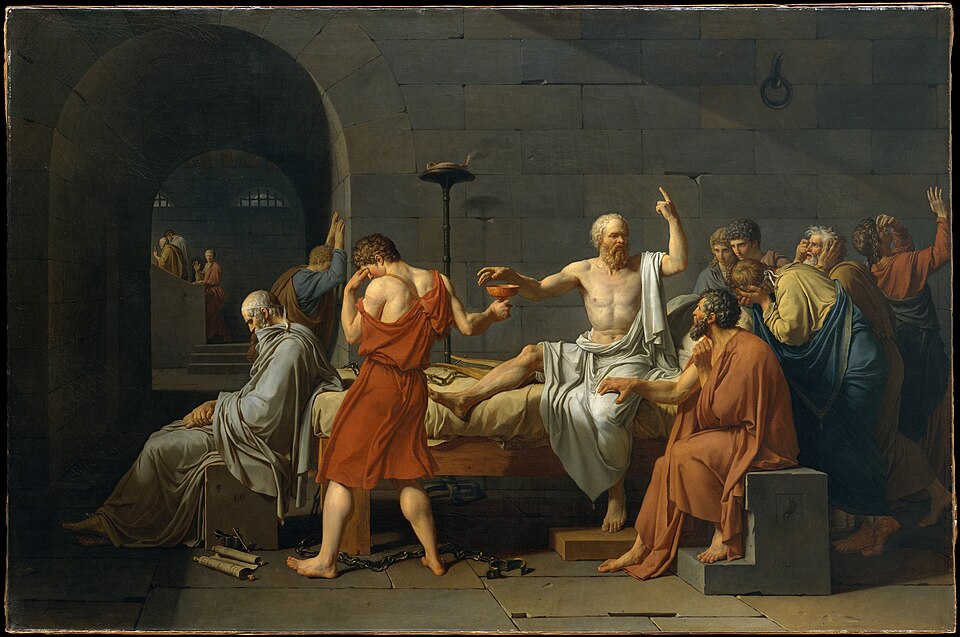
In the essay: Plato · Justin Martyr · Religion and spirituality
Further reading: Louise Bruit Zaidman and Pauline Schmitt Pantel, La Religion grecque (1989) ; Walter Burkert, Greek Religion (1977, trans. 1985) ; Jean-Pierre Vernant, Mythe et religion en Grèce ancienne (1990) ; Marcel Detienne and Jean-Pierre Vernant (eds.), La Cuisine du sacrifice en pays grec (1979) ; Robert Parker, Athenian Religion (1996) ; John Scheid, La Religion des Romains (1998)
The philosophers against the myths: from Xenophanes to allegoryGreek myths
The critique of religion begins in Greece as a critique of myths. From the sixth century BCE, thinkers reproach the poets for having lent the gods unworthy actions, and seek either to purify the idea of the divine or to reinterpret the narratives so as to save their meaning. These two gestures, correction and allegory, run through the whole later history of religious critique.
Xenophanes and Heraclitus
Xenophanes of Colophon reproaches Homer and Hesiod for having attributed to the gods everything that is shameful among men, theft, adultery, deceit. He observes that the Ethiopians depict their gods as black and snub-nosed, the Thracians as red-haired and blue-eyed, and that if oxen could paint, they would paint ox gods. Against this projection he sets a single god, the greatest, who resembles mortals neither in body nor in thought. Heraclitus of Ephesus likewise mocks rites of purification by blood and prayers addressed to statues, and makes fire and the logos the law of the world.
Plato against the poets
In the Republic, Plato excludes from the ideal city the narratives of Homer and Hesiod that show quarrelsome, lying or changeable gods, because they shape the souls of the guardians badly. Two rules must guide the poets: the god is good and is the cause only of good; he is simple and does not deceive. Plato does not for all that give up myth: he invents some himself to say what argument cannot reach.
The interpretations
To save Homer, readers read his narratives as allegories: as early as the sixth century, Theagenes of Rhegium sees in the battles of the gods struggles between natural elements, and the Stoics, from Zeno to Cornutus, make Zeus fire or ether, Hera air, Athena thought. Another reading, euhemerism, comes from Euhemerus of Messene, who relates around 300 BCE that he found on a distant island an inscription proving that Zeus was a king deified after his death: the gods would be illustrious men who became objects of worship. The Epicureans, finally, keep blessed and indifferent gods, but reject the whole mythology of fear.
Aristotle and useful myths
Aristotle, in the Metaphysics, distinguishes in the tradition a true core, the divinity of the first substances, and mythical additions, the human or animal form of the gods, introduced to persuade the multitude and to serve the laws. This political reading of myth will be taken up from Antiquity to the Enlightenment.
What the essay assumes
The essay assumes familiarity with Xenophanes, to whom it compares a formula of Montaigne, with the Platonic rejection of fables, Aristotle's thesis on the myths added to persuade the multitude, and the allegorical method that Philo of Alexandria applies to the Bible after the Stoics applied it to Homer. It does not name Euhemerus, but the explanation of the gods by the deification of men is the distant ancestor of the theories of projection it studies in d'Holbach and Feuerbach.
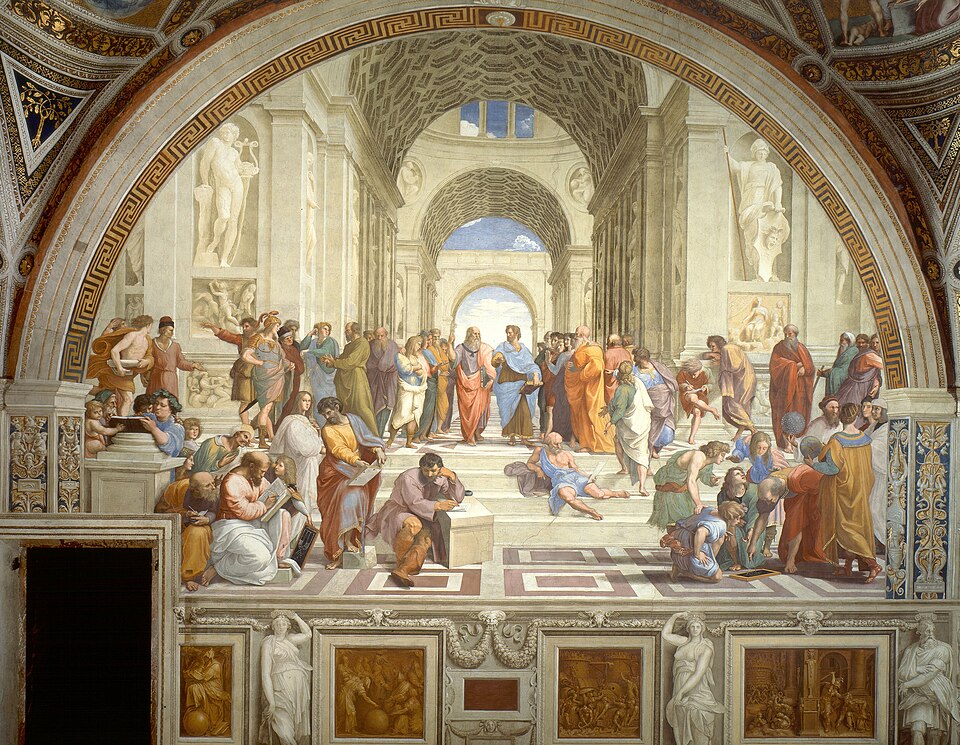
In the essay: Plato · Aristotle · Epicurus and Lucretius · Montaigne
Further reading: Jean Pépin, Mythe et allégorie (1958) ; Luc Brisson, Introduction à la philosophie du mythe, vol. I (1996) ; Werner Jaeger, The Theology of the Early Greek Philosophers (1947) ; Jean-Pierre Vernant, Mythe et pensée chez les Grecs (1965) ; Geoffrey Kirk, John Raven and Malcolm Schofield, Les Philosophes présocratiques (1983, trans. 1995)
Plato's myths: Er, Gyges, the noble lie, the androgyneGreek myths
Plato, who drives the poets out of his ideal city, is also the greatest inventor of myths in philosophy. His dialogues contain some twenty narratives, some taken from tradition, others forged for the occasion, which come in where argument stops: the origin of the world, the fate of the soul after death, the foundation of the city. Their status has been debated since Antiquity: pedagogical ornaments, likely truths, or political instruments.
The myths of the soul
At the end of the Republic, the Pamphylian soldier Er, left for dead on the battlefield, comes back to life and recounts what he saw: the judgement of souls, the rewards and punishments of a thousand years, then the choice each soul makes of its next life, under the gaze of the Moirai, before drinking the water of Lethe. The narrative makes each person the author of his fate: the god is not responsible, responsibility belongs to the one who chooses. In the Phaedrus, the soul is compared to a winged team, a charioteer driving two horses, one docile, the other unruly, which rises to contemplate the intelligible realities or falls back towards the body. The Gorgias and the Phaedo also have their myths of the judgement of the dead.
The myths of the city
The Protagoras tells that Prometheus, having given fire and the arts to men, could not give them the political art; Zeus sent Hermes to distribute to all of them shame and justice, without which cities cannot last. In the Republic, Gyges, a shepherd who finds a ring that makes him invisible, seduces the queen and kills the king: the narrative raises the question of whether anyone would remain just without fear of being seen. The same dialogue proposes to the founders of the city a noble lie, the myth of the metals: all the citizens would be born of the earth, brothers, but the god would have mixed gold into the soul of the rulers, silver into that of the guardians, iron and bronze into that of the producers. The Timaeus and the Critias, finally, tell of Atlantis, a maritime power swallowed up after being defeated by primitive Athens.
The myths of love and of the world
In the Symposium, Aristophanes tells that the first humans were double, round, with four arms and four legs; Zeus cut them in two to weaken them, and each has been looking for his other half ever since. The Timaeus describes a demiurge who shapes the world by looking at an eternal model, a narrative that Philo and the Fathers will read as a philosophical version of creation.
The readings
The Neoplatonists read these myths as allegories of a higher truth. Karl Popper saw in the noble lie the proof of an authoritarian project, which others dispute. Leo Strauss read in it an illustration of writing on two levels, one for the multitude, the other for the philosophers.
What the essay assumes
The essay assumes familiarity with Plato's ambivalence, the legislator of the Laws who punishes impiety and the thinker of conversion who tells of the cave, and with the idea that useful narratives can be imposed on those who do not philosophize, an idea it finds again in Averroes, in Leo Strauss and in the Grand Inquisitor.
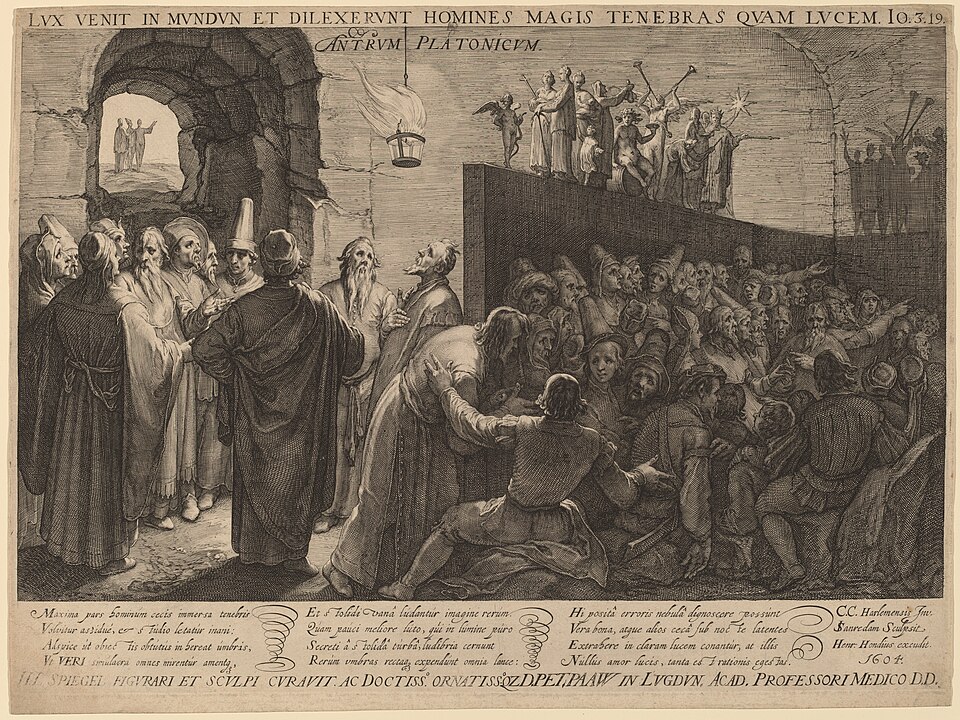
In the essay: Plato · Leo Strauss · Averroes
Further reading: Luc Brisson, Platon, les mots et les mythes (1982) ; Jean-François Mattéi, Platon et le miroir du mythe (1996) ; Monique Dixsaut, Platon et la question de la pensée (2000) ; Karl Popper, La Société ouverte et ses ennemis, vol. I (1945, trans. 1979) ; Catherine Collobert, Pierre Destrée and Francisco Gonzalez (eds.), Plato and Myth (2012)
The mysteries and Orphism: Eleusis, Orpheus, Cybele, Isis, MithrasGreek myths
Alongside the public cults of the city, the Greek and Roman world knew mystery cults: secret initiation rites, open to the individuals who chose them, promising a personal relationship with a deity and often a better fate after death. They complement civic religion without replacing it, and they have held a large place in the debates on the originality of Christianity.
Eleusis
The mysteries of Eleusis, near Athens, celebrated Demeter and her daughter Persephone, also called Kore. The myth, told by the Homeric Hymn to Demeter, relates the abduction of Persephone by Hades, the grief of her mother, who makes the harvests perish, then the compromise of Zeus: the girl will spend part of the year under the earth and the other part with her mother, which has been read as the cycle of the seeds. The initiation, open to men and women, to free people and to slaves who spoke Greek, included a procession from Athens and nocturnal revelations in the hall of the Telesterion. The secret was so well kept that almost nothing is known of what was shown there; the initiates went away with the hope of a better life in the hereafter.
Orphism
Under the name of Orpheus, the Thracian singer who went down to the underworld to fetch Eurydice, poems and rules of life circulated. Their central narrative tells that the child Dionysus, sometimes called Zagreus, was torn apart and devoured by the Titans, whom Zeus struck with lightning; men would have been born from their ashes, mixing a guilty Titanic part and a divine part. Hence a doctrine of the soul exiled in the body as in a prison or a tomb, purifications, abstinence from meat, and the promise of escaping the cycle of births. Gold tablets found in tombs give the dead instructions for finding their way in the hereafter. Plato and the Neoplatonists owe much to these ideas.
The Oriental cults
In the Hellenistic and Roman period, cults coming from the East spread: Cybele, the Phrygian Great Mother, and her consort Attis, served by eunuch and begging priests; Isis, the Egyptian goddess who finds and revives Osiris, honoured by initiations that Apuleius's Golden Ass describes; Mithras, a god of Iranian origin worshipped in underground sanctuaries by soldiers and merchants.
The debate over Christian parallels
The history of religions school, at the turn of the twentieth century, explained part of Pauline Christianity by these cults: baptism and the meal as initiation rites, the Lord invoked as a saviour god, death and resurrection as a myth of a dying god. Frazer grouped Attis, Adonis and Osiris into a category of gods who die and are reborn with vegetation. Later work has strongly qualified these comparisons: the sources for the mysteries are often late, Frazer's category is disputed, and Judaism is enough to explain many Christian features.
What the essay assumes
The essay assumes familiarity with the mysteries to which Plotinus compares the ineffable union with the One, the mystery cults with which Bousset compares the invocation of the Lord, the god who dies and is reborn whom the mythicists make the model of Christ, and the priests of Cybele to whom Celsus compares the Christians.
 The Return of Persephone (1891, Leeds Art Gallery): Hermes brings Persephone back from the underworld to her mother Demeter
In the essay: Plotinus · Celsus and Origen · Tylor and Frazer
Further reading: Walter Burkert, Les Cultes à mystères dans l'Antiquité (1987, trans. 1992) ; Franz Cumont, Les Religions orientales dans le paganisme romain (1906) ; Marcel Detienne, Dionysos mis à mort (1977) ; Alberto Bernabé and Ana Isabel Jiménez San Cristóbal, Instructions for the Netherworld (2008) ; Jonathan Z. Smith, Drudgery Divine (1990) ; Tryggve Mettinger, The Riddle of Resurrection (2001)
Dionysus and the Bacchae: the foreign god, madness, dismembermentGreek myths
Dionysus is the Greek god of wine, of intoxication, of the theatre and of metamorphoses. Son of Zeus and of the mortal Semele, born a second time from his father's thigh, he appears in the myths as a god who arrives from elsewhere, always a stranger, whom cities refuse before being forced to welcome him. His cult mingles collective festival, trance and a violence that tragedy has put on stage.
The god and his retinue
Dionysus is accompanied by satyrs and by maenads, or bacchants, women seized by the god who leave the city for the mountain, dressed in fawnskins, armed with the thyrsus, a stalk crowned with ivy. The narratives lend them extraordinary acts: making milk and wine spring from the ground, tearing animals apart with their bare hands, the ritual dismemberment called sparagmos, and eating their raw flesh. In Athens, the god was honoured by civic festivals, the Dionysia, during which tragedies and comedies were performed: Greek theatre was born in his cult.
Euripides' Bacchae
Euripides' last tragedy, performed after his death in 405 BCE, tells of the return of Dionysus to Thebes, his native city, where his divinity is denied. The young king Pentheus, his cousin, has the stranger arrested and wants to forbid the rites. The god drives him to disguise himself as a woman to spy on the bacchants on Cithaeron; discovered, Pentheus is torn to pieces by the women of Thebes, and first of all by his own mother, Agave, who comes back to the city carrying his head, which she takes for a lion's. The god then drives out the royal family. The play has been read as an apology for piety, as a critique of religion, and as a study of the crowd.
Nietzsche: the Apollonian and the Dionysian
In The Birth of Tragedy (1872), Nietzsche contrasts two drives of Greek art: the Apollonian, dream, form, measure, and the Dionysian, intoxication, fusion, the dissolution of the individual. Tragedy is born of their union, and dies when Socrates and Euripides impose reason on it. In his last writings, Dionysus becomes the name of his affirmation of life, which he sets against the Crucified, symbol of life judged and condemned; Ecce Homo ends on this opposition.
Girard: the lynching seen from within
René Girard reads The Bacchae as an almost transparent description of the scapegoat mechanism: a crisis in which differences fade, a unanimous crowd, a victim torn to pieces, then an order restored that the myth attributes to the god. Taking up Nietzsche's formula, he maintains that the difference between Dionysus and Christ lies in the victim: the Dionysian myth proves the crowd right, the Gospels the victim.
What the essay assumes
The essay assumes familiarity with Dionysus, the bacchants and the death of Pentheus, which the box in the Girard section evokes, as well as with the closing formula of Ecce Homo, Dionysus against the Crucified, which Girard takes up to say that Nietzsche was right in his diagnosis and wrong in his choice.
In the essay: Girard
Further reading: Euripides, Les Bacchantes (405 BCE) ; Marcel Detienne, Dionysos à ciel ouvert (1986) ; Walter F. Otto, Dionysos (1933) ; Jean-Pierre Vernant and Pierre Vidal-Naquet, Mythe et tragédie en Grèce ancienne (1972-1986) ; Albert Henrichs, “Loss of Self, Suffering, Violence” (1984) ; René Girard, La Violence et le sacré (1972)
Oedipus: the oracle, the Sphinx, the plague of ThebesGreek myths
Oedipus is the Theban hero who, without knowing it, kills his father and marries his mother. His legend, already known to Homer, received its classical form in the tragedies of Sophocles, and in the twentieth century it became one of the most commented narratives of European culture, by psychoanalysis, structural anthropology and mimetic theory.
The legend
An oracle of Apollo foretold to Laius, king of Thebes, that his son would kill him. The child, his feet pierced, hence his name of swollen foot, is exposed on Mount Cithaeron, taken in by shepherds and raised in Corinth as the king's son. Grown up and warned in his turn by the oracle that he will kill his father and marry his mother, he flees Corinth, kills at a crossroads an old man who was blocking his way, Laius, then delivers Thebes from the Sphinx by solving its riddle: what being walks on four legs in the morning, on two at noon, on three in the evening. He becomes king and marries the widowed queen, Jocasta, with whom he has four children, Eteocles, Polynices, Antigone and Ismene.
Oedipus Rex
Sophocles' tragedy begins years later: plague ravages Thebes, and the oracle demands that the murderer of Laius be driven out. Oedipus leads the inquiry relentlessly; the blind seer Tiresias accuses him, he suspects Creon of a plot, and the successive witnesses gradually reveal the truth. Jocasta hangs herself, Oedipus puts out his eyes and asks for exile. In Oedipus at Colonus, Sophocles' last play, the old wandering Oedipus, guided by Antigone, dies mysteriously near Athens and becomes a protecting hero for the city that welcomes him.
Modern readings
Freud sees in the legend the expression of a universal desire of the child for the parent of the other sex and of its rivalry with the other parent, the Oedipus complex, which in Totem and Taboo he extends to the origin of religion through the murder of the primal father. Claude Lévi-Strauss analyses the myth as a system of oppositions, between overrated kinship and underrated kinship, autochthonous origin and sexual origin. Jean-Pierre Vernant insists on the reversal: the saviour king becomes the defilement to be expelled, like the pharmakos, the scapegoat victim that certain cities drove out during festivals of purification.
Girard's reading
René Girard reads Oedipus Rex as the narrative of a sacrificial crisis: the plague figures the contagion of violence in which differences fade, the symmetrical accusations between Oedipus, Tiresias and Creon show doubles, and the expulsion of Oedipus restores order. Parricide and incest would be the typical crimes that a crowd attributes to its victim; the tragedy would half show the mechanism, the myth would hide it entirely.
What the essay assumes
The essay assumes familiarity with the oracle, the plague of Thebes and Oedipus's inquiry, which the Girard section summarizes, with Freud's Oedipus complex and the murder of the father in Totem and Taboo, as well as with Becker's rereading, which, after Otto Rank, makes the Oedipus complex a causa sui project, the child's desire to become his own father.
In the essay: Girard · Freud · Becker
Further reading: Sophocles, Œdipe roi (c. 430 BCE) and Œdipe à Colone (401 BCE) ; Jean-Pierre Vernant, “Ambiguïté et renversement” (1970), in Mythe et tragédie en Grèce ancienne ; Claude Lévi-Strauss, “La structure des mythes”, in Anthropologie structurale (1958) ; René Girard, La Violence et le sacré (1972) ; Didier Anzieu, L'Auto-analyse de Freud (1959) ; Lowell Edmunds, Oedipus (2006)
Antigone: the law of the city and the unwritten lawsGreek myths
Antigone, daughter of Oedipus and Jocasta, is the heroine of the tragedy that Sophocles had performed around 442 BCE. She buries her brother against the king's prohibition and dies of this act. Since Hegel, the play has become the reference text for the conflict between the law of the State and a higher law, and each age has read its own question in it.
The myth and the play
After the exile of Oedipus, his two sons, Eteocles and Polynices, were to reign over Thebes in turn. Eteocles refuses to give up the throne; Polynices returns with a foreign army, and the two brothers kill each other before the gates of the city. Creon, their uncle, now king, has Eteocles buried with honour and orders that the body of Polynices, a traitor to his country, remain without burial, left to the dogs and the birds, on pain of death for whoever buries it. Antigone, despite the pleas of her sister Ismene, scatters a handful of dust over the body. Arrested, she answers Creon that she did not believe his decrees could prevail over the unwritten and unchanging laws of the gods, which are neither of today nor of yesterday. Creon has her shut up alive in a tomb. The seer Tiresias warns him that the gods are offended; when he gives way, it is too late: Antigone has hanged herself, his son Haemon, who loved her, kills himself over her body, and his wife Eurydice kills herself in turn.
What is at stake
Burying the dead was in Greece a religious and family duty; to deprive a dead person of burial was to prevent him from reaching the underworld. The conflict therefore sets against each other the city and the family, man and woman, written law and divine law, but also two forms of excess: the rigidity of the king, who confuses public order with his own will, and the obstinacy of a young woman who chooses death.
The readings
Hegel, in the Phenomenology of Spirit, sees in the play the collision of two equally legitimate powers, the human law of the State and the divine law of the family, each of which is both right and wrong; tragedy is the reconciliation born of their mutual destruction. Kierkegaard, Hölderlin, who translated it, and then Heidegger commented on it. Simone Weil, in 1936, wrote for the workers of a factory at Rosières a presentation of it that makes Antigone the figure of love that refuses to take sides in hatred. Jean Anouilh, in 1944, under the Occupation, gave Creon the arguments of a realist ruler, and the play was read sometimes as a work of resistance, sometimes as an accommodating one. Judith Butler has examined what it says about kinship and mourning.
What the essay assumes
The essay assumes familiarity with Antigone's answer to Creon, which it quotes from Sophocles in the box in the Weil section, and with the idea of a self-offering that refounds no religion: Antigone dies for a duty she imposes on no one, and the essay places her on the side of the refusal of the scapegoat.
In the essay: Simone Weil
Further reading: Sophocles, Antigone (c. 442 BCE) ; Hegel, Phénoménologie de l'esprit (1807) ; George Steiner, Les Antigones (1984, trans. 1986) ; Simone Weil, “Antigone” (1936), in La Source grecque (1953) ; Jean Anouilh, Antigone (1944) ; Judith Butler, Antigone's Claim (2000)
Prometheus and Pandora: the sharing of the sacrifice, fire, evilGreek myths
Prometheus is the Titan who deceives Zeus for the benefit of men, gives them fire and pays for this gift with eternal torment. His myth tells at once of the origin of sacrifice, of technology and of human misfortune, and from Antiquity to Romanticism it became the figure of the man who challenges the gods.
Hesiod: Mecone and Pandora
In the Theogony, during a division at Mecone between gods and men, Prometheus carves up an ox and presents two portions to Zeus: on one side the meat and the entrails hidden under the hide and the stomach, on the other the white bones wrapped in glistening fat. Zeus chooses the appetizing portion and uncovers the bones; since then, men burn the bones for the gods and eat the meat. The myth thus founds the division of the sacrifice and the separation of gods and men. To take revenge, Zeus hides fire; Prometheus steals it and brings it back to mortals in a fennel stalk. Zeus then has the first woman fashioned, Pandora, adorned with all the gifts of the gods, whom Epimetheus, the improvident brother, accepts despite the warnings; she lifts the lid of the jar, and all evils spread over the earth, only hope remaining inside. Prometheus, chained to the Caucasus, sees an eagle devour his liver each day, which grows back at night, until Heracles delivers him.
Aeschylus and Plato
The Prometheus Bound attributed to Aeschylus makes the Titan the benefactor of humanity, to whom he gave fire, but also numbers, writing, medicine and the art of foresight, and the rebel who refuses to bend before a tyrannical Zeus whose secret he knows. In the Protagoras, Plato has him give men the arts, but not the political art, which Zeus alone grants.
The Prometheus of the moderns
From the Renaissance onwards, Prometheus becomes the symbol of man the creator. Goethe, in a poem of 1774, has him defy Zeus and declare that he shapes men in his own image, who will have no need of gods. Shelley writes a Prometheus Unbound, Mary Shelley subtitles Frankenstein the Modern Prometheus, and Marx, in the preface to his thesis of 1841, makes Prometheus the noblest saint and martyr in the philosophical calendar. Camus, in The Rebel, makes him one of the first figures of metaphysical rebellion, and Blumenberg devotes the last part of Arbeit am Mythos to the reworkings of the myth, from Goethe's poem to its exhaustion.
What the essay assumes
The essay assumes familiarity with Goethe's poem, Mary Shelley's Frankenstein and Kafka's legends of Prometheus, which the box in the Blumenberg section relates to the self-assertion of the modern age, as well as with the idea, present in the poem, of gods who live off the sacrifices of men, the essay's criterion read in reverse.
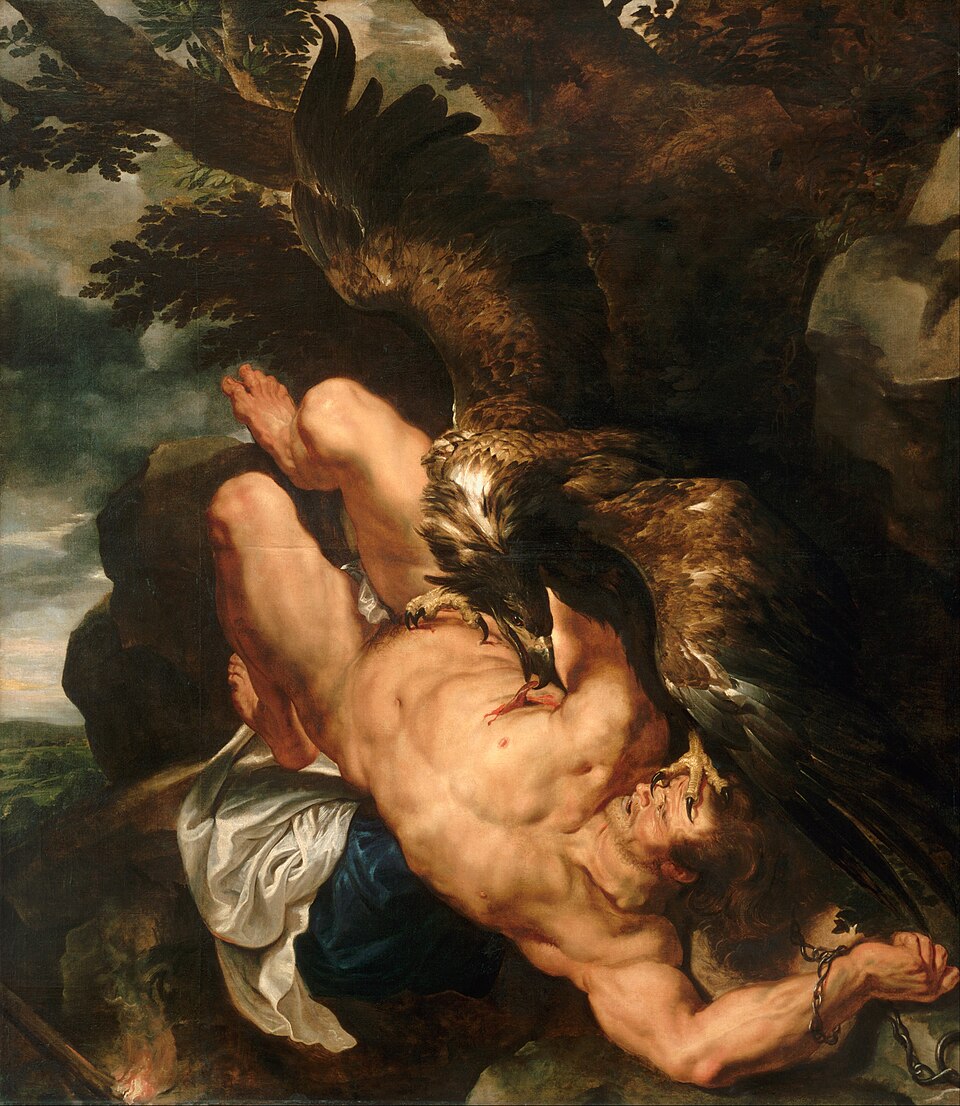 Peter Paul Rubens and Frans Snyders, Prometheus Bound (1611-1618, Philadelphia, Philadelphia Museum of Art)
In the essay: Hans Blumenberg · Camus
Further reading: Hesiod, Théogonie and Les Travaux et les Jours (7th century BCE) ; Aeschylus, Prométhée enchaîné (5th century BCE) ; Jean-Pierre Vernant, “À la table des hommes”, in La Cuisine du sacrifice en pays grec (1979) ; Hans Blumenberg, Arbeit am Mythos (1979) ; Raymond Trousson, Le Thème de Prométhée dans la littérature européenne (1964) ; Olivier Got, Le Mythe de Prométhée (2006)
Sisyphus and the underworld: Hades, Tantalus, the DanaidsGreek myths
The Greeks pictured the abode of the dead as an underground world ruled by Hades, where most souls lead an existence of shades without strength or memory. A few great culprits undergo eternal punishments there, of whom Sisyphus has become, through Camus, the most famous figure.
The kingdom of Hades
Hades, brother of Zeus, received the underworld as his share, and he rules it with Persephone. To reach it, the dead cross the Acheron or the Styx in the boat of Charon, who was paid with an obol placed in the mouth of the deceased; the three-headed dog Cerberus guards its entrance. In the Odyssey, in Book XI, Odysseus calls up the dead on the shore of Ocean: they are shades who must drink the blood of victims to recover speech for a moment, and the shade of Achilles tells him that he would rather be the servant of a poor man on earth than reign over all the dead. Below lies Tartarus, prison of the defeated Titans. Later there develops the idea of a judgement of the dead by Minos, Aeacus and Rhadamanthus, and of a happy abode, the Elysian Fields or the Isles of the Blessed, reserved for heroes and the just, then for initiates of the mysteries.
The great punished
Sisyphus, the cunning king of Corinth, deceived the gods and, according to some versions, chained up Death himself, or obtained leave to go back up to earth and refused to return; he is condemned to push a rock eternally to the top of a slope from which it endlessly rolls back down. Tantalus, who had served the gods the flesh of his son to test their perspicacity, stands in water up to his chin beneath branches laden with fruit, without ever being able to drink or eat. The Danaids, who had killed their husbands on their wedding night, endlessly fill leaking jars. Ixion, who had tried to seduce Hera, turns bound to a flaming wheel, and Tityos has his liver devoured by vultures.
The philosophical readings
Lucretius, in Book III of his poem, maintains that these torments do not exist after death but in this life: Tantalus is the man who dreads the gods, Sisyphus the ambitious man who endlessly seeks power, the Danaids those whom nothing satisfies. The myth becomes the description of the passions from which philosophy delivers. Camus, in 1942, makes Sisyphus the hero of the absurd: the human condition is a task without end and without hope, but the man who looks it in the face and takes it up again, at the moment when he goes back down towards his rock, is superior to his fate, and one must imagine him happy.
What the essay assumes
The essay assumes familiarity with the punishment of Sisyphus and with the conclusion of The Myth of Sisyphus, which it quotes, and in which it reads a spirituality without consolation, as well as with the fear of punishment after death, which the Letter to Menoeceus and Lucretius's poem seek to dispel at the same time as the fear of the gods.
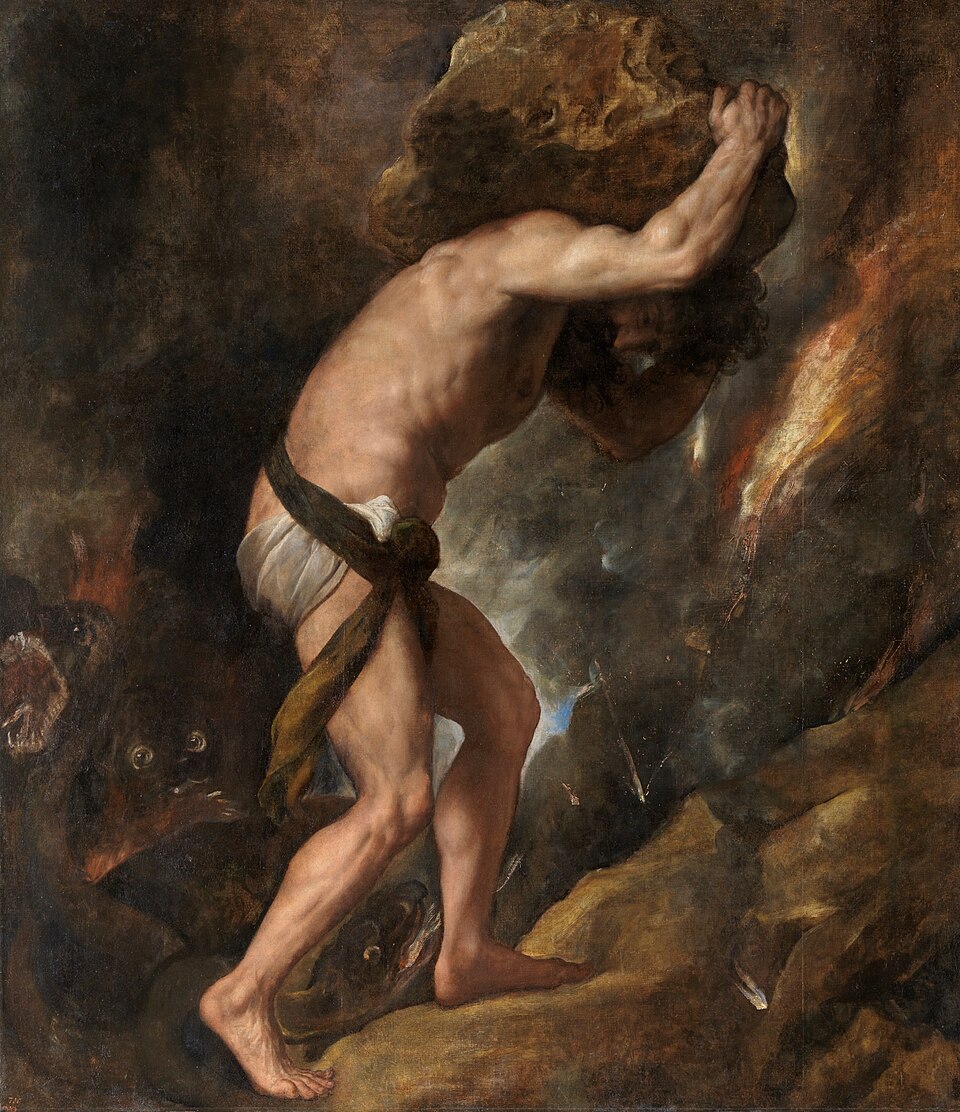 Sisyphus (1548-1549, Madrid, Prado): the figure whom Camus makes the hero of the absurd
In the essay: Camus · Jaspers · Epicurus and Lucretius
Further reading: Homer, Odyssée, Book XI (8th century BCE) ; Lucretius, De la nature, Book III (1st century BCE) ; Albert Camus, Le Mythe de Sisyphe (1942) ; Christiane Sourvinou-Inwood, Reading Greek Death (1995) ; Jan Bremmer, The Rise and Fall of the Afterlife (2002) ; Robert Garland, The Greek Way of Death (1985)
The Trojan War: Iphigenia at Aulis, the wrath of Achilles, PriamGreek myths
The Trojan War is the great legendary cycle of the Greeks: ten years of siege of a city of Asia Minor by a coalition of Achaean kings, to take back Helen, the wife of Menelaus abducted by the Trojan prince Paris. The Iliad recounts only a few weeks of it, but the poems of the cycle, the tragedians and the mythographers fixed all its episodes, from the quarrel of the goddesses to the fall of the city.
The origins
At the wedding of Peleus and Thetis, Discord throws down a golden apple meant for the most beautiful. Hera, Athena and Aphrodite contend for it; the Trojan shepherd Paris, chosen as judge, awards it to Aphrodite, who promises him the love of the most beautiful of women. He carries off Helen from Sparta, and the Greek princes, bound by an oath, gather under the command of Agamemnon, brother of Menelaus.
The sacrifice of Iphigenia
At Aulis, the Greek fleet is held back by contrary winds. The seer Calchas reveals that Artemis, offended by Agamemnon, demands the sacrifice of his daughter Iphigenia. Agamemnon sends for the girl on the pretext of marrying her to Achilles, and leads her to the altar. Depending on the versions, her throat is cut, or the goddess substitutes a hind for her at the last moment and carries her off to Tauris. The sacrifice of Iphigenia is the first cause of Clytemnestra's hatred and of the murder of Agamemnon on his return. Euripides drew from it Iphigenia at Aulis, and the scene has often been compared to the sacrifice of Isaac.
The Iliad
The poem begins with the wrath of Achilles, the best of the Achaeans, from whom Agamemnon has taken his captive Briseis. Achilles withdraws from the fighting, and the Greeks are routed by Hector, son of Priam. When Hector kills Patroclus, Achilles' friend, Achilles returns, kills Hector and drags his corpse around Patroclus's tomb. In the last book, the old king Priam, guided at night by Hermes, comes to Achilles' tent to beg that the body of his son be given back to him; the two enemies weep together, each for his own dead, and Achilles gives back the body. The gods are present everywhere, but partial, and guarantee no justice.
The fall of Troy
After the death of Hector and then that of Achilles, killed by an arrow of Paris guided by Apollo, the Greeks take the city by the ruse of the wooden horse, sack it and burn it. The Odyssey and the tragedies then tell of the difficult and bloody returns of the victors.
What the essay assumes
The essay assumes familiarity with the sacrifice of Iphigenia, which Lucretius recounts as the example of the crimes engendered by religion, and with the scene of Priam and Achilles in the last book of the Iliad, which the box in the Weil section quotes after L'Iliade ou le poème de la force, and in which it sees the refusal to give a meaning to misfortune.
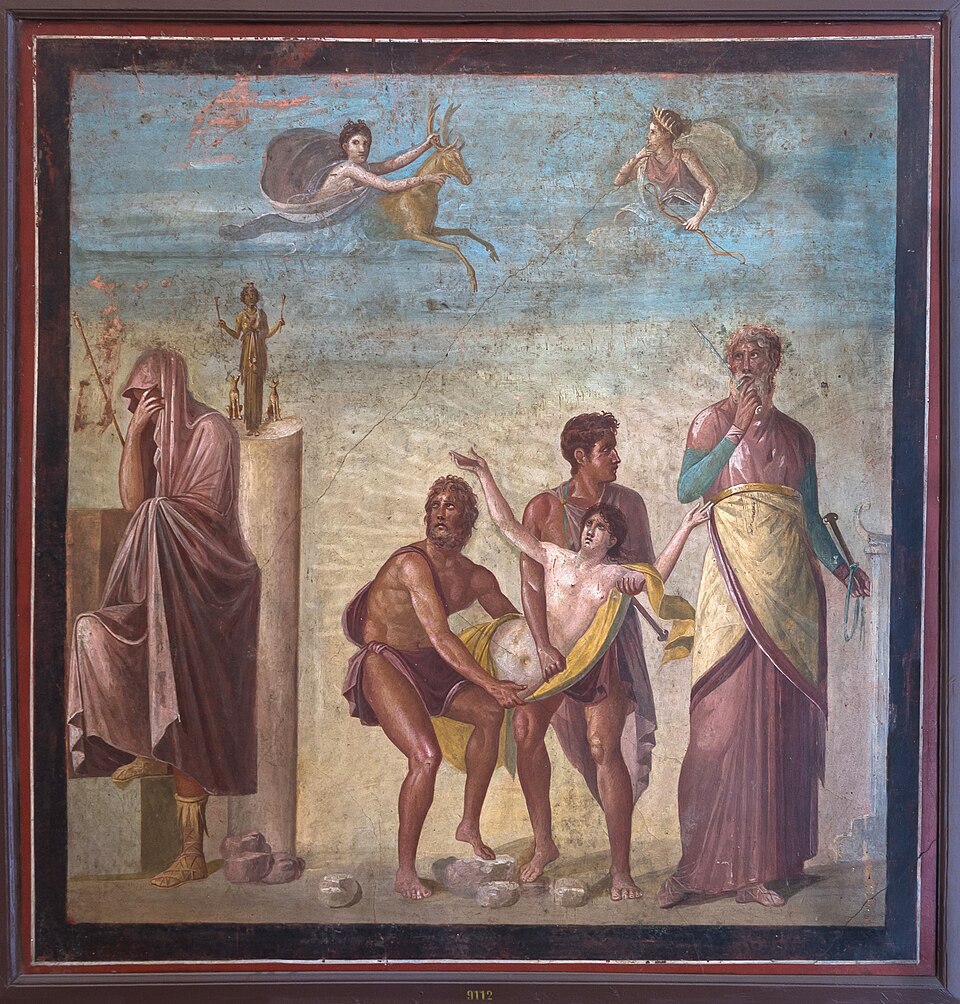 The Sacrifice of Iphigenia, fresco from the House of the Tragic Poet in Pompeii (1st century CE, Naples, Museo Archeologico Nazionale): Agamemnon turns his head away, Artemis sends the hind that will take the girl's place
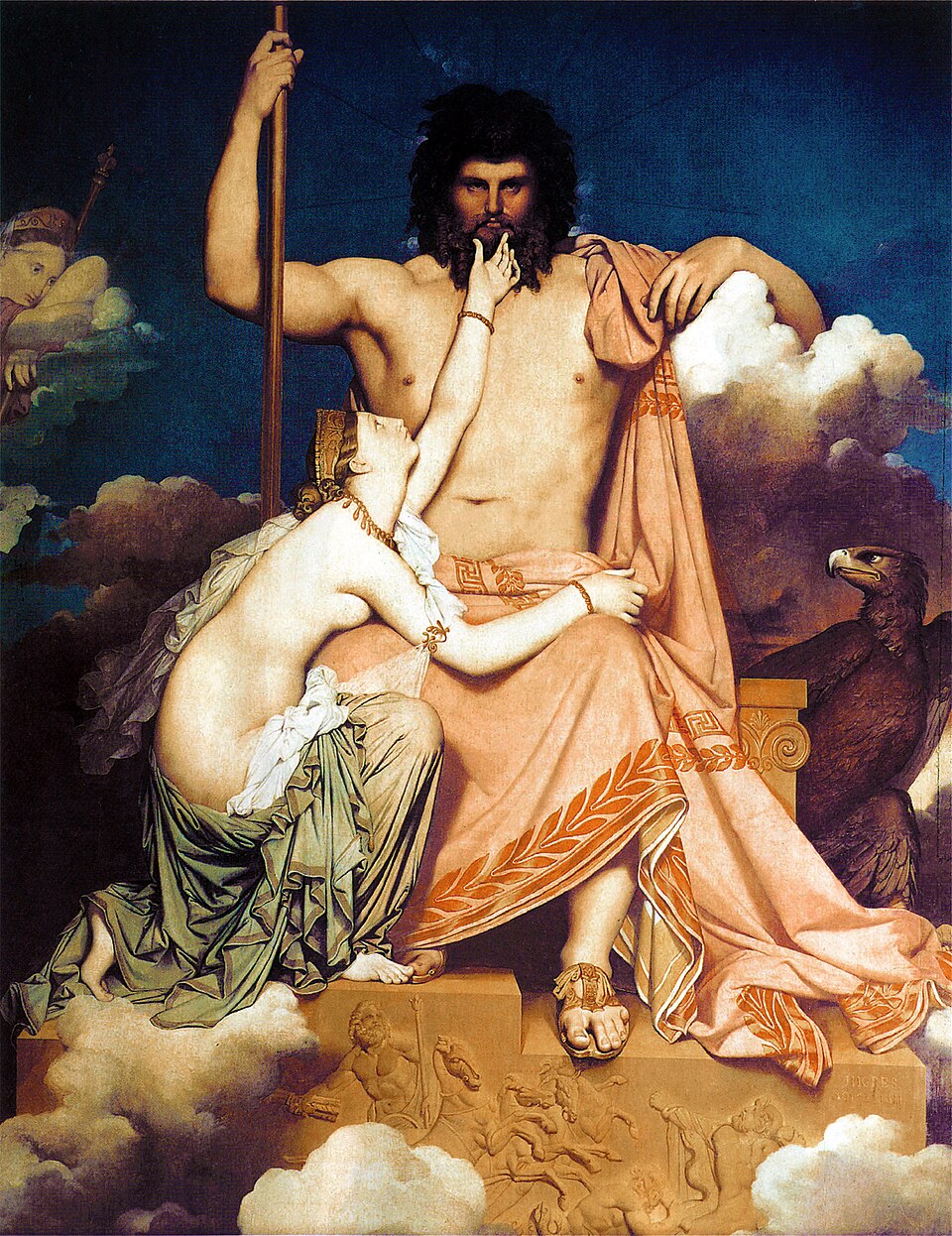 Jupiter and Thetis (1811, Aix-en-Provence, Musée Granet): Thetis entreats Zeus on behalf of her son Achilles, in the first book of the Iliad
In the essay: Epicurus and Lucretius · Simone Weil
Further reading: Homer, Iliade (8th century BCE) ; Euripides, Iphigénie à Aulis (405 BCE) ; Simone Weil, “L'Iliade ou le poème de la force” (1940-1941) ; Pierre Vidal-Naquet, Le Monde d'Homère (2000) ; Gregory Nagy, Le Meilleur des Achéens (1979, trans. 1994) ; Jean-Pierre Vernant, L'Individu, la mort, l'amour (1989)
The Atreids: Agamemnon, Clytemnestra, Orestes and the ErinyesGreek myths
The house of the Atreids, descendants of Tantalus and Atreus, is in Greek legend the family in which crime calls for crime over several generations, until a court puts an end to it. Aeschylus drew from it the Oresteia, the only surviving tragic trilogy, which recounts the passage from vengeance to the justice of the city.
The curse
Atreus, king of Mycenae, to take revenge on his brother Thyestes, who had seduced his wife, had him served at a banquet the flesh of his own children. From this horror a curse is born. The son of Atreus, Agamemnon, leader of the Greeks before Troy, sacrifices his daughter Iphigenia at Aulis to obtain favourable winds. During the ten years of the war, his wife Clytemnestra takes as her lover Aegisthus, the surviving son of Thyestes. On Agamemnon's return, she kills him in his bath, together with the Trojan captive Cassandra, and reigns with Aegisthus.
The Oresteia
Aeschylus's trilogy, performed in 458 BCE, comprises three plays. In Agamemnon, the king returns victorious and dies murdered. In The Libation Bearers, his son Orestes, an exile, returns at the command of Apollo, finds his sister Electra at their father's tomb, and kills Aegisthus and then his mother. At once the Erinyes, archaic divinities of blood vengeance, rise up to pursue him. In The Eumenides, Orestes takes refuge at Delphi and then in Athens; Athena institutes a court of citizens to judge him, the Areopagus. The votes are equal, and the goddess tips the balance towards acquittal. The Erinyes, appeased, accept a cult in the city and become the Eumenides, the Kindly Ones. The cycle of private vengeance is closed by an institution.
The other versions
Sophocles and Euripides each wrote an Electra, centred on the sister who awaits her brother's return, and Euripides an Orestes in which the hero, pursued by madness, is condemned by the assembly of Argos. In the twentieth century, Giraudoux wrote an Électre, Eugene O'Neill transposed the trilogy to the America of the Civil War, and Sartre, in 1943, staged The Flies, in which Orestes refuses the remorse that Jupiter and Aegisthus impose on the city of Argos.
The readings
The Oresteia has been read as the story of the birth of law, public justice replacing blood vengeance; as that of the passage from a matriarchal order to a patriarchal order, according to Bachofen and then Engels; and, in René Girard, as the description of a reciprocal violence that stops only through institution, sacrificial or judicial.
What the essay assumes
The essay assumes familiarity with Orestes, Clytemnestra and the Erinyes, whom the box in the Sartre section encounters in The Flies: Orestes there leaves God through an act and carries off the flies like a scapegoat, thus keeping from religion the form of sacrifice.
In the essay: Sartre
Further reading: Aeschylus, Orestie (458 BCE) ; Sophocles, Électre ; Euripides, Électre and Oreste ; Jean-Paul Sartre, Les Mouches (1943) ; Pierre Vidal-Naquet, “Chasse et sacrifice dans l'Orestie”, in Mythe et tragédie en Grèce ancienne (1972) ; Christian Meier, De la tragédie grecque comme art politique (1988, trans. 1991)
Heracles: the labours, the choice, the apotheosisGreek myths
Heracles, whom the Romans call Hercules, is the most popular of the Greek heroes: son of Zeus and of the mortal Alcmene, pursued by the hatred of Hera, he performs twelve labours, dies in the flames and rises among the gods. A hero of strength, he has also become, among the philosophers, a moral figure of effort and virtue.
The birth and the labours
Zeus, having taken the appearance of Amphitryon, lies with his wife Alcmene; Hera, jealous, sends two serpents against the newborn, who strangles them in his cradle. Later, driven mad by the goddess, Heracles kills his wife and his children; to atone for this crime, the oracle of Delphi orders him to serve King Eurystheus, who imposes twelve labours on him. He strangles the Nemean lion, whose skin he then wears, kills the Lernaean hydra with its regrowing heads, captures the Ceryneian hind and the Erymanthian boar, cleans the Augean stables in a single day by diverting two rivers, drives off the birds of Lake Stymphalus, captures the Cretan bull and the mares of Diomedes, takes the girdle of the queen of the Amazons, the cattle of Geryon, the golden apples of the Hesperides, and finally brings back from the underworld the dog Cerberus. Other exploits are added, among them the deliverance of Prometheus.
The death and the apotheosis
His last wife, Deianira, believing she will win back his love, sends him a tunic soaked in the blood of the centaur Nessus, which burns him beyond all remedy. Heracles has a pyre built on Mount Oeta and has himself burned alive on it; he is then carried up to Olympus, reconciled with Hera, and marries Hebe, youth. A hero become a god, he received a double cult, as a mortal and as an immortal.
The choice of Heracles
The sophist Prodicus, whose story Xenophon reports, imagines the young Heracles at the parting of two ways: two women approach him, Vice, who promises an easy life full of pleasures, and Virtue, who promises efforts and lasting glory; he chooses the second. The Cynics, then the Stoics, made Heracles the model of the sage who faces trials and makes himself free through effort; Seneca devotes two tragedies to him. The Fathers of the Church discussed the resemblances between the apotheosis of the hero, son of a god and a mortal woman, and the story of Christ, and the Renaissance often depicted the choice of Heracles as a moral allegory.
What the essay assumes
The essay mentions Hercules in the box in the Malinowski section, in connection with La Fontaine's fable in which the carter stuck in the mud calls on him and is told in reply that he must act first. The Stoic hero of effort also sheds light on the spiritual exercises that Pierre Hadot rediscovers in ancient philosophy.
 Hercules and the Nemean Lion (1634, Madrid, Prado), from the series of the labours of Hercules painted for the Buen Retiro palace
In the essay: Malinowski · Pierre Hadot
Further reading: Prodicus, in Xenophon, Mémorables, II, 1 ; Sophocles, Les Trachiniennes ; Euripides, Héraclès furieux ; Seneca, Hercule furieux and Hercule sur l'Œta ; Marcel Simon, Hercule et le christianisme (1955) ; G. Karl Galinsky, The Herakles Theme (1972) ; Emma Stafford, Herakles (2012)
Narcissus and Echo: the reflection, the voice, narcissismGreek myths
Narcissus is the young man of perfect beauty who, refusing all loves, falls in love with his own reflection and dies of it. The myth, known above all through Ovid's Metamorphoses, was read by the philosophers as an image of the soul that mistakes itself for appearance, and in the twentieth century it gave its name to one of the concepts of psychoanalysis.
Ovid's narrative
Narcissus is the son of the river Cephissus and of the nymph Liriope. Consulted at his birth, the seer Tiresias foretells that he will live long if he does not know himself. Grown into an adolescent desired by boys and girls alike, he rejects them all. The nymph Echo, condemned by Hera to be able only to repeat the last words she hears, loves him without being able to speak to him first; rejected, she wastes away with grief until she is nothing but a voice. One of the scorned asks the gods that Narcissus in his turn should love without being able to possess what he loves. Leaning over a spring to drink, Narcissus sees his image, falls in love with it, and understands too late that he loves his own reflection; he pines away at the water's edge, and in his place only a flower is found, the narcissus. Pausanias reports a variant in which he mourns a twin sister whose features his own face recalls to him.
The ancient readings
Plotinus, in the treatise on beauty, compares the one who runs after sensible beauties to someone who would try to seize a beautiful image reflected in the water and would drown in it; Pierre Hadot has shown how the Neoplatonists and the Fathers made Narcissus a figure of the soul that loses its way in the world of reflections instead of turning towards its source. In the Middle Ages and the Renaissance, the myth becomes a warning against pride and self-love.
Narcissism
The psychiatrist Paul Näcke and the sexologist Havelock Ellis used the word at the end of the nineteenth century to designate a perversion. Freud, in 1914, makes it a stage of development: primary narcissism, in which the child invests his libido in himself before turning it towards objects, and a secondary narcissism, a return of the libido towards the ego. In Civilization and Its Discontents, he traces the oceanic feeling that Romain Rolland describes to him back to this primary narcissism, a state in which the infant does not yet distinguish his ego from the world. Beyond psychoanalysis, the word has become a diagnosis of society, notably in Christopher Lasch.
What the essay assumes
The essay assumes familiarity with the notion of primary narcissism, by which Freud explains Rolland's oceanic feeling, in the Freud section and in the constructed debate on the reasons for believing: a remnant of childhood in which ego and world are not yet separated.
In the essay: Freud · Why do people believe? A constructed debate
Further reading: Ovid, Métamorphoses, III (c. 8 CE) ; Pausanias, Description de la Grèce, IX, 31 ; Sigmund Freud, Pour introduire le narcissisme (1914) ; Pierre Hadot, “Le mythe de Narcisse et son interprétation par Plotin”, Nouvelle Revue de psychanalyse (1976) ; Louise Vinge, The Narcissus Theme in Western European Literature (1967) ; Christopher Lasch, La Culture du narcissisme (1979, trans. 1981)
Eros and Psyche: the primordial god, the ladder of the Symposium, Apuleius's taleGreek myths
Eros, the Greek god of love, has had two very different histories: a cosmic power born at the origins of the world, and the young winged god, son of Aphrodite, who wounds with his arrows. The philosophers made him the name of the desire that raises the soul towards the beautiful and the good, and the tale of Eros and Psyche, handed down by Apuleius, became an allegory of the soul.
The primordial god and the winged god
In Hesiod's Theogony, Eros is one of the first beings, appearing with Chaos and Gaia, the most beautiful of the immortals, who loosens the limbs and overpowers the reason of gods and men; he is the force that makes beings unite and engender the world. The Orphic cosmogonies have him born from a primordial egg. In lyric poetry and then in the Hellenistic period, he becomes a winged child, son of Aphrodite and often of Ares, armed with a bow, whom the Romans call Cupid or Amor.
Plato's Symposium
In the Symposium, each guest delivers a eulogy of Eros. Socrates reports the teaching supposedly given to him by a priestess of Mantinea, Diotima: Eros is not a god but a daimon, an intermediary between gods and men, son of Penia, poverty, and of Poros, resource; he is desire for what he does not have, and therefore a philosopher. Diotima describes an ascent: from the love of one beautiful body to that of all beautiful bodies, then to the beauty of souls, of institutions and of the sciences, up to the sudden contemplation of beauty itself, eternal and unmixed. The Phaedrus takes up this ascent in the form of the winged soul that remembers the realities seen before birth.
Apuleius's tale
In the second century, Apuleius inserts into his Metamorphoses the tale of Cupid and Psyche. Psyche, a princess of a beauty that makes Venus jealous, is exposed on a rock, then carried off to a palace where an invisible husband joins her each night on condition that she does not try to see his face. Urged on by her sisters, she lights him with a lamp, discovers Cupid asleep, lets fall a drop of oil that wakes him, and he flees. After a series of trials imposed by Venus, among them a descent to the underworld, she is restored to her husband, receives immortality and gives birth to Pleasure. The Neoplatonists and the Christians read in it the journey of the soul, in Greek psychè, towards the divine.
Eros and Agape
In the twentieth century, the Lutheran theologian Anders Nygren contrasts Greek eros, the ascending desire of the soul seeking its own good, with Christian agape, the descending and gratuitous love of God for men, and sees the history of Christianity as their mixture. Freud names Eros the life drives, which he sets against the death drives.
What the essay assumes
The essay mentions the Symposium among the works that had marked Iris Murdoch most, whose sovereignty of the Good takes up the Platonic ascent: a desire that purifies itself into attention, and that tends towards a Good it does not possess.
In the essay: Iris Murdoch
Further reading: Hesiod, Théogonie (7th century BCE) ; Plato, Le Banquet and Phèdre ; Apuleius, Les Métamorphoses or L'Âne d'or, IV-VI (2nd century) ; Anders Nygren, Éros et Agapè (1930-1936, trans. 1944-1952) ; Denis de Rougemont, L'Amour et l'Occident (1939) ; Iris Murdoch, The Fire and the Sun (1977)
History
Christianity in the Roman Empire: from Nero to DiocletianHistory
For three centuries, from the death of Jesus (c. 30) to the agreement of Milan (313), Christianity was a religion without status in the Roman Empire, tolerated by default and punished intermittently. The persecutions, less continuous than legend claims, shaped its vocabulary, its cult of the martyrs and its first literature, apologetics.
A religion without status
Rome did not persecute cults as such, and Judaism enjoyed a long-standing tolerance that exempted Jews from the imperial cult. Christians lost this benefit as they separated from the synagogue, especially after the destruction of the Temple in 70. They refused to sacrifice to the gods of the city and to the genius of the emperor, which Rome took as a refusal of civic loyalty; they were accused of atheism, of hatred of the human race and of secret crimes. The offence was not belief but the obstinate refusal to perform the public gesture.
The first episodes were local. In 64, after the fire of Rome, Nero laid the blame on the Christians of the city and had a great many of them tortured to death; Tacitus, who reports the fact around 116 in the Annals (XV, 44), notes in passing that their name comes from a certain Christus executed under Tiberius by the procurator Pontius Pilate. Around 112, Pliny the Younger, governor of Bithynia, asked Trajan how to deal with the Christians denounced to him; Trajan's answer set the rule for a century: do not seek them out, reject anonymous denunciations, punish those who, once denounced, refuse to sacrifice. The martyrs of the second century, Polycarp at Smyrna (c. 155), Justin at Rome (c. 165), the Christians of Lyon (177), Perpetua at Carthage (203), died under this regime of denunciation, not under a general law.
The imperial persecutions
The turning point came in the middle of the third century. In 250 Decius ordered all the inhabitants of the Empire to sacrifice to the gods and to obtain a certificate of it; this was the first general persecution, and it produced more apostates than martyrs. Valerian, in 257-258, targeted the clergy; Cyprian of Carthage was executed. Gallienus, in 260, restored the places of worship: forty years of peace followed. Diocletian's Great Persecution, launched in 303 by a series of edicts (destruction of churches and books, arrest of the clergy, obligation to sacrifice), was the harshest, especially in the East; Galerius's edict of toleration (311) brought it to an end.
The word martyr, in Greek the witness, first designates the one who attests his faith before the tribunal; the cult of their tombs made them the first saints. The apologists, Justin, Athenagoras, Tertullian, addressed the authorities to claim the protection of the ordinary law and to present Christianity as the true philosophy.
A slow, urban spread
Christianity spread through the cities, along the roads and the networks of the Jewish diaspora: Antioch, Alexandria, Asia Minor, Rome, then North Africa and Gaul. Its followers were at first artisans, women, slaves and freedmen, then men of letters and notables. Around 300 they were still a minority, a tenth of the population, but an organized one, with bishops, property and schools. Celsus wrote around 178, when this minority was beginning to cause concern; Origen answered him around 248, on the eve of the edict of Decius.
What the essay assumes
The essay cites Tacitus on Nero as non-Christian testimony to the existence of Jesus, mentions the martyrdom of Justin, a case in which it is Rome that demands the sacrifice, and reports Celsus's mockery of the religion of slaves and Engels's thesis of a movement of the oppressed. It takes it as known that the Empire demanded the gesture of sacrifice, not inner adherence.
Key dates
- 64: fire of Rome, first executions of Christians under Nero.
- c. 112: Pliny's letter to Trajan and the imperial rescript.
- c. 165: martyrdom of Justin at Rome.
- 250: edict of Decius; 257-258: persecution of Valerian; 260: peace of Gallienus.
- 303-311: Diocletian's Great Persecution; 311: edict of Galerius; 313: agreement of Milan.
In the essay: Part Two · Justin Martyr · Celsus and Origen · Did Jesus exist? The Jesus of history and the mythicist thesis
Further reading: Peter Brown, The World of Late Antiquity (1971) ; Robin Lane Fox, Pagans and Christians (1986) ; Marie-Françoise Baslez, Les Persécutions dans l'Antiquité (2007) ; Paul Veyne, Quand notre monde est devenu chrétien (2007)
Judaism: from the Second Temple to emancipationHistory
Christianity is born within Judaism, and several authors of the essay, Philo, Paul, Maimonides, Spinoza, Levinas, Buber, come from it. Yet Judaism did not remain what it was in the time of Jesus: it rebuilt itself after the destruction of the Temple, produced the Talmud, a philosophy and a mysticism, then passed through modern emancipation. The essay takes these landmarks as known.
The Second Temple and its currents
The Second Temple of Jerusalem, rebuilt after the return from the Babylonian exile (c. 515 BCE) and enlarged by Herod, is the centre of the sacrificial cult. Around it, in the time of Jesus, Judaism is divided into currents: the Sadducees, a priestly aristocracy attached to the Temple and to the written Torah alone; the Pharisees, masters of the oral law, who believe in the resurrection and practise a piety of everyday life; the Essenes, a separate community whose manuscripts were found at Qumran in 1947; the Zealots, partisans of revolt against Rome. A large diaspora lives in Egypt, in Asia Minor and in Rome; in Alexandria the Bible has been translated into Greek, the Septuagint, and Philo reads it alongside Plato. The revolt of 66 ends with the capture of Jerusalem and the burning of the Temple by Titus in 70; that of Bar Kokhba (132-135) with the ban on Jews residing in Jerusalem.
Rabbinic Judaism
Without Temple or sacrifices, Judaism rebuilds itself around the Torah, the synagogue and study, under the leadership of the heirs of the Pharisees, the rabbis. The oral law is set down in writing in the Mishnah (c. 200), on which the Gemara of Palestine and that of Babylon comment: the Babylonian Talmud, completed around 500, becomes the text of reference. Rabbinic Judaism ignores Philo, who was handed down by Christians, and defines itself against Christianity as much as Christianity defines itself against it. In the Middle Ages, in the lands of Islam and then in Christian Spain, there develop a philosophy, Saadia Gaon, Judah Halevi, Maimonides (1138-1204), whose Guide for the Perplexed reconciles the Torah with Aristotle and whose Mishneh Torah codifies the law, and a mysticism, the Kabbalah, whose major book is the Zohar, in Castile at the end of the thirteenth century. The expulsion from Spain in 1492 scatters the Sephardim towards the Ottoman Empire, Italy and Amsterdam, where Spinoza will be born, to be expelled from his community by the herem of 1656.
Emancipation and modernity
From the eighteenth century onwards, the Haskalah, the Jewish Enlightenment of Moses Mendelssohn in Berlin, opens Judaism to European culture; the French Revolution emancipates the Jews of France in 1791, and the German states follow in the nineteenth century. Judaism then divides into Reform Jews, who adapt the liturgy, Orthodox and Conservative Jews. In Eastern Europe, Hasidism, born in the eighteenth century around the Baal Shem Tov, offers a piety of joy and fervour, which Buber studied. The science of Judaism applies historical criticism to the texts. The twentieth century is that of the Shoah, which destroys the Judaism of Eastern Europe, and of the founding of the State of Israel in 1948. Levinas, Buber, Rosenzweig and Scholem think within this heritage.
What the essay assumes
The essay takes as known the pluralism of first-century Judaism, in which Paul is a Pharisee, the break of 70, the difference between Philo's Judaism and rabbinic Judaism, Spinoza's herem, and the fact that Maimonides, Spinoza and Levinas think within a tradition of the Law and of commentary, not of dogma. It says itself that it treats Judaism only in passing and knows it is centred on Christian Europe.
Key dates
- C. 515 BCE: dedication of the Second Temple.
- 70: destruction of the Temple; 135: end of the Bar Kokhba revolt.
- C. 200: Mishnah; c. 500: Babylonian Talmud.
- 1204: death of Maimonides; 1492: expulsion from Spain.
- 1656: Spinoza's herem in Amsterdam.
- 1791: emancipation of the Jews of France.
- 1948: founding of the State of Israel.
In the essay: Philo of Alexandria · Paul of Tarsus · Maimonides · Levinas
Further reading: Mireille Hadas-Lebel, Jérusalem contre Rome (1990) ; Gershom Scholem, Les Grands Courants de la mystique juive (1941) ; Maurice-Ruben Hayoun, Maimonides (1987) ; Michael A. Meyer, Response to Modernity (1988) ; Shmuel Trigano (ed.), La Société juive à travers l'histoire (1992)
Islam: birth, expansion and thought, from Muhammad to AverroesHistory
Islam is born in Arabia in the seventh century and within a century rules a territory stretching from Spain to the Indus. It is in this territory, between the ninth and the twelfth centuries, that Greek philosophy is translated, commented upon and carried further, before returning to Latin Europe by way of Spain. The essay treats Islam only in passing, through Averroes, Maimonides, Arkoun and Bidar, but it takes the main features of this history as known.
Birth and expansion
Muhammad (c. 570-632), a merchant of Mecca, receives from about 610 onwards revelations that he proclaims as the word of the one God; in 622 he emigrates to Medina, where he founds a community that is at once religious and political: this is the hijra. At his death Arabia is unified. The Qur'an, the collection of these revelations, is set down in writing under the caliph Uthman, around 650. The caliphs conquer Syria, Egypt, Persia and, at the beginning of the eighth century, Spain. The succession to Muhammad divides Muslims between Sunnis, the majority, and Shiites, partisans of Ali and his descendants. The Umayyads reign from Damascus (661-750), then the Abbasids from Baghdad (750-1258), while an emirate, then an independent Umayyad caliphate, holds on in Cordoba. Christians and Jews, people of the Book, have there a protected and inferior status, that of dhimmi.
The translations and falsafa
In Baghdad, under the Abbasids, a vast translation movement carries into Arabic, often by way of Syriac, Aristotle, Plato, Galen, Euclid and Ptolemy. From this reception is born falsafa, philosophy in the Greek tradition written in Arabic: al-Kindi in the ninth century, al-Farabi in the tenth, Avicenna (Ibn Sina, 980-1037) in Persia, whose metaphysics of the necessary being and of possible beings will mark the whole of Latin scholasticism, and finally Averroes (Ibn Rushd, 1126-1198) in Cordoba, the Commentator on Aristotle par excellence. Alongside the philosophers, the theologians of kalam debate the justice of God, human freedom and the status of the Qur'an. The Mu'tazilites, dominant in Baghdad at the beginning of the ninth century, hold that the Qur'an is created, that God is just in the sense in which reason understands justice, and that man is free; the caliph al-Ma'mun imposes their doctrine through an inquisition, the mihna. The reversal comes with their adversaries: Ash'arism, which affirms the omnipotence of God against human reason, and the profession of faith of the caliph al-Qadir, at the beginning of the eleventh century, which declares the Qur'an uncreated and condemns the Mu'tazilite theses. Arkoun sees in this moment the dogmatic closure of Sunni Islam.
Al-Ghazali and Averroes
Al-Ghazali (1058-1111), theologian and mystic, writes the Tahāfut al-falāsifa, The Incoherence of the Philosophers, which condemns twenty theses of falsafa, three of them as impious: the eternity of the world, God's ignorance of particulars, the denial of the resurrection of bodies. Averroes answers him with the Tahāfut al-tahāfut, The Incoherence of the Incoherence, and, in the Faṣl al-maqāl, The Decisive Treatise, maintains that the revealed Law itself commands philosophizing and that truth does not contradict truth. His work is little read in the Muslim world after him, where Sufism and theology prevail, and widely read in Latin Europe, where it nourishes Parisian Averroism and the condemnations of 1277. Philosophy continues in Shiite Iran, with Suhrawardi and Mulla Sadra, in a tradition that Europe long ignored.
What the essay assumes
The essay uses without explaining them the distinction between falsafa and kalam, the memory of the Mu'tazilites as the lost possibility of a rationalist Islam, the closure of al-Qadir, which it ranks among the strict refoundations, and the quarrel between al-Ghazali and Averroes, an attested response. It recalls that the double truth attributed to Averroes is a Latin legend, and that Maimonides, a Jew of Cordoba writing in Arabic, belongs to the same intellectual world.
Key dates
- 622: hijra, founding of the community of Medina.
- 632: death of Muhammad; 711: landing in Spain.
- 750: accession of the Abbasids; Baghdad founded in 762.
- 833-848: mihna, the Mu'tazilite inquisition.
- 1018: profession of faith of al-Qadir.
- 1037: death of Avicenna; 1111: death of al-Ghazali; 1198: death of Averroes.
- 1258: capture of Baghdad by the Mongols.
In the essay: Averroes · Maimonides · Islam before the exit from religion · Part One
Further reading: Maxime Rodinson, Mahomet (1961) ; Henry Corbin, Histoire de la philosophie islamique (1964) ; Dimitri Gutas, Greek Thought, Arabic Culture (1998) ; Ali Benmakhlouf, Averroes (2000) ; Christian Jambet, Qu'est-ce que la philosophie islamique ? (2011)
From Constantine to Theodosius: Christianity as the religion of the EmpireHistory
In eighty years, from Constantine's victory at the Milvian Bridge (312) to the ban on pagan sacrifices by Theodosius (391-392), Christianity passes from the status of a persecuted religion to that of the religion of the Empire. This is not a single act but a series of imperial decisions, which the bishops inspired and from which they profited.
Constantine: favour, not obligation
Constantine, master of the West after the Milvian Bridge, attributes his victory to the God of the Christians. In 313, at Milan, he agrees with Licinius to grant freedom of worship to all and to restore to the Churches their confiscated property. He does not make Christianity the official religion, but he heaps favours on the Church: tax exemptions for the clergy, jurisdiction for bishops, the building of basilicas in Rome (the Lateran, St Peter's) and in Jerusalem, Sunday rest in 321. Sole emperor from 324, he founds Constantinople and in 325 convenes the Council of Nicaea to settle Arius's quarrel over the divinity of the Son: the first time an emperor assembles the Church and guarantees its decisions. He receives baptism only on his deathbed, in 337.
His sons continue the policy and harden it: Constantius II bans sacrifices (341) and orders the closing of the temples (356). The Church then divides as much as it grows, and the emperor becomes the arbiter of its quarrels.
Julian: the reverse attempt
Julian, Constantine's nephew, brought up a Christian and secretly converted to Neoplatonism, reigns from 361 to 363. He restores paganism, but in a new form copied from the adversary: a hierarchical clergy, a morality, works of charity, a theology borrowed from Iamblichus. He forbids Christians to teach classical letters (362) and writes an Against the Galileans whose arguments echo those of Celsus and Porphyry. His death in Persia, after twenty months of rule, ends the experiment; Christian tradition nicknamed him the Apostate.
Theodosius: compulsory religion
His successors return to Christianity. Gratian renounces the title of pontifex maximus and has the altar of Victory removed from the Senate (382); in 384 the prefect Symmachus will plead in vain for its restoration, and Ambrose of Milan will answer him. In 380, by the Edict of Thessalonica, Theodosius orders all the peoples of the Empire to follow the faith of Nicaea as professed by the bishops of Rome and Alexandria, and calls the others madmen and heretics, liable to divine and then imperial punishment. The Council of Constantinople (381) confirms Nicaea. In 391 and 392 a series of laws bans sacrifices, visits to temples and domestic worship; the Serapeum of Alexandria is destroyed in 391. After the massacre of Thessalonica (390), Ambrose imposes a public penance on Theodosius: the bishop now judges the emperor.
The Empire is Christian, but pagans remain numerous, especially in the countryside, hence the word paganus according to the most common etymology, and in the senatorial aristocracy; Christianization still takes centuries. Repression turns towards heretics and schismatics: it is against the Donatists of Africa that Augustine, c. 405-412, justifies recourse to the secular arm.
What the essay assumes
The essay sums up this period in one sentence, the Christian emperors, from Constantine to Theodosius, carrying out the strict refoundation Plato had dreamed of, a rational theology armed by the state; it mentions Lactantius as tutor to Constantine's son, Julian as the refounder of a restored paganism, and Augustine against the Donatists. It assumes the reader knows that the alliance of Church and Empire, and not the conversion of individuals alone, made Christianity the religion of Europe.
Key dates
- 312: victory at the Milvian Bridge; 313: agreement of Milan.
- 325: Council of Nicaea; 330: founding of Constantinople; 337: death of Constantine.
- 341 and 356: laws of Constantius II against sacrifices and temples.
- 361-363: reign of Julian.
- 380: Edict of Thessalonica; 381: Council of Constantinople.
- 382: removal of the altar of Victory; 390: penance of Theodosius.
- 391-392: ban on pagan cults; 395: death of Theodosius, division of the Empire.
In the essay: Porphyry and Augustine · Part Two · Assessment of the refoundations · Plotinus
Further reading: Peter Brown, The Rise of Western Christendom (1996) ; Paul Veyne, Quand notre monde est devenu chrétien (2007) ; Ramsay MacMullen, Christianizing the Roman Empire (1984) ; Pierre Maraval, Théodose le Grand (2009)
Why Christianity prevailed: the historians' explanationsHistory
How did a Jewish sect from Galilee become, in three centuries, the religion of the Empire, and then of Europe? The question is as old as critical history, and the answers have followed one another without cancelling each other out: each singles out one factor, doctrine, organization, society, power, and the debate concerns their respective weight.
Gibbon and the secondary causes
In chapter XV of his History of the Decline and Fall of the Roman Empire (1776), Gibbon sets aside the first cause, providence, and retains only the secondary causes. He counts five: the uncompromising zeal inherited from Judaism, which refused any compromise with other cults; the doctrine of a future life, promised with a precision that philosophy did not offer; the miracles ascribed to the primitive Church; the austere morals of the first Christians; and finally the discipline and government of a community that formed, within the Empire, an independent state. His list has remained the starting point.
Harnack and Nock: networks and conversion
At the beginning of the twentieth century, Harnack reconstructs the geography of the mission: Christianity follows the routes of the Jewish diaspora, whose synagogues and pagan sympathizers serve it as a bridge, and it settles in the cities before reaching the countryside. He stresses care for the poor, widows and the sick, monotheism, simpler than polytheism for a world already worked on by philosophy, and universalism, which addressed everyone regardless of origin. Nock, in 1933, adds a decisive observation: the ancient cults were cumulative, one could honour Isis without leaving Jupiter; only the philosophical schools and the religions stemming from Judaism demanded exclusive adherence, a conversion, that is, a change of life. Christianity offered what philosophy offered the educated, but to everyone.
Sociology: Stark and networks
Rodney Stark, a sociologist of religion, proposed in 1996 an explanation through the ordinary mechanisms of religious movements. A growth of forty per cent per decade is enough to go from a thousand believers in 40 to six million around 300. Conversions happen through networks of kinship and friendship, not through mass preaching. The Christians, by nursing their sick during the epidemics of 165 and 251, had a higher survival rate and won grateful survivors. Women, more numerous in the communities, enjoyed a better status there and married pagans whom they converted; the rejection of infanticide and abortion favoured demographic growth. Martyrdom, finally, was a signal of sincerity that made the doctrine credible. Stark disputes that Christianity was the religion of slaves: its recruits came mainly from the urban middle classes.
Power: Veyne and MacMullen
Other historians shift the emphasis towards the end of the process. For Paul Veyne, Christianity in 312 was a minority of one tenth, and it was the conversion of Constantine, the personal decision of an emperor attracted by an ambitious and organized religion, that tipped the Empire; without it, nothing guaranteed victory. Ramsay MacMullen stresses the part played by miracle in popular conversions, and then, after 312, that of constraint, favours and prohibitions. Peter Brown describes a world of Late Antiquity in which bishops become the patrons of cities and Christianity provides a common culture for an Empire in transformation. The old thesis of an age of anxiety, which supposedly made people eager for salvation, is now disputed: the paganism of the 3rd century was alive, and the Christians did not fill a void.
What the essay assumes
The essay reports three old readings of this spread: Celsus mocking the audience of ignorant people and the religion of slaves, Engels seeing in it a movement of the oppressed comparable to the labour movement, Nietzsche making Paul the inventor of Christianity. It does not decide between the historians, but its ninth part, with Norris and Inglehart, assumes that belief recedes with existential security; Antiquity, a world of insecurity, is its implicit counter-example. Stark appears in it as a theorist of the religious market, which is the other side of his sociology.
In the essay: Part Two · Paul of Tarsus · Norris and Inglehart
Further reading: Edward Gibbon, The History of the Decline and Fall of the Roman Empire, chapter XV (1776) ; Adolf von Harnack, Die Mission und Ausbreitung des Christentums (1902) ; Arthur Darby Nock, Conversion (1933) ; Rodney Stark, The Rise of Christianity (1996) ; Paul Veyne, Quand notre monde est devenu chrétien (2007)
Councils and the formation of dogma: from Nicaea to ChalcedonHistory
Early Christianity had neither a fixed creed nor a closed Scripture. Between the second and the fifth century, it gave itself a canon, a rule of faith and dogmatic definitions, in councils convened by the emperors, at the end of quarrels that lasted for generations. This work was carried out with the vocabulary of Greek philosophy.
The canon and the rule of faith
The communities of the first century read the Jewish Bible and a few letters of apostles. Around 140, Marcion, who rejects the Old Testament and keeps only a Luke and ten letters of Paul, both expurgated, forces the Church to define what it receives. Irenaeus of Lyon, c. 180, defends the four gospels and a rule of faith handed down through the succession of bishops. The list of the twenty-seven books of the New Testament becomes stable in the fourth century; the festal letter of Athanasius, in 367, gives the first complete enumeration of it. The word heresy, which in Greek means choice or school, first designates any current of thought; with Irenaeus and Tertullian it becomes the name of deviation. Walter Bauer argued in 1934 that in many regions the forms later called heretical had preceded orthodoxy, which would thus be the result of a victory and not an origin.
The Trinity: Nicaea and Constantinople
The central question is that of Christ: how can Jesus be God if God is one? The theology of the Logos, in Justin and Origen, made the Son a second God, subordinate to the Father. Around 318, Arius, a priest of Alexandria, draws the consequence: the Son is a creature, and there was a time when he was not. The Council of Nicaea (325), convened by Constantine, condemns him and proclaims the Son consubstantial (homoousios) with the Father, begotten, not made. The word, foreign to Scripture, divides the East for fifty years; the emperors back the parties in turn, and Athanasius is exiled five times. The Cappadocian Fathers, Basil of Caesarea, Gregory of Nazianzus and Gregory of Nyssa, find the formula that prevails: one essence (ousia), three hypostases. The Council of Constantinople (381) extends it to the Holy Spirit; the creed known as the Niceno-Constantinopolitan Creed is its expression.
The Incarnation: Ephesus and Chalcedon
It remains to say how the divine and the human are united in Christ. Nestorius, patriarch of Constantinople, refuses to call Mary mother of God and sharply distinguishes the two natures; Cyril of Alexandria has him condemned at Ephesus (431). Eutyches falls into the opposite excess, a single nature after the union. The Council of Chalcedon (451) defines a single person in two natures, without confusion or separation; the Churches of Egypt, Syria and Armenia, which reject this formula, separate for good. Origen himself, three centuries after his death, is condemned for some of his theses (553).
Greek philosophy and dogma
Essence, hypostasis, nature, person, consubstantial: the terms of dogma come from Plato, Aristotle, the Stoics and Plotinus. The Fathers defend themselves by saying that they name a revealed mystery with human words; their pagan adversaries, Celsus and Porphyry, and later the moderns, see in this the proof that Christianity thought itself in Greek. Dogma also has a political face: from Theodosius onwards, adherence to the Nicene creed is compulsory, and the heretic is an offender.
What the essay assumes
The essay follows the Logos from Philo to the incarnate Word of John and Augustine, and notes that Augustine found the Logos among the Platonists but not the Incarnation; it calls the fusion of the God of the philosophers and the God of the Bible the major fact of the intellectual history of the West. It mentions that Jaspers reads the Trinity as a set of ciphers, and that rational theology was armed by the state. It assumes the reader knows the names of the councils and the meaning of the words consubstantial, heresy and orthodoxy.
Key dates
- c. 140: Marcion; c. 180: Irenaeus, Against Heresies.
- 325: Nicaea; 367: festal letter of Athanasius.
- 381: Constantinople; 431: Ephesus; 451: Chalcedon.
- 553: Constantinople II, condemnation of Origenism; 787: Nicaea II.
In the essay: Celsus and Origen · Porphyry and Augustine · Philo of Alexandria · Transition (part two) · Jaspers
Further reading: Jaroslav Pelikan, The Emergence of the Catholic Tradition (1971) ; R. P. C. Hanson, The Search for the Christian Doctrine of God (1988) ; Bernard Sesboüé and Joseph Wolinski, Le Dieu du salut (1994) ; Walter Bauer, Rechtgläubigkeit und Ketzerei im ältesten Christentum (1934)
Medieval Christendom: from the fall of Rome to the stakeHistory
From the ninth century onwards, the word Christendom (christianitas) designates the whole of the peoples of the West united by the same faith, the same clergy and the same Roman authority: a society in which the Church is everywhere, in law, in the calendar, in the school, at birth and at death. In Kierkegaard, it also designates that religion turned into custom which Christianity must fight. The history of medieval Christendom is the history of how this whole was built, and then of how its borders were policed.
From the fall of Rome to Charlemagne
After the end of the Western Empire (476), the barbarian kingdoms are often Arian; the baptism of Clovis, king of the Franks, c. 500, brings the most powerful kingdom over to Catholicism. The bishops, heirs of the Roman administration, and the monks, who follow the Rule of Benedict of Nursia (c. 530), preserve books and evangelize the countryside; Irish and then Anglo-Saxon missionaries win over Germany. With Gregory the Great (590-604), the papacy becomes the centre of the Latin West. The coronation of Charlemagne by the pope, in Rome, on Christmas Day 800, founds the alliance of Empire and Church; the Carolingian renaissance unifies liturgy and script.
The Gregorian reform and conquering Christendom
In the eleventh century, the reforming papacy seeks to free the Church from lay powers: Gregory VII forbids the investiture of bishops by princes and humiliates the emperor Henry IV at Canossa (1077); the conflict ends with the Concordat of Worms (1122). The Church equips itself with a law, canon law, a theology, scholasticism, and a capital. The break with Constantinople (1054) and the crusades (1095-1291) give Latin Christendom its outer borders; Cluny, Cîteaux, then the mendicant orders, Franciscans (1209) and Dominicans (1216), renew religious life. The Fourth Lateran Council (1215) requires every believer to confess once a year and defines transubstantiation: Christendom is henceforth a discipline of consciences.
Heresies, Inquisition, the stake
The same period invents organized exclusion. The Cathars of Languedoc and the Waldensians are fought first by preaching, then by the Albigensian Crusade (1209-1229). In 1231 Gregory IX entrusts the search for heresy to delegated judges, often Dominicans: this is the Inquisition, a procedure of inquiry with denunciation, interrogation, torture (authorized in 1252), and the handing over of relapsed heretics to the secular arm, which burns them. Jews are marked out and expelled from England (1290), France (1306, 1394) and Spain (1492). The Spanish Inquisition, created in 1478 at the request of the Catholic Monarchs, is an institution of the state, led by Torquemada, and its autos-da-fé target converts suspected of judaizing; it is this Inquisition that Dostoevsky transposes to Seville. The stake accompanies the whole of the late Middle Ages: Jan Hus at Constance (1415), Joan of Arc at Rouen (1431), then Savonarola (1498) and Giordano Bruno (1600). Meister Eckhart, prosecuted in Cologne and then in Avignon (1326-1329), dies before the sentence; the bull In agro dominico condemns his propositions, not his person.
Crisis and piety
The fourteenth and fifteenth centuries are those of the Black Death (1347-1352), the Avignon papacy (1309-1377) and the Great Schism (1378-1417), in which two and then three popes contend for the Church. Piety becomes more inward, with Rhineland mysticism and the devotio moderna, and more anxious: Jean Delumeau has described this pastoral of fear, sin and death, which prepares the Reformation.
What the essay assumes
The essay mentions the bull of 1329 against Eckhart, the Inquisition of the Grand Inquisitor, the burnings at the stake and the Inquisitors of historical Christianity, and the Christendom that Kierkegaard sets against Christianity. It assumes the reader knows that the Law of Plato's Laws found in Christendom its most lasting realization, and that Eckhart's negative theology was judged by a tribunal.
Key dates
- 476: end of the Western Empire; c. 500: baptism of Clovis.
- 800: coronation of Charlemagne.
- 1054: break between Rome and Constantinople; 1077: Canossa; 1095: First Crusade.
- 1215: Lateran IV; 1231: papal Inquisition.
- 1329: bull against Eckhart; 1478: Spanish Inquisition.
In the essay: Meister Eckhart · Dostoevsky · Part One · Transition (part one)
Further reading: Jacques Le Goff, La Civilisation de l'Occident médiéval (1964) ; Jean Delumeau, Le Péché et la peur (1983) ; Robert Ian Moore, The Formation of a Persecuting Society (1987) ; André Vauchez, La Spiritualité du Moyen Âge occidental (1975)
Byzantium and Russian Orthodoxy: the other ChristianityHistory
The Christianity that Dostoevsky reads is not that of Rome. It comes from Constantinople, the second Rome, and it took on in Russia a form of its own, made of liturgy, icons, monasticism and a relation to the State different from that of the West. Without this history, the monks of The Brothers Karamazov and the author's polemic against Catholicism remain obscure.
Constantinople and the symphony
Founded by Constantine in 330, Constantinople remains the capital of a Christian Roman Empire until 1453. There the emperor convenes the councils and protects the Church, and the patriarch crowns the emperor: this relationship, called symphony, knows nothing of the separation of the two swords that the Gregorian reform imposes in the West. Greek theology, that of the Cappadocian Fathers, of John of Damascus, of Maximus the Confessor, is contemplative and apophatic; it conceives salvation as the deification of man (theosis) and holds rational speculation in suspicion. The iconoclast crisis (726-843) ends in the triumph of images, which Orthodoxy still celebrates. In the 14th century, Gregory Palamas defends, against Latin-influenced theologians, hesychasm, the prayer of the heart of the monks of Athos, and the distinction between the unknowable essence of God and his uncreated energies.
The schism and the Slavic mission
The two halves of Christendom drift apart through language, rite, the celibacy of priests, the addition of the filioque to the creed and, above all, the primacy that Rome claims. The mutual excommunications of 1054 are only an episode; the sack of Constantinople by the crusaders (1204) makes the break definitive, and the union of Florence (1439) is rejected by the people. In the meantime, the brothers Cyril and Methodius have created an alphabet for the Slavs (863), and Bulgaria, Serbia and then Kievan Rus', with the baptism of Vladimir (988), have received Greek Christianity in a Slavic language.
Moscow, the third Rome
After 1453, Russia regards itself as the heir of Byzantium: a monk of Pskov writes c. 1520 that two Romes have fallen, that the third stands and that there will be no fourth. The patriarchate of Moscow is created in 1589. The liturgical reforms of Patriarch Nikon (1653-1667), which bring the Russian books into line with the Greek ones, provoke the Raskol: the Old Believers, led by the archpriest Avvakum, burned in 1682, refuse the new rites and form a dissenting body persecuted until the twentieth century. Peter the Great, in 1721, abolishes the patriarchate and entrusts the Church to a Holy Synod presided over by a lay official, the chief procurator: the Church becomes a department of the State, until 1917.
The startsy and Dostoevsky
Nineteenth-century Russia experiences a spiritual revival coming from the monasteries. Paisius Velichkovsky translated the Philokalia (1793), a collection of the hesychast Fathers; Seraphim of Sarov (1754-1833) embodies popular sanctity; the monastery of Optina, near Kozelsk, shelters a line of startsy (singular starets), elder monks who receive visitors, hear confessions and give counsel. Gogol, Tolstoy, Soloviev and Dostoevsky go there. Dostoevsky spends two days there in June 1878, after the death of his son Alyosha, and meets the starets Ambrose; the starets Zosima of The Brothers Karamazov owes him his features. The opposition between the Slavophiles, for whom Orthodoxy and the peasant commune carry a truth that the West has lost, and the Westernizers nourishes his Russian idea; his distrust of Roman Catholicism, which he accuses of having traded Christ for power, explains why the Grand Inquisitor is a cardinal of Seville.
What the essay assumes
The essay names Zosima, Markel and the starets, and reads the Grand Inquisitor as a parable of religious power; Dostoevsky's anti-Catholicism is its context. It takes as known the difference between a State Church without scholasticism, whose theology is negative and monastic, and the Roman Church to which almost all its authors address themselves.
Key dates
- 330: foundation of Constantinople; 843: end of iconoclasm.
- 863: mission of Cyril and Methodius; 988: baptism of Vladimir.
- 1054: mutual excommunications; 1204: sack of Constantinople; 1453: fall of the city.
- 1589: patriarchate of Moscow; 1653-1667: Nikon's reforms and the Raskol; 1721: Holy Synod.
- 1878: Dostoevsky at Optina.
In the essay: Dostoevsky · Part Two
Further reading: John Meyendorff, Byzantine Theology (1974) ; Olivier Clément, L'Église orthodoxe (1961) ; Pierre Gonneau, Histoire de la Russie, d'Ivan le Terrible à Nicolas II (2016) ; Georges Florovsky, Les Voies de la théologie russe (1937)
Scholasticism and the condemnations: faith and reason in the medieval universityHistory
Scholasticism is the philosophy and theology taught in the schools and then the universities of the Latin West, from the eleventh to the fourteenth century, by a method built on the reading of authorities, disputed questions and summae. It settled the relation between faith and reason for centuries, and then undid it itself; Arab and Jewish authors played a part in it that the essay recalls in connection with Averroes and Maimonides.
Anselm, the translations, the universities
Anselm of Canterbury (1033-1109) gives the programme its motto, faith seeking understanding, and the so-called ontological argument of the Proslogion. In the twelfth century, translations made in Toledo and Sicily bring almost the whole of Aristotle into Latin, with his Arab commentators, Avicenna and Averroes, and Maimonides' Guide for the Perplexed (c. 1220-1240). The universities of Bologna, Paris and Oxford arise around 1200; in Paris, the faculty of arts teaches philosophy, the faculty of theology sacred doctrine, and the tension between the two shapes the history of the century. Aristotle's physics and metaphysics are banned there in 1210 and in 1215, then tolerated, then made compulsory around 1255.
Thomas Aquinas: the two orders
Albert the Great and his pupil Thomas Aquinas (1225-1274), Dominicans, set out to integrate Aristotle into theology. The Summa Theologiae distinguishes what natural reason can demonstrate, the preambles of faith, the existence of God by the five ways (motion, efficient cause, the contingent and the necessary, the degrees of perfection, finality), from what revelation alone teaches, the Trinity and the Incarnation, which reason can defend against objections without proving them. One truth, two orders of knowledge, ranked in a hierarchy: this is the solution the essay calls the scholastic regulation of the demand. Thomas calls Maimonides Rabbi Moyses and Averroes the Commentator, while writing against him.
Latin Averroism and the condemnations
In the faculty of arts, masters such as Siger of Brabant and Boethius of Dacia teach Aristotle as Averroes reads him: the eternity of the world, the unity of the intellect for all men, the happiness of the philosopher in contemplation. They claim to speak as philosophers, according to the principles of reason, without denying the faith. Thomas attacks them in 1270 in On the Unity of the Intellect; the bishop of Paris, Étienne Tempier, condemns thirteen propositions in 1270, then two hundred and nineteen on 7 March 1277, some of which target Thomas himself, who had died three years earlier. The prologue to the condemnation reproaches the masters with maintaining that things are true according to philosophy and not according to faith, as if there were two contrary truths: this is the origin of the legend of the double truth, which Averroes did not teach. Pierre Duhem argued that 1277, by asserting God's omnipotence against Aristotelian necessity, had freed the imagination of physicists.
Duns Scotus, Ockham and nominalism
The fourteenth century draws the consequences. John Duns Scotus (d. 1308) places the divine will above the intellect; William of Ockham (c. 1287-1347), a Franciscan prosecuted at Avignon, maintains that universals are only names or concepts, that only individuals exist, and that God, by his absolute power, could have made everything quite otherwise: theology is no longer demonstrated, it is believed, and reason falls back on logic and experience. This via moderna shaped Luther, and Blumenberg sees in it the theological absolutism against which modernity asserts itself.
What the essay assumes
The essay mentions the condemnation of 1277, the five ways, the abyss of will that Duns Scotus and Ockham would recognize in Descartes, and nominalism in Blumenberg; it takes as known that scholasticism had regulated the rational demand received from the Greeks, and that the classical age set it free.
Key dates
- 1078: Anselm's Proslogion; c. 1200: universities of Paris and Oxford.
- 1210, 1215: bans on Aristotle in Paris; c. 1255: Aristotle on the curriculum.
- 1270 and 1277: Tempier's condemnations; 1274: death of Thomas Aquinas.
- 1308: death of Duns Scotus; 1347: death of Ockham.
In the essay: Averroes · Maimonides · Hans Blumenberg · Transition (part one) · Descartes
Further reading: Étienne Gilson, La Philosophie au Moyen Âge (1922) ; Alain de Libera, La Philosophie médiévale (1993) ; Luca Bianchi, Censure et liberté intellectuelle à l'université de Paris (1999) ; Kurt Flasch, Introduction à la philosophie médiévale (1987)
Renaissance, humanism and printing: the return to the sourcesHistory
Between the middle of the fourteenth and the end of the sixteenth century, Europe rediscovers the texts of Antiquity, invents printing and transforms its relation to religion without yet criticizing it head-on. Montaigne, with whom the third part of the essay opens, is the heir of this movement, and Descartes its late contemporary.
The humanists and the return to the sources
The word humanist first designates a profession: the teacher of the humanities, grammar, rhetoric, poetry, history and moral philosophy, studied in the ancient authors. Petrarch, in the fourteenth century, searches for the manuscripts of Cicero and sets the tone; in the fifteenth, the Italians recover Lucretius (the De rerum natura, copied by Poggio Bracciolini in 1417), Plato, whom Marsilio Ficino translates into Latin in Florence, and the Greek Fathers. The return to the sources, ad fontes, is at once philological and religious: Lorenzo Valla demonstrates in 1440 that the Donation of Constantine is a forgery, and applies criticism to the text of the New Testament; Erasmus (c. 1466-1536) publishes in 1516 the first printed Greek New Testament, with a new Latin translation, and proposes in The Praise of Folly and the Colloquies an inward piety that mocks monks, relics and pilgrimages, and that prepares the Reformation without joining it: Erasmus breaks with Luther in 1524 over the question of free will. Pico della Mirandola, in his Oration on the Dignity of Man (1486), makes man the being without a fixed nature who shapes himself. Humanism is not an atheism; it is another way of being Christian, nourished by the Ancients, and sometimes a dreamed-of concord between Plato, Moses and Christ.
Printing
Gutenberg prints in Mainz, around 1455, the first Bible in movable type. By 1500, more than two hundred towns have presses and some twenty million volumes have been produced. Printing fixes texts, multiplies readers, lowers the price of books and makes possible the rapid spread of ideas: Luther's theses go round Germany in a few weeks, and Bibles in the vernacular put Scripture into the hands of the laity. It also creates modern censorship: the Index of Forbidden Books is instituted by Rome in 1559. The culture of the printed book is that of Montaigne, who reads Plutarch, Seneca and Sextus Empiricus in his library, and whose Essays (1580, 1588, 1595) are among the first great books written in the first person for a public of anonymous readers.
Scepticism and custom
The rediscovery of ancient scepticism, with Sextus Empiricus translated into Latin in 1562 and 1569, supplies the thinkers of the end of the century with a new instrument. Faced with the Wars of Religion, Montaigne draws from Pyrrhonism a lesson of modesty: reason cannot ground faith, which depends on custom and birth, and this is what he calls being Christian as one is a native of Périgord. This position, fideism, is held by sincere believers, Montaigne, Charron, and also serves, a century later, the libertines. Descartes, trained by the Jesuits of La Flèche in humanist culture, will turn away from it to seek in reason alone a foundation that custom does not provide.
What the essay assumes
The essay takes for granted the meaning of the word humanist in the Renaissance, different from Feuerbach's humanism, the return of the Ancients, Lucretius and Plato, whom Montaigne reads, the role of printing in the Reformation, and the genealogy of Montaigne's scepticism, which it reads as a sincere fideism whose unintended effect is custom as the sole explanation of faith.
Dates
- 1417: rediscovery of Lucretius' De rerum natura.
- c. 1455: Gutenberg Bible.
- 1484: Ficino's Latin translation of Plato.
- 1516: Erasmus' Greek New Testament.
- 1559: first Roman Index of Forbidden Books.
- 1562: Sextus Empiricus in Latin; 1580: Montaigne's first Essays.
In the essay: Montaigne · Part Three
Further reading: Jacob Burckhardt, La Civilisation de la Renaissance en Italie (1860) ; Lucien Febvre and Henri-Jean Martin, L'Apparition du livre (1958) ; Eugenio Garin, L'educazione in Europa (1957) ; Elizabeth Eisenstein, The Printing Press as an Agent of Change (1979) ; Jean Delumeau, La Civilisation de la Renaissance (1967)
The Protestant Reformation: Luther, Calvin and the break-up of ChristendomHistory
The Reformation is the rupture which, in the sixteenth century, divides Latin Christendom into rival Churches. It arises from a question of salvation, raised by a German monk, and within a generation becomes an affair of princes, cities and wars. Almost all the German, Danish and Swiss authors of the essay, from Kant to Bonhoeffer, are heirs of this rupture.
Luther
Martin Luther (1483-1546), an Augustinian friar and professor of Scripture at Wittenberg, posts or sends on 31 October 1517 ninety-five theses against the trade in indulgences. His doctrine fits into a few formulas: man is justified by faith alone, not by his works; by grace alone; Scripture alone has authority, neither tradition nor the pope; every baptized person is a priest. Excommunicated in 1521, placed under the ban of the Empire at the Diet of Worms, he translates the New Testament (1522) and then the Bible (1534) into German, and printing, invented some sixty years earlier, spreads his writings in tens of thousands of copies: the Reformation is the first mass movement of the age of print. Luther condemns the Peasants' Revolt (1525) and entrusts to the princes the organization of the territorial Churches; the Augsburg Confession (1530) fixes Lutheran doctrine.
Calvin and the Reformed tradition
Zwingli in Zurich, then John Calvin (1509-1564), a French jurist in exile, give the Reformation its second form. The Institutes of the Christian Religion (1536 in Latin, 1541 in French) systematizes the doctrine: the absolute sovereignty of God, predestination, a sense of the divine inscribed in every human being, a Church governed by pastors and elders. In Geneva, from 1541 until his death, Calvin makes the city a disciplined commonwealth; Michael Servetus, an antitrinitarian, is burned there in 1553. Calvinism wins over France (the Huguenots), the Netherlands, Scotland with John Knox, and nourishes English Puritanism. England follows its own path: Henry VIII makes himself head of the Church (1534), Elizabeth sets a compromise in 1559, Anglicanism. The radical reformers, Anabaptists and spiritualists, who reject infant baptism and any state Church, are persecuted on all sides.
Counter-Reformation and confessions
Rome responds with the Council of Trent (1545-1563), which reaffirms tradition, the sacraments and works, reforms the clergy and creates the seminaries; the Jesuits (1540) and the Index (1559) are its instruments. The Peace of Augsburg (1555) leaves each prince of the Empire the choice of his subjects' religion. Europe divides into confessions, each with its catechisms, its schools and its control of morals; historians speak of confessionalization. The wars that follow, in France, in the Netherlands, then the Thirty Years' War, are its consequence.
Legacy
Lutheranism becomes the state religion in the Scandinavian kingdoms: the Church of Denmark that Kierkegaard attacks in 1855 is that of the Reformation of 1536. Pietism in the seventeenth century, then the liberal theology of the nineteenth, from Schleiermacher to Harnack, and Barth's dialectical theology in the twentieth, are moments of Protestant history; Bonhoeffer is a Lutheran pastor. Weber sought in Calvinist asceticism the origin of the spirit of capitalism, and in Protestantism the last act of disenchantment.
What the essay assumes
The essay says that the Reformation broke the unity of Christendom, sets Kierkegaard against the established Church, cites, through Plantinga, Calvin's sense of the divine and connects Weber with Puritanism; it takes for granted the principles of faith alone and Scripture alone, and the difference between Lutherans and the Reformed.
Key dates
- 1517: the Wittenberg theses; 1521: Diet of Worms.
- 1530: Augsburg Confession; 1534: Luther's Bible, Act of Supremacy in England.
- 1536: Calvin's Institutes, Reformation in Denmark; 1541: Calvin in Geneva.
- 1545-1563: Council of Trent; 1555: Peace of Augsburg.
In the essay: Weber · Søren Kierkegaard · Barth · Bonhoeffer · Part Three
Further reading: Lucien Febvre, Un destin : Martin Luther (1928) ; Jean Delumeau, Naissance et affirmation de la Réforme (1965) ; Diarmaid MacCulloch, Reformation : Europe's House Divided (2003) ; Pierre Chaunu, Le Temps des Réformes (1975)
Wars of Religion and the birth of toleration: from St Bartholomew's Day to BayleHistory
Between 1560 and 1690, Europe learns at its own cost that a society divided into confessions cannot be governed by a single truth. From this experience come the two ideas the essay follows in Montaigne, Spinoza and Bayle: that religion is not the necessary foundation of political order, and that conscience cannot be coerced.
France: eight wars and an edict
From 1562 to 1598, Catholics and Huguenots wage eight wars interrupted by precarious peaces. The St Bartholomew's Day massacre, in Paris on 24 August 1572 and then in the provinces, leaves several thousand dead; Montaigne, who writes the Essays during these years and will be mayor of Bordeaux (1581-1585), draws from it his distrust of any certainty that arms men. A party of jurists, the Politiques, among them Jean Bodin, maintains that the State must survive religious division. Henry IV, a Protestant converted to Catholicism (1593), promulgates the Edict of Nantes (1598): freedom of conscience for the Reformed, worship in designated places, places of safety. This is not toleration as a principle, but coexistence imposed by weariness.
The Empire and the United Provinces
The Thirty Years' War (1618-1648) devastates Germany; the treaties of Westphalia (1648) establish the parity of the confessions within the Empire and transfer Church property to the princes: this is where the legal use of the word secularization appears, which the confiscations of the Napoleonic era will generalize. In the Low Countries, the provinces in revolt against Spain proclaim as early as 1579 that no one shall be persecuted for his religion. Amsterdam welcomes the Jews expelled from the Iberian Peninsula, among them Spinoza's family, Protestant dissenters and printers from all over Europe. Toleration there has its limits: Spinoza is struck in 1656 by the herem of his community, his friend Koerbagh dies in prison in 1669, and the Theological-Political Treatise, published anonymously in 1670, is banned in 1674.
The Revocation and the Refuge
Louis XIV, absolute and Most Christian King, curtails the rights of the Reformed, then persecutes them: dragonnades, forced conversions, and the revocation of the Edict of Nantes by the Edict of Fontainebleau (1685). Two hundred thousand Huguenots flee to the United Provinces, England, Prussia and Switzerland. Pierre Bayle, a pastor's son, converted to Catholicism and then returned to Protestantism, is one of these exiles: a refugee in Rotterdam since 1681, he learns that his brother has died in a French prison. His Philosophical Commentary on the words of the Gospel, compel them to come in (1686), maintains that conscience, even when mistaken, must not be forced; the Various Thoughts on the Comet (1682-1683) had already argued that a society of atheists could subsist. His quarrel with Pierre Jurieu, a pastor of the Refuge who demands against Rome the intolerance of the righteous, shows that toleration divided the persecuted themselves.
Libertines, Locke and toleration
In Paris, between 1620 and 1650, the erudite libertines, Gabriel Naudé, La Mothe Le Vayer, Gassendi, readers of Montaigne and Charron, practise a discreet scepticism and treat religion as a matter of public order; clandestine manuscripts, among them the Treatise of the Three Impostors, circulate until the eighteenth century. In England, after the civil war and the revolution of 1688, Locke's Letter Concerning Toleration (1689) separates the ends of the State, which are civil, from those of the Church, which concern salvation; it still excludes Catholics and atheists. The Enlightenment will inherit these three justifications of freedom of conscience, sceptical, political and theological.
What the essay assumes
The essay names the Wars of Religion, Bayle's exile, the herem and Spinoza's Amsterdam, and the libertines who made Montaigne's Apology their breviary; it takes as known St Bartholomew's Day, the Edict of Nantes and its revocation, and the legal origin of the word secularization.
Key dates
- 1562-1598: Wars of Religion; 1572: St Bartholomew's Day; 1598: Edict of Nantes.
- 1618-1648: Thirty Years' War; 1648: Westphalia.
- 1656: Spinoza's herem; 1670: Theological-Political Treatise.
- 1685: revocation; 1686: Philosophical Commentary; 1689: Letter Concerning Toleration.
In the essay: Bayle · Spinoza · Part Three · Montaigne
Further reading: Denis Crouzet, Les Guerriers de Dieu (1990) ; Elisabeth Labrousse, Pierre Bayle (1963-1964) ; Jonathan Israel, Radical Enlightenment (2001) ; Steven Nadler, Spinoza, a Life (1999) ; René Pintard, Le Libertinage érudit (1943)
From absolutism to the Revolution: the Church of France, the Enlightenment and the cult of the Supreme BeingHistory
The France of the Ancien Régime is a monarchy by divine right in which the Catholic Church is the first order of the realm; in ten years the Revolution strips it of its property, its clergy and its calendar, then attempts to replace it. The revolutionary cults of 1793 and 1794 are, for Durkheim as for Comte, the experiment that shows what becomes of religion when one tries to do without it.
The Gallican Church and its quarrels
The king, anointed at Reims, holds his power from God alone; Bossuet sets out the theory of this in the Politique tirée de l'Écriture sainte (1709). The Church of France is Gallican: the declaration of 1682 limits the pope's authority over the realm, and the king appoints the bishops. It is riven by the Jansenist quarrel: the Augustinian theology of grace, defended at Port-Royal and by Pascal in the Provinciales (1656-1657), is condemned by Rome and by the king, the monastery is razed in 1710, and the bull Unigenitus (1713) divides the clergy for half a century. The parlements, Jansenist and Gallican, obtain the expulsion of the Jesuits (1764). Protestantism has been outlawed since 1685; the edict of 1787 restores civil status to the Reformed.
The Enlightenment and the Infamous
Royal and ecclesiastical censorship strikes the Encyclopédie (1759), Emile and The Social Contract (1762, condemned in Paris and in Geneva), and the Système de la nature (1770). Voltaire campaigns against the Infamous, fanaticism and the Church, around the Calas affair (1762); d'Holbach and his coterie privately profess an atheism that Voltaire judges dangerous for the people. Historians have shown that religious practice was already declining, slowly, among the urban elites, but that the mass of the realm remained faithful.
The Revolution against the Church
The Assembly nationalizes the property of the clergy (2 November 1789) and votes the Civil Constitution of the Clergy (12 July 1790), which makes priests elected public officials; the oath required in 1791 splits the clergy into jurors and refractories, and the pope condemns the Constitution. War and the Terror turn the rupture into persecution: priests deported or executed, civil registration secularized (1792), the republican calendar (October 1793), dechristianization carried out by the representatives on mission, the closing of churches, the festival of Reason at Notre-Dame on 10 November 1793. Robespierre, who regards atheism as aristocratic and venerates Rousseau, has the Convention decree, on 18 Floréal Year II (7 May 1794), that the French people recognizes the existence of the Supreme Being and the immortality of the soul, and presides over the festival of the Supreme Being on 20 Prairial (8 June 1794). Thermidor, seven weeks later, ends the cult together with its founder. The Directory separates Church and State (February 1795) and lets theophilanthropy, a natural religion with a civic liturgy, and the decadal cult flourish.
The Concordat
Bonaparte signs the Concordat with Pius VII (15 July 1801): Catholicism, the religion of the great majority of the French, regains public worship, bishops are appointed by the State and instituted by the pope, and the clergy is salaried; the Organic Articles (1802) add Gallicanism to it. This regime lasts until the separation of 1905. The nineteenth century will oscillate between the alliance of throne and altar and anticlericalism; Saint-Simon, Comte and their disciples will seek a new religion in that century.
What the essay assumes
The essay quotes the decree of 18 Floréal and the festival of the Supreme Being, compares Robespierre's cult with Rousseau's civil religion, recalls that Durkheim sees in the Revolution the proof of society's capacity to create gods and that Comte judges the revolutionary cults too metaphysical; it mentions the condemnation of Emile and the refuge of Port-Royal. It assumes familiarity with Gallicanism, Jansenism and the dechristianization of Year II.
Key dates
- 1682: Gallican declaration; 1713: bull Unigenitus; 1764: expulsion of the Jesuits.
- 1790: Civil Constitution of the Clergy; 1793: republican calendar, festival of Reason.
- 7 May and 8 June 1794: decree and festival of the Supreme Being; 27 July 1794: fall of Robespierre.
- 1795: separation; 1801: Concordat.
In the essay: Rousseau · Voltaire · Durkheim · Part Four · Auguste Comte
Further reading: Michel Vovelle, La Révolution contre l'Église (1988) ; Bernard Plongeron, Théologie et politique au siècle des Lumières (1973) ; Mona Ozouf, La Fête révolutionnaire (1976) ; Jean-Marie Mayeur (ed.), Histoire du christianisme, vol. X (1997)
The nineteenth century: the Church against modernity, theology before criticismHistory
The nineteenth century is at once the century in which the critique of religion takes its modern forms, from Feuerbach to Nietzsche, and the century of a massive religious revival. The Catholic Church sets itself against the world that issued from the Revolution; German Protestantism invents the historical criticism of the Bible and liberal theology. Almost all the authors of the fifth and sixth parts of the essay write in this context.
Religious revival and Catholic intransigence
After the Revolution and the Concordat of 1801, Catholicism undergoes a renewal in France and in Europe: refounded congregations, missions, pilgrimages, the apparitions of Lourdes in 1858, Marian piety and devotion to the pope. This Catholicism is ultramontane, that is, turned towards Rome against the national Churches, and intransigent towards political modernity. Pius IX, pope from 1846 to 1878, proclaims the dogma of the Immaculate Conception in 1854 and publishes in 1864 the Syllabus, a catalogue of eighty modern errors, the last of which condemns the idea that the Roman pontiff can reconcile himself with progress, liberalism and modern civilization. The First Vatican Council (1869-1870) defines papal infallibility in matters of faith and morals; it is interrupted by the capture of Rome, which puts an end to the Papal States. In Germany, Bismarck launches the Kulturkampf against the Church (1871-1878), expelling the Jesuits and imprisoning bishops, before backing down. Leo XIII (1878-1903) opens the Church to the social question with Rerum novarum (1891) and revives Thomism, but Pius X's condemnation of modernism in 1907 closes the way to critical exegesis among Catholics for half a century.
Tübingen, biblical criticism and liberal theology
In the German Protestant universities, the Bible becomes an object of history. After Reimarus, whose fragments Lessing publishes in 1774-1778, the Tübingen school around Ferdinand Christian Baur applies a Hegelian reading to the history of early Christianity: the opposition between the Jewish Christianity of Peter and the universalism of Paul, then the Catholic synthesis. David Friedrich Strauss, a former student at Tübingen, publishes in 1835 the Life of Jesus, which reads the gospels as myths, and loses his chair. Julius Wellhausen establishes the documentary hypothesis on the Pentateuch in 1878. At the same time, liberal theology, heir to Schleiermacher, seeks to reconcile faith and culture: Albrecht Ritschl reduces Christianity to a moral experience, Adolf von Harnack, in What Is Christianity? (1900), to the fatherhood of God and the infinite value of the soul; this Kulturprotestantismus, cultural Protestantism, will be Barth's target after 1914. In France, Renan's Life of Jesus (1863) transposes German criticism into a best-selling narrative and costs its author his chair at the Collège de France.
The birth of the sciences of religion
The century sees the birth of the disciplines that study religion as a fact: the comparative philology of Max Müller, the anthropology of Tylor, the history of religions, whose first French chair is created in 1880 at the Collège de France, then the sociology of Durkheim. Comte's positivism, which announces the end of the theological age and founds a religion of Humanity, is its most ambitious form.
What the essay assumes
The essay assumes knowledge of the climate of Catholic intransigence, which explains the violence of the conflict between science and faith, the difference between Strauss's historical criticism and the liberal theology it shakes, the scandal of Renan, the position of the cultural Protestantism against which Barth will rise, and the fact that the Young Hegelians write in a Prussian State that calls itself Christian.
The dates
- 1835: Strauss's Life of Jesus; 1863: Renan's Life of Jesus.
- 1854: Immaculate Conception; 1858: Lourdes.
- 1864: Syllabus; 1870: papal infallibility and the capture of Rome.
- 1871-1878: Kulturkampf.
- 1891: Rerum novarum; 1900: Harnack's What Is Christianity?.
- 1907: condemnation of modernism.
In the essay: Part Five · Ernest Renan · Part Six · Auguste Comte
Further reading: Émile Poulat, Église contre bourgeoisie (1977) ; Owen Chadwick, The Secularization of the European Mind in the Nineteenth Century (1975) ; Gérard Cholvy and Yves-Marie Hilaire, Histoire religieuse de la France contemporaine (1985-1988) ; Jacques Gadille and Jean-Marie Mayeur (eds.), Histoire du christianisme, vol. 11 (1995) ; Albert Schweitzer, Von Reimarus zu Wrede (1906)
French laïcité: from Jules Ferry's school to the law of 1905History
Laïcité is the French form of the exit of religion from the State, built between 1880 and 1905 against a Catholic Church then hostile to the Republic. It is the framework of Durkheim, of Gauchet and of contemporary debates on the religious, and the essay takes it as known.
The school and the Republic
The word laïcité appears in the 1870s. The Third Republic, founded in 1870 and consolidated in 1879 by the victory of the republicans, comes up against a Church that had supported the Moral Order and had condemned modern liberalism in the Syllabus of 1864. The first front is the school. The Jules Ferry laws make primary education free (1881), then compulsory and secular (1882): religious instruction leaves the curriculum, replaced by moral and civic instruction, and one day off is left for catechism outside school. The Goblet law of 1886 entrusts public education to lay staff. The school of the Republic's black hussars trains citizens; secular morality, of which Durkheim is one of the theorists at the Sorbonne, seeks to ground duty without God, on society. At the same time, divorce is restored (1884), and cemeteries and hospitals are secularized.
The failed rallying and the Dreyfus affair
In 1892 Leo XIII invites French Catholics to rally to the Republic. The rallying largely fails, and the Dreyfus affair, from 1894 to 1906, reopens the rift: part of the clergy and the Catholic press, the Assumptionists' La Croix, side with the anti-Dreyfusard and antisemitic camp. The victory of the Dreyfusards brings the Bloc des gauches to power; the law of 1901 on associations makes religious congregations subject to authorization, and Émile Combes, head of government from 1902 to 1905, closes thousands of their establishments, forbids members of congregations to teach (1904) and breaks with the Vatican.
The law of 1905
The law of 9 December 1905 on the separation of the Churches and the State, which Briand and Jaurès carried against the partisans of a punitive separation, rests on two articles of principle: the Republic ensures freedom of conscience and guarantees the free exercise of worship; it recognizes, pays and subsidizes no religion. The Concordat of 1801 is abrogated, and Church property is entrusted to associations for worship. Pius X condemns the law (Vehementer nos, 1906) and forbids the associations; the quarrel over the inventories causes incidents, after which the buildings remain at the disposal of the faithful. Appeasement comes after 1914: the union sacrée, the restoration of diplomatic relations (1921), Pius XI's acceptance of diocesan associations (1924). Alsace-Moselle, German in 1905, keeps the concordat regime. Laïcité becomes a constitutional principle in 1946 and 1958.
Models and debates
French laïcité differs from the American model, where separation protects the Churches from the State as much as the reverse, and from the European regimes of an established Church or of the recognition of religions. The debate revives from 1989 onwards, with the headscarf affairs at school, the 2004 law on religious symbols and the discussions on Islam, in which a laïcité of neutrality and a laïcité of combat confront each other. Gauchet sees in it the effect of an exit from religion that is not an exit from belief: religion returns in democracy as identity and as choice.
What the essay assumes
The essay takes as known the conflict between the Republic and the Church, which explains the tone of the French sciences of religion and Durkheim's secular morality, the content of the law of 1905, and the difference between French laïcité and the secularization that Taylor or Habermas describe for other countries. It relies on Gauchet to think what remains of the religious in a secular society.
The dates
- 1882: compulsory and secular school.
- 1892: encyclical of the rallying.
- 1894-1906: Dreyfus affair.
- 1901: law on associations ; 1904: congregations forbidden to teach.
- 9 December 1905: law of separation.
- 1924: diocesan associations ; 1946: laïcité in the Constitution.
- 2004: law on religious symbols at school.
In the essay: Marcel Gauchet · Part Eleven
Further reading: Jean Baubérot, Histoire de la laïcité en France (2000) ; Émile Poulat, Liberté, laïcité (1987) ; Jean-Marie Mayeur, La Séparation des Églises et de l'État (1966) ; Jacqueline Lalouette, La République anticléricale (2002) ; Marcel Gauchet, La Religion dans la démocratie (1998)
The Churches and the totalitarian regimes: Barmen, the concordats, state atheismHistory
Between 1917 and 1945, the Christian Churches faced regimes that laid claim to the whole of man. They resisted, accommodated themselves or collaborated, and contemporary thinkers, Voegelin and Aron, described these regimes as religions without God, while Camus would speak of the divinization of history. Barth, Bonhoeffer and Schmitt, read in the essay, took positions within this history.
The Soviet Union and state atheism
The October Revolution made atheism a policy. The decree of January 1918 separated the Church from the State and the school from the Church, confiscated ecclesiastical property and stripped the Churches of legal personality. Persecution struck the Orthodox clergy from the civil war onwards, then peaked in the 1930s: the closure or destruction of most churches, tens of thousands of priests and monks shot or deported, and the League of Militant Godless, founded in 1925, entrusted with anti-religious propaganda. The Orthodox Church survived by submitting, through Metropolitan Sergius's declaration of loyalty in 1927, then enjoyed a respite during the war, when Stalin restored the patriarchate in 1943. After 1945 state atheism was extended to the people's democracies, with uneven violence, from Albania, which proclaimed itself the first atheist state in 1967, to Poland, where the Church remained powerful.
Nazi Germany: concordat, Deutsche Christen, Barmen
Hitler came to power in January 1933. In July the Holy See signed with the Reich a concordat guaranteeing freedom of worship and denominational education in exchange for the clergy's withdrawal from politics; the Catholic Centre Party had dissolved itself two weeks earlier. The concordat of 1933 was violated almost at once, and Pius XI protested in 1937 with the encyclical Mit brennender Sorge, read from the pulpit throughout Germany. On the Protestant side, the movement of the Deutsche Christen, the German Christians, wanted a Reich Church conforming to Nazism, purged of the Old Testament and of pastors of Jewish origin. Against them arose Martin Niemöller's Pastors' Emergency League, then the Confessing Church, whose synod at Barmen, in May 1934, adopted a theological declaration drafted for the most part by Karl Barth: Jesus Christ is the one Word of God, and the Church cannot recognize other events, powers or figures as revelation. Barth, who refused the oath to the Führer, was expelled from his chair at Bonn in 1935 and returned to Switzerland. Bonhoeffer directed the clandestine seminary of Finkenwalde, entered the resistance through the Abwehr, was arrested in 1943 and hanged at Flossenbürg on 9 April 1945. Carl Schmitt, a Catholic jurist, joined the party in May 1933 and justified the murders of June 1934 in an article asserting that the Führer protects the law, before being sidelined in 1936.
Italian Fascism and political religions
In 1929 Mussolini signed the Lateran Accords, which created the State of Vatican City and made Catholicism the religion of the Italian State; conflicts over youth followed in 1931. Faced with these regimes, contemporary observers forged the concepts the essay discusses: Voegelin, in The Political Religions (1938), describes the divinization of the people and of the State; Aron speaks in 1944 of secular religions, doctrines that take the place of faith and locate salvation here below; Berdyaev saw in communism an inverted religion; Emilio Gentile would speak of the sacralization of politics.
What the essay assumes
The essay assumes familiarity with the Barmen Declaration as the context of Barth's theology, with Bonhoeffer's commitment and death, which give the prison letters their weight, with Schmitt's adherence to Nazism, and with the fact that the secular religions of Aron and Voegelin refer first of all to communism and Nazism, the most massive cases of the sacrifice criterion.
Dates
- 1918: Soviet separation; 1925: League of the Godless.
- 1929: Lateran Accords.
- 1933: Reich Concordat; 1934: synod of Barmen.
- 1937: Mit brennender Sorge.
- 1938: Voegelin's The Political Religions.
- 1943: restoration of the Moscow patriarchate.
- 9 April 1945: execution of Bonhoeffer.
In the essay: Barth · Bonhoeffer · Voegelin and Aron · Carl Schmitt · Part Eleven
Further reading: Klaus Scholder, Die Kirchen und das Dritte Reich (1977-1985) ; Eberhard Bethge, Dietrich Bonhoeffer (1967) ; Nikolai Berdyaev, Les Sources et le sens du communisme russe (1938) ; Emilio Gentile, Les Religions de la politique (2001) ; Philippe Chenaux, L'Église catholique et le communisme en Europe (2009)
Vatican II, the secularization of Europe and the return of the religiousHistory
The second half of the twentieth century sees the Catholic Church reconcile itself with modernity at the very moment when Europe, within a generation, stops practising. Then the religious returns, in other forms, and a new militant atheism answers it. This is the present in which the authors of the eleventh and twelfth parts of the essay write.
Vatican II
John XXIII, elected in 1958, convenes a council for an aggiornamento, an updating of the Church. Vatican II sits from 1962 to 1965 under John XXIII and then Paul VI and brings together more than two thousand bishops. Its major texts reform the liturgy, now in the vernacular and facing the congregation (Sacrosanctum concilium, 1963), redefine the Church as the people of God (Lumen gentium, 1964), recognize religious freedom as a right of the person (Dignitatis humanae, 1965), open dialogue with other religions and release the Jews from the charge of deicide (Nostra aetate, 1965), and affirm the solidarity of the Church with the world of its time (Gaudium et spes, 1965). The council closes the intransigence of the nineteenth century: it accepts democracy, the autonomy of the political and critical exegesis. It also provokes a crisis: mass departures of priests and religious, quarrels over the liturgy, the traditionalist schism of Archbishop Lefebvre (1988), and the restoration of order carried out by John Paul II (1978-2005) and Benedict XVI (2005-2013).
The rupture of the 1960s
Throughout Western Europe, religious practice collapses between 1965 and 1975: Sunday Mass, attended by a quarter of the French at the beginning of the 1960s, is attended by only about one in ten around 1980, and ordinations fall by half; the same curves can be read in the Netherlands, Belgium and Quebec. Historians debate the causes: prosperity and the welfare state, sexual liberation and contraception, condemned by Humanae vitae in 1968, a culture of autonomy, and the effects of the council itself. Family transmission breaks down, and the following generations are no longer disaffiliated but simply without religion. The sociology of secularization, Berger, Luckmann, Bryan Wilson, theorizes this development, which Norris and Inglehart will measure and which Taylor will call the secular age.
The return of the religious and the new atheists
From the late 1970s onwards, the religious returns to the public stage in forms that secularization had not foreseen: the Islamic revolution in Iran (1979), the election of John Paul II (1978) and the role of the Church in the fall of Polish communism, the Christian right in the United States, evangelical and Pentecostal movements in the global South, a revival of pilgrimages and of spiritualities outside institutions. In 1991 Gilles Kepel speaks of the revenge of God, in 1999 Berger retracts his secularization thesis, in 2001 Habermas coins the word postsecular. The attacks of 11 September 2001 give birth to a militant atheism: Sam Harris (2004), Richard Dawkins and Daniel Dennett (2006), Christopher Hitchens (2007), the new atheists, and in France Onfray's Traité d'athéologie (2005). At the same time, the share of people without religion keeps growing in Europe, and Islam becomes the second religion of several countries.
What the essay assumes
The essay assumes familiarity with the turning point of Vatican II, which makes possible a Catholicism reconciled with democracy, the background to the positions of Taylor and Habermas, the collapse of European practice, which Hervieu-Léger describes as the end of a world, the return of the religious, which motivates postsecular theories, and the context of the new atheists, whom it places in the poorest form of the regime of error.
The dates
- 1962-1965: Second Vatican Council.
- 1968: Humanae vitae ; 1965-1975: collapse of practice.
- 1978: election of John Paul II ; 1979: Iranian revolution.
- 1988: schism of Archbishop Lefebvre.
- 1999: Berger's retraction ; 2001: Habermas's Glauben und Wissen.
- 2004-2007: books of the new atheists ; 2005: Traité d'athéologie.
In the essay: Part Eleven · Part Twelve · Contemporary militant atheists · Hervieu-Léger
Further reading: Giuseppe Alberigo (ed.), Histoire du concile Vatican II (1995-2005) ; Hugh McLeod, The Religious Crisis of the 1960s (2007) ; Gilles Kepel, La Revanche de Dieu (1991) ; Danièle Hervieu-Léger, Catholicisme, la fin d'un monde (2003) ; Guillaume Cuchet, Comment notre monde a cessé d'être chrétien (2018)
Disciplines and methods
The sociology of religion: from Comte to secularization theoryDisciplines and methods
The sociology of religion studies religion as a social fact: what it does to groups, what groups make of it, and how it changes along with societies. Born with sociology itself, it supplies the essay with several of its major authors and with the background of its eleventh part.
The founders
Comte, who coins the word sociology in 1839, makes religion the first state of the human mind and ends by founding one. Tocqueville observes in America a religion that supports democracy instead of fighting it. But the discipline truly takes shape with two contemporary works. Durkheim, in The Elementary Forms of Religious Life (1912), defines religion by the distinction between the sacred and the profane and by the Church that unites the faithful, and seeks in Australian totemism the simplest form of the phenomenon: religion is society representing itself, and its rites periodically remake the group. Weber, in The Protestant Ethic and the Spirit of Capitalism (1904-1905) and then in his studies of the religions of China, India and ancient Judaism, asks conversely what religious ideas do to the economy and to the conduct of life: Calvinist asceticism shaped the spirit of capitalism, and the disenchantment of the world is the work of the prophetic religions themselves. He constructs types, priest, prophet, magician, Church and sect, and a comparative sociology of the paths of salvation. Ernst Troeltsch extends the typology of Church, sect and mysticism; Marcel Mauss, Durkheim's nephew, studies sacrifice, prayer and the gift.
Secularization theory and its crisis
After 1945, the discipline develops mainly around one thesis: modernization, the differentiation of spheres, rationalization, urbanization, pluralism, weakens religion. Bryan Wilson in England, Thomas Luckmann in Germany and Peter Berger in the United States, in the line of Weber, give it its classic formulations: religion loses its social functions, becomes privatized, and pluralism undermines the plausibility of beliefs. As early as the 1980s, this theory is contested. In the United States, Rodney Stark and his colleagues propose a model of the religious market: religious vitality depends on supply, and competition between Churches, not monopoly, stimulates it; this is rational choice applied to religion. Berger himself recants in 1999 in the face of a world that has remained religious. José Casanova distinguishes three senses of secularization, of which only the first, differentiation, seems to him to hold; Grace Davie describes a Europe that believes without belonging, and then belongs without believing; Norris and Inglehart defend a corrected version of the thesis, based on existential security. In France, Hervieu-Léger analyses religious modernity through memory and lineage, and Jean-Paul Willaime the recompositions of Protestantism.
Methods and objects
The sociology of religions works through statistical surveys of practice and belief, monographs on communities, and comparative history. Its objects have widened: new religious movements, spiritualities without institutions, religion and politics, Islam in Europe, global Pentecostalism, civil religion in the sense of Robert Bellah, who takes up Rousseau's term for the United States.
What the essay assumes
The essay draws on Durkheim and Weber as the two founders of one and the same regime of critique, social function, and sets them in dialogue with James and Bergson. It assumes familiarity with secularization theory, of which the eleventh part examines the philosophers rather than the sociologists, with Stark's critique, which Norris and Inglehart refute, and with Berger's reversal. It treats secularization as a measurable fact in Norris and Inglehart, and the exit from religion as a philosophical question in its eleventh part.
In the essay: Durkheim · Weber · Berger and Luckmann · Hervieu-Léger · Part Eight
Further reading: Max Weber, Gesammelte Aufsätze zur Religionssoziologie (1920-1921) ; Peter L. Berger, The Sacred Canopy (1967) ; Bryan Wilson, Religion in Secular Society (1966) ; Danièle Hervieu-Léger and Jean-Paul Willaime, Sociologies et religion (2001) ; Rodney Stark and Roger Finke, Acts of Faith (2000)
The psychology and psychoanalysis of religion: from James to experimental psychologyDisciplines and methods
The psychology of religion asks what happens in the individual who believes, prays, converts or loses faith. It emerges in the United States at the end of the nineteenth century, takes with Freud and Jung the form of an interpretation of the depths, and becomes in the twentieth century an experimental science. Four of the essay's authors fall within it.
American religious psychology
The first studies are American and empirical: Edwin Starbuck surveys the conversion of adolescents by questionnaire (1899), James Leuba the belief of scientists (1916). William James, in the Gifford Lectures of 1901-1902 published under the title The Varieties of Religious Experience, founds the discipline by choosing to study personal religion, the experience of individuals in their solitude, on the basis of autobiographical documents: conversions, mystical states, healthy-minded and sick souls. His pragmatism leads him to judge these experiences by their fruits, not by their causes, and to reject the medical materialism that reduces a vision to a pathology. This tradition continues with Gordon Allport, who contrasts as early as 1950 a mature and an immature religion, then, in the 1960s, intrinsic religiosity, lived for its own sake, and extrinsic religiosity, used for other ends, a distinction that has become standard in measurement scales.
Psychoanalysis
Freud takes up religion as early as 1907, comparing rites to obsessional ceremonials, then in Totem and Taboo (1913), which derives the sacred from the murder of the primal father, The Future of an Illusion (1927), which explains belief by infantile helplessness and the need for paternal protection, Civilization and Its Discontents (1930), which discusses Romain Rolland's oceanic feeling, and Moses and Monotheism (1939). In these works religion is an illusion, defined by the desire that produces it, and a collective neurosis from which humanity can be cured by education to reality. Jung, after his break with Freud in 1913, takes the opposite path: the psyche has a natural religious function, religious images express archetypes of the collective unconscious, and individuation, the relation of the ego to the Self, accomplishes psychologically what religions called salvation; he refuses to say anything about God outside the psyche. Other psychoanalysts extend the debate: Oskar Pfister, a pastor and friend of Freud, answers him in 1928 with The Illusion of a Future; Erik Erikson studies Luther and Gandhi; Donald Winnicott and Ana-Maria Rizzuto locate the representation of God in the transitional space of childhood; Antoine Vergote, at Louvain, builds a psychology of faith and unbelief.
Experimental psychology
From the 1960s onwards, the discipline adopts the methods of social and cognitive psychology: scales of religiosity, studies on prayer, religious coping in the face of illness, the relation between religion and health, meditation experiences. Ernest Becker, a cultural anthropologist, proposes in 1973 a synthesis of Kierkegaard, Rank and Freud in which culture and religion answer the terror of death; terror management theory draws from it, from 1986 onwards, an experimental programme whose results have been debated in the light of the replications of the 2010s and 2020s. The cognitive science of religion, born in the 1990s, forms a distinct branch.
What the essay assumes
The essay makes James the representative of the regime of experience and the ally of its thesis in the order of belief, Freud the regime of illusion, Jung a transfer of the sacred onto the religious function of the psyche, Becker an explanation by death. It takes for granted the method of the Varieties, the difference between Freud and Jung on the origin of religious images, and the existence of an experimental psychology that puts these theories to the test.
In the essay: William James · Freud · Jung · Becker · Part Nine
Further reading: William James, The Varieties of Religious Experience (1902) ; Sigmund Freud, Die Zukunft einer Illusion (1927) ; C. G. Jung, Psychology and Religion (1938) ; Antoine Vergote, Religion, foi, incroyance (1983) ; Ralph W. Hood, Peter C. Hill and Bernard Spilka, The Psychology of Religion (4th ed., 2009)
The anthropology of religion: from Tylor to GirardDisciplines and methods
The anthropology of religion studies the beliefs and rites of human societies, first those that Europe called primitive, then all of them. It supplied the critique of religion with its theories of origin and sociology with its materials, and several authors of Part Nine of the essay belong to it.
Victorian evolutionism
The discipline was born in Darwin's England. Edward Tylor, in Primitive Culture (1871), defines religion at its minimum as belief in spiritual beings and derives all its forms from animism, the philosophy of the first humans, who explained dreams and death by a separable soul; religions evolve from animism to polytheism and then to monotheism, and leave survivals in modern societies. James Frazer, in The Golden Bough (1890-1915), arranges an immense compilation according to a sequence of magic, religion, science, and studies sacred kings put to death, gods who die and rise again, scapegoats. Robertson Smith, as early as 1889, puts sacrifice and the communion meal at the centre, which Durkheim and Freud would take up. This armchair anthropology works from the accounts of missionaries and travellers, and judges the beliefs it classifies.
Fieldwork and function
The twentieth century breaks with evolutionism through fieldwork. Bronisław Malinowski, stranded in the Trobriand Islands during the First World War, founds participant observation and describes magic, religion and science as three domains coexisting within one society: magic steps in where technique no longer suffices, religion answers death, myth is the charter of institutions. Radcliffe-Brown and British functionalism, Evans-Pritchard among the Azande and the Nuer, show the internal coherence of belief systems and refuse to treat them as errors. Durkheim, who did no fieldwork but read the ethnographers of Australia, draws from totemism a general theory of religion as a social fact. In France, Mauss, Lévy-Bruhl, who attributed a prelogical mentality to primitive peoples before retracting it, then Lévi-Strauss, who analyses myths as structures of thought, form another lineage.
Symbols, violence, ontologies
After 1960, the interpretive anthropology of Clifford Geertz defines religion as a system of symbols that establishes dispositions and conceptions of a general order of existence; Victor Turner studies ritual and liminality, Mary Douglas purity and pollution. René Girard, a literary critic who came to anthropology, proposes in 1972 a theory of the origin of the sacred in the lynching of a scapegoat victim, which professional anthropologists have received with reservation. More recently, Philippe Descola and the anthropology of ontologies take up Tylor's animism and make of it not an error but one of four ways of distributing interiority and physicality among beings. Talal Asad has shown that the very notion of religion, as an inner belief separate from the political, is a construction of the modern West.
What the essay assumes
The essay places Tylor and Frazer in the regime of error in its evolutionist form, retains from Malinowski that belief recedes with uncertainty and not with knowledge, reads Durkheim through totemism, and keeps the anthropological layer of Girard while leaving aside the apologetics. It takes as known the break between armchair anthropology and field anthropology, and the refutation of evolutionism by Durkheim and Wittgenstein.
In the essay: Tylor and Frazer · Malinowski · Durkheim · Girard · Part Nine
Further reading: Edward B. Tylor, Primitive Culture (1871) ; Bronisław Malinowski, Magic, Science and Religion (1925) ; E. E. Evans-Pritchard, Theories of Primitive Religion (1965) ; Clifford Geertz, The Interpretation of Cultures (1973) ; Philippe Descola, Par-delà nature et culture (2005)
The cognitive science of religion: why gods are easy to thinkDisciplines and methods
The cognitive science of religion is a research programme born in the 1990s, which explains the recurrence of religious beliefs by the ordinary workings of the human mind as studied by cognitive psychology, anthropology and evolutionary psychology. Boyer, whom the essay reads in its ninth part, is one of its founders.
The programme
Its guiding idea is that religion needs no special explanation, whether by a need, a function or a faculty of its own: it is a by-product of mental systems that evolved for other tasks. The human mind is made up of specialized inference systems, intuitive and fast, that handle physical objects, living beings, persons and social relations. Religious concepts exploit these systems: they respect almost all of their expectations and violate one or two, which makes them both memorable and usable. Stewart Guthrie, in Faces in the Clouds (1993), starts from anthropomorphism: we see faces in the clouds and intentions in the wind, because it costs less to take a rock for a bear than the reverse; gods are the product of this systematic bias, which Hume had described in 1757. Justin Barrett names the corresponding faculty the hypersensitive agency detection device. Pascal Boyer, in Religion Explained (2001), and Scott Atran, in In Gods We Trust (2002), develop the theory of minimally counterintuitive concepts and of supernatural agents endowed with strategic information about what matters to human beings, which makes them relevant to morality and cooperation. Robert McCauley and Thomas Lawson analyse rituals as actions whose form is constrained by cognition.
Internal debates
Two positions clash over function. For the by-product theory, religion was selected for nothing; for adaptationist theories, David Sloan Wilson or Ara Norenzayan, the great moralizing and watchful gods favoured cooperation in large societies, and religious groups thus survived better. Developmental psychology, with Barrett and Deborah Kelemen, studies children's tendency towards teleology and the attribution of intentions. Daniel Dennett, in Breaking the Spell (2006), popularizes the programme and draws from it a plea for the naturalistic study of religion, taking care to distinguish the explanation of causes from the question of truth, the genetic fallacy. The discipline has been criticized for its universalism, for the thinness of its data outside the West and for the replication crisis that has struck experimental psychology.
What the essay assumes
The essay retains from Boyer that gods are easy to think, that science is as unnatural as religion is natural, and that there is in man no empty place of the exact shape of God; it concludes that Boyer adds no regime to critique but explains the religious disposition. It recalls, after Dennett, the risk of the genetic fallacy, and reproaches him for explaining beliefs, not exercises: a spirituality without belief escapes his model. It assumes familiarity with the vocabulary of inference systems and the by-product, Hume's place as precursor, and Dennett's membership of both camps, the cognitive sciences and the new atheism.
In the essay: Boyer · Why do people believe? A constructed debate · Part Nine · Tylor and Frazer
Further reading: Stewart Guthrie, Faces in the Clouds (1993) ; Pascal Boyer, Religion Explained (2001) ; Scott Atran, In Gods We Trust (2002) ; Justin L. Barrett, Why Would Anyone Believe in God? (2004) ; Daniel Dennett, Breaking the Spell (2006) ; Ara Norenzayan, Big Gods (2013)
Historical-critical exegesis and the quests for the Jesus of historyDisciplines and methods
Historical-critical exegesis reads the Bible as a body of ancient documents, with the methods of history and philology, without presupposing its inspiration. Applied to the Gospels, it has produced over two centuries several quests for the Jesus of history, whose results the essay summarizes in its section on the existence of Jesus.
The method
Historical criticism took shape in the seventeenth and eighteenth centuries, with Spinoza, Richard Simon and the German scholars, then settled in the nineteenth into a set of procedures: textual criticism, which establishes the text from the manuscripts; source criticism, which identifies the documents an author used, and which established the priority of Mark and the probable existence of a sayings source, called Q, behind Matthew and Luke; form criticism, Formgeschichte, which, with Bultmann and Dibelius around 1920, classifies the units of the oral tradition according to their genre and their function in the communities; redaction criticism, which studies the particular theology of each evangelist; and finally the literary, sociological and narrative approaches of recent decades. The quests for the historical Jesus add criteria of authenticity: multiple attestation; embarrassment, for what the first Christians had no interest in inventing, such as the baptism by John or the crucifixion; dissimilarity; coherence; plausibility within first-century Judaism.
The three quests
The first quest begins with Reimarus, whose fragments Lessing published from 1774: Jesus was, on this account, a political messianic claimant, and his disciples invented the resurrection. Strauss, in 1835, puts myth in the place of imposture; Renan, in 1863, writes a historical novel; the liberal lives of the end of the century make Jesus a teacher of morality. Schweitzer, in 1906, closes this period by showing that each author painted his own face, and that the real Jesus is an apocalyptic prophet awaiting the imminent end of the world. A period of scepticism follows: Bultmann judges that almost nothing can be known of the life of Jesus and that only the preaching, the kerygma, matters. The second quest opens in 1953 with Ernst Käsemann, his pupil, who argues that a continuity between the Jesus of history and the Christ of faith is both necessary and possible. The third quest, from the 1980s, places Jesus back in the Judaism of his time and draws on archaeology and the Qumran texts: E. P. Sanders makes him a prophet of the restoration of Israel, John P. Meier a marginal Jew whose life he reconstructs in five volumes, Geza Vermes a Galilean hasid, the American Jesus Seminar a subversive sage, a minority reading that Sanders and Meier contest.
The results and the mythicist thesis
On the existence of Jesus, agreement is almost unanimous among believing, agnostic and atheist historians: a Jew from Galilee, baptized by John, a preacher of the reign of God, crucified under Pontius Pilate around 30, attested by Paul as early as the 50s, by the Gospels, by Josephus and by Tacitus. The mythicist thesis, sketched by Bruno Bauer, then put forward by Arthur Drews in 1909 and Paul-Louis Couchoud in 1924, and taken up by Richard Carrier in 2014, remains marginal; Bart Ehrman, an agnostic, refuted it in 2012. The disagreement concerns the portrait: apocalyptic or sapiential, and what can be said about the sayings and the miracles.
What the essay assumes
The essay takes for granted the vocabulary of the method, the criteria of authenticity, which it applies to the baptism and the crucifixion, the sequence of the three quests, from Reimarus to Schweitzer and then to Sanders and Meier, and the state of the debate on mythicism, which it places in the regime of error and, in the case of Drews, among the refoundations.
In the essay: Did Jesus exist? The Jesus of history and the mythicist thesis · David Friedrich Strauss and Bruno Bauer · Ernest Renan · Paul of Tarsus
Further reading: Albert Schweitzer, Von Reimarus zu Wrede (1906), 2nd ed. under the title Geschichte der Leben-Jesu-Forschung (1913) ; Rudolf Bultmann, Die Geschichte der synoptischen Tradition (1921) ; E. P. Sanders, Jesus and Judaism (1985) ; John P. Meier, A Marginal Jew (1991-2016) ; Bart D. Ehrman, Did Jesus Exist? (2012) ; Daniel Marguerat (ed.), Introduction au Nouveau Testament (2000)
Analytic philosophy of religion: from the problem of evil to Reformed epistemologyDisciplines and methods
Analytic philosophy of religion applies to religious beliefs the tools of logic, the theory of knowledge and the analysis of language, in the English-speaking tradition stemming from Frege, Russell and Wittgenstein. It provides the essay with the second half of its section on the right to believe.
From logical positivism to the revival
In the first half of the twentieth century the tradition is hostile or indifferent to religion. Russell, in Why I Am Not a Christian (1927), refutes the classical proofs and explains religion by fear; the image of the teapot in orbit, in a text of 1952, illustrates that the burden of proof lies on whoever makes the assertion. The logical positivism of the Vienna Circle and of Ayer holds theological statements to be meaningless, since they cannot be verified; the 1955 debate on falsification, between Flew, Hare and Mitchell, asks what could refute the assertion that God loves humankind. Wittgenstein, in his lectures on religious belief, and his heirs, Rush Rhees and then D. Z. Phillips, suggest that belief is a language game and a form of life, not a hypothesis, a so-called fideist reading, which its opponents hold against it. From the 1960s onwards the discipline is reborn with believing authors who defend the rationality of theism with full analytic rigour: Alvin Plantinga, Richard Swinburne, William Alston, Nicholas Wolterstorff.
The problem of evil
The problem of evil is the most closely followed debate. J. L. Mackie, in 1955, argues that the existence of an omnipotent and perfectly good God is logically incompatible with the existence of evil. Plantinga replies in 1974 with the free will defence: it is possible that a world containing free creatures and evil is better than a world without freedom, which suffices to remove the logical contradiction. The debate then shifts to the probabilistic or evidential problem, raised by William Rowe in 1979: do the quantity and gratuitousness of suffering make the existence of God improbable? Theists respond with theodicies, John Hick's on soul-making, or with sceptical theism, which denies that we can judge God's reasons. Mackie, in The Miracle of Theism (1982), examines all the arguments and concludes in favour of atheism; Swinburne, through Bayesian reasoning, concludes that theism is probable.
Evidentialism and Reformed epistemology
The second debate concerns the right to believe. Evidentialism, to which Clifford gave its strictest formulation in 1877, requires proportionate evidence for every belief. Plantinga's Reformed epistemology, from 1983 onwards, maintains that belief in God can be properly basic, rational without being inferred, in the manner of belief in other minds or in the past, and that it is warranted if it is produced by a reliable faculty, the sense of the divine of which Calvin spoke. The Great Pumpkin objection and the question of religious disagreement follow from it. Other fields, the divine attributes, miracles, W. L. Craig's kalam cosmological argument, the fine-tuning of the constants of the universe, religious experience as perception in Alston, make up an active discipline, above all in the United States.
What the essay assumes
The essay draws on Russell and the teapot, Mackie and Plantinga on evil, and Reformed epistemology to conclude that this school saves the coherence and rationality of faith at the price of its universality, and that there still remains Ivan Karamazov. It assumes familiarity with evidentialism as a position, the difference between the logical and the evidential problem of evil, and the fact that these authors reason about propositions, which the section on Foucault connects with the Cartesian moment.
In the essay: Do we have the right to believe? Clifford, James and analytic philosophy · Leibniz · Bayle · Wittgenstein · Part Nine
Further reading: Bertrand Russell, Why I Am Not a Christian (1927) ; Antony Flew, R. M. Hare and Basil Mitchell, Theology and Falsification (1955) ; J. L. Mackie, The Miracle of Theism (1982) ; Alvin Plantinga, Warranted Christian Belief (2000) ; Richard Swinburne, The Existence of God (1979) ; Roger Pouivet, Épistémologie des croyances religieuses (2013)
Phenomenology: from Husserl to the theological turnDisciplines and methods
Phenomenology is the philosophical movement founded by Edmund Husserl at the beginning of the twentieth century, which seeks to describe phenomena as they are given to consciousness, prior to any theory. Heidegger, Levinas and Marion, three authors of Part Ten of the essay, come from it, and the debate on what phenomenology can say about God runs through their works.
Husserl
Husserl (1859-1938), a mathematician by training, publishes the Logical Investigations in 1900-1901, against the psychologism that reduces logic to laws of the mind, then in 1913 the Ideas, which fix the method. His watchword is the return to the things themselves. Consciousness is intentionality: it is always consciousness of something, and the phenomenon is neither a thing in itself nor a subjective impression, but the thing as it appears. The phenomenological reduction brackets, epoché, the thesis of the existence of the world in order to describe the way in which the world is constituted for consciousness; the eidetic reduction brings out essences through imaginative variation. In his last works, the Krisis (1936), Husserl describes the life-world, Lebenswelt, which the sciences cover over and forget. He leaves few texts on God, whom he regards as a limit idea, but his method was taken up by believing philosophers, Max Scheler, who describes the religious act, Edith Stein, and Rudolf Otto, a phenomenologist in all but name, whose analysis of the numinous proceeds by describing states of consciousness.
Heidegger and existence
Heidegger, Husserl's assistant, transforms phenomenology in Being and Time (1927): the phenomenon to be described is no longer consciousness but Dasein, the human existent, in its being-in-the-world, its care, its being-towards-death, and the guiding question becomes that of the meaning of being. Phenomenology becomes a hermeneutics of existence, then, after the turn of the 1930s, a thinking of being and of its history, of which metaphysics is the forgetting. Heidegger separates philosophy from faith, and his critique of onto-theology maintains that the God of metaphysics is not a God before whom one can pray. Sartre and Merleau-Ponty introduce the movement into France, the former in an ontology of freedom, the latter in a philosophy of perception and the body.
The theological turn
From the 1960s onwards, part of French phenomenology turns towards what exceeds the phenomenon: Levinas describes the face of the other as what overflows all intentionality and where the trace of God is found; Michel Henry seeks in the self-affection of life a phenomenology of Christianity; Jean-Luc Marion develops a phenomenology of givenness, in which the saturated phenomenon, the event, the idol, the flesh, the icon, exceeds the concepts that would contain it, and in which revelation is thought as a possibility. Jean-Louis Chrétien and Jean-Yves Lacoste continue along this path. Dominique Janicaud denounces this theological turn in 1991 as an abandonment of Husserl's methodical neutrality; those concerned reply that description does not presuppose faith. Paul Ricoeur, for his part, grafts hermeneutics onto phenomenology.
What the essay assumes
The essay assumes familiarity with the meaning of the phenomenological method, the line running from Husserl to Heidegger, Levinas and Marion, the Heideggerian critique of onto-theology as the background of Part Ten, and the debate on the theological turn, which gives its context to Marion's idol and icon and to Levinas's face. It does not settle the quarrel over method; it asks only whether these philosophies install an absolute that demands.
In the essay: Heidegger · Levinas · Marion · Rudolf Otto · Part Ten
Further reading: Edmund Husserl, Ideen zu einer reinen Phänomenologie (1913) ; Martin Heidegger, Sein und Zeit (1927) ; Emmanuel Levinas, Totalité et infini (1961) ; Jean-Luc Marion, Étant donné (1997) ; Dominique Janicaud, Le Tournant théologique de la phénoménologie française (1991) ; Jean-François Lavigne, Husserl et la naissance de la phénoménologie (2005)
Hermeneutics: from Schleiermacher to RicoeurDisciplines and methods
Hermeneutics is the art, and then the theory, of the interpretation of texts and, by extension, of every human expression. Born of biblical exegesis and philology, it becomes in the nineteenth century a method of the human sciences, and in the twentieth a philosophy. Ricoeur, from whom the essay takes the name school of suspicion and the idea of second naivety, is its heir.
From rules of interpretation to method
Antiquity and the Middle Ages already practised a hermeneutics without the word: the allegory of Philo and Origen, the four senses of Scripture, the taʾwīl of Averroes. The word appears in the seventeenth century to designate the rules for interpreting sacred, legal and classical texts. Schleiermacher, at the beginning of the nineteenth century, makes it a general discipline: to understand is to reconstruct the meaning of a discourse from the language, grammatical interpretation, and from the individuality of the author, psychological interpretation, and the aim is to understand an author as well as, and even better than, he understood himself. He formulates the hermeneutic circle: one understands the whole only from the parts and the parts only from the whole. Wilhelm Dilthey, at the end of the century, makes understanding, Verstehen, the proper method of the human sciences, as opposed to the explanation of the natural sciences: nature is explained, the life of the mind is understood in its expressions.
Philosophical hermeneutics
Heidegger shifts the question: understanding is not a method but a mode of being of Dasein, which always already finds itself within a pre-understanding, and the circle is not a defect but the very structure of existence. Hans-Georg Gadamer, in Truth and Method (1960), draws from this a philosophical hermeneutics: all understanding is caught up in a tradition and carried by prejudices, in the sense of prior judgements, which the Enlightenment was wrong to discredit wholesale; to understand a text is to bring about a fusion of horizons between its world and ours, and the history of a work's effects is part of its meaning. Habermas objects, in a debate begun in 1967, that tradition can be ideology and that a critique going beyond it is needed; Gadamer replies that critique itself speaks from within a tradition. Emilio Betti defends against Gadamer a methodical and objective hermeneutics.
Ricoeur and the conflict of interpretations
Paul Ricoeur grafts hermeneutics onto phenomenology and routes it through the human sciences. The Symbolism of Evil (1960) starts from symbols and myths, which give rise to thought; De l'interprétation (1965) confronts Freud's psychoanalysis, a hermeneutics of suspicion that demystifies, with the hermeneutics of the restoration of meaning, that of Eliade and of the phenomenology of religion, and names Marx, Nietzsche and Freud the school of suspicion. The Conflict of Interpretations (1969) holds that rival readings do not cancel each other out. Ricoeur then develops a theory of the text, of metaphor and of narrative, and a biblical hermeneutics that distinguishes the world of the text from the author's intention. Second naivety is the name of the faith that has passed through critique without renouncing it.
What the essay assumes
The essay assumes familiarity with the line of Schleiermacher, Dilthey, Heidegger, Gadamer and Ricoeur, with the sense of understanding as opposed to explanation, with the idea that interpretation has no end, through which the essay has Ricoeur answer the objection it raises against him on the basis of Hegel and Strauss, and with the fact that Habermas, in Faith and Knowledge, proposes a translation of religious contents, a gesture that belongs to hermeneutics. It judges that Ricoeur is right about the method and wrong about the object, the three regimes of suspicion remaining distinct.
In the essay: Ricoeur · Friedrich Schleiermacher · Jürgen Habermas · Philo of Alexandria · Part Eight
Further reading: Friedrich Schleiermacher, Hermeneutik und Kritik (posth. ed., 1838) ; Wilhelm Dilthey, Die Entstehung der Hermeneutik (1900) ; Hans-Georg Gadamer, Wahrheit und Methode (1960) ; Paul Ricoeur, Le Conflit des interprétations (1969) ; Jean Grondin, L'Universalité de l'herméneutique (1993)
The vocabulary of Christian theology: revelation, grace, salvation, original sinDisciplines and methods
The essay uses, without defining them, the terms of Christian theology that its authors criticize, defend or turn around. This vocabulary became fixed between Augustine and the Reformation, and each word in it carries a debate. The main ones are presented here, in their most common sense among theologians.
Revelation, faith, reason
Revelation is the act by which God makes himself known to human beings, through the history of Israel, through Christ and through the Scripture that bears witness to it; it is opposed to what reason can reach by itself. Hence the distinction, fixed by scholasticism, between natural theology, the knowledge of God through reason starting from the world, and revealed theology, which receives its principles from Scripture and tradition. Faith is assent to revelation; Augustine and Anselm make it precede understanding, Thomas Aquinas distinguishes it from knowledge while holding the two to be compatible, Luther defines it as trust, Barth rejects all natural theology. A dogma is a truth of faith defined by the Church, whose denial is heresy; a mystery, a revealed truth that reason can neither demonstrate nor fully understand, such as the Trinity or the Incarnation. The supernatural designates what exceeds the powers and the demands of created nature, grace and the vision of God; the dispute over its relation to nature, revived by Henri de Lubac in 1946, runs through Catholic theology in the twentieth century.
Sin, grace, salvation
Original sin is the doctrine, formulated by Augustine against Pelagius at the beginning of the fifth century on the basis of Paul (Rm 5, 12), according to which Adam's fault corrupted human nature and is passed on to all his descendants, who cannot save themselves by their own powers. Grace is the free gift by which God saves; its relation to human freedom divides Augustine and Pelagius, Luther and Erasmus, the Jansenists and the Jesuits, Pascal writing the Provincial Letters in this last dispute. Predestination is the doctrine according to which God has chosen from all eternity those who will be saved; Augustine teaches it, Calvin pushes it as far as double predestination, to salvation and to damnation, and Weber makes it the psychological mainspring of Puritan asceticism. Salvation is deliverance from sin and death, through the redemption accomplished in the death and resurrection of Christ; justification, at the centre of the Reformation, is the act by which God declares or makes the sinner just, by faith alone according to Luther, by faith quickened by charity and works according to the Council of Trent. Eschatology deals with the last things, judgement, resurrection, the kingdom of God, and apocalyptic with their imminence.
God, Christ, Church
The Trinity, fixed at the councils of the fourth century, confesses one God in three persons; the Incarnation, the Word made flesh, and Chalcedon in 451 defines Christ as one person in two natures. Negative or apophatic theology says what God is not; affirmative, or cataphatic, theology proceeds by analogy. The Church is the people of the baptized and the institution that governs it; the sacraments, seven for Catholics, two for Protestants, are the efficacious signs of grace. Theodicy, a word of Leibniz's, is the justification of God in the face of evil; apologetics, the rational defence of the faith; kenosis, the self-abasement of God in the Incarnation, on which Bonhoeffer and Weil meditate under the name of the weakness of God.
What the essay assumes
The essay assumes this vocabulary is known when it opposes the God of revelation to the God of reason, when it reads Barth's critique of religion as a theology of revelation alone, when it reads in Pascal the hidden God and the wager, or when it distinguishes, in Bonhoeffer and Weil, a faith without religion. It itself recalls that religion in the strong sense involves dogmas, a community and an external absolute, features that this vocabulary helps to recognize.
In the essay: Part Two · Porphyry and Augustine · Pascal · Part Ten
Further reading: Augustine, De civitate Dei (413-426) ; Thomas Aquinas, Summa theologiae (1266-1273) ; Jean Calvin, Institution de la religion chrétienne (1536-1560) ; Henri de Lubac, Surnaturel (1946) ; Bernard Sesboüé (ed.), Histoire des dogmes (1994-1996) ; Jean-Yves Lacoste (ed.), Dictionnaire critique de théologie (1998)
Metaphysics and the proofs of the existence of God: from Anselm to KantDisciplines and methods
Since Aristotle, metaphysics has been the science of being as being and of the supreme being; the proofs of the existence of God are its most debated component, from scholasticism to Kant. The essay meets them in Descartes, sees them dismantled by Kant, and reads in their very structure, with Heidegger, what he calls onto-theology.
The vocabulary of metaphysics
The title Metaphysics designates the books of Aristotle placed after the Physics; there the discipline is called first philosophy, or theological philosophy. Its concepts form the vocabulary of the whole tradition: being and beings, that which is; substance, what exists in itself, and accidents, what exists in something else; essence, what a thing is, and existence, the fact that it is; act and potency; the four causes; the necessary and the contingent. Scholasticism divides metaphysics into ontology, the science of being in general, and special metaphysics, which treats the soul, the world and God; Christian Wolff fixes this division in the eighteenth century, and it is this division that Kant criticizes. Causa sui, cause of itself, is the name that Spinoza, after Descartes's Replies to Objections, gives to the being that exists by the necessity of its own essence.
The three proofs
The tradition produced several arguments, which Kant reduces to three. The ontological argument, formulated by Anselm in the Proslogion: God is that than which nothing greater can be thought; but what exists in reality is greater than what exists in the understanding alone; therefore God exists. The monk Gaunilo objects to it with the perfect island, Thomas Aquinas rejects it, Descartes takes it up again in the fifth Meditation, existence belonging to the essence of the perfect being as the sum of its angles belongs to the triangle, and Leibniz demands that the possibility of God be proved first. The cosmological proof starts from the world: every motion, every cause, every contingent being points back to a first mover, a first cause, a necessary being, failing which one would regress to infinity; these are the first three of Aquinas's five ways, inherited from Aristotle and Avicenna, and the principle of sufficient reason gives its Leibnizian version. The physico-theological proof, or argument from design, infers an intelligent author from the order and purposiveness of the world; it is the most popular in the eighteenth century, the one Hume discusses in the Dialogues and that Darwin will shake.
Kant's critique and its aftermath
Kant, in the Transcendental Dialectic of the Critique of Pure Reason (1781), argues that existence is not a real predicate, a hundred real thalers containing no more than a hundred possible thalers, which ruins the ontological argument; that the cosmological proof presupposes it in passing from the necessary being to the perfect being; and that the physico-theological proof proves at best an architect of the world, not its creator. God becomes a regulative idea of reason, then a postulate of practical reason. After Kant, Hegel rehabilitates the proofs as elevations of the spirit, neo-Thomism defends them, Heidegger sees in their structure, the supreme being grounding beings in general, the essence of metaphysics as onto-theology, and analytic philosophy takes them up again in modal and probabilistic forms, in Plantinga and Swinburne.
What the essay assumes
The essay assumes familiarity with the vocabulary of being and beings, the difference between the three proofs, the place of Descartes, who takes from theology the task of proving God and entrusts it to philosophy, Kant's critique, which dismantles that component, and Heidegger's reading, which makes the causa sui a god before whom one can neither pray nor dance. It holds the fusion of the God of the proofs and the God of the Bible to be the major fact that Pascal and Heidegger each undo in their own way.
In the essay: Descartes · Kant · Heidegger · Aristotle · Part Three
Further reading: Anselme de Cantorbéry, Proslogion (1077-1078) ; Thomas d'Aquin, Summa theologiae (1266-1273) ; René Descartes, Meditationes de prima philosophia (1641) ; Emmanuel Kant, Kritik der reinen Vernunft (1781) ; Étienne Gilson, L'Être et l'essence (1948) ; Jean-Luc Marion, Sur le prisme métaphysique de Descartes (1986)
The philosophy of history: from Augustine to LöwithDisciplines and methods
The philosophy of history asks whether human history has a meaning, a direction and an end. The expression is Voltaire's, but the question comes from Christian theology, and it is this link that Löwith, Voegelin and Blumenberg discuss in Part Eleven of the essay.
The history of salvation
The Greeks thought of time as a cycle and of history as repetition; the Bible introduces an oriented time, from creation to judgement, in which God acts through unique events. Augustine, in The City of God (413-426), writing against the pagans who blamed Christianity for the sack of Rome, produces the first theology of history: two cities, that of God and that of men, intermingled until the end of time, and a history divided into six ages, on the model of the six days; the meaning of history is invisible and reserved to God. Joachim of Fiore, a Calabrian abbot who died in 1202, breaks with this reserve by announcing a third age, that of the Spirit, after those of the Father and the Son, which is to be realized within history itself; his scheme will haunt millenarian movements and, according to Löwith and Voegelin, the modern philosophies of progress. Bossuet, in the Discourse on Universal History (1681), gives the last great Christian version: Providence guides empires in order to prepare and preserve the Church.
Progress and reason in history
Vico, in the New Science (1725), proposes a history of nations in three ages, of gods, of heroes and of men, governed by an immanent providence, and founds the idea that man can know history because he makes it. The Enlightenment replaces Providence with progress: Turgot, and Condorcet in the Sketch for a Historical Picture of the Progress of the Human Mind (1795), written under the Terror, describe a march of humanity towards enlightenment and happiness. Kant looks for a guiding thread in a purpose of nature; Herder sees in each people a singular expression of humanity. Hegel, in his lectures on the philosophy of history, makes universal history the progress in the consciousness of freedom, in which Spirit realizes itself through the cunning of reason, which uses the passions of individuals: the end of history is the modern State in which freedom is recognized. Comte gives it the form of the law of the three stages, Marx that of historical materialism, in which class struggle leads to the classless society; both, according to Löwith, transpose eschatology.
The critiques of the twentieth century
After the catastrophes of the century, the philosophy of history is put on trial. Löwith, in Meaning in History (1949), shows, by going back from Burckhardt and Marx to Augustine and the Bible, that the modern idea of progress is a secularized eschatology, and concludes with a withdrawal towards the ancient wisdom of the cosmos. Voegelin sees in it a gnosis. Aron, as early as 1938, holds that history has no single meaning and that the choice of one always remains open; Popper denounces, in a book of 1957 drawn from articles of 1944-1945, the poverty of historicism, the claim to predict the course of history; Camus speaks of the divinization of history. Blumenberg replies to Löwith that progress is not a disguised eschatology but a new answer to an old question. Francis Fukuyama revives in 1989 the Hegelian theme of the end of history.
What the essay assumes
The essay assumes familiarity with the passage from cyclical to oriented time, Augustine's theology of history and Joachim of Fiore's scheme, the Hegelian doctrine of reason in history, and the debate between Löwith and Blumenberg on secularization, which it settles, with Blumenberg against Löwith, in favour of function rather than filiation: the History of the revolutionaries is a strict refoundation because it demands sacrifice, not because it descends from eschatology.
In the essay: Karl Löwith · Georg Wilhelm Friedrich Hegel · Karl Marx and Friedrich Engels · Voegelin and Aron · Part Eleven
Further reading: Augustin, De civitate Dei (413-426) ; Jacques-Bénigne Bossuet, Discours sur l'histoire universelle (1681) ; Giambattista Vico, Scienza nuova (1725-1744) ; G. W. F. Hegel, Vorlesungen über die Philosophie der Geschichte (posthumous ed., 1837) ; Karl Löwith, Meaning in History (1949) ; Raymond Aron, Introduction à la philosophie de l'histoire (1938)
Currents and doctrines
Platonism and Neoplatonism: from the Academy to the RenaissanceCurrents and doctrines
Platonism is the longest tradition in Western philosophy: from the Academy founded by Plato around 387 BCE to the Florentine Renaissance, it supplied Hellenized Judaism, Christianity and Islam with the framework in which to think a transcendent God, an immortal soul and an intelligible world. The essay encounters it at every stage of its first and second parts.
The Academy and Middle Platonism
The Academy, the school Plato founded in a gymnasium in Athens, passes after him to Speusippus and Xenocrates, who systematize the doctrine of Forms and numbers, then, in the 3rd and 2nd centuries BCE, with Arcesilaus and later Carneades, to scepticism: the New Academy suspends judgement and combats Stoic dogmatism, and it is this Platonism that Cicero knew and handed on. In the 1st century BCE, Antiochus of Ascalon returns to dogmatism, and what the moderns call Middle Platonism begins: Philo of Alexandria, Plutarch, Apuleius, Numenius, Celsus and Alcinous read Plato as a theologian, place the Forms in the intellect of a transcendent God, rank the divine into a first God, a demiurge and a world soul, and absorb Aristotelian and Stoic elements. It is this school Platonism that the Christian apologists and the Gnostics found confronting them, and that Celsus defends against them.
Neoplatonism
Plotinus, in the 3rd century, gives Platonism its most rigorous form: the three hypostases, the One, Intellect, Soul, procession and conversion, and union with the One. Porphyry edits and popularizes; Iamblichus, in Syria, and Proclus, in Athens in the 5th century, multiply the intermediaries, systematize, and integrate theurgy, a ritual practice of salvation, in a last effort to give paganism a philosophical foundation; the school of Athens is closed by Justinian in 529, while that of Alexandria survives by becoming Christian. The Neoplatonists read Aristotle as an introduction to Plato, and it is through their commentaries, relayed by Boethius, that Aristotelian logic passed through the Middle Ages.
Christian, Jewish and Muslim Platonism
Augustine, through the books of the Platonists translated by Marius Victorinus, finds in Plotinus the Word without the Incarnation, and inwardness; Pseudo-Dionysius, an anonymous author of the early 6th century who passes himself off as the disciple of Paul, Christianizes Proclus and hands down to the Middle Ages negative theology and the hierarchy of angels; Eriugena, the school of Chartres, Bonaventure, Eckhart and Nicholas of Cusa draw their life from it. In Islam, the Theology of Aristotle, extracts from Plotinus attributed to Aristotle, and the Book of Causes, drawn from Proclus, nourish al-Farabi and Avicenna; in the Jewish world, Ibn Gabirol and the Kabbalah. The Renaissance, with Gemistus Plethon, Ficino, who translates Plato and Plotinus in Florence, and Pico della Mirandola, dreams of a Platonic theology and a concord of wisdoms; the Cambridge Platonists in the seventeenth century, then Schelling, Hegel, Bergson, Simone Weil and Murdoch carry the lineage forward.
What the essay assumes
The essay takes as known the distinction between Middle Platonism and Neoplatonism, Nietzsche's formula of Christianity as Platonism for the people, the role of the books of the Platonists in Augustine, the Christianization of Proclus by Pseudo-Dionysius, and the Platonic genealogy of negative theology and of the spirituality of exercise. It regards Plotinus as the consummate example of a spirituality that might not have become religion.
In the essay: Plato · Plotinus · Part One
Further reading: A. H. Armstrong (ed.), The Cambridge History of Later Greek and Early Medieval Philosophy (1967) ; Pierre Hadot, Qu'est-ce que la philosophie antique ? (1995) ; John Dillon, The Middle Platonists (1977) ; Luc Brisson, Lectures de Platon (2000) ; Werner Beierwaltes, Platonismus und Idealismus (1972) ; Endre von Ivánka, Plato christianus (1964)
The Hellenistic schools: Stoicism, Epicureanism, Scepticism, wisdom as a way of lifeCurrents and doctrines
After the death of Alexander in 323 BCE, in a Greek world enlarged to the dimensions of an empire, three new schools share Athens with the Academy and the Lyceum: the Porch, the Garden and Scepticism. All three offer a wisdom, an art of living happily in a world the citizen no longer governs, and it is of them that Hadot thinks first when he defines ancient philosophy as a way of life.
Stoicism
Founded around 300 by Zeno of Citium, who taught under the Painted Porch, the Stoa, Stoicism was developed by Cleanthes and Chrysippus, then adapted to Rome by Panaetius and Posidonius, and illustrated under the Empire by Seneca, Epictetus, a freed slave, and Marcus Aurelius, an emperor. The doctrine is divided into logic, physics and ethics. The world is a single living being, pervaded by a divine breath, the logos, reason and artistic fire, which orders everything according to providence and fate; the sage consents to it, and the universe is periodically consumed and reborn. Ethics teaches one to distinguish what depends on us, our judgements and our desires, from what does not, the body, reputation, fortune; virtue alone is a good, the passions are false judgements, and the sage, apathetic in the sense of free from passion, lives according to nature and reason, a citizen of the world. The Meditations of Marcus Aurelius and the Handbook of Epictetus are written exercises, and Stoic theology, pantheist, rational, tolerant of cults reinterpreted through allegory, nourished the Christian apologists and Spinoza.
Epicureanism
Founded in 306 in Epicurus's Garden, Epicureanism offers an atomist and materialist physics, indifferent gods living in the intermundia, a mortal soul, and a happiness defined as the absence of disturbance, obtained through knowledge of nature, the limitation of desires and friendship. Lucretius is its poet, and the school, slandered as libertine, lasted until the fourth century CE before being reborn with Gassendi.
Scepticism
Pyrrho of Elis, who wrote nothing, taught the suspension of judgement, epochè, as the source of tranquillity; the New Academy of Arcesilaus and Carneades practised it against the Stoics; Aenesidemus and then Sextus Empiricus, in the second century CE, systematized the modes of suspension, the tropes, in the Outlines of Pyrrhonism, whose rediscovery in the sixteenth century supplied Montaigne and the fideists with their arguments, and the moderns, Descartes, Bayle, Hume, with the problem of certainty. Ancient Scepticism is also a way of life, without dogma, following appearances and customs.
Legacies
The three schools supplied nascent Christianity with concepts, the logos, providence, moral conscience, conscientia, and with adversaries; the Renaissance and the classical age, Justus Lipsius, Montaigne, Charron, Gassendi, Spinoza, with the model of a wisdom without revelation; Hadot and Foucault, then Comte-Sponville and contemporary Stoics, with the idea of secular spiritual exercises.
What the essay assumes
The essay assumes familiarity with the framework of the three schools, Stoic theology, Epicurean ataraxia, sceptical suspension and its rediscovery by Montaigne, and the reading of Hadot, for whom ancient philosophy is a choice of life. It finds there the origin of the spiritualities of exercise that its twelfth part examines, and recalls, as early as the transition of its first part, that these wisdoms presupposed an elite.
In the essay: Epicurus and Lucretius · Pierre Hadot
Further reading: A. A. Long and D. N. Sedley, Les Philosophes hellénistiques (1987) ; Pierre Hadot, Qu'est-ce que la philosophie antique ? (1995) ; Jean Brun, Le Stoïcisme (1958) ; Carlos Lévy, Les Philosophies hellénistiques (1997) ; Martha Nussbaum, The Therapy of Desire (1994) ; Richard Popkin, Histoire du scepticisme (1960, 2003)
Gnosis and Gnosticism: from Valentinus to Hans Jonas and VoegelinCurrents and doctrines
Gnosticism is the name given to a set of religious currents of the second and third centuries, most of them Christian, which taught salvation through gnosis, a revealed knowledge of the soul's divine origin and of its fall into an evil world. Fought by the Fathers as the first heresy and rediscovered in the twentieth century through the Nag Hammadi texts, the word became, in Jonas and Voegelin, and then in Blumenberg's reply, a category for thinking about modernity.
The ancient doctrines
The Gnostic systems, long known through the refutations of Irenaeus, Hippolytus and Epiphanius, vary in detail but share a structure: the supreme God, unknowable and good, is a stranger to the world; the world was created by an inferior demiurge, ignorant or wicked, often identified with the God of the Old Testament, following a fall within the divine pleroma, that of Wisdom, Sophia, among the Valentinians; man carries within him a divine spark imprisoned in matter, and salvation comes from a revealer, Christ, who teaches him where he comes from and where he is going. Valentinus, in Rome c. 140, and his school, Basilides in Alexandria, the Sethians and the Ophites are its representatives; Marcion, c. 144, who opposes the just God of the Old Testament to the good God of the Gospel and rejects the Jewish Scriptures, is related to them without being a Gnostic in the strict sense; the Manichaeism of Mani, in the third century, is its dualist heir, which Augustine followed for nine years. The discovery in 1945, at Nag Hammadi in Upper Egypt, of thirteen Coptic codices, among them the Gospel of Thomas, the Gospel of Truth and the Apocryphon of John, gave access to the texts themselves. Contempt for the world, a negative theology pushed to dualism, and the elitism of the pneumatics against the psychics and the hylics characterize these currents, which Plotinus also combats in the treatise Against the Gnostics, in the name of the beauty of the cosmos.
Gnosis as a category
Hans Jonas, a student of Heidegger and Bultmann, reads ancient gnosis in 1934 in the light of existentialism, as the revolt of a man thrown into an alien world, and later reverses the comparison: modern nihilism is a gnosis without God. Eric Voegelin makes gnosis the essence of modernity, from Joachim of Fiore to the totalitarianisms, the claim to a knowledge of the meaning of history and to salvation through action; Blumenberg replies that modernity is on the contrary the second victory over gnosis, Augustine having left the problem of evil within the creature. Buber accuses Jung of a psychological gnosis; Simone Weil, in her letters of 1941 to Déodat Roché, admired the Cathars, medieval heirs of dualism; the word also serves historians of esotericism. In 1996 Michael Williams proposed abandoning the category of Gnosticism as too heterogeneous.
What the essay assumes
The essay takes as known the Gnostic schema, the demiurge, Marcion, Nag Hammadi, Plotinus's treatise, Voegelin's polemical use of the term, Blumenberg's reply and Buber's criticism of Jung. It sides with Kelsen and Blumenberg against the Gnostic genealogy of modernity, while keeping the function of secular religions.
In the essay: Voegelin and Aron · Jung
Further reading: Hans Jonas, Gnosis und spätantiker Geist (1934-1954) ; La Religion gnostique (1958) ; Henri-Charles Puech, En quête de la gnose (1978) ; Kurt Rudolph, Die Gnosis (1977) ; Jean-Pierre Mahé and Paul-Hubert Poirier (eds.), Écrits gnostiques (2007) ; Michael Allen Williams, Rethinking Gnosticism (1996)
Christian mysticism: from Dionysius to John of the Cross and quietismCurrents and doctrines
Christian mysticism designates the experience of union with God in this life and the writings that describe it, from late Antiquity to the seventeenth century. The essay meets in it the precursors of negative theology and of the spiritualities without God, Eckhart first, and the models to which James, Bergson, Bataille and Simone Weil refer.
The sources and the Middle Ages
The word comes from the Greek mustikos, hidden, and first designates the hidden sense of Scripture and the sacraments. Origen and Gregory of Nyssa describe the ascent of the soul towards God in the darkness, like Moses on Sinai; Augustine, the inner illumination and the ecstasy at Ostia; Pseudo-Dionysius, at the beginning of the sixth century, in the Mystical Theology, the negative theology that goes beyond every affirmation and every negation to reach God in unknowing, and he hands down to the Middle Ages the word hierarchy, which he coined, and the very title of mystical theology. Bernard of Clairvaux, in the twelfth century, sings the love of the soul for the Word in his sermons on the Song of Songs; the Victorines systematize contemplation; women, Hildegard of Bingen, Hadewijch, Mechthild of Magdeburg, Marguerite Porete, burned in 1310, write in the vernacular a mysticism of love and annihilation. Rhineland mysticism, Eckhart, Tauler, Suso, then Ruusbroec in Flanders, reflects on the birth of God in the soul and on detachment; the Devotio moderna and The Imitation of Christ give it its practical version, and Nicholas of Cusa, On Learned Ignorance.
The Spanish golden age and the French seventeenth century
In Spain, in the sixteenth century, Teresa of Ávila describes in her Life and The Interior Castle the degrees of prayer up to the spiritual marriage, and reforms the Carmelite order; John of the Cross, her companion, composes the poems of the Dark Night and the Spiritual Canticle and comments on them: the soul must pass through the night of the senses and the night of the spirit, a stripping away of every support, to be united with God in naked faith. Ignatius of Loyola gives the Spiritual Exercises their Jesuit form. The French seventeenth century, which Bremond called the mystical invasion, sees Francis de Sales, Bérulle, Pascal with the Memorial, Marie de l'Incarnation, Surin, then the quietist controversy: Madame Guyon and Fénelon defend pure love, passive abandonment to God without desire for reward, Bossuet fights them, and Rome condemns Fénelon in 1699. After this controversy mysticism is held in suspicion, and Michel de Certeau read in this century the moment when mysticism, turned into a noun, becomes a separate body of knowledge, detached from theology.
Modern rereadings
James classifies mystical states by four marks and makes them the ground of personal religion; Bergson places the great Christian mystics at the summit of dynamic religion; Schopenhauer, Bataille and Weil read them outside the Church; Otto compares Eckhart and Shankara; Hadot recalls what Christian exercises owe to the philosophers.
What the essay assumes
The essay assumes familiarity with the negative theology of Dionysius, Eckhart and Rhineland mysticism, John of the Cross, quietism and the controversy over pure love, and the uses made of them by James, Bergson and Bataille. It sees in mysticism one of the anticipations of the regime of experience, in Eckhart the ancestor of the spiritualities without God, and in Weil's decreation a mysticism that refuses consolation.
In the essay: Meister Eckhart · Simone Weil · Bergson
Further reading: Pseudo-Denys l'Aréopagite, Œuvres complètes, trans. Maurice de Gandillac (1943) ; Jean de la Croix, Œuvres (1618) ; Michel de Certeau, La Fable mystique (1982) ; Bernard McGinn, The Presence of God. A History of Western Christian Mysticism (1991-) ; Henri Bremond, Histoire littéraire du sentiment religieux en France (1916-1933) ; Alain de Libera, La Mystique rhénane (1984)
Pietism and German Romanticism: the religion of the heart and of the infiniteCurrents and doctrines
Two German movements, a century apart, shifted religion from doctrine towards feeling, and so prepared both Schleiermacher's regime of experience and Feuerbach's critique: Pietism, a Protestant revival of the seventeenth and eighteenth centuries, and Romanticism, the literary and philosophical revolution of the years 1795-1830. Schleiermacher and Nietzsche were sons of pastors; Kant, Hegel and Hölderlin were trained in Pietist schools or seminaries, the Collegium Fridericianum in Königsberg, the Stift in Tübingen.
Pietism
Against a Lutheran orthodoxy frozen in dogmatic controversy after the Thirty Years' War, Philipp Jakob Spener proposed in 1675, in the Pia Desideria, a reform of the Reformation: Bible reading in small groups, the collegia pietatis, an effective priesthood of the laity, piety of the heart and holy conduct rather than doctrine. August Hermann Francke made Halle, with its orphanage, its schools and its missions, the centre of the movement; Count Zinzendorf founded in 1722 the community of the Moravian Brethren at Herrnhut, a piety of love for the Saviour and of lived conversion, in which Schleiermacher would be brought up and which Wesley would frequent, the Methodist revival bearing its mark. Pietism insists on the new birth, the personal experience of grace, self-examination, the spiritual diary and autobiography, and sanctification. Kant, raised in Königsberg in a severe Pietism, kept its morality and rejected its practices; Lessing, Herder, Hamann and Jacobi, who set a leap of faith against the reason of Spinoza and Kant, were marked by it; Hegel saw in it a religion of feeling without concept, and Nietzsche is, through his family, its rebellious heir.
Romanticism
Early Romanticism, that of the circle of Jena and Berlin around the journal Athenaeum (1798-1800), Friedrich and August Wilhelm Schlegel, Novalis, Tieck, Schleiermacher, is a revolt against the Enlightenment and against classicism in the name of the infinite, of feeling, of poetry and of individuality; it rediscovers Spinoza, the Middle Ages, mythologies and the East, and dreams of a new mythology and a universal poetry. Schleiermacher's Speeches on Religion are its religious manifesto; Novalis's Christendom or Europe (1799) idealizes medieval Catholic unity; the Hymns to the Night blend love, death and Christ. Later Romanticism, in Heidelberg and then in Berlin, Brentano, Arnim, Görres, Eichendorff, turns towards the people, the nation and Catholicism; several convert, Friedrich Schlegel in 1808, and political Romanticism, which Carl Schmitt would analyse in 1919, serves the Restoration. Schelling gives the movement its philosophy of nature and of art, then its philosophy of mythology and of revelation; Hölderlin, standing apart, its poetry of the absent gods.
Legacies
Romanticism founded modern hermeneutics, renewed philology, launched the comparative history of religions, the music and painting of the infinite, and a religiosity without dogma that recurs in Carlyle, Emerson, Renan and as far as the New Age; Feuerbach and Marx came out of it, Kierkegaard fought it within himself, and Weber inherited its pessimism in the face of disenchantment.
What the essay assumes
The essay takes as known Pietism as a religion of the heart and as the milieu in which Kant, whom the essay calls a Lutheran of Pietist upbringing, and later Schleiermacher and Nietzsche were formed, the Romantic circle in Berlin where the Speeches were born, the rediscovery of Spinoza, whom Novalis called a God-intoxicated man, and the conversion of Friedrich Schlegel. It places in this climate the birth of the regime of experience and the weakness that the essay attributes to it: experience proves that one feels, not what one feels.
In the essay: Friedrich Schleiermacher · Part Five · Kant
Further reading: Philipp Jakob Spener, Pia Desideria (1675) ; Novalis, Die Christenheit oder Europa (1799) ; Friedrich Schlegel, Athenaeum-Fragmente (1798) ; Ernst Troeltsch, Protestantisches Christentum und Kirche in der Neuzeit (1906) ; Georges Gusdorf, Le Romantisme (1993) ; Jacques Droz, Le Romantisme allemand et l'État (1966) ; Pierre Deghaye, La Doctrine ésotérique de Zinzendorf (1969)
German idealism: Kant, Fichte, Schelling, HegelCurrents and doctrines
German idealism is the name given to the philosophical movement which, from the Critique of Pure Reason (1781) to the death of Hegel (1831), sought to complete Kant's undertaking by grounding all knowledge in the activity of the mind, and whose great names are Fichte, Schelling and Hegel. It supplied the nineteenth-century critique of religion with both its vocabulary and its target.
After Kant
Kant had limited knowledge to phenomena and left the thing in itself unknowable; his successors regard this limit as an inconsistency. Reinhold seeks a single principle; Jacobi maintains that every consistent rationalism leads to Spinozism, and will later denounce Fichte's idealism as a nihilism; and the pantheism controversy (1785), born of Jacobi's revelation of Lessing's Spinozism, puts Spinoza at the centre of the debate: the Tübingen generation, Hölderlin, Schelling, Hegel, reads him with enthusiasm. Fichte, in the Wissenschaftslehre (1794), starts from the absolute I that posits itself and posits the not-I, and deduces from this activity consciousness, the world and morality; freedom is the first principle, and the world is only the material of duty. Accused of atheism in 1799 for having identified God with the moral order of the world, he loses his chair at Jena, in what became the atheism controversy, and goes on to develop a doctrine of absolute being and the Addresses to the German Nation.
Schelling and Hegel
Schelling, a prodigy at twenty, adds to Fichte's I a philosophy of nature, in which nature is visible spirit and spirit invisible nature, then a System of Transcendental Idealism (1800), which makes art the organ of philosophy, and a philosophy of identity, in which the absolute is the indifference of subject and object, which Hegel will mock as the night in which all cows are black. After the Philosophical Investigations into the Essence of Human Freedom (1809), which think evil and a dark ground in God, Schelling publishes almost nothing for thirty years, teaches at Erlangen and then at Munich and, in 1841, in Berlin, where Kierkegaard, Engels, Bakunin and Burckhardt hear him, a positive philosophy, a philosophy of mythology and a philosophy of revelation, which starts from existence and not from the concept, against the dead Hegel. Hegel, the last to arrive, builds the completed system in which the absolute is spirit and knows itself through history, and in which religion is the representation of what philosophy thinks in concept.
The end of idealism and its sequels
Hegel's death opens the crisis: the Hegelian right and left dispute the inheritance, Feuerbach turns idealism into anthropology, Marx sets it on its feet, Kierkegaard opposes existence to the system, Schopenhauer despises it, neo-Kantianism and positivism turn away from it. Idealism is nonetheless reborn among the British neo-Hegelians, Bradley, in Croce and Gentile, in Kroner, and its study was renewed in the twentieth century by Heidegger, Hyppolite, Tilliette, Henrich and research on the Jena constellation.
What the essay assumes
The essay assumes familiarity with the pantheism controversy and the rediscovery of Spinoza, with Schelling's philosophy of revelation, from which it quotes the question of why there is something, and with Hegel's system. It locates in the exit from idealism the birth of the Hegelian left and of the modern critique of religion, and reports that Schelling was called to Berlin to combat the dragon's seed of Hegelian pantheism.
In the essay: Georg Wilhelm Friedrich Hegel · Kant · Part Five
Further reading: Johann Gottlieb Fichte, Grundlage der gesamten Wissenschaftslehre (1794) ; F. W. J. Schelling, System des transzendentalen Idealismus (1800) ; Philosophie der Offenbarung (1841-1842) ; Richard Kroner, Von Kant bis Hegel (1921-1924) ; Xavier Tilliette, Schelling. Une philosophie en devenir (1970) ; Alexis Philonenko, La Liberté humaine dans la philosophie de Fichte (1966) ; Jean-François Marquet, Liberté et existence. Étude sur la formation de la philosophie de Schelling (1973)
The Young Hegelians: from the critique of religion to the critique of politicsCurrents and doctrines
The Young Hegelians, or Hegelian left, are the group of German writers who, between Hegel's death in 1831 and the revolution of 1848, drew from his philosophy a radical critique of religion and then of the State, and from whom Feuerbach, Stirner, Marx and Engels emerged. The essay devotes its Part Six to them, and it is among them that the law of refoundations is stated for the first time.
The split in the school
Hegel had held religion to be true in its content and philosophy to be its completed form; the question whether this sublation preserved or dissolved Christianity divides his pupils. David Friedrich Strauss, whose Life of Jesus (1835) causes a scandal, introduces in 1837 the distinction, borrowed from the French Assembly, between a right, which holds philosophy to be the ally of faith, Göschel, Gabler, a centre, Rosenkranz, and a left, which concludes that they are incompatible: Strauss himself, then Bruno Bauer, who moved from the right to the left, Arnold Ruge, Ludwig Feuerbach, Moses Hess, Max Stirner, Edgar Bauer, Karl Marx, Friedrich Engels. Ruge founds in 1838 the Hallische Jahrbücher, then the Deutsche Jahrbücher, the organ of the movement, banned in 1843; the Rheinische Zeitung of Cologne, which Marx edits in 1842-1843, and the Deutsch-Französische Jahrbücher, which Ruge and Marx publish in Paris in 1844, carry it on.
From religion to politics
The movement follows a logic: the critique of religion is the premise of all critique, Marx says in 1844. Strauss dissolves the Gospels into myths and transfers the predicates of Christ to humanity; Bauer makes the Gospels works of self-consciousness and attacks the Christian State; Feuerbach, in 1841, discovers that theology is anthropology and that man has projected his own essence into God; Hess transposes the critique to money, the God of bourgeois society; Stirner, in 1844, turns the critique against the critics, Feuerbach's Man being a ghost just as God is; Marx and Engels, in The Holy Family (1845) and The German Ideology (1845-1846), settle their accounts with Saint Bruno and Saint Max and move from the critique of ideas to that of the relations of production. The accession of Frederick William IV in 1840, who summons Schelling to Berlin against Hegelian pantheism and drives the Young Hegelians out of the universities, makes the critique of religion the obligatory form of political critique in a State that calls itself Christian.
Legacy
The group scatters after 1848: Bauer turns to conservatism, Ruge to national liberalism, Feuerbach to retirement in Bruckberg, Marx and Engels to socialism, Stirner to oblivion; Kierkegaard, who read Feuerbach and Strauss, and Nietzsche, who replied to Strauss and read Feuerbach in his youth, inherit their critique. Löwith wrote their history in From Hegel to Nietzsche, and recent scholarship, Breckman, Moggach, has rehabilitated Bauer and Ruge as political theorists.
What the essay assumes
The essay takes as known the split in the Hegelian school, the sequence Strauss, Bauer, Feuerbach, Stirner, Marx, the Deutsch-Französische Jahrbücher, and the role of Frederick William IV and Schelling; the history Löwith wrote of them is not cited there. In this sequence it reads the statement of the law of refoundations, each critic accusing the previous one of having remained religious, and sees in Stirner the one who formulated it without escaping it.
In the essay: Part Six · Max Stirner · David Friedrich Strauss and Bruno Bauer
Further reading: Karl Löwith, Von Hegel zu Nietzsche (1941) ; Jacques D'Hondt, Hegel et l'hégélianisme (1982) ; Warren Breckman, Marx, the Young Hegelians, and the Origins of Radical Social Theory (1999) ; Douglas Moggach (ed.), The New Hegelians (2006) ; Jean-Pierre Osier, introduction to L'Essence du christianisme (1968) ; Henri Arvon, Aux sources de l'existentialisme. Max Stirner (1954)
Positivism and scientism: science as a substitute religion in the nineteenth centuryCurrents and doctrines
Positivism is the doctrine of Auguste Comte, which limits knowledge to the laws of phenomena and makes science the model of all knowledge; scientism, a word coined by its opponents at the end of the nineteenth century, designates the belief that science can answer every question, including moral and metaphysical ones, and replace religion. The essay meets both in Comte, Renan, Strauss, the freethinkers and, by inheritance, the new atheists.
From Comte's positivism to the positivists
In the Cours Comte had set out positive philosophy, then founded in the Système a religion of Humanity; his disciples split. Émile Littré, the lexicographer, and the scientific positivists keep the method, the law of the three stages and the classification of the sciences, reject the religion and the priesthood, and give the word positivist its ordinary meaning: a supporter of a philosophy of science, hostile to metaphysics and theology, republican and secular. Pierre Laffitte and the religious positivists perpetuate the cult, in France and in Brazil. Stuart Mill, in England, and the logical positivism of the Vienna Circle, in the twentieth century, keep the name while changing the thing. Positivism, in its various forms, trains the elites of the Third Republic, Gambetta, Ferry, and inspires secular schooling, medicine, the methodical history of Langlois and Seignobos, and the sociology of Durkheim, who both claims it and departs from it.
Scientism
Alongside strict positivism, the nineteenth century saw the flowering of a faith in science that goes beyond method. Renan, in The Future of Science, written in 1848, expects science to organize humanity and replace religion; Taine applies to history and literature the laws of race, milieu and moment, and declares that vice and virtue are products like vitriol and sugar; Berthelot, the chemist turned minister, proclaims in 1885 that the world is henceforth without mystery, and in 1897 dedicates a morality to science; Haeckel, in Germany, draws from Darwin a monism that he sets up as a religion, and founds a Monist League in 1906; Büchner, Vogt and Moleschott spread a popularized materialism. In France, free thought, organized in societies from the 1860s onwards, combines anticlericalism, a cult of reason and of science, and civil rites, secular funerals and baptisms. Brunetière, in 1895, announces the bankruptcy of science, and the word scientism, which spreads at the turn of the century, serves the spiritualists, and later Hayek and Popper, to denounce the illegitimate extension of scientific method.
Posterity and critiques
Nietzsche sees in faith in scientific truth the last form of the ascetic ideal; Weber sets science, which gives no meaning, against the prophets of the lectern; Husserl speaks of a crisis of the European sciences; the new atheists of the twenty-first century, Dawkins and Harris in particular, have been accused of scientism by their critics, and Science written with a capital letter is, for the essay, one of the essences in Stirner's sense, a comparison it presents as constructed.
What the essay assumes
The essay takes as known the difference between Comte's positivism and Littré's, the scientism of Renan and Berthelot, the monism of Haeckel, which touches Drews, and free thought. It ranks the Reason and the Science of the new atheists among the Stirnerian essences, turns § 344 of The Gay Science against Freud's faith in science, which holds against any scientism, and reports that Durkheim proves Comte right on substance and wrong on method.
In the essay: Auguste Comte · Ernest Renan · Part Eight · Contemporary militant atheists
Further reading: Auguste Comte, Discours sur l'esprit positif (1844) ; Émile Littré, Auguste Comte et la philosophie positive (1863) ; Ernest Renan, L'Avenir de la science (1848, publ. 1890) ; Marcelin Berthelot, Science et morale (1897) ; Annie Petit, Le Système d'Auguste Comte (2016) ; Jacqueline Lalouette, La Libre Pensée en France (1997) ; Owen Chadwick, The Secularization of the European Mind in the Nineteenth Century (1975)
Existentialism: from Kierkegaard to Sartre, believers and atheistsCurrents and doctrines
Existentialism is the name given after 1945 to a family of philosophies, born in the nineteenth century with Kierkegaard and developed in Germany and then in France between the two world wars, which start from the concrete existence of the individual, from his freedom, his anguish and his death, against systems and essences. It had a believing wing and an atheist wing, and the essay meets both in its tenth and twelfth parts.
The sources
Kierkegaard, against Hegel, holds that existence does not let itself be thought within the system, that subjectivity is truth and that faith is a leap; Dostoevsky stages the underground man, Ivan and Kirillov; Nietzsche announces the death of God and asks how to live after it; Pascal, Augustine and Job are reread as ancestors. In the twentieth century the word existence takes on a technical sense: the mode of being proper to man, who is not a thing but a relation to himself, to others and to death.
The philosophy of existence in Germany
Karl Jaspers, in his Philosophie (1932), calls philosophy of existence a thinking that illuminates existence without knowing it, through limit situations, communication and the ciphers of transcendence; Heidegger, in Being and Time (1927), analyses Dasein, being-towards-death, anxiety and authenticity, while refusing the label, as he would say in the Letter on Humanism (1947). The theologians of existence, Bultmann with demythologization, Tillich, Gogarten, take up these analyses; Martin Buber, in I and Thou (1923), reflects on relation; Lev Shestov, a Russian émigré in Paris, sets the faith of Jerusalem and the cry of Job against Athens and necessary reason.
French existentialism
Gabriel Marcel, who converted to Catholicism in 1929, a philosopher of mystery, incarnation and fidelity, is regarded as having introduced the word existentialism into French, applying it to Sartre before refusing it for himself. Sartre, in Being and Nothingness (1943) and the 1946 lecture, makes it a doctrine: existence precedes essence, man is freedom, condemned to choose himself without God or human nature, and responsible for everything; Simone de Beauvoir draws from it an ethics of ambiguity and The Second Sex; Merleau-Ponty a phenomenology of perception and of the body; Camus, who rejects the word, draws the absurd and revolt. In 1947 Mounier distinguishes Christian existentialisms, Marcel, Jaspers, Berdyaev, from atheist ones, Sartre, Heidegger; Pius XII condemns existentialism in 1950 in Humani generis, and the Communist Party denounces it as a bourgeois ideology. Saint-Germain-des-Prés, the cellars, the theatre, Huis clos, The Flies, Caligula, and the novels, Nausea, L'Étranger, make it the first mass philosophical movement. It declines in the 1960s before structuralism, which declares the death of the subject, but its themes, freedom, commitment, authenticity, the choice of oneself, have passed into common culture.
What the essay assumes
The essay takes for granted the genealogy Kierkegaard, Dostoevsky, Nietzsche, the difference between philosophy of existence and existentialism, the 1946 lecture, Heidegger's reply and the division between believers and atheists. It places Kierkegaard and Jaspers on the side of faith, Sartre among the atheists of the marketplace and Camus among the exceptions; Gabriel Marcel does not appear in it.
In the essay: Sartre · Søren Kierkegaard · Jaspers
Further reading: Jean Wahl, Les Philosophies de l'existence (1954) ; Emmanuel Mounier, Introduction aux existentialismes (1947) ; Walter Kaufmann (ed.), Existentialism from Dostoevsky to Sartre (1956) ; Sarah Bakewell, Au café existentialiste (2016) ; Jean-Paul Sartre, L'existentialisme est un humanisme (1946) ; Jacques Colette, L'Existentialisme (1994)
Marxism and religion: from Lenin to liberation theologyCurrents and doctrines
Marx had regarded the critique of religion as completed and had turned to the critique of the economy; his heirs had to decide what the workers' movement, and then the socialist States, would do with religion. From combative materialism to State atheism, and from dialogue with Christianity to liberation theology, Marxism has been at once the secular religion par excellence and an interlocutor of Christianity.
Social democracy and Lenin
Engels, in his studies of early Christianity, saw in the first Christians a movement of the oppressed comparable to the workers' movement; Karl Kautsky, theorist of the Second International, makes of it in 1908 a materialist history, Foundations of Christianity, a communism of consumption among slaves and the poor. The Erfurt programme (1891) declares religion a private matter, a position Lenin combats from 1905: religion is a private matter with regard to the State, not with regard to the party, which must carry on atheist propaganda without making it a precondition of membership; militant materialism, he says in 1922, must ally itself with the bourgeois atheists of the eighteenth century. After 1917, atheism becomes State doctrine, the Orthodox Church is persecuted, the League of the Godless organizes propaganda, and Marxism-Leninism, with its classics, its dogmas, its trials and its personality cult, takes on, in the eyes of Berdyaev, Voegelin and Aron, the form of an inverted religion.
The heterodox
Antonio Gramsci, in his Prison Notebooks, analyses the Church as an apparatus of hegemony and religious common sense as a terrain of struggle, and compares Marxism to an intellectual and moral Reformation; Walter Benjamin blends Jewish messianism and historical materialism in his theses On the Concept of History (1940); Ernst Bloch, in The Principle of Hope (1954-1959) and Atheism in Christianity (1968), reads the Bible as a book of revolt, from Exodus to the Apocalypse, and holds that only an atheist can be a good Christian and only a Christian a good atheist; Lucien Goldmann links Pascal and Marxism through the wager; Roger Garaudy, for the French Communist Party, opens in the 1960s a dialogue with Christians, welcomed by the Second Vatican Council and the journal Esprit, before converting to Islam.
Liberation theology
In Latin America, after Medellín (1968), Gustavo Gutiérrez, Leonardo Boff, Jon Sobrino and Juan Luis Segundo construct a liberation theology that starts from the praxis of the poor, borrows from Marxism the analysis of structures of dependency and reads the Gospel as a historical liberation; the base communities and Archbishop Romero, assassinated in 1980, are its figures. Rome, through the 1984 instruction signed by Ratzinger, condemns its Marxist borrowings, and Michael Löwy has spoken of this current as a liberation Christianity. In Europe, the political theology of Metz and Moltmann and left-wing Christians are its parallels.
What the essay assumes
The essay assumes familiarity with Engels's texts, Lenin's position, State atheism, the reading of Marxism as a secular religion by Aron and Voegelin, and State Marxism among the strict refoundations. It retains the view that Marx dismissed the sacred without dismissing salvation, and that the Protestation he named remains the question the wisdoms have not settled; the article extends the essay towards a Christian Marxism and a liberation theology that it does not treat.
In the essay: The sigh without a heaven · Part Eleven
Further reading: Friedrich Engels, Zur Geschichte des Urchristentums (1894-1895) ; Karl Kautsky, Der Ursprung des Christentums (1908) ; Lenin, Socialisme et religion (1905) ; Ernst Bloch, Das Prinzip Hoffnung (1954-1959) ; Atheismus im Christentum (1968) ; Gustavo Gutiérrez, Teología de la liberación (1971) ; Michael Löwy, La Guerre des dieux. Religion et politique en Amérique latine (1998) ; Roland Boer, Criticism of Heaven (2007)
Twentieth-century Christian theology: dialectical, existential, Catholic, death of GodCurrents and doctrines
Twentieth-century Christian theology responded to the critique of religion in two ways: by separating faith from religion, Barth, Bonhoeffer, or by translating faith into the terms of modernity, Bultmann, Tillich, Rahner. The essay reads its protagonists in its tenth part and draws up, at the end of its section on Marion, an assessment: a victory and a capitulation.
Protestantism: dialectical, existential, political
The liberal theology of the nineteenth century, Ritschl, Harnack, Troeltsch, is shattered by the war of 1914 and by Barth's Römerbrief (1919, recast in 1922): dialectical theology, Barth, Gogarten, Brunner, Bultmann, reaffirms the transcendence of God and the judgement of revelation on every religion. The group splits in the 1930s. Barth builds the Church Dogmatics; Bultmann, an exegete, proposes in 1941 to demythologize the New Testament, that is, to interpret its mythical language, the three-storeyed world, miracles, the end of time, as the expression of an understanding of existence, using Heidegger's concepts, so that the kerygma may reach modern man; Jaspers objects that myth cannot be translated without loss. Paul Tillich, who emigrated to the United States, develops a theology of correlation, in which revelation answers the questions of culture, and defines God as what concerns us ultimately, the ground of being beyond the God of theism; Bonhoeffer, in his prison letters, sketches a non-religious Christianity. After 1960, death of God theology, Altizer, Hamilton, Van Buren, radicalizes Bonhoeffer and Nietzsche; Moltmann's theology of hope (1964), nourished by Bloch, and Metz's political theology turn eschatology back towards history; process theology, inspired by Whitehead, conceives of a God in becoming.
Catholicism: from modernism to Vatican II
The condemnation of modernism in 1907 closes Catholicism to critical exegesis for half a century; Neo-Thomism, Maritain, Gilson, is the official philosophy. The nouvelle théologie of the 1940s, Henri de Lubac, Daniélou, Chenu, Congar, returns to the Fathers and to Scripture, rethinks the relation of nature and the supernatural and prepares the council, after being sanctioned by Humani generis in 1950. Karl Rahner, a German Jesuit, builds a transcendental theology of man as hearer of the Word, open to the absolute, and coins the notion of anonymous Christians; Hans Urs von Balthasar sets against him a theological aesthetics; Joseph Ratzinger, an expert at the council, then prefect of the Congregation for the Doctrine of the Faith and Pope Benedict XVI, defends the rationality of faith against relativism in Introduction to Christianity (1968) and in his dialogue with Habermas (2004). Vatican II (1962-1965) consecrates these currents and opens the post-conciliar crisis, between Concilium, a progressive journal, and Communio, founded by Balthasar, de Lubac and Ratzinger.
What the essay assumes
The essay assumes familiarity with dialectical theology, demythologization and the attested debate with Jaspers, the positivism of revelation for which Bonhoeffer reproaches Barth, death of God theology, the nouvelle théologie and the dialogue between Habermas and Ratzinger, which it has not read. It draws from this century the conclusion that purified faith has given up knowing, consoling, founding and instituting, and that what remains of it is a spirituality that atheists also claim.
In the essay: Bonhoeffer · Part Ten · Assessment of Part Ten
Further reading: Rosino Gibellini, Panorama de la théologie au XXe siècle (1992) ; Bernard Sesboüé, La Théologie au XXe siècle et l'avenir de la foi (2007) ; Rudolf Bultmann, Neues Testament und Mythologie (1941) ; Paul Tillich, Systematic Theology (1951-1963) ; Karl Rahner, Grundkurs des Glaubens (1976) ; Jürgen Moltmann, Theologie der Hoffnung (1964) ; Joseph Ratzinger, Einführung in das Christentum (1968)
Buddhism: landmarks for a religion without a creator GodCurrents and doctrines
Buddhism was born in northern India in the 5th century BCE from the teaching of Siddhārtha Gautama, the Buddha, the Awakened One, and today counts some five hundred million followers in Asia and beyond. A religion without a creator God, but not without gods, nor without rites or institutions, it served the European philosophers of the nineteenth century as a mirror and a projection, and the essay makes it the test of any definition of religion by God.
The teaching
According to tradition, Prince Gautama, born at Lumbinī c. 560 BCE according to the traditional chronology, c. 480 according to the revised chronology, leaves the palace on discovering old age, sickness and death, practises asceticism, abandons it, and attains awakening under the tree at Bodhgayā; he preaches for forty-five years and dies at Kuśinagar. His first sermon, at Sārnāth, sets out the Four Noble Truths: everything is suffering, duḥkha, unsatisfactoriness; suffering has an origin, craving, desire, hatred and ignorance; it has a cessation, nirvāṇa, the extinction of craving; there is a path to this cessation, the Noble Eightfold Path, right view, thought, speech, action, livelihood, effort, mindfulness and concentration. The teaching rests on dependent origination, every phenomenon arising from conditions, on impermanence, and on non-self, anātman: there is no substantial soul, only aggregates, and what transmigrates according to karma, the law of deeds, is not a person but a stream. The Buddha refuses to answer metaphysical questions, the eternity of the world, existence after death, as useless for liberation; the gods exist, but are subject to the cycle like human beings, and no one saves anyone.
The schools and history
The community, the saṅgha, monks and nuns supported by lay people, forms with the Buddha and the Dharma, the doctrine, the triple refuge that every Buddhist pronounces. After the master's death, councils fix the canon and the schools divide: the Theravāda, school of the Elders, preserved in Pali in Ceylon, Burma, Thailand, Cambodia and Laos, where the ideal is the arhat; the Mahāyāna, the Great Vehicle, born around the beginning of the Common Era, which exalts the bodhisattva who renounces nirvāṇa to save all beings, develops Nāgārjuna's philosophy of emptiness and the mind-only school, and spreads to China, Korea and Japan, in the forms of Chan and Zen, Pure Land and Tiantai; the tantric Vajrayāna, in Tibet and Mongolia, with its lamas and its Dalai Lama. The emperor Aśoka, in the 3rd century BCE, makes it a state religion and a missionary religion; Buddhism almost disappears from India after the 12th century. Monastic institutions, cults of relics and images, funeral rites, ties with the powers that be, wars and persecutions, including recent ones, make it a complete religion.
The Buddhism of the Europeans
Known in fragments before the nineteenth century, Buddhism is constituted as an object by philology, Burnouf in 1844, and read by Schopenhauer, Renan and Nietzsche as a nihilism, a cult of nothingness, a European image that Droit has studied, or, in Nietzsche, as a positivist religion without God; Droit and Lopez have shown what this image owed to Europe. Twentieth-century Western Buddhism, Suzuki's Zen, vipassanā meditation, Kabat-Zinn's medicalized mindfulness, is a selective reinvention of it.
What the essay assumes
The essay takes as known the Four Noble Truths, nirvāṇa, karma, the saṅgha and the triple refuge, the division into vehicles, and the European construction studied by Droit. It draws from them that religion is not defined by God, that a doctrine without sacrifice can have sacrificial institutions, and that Buddhism is, for its thesis, neither an exception nor an ally but a test; corporate meditation seems to it a form of palliative care.
In the essay: The Buddhism of the philosophers · Arthur Schopenhauer · Part Twelve
Further reading: Walpola Rahula, L'Enseignement du Bouddha (1961) ; Étienne Lamotte, Histoire du bouddhisme indien (1958) ; Richard Gombrich, Theravāda Buddhism (1988) ; Paul Williams, Mahāyāna Buddhism (1989) ; Roger-Pol Droit, Le Culte du néant. Les philosophes et le Bouddha (1997) ; Bernard Faure, Bouddhisme, philosophie et religion (1998) ; Donald S. Lopez, Prisoners of Shangri-La (1998)
The new atheists: Dawkins, Harris, Dennett, HitchensCurrents and doctrines
The name new atheists, or New Atheism, is given to a group of English-speaking authors whose books, published between 2004 and 2007 after the attacks of 11 September 2001, attacked religion with a virulence and a commercial success unseen since the Enlightenment: Sam Harris, Richard Dawkins, Daniel Dennett and Christopher Hitchens, nicknamed the Four Horsemen. The essay treats them together with Onfray, of whom they are the other side, and places them in the poorest version of the regime of error.
The books
Sam Harris, trained in philosophy and then a neuroscientist, opens the series with The End of Faith (2004): faith, belief without evidence, is intrinsically dangerous, Islam especially, and religious moderation shields fanaticism; he will later defend a spirituality without religion based on meditation. Richard Dawkins, an Oxford biologist, author of The Selfish Gene and inventor of the word meme, publishes The God Delusion in 2006: the God hypothesis is a scientific hypothesis that is almost certainly false, the argument from the improbability of the designer, religion is a by-product of evolved dispositions, a virus of the mind, the religious education of children a form of abuse, and the atheist can be happy and moral. Daniel Dennett, a philosopher of mind, asks in Breaking the Spell (2006) that religion be studied as a natural phenomenon, by the cognitive sciences and evolution, and defends, with Dawkins, the word brights proposed in 2003 for naturalists. Christopher Hitchens, a journalist and polemicist, draws up in God Is Not Great (2007) the historical and moral indictment: religion poisons everything. Victor Stenger, A. C. Grayling, Michel Onfray in France, with the Traité d'athéologie (2005), and Ayaan Hirsi Ali are associated with them, and public debates, associations and advertising campaigns on buses make it a movement.
The common theses
New Atheism holds religion to be a set of false empirical propositions that science refutes; it judges faith harmful in itself, and not only in its abuses; it rejects the respect owed to beliefs and the non-overlapping magisteria proposed by Stephen Jay Gould; it grounds morality in evolution and reason; and it claims the legacy of the Enlightenment, of Hume, of Russell and of Clifford. It is indebted to evolutionary biology and the cognitive sciences, Boyer, Atran, whose results it simplifies.
The criticisms
They have come from every side: from believers, Alister McGrath, John Lennox, who point to a caricature theology; from philosophers, Michael Ruse, Thomas Nagel, who judge the arguments threadbare; from the left, Terry Eagleton, for whom Dawkins does not know what he is talking about and serves Islamophobia; from sociologists, who see in it a scientism and one more secular religion, with its prophets and its heretics; and from within, as controversies over sexism and politics divided the movement after 2011. New Atheism ebbed in the 2010s, leaving an organized atheist culture, mostly American.
What the essay assumes
The essay assumes familiarity with the four authors and their books, which it does not quote, the thesis of religion as scientific error, the legacy of Clifford and Russell, and the link with the cognitive sciences. It sees in them the poorest version of the regime of error, Reason and Science set up as essences in Stirner's sense, the men of the marketplace of § 125, and against their Clifford-style crusades it sets the combination of James and Clifford: the problem is not belief, it is the Inquisitor.
In the essay: Contemporary militant atheists · Do we have the right to believe? Clifford, James and analytic philosophy · Boyer
Further reading: Sam Harris, The End of Faith (2004) ; Richard Dawkins, The God Delusion (2006), trans. Pour en finir avec Dieu ; Daniel Dennett, Breaking the Spell (2006) ; Christopher Hitchens, God Is Not Great (2007), trans. Dieu n'est pas grand ; Terry Eagleton, Reason, Faith, and Revolution (2009) ; Stephen LeDrew, The Evolution of Atheism (2016)
Contemporary spiritualities: New Age, meditation, spiritual but not religiousCurrents and doctrines
Since the 1960s, the decline of the Churches in the West has not resulted in the disappearance of the religious but in the growth of spiritualities outside institutions, individual, composite, centred on experience and well-being, which sociologists call the mystical-esoteric nebula, religion à la carte or the spiritual revolution. The essay encounters them in its twelfth part, around Western Buddhism and spiritualities without God.
The New Age and the nebula
The New Age, born in California and England in the 1960s and 1970s, announces the entry into the Age of Aquarius, an age of expanded consciousness, and brings together heterogeneous sources: nineteenth-century theosophy, Western esotericism, humanistic and transpersonal psychology, Maslow, Jung, Eastern spiritualities imported by Indian gurus and Zen masters, shamanism, ecology, alternative medicine, channelling and crystals. Its implicit doctrine comes down to a few features: the divine is within oneself, personal experience takes precedence over dogma, everything is energy and interdependence, the transformation of the self will transform the world, and one chooses freely from all traditions. In France Françoise Champion described a mystical-esoteric nebula, Paul Heelas a spirituality of the self, Hervieu-Léger the figure of the pilgrim. The term New Age grew dated in the 1990s, but its contents spread into personal development, coaching, wellness and bookshops.
Meditation, mindfulness, yoga
Yoga, practised in the West since Vivekananda in 1893 and popularized by Indian teachers of the twentieth century, has become a mass form of exercise, largely detached from its Hindu metaphysics. Buddhist meditation, Zen, vipassanā, Tibetan, has followed the same path: in 1979 Jon Kabat-Zinn created a stress reduction programme based on mindfulness, which entered hospitals, then schools, prisons, Silicon Valley companies and apps, backed by clinical studies; Matthieu Ricard and the Dalai Lama are the media faces of this Western Buddhism, and some Buddhists criticize a McMindfulness that has stripped meditation of ethics and liberation to make it a performance technique. Corporate meditation is, for the essay, the end point of this transfer.
Spiritual but not religious
In the United States, the phrase spiritual but not religious has designated since the 1990s a growing share of the population, about a quarter at the turn of the 2020s, which rejects institutions without giving up a quest for meaning; in Europe, the nones, disaffiliated rather than atheist, likewise improvise their own arrangements. Frédéric Lenoir, in France, has described and accompanied this metamorphosis of God towards a secular spirituality of wisdom and happiness, from Spinoza to Buddhism; pocket Stoics, books of wisdom and retreats are its market. Sociologists debate whether this spirituality is a disguised secularization, a privatization of religion or a new religion, without a Church but with its merchants; the Churches see in it sometimes a competitor, sometimes a field of action, and the French state, through the Miviludes, monitors its sectarian excesses.
What the essay assumes
The essay assumes familiarity with the New Age and the nebula, Hervieu-Léger's pilgrim, mindfulness and corporate meditation, the phrase spiritual but not religious, and Lenoir, heir to Renan. It judges Western Buddhism a reinvention and corporate meditation a palliative treatment, sees in these spiritualities the position of the atheists of the marketplace when they believe themselves to be without history, and recalls that a spirituality without a lineage escapes refoundation but is not handed down.
In the essay: Part Twelve · The Buddhism of the philosophers · The spiritualities of the Universe · Hervieu-Léger · André Comte-Sponville
Further reading: Paul Heelas, The New Age Movement (1996) ; Paul Heelas and Linda Woodhead, The Spiritual Revolution (2005) ; Françoise Champion and Danièle Hervieu-Léger (eds.), De l'émotion en religion (1990) ; Frédéric Lenoir, Les Métamorphoses de Dieu (2003) ; Jon Kabat-Zinn, Full Catastrophe Living (1990) ; Robert Fuller, Spiritual, but not Religious (2001) ; Nathalie Luca, Individus et pouvoirs face aux sectes (2008)
Received revelations: spiritism, channeling, the Christ LettersCurrents and doctrines
Received revelations, or channeling in the vocabulary of the New Age, are texts presented as dictated to a human intermediary by an outside entity: a dead person, a spirit, an ascended master, an angel, Christ or God himself. The intermediary claims to be a transcriber, not an author. The genre is old, but it took its modern form in the nineteenth century and has flourished since the 1970s in the nebula of contemporary spiritualities.
From table-turning to spiritism
In the eighteenth century Swedenborg published the account of his visions of the world of spirits. In 1848 the rappings heard in the house of the Fox sisters, in New York State, launched American spiritualism; the fashion for table-turning reached Europe in 1853. Allan Kardec, a teacher from Lyon, founded spiritism in 1857 with The Spirits' Book, a doctrine built from the answers obtained from spirits through mediums: God, the immortality of the soul, reincarnation and moral progress through successive lives. Spiritism presents itself as an experimental science and a philosophy rather than a Church; it remains very much alive in Brazil. Victor Hugo, on Jersey, made the tables speak from 1853 to 1855. Scientists were divided: Faraday and Chevreul explained the movements by unconscious muscular effort, while others, such as William Crookes or Charles Richet, studied mediums, and the Society for Psychical Research, founded in London in 1882, counted William James among its members.
Modern channeling
In the twentieth century the genre detached itself from spiritism and from the dead. The Seth messages, received by Jane Roberts from 1963 onwards, teach that each person creates their own reality. A Course in Miracles, dictated from 1965 to 1972 to the New York psychologist Helen Schucman by a voice presenting itself as Jesus, proposes a rereading of Christianity in which the world is an illusion and salvation a forgiveness that undoes guilt. Neale Donald Walsch's Conversations with God, from 1995 onwards, are written dialogues with God that became worldwide bestsellers.
The Christ Letters belong to this family. They are nine letters, accompanied by articles, presented as dictated by Christ to an anonymous South African woman, his Recorder, who says she prepared for the task over decades; circulated online in English, they appeared in French from Interkeltia in 2010, from Atlantes in 2012 and then in paperback. In them Christ corrects the interpretations of the Churches: no sin against God, no Trinity, no salvation through the blood of the cross; in their place, a universal Consciousness, an ego that is the source of suffering, a law of cause and effect described in terms of electromagnetism, and a practice of meditation and purification of thoughts.
Common features and scholarly readings
These texts share a source declared to lie outside the intermediary, a correction of the instituted religions in the name of an older or purer teaching, a cosmology of consciousness or energy, and an ethics of self-transformation. Historians of esotericism such as Wouter Hanegraaff and Olav Hammer study the genre's strategies of authority: the appeal to experience, to a lost tradition and to scientific vocabulary. Psychologists invoke dissociation, automatic writing and unconscious creativity; as early as 1900 Théodore Flournoy had shown in From India to the Planet Mars how a medium recomposed her forgotten reading. The Churches generally see in these texts a private revelation without guarantee, and the bodies that monitor sectarian abuses keep watch on the groups that form around certain messengers.
What the essay assumes
The essay assumes familiarity with spiritism, the channeling genre and the existence of the Christ Letters, which it examines in Part Twelve together with quantum mysticism. It reads in them a replacement revelation that contests the authority of the Churches in the name of a higher authority, a new Jesus made to the measure of his age, and a law of retribution that refuses the sacrifice of the cross but makes the sick responsible for their sickness.
In the essay: The spiritualities of the Universe · Part Twelve · William James
Further reading: Allan Kardec, Le Livre des Esprits (1857) ; Jane Roberts, Seth Speaks (1972) ; Helen Schucman, A Course in Miracles (1976) ; Neale Donald Walsch, Conversations with God (1995) ; Olav Hammer, Claiming Knowledge. Strategies of Epistemology from Theosophy to the New Age (2001) ; Wouter J. Hanegraaff, New Age Religion and Western Culture (1996) ; Guillaume Cuchet, Les Voix d'outre-tombe. Tables tournantes, spiritisme et société au XIXe siècle (2012)
Quantum mysticism, synchronicity and the law of attractionCurrents and doctrines
Quantum mysticism is the name given to the contemporary spiritualities that invoke quantum physics to assert that consciousness creates or influences reality, that everything is connected and that the mind can act directly on matter. It is often associated with Jung's synchronicity and with the law of attraction, and it inherits a long tradition that, since the eighteenth century, has borrowed its vocabulary from the physics of the moment.
The ancestors: fluid, magnetism, thought
Franz Anton Mesmer, a Viennese physician who settled in Paris in 1778, treated patients with animal magnetism, a universal fluid he claimed to capture and transmit; a royal commission on which Lavoisier and Franklin sat concluded in 1784 that the effects observed were due to imagination. Magnetism survived into the nineteenth century, with Puységur and his disciples, and then in hypnosis. In the United States Phineas Quimby, a clockmaker turned healer, taught around 1850 that illness arises from false beliefs; from him descend Mary Baker Eddy's Christian Science (1875) and the New Thought movement, which William James described in 1902 under the name of mind-cure, and whose heirs are positive thinking and personal development.
Synchronicity
Jung called synchronicity the coincidence of a psychic state and an external event linked not by a cause but by a meaning, and he made it a principle of acausal connection. He set it out in 1952 in a volume shared with Wolfgang Pauli, Nobel laureate in physics, who published a study of Kepler in it; the best-known example is that of the golden scarab that strikes the window while a patient is recounting a dream about a scarab. The notion has had an immense posterity in popular spiritualities. Cognitive psychology explains the impression of meaningful coincidence by the tendency to perceive patterns and intentions in chance, which the psychiatrist Klaus Conrad named apophenia in 1958, and by selective memory, which retains coincidences and forgets non-coincidences.
From The Tao of Physics to The Secret
In 1975 Fritjof Capra, who holds a doctorate in physics, published The Tao of Physics, which brings quantum mechanics close to Hindu, Buddhist and Taoist mysticism. David Bohm, a recognized physicist, proposed in 1980 an implicate order, an undivided totality of which things would be the unfoldings, and held dialogues with Krishnamurti. Deepak Chopra, a physician, launched quantum healing in 1989. The film What the Bleep Do We Know!? (2004) popularized the idea that the observer creates reality, and Rhonda Byrne's The Secret (2006), book and film, presented the law of attraction, according to which thoughts attract the events that resemble them, as a secret known to the great men of history.
The physicists' answer
Physicists object that the observer of quantum mechanics designates an interaction with a measuring apparatus and not a consciousness, that entanglement transmits no information and does not connect minds, and that quantum effects vanish at the scale of the brain and the body. Murray Gell-Mann spoke of quantum flapdoodle, Victor Stenger devoted a book to refuting the thesis of a quantum consciousness, and the Sokal affair, in 1996, opened a wider debate on the use of the exact sciences by the humanities. The law of attraction is also criticized for its consequences: making the sick and the poor responsible for their lot, and sometimes turning people away from medical care.
What the essay assumes
The essay assumes familiarity with Jung's synchronicity, quantum mysticism, the law of attraction and their ancestor, the mind-cure described by William James. It examines them in Part Twelve together with the Christ Letters, as a demand that science testify for the sacred, a Providence renamed the Universe and a theodicy without God that turns complaint into a negative thought.
In the essay: The spiritualities of the Universe · Jung · Boyer · William James
Further reading: C. G. Jung and W. Pauli, Naturerklärung und Psyche (1952) ; Fritjof Capra, The Tao of Physics (1975) ; David Bohm, Wholeness and the Implicate Order (1980) ; Deepak Chopra, Quantum Healing (1989) ; Rhonda Byrne, The Secret (2006) ; Victor Stenger, The Unconscious Quantum (1995) ; Murray Gell-Mann, The Quark and the Jaguar (1994) ; Jean Bricmont and Alan Sokal, Impostures intellectuelles (1997) ; Mitch Horowitz, One Simple Idea (2014)
No article matches.