Prologuethere is no such thing as “atheism”
The history of the critique of religion is readily told as a relay race. Lucretius supposedly passed the baton to Spinoza, Spinoza to the Enlightenment, the Enlightenment to Feuerbach, Feuerbach to Marx, Marx to Nietzsche, Nietzsche to Freud, and so on down to our contemporaries, each adding an argument to the pile until the pile finally crushed God. This story is false, and not only because it simplifies. It is false because the authors it lines up do not criticize the same thing, do not aim at the same goal, and above all criticize one another with more violence than they bring against the theologians. It is false, too, because it forgets that the harshest critique of religion has often been waged from within faith: by Pascal against the God of the philosophers, by Kierkegaard against Christendom, by Barth against religion itself, by Simone Weil against the consoling God. And it is false, finally, because it assumes that we know what the thing is that we are leaving.
It also begins too late and looks too narrowly. Our question was born neither with the Moderns nor with Christianity. Plato was the first to raise it, the other way round: he sought to found by reason a religion of the city, and in the same stroke he invented the prison for the impious. Aristotle made the god an object of science and noted that myths serve the laws. It was in medieval Judaism and Islam, with Maimonides in Cairo and Averroes in Córdoba, that philosophy first asked whether one can think God without representing him, and reserve for the learned a truth that the Law gives to others in images. They have their place here, as do the classical thinkers who built the God of the philosophers, Montaigne, Descartes and Leibniz, and Rousseau, who drew a civil religion from it. The essay remains centred on Christian and post-Christian Europe, and this must be said frankly: the “exit from religion” described by Weber and Gauchet is first of all a Christian story, and Jewish and Muslim societies have known other paths, which this essay touches on only in passing, through Averroes, Maimonides, Arkoun and Bidar. But Christianity did not forge the weapons of its own critique alone, and to forget this would be to perpetuate the relay fable. The essay finally widens the question beyond any particular religion: wonder at the fact that there is something, from Plato to Wittgenstein, is perhaps the barest form of spirituality, and it will have its own debate.
Two further questions run through the essay. Where does Christianity come from, since nearly all the critiques examined here are critiques of it? Part Two follows its birth between Athens and Jerusalem and examines, without indulgence, the thesis that Jesus never existed. Why do people believe? Part Nine asks anthropologists, psychologists, sociologists and the cognitive sciences what the religious disposition owes to fear, to desire, to society, to death and to the very structure of the mind.
Eight regimes of critique
At least eight regimes of critique must be distinguished; they cannot be added together, and they will serve as the essay's map.
In the first, religion is an error: a false representation to be corrected, or translated into its truth. This is the regime of Epicurus and Lucretius, for whom the gods exist but take no care of us; of Spinoza, for whom God exists but is not what the vulgar believe; of Hume and d'Holbach, who explain belief by ignorance of causes; and finally of Feuerbach, for whom God is man misrecognized. In the second, religion is a symptom: not first of all a false thesis, but the expression of a world that needs it, and which must be changed in order to abolish it. This is the regime of Marx. In the third, religion is a value, or rather a way of evaluating, whose genealogy one traces, and which survives belief in God in morality, in science, in grammar itself. This is the regime of Nietzsche. In the fourth, the Christian religion and Western philosophy are caught together in a single history, that of metaphysics, and the “death of God” is not the victory of one over the other but their common completion. This is the regime of Heidegger, which Pascal had foreseen and which Marion turns around.
The next four regimes were born later. The fifth makes religion an illusion in the technical sense: not just any error, but a belief commanded by a desire, the desire for a protecting father. This is the regime of Freud. The sixth makes religion a social function: the sacred is the form in which a society represents its own strength to itself, and no society does without it. This is the regime of Durkheim and, through the sociology of rationalization, of Weber. The seventh raises the question of secularization: are the modern categories, the State, history, progress, theological categories in disguise, or new answers to inherited questions? This is the debate of Schmitt, Löwith, Blumenberg, Gauchet, Taylor and Habermas. The eighth shifts the whole terrain: it no longer asks whether dogmas are true, it starts from experience: intuition and feeling of the universe in Schleiermacher, individual experience in James, the numinous in Otto, mysticism in Bergson, inner experience in Bataille. It is this regime that forces us to widen the question of religion into that of spirituality.
Other authors create no new regime, but show that several are older than one thinks. Social function begins with Plato, who makes theology a law of the city, and with Aristotle, who writes that myths were added to persuade the multitude; Averroes gives its learned version, Montaigne its descriptive version, Rousseau its republican version, Girard its darkest, since he has the sacred arise from the sacrifice of a victim, which bears directly on this essay's criterion. Onto-theology takes as its target the god of Aristotle, Descartes and Leibniz. The negative theology of Plotinus and Maimonides anticipates the regime of experience, to which Wittgenstein, Levinas and Jaspers give its twentieth-century forms. Ricoeur gathers under the name of the school of suspicion Marx's symptom, Nietzsche's genealogy and Freud's illusion, and asks what one can still believe after them. Finally, the cognitive science of Boyer explains why religious beliefs are so easy to think, without saying anything about their truth.
These regimes do not complement one another, they accuse one another, and the accusation is almost always the same: you think you have left religion, but you are still in it. Stirner hurls it at Feuerbach, Marx at Stirner, Nietzsche at all the “atheists” of his century, Heidegger at Nietzsche, Camus at Marx, and, according to a reported phrase, Onfray at Comte-Sponville. It gives the essay its guiding question: can one leave religion without founding another?
Religion and spirituality: two words, two etymologies
Background: The religion of the Greek city: sacrifices, festivals, oracles, impiety trials
We still need to know what it is we are leaving. The Latin word religio received two competing etymologies in Antiquity, and their conflict is no grammarians' quarrel: it sets two conceptions of the thing against each other.
The first is Cicero's, in the De natura deorum (On the Nature of the Gods, 45 BCE). There the Stoic Balbus distinguishes the superstitious from the religious. The superstitious are those who spent whole days praying and sacrificing so that their children might survive them, superstites; the religious are those “qui autem omnia quae ad cultum deorum pertinerent diligenter retractarent et tamquam relegerent”, who carefully went back over and, as it were, reread everything that pertained to the worship of the gods, whence their name, “ex relegendo” (II, 72). Ciceronian religio is a scruple, an attentiveness, a rereading: a way of doing things exactly. Civic and ritual, it presupposes neither dogma, nor inner faith, nor a personal relation to a god.
The second etymology is Christian. Lactantius (c. 250-c. 325), tutor to Constantine's son, gives it in the Divinae institutiones (Divine Institutes, c. 303-311), expressly refuting Cicero: “hoc uinculo pietatis obstricti deo et religati sumus: unde ipsa religio nomen accepit, non ut Cicero interpretatus est a relegendo”, it is by this bond of piety that we are bound and tied to God, and it is from this that religion took its name, not from relegere as Cicero interpreted it (IV, 28, 3). He adds, not without irony: if the religious took their name from attentive rereading, those who pray several times a day ought to lose their title, since they reread far more (IV, 28, 10). With religare, religion becomes a bond, a personal obligation towards a single God. It is this bond that the moderns will seek to undo; and that is why the question “can one leave religion?” is first of all a Christian question.
Two modern definitions reproduce the same opposition twenty centuries apart. Émile Durkheim, in 1912, defines religion as a collective fact: “Une religion est un système solidaire de croyances et de pratiques relatives à des choses sacrées, c'est-à-dire séparées, interdites, croyances et pratiques qui unissent en une même communauté morale, appelée Église, tous ceux qui y adhèrent”, a religion is a unified system of beliefs and practices relative to sacred things, that is to say, things set apart and forbidden, beliefs and practices which unite into one single moral community, called a Church, all those who adhere to them (The Elementary Forms of Religious Life, book I, ch. 1). William James, ten years earlier, defines it as an individual fact: “the feelings, acts, and experiences of individual men in their solitude, so far as they apprehend themselves to stand in relation to whatever they may consider the divine” (The Varieties of Religious Experience, 1902, lecture II). James specifies that he takes this definition “arbitrarily”. Durkheim is on the side of Cicero and the Church, James on the side of the solitary mystic.
The word “spirituality” has lodged itself in the gap between these two definitions. In contemporary usage, it designates what remains of James's definition once Durkheim's has been removed: an experience without a Church, a relation to the absolute without dogma or obligatory community. But it has a more precise philosophical history, which Pierre Hadot and Michel Foucault have reconstructed. For Foucault, in the lecture of 6 January 1982 at the Collège de France, spirituality is “la recherche, la pratique, l'expérience par lesquelles le sujet opère sur lui-même les transformations nécessaires pour avoir accès à la vérité”, the search, practice and experience through which the subject carries out on itself the transformations necessary to have access to the truth (The Hermeneutics of the Subject, published in 2001, p. 16). Spirituality, in this sense, is a work of the subject upon itself; the Stoics and the Epicureans had one, so did Spinoza, and perhaps Nietzsche.
Hence a distinction that will run through the essay. Religion, in the strong sense, involves an external absolute to which the individual is bound and subjected, dogmas that state its nature, and a community that keeps its worship. Spirituality, in Foucault's sense, involves only an exercise through which the subject transforms itself. One can have the one without the other: a religion of pure observance without inner life, such as the one Cicero describes and which Kant will call Afterdienst; or a spirituality without God, such as that of the Epicureans, of Spinoza or of Comte-Sponville.
Thesis
My thesis is twofold. On the one hand, every “exit” from religion examined here has reinstalled an absolute in the place of God: the city of civil religion in Rousseau, Man in Feuerbach and Comte, the Self in Stirner, emancipated Humanity in Marx, Society in Durkheim, Reason in Freud, History in the revolutionaries whom Camus indicts, Being in Heidegger, Civilization in Onfray. On the other hand, and this is the paradox, those who escape the trap are those who keep something of the religious knowingly: first Spinoza, who retains the name of God; then the Nietzsche of § 344 of The Gay Science, who admits that his own fire still comes from the Christian blaze.
Widening the question to spirituality makes it possible to state this more precisely, and this is the hypothesis I shall put to the test. What distinguishes a successful exit from a refoundation is perhaps not the presence of God, but that of an absolute in whose name the sacrifice of the individual can be demanded, and the critique of which becomes sacrilege; self-offering freely consented to does not fall under it. The criterion admits of degrees: refoundation in the strict sense installs an absolute that demands, as in Plato, Rousseau or Comte; soft refoundation is content with the need to consecrate without demanding anything, the need for which Engels will reproach Feuerbach and which we shall find again in Ferry. A spirituality of exercise, which transforms the subject without subjecting it to anything external, would be the only exit that does not refound. It has two serious adversaries. Durkheim, for whom no society can live without the sacred, and who would make every private spirituality a religion unaware of itself. And Blumenberg, for whom the question itself is badly posed, since it presupposes that whatever occupies the place of God is a god. They will have to be given their strongest form.
Dostoevsky occupies a place apart here. He does not argue, he embodies; and the figure he invents, the Grand Inquisitor, shows what becomes of a religion from which God has been removed. It will serve as a touchstone down to our contemporaries, among whom we shall find again, with Michel Onfray, the temptation to keep the Church while losing God. Voltaire, a century before Dostoevsky, had in fact written the Inquisitor's programme in a single alexandrine: “Si Dieu n'existait pas, il faudrait l'inventer”, if God did not exist, it would be necessary to invent him.
Part Onethe Ancients and the monotheisms before reason
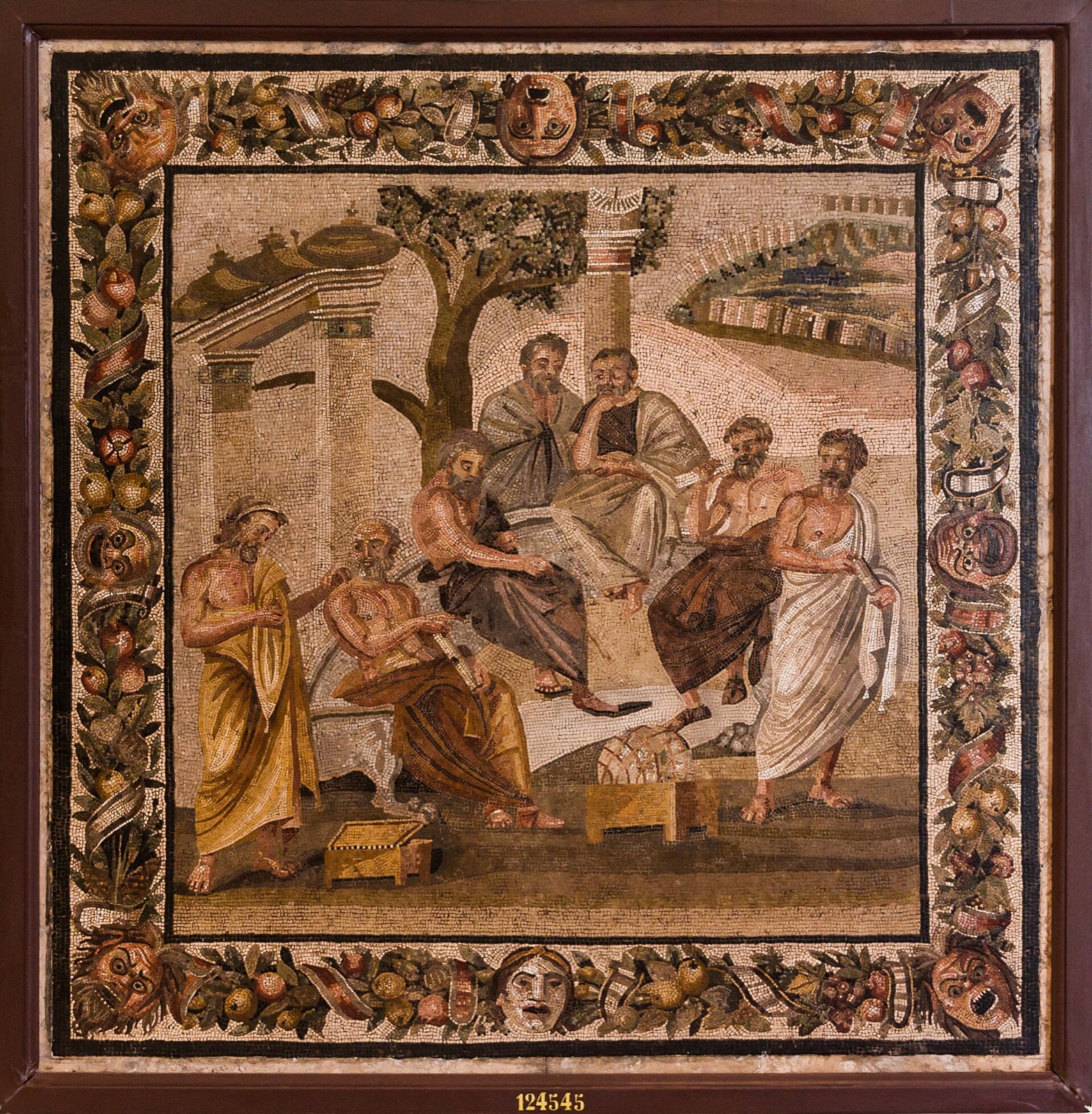
Background: Greek myths: sources, gods and divine generations · Platonism and Neoplatonism: from the Academy to the Renaissance · Islam: birth, expansion and thought, from Muhammad to Averroes · Exodus: Moses, the departure from Egypt, Sinai and the Law · Medieval Christendom: from the fall of Rome to the stake · From the Judges to the Kings: Samuel, Saul, David and Goliath, Solomon and the Temple · The short books: Ruth, Esther, Jonah, Tobit, Judith, Lamentations, Ezra and Nehemiah
The critique of religion, which is usually made to begin with Spinoza or the Enlightenment, has an ancient and medieval prehistory, which supplied it with its most durable arguments and its most radical gestures. Plato and Aristotle wanted a rational theology, which Plato armed with a penal law. The Epicureans invented the idea that religion is an error that causes suffering. Plotinus showed that one could seek union with the principle without temple or priest. Averroes and Maimonides, the one a Muslim, the other a Jew, asked what becomes of the revealed Law when a philosopher reads it. Eckhart, finally, carried the critique of the image of God into the heart of Christian mysticism. All of them already raise our question: some leave religion without leaving the gods, others criticize the representation of God in the name of God himself.
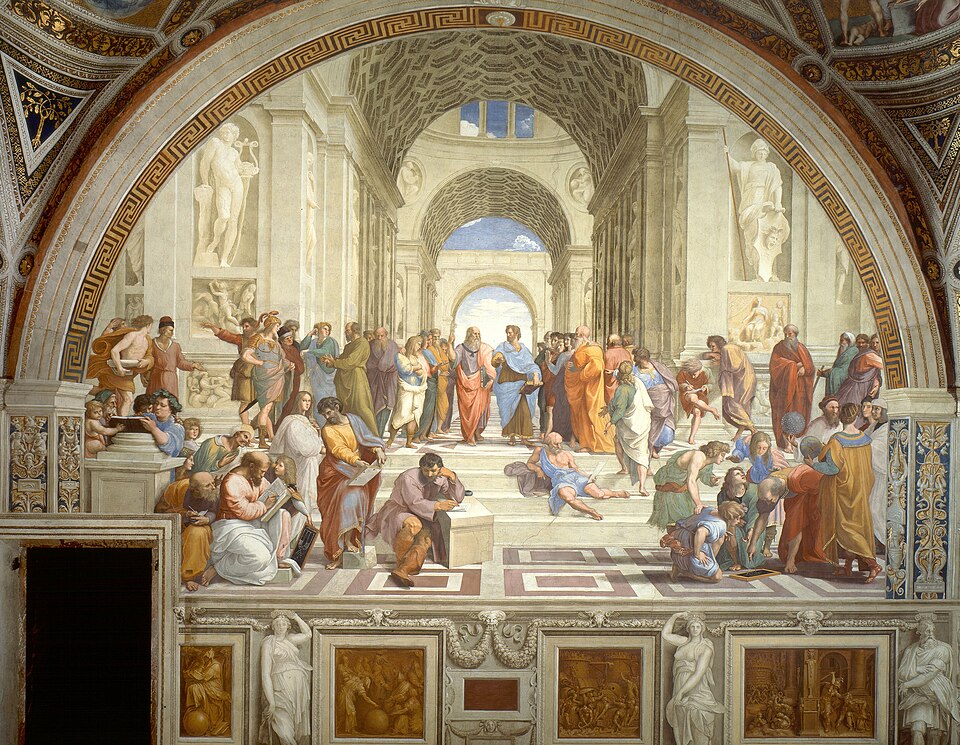
 Plato428/427-348/347 BCEthe first theology, and the first prison for the impious
Background: Greek myths: sources, gods and divine generations · Platonism and Neoplatonism: from the Academy to the Renaissance · Plato's philosophy: Forms, soul, city, the Good · The religion of the Greek city: sacrifices, festivals, oracles, impiety trials · The philosophers against the myths: from Xenophanes to allegory · Plato's myths: Er, Gyges, the noble lie, the androgyne · Rousseau's thought: state of nature, social contract, general will, Emile · The thought of Iris Murdoch: the novels, the Good, attention
We must begin with Plato, and not only for reasons of chronology. It was he who invented the word theology in the sense in which we understand it, speech about the gods subjected to rules (the term θεολογία, theologia, appears in Book II of the Republic, when Socrates lays down the “τύποι περὶ θεολογίας”, the models to which the poets' stories about the gods must conform, 379a); it was he who gave the first philosophical demonstration of the existence of the gods; and it was he, finally, who wrote the first penal law against unbelief. The three gestures are linked, and they are linked in Book X of the Laws (Νόμοι, Nomoi), his last work, unfinished at his death and published, according to tradition, by his disciple Philip of Opus. Anyone who wants to know what it means to “found a religion” through philosophy must read these thirty pages: they are the original of which almost all later refoundations are copies.
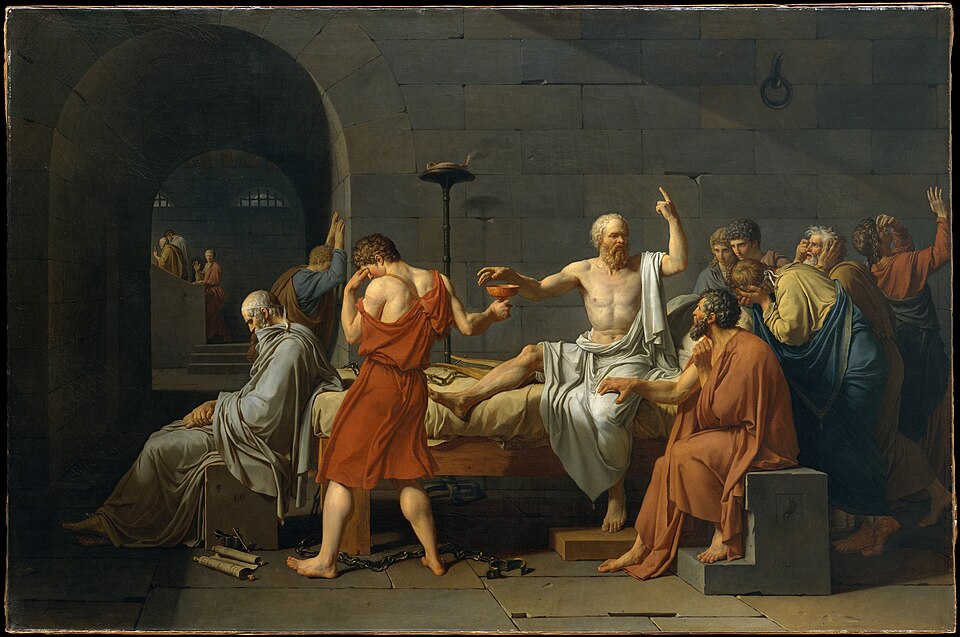
The book opens on a problem of criminal law. The Athenian, who leads the dialogue with the Cretan Clinias and the Lacedaemonian Megillus, has finished legislating on acts of violence and comes to outrages against the gods. Before fixing the penalties, he makes a diagnosis that is the founding text of every typology of unbelief: “θεοὺς ἡγούμενος εἶναι κατὰ νόμους οὐδεὶς πώποτε οὔτε ἔργον ἀσεβὲς ἠργάσατο ἑκὼν οὔτε λόγον ἀφῆκεν ἄνομον, ἀλλὰ ἓν δή τι τῶν τριῶν πάσχων, ἢ τοῦτο, ὅπερ εἶπον, οὐχ ἡγούμενος, ἢ τὸ δεύτερον ὄντας οὐ φροντίζειν ἀνθρώπων, ἢ τρίτον εὐπαραμυθήτους εἶναι θυσίαις τε καὶ εὐχαῖς παραγομένους”, no one who believes, as the laws prescribe, that the gods exist has ever willingly committed an impious act or let slip a lawless word; rather, one of three things has befallen him: either he does not believe that they exist, or, secondly, he believes that they exist but take no care of men, or, thirdly, that they are easily appeased, won over by sacrifices and prayers (885b). Three impieties, then: atheism properly so called, indifferent deism, and what might be called mercantile religion, the kind that thinks it can buy the gods.
This table already contains half of the essay. The first impiety is the one Plato attributes to the “learned men” of his time, natural philosophers and sophists, who explain the world by nature and chance and make the gods conventions of the law (889e-890a): it is, twenty-three centuries before d'Holbach, the regime of error. The second is the position that Epicurus will maintain a generation later: gods who exist but concern themselves with nothing. The third, finally, is the target of the whole moral critique of religion, from Spinoza to the Enlightenment and Kant. Plato therefore fights on two fronts. Against the unbeliever, he defends the existence and the providence of the gods; against the devout, their incorruptibility. His religion is at once an apologetics and a critique of popular religion, and that is what makes it formidable: it has already absorbed the objection.
Then comes the proof, the first in history to present itself as a demonstration. It starts not, as Aristotle's will, from the motion of the heavens, but from the soul. Every communicated motion presupposes a first motion that is not communicated; this first motion is “τὴν δυναμένην αὐτὴν αὑτὴν κινεῖν κίνησιν”, the motion capable of moving itself (896a). Now this self-moving motion is the very definition of the soul; Cousin translates: “Une substance qui a la faculté de se mouvoir elle-même”, a substance that has the faculty of moving itself. The soul is therefore prior to the body, and the good souls that move the stars are gods. The Athenian concludes with a rhetorical question in which one recognizes the formula that tradition attributed to Thales: “ἔσθʼ ὅστις ταῦτα ὁμολογῶν ὑπομενεῖ μὴ θεῶν εἶναι πλήρη πάντα;”, is there anyone who, granting this, will bear to deny that all things are full of gods? (899b). I leave aside the worth of the argument, which modern criticism, from Hume to Kant, has taken apart thoroughly enough; what matters to me is its status: for the first time, belief in the gods is no longer handed down by the poets and the ancestors but demonstrated by a philosopher, and, once demonstrated, it can be required.
After the proof comes the law, and it is terrible. Plato provides for three prisons in his city; one of them, near the place where the nocturnal council meets, bears the name “σωφρονιστήριον”, sôphronistêrion, the house where one is made wise (908a). The impious man in good faith, the one who has gone astray through want of judgement and not through vice, will spend at least five years there, with no visitors other than the members of the nocturnal council, who will come to converse with him “ἐπὶ νουθετήσει τε καὶ τῇ τῆς ψυχῆς σωτηρίᾳ”, for admonition and for the salvation of his soul; on his release, if he seems to have grown wise, he will live among the wise; if not, should he be convicted a second time, “θανάτῳ ζημιούσθω”, let him be punished with death (909a). Those who join impiety to trickery, the charlatans who claim to summon the dead and to sway the gods, will be shut up for life in the prison in the wilderness, and their corpse will be cast beyond the borders, unburied; any free man who buried it could be prosecuted for impiety (909c). To cut the root of the evil, a last law forbids private worship: “Ἱερὰ μηδὲ εἷς ἐν ἰδίαις οἰκίαις ἐκτήσθω”, let no one possess a shrine in his private house; whoever wishes to sacrifice will go to the public temples, into the hands of the priests (909d).
I have proposed that a religious refoundation be recognized by the presence of an absolute in whose name the sacrifice of the individual can be demanded. Book X of the Laws is the pure case of it, and a philosophical case: it is not priests persecuting philosophers, it is a philosopher who founds a state religion, who demonstrates its articles, and who entrusts to a council of the wise the task of re-educating, and then of killing, those who do not adhere to it. Dostoevsky's Grand Inquisitor, who wants the happiness of men and to that end takes from them the freedom to believe, has his ancestor here; and one understands why Karl Popper, in 1945, made Plato the first enemy of the “open society” (I summarize the general thesis of The Open Society and Its Enemies, vol. I, without citing a page). Yet Plato must be given his best form. The sôphronistêrion is a compulsory school, not a place of torture; the impious man in good faith is treated there as sick in soul, not as a criminal; and the religion imposed on him is not that of the poets, whom Plato despises, but a purified theology in which the gods are good, do not lie, and cannot be bought. The violence of the law serves a religion more moral than the one it replaces. That is the argument of all later refoundations, and what makes them dangerous: Rousseau's civil religion, Comte's cult of Humanity, the education of the new man by the party, all plead that they are replacing a superstition with a truth.
There is, however, another Plato, who nourished the critique of religion rather than state religion: the Plato of the Euthyphro, an early dialogue in which Socrates, a few days before his trial for impiety, questions a soothsayer very sure of his own piety. His question has become philosophy's most durable weapon against revealed morality: “ἆρα τὸ ὅσιον ὅτι ὅσιόν ἐστιν φιλεῖται ὑπὸ τῶν θεῶν, ἢ ὅτι φιλεῖται ὅσιόν ἐστιν;”, is the pious loved by the gods because it is pious, or is it pious because it is loved by the gods? (10a). If the pious is pious because the gods love it, morality is merely the arbitrariness of a sovereign will; if they love it because it is pious, piety has its reason in itself, and the gods are merely the witnesses of an order they did not make. The dilemma does not deny the gods, it makes them useless for grounding the good. We shall meet it again, without Plato's name, in the quarrel that closes Part Four: Bayle maintaining that a society of atheists can have morals, Kant making religion the recognition of our duties as if they were divine commands, Dostoevsky putting into Ivan's mouth the claim that there is no virtue without immortality. It is a constructed confrontation, since none of them replies expressly to the Euthyphro; but all of them inhabit the question that Socrates opened.
Between the Socrates of the Euthyphro and the Athenian of the Laws there is thus a tension that Plato did not resolve, and which I take to be the very tension of this essay: on one side, the philosopher who questions religion to the point of dissolving it into morality; on the other, the legislator who protects religion to the point of imprisoning those who question it. The trial of Socrates, accused of not recognizing the gods of the city (Apology, 24b-c, which I paraphrase), is the one that the law of the Laws makes possible: Plato watched his master die for impiety and wrote, forty years later, a law against impiety. One could not say more brutally that the exit from religion, when philosophy leads it, can end in a religion more demanding than the one it was leaving.
There remains a third Plato, the Plato of the cave, whom the widening to spirituality obliges us to take seriously. In Book VII of the Republic, education is not the filling of an empty soul, it is a conversion of the gaze: just as an eye could turn towards the light only together with the whole body, one must, says Socrates, turn the whole soul, “σὺν ὅλῃ τῇ ψυχῇ ἐκ τοῦ γιγνομένου περιακτέον εἶναι”, it must be turned round, with the whole soul, away from what comes to be (518c), and the art of education is “τῆς περιαγωγῆς”, the art of this turning round (518d). The περιαγωγή, periagôgê, is the first philosophical name for what Foucault will call spirituality: a transformation of the subject necessary for access to the truth. And the goal of the conversion, the Good, is placed by Plato beyond all that is: it is not an essence, but “ἐπέκεινα τῆς οὐσίας”, beyond essence, which it surpasses in dignity and in power (VI, 509b). This Good beyond being has neither temple, nor priest, nor penal law. Plotinus will make it the One, Dionysius and Maimonides the God of whom nothing can be affirmed, Levinas the Other who escapes ontology.
Plato thus holds both branches of our alternative: the civil religion demonstrated and imposed, with its nocturnal council and its prison for the impious; the spirituality of conversion, which subjects the soul to nothing external but turns it towards a Good it does not possess. The history that follows could be read as the struggle of these two Platos. Lucretius rises up against the first; the Neoplatonists develop the second; and Christianity, which inherits both, will make the Euthyphro a theological question (does God will the good because he is good?) and the Laws an institution.
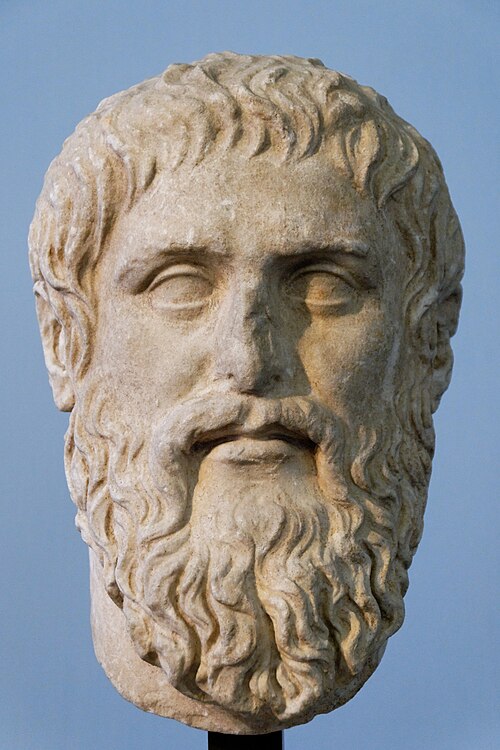
Portrait: D'après Silanion, photo Marie-Lan Nguyen, CC BY 2.5
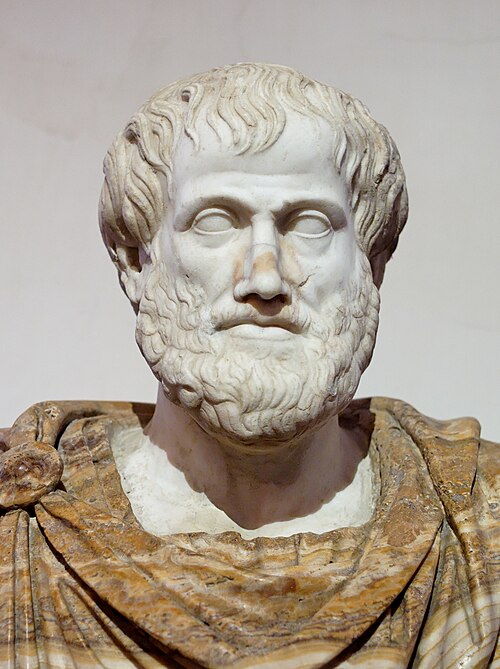 Aristotle384-322 BCEa god who thinks only himself
Background: Greek myths: sources, gods and divine generations · Aristotle's philosophy: act and potency, causes, the unmoved mover, virtue, contemplation · The philosophers against the myths: from Xenophanes to allegory · Metaphysics and the proofs of the existence of God: from Anselm to Kant
Aristotle wrote no law against the impious, and tradition even relates that he had to leave Athens in 323 under threat of a trial for impiety, after the death of Alexander (I report a late biographical tradition, whose details are uncertain). He nonetheless supplied Western theology with its most durable concept and, without meaning to, supplied its critique with its two strongest arguments: the idea of a god indifferent to human beings, and the idea that religious myths were invented in order to govern.
The first is contained in Book Λ (XII) of the Metaphysics (τὰ μετὰ τὰ φυσικά, ta meta ta phusika), a brief, dense treatise, probably independent of the rest of the collection, which tradition traces back to the editor Andronicus of Rhodes (1st century BCE), though the origin of the title is not certain. The eternal motion of the heavens requires a first mover that is not itself moved, otherwise one would go on to infinity. Now what moves without being moved is the object of desire: “κινεῖ δὴ ὡς ἐρώμενον, κινούμενα δὲ τἆλλα κινεῖ”, it moves, then, as that which is loved, while the other things move by being moved (Λ 7, 1072b3). The world hangs upon it, “ἐκ τοιαύτης ἄρα ἀρχῆς ἤρτηται ὁ οὐρανὸς καὶ ἡ φύσις”, it is on such a principle, then, that the heavens and nature depend (1072b13-14); but it does nothing for the world. It does not create it, since the world is eternal; it does not govern it, since it does not act; it attracts it, as the beloved attracts the lover, without knowing it.
What, then, does it do? It thinks, and, being what is best, it can think only what is best, that is to say itself. Chapter 9 draws the conclusion with admirable dryness: to think anything other than itself would be a fall, for “μὴ ὁρᾶν ἔνια κρεῖττον ἢ ὁρᾶν”, it is better not to see some things than to see them; therefore “αὑτὸν ἄρα νοεῖ, εἴπερ ἐστὶ τὸ κράτιστον, καὶ ἔστιν ἡ νόησις νοήσεως νόησις”, it is itself, then, that it thinks, if indeed it is the most excellent of things, and its thinking is a thinking of thinking (Λ 9, 1074b32-35). Aristotle's god knows neither Socrates, nor the city, nor the prayers addressed to it; it can neither reward nor punish. It is, in the formula that comes earlier, “ζῷον ἀΐδιον ἄριστον”, an eternal and most excellent living being (1072b29), whose life is the activity of the intellect, and this life we share only “μικρὸν χρόνον”, for a short time (1072b15).
Hence the paradox. By the table of the Laws, Aristotle falls under the second impiety, that of gods who take no care of human beings; Plato's Athenian would have sent him to the sôphronistêrion. Yet this indifferent god became, through Averroes, Maimonides and Thomas Aquinas, the God of the philosophers of the three monotheisms: the first mover of the Thomist “five ways” is a direct reprise of it. Everything Aristotle denied it had to be added: creation, knowledge of particulars, providence; and the tension between the Aristotelian god and the biblical God has never ceased to work on theology. I hold that Pascal was right in substance (Part Three): Aristotle's god is an object of contemplation, not of religion, and one does not pray to the thinking of thinking. But that is precisely what makes it an ancestor of the spiritualities without God: an absolute that demands nothing.
Aristotle is not entirely consistent on this point, and this must be said so as not to modernize him. In the Nicomachean Ethics, he writes that the man who lives according to the intellect is “θεοφιλέστατος”, the most loved by the gods, and he immediately adds a conditional: “εἰ γάρ τις ἐπιμέλεια τῶν ἀνθρωπίνων ὑπὸ θεῶν γίνεται, ὥσπερ δοκεῖ”, for if the gods take some care of human affairs, as people think (X, 8, 1179a22-24). The “as people think”, ὥσπερ δοκεῖ, marks a calculated prudence: Aristotle does not deny popular providence, he lodges it in opinion without integrating it into his theology.
The second argument is more discreet, and more important. In chapter 8 of the same Book Λ, after calculating the number of the celestial movers, Aristotle makes a remark worthy of a historian of religions before the term existed: the ancients, he says, handed down in the form of myth that the stars are gods and that the divine encompasses the whole of nature; and he goes on: “τὰ δὲ λοιπὰ μυθικῶς ἤδη προσῆκται πρὸς τὴν πειθὼ τῶν πολλῶν καὶ πρὸς τὴν εἰς τοὺς νόμους καὶ τὸ συμφέρον χρῆσιν”, the rest has since been added in mythical form, to persuade the many and for its usefulness with a view to the laws and the common interest (1074b3-5). Gods in human form, genealogies, metamorphoses into animals: all this is superadded. Only the kernel, the idea that the first substances are divine, deserves to be said “θείως”, divinely, and it is a relic of a lost wisdom that the revolutions of the arts have several times destroyed and recovered.
These three lines reach far. They contain the thesis of religion as social function, which Durkheim will systematize in 1912, and that of religion as a political instrument, which the libertines and the anonymous author of the Treatise of the Three Impostors will harden into the accusation of fraud. But in a subtler form than in his heirs: Aristotle does not say that the legislators lied, he says that myth was added to a truth, to make it effective among those who cannot contemplate it. Popular religion is a useful translation of a philosophical truth. Averroes in The Decisive Treatise, Spinoza in making Scripture a pedagogy of obedience, Hegel in making religion the truth in the form of representation, will give successive versions of it. It is a lineage, not a series of attested responses; but it is clear enough for me to hold Aristotle, and not Lucretius, to be the true ancestor of the “elitist” reading of religion, which does not deny its content but relegates its form.
To him, finally, we owe the expression that will occupy Heidegger. In Book E of the Metaphysics, he classifies the theoretical sciences: “ὥστε τρεῖς ἂν εἶεν φιλοσοφίαι θεωρητικαί, μαθηματική, φυσική, θεολογική”, so there would be three theoretical philosophies, mathematics, physics, theology (E 1, 1026a18-19). First philosophy is thus at once the science of being qua being and the science of the highest being, the divine. It is this double vocation, ontology and theology fused, that Heidegger will call the onto-theo-logical constitution of metaphysics, and that he will make the common source of Western philosophy and of the Christian God of the theologians (we shall meet it again in Part Ten). If Heidegger is right, philosophy cannot lead the critique of religion, since it is already, and has been ever since Aristotle, a theology. This is the most radical of the accusations in this essay, you think you have left religion, but you are still in it, addressed not to this or that author but to metaphysics as a whole; it has its origin in an adjective of Aristotle's.
There remains a spiritual Aristotle, an unexpected one. In Book X of the Nicomachean Ethics, the happiest life is the contemplative life, and Aristotle describes it in terms that border on mysticism: such a life “κρείττων ἢ κατʼ ἄνθρωπον”, would be higher than the human level, for it is not insofar as he is a man that one will live it, “ἀλλʼ ᾗ θεῖόν τι ἐν αὐτῷ ὑπάρχει”, but insofar as there is something divine in him; and we must not listen to those who advise man to think human thoughts and the mortal to think mortal thoughts, but must on the contrary, “ἐφʼ ὅσον ἐνδέχεται ἀθανατίζειν”, as far as is possible, make ourselves immortal (X, 7, 1177b26-33). The verb ἀθανατίζειν, athanatizein, is one of the most astonishing in the Greek philosophical language. It promises no survival; it designates a way of living, here and now, at the height of what does not die, without worship, without prayer, without community, through the sole exercise of the intellect.
Aristotle's best lesson perhaps lies there. He supplied the religion of the philosophers with its god and its critique with its sociological suspicion; but above all he showed that one could have a relation to the divine that is neither a belief, nor an obedience, nor a hope. The god who thinks only himself demands no sacrifice, since he does not know that we exist; the man who makes himself immortal by thinking submits to nothing, he rises. It is, in a form that is still theological, the spirituality of exercise which I have hypothesized to be the only exit that does not refound. Spinoza, who did not like Aristotle, will give its version without transcendence with the intellectual love of God, and the eternity that he says is felt and experienced (Part Three) is very close to the Aristotelian ἀθανατίζειν.
Portrait: D'après Lysippe, photo Jastrow, Public domain
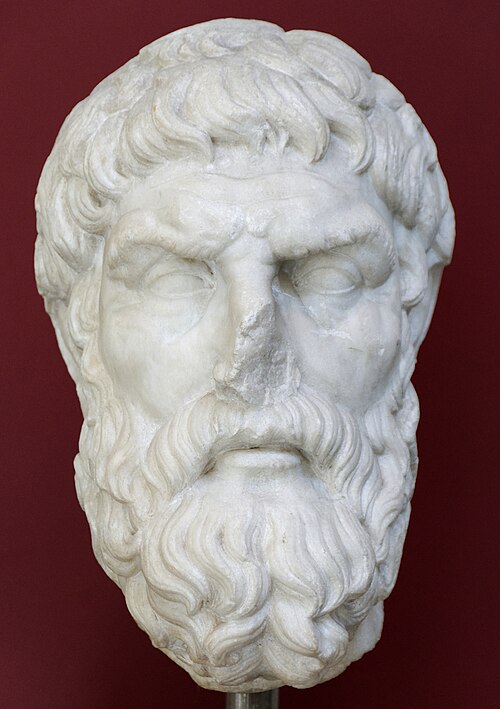
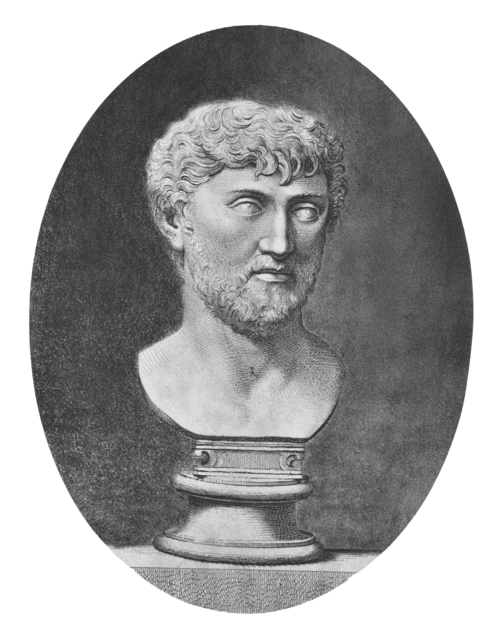 Epicurus and Lucretius341-270 BCE; c. 98-c. 55 BCEterror and peace
Background: The philosophy of Epicurus: atoms, canonic, pleasure and the remedy for fears · Lucretius and the De rerum natura: nature explained against religion · The Hellenistic schools: Stoicism, Epicureanism, Scepticism, wisdom as a way of life · The philosophers against the myths: from Xenophanes to allegory · D'Holbach: materialism, the Système de la nature, the militant atheism of the Enlightenment · Sisyphus and the underworld: Hades, Tantalus, the Danaids · The Trojan War: Iphigenia at Aulis, the wrath of Achilles, Priam
Let us first correct an image: Epicurus is not an atheist. The Letter to Menoeceus, preserved by Diogenes Laertius in Book X of the Lives of the Eminent Philosophers, affirms the existence of the gods and even makes it the first article of wisdom. In Octave Hamelin's translation (1910): “Commence par te persuader qu'un dieu est un animal immortel et bienheureux, te conformant en cela à l'anticipation du dieu qui est gravée en toi”, begin by persuading yourself that a god is an immortal and blessed living being, in keeping with the common notion of god engraved in you; then: “Car les dieux existent, attendu que nous connaissons leur existence par une intuition évidente. Mais, quant à leur nature, ils ne sont pas tels que la foule le croit”, for the gods exist, since our knowledge of them is a matter of clear vision; but as to their nature, they are not such as the many believe. The Epicurean critique bears not on the existence of the gods, but on their character. The gods of the crowd grow angry, reward, punish, demand sacrifices; those of Epicurus, perfectly happy, concern themselves with nothing, for any care would disturb their blessedness.
Hence the sentence that overturns the very notion of impiety: “Et celui-là n'est pas impie qui nie les dieux de la foule, c'est celui qui attribue aux dieux ce que leur prêtent les opinions de la foule”, the impious man is not the one who denies the gods of the many, but the one who attaches to the gods what the opinions of the many ascribe to them. The impious man is no longer the unbeliever, but the devout man who forms an unworthy idea of God. This reversal Spinoza will take up, and Simone Weil will push it to its limit in speaking of a purifying atheism. Religious error, for Epicurus, is first of all a lapse of metaphysical taste: we lend the gods our passions.
This error is serious because it causes suffering. Epicurean philosophy is a therapeutics, and the religion of the crowd is, along with the fear of death, one of the two great causes of the soul's disturbance. Against the latter, the Letter gives the famous formula: “Prends l'habitude de penser que la mort n'est rien relativement à nous”, accustom yourself to thinking that death is nothing to us. The two fears are linked, for one fears the gods for what they will do with us after death: remove the one, and the other falls.
Lucretius gives this therapeutics its epic form and its violence. The De rerum natura (On the Nature of Things), a didactic poem in six books whose date of composition is uncertain and whose author is almost unknown, opens with a eulogy of Epicurus that is a battle painting. Human life lay on the ground, shamefully, “humana ante oculos foede cum vita iaceret / in terris oppressa gravi sub religione”, crushed beneath the weight of religion (I, 62-63); and it was a Greek, a mortal, who first dared to raise his eyes against it, “primum Graius homo mortalis tollere contra / est oculos ausus” (I, 66-67). The victory is total and it has a precise meaning: “quare religio pedibus subiecta vicissim / opteritur, nos exaequat victoria caelo”, therefore religion in its turn is cast beneath our feet and trampled, and the victory makes us equal to heaven (I, 78-79).
This last line announces our whole problem. Victory over religion makes us equal to heaven. Lucretius does not say merely that man is liberated, but that he takes the place of the gods, or at least rises to their height. The end of the Letter to Menoeceus promises it to the disciple: “vivras comme un dieu parmi les hommes”, you will live like a god among men. The exit from religion is accomplished as a divinization of man. Feuerbach, nineteen centuries later, will say nothing else, and Stirner will reproach him for it.
Then comes the example, the most famous passage of the poem. So that no one should think that philosophy leads to impiety, Lucretius recalls that it is religion that has given birth to crimes, “religio peperit scelerosa atque impia facta” (I, 83), and he tells of the sacrifice of Iphigenia at Aulis: the girl led to the altar not for her wedding but to be slaughtered by her father, so that the Greek fleet might obtain a favourable wind. The account closes on the line that the whole libertine tradition engraved on the pediment of its books: “tantum religio potuit suadere malorum”, so great the evils religion could prompt (I, 101).
The word religio in Lucretius does not have its Christian sense. It designates the scrupulous fear of the gods, the feeling of being bound by sacred obligations, and it is this feeling, more than any dogmas, that Lucretius combats. His critique belongs entirely to the regime of error: the fear of the gods comes from ignorance of natural causes, and atomist physics, by explaining lightning, earthquakes and disease, dispels the terror. But it already contains a spiritual dimension that the moderns will forget: knowledge of nature is not an end in itself, it is an exercise that procures ataraxia, the absence of disturbance.
Michel Onfray will claim Epicurus and Lucretius as his ancestors. That is half right. He inherits from them the regime of error and the hatred of priests, not their piety: Epicurus and Lucretius, who mock the religion of the crowd, keep gods, and these gods are a model of life. The Epicureans leave religion without leaving the divine: it is the first form, and perhaps the wisest, of my paradox.
Portrait: Sculpteur inconnu, photo Marie-Lan Nguyen, Public domain
Portrait: Auteur inconnu, CC0
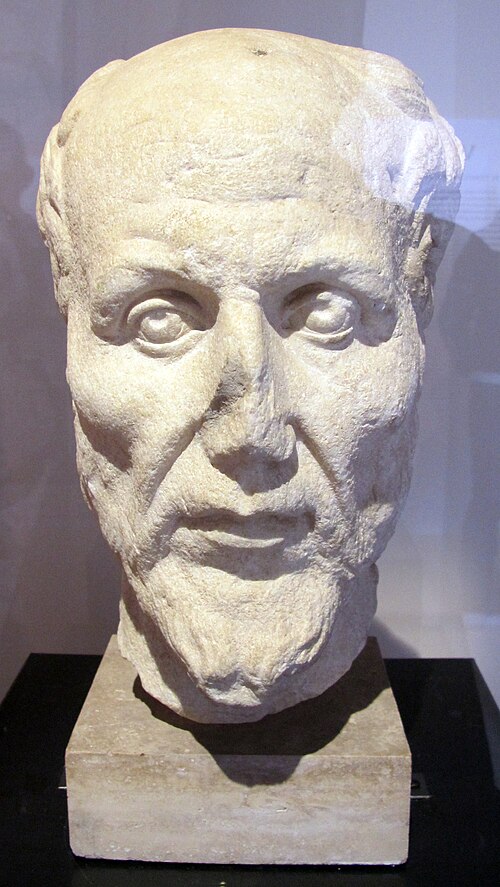 Plotinus205-270a mysticism without a Church
Background: Platonism and Neoplatonism: from the Academy to the Renaissance · The philosophy of Plotinus: the hypostases, procession and conversion · From Constantine to Theodosius: Christianity as the religion of the Empire · Porphyry: the editor of Plotinus and the critic of the Christians · The mysteries and Orphism: Eleusis, Orpheus, Cybele, Isis, Mithras · The thought of Pierre Hadot: ancient philosophy as a way of life
Plotinus is one of the few Ancients in this story who neither fought nor founded any religion, and that is precisely why he must appear here. Born in Egypt, a pupil of Ammonius Saccas in Alexandria, he taught in Rome from 244 onwards and did not begin to write until he was fifty. After his death his fifty-four treatises were arranged by his disciple Porphyry into six groups of nine, the Enneads (Ἐννεάδες, the “nines”), in a thematic order that is not the order of composition; Porphyry added a Life of Plotinus, which is our main source. The Plotinus of this Life “paraissait honteux d'avoir un corps”, seemed ashamed of having a body, refused to let anyone paint his portrait, and never spoke of his family or his homeland (Life, 1, trans. Bouillet). He was a teacher, not a founder; and yet he described with precision an experience of the absolute that owes nothing to a revelation, a Church or a cult.
The starting point is Platonic. Of the Good of the Republic, beyond essence, Plotinus makes the principle of everything, the One (τὸ ἕν, to hen), and he draws every consequence from the formula. If the One is beyond essence, it is also beyond thought: “ὅτι ἐπέκεινα οὐσίας, ἐπέκεινα καὶ ἐνεργείας καὶ ἐπέκεινα νοῦ καὶ νοήσεως”, because it is beyond essence, it is also beyond activity, beyond intellect and thought (I 7, 1). The distance from Aristotle is great: his first principle was a thought thinking itself; that of Plotinus is above thought, and does not even think itself: one treatise goes so far as to say that it is not absurd that it should not know itself (V 6, 6). Between the One and us come, in descending order, the Intellect (νοῦς, nous), which is Aristotelian thought demoted to second place, then the World Soul; everything proceeds from the One by superabundance, without decision or creation, as light proceeds from the sun.
But Neoplatonism is less a cosmology than a path of return. The soul that has scattered itself among bodies must climb back to its source, and the method of this ascent is a stripping away. At the end of treatise V 3, having shown that the One can be neither spoken nor thought, Plotinus asks how it can be seen, and answers with two words, perhaps the most famous in the whole of Western mysticism: “Πῶς ἂν οὖν τοῦτο γένοιτο; Ἄφελε πάντα”, how then could this come about? Take away everything (V 3, 17). One is not united with the absolute by adding a belief, a rite or a body of knowledge, but by removing everything that is not it.
The experience itself is described at the end of treatise VI 9, On the Good or the One, which Porphyry placed at the end of the whole work as its crowning. The one who has seen, says Plotinus, cannot say that he has seen, for there were no longer two, the seer and the seen: “ἐπεὶ τοίνυν δύο οὐκ ἦν, ἀλλʼ ἓν ἦν αὐτὸς ὁ ἰδὼν πρὸς τὸ ἑωραμένον, ὡς ἂν μὴ ἑωραμένον, ἀλλʼ ἡνωμένον”, since there were not two, but the one who saw was one with what was seen, as though he had not seen it but been united with it (VI 9, 11). Plotinus compares it to the mysteries, whose secret may not be divulged to the uninitiated: not because that would be sacrilege, but because the thing cannot be divulged. And the treatise, and so the Enneads, ends on the formula that sums everything up: the life of the gods and of godlike men is “ἀπαλλαγὴ τῶν ἄλλων τῶν τῆιδε, βίος ἀνήδονος τῶν τῆιδε, φυγὴ μόνου πρὸς μόνον”, release from the other things of this world, a life that takes no pleasure in the things of this world, flight of the alone to the alone (VI 9, 11). Bouillet's translation adds “Dieu” and “l'âme”, God and the soul, which the Greek does not name: a small example of the way the Christian tradition read Plotinus.
What is striking is the complete absence of religious apparatus in this experience. No revelation: the One does not speak, does not manifest itself in history, chooses no people. No grace: it is the soul that strips itself bare, through philosophy and virtue. No Church: the flight is “of the alone to the alone”. No cult, or rather a sovereign contempt for cult: Porphyry reports that Amelius, a disciple punctilious in sacrificing, wanted to take Plotinus to the festival of the new moon, and that Plotinus replied: “C'est à ces dieux de venir me chercher, et non pas à moi d'aller les trouver”, it is for those gods to come to me, not for me to go to them (Life, 10, trans. Bouillet); Porphyry admits that the disciples, not understanding this pride, did not dare to question him. All of this is nonetheless religious in James's sense: a solitary experience of what the subject holds to be divine. Porphyry gives the count with an archivist's precision: during the six years he lived with him, Plotinus “eut quatre fois le bonheur de toucher à ce but, non par simple puissance, mais par un acte réel et ineffable”, four times had the happiness of reaching this goal, not merely in potency but by a real and ineffable act, and Porphyry himself only once, at the age of sixty-eight (Life, 23, trans. Bouillet). The last words of the dying Plotinus, according to the same Life, were: “je m'efforce de réunir ce qu'il y a de divin en nous à ce qu'il y a de divin dans l'univers”, I am striving to unite what is divine in us with what is divine in the universe (Life, 2, trans. Bouillet).
It will be objected that this mysticism did not leave religion, since it had never entered it in the Christian sense; and that Plotinus is a pious pagan, who believed in the gods, in daemons, in providence. This is true, and it is what makes him precious: he shows that an experience of the absolute can exist without any of the structures that modern critique will attack. The sacrifice criterion does not apply to him. The One demands nothing: it is what the soul turns towards of its own accord when it ceases to scatter itself. It is he, far more than Epicurus, who is the distant ancestor of the spiritualities without God of the last part. And it is no accident that Pierre Hadot, before writing on the spiritual exercises of antiquity, devoted his first book of his own to Plotinus, Plotin ou la simplicité du regard (1963): he saw in him the model of an inner transformation that dispenses with every institution.
Plotinus had two posterities, which fought each other. The first is pagan and polemical. Porphyry, his editor, wrote a treatise Against the Christians in fifteen books, condemned to the flames by the Christian emperors and known to us only in fragments; and Plotinus himself composed a treatise against the Gnostics (II 9), which Porphyry entitles Against the Gnostics, in which he reproaches these sects of Christian origin for despising the world and its creator. Neoplatonism was thus, in the third century, the last great philosophy to oppose rising Christianity, and Julian the Apostate would try, in the following century, to make it the theology of a restored paganism: a refoundation, this time, in the strict sense.
The second, Christian, proved the more lasting. Augustine relates in the Confessions how, in Milan, he was supplied by a man “immanissimo typho turgidum”, swollen with monstrous pride, with “quosdam platonicorum libros ex graeca lingua in latinam versos”, certain books of the Platonists translated from Greek into Latin, and that he read in them, not in those words but in substance, that “in the beginning was the Word”; but that the Word was made flesh and dwelt among us, “non ibi legi”, I did not read that there (Confessions, VII, 9, 13-14). Augustine's sentence draws the frontier between Plotinian spirituality and the Christian religion: everything is there, except the incarnation, that is, except history, the Church and the salvation of a God made man. The “books of the Platonists” had been translated by Marius Victorinus, as Augustine himself says (Confessions, VIII, 2, 3); that they were treatises of Plotinus, of Porphyry or of both is the common opinion of historians, and the detail remains disputed. Through Augustine, then through Pseudo-Dionysius, Neoplatonic negative theology would pass into Christianity, and it is this that we shall find again, transformed, in Maimonides and in Eckhart, whose God beyond God owes as much to Plotinus as to the Gospels.
I therefore hold, against a widespread opinion, that Plotinus is not a precursor of Christianity, but the accomplished example of a spirituality that might never have become a religion. Christianity absorbed him by adding to him what Augustine “did not read there”; late paganism wanted to make him a state religion. Plotinus wanted neither. Take away everything: the formula holds for Churches too.
Before the Rhineland mystic, a detour by way of Córdoba and Cairo is necessary, and it is not an ecumenical courtesy. Our question presupposes an older one: can one think God as a philosopher within a religion of revealed Law, without betraying either the Law or philosophy? It was first posed, and more radically than in Latin Christianity, in Islam and in the Arabic-speaking Judaism of the twelfth century, by judges and court physicians who read Aristotle in the text handed down by the translators of Baghdad and had to account for their philosophy before jurists. It is largely through Averroes's commentaries that scholasticism read Aristotle. Averroes and Maimonides, born twelve years apart in the same city, do not leave religion, but they invent the two instruments that every later exit will need: the interpretation that separates the apparent meaning from the true meaning, and the division of human beings into those who can hear the second and those who must keep to the first.
Portrait: Sculpteur inconnu, photo Sailko, CC BY 3.0
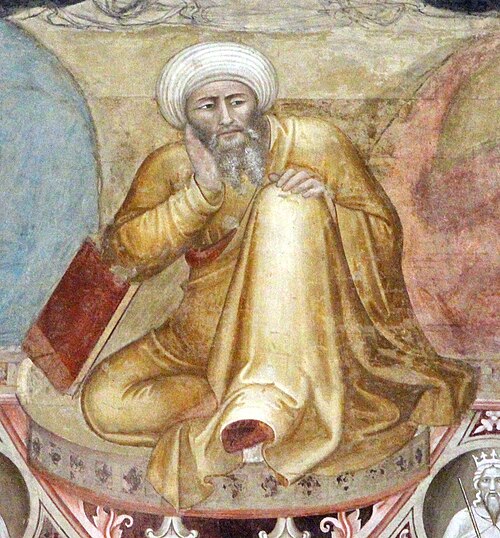 Averroes1126-1198the Law commands philosophy
Background: Islam: birth, expansion and thought, from Muhammad to Averroes · The philosophy of Averroes: the Commentator, the intellect, the reply to al-Ghazali, Latin Averroism · The thought of Maimonides: the Guide for the Perplexed, the Mishneh Torah, prophecy · Plato's myths: Er, Gyges, the noble lie, the androgyne · Scholasticism and the condemnations: faith and reason in the medieval university · The thought of Mohammed Arkoun: the critique of Islamic reason, the unthought, applied Islamology · How the Bible has been read: allegory, the four senses, historical criticism
Abū l-Walīd Muḥammad ibn Aḥmad ibn Rushd, whom the Latins would call Averroes and, more simply, “the Commentator”, was a judge before he was a philosopher, or rather he never ceased to be both. Grandson of a chief qadi of Córdoba, himself qadi in Seville and then in Córdoba, physician to the Almohad caliph in Marrakesh, he commented on almost the whole of Aristotle at the sovereign's request, before falling into disgrace in 1195, being exiled to Lucena and seeing his books burned, then being recalled shortly before his death. The text that concerns us, a short one, is entitled Faṣl al-maqāl, the “decisive discourse”, or more exactly the examination that settles the question of the relation between the religious Law and philosophy, and it dates from around 1179. Léon Gauthier translated it under the title Accord de la religion et de la philosophie (Algiers, 1905; the title page of the digitized copy bears 1906).
The form of the text is already a thesis: Averroes poses the question not as a philosopher but as a jurist, in the categories of Islamic law, which classify every action as obligatory, recommended, permitted, reprehensible or forbidden. The task, he writes, is to “examiner, au point de vue de la spéculation religieuse, si l'étude de la philosophie et des sciences logiques est permise ou défendue par la Loi religieuse, ou bien prescrite par elle soit à titre méritoire soit à titre obligatoire”, to examine, from the standpoint of religious inquiry, whether the study of philosophy and the logical sciences is permitted or forbidden by the religious Law, or else prescribed by it, either as meritorious or as obligatory. The answer is the strongest possible: philosophy is a duty. If philosophy is nothing but the study of the universe insofar as it makes its Maker known, and if the Law invites us to consider the universe, then philosophy is “de par la Loi religieuse, ou bien obligatoire ou bien méritoire”, by virtue of the religious Law, either obligatory or meritorious. Averroes quotes the Qur'an: “Draw a lesson [from this], O you who are endowed with understanding!” (sura LIX, 2), and reads in it a formal injunction to reason. Since the most perfect form of reasoning is demonstration (burhān) in the sense of the Posterior Analytics, the Law itself commands the study of Aristotle's logic.
The gesture is striking: philosophy has no need to leave religion, since religion orders it to exist. But it comes at a price, stated in the most famous sentence of the treatise: “la vérité ne saurait être contraire à la vérité : elle s'accorde avec elle et témoigne en sa faveur”, truth cannot be contrary to truth: it agrees with it and bears witness in its favour. If demonstration arrives at a knowledge that the apparent meaning (ẓāhir) of the revealed text contradicts, the text must be interpreted, that is, led back to its inner meaning (bāṭin) by taʾwīl, the interpretation that brings the word back to what it truly signifies. Demonstration never bends; the text does.
Then arises the question of the addressee: if the Qur'an has an apparent meaning and a true meaning, to whom should the second be told? Averroes answers with an anthropology of assent, which human beings do not give in the same way: some through demonstration, others through dialectical arguments, most through oratorical, that is, rhetorical, arguments. Hence the division: “Les gens [se divisent] donc, au point de vue de la Loi religieuse, en trois classes”, people are therefore divided, from the standpoint of the religious Law, into three classes: those who are “hommes de démonstration en aucune façon”, in no way people of demonstration, who “constituent la grande masse”, make up the great mass; the dialecticians; and “les hommes de démonstration par nature et par art, je veux dire l'art de la philosophie”, the people of demonstration by nature and by art, I mean the art of philosophy. The consequence is a rule of silence: the duty of the common people is to take the symbols “dans leur sens extérieur”, in their outward sense, and “il n'est pas permis qu'ils connaissent, en aucune façon, cette interprétation”, it is not permitted that they should know this interpretation in any way; more than that, “les interprétations vraies ne doivent pas être traitées dans les livres destinés au vulgaire, à plus forte raison les fausses”, true interpretations must not be treated in books intended for the common people, still less false ones. Averroes traces the sects of Islam back to this fault: the community split because interpretations were set out openly before the people.
This rule is aimed at a named adversary, al-Ghazālī (1058-1111), who, in the Tahāfut al-falāsifa, which Gauthier proposes to render as L'Effondrement des falāsifa (The Collapse of the falāsifa) rather than La Destruction des philosophes (The Destruction of the Philosophers), had declared al-Fārābī and Avicenna unbelievers on three points: the eternity of the world, the claim that God does not know particular things, and the interpretation of the resurrection of bodies. Averroes recalls this in the Faṣl and answers as a jurist: the charge of unbelief for having broken the consensus is only “hypothétique”, hypothetical, since no unanimous consensus can be established on questions that the ancients themselves reserved for “hommes d'une science profonde”, people of profound learning. The philosophical answer would come in the Tahāfut al-tahāfut, the “Collapse of the Collapse”, which turns the title of Ghazālī's book against him. This is an attested response: the first debate on the right to philosophize within a revealed religion sets two Muslims against each other, one of whom had been dead for nearly seventy years when the other replied to him.
Let us correct here a stubborn legend, which distorts everything that follows: Averroes never taught the “double truth”, the idea that a proposition could be true in philosophy and false in religion. He teaches the opposite: a single truth, two modes of access, a single arbiter, demonstration. The formula of the “double truth” comes from elsewhere: in 1277 the bishop of Paris, Étienne Tempier, condemning two hundred and nineteen propositions taught in the faculty of arts, reproaches certain masters in his prologue for saying things that are true according to philosophy but not according to the Catholic faith, as though there were two contrary truths. Historians still debate whether a single one of the “Latin Averroists” targeted, Siger of Brabant or Boethius of Dacia, ever upheld the thesis in that form; what is certain is that Averroes did not uphold it and that the label is polemical. Renan devoted his first major book, Averroès et l'averroïsme (1852), to this posterity, and it was he who made Ibn Rushd the patron saint of freethinkers. The Commentator deserved both better and less: he was not a freethinker, but a judge who thought freely.
Where should he be placed among our eight regimes? Not in the regime of error: religion is not false, it tells the truth in symbols. Nor outside critique, for the doctrine of the three classes is already, in theological form, a theory of the social function of religion. The Law is a medicine for the many: Averroes compares the lawgiver to the skilful physician who gives everyone precepts of health to which each can assent, because “il ne lui est pas possible de les rendre tous médecins”, it is not possible for him to make them all physicians; and whoever divulges the interpretations to the people resembles the man who would ruin the patients' confidence in the physician's prescriptions without being able to give them an understanding of them. Plato had wanted the city to impose a salutary theology; Aristotle had acknowledged, as we have seen, that the myths had been added to persuade the multitude. Averroes gives this tradition a more elegant form: for him, the religion of the people is not a useful lie, but the truth itself, clothed for those who cannot see it naked. He ends on an image that says everything: philosophy is “la compagne de la religion et sa sœur de lait”, the companion of religion and its foster sister, and harm that comes from a friend is more painful than harm that comes from an enemy.
The confrontation that follows is constructed. Spinoza did not, to my knowledge, discuss the Faṣl, which did not circulate in Latin. But when he attacks the method of Maimonides, which on this point is the same, he is aiming at the Averroist arrangement: if Scripture can be understood only in the light of demonstration, then the common people, who do not know what a demonstration is, “ne pourrait connaître l'Écriture sainte que sur l'autorité et le témoignage des philosophes”, could know Holy Scripture only on the authority and testimony of the philosophers, and one would have invented “une autorité fort nouvelle dans l'Église, une nouvelle espèce de prêtres et de pontifes”, a quite new authority in the Church, a new kind of priests and pontiffs (Theological-Political Treatise, ch. VII, trans. Saisset). The objection goes deep: the Averroist division does not lead out of religion, it installs at its summit a caste that knows what the text means and hides it. Averroes, at least, believes that the Law is true; but the structure will outlive the faith that justified it.
My judgement is therefore twofold. Averroes does not leave religion and founds nothing: he divides. He demands no sacrifice of the philosopher, who enjoys the truth without guilt since the Law itself commands it of him. But he demands of the people a sacrifice he does not name, that of access to the truth. By the criterion, he installs no new absolute; he ranks access to the old one. It is the most stable solution the question has ever received, and so it will return under every regime, in Spinoza himself, in Comte, in Renan, and even in the Straussian theory of esoteric writing.
Portrait: Andrea di Bonaiuto, photo Sailko, CC BY 3.0
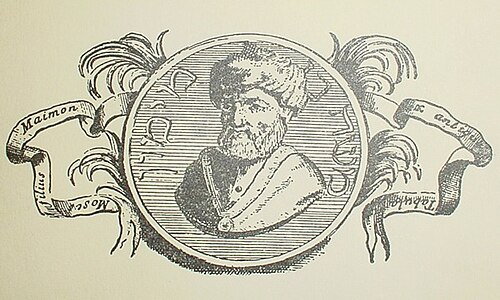 Maimonides1138-1204of God, we know only what he is not
Background: Judaism: from the Second Temple to emancipation · Islam: birth, expansion and thought, from Muhammad to Averroes · The philosophy of Averroes: the Commentator, the intellect, the reply to al-Ghazali, Latin Averroism · The thought of Maimonides: the Guide for the Perplexed, the Mishneh Torah, prophecy · The patriarchs: Abraham, the sacrifice of Isaac, Jacob · Exodus: Moses, the departure from Egypt, Sinai and the Law · Scholasticism and the condemnations: faith and reason in the medieval university · Sacrifice in the Bible: from Abel's altar to self-offering · The God of the Bible: his names, his images and the formation of monotheism
Moses ben Maimon was also born in Cordoba. His family fled after the Almohad conquest of 1148, wandered through Andalusia and Morocco, then settled in Egypt, at Fustat, where Maimonides became head of the Jewish community and physician at the court of Saladin. We owe him the greatest code of Jewish law, the Mishneh Torah, written in Hebrew, and the greatest book of Jewish philosophy of the Middle Ages, written around 1190 in Arabic set down in Hebrew characters: Dalālat al-ḥāʾirīn, which the Hebrew translators rendered as Moreh nevukhim, the Latins as Dux neutrorum or Dux perplexorum, and Salomon Munk, in the standard French translation (1856-1866), as Le Guide des égarés, the guide of those who have gone astray. Munk notes that the translation closest to the literal sense would be Guide des perplexes, guide of the perplexed, but that it would have “l'inconvénient de paraître prétentieuse”, the drawback of seeming pretentious.
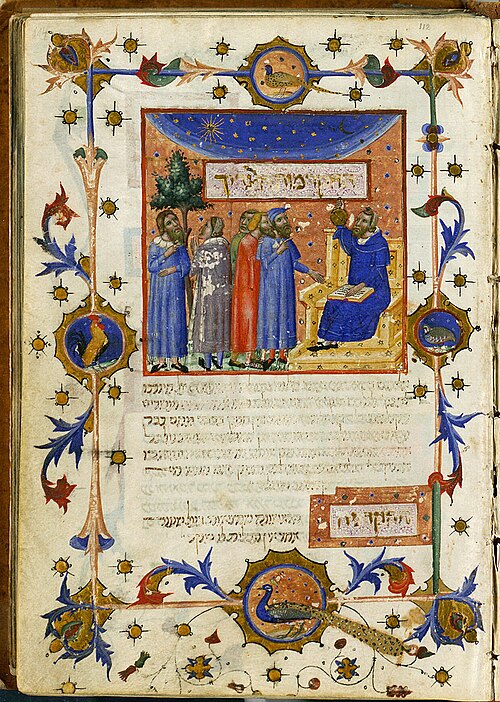
The introduction defines its addressee with a precision that speaks volumes. The book aims “de donner l'éveil à l'homme religieux chez lequel la vérité de notre Loi est établie dans l'âme et devenue un objet de croyance, qui est parfait dans sa religion et dans ses mœurs, qui a étudié les sciences des philosophes”, to awaken the religious man in whose soul the truth of our Law is established and has become an object of belief, who is perfect in his religion and his morals, who has studied the sciences of the philosophers, but who is “embarrassé par le sens extérieur (littéral) de la Loi”, troubled by the external (literal) sense of the Law, so that he “reste dans l'agitation et dans le trouble”, remains in agitation and confusion (Introduction, trans. Munk). The perplexed man is neither the unbeliever nor the simple, but the cultivated believer who has read Aristotle and can no longer read the Bible to the letter. Maimonides does not invite him to choose: he teaches him to read.
The first lesson concerns names. The Bible speaks of a God who sees, who hears, who comes down, who sits, who has a hand and a face. A large part of the first part of the Guide is a lexicon of these terms, showing for each that it is a homonym, and that taken in its proper sense it would make God a body. Yet God's incorporeality is demonstrated, and it governs the reading. Maimonides says so with a frankness that Spinoza will copy out in order to combat it: if he rejects the eternity of the world, it is not because of the verses on creation, for “de même que nous avons expliqué ces endroits de l'Écriture de façon à éloigner de la nature de Dieu toute matérialité, nous aurions également trouvé moyen d'interpréter les passages sur la création dans un sens favorable à l'éternité du monde”, just as we have explained those places in Scripture so as to remove all materiality from the nature of God, we would likewise have found a way to interpret the passages on creation in a sense favourable to the eternity of the world; it is only that the eternity of the world “n'est établie par aucune démonstration”, is established by no demonstration (Guide, II, 25, quoted in the Theological-Political Treatise, ch. VII, trans. Saisset). The revealed text yields before demonstration, not before mere probability. Creation is therefore upheld, but for want of a proof to the contrary, and Maimonides leaves open, in the eyes of an attentive reader, a question that faith believed closed.
The second lesson goes further and founds a tradition. If no name fits God in its proper sense, nothing positive can be said of him. “Nous ne saisissons de lui autre chose, si ce n'est qu'il est, mais non pas ce qu'il est”, we grasp nothing of him except that he is, but not what he is (I, 58). The only legitimate attributes are negative: to say that God is living is to say that he is not dead; powerful, that he is not powerless. Knowledge of God advances by subtraction: “à mesure que tu augmentes les négations à l'égard de Dieu, tu t'approches de la perception”, as you multiply the negations concerning God, you draw nearer to apprehension (I, 59). The end of this path is silence. Maimonides finds it in Psalm 65, 2, lekha dumiyya tehilla, which he reads thus: “pour toi le silence est la louange”, for you, silence is praise (I, 59). For, he adds, “quoi que ce soit que nous disions dans le but d'exalter et de glorifier (Dieu), nous y trouverons quelque chose d'offensant à l'égard de Dieu”, whatever we say with the aim of exalting and glorifying (God), we shall find in it something offensive towards God.
This negative theology joins the critique of religion: from within faith, it destroys all the representations of God that popular faith sustains: the God who grows angry, who rewards, who hears prayers in the way a king hears a petition. Eckhart received it; he quotes “Rabbi Moyses” abundantly in his Latin commentaries, and the debt is well enough established for a recent study to bear precisely that title, “Verba sunt Rabbi Moysis”. When Eckhart prays God to rid him of God, he carries into prayer the negation that Maimonides had carried into silence.
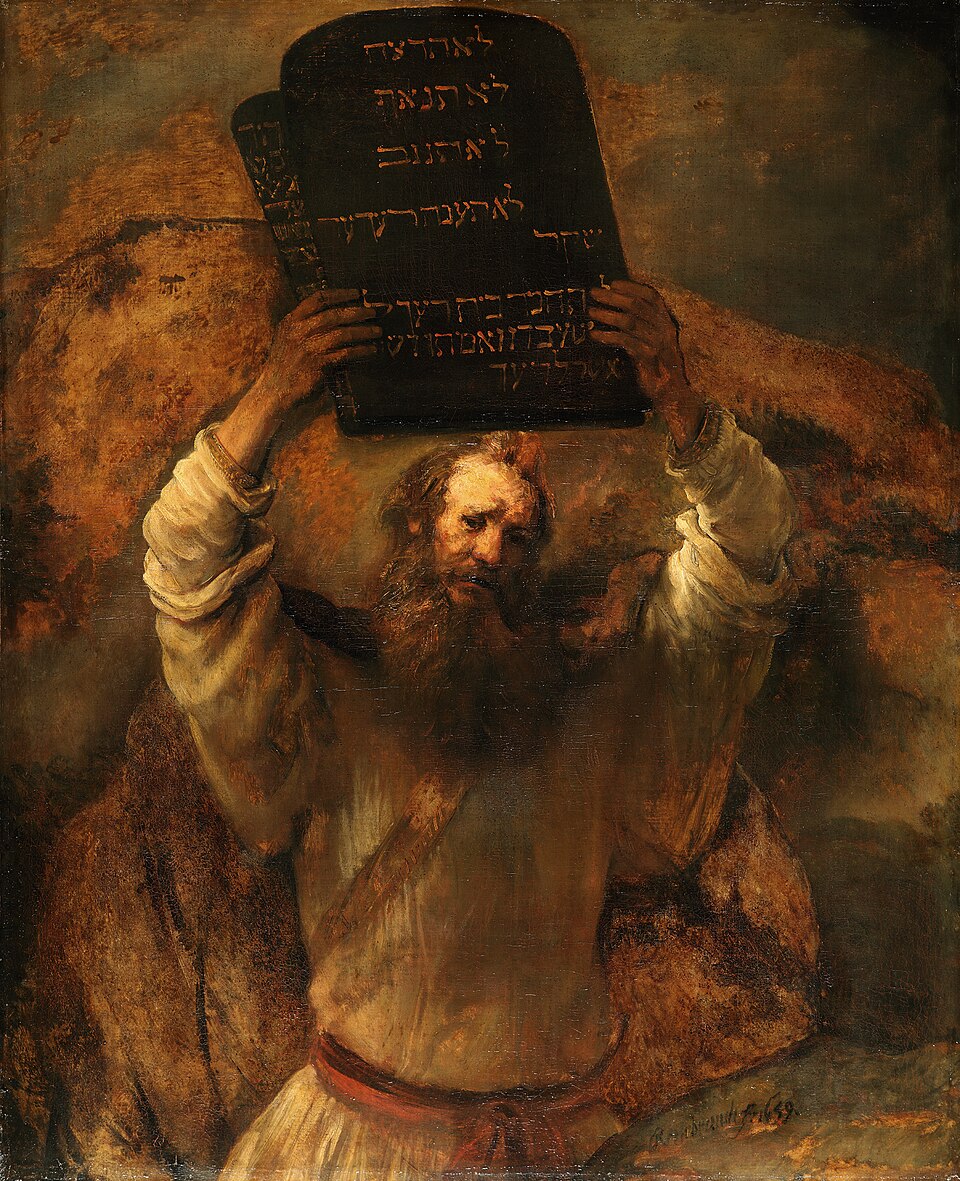
It also has a modern adversary. Feuerbach, in Das Wesen des Christenthums, attacks the theology that denies God every positive predicate. A God of whom every determination is denied, he says, has an existence “ohne Existenz”, an existence without existence, indistinguishable from nothingness; and the negation of the positive predicates of the divine essence is nothing other, in his view, than “ein subtiler, verschlagner Atheismus”, a subtle and cunning atheism, which keeps the appearance of religion and is not recognized as negation (1841, Introduction, ch. 2, p. 21-22 of the first edition). Feuerbach does not name Maimonides in this passage, so the confrontation is constructed; it is the best objection that can be made to the Guide. For Feuerbach, religion lives on predicates: to remove them all is to leave it without daring to say so. For Maimonides, true religion begins when they are removed; to keep them is idolatry. I believe Feuerbach is right about the ordinary believer, who does not pray to a God of whom he knows nothing, and Maimonides about the philosopher, who cannot worship a God he understands. This disagreement runs through the whole essay: it sets those for whom religion is a representation against those for whom it is the surpassing of all representation.
The third lesson, the most surprising, makes Maimonides, in my view, one of the first theorists of the historical function of rites. In the third part of the Guide, he undertakes to give the reasons for the commandments, the ṭaʿamei ha-mitzvot, and comes up against the sacrifices, which occupy an immense place in the Torah and for which no philosophical reason accounts. His answer is historical: God proceeded with the Hebrews as nature proceeds with the infant, by degrees: “comme il est impossible de passer subitement d'un extrême à l'autre, l'homme, selon sa nature, ne saurait quitter brusquement toutes ses habitudes”, since it is impossible to pass suddenly from one extreme to the other, man, by his nature, cannot abruptly abandon all his habits (III, 32). Now the universal worship of the time consisted in offering animals in the temples of idols. To forbid all worship of that kind would have been as inconceivable as a prophet coming today to say that God forbids prayer and fasting. “C'est pourquoi Dieu laissa subsister ces différentes espèces de cultes ; mais, au lieu d'être rendues à des objets créés et à des choses imaginaires, sans réalité, il les a transférées à son nom”, that is why God allowed these various kinds of worship to remain; but instead of their being rendered to created objects and to imaginary things without reality, he transferred them to his name (III, 32). The sacrifices are not willed for their own sake; they are a detour, like the detour through the desert that God has the people take on leaving Egypt so as not to expose them to war (Ex 13, 17-18), an example Maimonides himself invokes.
Let us weigh this thesis. It says that part of the revealed Law is explained by the historical conditions of its revelation and by the psychology of a people, that it is a pedagogical concession and not an eternal truth: a functional and historical explanation of worship, given from within faith by the greatest rabbi of his century. Hume, Durkheim and Weber will say in other ways what rites do to human beings; Maimonides had said it by referring it to the wisdom of God. The step separating his explanation from an explanation without God is a short one: it is enough to remove the divine “ruse” and keep the history. Maimonides does not take it, but he showed where it lay.
There remains the question of writing. The Guide itself announces that it contradicts itself, and that it does so on purpose. Among the seven causes of contradiction it lists in its introduction, the seventh is “la nécessité du discours, quand il s'agit de choses très obscures dont les détails doivent être en partie dérobés et en partie révélés”, the necessity of discourse, when it concerns very obscure matters whose details must be partly concealed and partly revealed; and in that case, “le vulgaire ne doit d'aucune manière s'apercevoir de l'endroit où existe la contradiction, et l'auteur quelquefois cherche toute sorte d'expédients pour la dérober”, the vulgar must in no way notice the place where the contradiction lies, and the author sometimes seeks every kind of expedient to conceal it. He adds that the divergences in the present treatise arise from the sixth and seventh causes. This is Averroes's arrangement, carried over from teaching into writing: the book speaks to two audiences at once. Leo Strauss will make these lines the key to a reading of all premodern philosophy (Part Eleven); questionable elsewhere, this reading, where Maimonides is concerned, merely takes the author at his word.
Spinoza then intervenes, and his response is attested, by name, and of rare violence. In chapter VII of the Theological-Political Treatise, he examines Maimonides's method and judges it inapplicable and harmful: it assumes that the prophets were philosophers, that the clearest literal sense may be tortured in the name of reason, and that one must defer to the learned. He concludes: “Il faut donc absolument rejeter la méthode de Maimonide comme inutile, dangereuse et absurde”, the method of Maimonides must therefore be utterly rejected as useless, dangerous and absurd (ch. VII, trans. Saisset). And in chapter XV he makes it the origin of an error: the first among the Pharisees to declare that Scripture must be bent to the demands of reason “fut Maimonide”, was Maimonides. The break is complete, and it is the true starting point of the modern critique of the Bible. Maimonides accommodated Scripture to reason in order to save it; Spinoza separates them in order to free them both. Scripture teaches not truth but obedience; it therefore has no need to be true in the philosophical sense, and philosophy has no need of it.
Yet Spinoza owes Maimonides more than he admits. The idea that Scripture speaks according to the capacity of the people and that its images are concessions to their imagination is already in Maimonides; Spinoza takes it up while removing its divine guarantee. Negative theology, which denies God every human predicate, prepares the God of the Ethics, who loves no one and has neither understanding nor will in the human sense. The separation of the sage and the vulgar, for which he reproaches Maimonides in interpretation, he keeps in life: beatitude is for the sage, obedience for the multitude. What he rejects is that the sage should have authority over the meaning of the text, not that there should be sages.
Where should Maimonides be placed? He does not leave religion and does not claim to: he is the legislator of his community and the guardian of its Law. But within this fidelity, he practises three of the regimes of critique. He treats the representations of God as errors to be corrected; he explains part of worship by its historical function; and he leads the knowledge of God to a silence that closely resembles the experience of the mystics. What he does not admit is that the people should be deprived of the Law. Like Averroes, he divides; but where Averroes divides human beings, he divides the text, and he writes a book that says everything only to the one who knows how to read. The exit from religion, which in Spinoza will be a matter of hermeneutics before it is a matter of metaphysics, begins with this quarrel among readers.
Portrait: Graveur inconnu, Public domain
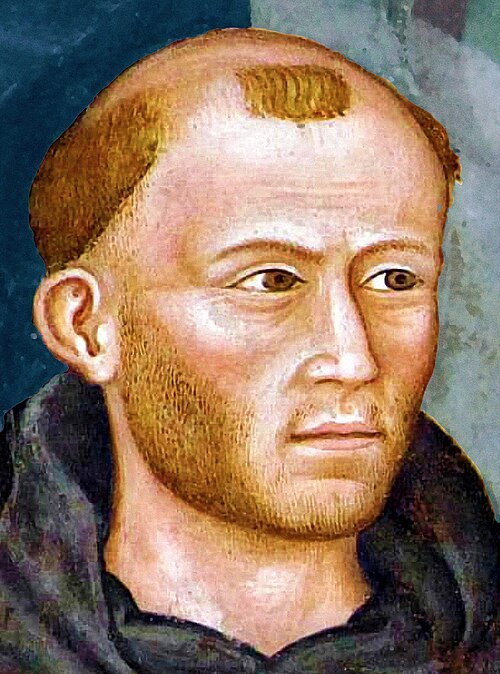 Meister Eckhartc. 1260-1328praying God to be rid of God
Background: The philosophy of Plotinus: the hypostases, procession and conversion · The thought of Meister Eckhart: detachment, the birth of God in the soul, the trial · Christian mysticism: from Dionysius to John of the Cross and quietism · Medieval Christendom: from the fall of Rome to the stake · Schopenhauer's philosophy: the Will, suffering, compassion, the denial of the will
The Christian prehistory begins with a scandal. The Dominican Eckhart of Hochheim, master of theology in Paris, preached in Strasbourg and Cologne, in German, to nuns and to lay people, sermons of an audacity without equal. He died during his trial; the bull In agro dominico of John XXII, in 1329, condemned twenty-eight propositions drawn from his works. I do not settle the question of his orthodoxy, which is still debated; I read a sermon that contains, four centuries before the Enlightenment, the most radical critique of the image of God.
The sermon numbered 52 in Josef Quint's critical edition comments on the first beatitude, “Beati pauperes spiritu”, blessed are the poor in spirit. Eckhart gives there a definition of poverty that rejects every pious definition. In Gustav Landauer's modern German translation (1903): “Das ist ein armer Mensch, der nichts will und nichts weiss und nichts hat”, he is a poor man who wills nothing, knows nothing and has nothing. To will nothing is not even to will to accomplish the will of God: Eckhart specifies that as long as a man's will is to accomplish the most dear will of God, he does not have the poverty of which he speaks, for he still has a will. To know nothing is not even to know that God is at work in oneself; to have nothing, not even to be a place where God might work.
From this Eckhart draws a prayer: “Darum bitte ich Gott, dass er mich Gottes quitt mache”, therefore I pray God to rid me of God. The Middle High German reads, in Franz Pfeiffer's edition: “hier umbe so bite ich got, daz er mich quit mache gotes” (Deutsche Mystiker des vierzehnten Jahrhunderts, vol. II, Leipzig, 1857, sermon LXXXVII, p. 283, which is sermon 52 in Quint's numbering); I have not checked the text established by Quint (DW II). Eckhart justifies the request by a distinction: the God of whom one must be rid is God as creator, the God who stands over against the creature, the one the creature represents to itself; beyond him there is a being without mode, “über Gott und über Unterschiedenheit”, above God and above all difference, where the soul was before it was created.
History has read this sentence in two ways. The first, orthodox at least in intention, sees in it negative theology pushed to its limit, that of Pseudo-Dionysius, for whom God surpasses all names, including the name of God. To pray to be rid of God is to pray to be rid of the idol one makes of him, in order to reach the nameless Godhead. The second is modern, and it will make Eckhart an ancestor of the spiritualities without God: detachment, Gelassenheit, becomes an exercise in dispossession that no longer needs any object. Schopenhauer will hail in Eckhart a brother of the sages of India; Simone Weil will speak of decreation.
Eckhart establishes what modern critics will often forget: the critique of the representation of God, far from being an invention of unbelief, lies at the heart of Christian mysticism. When Feuerbach comes to say that the believers' God is a projection of man, he will be saying what Eckhart says of God the creator, and will draw the opposite conclusion: Eckhart leaves the image of God to enter the Godhead, Feuerbach to return into man. The two gestures have the same form. The confrontation is constructed; it shows at least that the boundary between the critique of religion and spirituality does not run where one thinks.
Portrait: Andrea di Bonaiuto, CC BY-SA 4.0
Transition: from the Law to reason
Background: Aristotle's philosophy: act and potency, causes, the unmoved mover, virtue, contemplation · Medieval Christendom: from the fall of Rome to the stake · Scholasticism and the condemnations: faith and reason in the medieval university
At the close of the Middle Ages, the critique of religion does not yet exist as a project, but it already has three of its gestures. The first is political: in Plato, Aristotle and Averroes, religion appears for the first time as a function of the city, which the philosopher can judge useful without holding it literally true. The second is therapeutic: Epicurus and Lucretius deliver people from the fear of the gods without denying the gods. The third is apophatic: Plotinus, Maimonides and Eckhart deny of God everything that is said of him, to the point that Feuerbach will see in negative theology a subtle atheism. They share one trait, which will fade in the classical age: they all presuppose an elite, philosophers, sages or mystics, and a multitude left with its images. We must first go back in time to follow the birth of Christianity, which received the God of the Greek philosophers long before the Moderns reworked him and democratized the question.
Part Twothe birth of Christianity, between Athens and Jerusalem
Background: Biblical chronology: the time of the story and the time of the writing · Christianity in the Roman Empire: from Nero to Diocletian · The Bible: books, canons and languages · From Constantine to Theodosius: Christianity as the religion of the Empire · Why Christianity prevailed: the historians' explanations · Byzantium and Russian Orthodoxy: the other Christianity · The vocabulary of Christian theology: revelation, grace, salvation, original sin · The New Testament: twenty-seven books, their dates and their authors · How the canon was formed: criteria, lists and excluded texts
The origin of Christianity is not a matter for historians that lies outside our question. Every critique of the Christian religion presupposes a thesis about its birth: Feuerbach thinks it is the projection of the human essence, Nietzsche that it is the work of Paul, Strauss and Bauer that it is a myth, Engels that it is the uprising of the oppressed of the Empire, Onfray that it is a literary fiction. And every refoundation takes up something of this birth, since it was there that the bond was tied between a God of the Law, who came from Jerusalem, and a God of reason, who came from Athens. Tertullian, c. 200, gave the opposition its most famous form: “Quid ergo Athenis et Hierosolymis? quid academiae et ecclesiae?”, what then has Athens to do with Jerusalem, the Academy with the Church? (De praescriptione haereticorum, 7, 9). And he adds, against those who have produced “a Stoic, Platonic and dialectical Christianity” (“Stoicum et Platonicum et dialecticum christianismum”), that after Jesus Christ curiosity is no longer needed (ibid., 7, 11-12). But the question is rhetorical in a sense he did not intend: Athens and Jerusalem already had a great deal in common. Nietzsche, seventeen centuries later, reversed the reproach while keeping it: “Christenthum ist Platonismus für's "Volk"”, Christianity is Platonism for the “people” (Jenseits von Gut und Böse, preface). The formula is polemical, but it points to a fact that historians do not dispute: Christianity thought itself in the categories of Greek philosophy, beginning with that of the Logos. We shall follow this passage from Philo of Alexandria, who reads Genesis with the Timaeus, to Augustine, who turns the God of the Platonists into a God to whom one prays, by way of Celsus and Porphyry, whose critiques, Platonist in character, already contained almost all the arguments of the Enlightenment.
 Philo of Alexandriac. 20 BCE-c. 45/50 CEMoses read with the Timaeus
Background: Judaism: from the Second Temple to emancipation · Genesis 1 to 3: the creation, Adam and Eve, the fall · The thought of Philo of Alexandria: Genesis read with Plato · The thought of Origen: allegory, the pre-existence of souls, apocatastasis · Councils and the formation of dogma: from Nicaea to Chalcedon · Hermeneutics: from Schleiermacher to Ricoeur · Between the two Testaments: the Maccabees, Enoch, Qumran and apocalyptic expectation · The Gospel of John: the Word made flesh · Messiah, Son of Man, Son of God: the titles of Jesus
Philo is a Jew of Alexandria, an exact contemporary of Jesus, born into one of the wealthiest families of the community, and in 39-40 a member of the embassy that pleaded the cause of his fellow Jews before the emperor Caligula. He writes in Greek, reads the Bible in the Greek translation of the Septuagint, and comments on it in an immense body of work, almost entirely allegorical. Nothing suggests that he ever heard of Jesus, and none of his treatises mentions the Christian movement. Yet he supplied nascent Christianity with the tool that allowed it to think its God as a philosopher would.
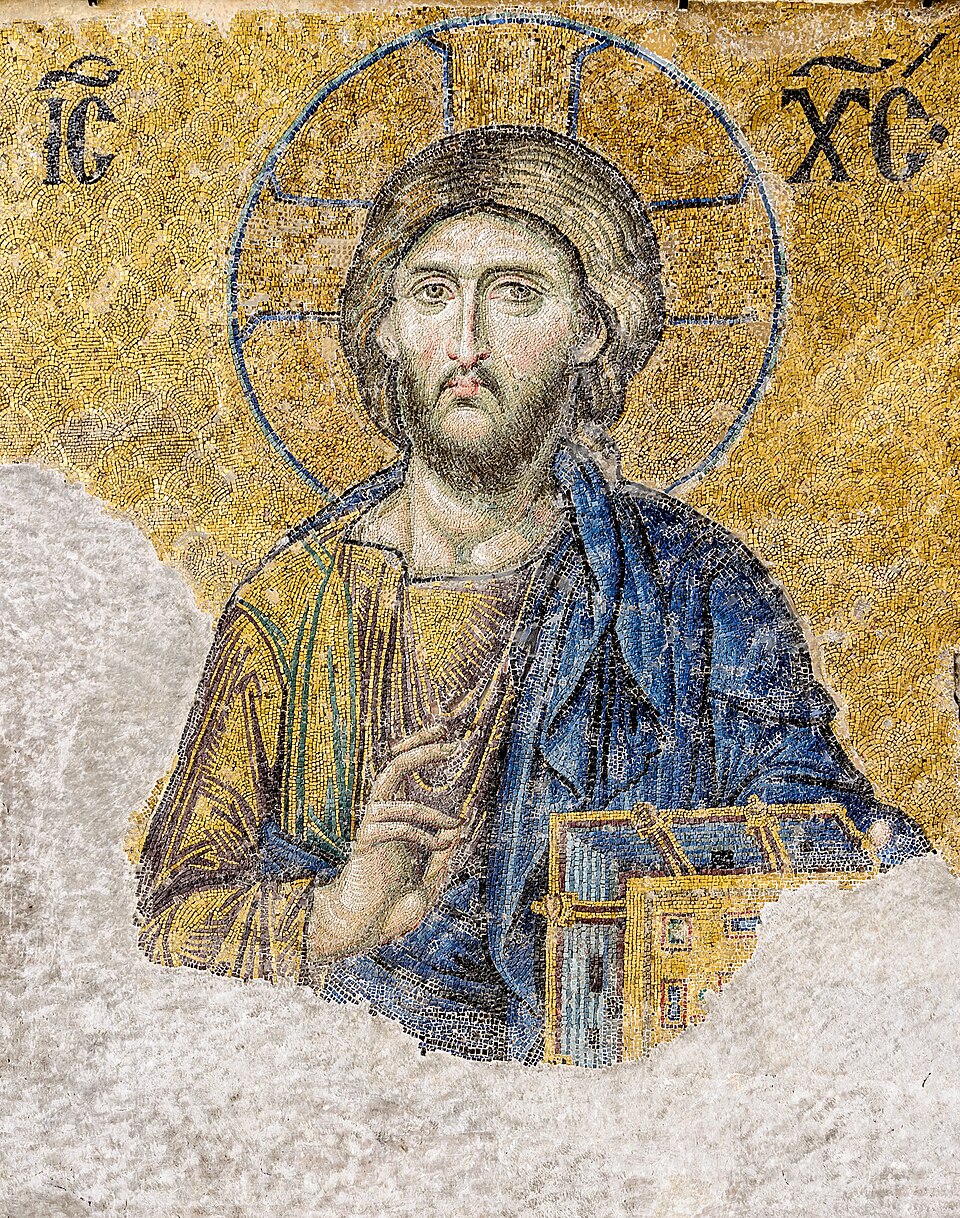
His project comes down to one assertion, set out at the beginning of the De opificio mundi, his treatise on the creation of the world: Moses is a philosopher, and indeed the first. Moses, he writes, had reached the summits of philosophy very early, and had learned from the oracles of God the most numerous and most important principles of nature (De opificio mundi, 8). Genesis and the Timaeus therefore say the same thing, and when they seem to diverge, it is because the letter of Genesis hides a meaning that allegory must uncover.
The heart of the doctrine is the Logos. Reading Genesis with the Timaeus requires solving a difficulty that the Timaeus itself leaves open: how can the transcendent God, who has nothing in common with matter, shape the world? Plato placed the Ideas, eternal models, between the demiurge and the world. Philo places them in the mind of God, and he calls this mind in act the Logos. If one wished to speak plainly, he says, one would not say that the intelligible world is anything other than the Logos of God already engaged in creating the world, just as the intelligible city is nothing other than the thought of the architect who plans to build it; and he immediately adds that this is the doctrine of Moses, not his own (De opificio mundi, 24-25). The Logos is thus at once the place of the Ideas, the instrument of creation and the model of man, since man is made “in the image of God”. Philo goes so far as to call it, in a passage of the Questions on Genesis whose Greek original is lost but which Eusebius of Caesarea preserved, the “second God”: nothing mortal could be made in the likeness of the supreme God and Father of the universe, but only in the likeness of the second God, who is his Logos (Quaestiones in Genesim II, 62, quoted by Eusebius, Preparation for the Gospel VII, 13).
A Jew faithful to the Law, who recited every day that God is one, thinks the world on the basis of a divine intermediary who is not God himself and whom he nonetheless names “second God”. In Philo this is not a person, still less a man: the Logos is a function of divine thought, which Philo describes now as a power, now as an archangel, now as the high priest of the world, without ever fixing the metaphor. But a few decades later the prologue of the Gospel of John would write: “Ἐν ἀρχῇ ἦν ὁ λόγος, καὶ ὁ λόγος ἦν πρὸς τὸν θεόν, καὶ θεὸς ἦν ὁ λόγος”, in the beginning was the Word, and the Word was with God, and the Word was God (Jn 1, 1), and then what Philo could never have written: “Καὶ ὁ λόγος σὰρξ ἐγένετο”, and the Word became flesh (Jn 1, 14). Whether or not Philo directly influenced John, a disputed question, the concept was available, and it was through it that Christianity entered philosophy.
The allegorical method is the common ancestor of almost all the religious hermeneutics of the West. Philo starts from a principle he holds to be self-evident: God has neither hands, nor anger, nor repentance, and when Scripture ascribes them to him, it speaks the language of men in order to be understood by them. Every narrative therefore has two senses, the literal, which serves the multitude, and the figurative, addressed to those who know how to read. The garden of Eden becomes virtue, the patriarchs become dispositions of the soul, the exodus from Egypt becomes the soul's departure from the body. Philo does not for all that despise the letter: he expressly reproaches the radical allegorists of his time for neglecting the observance of the Law on the pretext of having understood its meaning. The two levels of reading are thus a way of holding together the community and philosophy, the practice of all and the contemplation of a few. One recognizes the division that Averroes would theorize eleven centuries later.
Philo also left, in the De vita contemplativa, the description of a community of men and women, the Therapeutae, who lived near Lake Mareotis in prayer, the study of the Scriptures and song, withdrawn from the city. Reality or ideal, it is the first image of a spiritual life that is neither the worship of the Temple nor the school of the philosophers, but a form of life governed by contemplation. The Christian monks of Egypt, two centuries later, recognized their ancestors in it, and Eusebius even believed that the Therapeutae were Christians. The confusion is instructive: the form of spiritual life preceded the doctrine that would appropriate it.
The most instructive fact of his history is his posterity: rabbinic Judaism did not hand him down; the tradition that kept him is Christian. It was Christians of Alexandria, Clement and then Origen, who read him, quoted him, imitated him and copied his manuscripts; it was Christians, such as Eusebius, who preserved for us what we have lost of his Greek text. This is the consensus of historians. Judaism, which was to rebuild itself after the destruction of the Temple in 70 around the Law and its commentary, had no need of a Logos; Christianity, which had to explain how a crucified man could be the son of a single God, needed one vitally. Philo supplied a religion that was not his own with the philosophy it was looking for.
Philo belongs to the regime of allegory, prior to all the regimes of critique: he does not criticize religion, he translates it into philosophy. This translation has two faces: it shields the Law from the rationalist objection, but it installs in biblical religion a philosopher's God, without passion and without a face. Philo is thus, before Christianity, the inventor of what Heidegger would call onto-theology, applied to the Bible. His allegorical reading also has a price, which Spinoza would make Maimonides, his distant heir, pay (Part One): if one can always read beneath the letter the meaning that reason demands, reason no longer learns anything from Scripture. With regard to the criterion, finally, Philo refounds nothing and demands no new sacrifice; he makes Greek philosophy religious, and biblical religion philosophical.
Portrait: André Thevet, Les Vrais Pourtraits (1584), Public domain
Paul of Tarsusd. c. 64/67Christ crucified, folly to the Greeks
Background: Judaism: from the Second Temple to emancipation · Paul of Tarsus: the letters, justification, the Law and the new perspective · Why Christianity prevailed: the historians' explanations · Historical-critical exegesis and the quests for the Jesus of history · Engels: dialectical materialism, the history of early Christianity, the reckoning with Feuerbach · Between the two Testaments: the Maccabees, Enoch, Qumran and apocalyptic expectation · The Acts of the Apostles: from Jerusalem to Rome · The letters of Paul: Romans, Corinthians and the others · Sacrifice in the Bible: from Abel's altar to self-offering
If Philo supplied the concept, Paul supplied the scandal. Still, one must know which Paul one is speaking of. Of the thirteen letters the New Testament attributes to him, historical criticism holds only seven to be authentic: the First Letter to the Thessalonians, the Letter to the Galatians, the two Letters to the Corinthians, the Letter to the Romans, the Letter to the Philippians and the note to Philemon. This is the dominant interpretation, almost a consensus; the others are called deutero-Pauline, written in his school after his death. These seven letters, composed between about 50 and 60, are the oldest Christian texts we have, earlier than all the Gospels. The Acts of the Apostles, which tell his life, are later by at least a generation, composed by the author of the Gospel of Luke with an ancient historian's freedom that calls for caution.
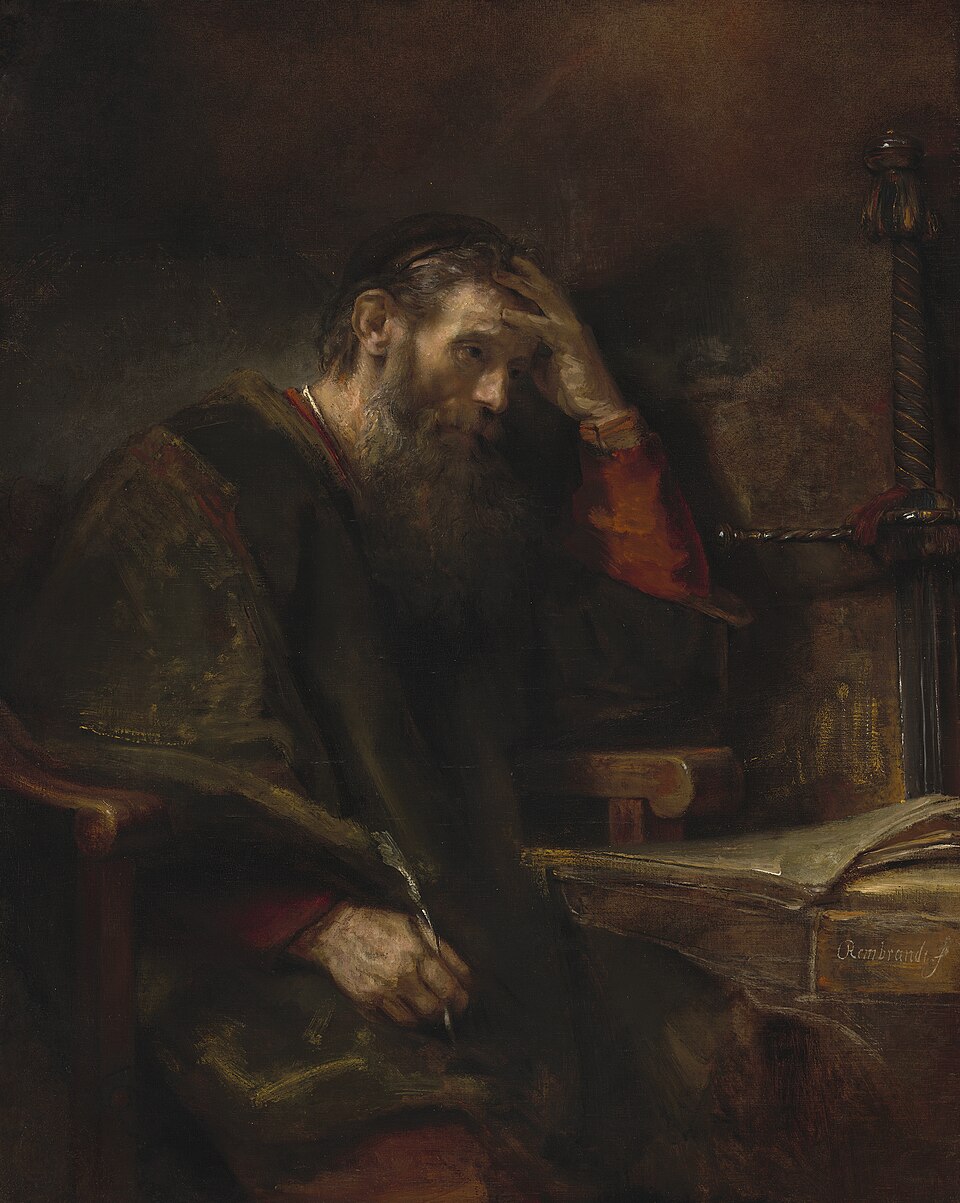
Paul presents himself as a Jew, and even as an elite Jew. He reminds the Galatians of what his conduct had been “in Judaism”, how he persecuted the Church, and how he “advanced in Judaism beyond many of [his] own age” (Ga 1, 13-14). He does not say that he left Judaism for a new religion; he says that it pleased God “to reveal his Son in me, that I might proclaim him among the nations” (Ga 1, 16). Scholarship in the second half of the twentieth century insisted on this point: the “new perspective on Paul”, inaugurated by E. P. Sanders (Paul and Palestinian Judaism, 1977), challenged the Lutheran image of a Paul who set Christian grace against a Judaism of legal performance: the Judaism of his time, Sanders shows, was already a religion of the covenant received by grace, and Paul does not leave Judaism, he opens its borders to the nations. Without settling this debate among exegetes, we may note that the presumed founder of Christianity did not think of himself as the founder of a religion.
What he founds, however, is unheard of, and he knows it. The First Letter to the Corinthians contains the sentence that sums up the encounter of Athens and Jerusalem, and makes it impossible: “ἐπειδὴ καὶ Ἰουδαῖοι σημεῖα αἰτοῦσιν καὶ Ἕλληνες σοφίαν ζητοῦσιν, ἡμεῖς δὲ κηρύσσομεν Χριστὸν ἐσταυρωμένον, Ἰουδαίοις μὲν σκάνδαλον, ἔθνεσιν δὲ μωρίαν”, Jews demand signs and Greeks seek wisdom, but we proclaim Christ crucified, a scandal to Jews and folly to the Gentiles (1 Co 1, 22-23). Paul does not offer a wisdom better than that of the philosophers; he offers a folly, a God who manifests himself in the punishment reserved for slaves. Philo's Logos was the place of the Ideas; Paul's Christ is a condemned man.
Acts nevertheless tells of an attempt at reconciliation, the scene in which Athens and Jerusalem physically meet. Paul, in Athens, debates with Epicurean and Stoic philosophers, who take him to the Areopagus. There he delivers a speech that starts from an altar “to an unknown god”, quotes a Greek poet, “for we are also his offspring”, and declares that God “does not dwell in temples made with hands”; then he announces the judgement and the resurrection of a man, and at that point, says the narrative, “some mocked, and others said: We will hear you again about this” (Ac 17, 22-32). This speech is, according to the dominant interpretation among exegetes, a composition by Luke rather than a transcript, but it rightly shows where the frontier lies. A creator God who does not dwell in temples, the Stoics could understand, and Plato had almost said as much; it is the resurrection of a body that makes the Areopagus laugh. Christianity can speak Greek as long as it speaks of God; it ceases to be Greek as soon as it speaks of the flesh.
The oldest testimony to the content of the faith is in Paul, and it is a received account rather than a doctrine: the formula of 1 Co 15, 3-5, which we shall meet again in connection with the existence of Jesus, hands down the death of Christ for our sins according to the Scriptures, his burial, his resurrection on the third day and his appearances to Cephas, then to the twelve. Paul writes c. 54; he says he is handing on what he received, probably in Damascus or Jerusalem, in the thirties. And in the Letter to the Galatians he mentions his meeting with Cephas, that is, Peter, and with James, the brother of the Lord (Ga 1, 19). This verse will weigh heavily in the debate on the historical existence of Jesus.
Two features of Paul's thought matter for our debate. The first is his universalism. “There is neither Jew nor Greek, there is neither slave nor free, there is no male and female; for you are all one in Christ Jesus” (Ga 3, 28). The sentence does not promise the abolition of slavery or the civil equality of the sexes, and elsewhere Paul sends the slave back to his master; it declares that these distinctions no longer count before God. That is little from the point of view of politics, and it is immense from the point of view of ancient religion, which was always the religion of a people, a city or a station in life. The second feature is his expectation of the end. The oldest letters assume that Christ will return within the lifetime of those to whom they are addressed. The dominant interpretation among historians draws from this a consequence that theologians long refused: Pauline Christianity is first of all an eschatology, an expectation of the imminent end of the world, and not a morality or a metaphysics. Albert Schweitzer, at the beginning of the twentieth century, would make it the key to all research on Jesus.
Engels, who had read Bruno Bauer closely, drew from these two features an analogy that has enjoyed lasting success. “Die Geschichte des Urchristentums bietet merkwürdige Berührungspunkte mit der modernen Arbeiterbewegung”, the history of early Christianity offers curious points of contact with the modern labour movement: like it, Christianity was originally a movement of the oppressed, and both proclaim an imminent deliverance from bondage and misery (Zur Geschichte des Urchristentums, 1894). Engels adds that Christianity places this deliverance in the beyond and socialism in this world. The analogy is illuminating and dangerous: it illuminates the sociology of the first communities, and announces without meaning to what Löwith would reproach Marxism with, namely that it is a transposed eschatology. Celsus, as we shall see, was already saying with contempt what Engels says with sympathy.
Did Paul invent Christianity? That is Nietzsche's thesis, for whom Paul is the bearer of bad tidings (Part Seven): Paul “verlegte einfach das Schwergewicht jenes ganzen Daseins hinter dies Dasein”, simply shifted the centre of gravity of that whole existence beyond this existence, into the lie of the risen Jesus, and his need was power (Der Antichrist, § 42). Renan, in his Saint Paul (1869), had already set the Galilean Jesus of the parables against the theologian of Tarsus, with less violence and more melancholy. The comparison is constructed, since Nietzsche does not quote Renan on this point; the two readings converge on a Jesus without doctrine and a Paul without Jesus.
I believe this thesis is half right. Right, in that Paul made a theology out of an execution, and that the letters take almost no interest in the life of Jesus, in his words, in his deeds: all that counts is the cross and what follows it. Wrong, in that it makes Paul a solitary inventor. Paul says he “received” the formula of 1 Co 15, he keeps company with Peter and James, he quarrels with them over whether converted Gentiles must observe the Law; he joins a movement that existed before him and already believed Jesus risen. And Nietzsche, like Renan, is unaware of what Sanders has shown: for Paul the cross is not the rejection of Judaism, it is its fulfilment for the nations. With regard to the criterion, finally, a phrase from the Letter to the Romans deserves attention: “I appeal to you therefore, brothers, by the mercies of God, to present your bodies as a living sacrifice, holy and acceptable to God, which is your reasonable worship” (Rm 12, 1). Blood sacrifice is replaced by self-offering, and this worship is called logikê, in keeping with the Logos. Paul spiritualizes sacrifice instead of abolishing it. It is an immense advance over the burnt offerings, and it is at the same time the birth certificate of a religion that will be able to demand that the individual offer himself entirely.
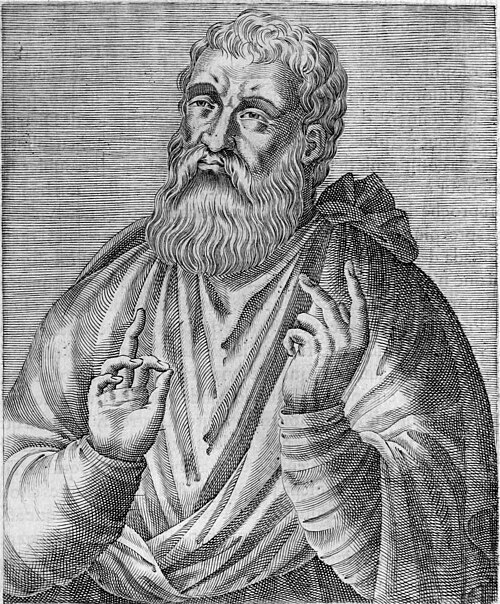 Justin Martyrc. 100-c. 165the Logos sown in all human beings
Background: Christianity in the Roman Empire: from Nero to Diocletian · The religion of the Greek city: sacrifices, festivals, oracles, impiety trials · The thought of Philo of Alexandria: Genesis read with Plato · Justin and the apologists of the 2nd century: Christianity as philosophy · The Acts of the Apostles: from Jerusalem to Rome
Born in Samaria into a pagan family, Justin sought the truth among the philosophers before finding it, he says, among the prophets. Converted c. 130, he opened a school in Rome where he taught Christianity as a philosophy, wearing the philosopher's cloak, and he died a martyr there c. 165. His two Apologies, addressed c. 150-155 to the emperor Antoninus and to the senate, are the first systematic effort to present the Christian faith to the Greco-Roman world in its own language. They rest on an idea that Philo had prepared and that Justin carries to its conclusion: the Logos that became flesh in Jesus was already present, in part, in all human beings.
The thesis is stated with a clarity that is still astonishing. Christ, Justin writes, is the Logos in which the whole human race has had a share, and those who lived according to the Logos are Christians, even if they were held to be atheists: among the Greeks, Socrates and Heraclitus and those like them; among the barbarians, Abraham, Elijah and many others (1 Apology, 46). The word “atheists” carries all the weight here. Christians were accused of atheism because they refused the gods of the city; Socrates had been accused for the same reason, and the trial of Socrates becomes the precedent for Christian martyrdom. Justin says so expressly in the Second Apology: Socrates was accused of the same crimes as we are, of introducing new divinities and of not recognizing the gods the city recognized (2 Apology, 10). This is the very crime that the law of the Laws punished: at its birth, Christianity presents itself as the religion of the impious according to Plato and of the just according to Socrates.
The same chapter contains a quotation over which Celsus and Origen would argue. Justin writes that Socrates urged men to come to know the God unknown to them through the inquiry of reason, saying that it is neither easy to find the Father and maker of all things nor safe, having found him, to declare him to all (2 Apology, 10). This is the Timaeus, which Justin attributes to Socrates: “τὸν μὲν οὖν ποιητὴν καὶ πατέρα τοῦδε τοῦ παντὸς εὑρεῖν τε ἔργον καὶ εὑρόντα εἰς πάντας ἀδύνατον λέγειν”, to find the maker and father of this universe is a task, and having found him, it is impossible to declare him to all (Timaeus 28c). For Justin, Christ did what Plato declared impossible: the Father, inaccessible to the philosophers, made himself known to all.
The doctrine that gave its name to Justin's thought is that of the Logos spermatikos, the seminal reason. Each of the philosophers, he writes, spoke well insofar as he had a share in the seminal Logos, seeing what was akin to it; and whatever has been well said among all men belongs to us Christians (2 Apology, 13). The formula is double, and its two faces have had two opposite posterities. On the one hand, it is an opening of rare generosity: truth is not the preserve of the baptized, it is sown in all, and one can be a Christian without knowing it. On the other, it is an annexation: everything that is true in others is ours. Justin adds that he professes Christianity not because Plato's teachings are foreign to those of Christ, but because they are not in every respect similar to them (ibid.). Plato saw a part; Christ is the whole.
Justin also wrote, c. 160, a Dialogue with Trypho, in which he discusses the interpretation of the Scriptures with a cultivated Jew. The book opens with the account of his conversion: he had gone through the schools, Stoic, Peripatetic, Pythagorean, and had settled on Platonism, which promised him the sight of God, when an old man met by the seashore showed him that the prophets knew more than the philosophers. The account is no doubt stylized, but it says the essential: Christianity is not the opposite of philosophy, it is its fulfilment, the only one that keeps its promises. Hegel would take up this scheme by inverting it, since for him it is philosophy that fulfils religion by raising it to the concept; the comparison, which is constructed, shows that the question of which fulfils the other has never ceased to be asked.
The Dialogue with Trypho also has a dark side: it is one of the first texts in which separation from Judaism becomes a polemic against it: the Law is presented there as a discipline imposed on the Jews because of the hardness of their hearts, and the Church as the true Israel. The doctrine of the seminal Logos, so welcoming towards the Greeks, is much less so towards the Jews, whom it reproaches for having had the Word before their eyes without recognizing it. Christian universalism thus begins with an exclusion, and the long history of Christian anti-Judaism finds one of its roots there.
An argument that now seems naive has had a long history. Justin asserts that Plato borrowed from Moses his doctrine of creation from formless matter, and even that the passage of the Timaeus in which the world soul is arranged “in the shape of a chi”, crossed within the universe, comes from the bronze serpent that Moses raised in the desert, read by Plato as a cross he did not understand (1 Apology, 59-60). This is the thesis of the “theft of the Greeks”, taken up by Clement of Alexandria and by Eusebius: Greek wisdom is later than Moses and derived from him. Historically false, it answers a polemical necessity: in a world where antiquity confers authority, a religion born under Tiberius had to prove that it was older than Plato.
Justin made Christianity a philosophy, and it is as a philosopher that he dies, refusing to sacrifice to the gods of the Empire. Martyrdom here is not the sacrificial absolute that the criterion denounces: it is the Roman state, not Justin's doctrine, that demands the sacrifice, and Justin dies for having refused an act of worship. But the doctrine of the seminal Logos contains in germ the other danger: if everything that is true belongs to Christians, those who deny it are not merely in error, they are withholding what does not belong to them. Justin's openness and the intolerance of the following centuries come out of the same sentence.
Portrait: André Thevet, Les Vrais Pourtraits (1584), Public domain
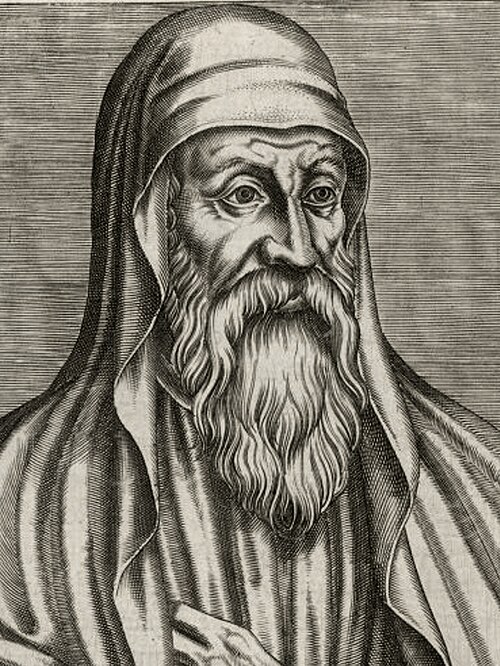 Celsus and Origenthe first critique of Christianity, and its answer
Background: Christianity in the Roman Empire: from Nero to Diocletian · Justin and the apologists of the 2nd century: Christianity as philosophy · Celsus and the True Doctrine: the first philosophical critique of Christianity · The thought of Origen: allegory, the pre-existence of souls, apocatastasis · Councils and the formation of dogma: from Nicaea to Chalcedon · The mysteries and Orphism: Eleusis, Orpheus, Cybele, Isis, Mithras · The apocryphal gospels: Thomas, Peter, Mary, Judas and the others · How the canon was formed: criteria, lists and excluded texts · How the Bible has been read: allegory, the four senses, historical criticism
Around 178, under Marcus Aurelius, a Platonist philosopher of whom we know almost nothing, Celsus, wrote against the Christians a treatise he entitled Alêthês logos, The True Word. The book is lost. We know it because Origen, around 248, at the request of his patron Ambrose, refuted it sentence by sentence in the eight books of Against Celsus, quoting his adversary at length. Origen says as much in the very preface: he is answering the treatise that was sent to him, which he does not think anyone, however little advanced in philosophy, will accept as a “true word”, as Celsus entitled it (Against Celsus, preface, 4). A complete paradox: the first great anti-Christian pamphlet has reached us only through the piety of a theologian who wanted to destroy it. It is an attested response, the oldest in this essay.
Celsus's accusations fall into four families. The first targets the person of Jesus: Celsus has a Jew speak, who reproaches Jesus for having invented his virgin birth, for having been born in a village of Judea to a poor spinner driven out by her husband, a carpenter, for adultery; Jesus is said to have hired himself out as a servant in Egypt, to have learned marvellous powers there, and to have come back to proclaim himself a god (Against Celsus I, 28). The father is said to be a soldier named Panthera (I, 32). Celsus then compares the miracles of Jesus to the tricks of the charlatans who, in the marketplaces, for a few obols, drive out demons and cure diseases (I, 68). This is the magician thesis, which denies the divinity of Jesus, not his existence.
The second family targets faith itself. Celsus reproaches the Christians for wanting neither to give nor to receive a reason for what they believe, and for repeating: do not examine, believe, your faith will save you; and he compares them to the begging priests of Cybele and to soothsayers (I, 9). The third targets their audience. According to Celsus, the Christians say: let no educated, wise or prudent man come to us, but if anyone is ignorant, foolish, uneducated, let him come with confidence; which shows, he concludes, that they neither want nor are able to win over anyone but the simple, the nobodies, slaves, women and children (III, 44). The fourth, the most interesting for us, accuses the Christians of having misunderstood Plato: whatever is good in Scripture, Plato said better, without bombast and without promises (VI, 1), and the Christians who speak of a “supercelestial” God have merely misread the Phaedrus (VI, 19).
Celsus thus anticipated almost the whole of the modern critique. The thesis of credulity, which demands reasons, is that of Voltaire and d'Holbach. The social thesis, which makes Christianity a religion of slaves and the ignorant, will be Nietzsche's, turned into an accusation of ressentiment, and Engels's, turned into a eulogy of the oppressed. The thesis of borrowing, which makes Christianity a degraded Platonism, announces Nietzsche's formula quoted at the head of this part. And the scandalous genealogy of Jesus, son of a soldier and a repudiated woman, will be taken up by medieval Jewish polemic, then by the libertines. A single argument is missing, and its absence is remarkable: Celsus never claims that Jesus did not exist; on the contrary, he despises him because he lived and was crucified. The first adversary of Christianity, who lived a century and a half after the crucifixion and had every interest in denying whatever he could deny, does not deny that.
Origen's answer ranks among the great texts of Christian thought because it accepts the adversary's ground. On credulity, Origen answers that, if it were possible for all men to leave the business of life and devote themselves to philosophy, no other method should be followed but that one; but that this is impossible, and that faith is the path of those who cannot philosophize, without Christianity thereby renouncing inquiry and interpretation (I, 9). On the audience, he answers that the ambassadors of truth must seek to win over the greatest number, the simple as well as the intelligent, barbarians as well as Greeks, and that those who turn away from the ignorant as from slaves incapable of following a polished discourse strangely restrict the public good (VI, 1).
The climax of the dispute is an exchange about the Timaeus. Celsus sends the Christians back to Plato as a better teacher of theology, and quotes the sentence Justin had already quoted: it is hard to find the maker and father of this universe, and having found him, impossible to make him known to all; see, he adds, how divine men seek the way of truth, and how well Plato knew that it was impossible for all to walk in it (VII, 42). Origen answers that these words of Plato are noble and admirable, but that Scripture shows a still greater love of humankind in the Logos of God, who was in the beginning with God and who became flesh, in order to reveal to all what, according to Plato, it was impossible to make known to all (ibid.). The whole difference between Platonism and Christianity lies there. For Celsus, the knowledge of God is the privilege of an elite, and the multitude must keep to the cults of the city. For Origen, it is offered to all, because God himself came down to them.
Still, one must measure what Origen grants his adversary. Origen is himself a philosopher trained in Alexandria, a pupil, according to Porphyry, of the same Ammonius who was Plotinus's teacher. He reads Scripture according to Philo's method, on three levels, body, soul and spirit, and does not shrink from theses that the Church would later judge unacceptable: the pre-existence of souls, or the hope that all beings, perhaps even the devil, will in the end be restored in God. These doctrines, or those attributed to him, were condemned in the sixth century, long after his death, and most of his Greek work was lost for that reason. The first great Christian theologian, who had answered the first great critique, thus ended up a posthumous heretic. The lesson is twofold: Christian theology was built by borrowing from Greek philosophy its weapons against Greek philosophy, as Celsus accused it of doing; and the institution that came out of it ended up condemning the man who had best defended it, for having thought too much. Eckhart, also condemned after his death, would meet the same fate: the critique of religion has often begun inside theology, among those whom the Church afterwards rejected.
Celsus, moreover, is not a sceptic. He believes in a supreme God, inaccessible, whom only the wise approach, and in a host of lesser divinities, demons in the Greek sense, who govern peoples and places and to whom it is right to render the honours that custom prescribes. This is therefore not the critique of an unbeliever, but that of a man who cares about the hierarchy of the divine and about traditional piety, and who sees in a religion claiming universality a threat to the order of the world. That is why it seems to me wrong to make him the ancestor of modern atheists. He is the ancestor of those who defend religion for the order it secures, from Voltaire to Maurras and down to the later Onfray, who defends a Christian civilization without sharing its faith. The first adversary of Christianity was a religious conservative.
The dispute also concerns the city, and in that way it bears directly on our question. At the end of his treatise, Celsus adjures the Christians to help the emperor with all their strength, to work with him to uphold justice, to fight for him and, if need be, under his command; and he urges them to accept the public offices required to uphold the laws and religion (Against Celsus VIII, 73 and 75). Celsus does not ask the Christians to believe in the gods; he asks them to be citizens, that is, to take part in the civil religion without which, he thinks, the Empire dissolves. Origen answers that the Christians help the emperor by their prayers better than soldiers by their arms, and above all that the Christians recognize, in each city, the existence of another homeland, founded by the Logos of God, the Church, whose offices they prefer to serve (VIII, 73 and 75).
This answer gives birth to an idea that would govern the whole political history of the West: the separation of the religious community from the political community. For Celsus as for Plato, religion is a matter for the city; for Origen, there are two cities, and the higher is not the emperor's. Augustine would give this idea its finished form in the City of God. It has two faces. It frees conscience from the grip of the State, and Bayle, Locke and the Enlightenment would be its distant heirs. But it also creates a second power, the Church, which would in turn be able to demand what the city used to demand.
Who is right? Justice must first be done to Celsus, whom the Christian tradition has treated as a slanderer. His arguments on credulity and on the borrowings from Platonism are strong, his information on the Jewish polemic of his time precious. But his position rests on the Platonic presupposition par excellence, the division between the philosophers who know and the multitude who believe what the city prescribes for them: Celsus is the last heir of Plato the legislator. Origen, for his part, opens the door to spiritual equality: the God of the philosophers becomes everyone's God, and the slave can know as much as Plato. But he closes, at least in germ, the door to freedom of thought: if the truth is given to all by revelation, the one who refuses it is no longer an ignorant person to be enlightened, he becomes a rebel. The dispute is therefore symmetrical. Celsus defends a political absolute, the gods of the city, to which the individual must sacrifice; Origen defends a revealed absolute, which Christian power would soon impose with the same rigour. Neither of them leaves religion. But from their dispute are born the very idea of a critique of religion by reason and the idea, just as modern, that it must be possible to tell the truth to all.
Portrait: André Thevet, Les Vrais Pourtraits (1584), Public domain
 Porphyry and Augustinethe last adversary and the first synthesizer
Background: Biblical chronology: the time of the story and the time of the writing · From Constantine to Theodosius: Christianity as the religion of the Empire · Genesis 1 to 3: the creation, Adam and Eve, the fall · Porphyry: the editor of Plotinus and the critic of the Christians · The thought of Augustine: Confessions, City of God, grace, original sin, controversies · Councils and the formation of dogma: from Nicaea to Chalcedon · The prophets of Israel, the exile and the book of Daniel · The vocabulary of Christian theology: revelation, grace, salvation, original sin · How the canon was formed: criteria, lists and excluded texts
The dispute between Celsus and Origen has a sequel, and it takes place in the same school. Porphyry of Tyre (c. 234-c. 305), disciple and editor of Plotinus, knew Origen in his youth and judged him severely. In a fragment preserved by Eusebius, he relates that Origen, a pupil of Ammonius, the most learned philosopher of his time, had drawn from his teacher a great knowledge of the sciences, but that, in the conduct of his life, he had taken the opposite road, passing from Greek culture to “barbarian audacity” (Eusebius, Ecclesiastical History VI, 19). For a third-century Platonist, Christianity is not a philosophy; it is a barbarism that stole philosophy.
Of his Against the Christians, written around 270 according to the most common dating (others place it around 300), only fragments quoted by his refuters remain. The most famous concerns the book of Daniel. Jerome reports, in the prologue to his commentary, that Porphyry devoted his twelfth book to denying that Daniel was written by the prophet whose name it bears, and to maintaining that it was composed in Judea in the time of Antiochus Epiphanes, so that Daniel did not predict the future but recounted the past (Jerome, Commentary on Daniel, prologue). This is also the conclusion of modern historical-critical exegesis, which dates the composition of Daniel to the years 167-164 BCE. Porphyry was right fifteen centuries before Spinoza and before David Friedrich Strauss, and his method is already theirs: whatever looks too much like a fulfilled prophecy was written after the event.
Porphyry is nevertheless neither an atheist nor even an enemy of Jesus, and that is what makes his position instructive. Augustine quotes, in the City of God, a passage from his Philosophy from Oracles: the gods, Porphyry writes, have proclaimed Christ most pious and made immortal, and they remember him with praise; but they say that the Christians are polluted, contaminated and entangled in error (“Christum enim dii piissimum pronuntiauerunt et inmortalem factum[…] Christianos uero pollutos[…] et contaminatos et errore implicatos esse dicunt”) (Augustine, De civitate Dei XIX, 23). Jesus is a sage whom his disciples betrayed by making him a god: the thesis that Renan would take up and that Nietzsche would radicalize by setting Jesus against Paul was first formulated by a Neoplatonist.
Augustine (354-430) answers Porphyry, and his answer settles the form Western theology would take for a thousand years. We have seen that he found among the Platonists the equivalent of the prologue of John, the Word with God, but not the Incarnation (Part One). His whole dialogue with them lies in this lack: they saw the goal without finding the way; they know the Logos, they refuse the Incarnation.
Book VIII of the City of God draws from this encounter a hierarchy of philosophies. Augustine takes up there Varro's distinction between three theologies, the fabulous theology of the poets, the civil theology of cities and the natural theology of the philosophers, and it is with the philosophers alone that he wants to argue, because if wisdom is God, “uerus philosophus est amator Dei”, the true philosopher is the one who loves God (De civitate Dei VIII, 1). Among them, the Platonists prevail: “Nulli nobis quam isti propius accesserunt”, none have come closer to us than they (VIII, 5). And Augustine adds that he argues with the Platonists because their books are the best known, without ruling out that other sages, of any nation whatever, may have thought the same about God (VIII, 10). One recognizes Justin's seminal Logos, become a victor's courtesy.
Augustine does more, and it is perhaps his most lasting legacy for spirituality: he shifts the place where God is sought. Plotinus sought the One by climbing above the soul; Augustine seeks him within the soul, and he finds a formula that expresses both movements at once: “tu autem eras interior intimo meo et superior summo meo”, you were more inward than my innermost self, and higher than my highest (Confessions III, 6, 11). The Confessions are the first great book in which a man tells his own life as the path of this inner search. It has been said that modern inwardness, that of Descartes seeking certainty in the cogito and that of Rousseau seeking religion in the heart, is its heir. If so, the spirituality of exercise that Part Twelve will defend as an exit from religion also has a Christian genealogy, and Hadot knew it, recalling what Christian spiritual exercises owed to the philosophical exercises of antiquity.
Augustine also fixes the relation between faith and reason that the whole of scholasticism would take up. He reads in the Latin translation of Isaiah that unless one believes, one will not understand, and he draws a method from it: believe in order to understand, then understand what one believes. Anselm of Canterbury would make it, in the eleventh century, the motto of a faith seeking understanding, fides quaerens intellectum, and it is within this framework that he would formulate the argument Descartes takes up in the fifth Meditation. The God of the philosophers of the classical age was therefore not born with Descartes: he is the God of Augustine and Anselm, from whom Descartes removes the prior faith so as to keep only the proof.
The Augustinian synthesis produces the God of whom this whole essay has been speaking from the beginning. It is the God of Plato and Plotinus, immutable, simple, source of being, of truth and of happiness, but endowed with what the Platonists denied him: a will, a history, a love, a grace, a wrath. The Good beyond being becomes a Father who judges and saves. This fusion of the God of the philosophers and the God of the Bible is the major fact of the intellectual history of the Christian West, and the moderns would undo it from two sides. Pascal would undo it from above, by setting the God of Abraham against the God of the philosophers; Heidegger would undo it from below, by showing that the God of metaphysics, cause of itself and ground of beings, has nothing divine about him. Between the two, Spinoza would keep the God of the philosophers while removing from him everything the Bible had given him, and Feuerbach would give back to man everything Augustine had given to God.
Augustine is also the author who, against the Donatists, justified recourse to the secular arm to bring schismatics back into the Church, commenting on the “compel them to come in” of the parable (Lc 14, 23); this is a fact established by his correspondence, which I do not quote here for lack of having reread it. The God of the philosophers, become a personal God and the God of the Empire, can henceforth demand. Celsus defended the gods of the city against the religion of slaves; two centuries later, the religion of slaves has become the religion of the city, and it has made the law of the Laws its own. The birth of Christianity thus ends in a refoundation in the strict sense, the one Plato had dreamed of and that the Christian emperors, from Constantine to Theodosius, carried out: a rational theology, armed by the State. The whole history of the modern critique of religion would be, in many respects, the history of the defeat of this alliance.
Portrait: Philippe de Champaigne, Public domain
Did Jesus exist? The Jesus of history and the mythicist thesis
Background: Christianity in the Roman Empire: from Nero to Diocletian · Historical-critical exegesis and the quests for the Jesus of history · David Friedrich Strauss: The Life of Jesus, myth, The Old Faith and the New · Bruno Bauer: the critique of the Gospels, the Berlin Free Ones, the Jewish question · Ernest Renan: the Life of Jesus, science, the nation · The New Testament: twenty-seven books, their dates and their authors · The Passion and the Resurrection: the four accounts and what history retains · The teaching of Jesus: the Kingdom, the parables, the miracles · Messiah, Son of Man, Son of God: the titles of Jesus
The preceding sections followed the construction of a figure. Was there, behind it, a man? The question is a recent one. The Ancients argued over the nature of Christ, over his divinity, over the worth of his miracles; they did not doubt that a Jesus had been crucified under Pontius Pilate, and Celsus himself takes him for a magician, not for an invented character. Doubt about his existence arises in the eighteenth century, becomes radical in the nineteenth with Bruno Bauer, turns into a public movement at the beginning of the twentieth with Arthur Drews, and returns today, in France, through Michel Onfray.
I state my position at the outset, without false symmetry, as the state of knowledge requires. The historical existence of Jesus of Nazareth, a Jewish preacher from Galilee crucified in Jerusalem under Pontius Pilate, is the established consensus of historians of antiquity, believers, agnostics and atheists alike. The mythicist thesis, according to which Jesus never existed and was a god humanized after the fact, is a marginal thesis, held by almost no specialist in Christian origins. This is not a matter of opinion or of academic caution, but the result of an examination of the sources, which are few and convergent. The mythicist thesis nonetheless deserves a constructed debate rather than a summary dismissal, for it reveals, in its main defenders, something unexpected: the desire to found another religion.
What the sources say. The earliest witness is Paul, who did not know Jesus, and whose authentic letters, written in the 50s, tell almost nothing of his life, as the mythicists have always stressed. They nonetheless contain a few data that historians regard as decisive. Paul reports that in Jerusalem, three years after his conversion, he saw no other apostle but Peter, “εἰ μὴ Ἰάκωβον τὸν ἀδελφὸν τοῦ κυρίου”, except James, the brother of the Lord (Ga 1, 19). He says of Jesus that he was born “γενόμενον ἐκ γυναικός, γενόμενον ὑπὸ νόμον”, born of a woman, born under the Law (Ga 4, 4). And he passes on to the Corinthians a formula he himself “received”, whose origin critics agree in dating to the first years after the death of Jesus: “ὅτι Χριστὸς ἀπέθανεν ὑπὲρ τῶν ἁμαρτιῶν ἡμῶν κατὰ τὰς γραφάς, καὶ ὅτι ἐτάφη”, that Christ died for our sins according to the Scriptures, and that he was buried (1 Co 15, 3-4). A brother, a mother, the Law, a death, a burial: it is little, but it is a man.
The gospels come next, from Mark, c. 70, to John, at the end of the first century. They are texts of faith, composed for communities, and Strauss showed as early as 1835 how far legend shapes history in them. But their theological character no more proves the nonexistence of their hero than the legends of Alexander prove that of Alexander. And they contain elements that embarrassed the first Christians, which for the historian is a sign of early tradition: the baptism of Jesus by John, which implies subordination; his Galilean origin, from Nazareth, an obscure village that later had to be linked to Bethlehem; above all the crucifixion, an infamous punishment reserved for slaves and rebels, which no community would have invented for its Messiah.
The non-Christian sources are rare and disputed, but they exist. Flavius Josephus, a Jewish historian who wrote the Jewish Antiquities c. 93-94, mentions Jesus twice. The first passage, the Testimonium Flavianum, says in the form transmitted by the manuscripts: “Γίνεται δὲ κατὰ τοῦτον τὸν χρόνον Ἰησοῦς σοφὸς ἀνήρ, εἴγε ἄνδρα αὐτὸν λέγειν χρή”, there was about this time Jesus, a wise man, if indeed one ought to call him a man; then: “ὁ χριστὸς οὗτος ἦν”, this man was the Christ; and further that he appeared alive on the third day to those who had loved him (AJ XVIII, 63-64). No non-Christian Jew could have written “this man was the Christ”. The passage was therefore retouched by a Christian hand, and an external clue confirms it: Origen, in the third century, writes that Josephus did not believe that Jesus was the Christ, “not believing in Jesus as the Christ” (Against Celsus I, 47), which he could not have said had he read the text we read. The dominant interpretation sees in it a partial interpolation: an authentic core, which mentioned a wise man, a doer of astonishing works, crucified by Pilate, and Christian additions that turn it into a confession of faith. A minority of scholars regard the whole passage as interpolated; almost no one regards it as entirely authentic. The second passage is rarely contested. Josephus relates there that the high priest Ananus brought before the Sanhedrin, in 62, “τὸν ἀδελφὸν Ἰησοῦ τοῦ λεγομένου Χριστοῦ, Ἰάκωβος ὄνομα αὐτῷ”, the brother of Jesus who was called Christ, whose name was James, and had him stoned (AJ XX, 200). The “who was called Christ” is a nonbeliever's qualification, and the James of Josephus is the James of Paul.
Tacitus, finally, a Roman senator and a hostile historian, relates c. 116 how Nero, accused of the fire of Rome in 64, shifted the blame onto those the crowd called Christians, and he specifies the origin of the name: “auctor nominis eius Christus[…] per procuratorem Pontium Pilatum supplicio adfectus erat”, the author of that name, Christus, had been put to death by the procurator Pontius Pilate (Annals XV, 44). Tacitus, who despises the Christians, did not get this information from them; he gives it as a fact, with an administrative title, procurator, which is moreover inaccurate, Pilate having been prefect, which suggests that he is not copying an official document but reporting what was known in Rome. None of this makes a biography, but all of it suffices to establish, by the ordinary criteria of ancient history, that a man lived, taught and was executed.
Reimarus, or the first quest. The historical criticism of the life of Jesus begins with a book its author did not dare to publish. Hermann Samuel Reimarus, professor of oriental languages in Hamburg, who died in 1768, left a manuscript from which Lessing published extracts from 1774 to 1778 under the title Fragmente eines Ungenannten (Fragments of an Anonymous Author), the last and most explosive being Von dem Zwecke Jesu und seiner Jünger (On the Aims of Jesus and His Disciples, 1778). Reimarus does not doubt the existence of Jesus; he doubts his divinity and the good faith of his disciples. Jesus, in his view, was a political Jewish messiah who failed; the disappointed disciples stole the body and invented the resurrection and the return. This is still the Enlightenment thesis, that of imposture, which Strauss would ruin. But Albert Schweitzer, who wrote the history of this whole inquiry, sees in Reimarus the first to have understood the essential point. His work, he writes, is “perhaps the most splendid achievement in the whole course of the historical investigation of the life of Jesus, for he was the first to grasp the fact that the world of thought in which Jesus moved was essentially eschatological”.
Strauss would substitute myth for imposture, and Bruno Bauer, going further, would make the gospels the conscious work of an author and would come to doubt that Jesus had existed (Part Five). Schweitzer, who does not share Bauer's conclusion, pays him a rarely cited tribute: “For us the great men are not those who solved the problems, but those who discovered them. Bauer's "Criticism of the Gospel History" is worth a good dozen Lives of Jesus”. The phrase states the place history must give to radical doubt: it discovers real difficulties, and resolves them badly.
Schweitzer, or the broken mirror. Schweitzer's book, Von Reimarus zu Wrede. Eine Geschichte der Leben-Jesu-Forschung (From Reimarus to Wrede: A History of Research on the Life of Jesus, 1906, recast in 1913 under the title Geschichte der Leben-Jesu-Forschung), is one of the great works of criticism of the twentieth century, and it bears on our question more closely than one might think. Its first thesis is that each age has made Jesus into its own portrait. For the rationalists, he was the revealer of a virtue in conformity with reason; for the authors fascinated by the order of the Illuminati, the instrument of a secret society. “So fand jede folgende Epoche der Theologie ihre Gedanken in Jesus, und anders konnte sie ihn nicht beleben”, thus each successive age of theology found its own thoughts in Jesus, and it could bring him to life in no other way. And Schweitzer adds: “Es gibt kein persönlicheres historisches Unternehmen, als ein Leben-Jesu zu schreiben”, there is no historical undertaking more personal than writing a life of Jesus. One gives life to this figure, Schweitzer specifies, only by pouring into it all the hatred or all the love of which one is capable.
The second thesis bears directly on the mythicist debate. At the end of his inquiry, Schweitzer writes: “Es gibt nichts Negativeres als das Ergebnis der Leben-Jesu-Forschung”, there is nothing more negative than the result of research on the life of Jesus. And he specifies what has collapsed: “Der Jesus von Nazareth, der als Messias auftrat, die Sittlichkeit des Gottesreiches verkündete, das Himmelreich auf Erden gründete und starb, um seinem Werke die Weihe zu geben, hat nie existiert”, the Jesus of Nazareth who came forward as Messiah, proclaimed the ethics of the kingdom of God, founded the kingdom of heaven on earth and died to consecrate his work, never existed. “Er ist eine Gestalt, die vom Rationalismus entworfen, vom Liberalismus belebt und von der modernen Theologie mit geschichtlicher Wissenschaft überkleidet wurde”, he is a figure sketched by rationalism, brought to life by liberalism, and clothed by modern theology in historical scholarship.
A misreading must be avoided: what “never existed”, for Schweitzer, is not Jesus; it is the liberal Jesus, the moral teacher of cultivated Protestantism. The Jesus Schweitzer recovers is strange in quite another way: an apocalyptic prophet, who awaits the imminent end of the world and the coming of the kingdom, who believes himself called to hasten that end through his own suffering, and whom the end did not follow. “The historical Jesus will be to our time a stranger and an enigma”. Schweitzer thus did the opposite of what the mythicists would do: he destroyed the image and kept the man, a man all the more real for resembling us less. And his last page, one of the most famous in modern theology, turns the gesture of criticism into a call: “Als ein Unbekannter und Namenloser kommt er zu uns, wie er am Gestade des Sees an jene Männer, die nicht wußten wer er war, herantrat”, he comes to us as one unknown and without a name, as he came, by the shore of the lake, to those men who did not know who he was. Schweitzer would leave shortly afterwards for Lambaréné. His spirituality is no longer a Christology; it is an ethics of reverence for life: a case of faith that has passed through criticism, in the sense Ricoeur would give the phrase.
The Christ of the cult. The history of religions school, which dominated German exegesis at the beginning of the twentieth century, shifts the question. Wilhelm Bousset, in Kyrios Christos (1913), does not ask who Jesus was, but how he became the Lord. His answer lies in the title. “Kyrios Christos ist Jesus von Nazareth im wesentlichen als der im Kultus verehrte Herr seiner Gemeinde”, the Kyrios Christos is Jesus of Nazareth essentially as the Lord venerated in the cult of his community; and the book means to take its starting point everywhere “von der Praxis des Kultus und des Gemeindegottesdienstes”, from the practice of the cult and of communal worship. According to Bousset, the primitive Palestinian community did not yet know the title Kyrios; it arose in the Hellenistic communities, where Jesus was invoked as the faithful of the mystery cults invoked their saviour god. Later exegesis has much corrected this scheme, by showing that the Aramaic invocation maranatha, “Lord, come”, goes back to the Aramaic-speaking community. But the intuition remains, and it is the one this part has followed since Philo and Justin: the figure of Christ was built in the cult and in Greek thought, at the crossing of Jewish expectation and the Logos of the philosophers. This in no way requires that there was no man at the origin, only that one not confuse the man with the object of the cult.
Rudolf Bultmann draws a radical consequence from this, but not a mythicist one. In his Jesus (1926), he maintains that we can know almost nothing any more of the life and personality of Jesus, because the sources are not interested in them, and that this is of no importance for faith, which rests not on a historical portrait but on the kerygma, the proclamation of Christ crucified and risen. In 1941, in Neues Testament und Mythologie, he proposes to “demythologize” the New Testament: one cannot, he argues, use electric light and the radio, and resort to modern medicine, while believing in the New Testament world of spirits and miracles. The myth must therefore be translated into existential terms, as an address that sets man before his decision. The quarrel this programme provoked with Jaspers will come later (Part Twelve). What matters here is the paradox: one of the greatest Protestant exegetes of the century admits that the Jesus of history is almost unknown to us, and he does not doubt for a moment that he existed. Scepticism about the content does not entail scepticism about the existence.
Drews, or myth in the service of a religion. It is against this theology that Arthur Drews (1865-1935), professor of philosophy at Karlsruhe and a disciple of Eduard von Hartmann, published in 1909 Die Christusmythe (The Christ Myth). The book takes up the arguments of Bauer, of the Englishman John M. Robertson and of the American William Benjamin Smith: it makes Jesus a cult god of a pre-Christian Jewish sect, a mediator after the manner of Philo, a god who suffers and dies like the gods of the mysteries, whom the gospels then supposedly clothed in a story. The arguments were neither new nor sound, and a recent article on the controversy says so plainly. The book nonetheless became a public event. On 31 January and 1 February 1910, the Deutscher Monistenbund organized in Berlin, at the Zoological Garden, a public debate on Drews's thesis, and Drews then toured Germany from town to town.
One rarely reads why Drews was so keen that Jesus should not have existed; the preface says it bluntly. The book is addressed not to theologians but to cultivated people who feel the reduction of religion to a historical belief “als eine bedenkliche Verflachung und Veräußerlichung des religiösen Bewußtseins”, as a worrying flattening and externalization of religious consciousness; and the question of historicity, he adds, must necessarily lead to a discussion “des religiösen Problems der Gegenwart überhaupt”, of the religious problem of the present as a whole. The last chapter in fact bears this title: “Das religiöse Problem der Gegenwart”. And its conclusion reveals the programme. What Drews calls the truth of the Christian doctrine of salvation is a religion of the immanent god: “Das Leben der Welt als Gottes Leben; die leidvolle Entwicklung der Menschheit als göttliche Passionsgeschichte”, the life of the world as the life of God; the painful development of humanity as the story of the divine passion. And the obstacle to this religion is named: “Das Haupthindernis einer monistischen Religion und Weltanschauung aber ist der mit keiner Vernunft und Geschichte vereinbare Glaube an die geschichtliche Wirklichkeit einer "einzigartigen", vorbildlichen und unübertrefflichen Erlöserpersönlichkeit”, but the chief obstacle to a monist religion and worldview is the belief, compatible with no reason and no history, in the historical reality of a “unique”, exemplary and unsurpassable redeemer personality.
This is a textbook case for this essay, and I believe it has not been sufficiently noticed. The most famous of the German mythicists does not deny Jesus in order to leave religion; he denies him in order to found another religion, an idealist monism in which God suffers in every creature, which he wants to substitute for historical Christianity and which he offers to Haeckel's materialist monists to “reconcile” them with piety. The denial of the man is the condition of a new cult. Stirner's law (Part Six) is verified here in its purest form: the author of The Christ Myth is a founder of religion who needs Christ to be a myth so that his own god may have the place free. The comparison is constructed; it rests entirely on what Drews himself writes.
Couchoud, Goguel and the French quarrel. In France, the thesis was taken up in the 1920s by a physician and man of letters, Paul-Louis Couchoud (1879-1959), a friend of Anatole France, in Le Mystère de Jésus (1924). The book has the merit of clarity. “Jésus n'est pas un homme progressivement divinisé, mais un Dieu progressivement humanisé”, Jesus is not a man progressively divinized, but a God progressively humanized. And again: “Il n'est pas un fondateur religieux mais un Dieu nouveau.[…] Il n'est pas Mahomet, il est Allah”, he is not a religious founder but a new God.[…] He is not Muhammad, he is Allah. The conclusion of this chapter is fine prose: Jesus “n'est pas un personnage historique. Il n'a pas de place dans les générations des hommes. Il n'est pas un homme qui a vécu et qui s'est évanoui dans la mort. Il est un grand rêve des hommes, continuellement vivant”, is not a historical figure; he has no place in the generations of men; he is not a man who lived and vanished into death; he is a great dream of mankind, continually alive. Couchoud makes a prediction that shows the measure of his confidence: “Je crois que vers 1940 Jésus tout entier aura passé du plan des faits matériels dans celui des représentations mentales collectives”, I believe that by about 1940 the whole of Jesus will have passed from the plane of material facts to that of collective mental representations; and he calls Durkheim's sociology to his aid, since “L'histoire de Jésus est une représentation collective de nature sacrée”, the story of Jesus is a collective representation of a sacred nature.
The appeal to Durkheim turns against Couchoud. If the story of Jesus is a sacred collective representation, it can be so, in sound sociology, whether or not a man existed: Durkheim never asked whether the totem had lived. Couchoud confuses two questions, that of the nature of the Christ of believers, which is indeed a collective representation, and that of the existence of the Jesus of history, which is a matter for the sources. The answer came from a Protestant exegete, professor at the Faculté libre de théologie protestante in Paris, Maurice Goguel, in Jésus de Nazareth : mythe ou histoire ? (1925), and it is an attested response, addressed by name. Goguel begins by quoting a contributor to the very series Couchoud edited, Albert Houtin, for whom “Without Jesus, the history of Christianity would seem as inexplicable as that of Islam without Mahomet”; then he pays tribute to Couchoud's loyalty and sincerity, which does not prevent him from seeing in his book “the dream of a poet rather than the work of an historian”. Goguel then examines the mythicist arguments source by source and refutes them one by one: Paul's silence is not a silence, the “brother of the Lord” is not the title of a confraternity, the parallels with the gods of the mysteries are remote. Prosper Alfaric, a former priest turned militant rationalist, extended Couchoud's thesis in the 1930s; Michel Onfray prefaced in 2005 the reissue of his Jésus a-t-il existé ?. Couchoud had got the date wrong: in 1940, and since, Jesus has not left the plane of facts for that of representations; he has remained, for historians, a poorly known fact that produced an immense representation.
Carrier, Ehrman and the consensus. The mythicist thesis enjoyed a revival at the beginning of the twenty-first century, first on the internet, then in a scholarly form, with the American historian Richard Carrier. His On the Historicity of Jesus (Sheffield Phoenix Press, 2014), published by an academic house, submits the question to an explicit method, Bayesian probability calculus. Carrier argues there that the probability that Jesus existed cannot reasonably exceed one chance in three, and that with less favourable estimates it falls to one chance in twelve thousand. The most detailed review, that of Daniel Gullotta in the Journal for the Study of the Historical Jesus (15, 2017, p. 310-346), acknowledges, according to Carrier himself, the rigour of the undertaking, but judges the mythicist reconstruction implausible, and concludes that the reality of a crucified Jesus, “another failed messianic pretender from Palestine”, “is remarkably more likely than a demonic crucifixion in outer space”, which is Carrier's reconstruction. The irony hits the mark: to account for Paul's letters without a historical Jesus, Carrier must suppose that the first Christians believed in a Christ crucified by demons in a celestial sphere, a myth that the gospels then transposed onto earth. The hypothesis is not absurd in itself; it is simply more costly than the one it seeks to replace.
The most widely read response is that of Bart Ehrman, a New Testament scholar and declared agnostic, in Did Jesus Exist? (2012). Ehrman states the finding I make my own: “The view that Jesus existed is held by virtually every expert on the planet”. He makes clear that he has no stake in the matter: “I am not a Christian, and I have no interest in promoting a Christian cause or a Christian agenda”; and he concludes: “a dispassionate consideration of the case makes it quite plain: Jesus did exist”. Ehrman goes further, and here he must be read with reservation: those who deny the existence of Jesus, he writes, do so not because they have considered the evidence “with the dispassionate eye of the historian, but because they have some other agenda that this denial serves”. The argument is ad hominem, and it would be worthless if it replaced the examination of the sources, which Ehrman carries out elsewhere. But the case of Drews shows that it is not without historical foundation: mythicism has often been, from Bauer to Onfray, a weapon more than a hypothesis.
E. P. Sanders, in Jesus and Judaism (1985), draws up a list of facts he regards as practically indisputable: Jesus was baptized by John, he preached and healed in Galilee, he called disciples, he was involved in a conflict over the Temple, he was crucified in Jerusalem by the Roman authorities, and his disciples continued to form a movement after his death. John P. Meier, in the volumes of A Marginal Jew (1991-2016), and Paula Fredriksen, in Jesus of Nazareth, King of the Jews (1999), reconstruct an apocalyptic Jewish prophet, very close to Schweitzer's, whose crucifixion as “king of the Jews” is explained by Roman fear of unrest during Passover. This Jesus is neither that of the Churches nor that of the mythicists: he is a man of his time, whom his disciples understood, after his death, through the Scriptures, then through the Greek Logos.
Onfray in the debate. It is in this landscape that Michel Onfray's thesis must be placed. The Traité d'athéologie (2005) already replaced the question of the existence of Jesus with that of “cette construction nommée Jésus”, this construction named Jesus (p. 158). Théorie de Jésus. Biographie d'une idée (Bouquins, 2023) radicalizes this point. The thesis is stated bluntly on the back cover: “Jésus a bel et bien existé, mais comme un mythe qui convoque et cristallise les savoirs de l'époque”, Jesus did indeed exist, but as a myth that summons and crystallizes the knowledge of the age, and: “Jésus a bel et bien existé, mais comme concept. Cette Théorie de Jésus propose la biographie de cette immortelle idée”, Jesus did indeed exist, but as a concept; this Theory of Jesus offers the biography of that immortal idea. In an interview, Onfray is blunter still: “Il n'y a pas eu quelqu'un qui s'appelait Jésus”, there was no one called Jesus. The genealogy is the one we have just followed: Bruno Bauer, Arthur Drews, Paul-Louis Couchoud, Prosper Alfaric. The Dominican Renaud Silly, who has examined it, even judges that to call it, as Onfray does, “ultra-minoritaire chez les historiens”, ultra-minority among historians, “c'est complaisance, courtoisie ou euphémisme”, is indulgence, courtesy or euphemism.
One then sees what is original in Onfray's thesis and what is borrowed. It borrows from Couchoud the idea of a humanized God and the fine formula of the great dream; from Bauer and Drews the argument from Paul's silence; from Strauss, without saying so, the vocabulary of the idea: Strauss already made the human species, and not an individual, the subject of the predicates the Church attributes to Christ (Part Five). “Jesus as concept” is not his formula, but it is indeed his gesture. It owes nothing to the research that, from Schweitzer to Sanders, has established what can be known. And it illustrates precisely Schweitzer's first thesis: each age, each individual creates the Jesus he can love or hate. The liberal Jesus was a professor of morals; Onfray's Jesus is a concept, that is to say the object a philosopher can take apart.
Why the question matters little, and why it matters. This debate, which so excites public opinion, nonetheless counts for little in our question. Two of the greatest critics of Christianity did not doubt Jesus. Nietzsche, who makes him the only true Christian (Part Seven), takes him for a real man, and the Church for the betrayal of that man. Engels, who thought the historicity doubtful, held the question to be secondary, and said why. He recalled that Bauer had made Philo of Alexandria “der eigentliche Vater des Christentums” and the Stoic Seneca “sozusagen dessen Onkel”, the true father of Christianity and, so to speak, its uncle; but he at once added that philosophers do not found religions: “Religionen werden gestiftet von Leuten, die selbst ein religiöses Bedürfnis empfinden und Sinn haben für das religiöse Bedürfnis der Massen, und das ist in der Regel nicht der Fall bei Schulphilosophen”, religions are founded by people who themselves feel a religious need and have a sense of the religious need of the masses, and as a rule that is not the case with academic philosophers. And the text of 1894, already cited, saw in early Christianity a movement of the oppressed. What explains Christianity, for Engels, is not the existence or nonexistence of a man; it is the need to which it responded, and which the part devoted to the reasons for belief will examine.
The mythicist thesis here shows its true nature. It believes that Christianity would be refuted by proving that its founder did not exist, and thus remains within the first regime of critique, the regime of error, in its most naive form. Yet Feuerbach had shown, as early as 1841, that the truth of religion lies not in the accuracy of its narratives but in what it says about man; Nietzsche, that its strength lies in the values it installs; Durkheim, that its object is a collective representation, which lives independently of its origin. Whether or not Jesus existed changes nothing in the history followed from Philo to Augustine, that of a figure built by the faith of a community and thought through with the concepts of Greek philosophy: a figure that exceeds on every side what the historian can know of the man. My conclusion is therefore twofold. On historical ground, the debate is settled: Jesus existed, and the mythicist thesis does not have the standing of a competing hypothesis. On the ground of this essay, it is instructive: to deny the existence of Jesus is not to leave religion, and that denial served, in Drews, to found another. What matters for our question is not the man from Galilee, whom historians know poorly but do know; it is the way in which a crucified Jewish prophet became, in four centuries, the incarnate Logos of the philosophers. This transformation Celsus denounced as plagiarism, and Origen celebrated as a fulfilment. It is the true mystery of Jesus, and there is nothing mythical about it.
Transition: from the Cross to the God of the philosophers
Background: Councils and the formation of dogma: from Nicaea to Chalcedon
The religion that the Moderns will seek to leave has now received its form: the faith of a messianic Jewish community, thought through with the instruments of Greek philosophy. The God of the Bible, who speaks, chooses, grows angry and repents, has become in Philo a Being of whom we know only that he exists, and whose Logos secures the link with the world. The Christ of the first communities, a crucified prophet whom his disciples saw alive, has become in Justin the Logos itself, which the philosophers had glimpsed, and in Augustine the Word that the books of the Platonists announced without knowing it incarnate. Celsus was right, against the Christians, to say that their theology owes much to Plato, and wrong to see plagiarism in it: it was a translation, perhaps the most fruitful in the whole intellectual history of Europe.
This translation has a price, which the following centuries will pay. In receiving the God of the philosophers, Christianity also received his demands: a God who must be demonstrated, who must be coherent, who must account for the world and its evil. As long as the Church guaranteed the agreement of faith and reason, the demand remained under control; scholasticism had settled it by distinguishing what reason can prove from what revelation alone teaches. The classical age will set it free, and when Pascal sets the God of Abraham, of Isaac and of Jacob against the God of the philosophers, it is precisely to the God from before the Greek translation that he will appeal.
Part Threethe classical age, the God of the philosophers
Background: The patriarchs: Abraham, the sacrifice of Isaac, Jacob · Renaissance, humanism and printing: the return to the sources · The Protestant Reformation: Luther, Calvin and the break-up of Christendom · Wars of Religion and the birth of toleration: from St Bartholomew's Day to Bayle · Metaphysics and the proofs of the existence of God: from Anselm to Kant
Between the Wars of Religion and the Enlightenment, the question changes shape. The Reformation shattered the unity of Christendom, and Renaissance scepticism, nourished on Sextus Empiricus, shook confidence in reason. Montaigne uses this double shock to humble reason before received faith, and he leaves it to his readers to decide whether he is defending faith or reducing it to a custom. Descartes builds against doubt a metaphysics with God as its keystone, and Pascal rejects it in the name of faith. Spinoza thinks God as nature itself. Bayle draws from the quarrel a conclusion that will scandalize: morality does not depend on belief. Leibniz, finally, answers him by making God the sufficient reason of everything that exists, called upon to account for evil. This is the age in which the God of the philosophers takes shape, and in which, by the same stroke, the weapons of its critique are forged.
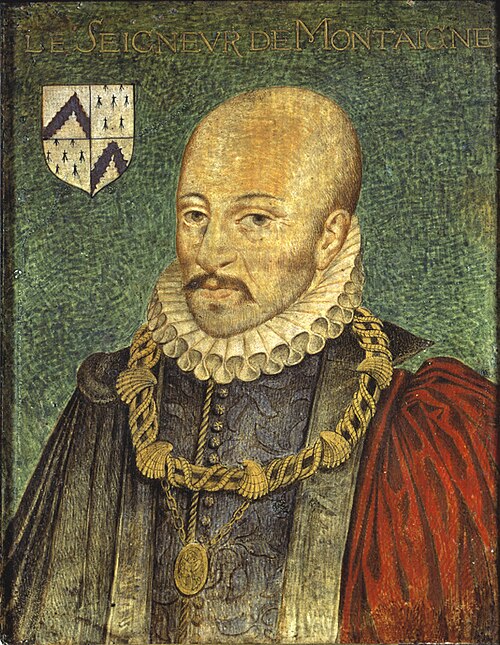 Montaigne1533-1592received religion as a custom
Background: Lucretius and the De rerum natura: nature explained against religion · The philosophers against the myths: from Xenophanes to allegory · The thought of Montaigne: the Essays, scepticism, custom, experience · The thought of Pascal: the three orders, the wager, Jansenism · Renaissance, humanism and printing: the return to the sources · Wars of Religion and the birth of toleration: from St Bartholomew's Day to Bayle · How the canon was formed: criteria, lists and excluded texts
The longest chapter of the Essays is a filial commission that went wrong. Pierre Bunel, a humanist passing through the château, had left Montaigne's father a fifteenth-century book, the Theologia naturalis of the Catalan Raymond Sebond, a professor at Toulouse, who claimed to establish all the truths of the faith by reason alone, by reading the “book of creatures”. The father asked the son to translate it; Montaigne did, and the translation appeared in 1569. Then, to defend the book against its critics, he wrote the Apology for Raymond Sebond (Essays II, 12), published with the first two books in 1580 and enlarged up to the posthumous edition of 1595. The story of its origins is in the chapter itself: Bunel made his father a present “d'un livre qui s'intitule Theologia naturalis ; sive, Liber creaturarum magistri Raimondi de Sebonde”, of a book entitled Theologia naturalis, or Book of Creatures, by Master Raymond Sebond.
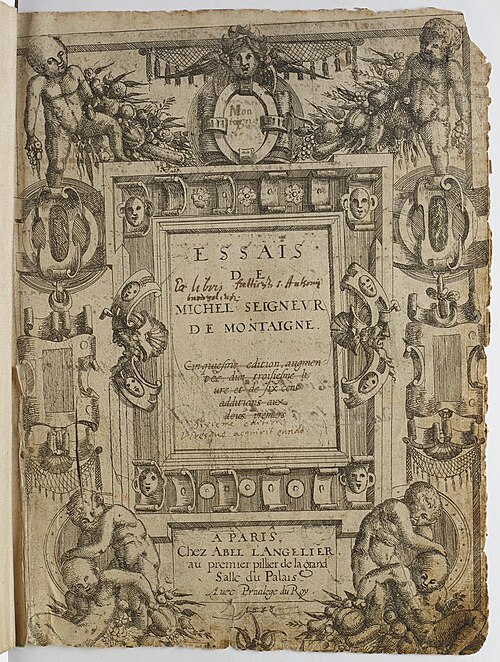
The paradox of the Apology fits into one sentence: Montaigne defends a rational theology by ruining reason. To the critics who reproach Sebond for the weakness of his arguments, he does not reply that they are strong; he replies that the contrary arguments are no better, and that human reason, looked at without indulgence, is worth nothing at all. The two hundred pages that follow are the most systematic inventory of human impotence the Renaissance produced. The thesis is laid down at once: “La presomption est nostre maladie naturelle et originelle. La plus calamiteuse et fragile de toutes les creatures c'est l'homme, et quant et quant, la plus orgueilleuse”, presumption is our natural and original disease; the most wretched and frail of all creatures is man, and at the same time the proudest. Man believes himself master of the world and does not even know what his cat thinks: “Quand je me jouë à ma chatte, qui sçait, si elle passe son temps de moy plus que je ne fay d'elle ?”, when I play with my cat, who knows whether she is not passing her time with me more than I am with her? The privilege theology granted to man, created in the image of God and king of creation, is dismantled piece by piece through a comparison with the beasts that always turns to the beasts' advantage.
Then comes reason, and Pyrrhonian scepticism, which Montaigne had read in Sextus Empiricus, serves as the instrument of demolition. The philosophers contradict one another on everything, the senses deceive us, judgment varies with mood and health. Montaigne draws a motto from it, which he says he bears with the emblem of a pair of scales: “Cette fantasie est plus seurement conceuë par interrogation : Que sçay-je ? comme je la porte à la devise d'une balance”, this idea is more surely conceived in the form of a question: what do I know? as I bear it as a motto with a pair of scales. The interrogative form matters: it avoids the negative dogmatism of the sceptic who asserts that nothing is known, and who, in so doing, still knows something.
The weapon then turns around. If reason can do nothing, it can do nothing for religion either, and the only thing that distinguishes one religion from another is the place where one was born. The passage, the most famous in the chapter, is of an audacity that is poorly measured because it is quoted out of context. Montaigne observes that Christians live no better than others, and he concludes: “Tout cela c'est un signe tres-evident que nous ne recevons nostre religion qu'à nostre façon et par nos mains, et non autrement que comme les autres religions se reçoivent”, all this is a very evident sign that we receive our religion only in our own fashion and by our own hands, and in no other way than other religions are received. Then, after listing the human reasons that bind us to ours (antiquity, authority, fear of threats), he adds: “Une autre region, d'autres tesmoings, pareilles promesses et menasses, nous pourroyent imprimer par mesme voye une creance contraire. Nous sommes Chrestiens à mesme tiltre que nous sommes ou Perigordins ou Alemans”, another region, other witnesses, similar promises and threats could imprint on us by the same path a contrary belief. We are Christians by the same title as we are Perigordians or Germans. What makes us Christians is not the truth of Christianity but custom, just as what makes us Perigordians is geography.
The same logic extends to the gods themselves. Montaigne, who had read Lucretius and Cicero, is ironic about the human manufacture of divinities: “L'homme est bien insensé : Il ne sçauroit forger un ciron, et forge des Dieux à douzaines”, man is truly mad: he could not make a mite, and he makes gods by the dozen. The sentence has the air of a maxim of Epicurus or a fragment of Xenophanes, and one understands why the seventeenth-century libertines made the Apology their breviary.
Must we then read Montaigne as an atheist in disguise, defending Sebond the better to undermine faith? That is the libertine reading, which has had great champions. I do not think it right, and the conclusion of the chapter says why. Montaigne there quotes a saying of Seneca, whom he calls a pagan “tesmoing”, a witness: “O la vile chose, dict-il, et abjecte, que l'homme, s'il ne s'esleve au dessus de l'humanité !”, oh what a vile and abject thing, he says, is man, if he does not raise himself above humanity! And he replies: the wish is good, but absurd, for man can see only with his own eyes and grasp only with his own hold. “Il s'eslevera si Dieu lui preste extraordinairement la main ; il s'eslevera, abandonnant et renonçant à ses propres moyens, et se laissant hausser et soubslever par les moyens purement celestes. C'est à nostre foy Chrestienne, non à sa vertu Stoique, de pretendre à cette divine et miraculeuse metamorphose”, he will rise if God extraordinarily lends him a hand; he will rise by abandoning and renouncing his own means, and letting himself be raised and lifted up by purely heavenly means. It is for our Christian faith, not for his Stoic virtue, to aspire to that divine and miraculous metamorphosis. The structure is that of fideism: reason is humbled so that grace alone can raise. The humbling of reason is not the negation of faith; it is, in Montaigne as later in Pascal and in Bayle, its condition.
This structure nonetheless has an effect its author does not control, and that is what matters here. By placing faith entirely outside reason, Montaigne leaves reason a single explanation of religion as it exists in the world: custom. He has no need to deny grace; it is enough for him to observe that it cannot be seen, and that people believe what they have been taught to believe. The sincerity of the Catholic Montaigne, who died, according to the account given by Étienne Pasquier, while mass was being said in his room, is beyond question and in any case undecidable; what is not undecidable is that his book already contains, two centuries before Hume, the thesis of The Natural History of Religion: people's religion is explained by their nature and their history, not by its truth. Without being a critic of religion in the sense that d'Holbach is, Montaigne brackets religion: without denying it, he suspends judgment on its truth and describes its reality. This is a new form, descriptive rather than legislative, of what I have called the regime of social function, and it is born from the pen of a believer.
Pascal's response is attested, and it is twofold. In the Conversation with M. de Sacy, dated to 1655 and known to us only through the account left by Nicolas Fontaine, Sacy's secretary, Pascal sets Epictetus and Montaigne against each other as the two philosophers who saw most clearly, the one the greatness of man, the other his wretchedness; each is right against the other, and only Christianity reconciles the two truths. Montaigne thus serves Pascal as an instrument: he brings down the pride of reason and prepares the place of faith. But the Pensées also show what Pascal does not forgive him, and it is not his scepticism, it is his way of dying. Fragment 62 of the Brunschvicg edition attacks the “sot projet qu'il a de se peindre”, the foolish project he has of portraying himself, and fragment 63 something graver: “on ne peut excuser ses sentiments tout païens sur la mort ; car il faut renoncer à toute piété, si on ne veut au moins mourir chrétiennement ; or, il ne pense qu'à mourir lâchement et mollement par tout son livre”, one cannot excuse his wholly pagan feelings about death; for one must renounce all piety if one does not at least wish to die as a Christian; yet throughout his book he thinks only of dying cowardly and softly. And the next fragment says in a word what Montaigne was for him: “Ce n'est pas dans Montaigne, mais dans moi, que je trouve tout ce que j'y vois”, it is not in Montaigne but in myself that I find everything I see there (fr. 64).
Pascal's reproach hits the mark, and it opens the second side of Montaigne, the one that concerns spirituality. The first book contained a chapter with a Ciceronian title, “Que philosopher, c'est apprendre à mourir”, that to philosophize is to learn to die (I, 20), where Montaigne takes up the Stoic meditation on death: “La premeditation de la mort est premeditation de la liberté. Qui a apris à mourir, il a desapris à servir”, the premeditation of death is the premeditation of freedom. Whoever has learned to die has unlearned how to serve. But he already slips in a wish that announces the book's evolution: “Je veux qu'on agisse, et qu'on allonge les offices de la vie tant qu'on peut, et que la mort me treuve plantant mes chous, mais nonchalant d'elle, et encore plus de mon jardin imparfait”, I want us to act, and to prolong the tasks of life as long as we can, and I want death to find me planting my cabbages, but unconcerned about it, and even more so about my unfinished garden. It is this nonchalance that Pascal calls dying softly. And the last chapter of the Essays, “De l'expérience”, “Of experience” (III, 13), completes the movement by explicitly refusing any elevation above the human. There Montaigne says of those who want to get outside themselves: “C'est folie : au lieu de se transformer en anges, ils se transforment en bestes ; au lieu de se hausser, ils s'abattent. Ces humeurs transcendentes m'effrayent, comme les lieux hautains et inaccessibles”, it is folly: instead of transforming themselves into angels, they transform themselves into beasts; instead of raising themselves, they bring themselves down. These transcendent humours frighten me, like lofty and inaccessible places. Wisdom lies elsewhere: “C'est une absolue perfection, et comme divine, de scavoyr jouyr loiallement de son estre”, it is an absolute perfection, and as it were divine, to know how to enjoy one's being loyally. And the book almost closes on a sentence that could serve as an epigraph to the whole of Part Twelve of this essay: “Les plus belles vies sont, à mon gré, celles qui se rangent au modelle commun et humain, avec ordre, mais sans miracle et sans extravagance”, the finest lives are, to my mind, those that conform to the common human pattern, with order, but without miracle and without extravagance.
Between the conclusion of the Apology and that of the Essays, something has tipped over. In the Apology, man can rise only if God lends him a hand. In “Of experience”, he no longer has to rise at all: elevation has become a danger, and perfection “as it were divine” consists in inhabiting one's condition loyally. Montaigne does not deny salvation; he stops talking about it. This silence is a spirituality, in the sense in which Hadot and Foucault will take the word, a way of transforming oneself through the exercise of writing and judgment; and it is a spirituality without salvation, which promises nothing after death. Long before modern wisdoms argued over whether they should remain immanent or keep a transcendence (Part Twelve), Montaigne chose immanence, and he did so without polemic, as a practising Catholic. That is why he enters none of the refoundations this essay records: he proposes no absolute, he asks no one to sacrifice themselves to it, and his motto is a question.
Portrait: Anonyme, Public domain
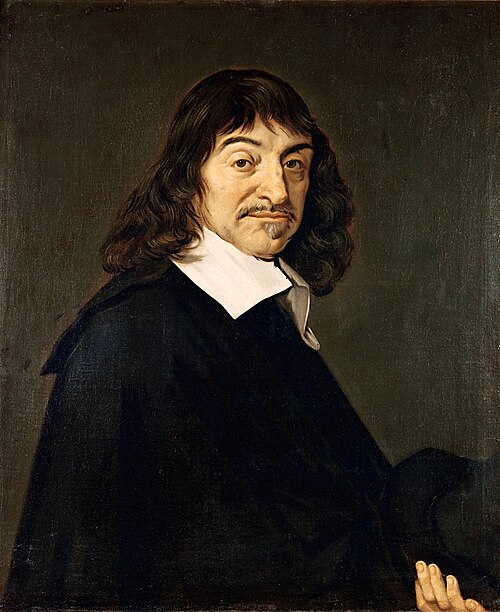 Descartes1596-1650the idea of the infinite and the guarantor God
Background: The thought of Augustine: Confessions, City of God, grace, original sin, controversies · The philosophy of Descartes: doubt, the cogito, God as guarantor of science · Kant's philosophy: the three Critiques, the imperative, the postulates, religion · Scholasticism and the condemnations: faith and reason in the medieval university · Metaphysics and the proofs of the existence of God: from Anselm to Kant
The Meditationes de prima philosophia (Meditations on First Philosophy) appeared in Latin in Paris in 1641, followed by the objections of several learned men and the author's replies, then in Amsterdam in 1642; the French translation by the duc de Luynes, revised by Descartes, appeared in 1647. The book opens with a dedicatory letter to the Faculty of Theology of Paris, the Sorbonne, and this letter states the project in so many words: “Semper existimavi duas quaestiones, de Deo & de Animâ, praecipuas esse ex iis quae Philosophiae potius quàm Theologiae ope sunt demonstrandae”, I have always thought that these two questions, of God and of the soul, were the chief among those that ought to be demonstrated by the aid of philosophy rather than of theology.
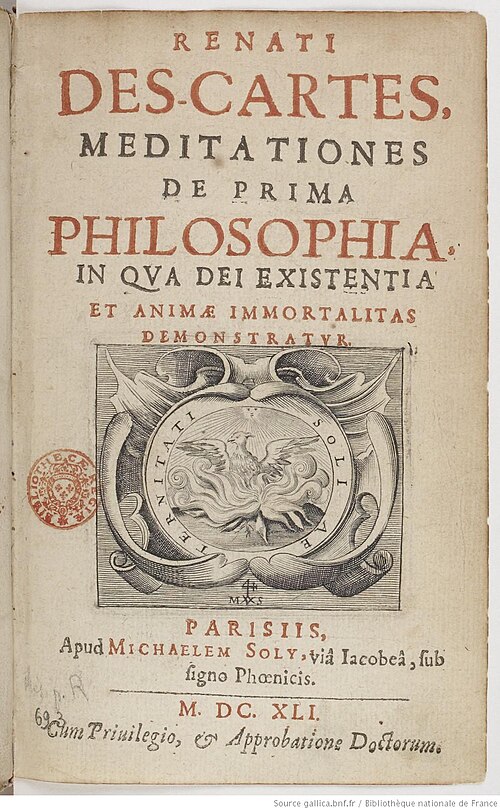
The rest of the sentence gives the reason, political as much as philosophical. For the faithful, faith suffices; but infidels can be persuaded of no religion, and of hardly any moral virtue, unless one first proves these two things to them by natural reason, for, says Descartes, “pauci rectum utili praeferrent, si nec Deum timerent, nec aliam vitam expectarent”, few would prefer the right to the useful if they neither feared God nor expected another life. Descartes takes it for granted that human morality hangs on the fear of God and the hope of the hereafter, a thesis that Bayle, forty years later, will set about demolishing in the Various Thoughts on the Occasion of a Comet. The comparison is constructed, since Bayle is not aiming at Descartes here; the fact remains that the philosopher who founds modern science shares, on religion, the oldest prejudice of all, that of Polybius and Critias. Descartes even adds, in the same letter, that proving God by Scripture and Scripture by God would seem to infidels a circle. The irony is that his readers, beginning with Antoine Arnauld in the Fourth Objections, will accuse him of committing another circle, by guaranteeing through God the clear and distinct ideas he uses to prove God.
Descartes's gesture is understood by contrast with the tradition he rejects. Thomas Aquinas, in the Summa theologiae (I, q. 2, a. 3), had given five ways of proving God, all a posteriori, all starting from the world: motion, causality, contingency, degrees of perfection, order; and he had rejected, in the first article of the same question, Anselm's argument, which claimed to conclude from the idea of God to his existence. Descartes reverses the order. He does not start from the world, which he has just doubted to the point of supposing that an evil genius deceives him about everything; he starts from the only point that resists doubt, the cogito, “Ego sum, ego existo”, and he looks for God in thought.
The Third Meditation finds in me an idea that cannot come from me: that of the infinite. I do not perceive the infinite by negating the finite, as I perceive rest by negating motion; on the contrary, “manifeste intelligo plus realitatis esse in substantiâ infinitâ quàm in finitâ, ac proinde priorem quodammodo in me esse perceptionem infiniti quàm finiti, hoc est Dei quàm meî ipsius”, I clearly understand that there is more reality in an infinite substance than in a finite one, and hence that my perception of the infinite is in some way prior to my perception of the finite, that is, my perception of God prior to that of myself. How would I know that I doubt, that I desire, that I lack something, if I had no idea of a being more perfect than myself? This idea cannot have been produced by a finite being; it must therefore have been placed in me by God himself, “tanquam nota artificis operi suo impressa”, like the mark of the craftsman stamped on his work. The Fifth Meditation adds the proof known as ontological, a name Kant will give it: existence belongs to the essence of the supremely perfect being, so that it is no less contradictory to think of God without existence “quàm cogitare montem cui desit vallis”, than to think of a mountain without a valley. This is the argument of Anselm of Canterbury, who in chapter 2 of the Proslogion defined God as “aliquid quo nihil maius cogitari possit”, something than which nothing greater can be thought, recast in the language of clear and distinct ideas.
But Descartes's God is not only proved; he works. His function in the system is to guarantee truth. God being perfect, he cannot be a deceiver, for “proculdubio velle fallere, vel malitiam vel imbecillitatem testatur”, the will to deceive undoubtedly bears witness either to malice or to weakness. He therefore guarantees that what I conceive clearly and distinctly is true, and the Fifth Meditation draws the conclusion that makes him the keystone of science: “Atque ita plane video omnis scientiae certitudinem & veritatem ab unâ veri Dei cognitione pendere”, and so I see plainly that the certainty and truth of all knowledge depend on the knowledge of the true God alone.
It is this God that Pascal does not forgive Descartes. Fragment 77, which opens with “Je ne puis pardonner à Descartes”, I cannot forgive Descartes, goes on: Descartes “n'a pu s'empêcher de lui faire donner une chiquenaude, pour mettre le monde en mouvement ; après cela, il n'a plus que faire de Dieu”, could not help making him give a flick of the finger to set the world in motion; after that, he has no further use for God. The Cartesian God is indispensable, but he is so as a foundation: he guarantees mathematics and physics, then withdraws and leaves science to work on its own. He has no history, no covenant, no people; he has spoken to no one. Heidegger, who will make Descartes the moment when the being of beings becomes the certain representation of a subject, will see in this God the accomplished figure of onto-theology, and his reproach joins Pascal's: a God who serves to found is not a God before whom one prays.
Two features nonetheless complicate this picture, and they bear on our question. The first is the doctrine of the creation of the eternal truths. In a letter to Mersenne of 15 April 1630, Descartes maintains that mathematical truths, which are called eternal, were established by God and depend on him like the rest of his creatures, so that God “a été aussi libre de faire qu'il ne fût pas vrai que toutes lignes tirées du centre à la circonférence fussent égales, comme de ne pas créer le monde”, was as free to make it untrue that all lines drawn from the centre to the circumference are equal as he was free not to create the world. The God who guarantees reason is thus also a God above reason, with a freedom that exceeds anything we can understand. Leibniz will see a danger in this. For our purpose, the doctrine shows that the God of the philosophers, in the very thinker who constructed him best, is not wholly reducible to a function: there remains in him an abyss of will that Duns Scotus and Ockham would recognize.
The second feature is the very form of the book. The Meditationes are not a treatise. They are six meditations, spread out like six days, written in the first person, which ask the reader to retrace with the author the path from doubt to certainty, and which warn him that he must sometimes dwell for a long time on a single thought to make it familiar. And the Third Meditation, at the moment when God has just been found, breaks off for a contemplation: Descartes says he now wishes “in ipsius Dei contemplatione immorari, ejus attributa apud me expendere, & immensi hujus luminis pulchritudinem, quantum caligantis ingenii mei acies ferre poterit, intueri, admirari, adorare”, to dwell for a while in the contemplation of God himself, to weigh his attributes within myself, and to gaze upon, admire and adore the beauty of this immense light, so far as the eye of my darkened mind can bear it. He adds that, just as faith teaches us that the supreme happiness of the next life consists in this contemplation, so we experience even now that a similar contemplation, though less perfect, gives us the greatest contentment of which we are capable in this life.
This passage creates a difficulty for Foucault's thesis, examined in Part Twelve, of a “Cartesian moment” in which philosophy supposedly separated itself from spirituality: the book that performs this separation keeps the form of the exercise and culminates in adoration. This is my reading, and I offer it as such: the Cartesian moment is not a clean break, it is a conversion of spirituality into metaphysics, in which the contemplation of God remains the summit, but a summit reached by demonstration and not by purification. Descartes is the last great philosopher for whom the knowledge of God is at the same time a joy, and the first for whom that joy is no longer necessary to science. Spinoza, his reader, will take up both ends, the geometrical method and the intellectual love of God, and will try to weld them together.
Descartes therefore does not leave religion. He does more and less: he takes away from theology the task of proving God and entrusts it to philosophy, and he makes God a component of reason. This is at once the triumph of the God of the philosophers and the beginning of his fragility, for a God who is a component of reason can be dismantled by reason. Kant will do so, by showing that existence is not a predicate that can be drawn from a concept, and the ontological proof, after him, will hardly be defended except as an exercise in logic.
Portrait: D'après Frans Hals, Public domain
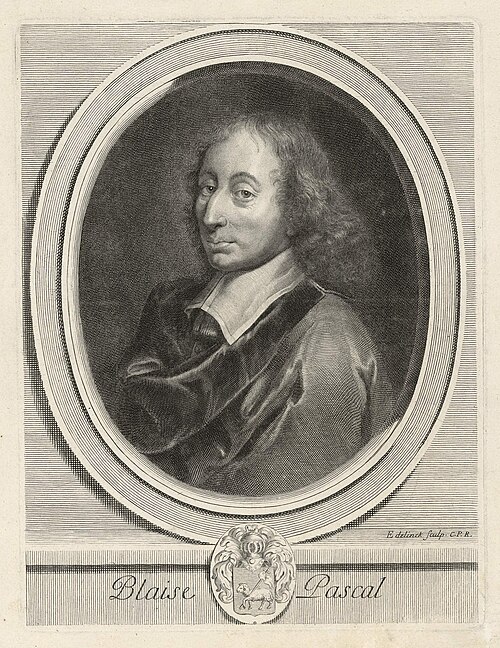 Pascal1623-1662the God of Abraham against the God of the philosophers
Background: The thought of Augustine: Confessions, City of God, grace, original sin, controversies · The thought of Montaigne: the Essays, scepticism, custom, experience · The philosophy of Descartes: doubt, the cogito, God as guarantor of science · The thought of Pascal: the three orders, the wager, Jansenism · The patriarchs: Abraham, the sacrifice of Isaac, Jacob · The prophets of Israel, the exile and the book of Daniel · The vocabulary of Christian theology: revelation, grace, salvation, original sin · The God of the Bible: his names, his images and the formation of monotheism
On the night of Monday 23 November 1654, from about half past ten in the evening until about half past midnight, Blaise Pascal lived through an experience that he recorded on a sheet of paper, copied onto a piece of parchment, and sewed into the lining of his coat, where it was found after his death. This text, known as the Memorial, bears after the date a single isolated word, “Feu”, fire, and continues thus: “Dieu d'Abraham, Dieu d'Isaac, Dieu de Jacob, / non des philosophes et des savants. / Certitude. Certitude. Sentiment. Joie. Paix.”, God of Abraham, God of Isaac, God of Jacob, / not of the philosophers and the scholars. / Certainty. Certainty. Feeling. Joy. Peace.
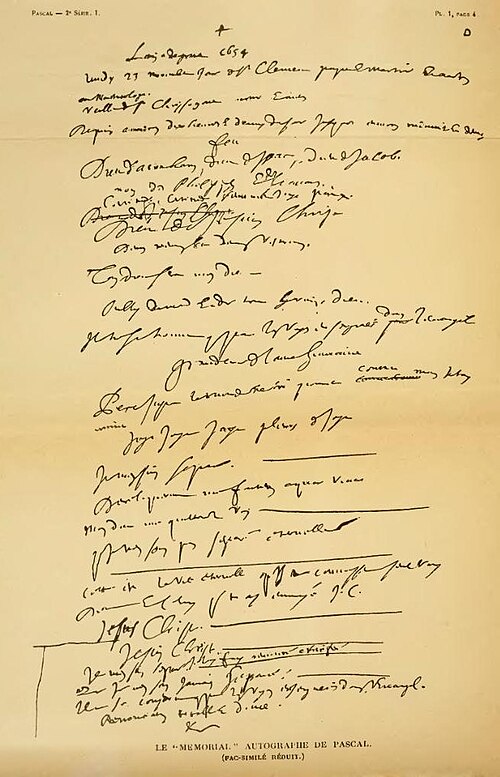
These two lines contain a critique of religion that is never ranked among the critiques of religion, because it is made in the name of faith. The God “of the philosophers and the scholars” is the God of Descartes, whom Pascal knew, and whom he did not forgive Descartes for having wanted to do without (fr. 77, quoted above): a demonstrated God, guarantor of the eternal truths, first mover, cause of himself. This God Pascal does not deny; he declares him useless for salvation. The true God is the God of a history, that of Abraham, Isaac and Jacob, the God who reveals himself to persons and not to reasonings. Heidegger will say the same thing of the causa sui (Part Ten); Pascal had said it, without the concept of onto-theology, on that night in 1654. And Jean-Luc Marion, a reader of both Pascal and Heidegger, will make this opposition the centre of God Without Being.
The Pensées, published in 1670 by Port-Royal from the bundles of papers Pascal left (the order of the fragments is a reconstruction by the editors, and the Léon Brunschvicg edition I quote proposes one among others), develop this critique in three directions.
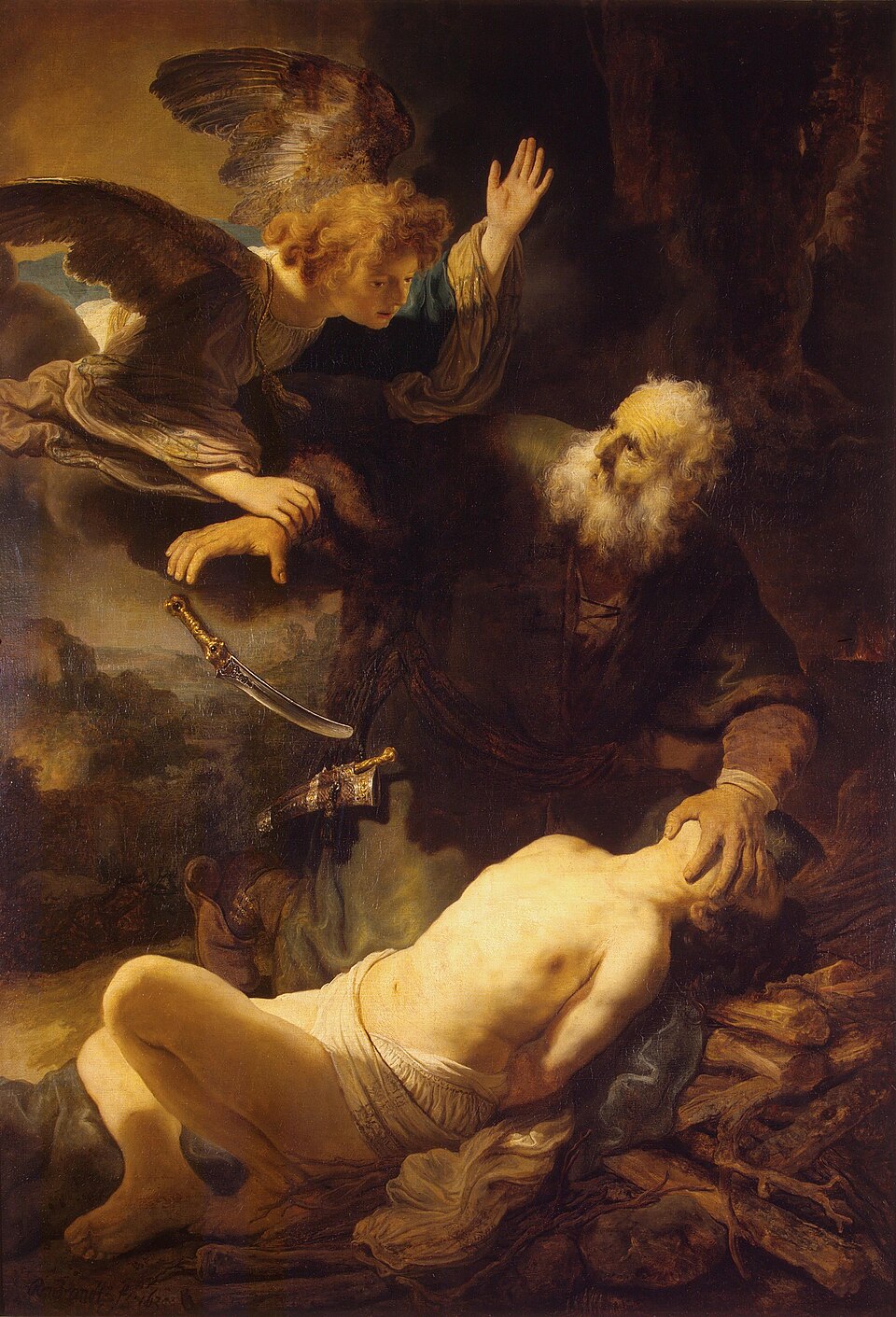
The first is the primacy of the heart. “Le cœur a ses raisons, que la raison ne connaît point”, the heart has its reasons, which reason does not know (fr. 277); and the next fragment: “C'est le cœur qui sent Dieu, et non la raison : voilà ce que c'est que la foi : Dieu sensible au cœur, non à la raison”, it is the heart that feels God, and not reason: that is what faith is: God perceptible to the heart, not to reason (fr. 278). The Pascalian “heart” is not feeling in the Romantic sense; it is the faculty that grasps first principles, immediate intuition. But the formula opens a path that Schleiermacher will take, and that leads to religion as experience.
The second is the hidden God. Pascal takes up the verse of Isaiah, “Vere tu es Deus absconditus” (Is 45, 15), and makes it a thesis: Scripture “dit au contraire que Dieu est un Dieu caché”, says on the contrary that God is a hidden God (fr. 242). One must therefore not seek to prove God from nature, as the apologists do; nature proves nothing, or rather it shows both the presence and the absence of God. Modern man, in the infinite universe, first experiences the void: “Le silence éternel de ces espaces infinis m'effraie”, the eternal silence of these infinite spaces frightens me (fr. 206). Pascal is one of the first Christian thinkers to take the experience of God's absence seriously as a religious experience. Nietzsche, who said he did not read him but loved him, will see in him “das lehrreichste Opfer des Christentums”, the most instructive victim of Christianity (Ecce homo, “Warum ich so klug bin”, § 3); Simone Weil will take up the idea of a God who withdraws.
The third is the wager, fragment 233, the most famous and the most misread. It is presented as a calculation of interest, and it is one; but the essential lies elsewhere. “Dieu est, ou il n'est pas”, God is, or he is not: reason cannot decide. Yet one cannot not choose: “il faut parier ; cela n'est pas volontaire, vous êtes embarqué”, you must wager; it is not optional, you are embarked. And when the interlocutor objects that he is so made that he cannot believe, Pascal gives him a method: do as those who believe do, “en prenant de l'eau bénite, en faisant dire des messes, etc. Naturellement même cela vous fera croire et vous abêtira”, taking holy water, having masses said, and so on. Quite naturally this will make you believe and will make you like the beasts.
This “vous abêtira” does not mean “will make you stupid” but “will make you like the beasts”, that is, will submit the machine, the automaton, habit, in place of proud reason. But it says something that all of modern critique will rediscover: belief is acquired through practice, and practice precedes belief. Durkheim will show that rite makes belief and not the reverse; Pascal, for his part, had prescribed it. One sees here how thin the line is between the apologist and the sociologist: the same proposition, that belief is born of habit, serves Pascal to convert and Hume to explain.
Pascal is therefore not a critic of religion in the sense that Spinoza is, but he radically separates the God of faith from the God of reason, and it is this separation that will make possible, on the one hand, the rational critique of theology (if the God of the philosophers is not the true God, he can be demolished without touching faith), and on the other, a religion of the heart that no longer owes anything to proofs. Kierkegaard, two centuries later, will take up his fight against an overly reasonable Christendom.
Portrait: Gérard Edelinck, CC BY-SA 4.0
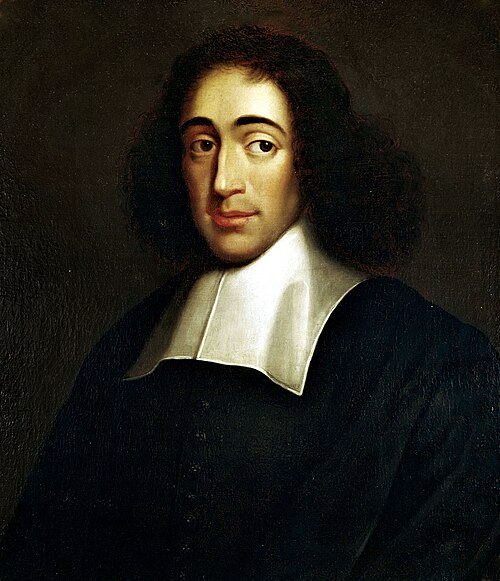 Spinoza1632-1677God is not someone
Background: Biblical chronology: the time of the story and the time of the writing · The Bible: books, canons and languages · Spinoza's philosophy: substance, attributes, modes, conatus, kinds of knowledge, the Theological-Political Treatise · The short books: Ruth, Esther, Jonah, Tobit, Judith, Lamentations, Ezra and Nehemiah · Wars of Religion and the birth of toleration: from St Bartholomew's Day to Bayle · The thought of Leo Strauss: natural right, esotericism, Athens and Jerusalem · The thought of Comte-Sponville: materialism, wisdom, spirituality without God · How the Bible has been read: allegory, the four senses, historical criticism
The Tractatus theologico-politicus (Theological-Political Treatise) appeared in 1670, anonymously, under a false publisher's imprint; the Ethica (Ethics) appeared only after Spinoza's death, in the Opera posthuma of 1677. This gap between what Spinoza published in his lifetime and what he held back matters: the TTP is a book of political combat, the Ethics a system. The critique of religion does not have the same function in the one and in the other, and confusing them produces the most widespread misreading of Spinoza, the one that makes him a masked atheist.
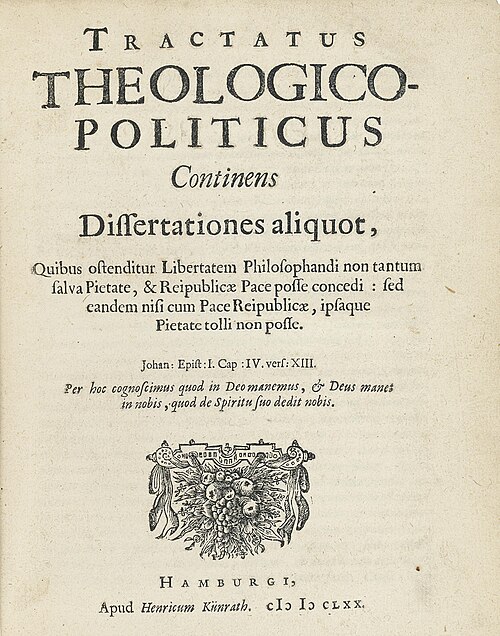
His fundamental thought is contained in a formula from the preface to the fourth part of the Ethics: “Deus seu Natura”, God, that is, Nature. The full sentence reads: “Ratio igitur, seu causa, cur Deus seu Natura agit, et cur existit, una eademque est”, the reason, or cause, why God, that is, Nature, acts and why he exists is one and the same. The formula does not abolish God; it displaces him. God is not a being separate from the world who wants something for himself; he is the single substance of which all things are modes, and he acts by the sole necessity of his nature. He therefore has neither design, nor anger, nor favour. What is false in religion is not God; it is the image of a God who resembles a king. One recognizes the gesture of Epicurus, but radicalized: the gods of Epicurus were indifferent, the God of Spinoza is impersonal.
The appendix to the first part dismantles the mechanism of this image. Men are born ignorant of the causes of things and conscious of their desires; they believe themselves free because they do not know what determines them, and they imagine that nature, like them, acts for ends. Hence finalism, and from finalism a God who supposedly arranged everything for man. When such a mind is pressed with questions about the cause of an accident, it goes back from cause to cause “donec ad Dei voluntatem, hoc est ignorantiæ asylum, confugeris”, until you take refuge in the will of God, that is, the asylum of ignorance. The will of God, in vulgar theology, is not an explanation: it is the name that explanation takes when it comes to a halt.
The TTP adds to this analysis an affective genesis and a political thesis. The preface opens on superstition: if men could manage all their affairs by a sure plan, or if fortune were always favourable to them, they would not be superstitious; but they waver between hope and fear. And Spinoza concludes: “The true cause of superstition, what preserves and sustains it, is therefore fear”. This is the thesis of Lucretius, transposed from physics to the psychology of the passions, and Hume will take it up. As for the political thesis, it lies in the radical separation of faith and philosophy. Philosophy aims at truth; faith “requires not so much truth in its doctrines as piety, that is, what moves the mind to obedience” (ch. XIV). Between the two, “there is no commerce and no affinity” (ch. XIV).
Here lies Spinoza's originality: he does not ask for religion to disappear. He asks that it cease to lay claim to truth and content itself with what it actually does: securing obedience to a few precepts of justice and charity. Religion becomes a social practice without theoretical content, which the State can regulate and which the philosopher has no need to combat. Spinoza therefore does not leave religion: he puts it in its place. Religion so placed closely resembles Cicero's religio, civic observance without metaphysics, and what Durkheim will call the social function of the sacred. Spinoza thinks of religion, after Polybius and Machiavelli but with another rigour, as a useful institution whose truth matters little.
For Spinoza keeps, for himself, the name of God, charged with a meaning the vulgar do not suspect, and here the question of spirituality changes the reading. The fifth part of the Ethics culminates in a notion that hasty readers treat as a rhetorical concession and that is the summit of the system: the intellectual love of God. “Mentis Amor intellectualis erga Deum est ipse Dei Amor, quo Deus se ipsum amat”, the mind's intellectual love of God is the very love with which God loves himself (V, prop. 36). This love expects nothing in return, since God loves no one in the human sense; it is the joy that accompanies the knowledge of things in their necessity, sub specie aeternitatis. It affords an experience that Spinoza does not hesitate to describe in terms of eternity: “At nihilominus sentimus experimurque, nos æternos esse”, and nevertheless we feel and experience that we are eternal (V, prop. 23, scholium). And it is not the reward of a virtuous life: “Beatitudo non est virtutis præmium, sed ipsa virtus”, blessedness is not the reward of virtue, but virtue itself (V, prop. 42).
This last proposition is Spinoza's deepest answer to religion, deeper than the critique of finalism. Every religion of salvation promises a reward: a paradise, an eternal life, a retribution. Spinoza abolishes the reward by interiorizing it: there is no other salvation than the present joy of understanding. This is what Foucault will call a spirituality: a transformation of the subject that gives it access to the true. And this is why the Ethics can end on a sentence that sounds like a word of wisdom rather than a theorem: “Sed omnia præclara tam difficilia quam rara sunt”, but all things excellent are as difficult as they are rare. The free man, the fourth part says again, “de nulla re minus quam de morte cogitat; et ejus sapientia non mortis, sed vitæ meditatio est”, thinks of nothing less than of death, and his wisdom is a meditation not on death but on life (IV, prop. 67).
The libertine tradition, and later part of Marxist criticism, read the retention of the name of God as prudence. I believe this reading is wrong. The God of the Ethics is not a pseudonym for Nature meant to deceive the censors; he is what allows Spinoza to think Nature as infinite, necessary and perfect, and to ground a blessedness upon it. What is preserved out of prudence is not the name of God; what is preserved, out of conviction, is the structure of the blessed life. Spinoza is a philosopher of the exit from superstition, not of the exit from the divine. Novalis, in a fragment published after his death by Friedrich Schlegel and Ludwig Tieck, called him “ein Gott-trunkener Mensch”, a God-intoxicated man (Novalis Schriften, vol. II, Berlin, 1802, p. 487).
This is precisely what his successors will hold against him, and their objections already form a debate. Hegel, in his lectures on the history of philosophy, will say that Spinozism is not an atheism but an acosmism, “Der Spinozismus ist also Akosmismus”, and that there is in him not too little but “zu viel Gott”, too much God (Vorlesungen über die Geschichte der Philosophie, Suhrkamp ed., vol. 20, p. 162-163): far from denying God, he denies the world, which is now no more than a set of modes without consistency. Feuerbach and the Hegelian left, conversely, will read Deus seu Natura as an elegant way of saying that only Nature exists. The real objection, the one that will tell, is a different one: Spinoza explains the illusion by ignorance and fear; he does not explain why man clings to it even when it is shown to him. He describes the error; he does not account for the need for the error. That need will be the object of Feuerbach, Marx and Freud. Nietzsche, finally, who will recognize in Spinoza a precursor, will also mock the “Hocuspocus von mathematischer Form” with which he armours his philosophy (Jenseits von Gut und Böse, § 5): the geometrical form itself will seem to him a mask of the will.
Portrait: Anonyme, Public domain
 Bayle1647-1706a society of atheists is possible
Background: The thought of Pierre Bayle: the comet, the Dictionary, toleration · Leibniz's philosophy: monads, pre-established harmony, sufficient reason, theodicy · Analytic philosophy of religion: from the problem of evil to Reformed epistemology · Wars of Religion and the birth of toleration: from St Bartholomew's Day to Bayle
Pierre Bayle, a French Protestant who took refuge in Rotterdam in 1681 after the suppression of the Protestant Academy of Sedan, published in 1682 a Lettre sur la comète, which became the following year the Pensées diverses sur la comète. The pretext was the passage of the comet of 1680, which popular belief held to be an omen. Bayle first demonstrates that a comet portends nothing; then he arrives at an unexpected argument. If comets were omens sent by God to warn men, they could only strengthen the idolatry of the pagans, who interpreted them as signs from their gods. God would thus have worked a miracle to fortify idolatry. Now is idolatry, Bayle asks, less grave than atheism? And he answers, in the very title of a section: “Que l'Athéisme n'est pas un plus grand mal que l'Idolâtrie”, that atheism is not a greater evil than idolatry (§ CXIV).
The scandal was immediate, and it provoked an immediate attested response. The pastor Pierre Jurieu, a former friend turned enemy, attacked him precisely on this point; the modern editor quotes his complaint: “On lit le dangereux paradoxe, que l'Athéisme n'est pas un plus grand mal que l'idolâtrie”, one reads the dangerous paradox that atheism is not a greater evil than idolatry. What troubles Jurieu is not so much the theological proposition as its practical consequence: if the atheist is no worse than the idolater, why punish him?
Bayle goes further, and this is the heart of the matter: he maintains that men act not according to their principles but according to their passions, their temperament and their habits; that belief in God therefore does not prevent Christians from being as vicious as anyone else; and that, conversely, the absence of belief does not prevent one from being virtuous. Hence the conjecture, in § CLXI of the 1749 edition: as regards morals and civil actions, a society of atheists “seroit toute semblable à une société de Paiens. Il y faudroit à la vérité des loix fort severes, et fort bien exécutées pour la punition des criminels. Mais n'en faut-il pas par tout ?”, would be quite like a society of pagans; it would indeed need very severe laws, very well enforced, for the punishment of criminals; but are they not needed everywhere? And Bayle concludes with a sentence that would delight a sociologist: “la Justice humaine fait la vertu de la plus grande partie du monde”, human justice makes the virtue of the greater part of the world.
Bayle's argument is therefore not an apology for the atheist; it is a sociology before the term existed: men's virtue does not depend on their belief in immortality, it depends on laws, honour, opinion, temperament. Durkheim will draw the opposite consequence: if morality depends on society, and if religion is society worshipping itself, then religion did not die with God. The confrontation with the thesis that posterity attributed to Ivan Karamazov will be conducted in Part Seven.
Bayle was not an atheist but a sceptical Calvinist, convinced that reason is powerless to establish the truths of faith and that faith must therefore do without reason, which brings him close, by an entirely different path, to Pascal. His defence of the virtuous atheist is a defence of tolerance: if the atheist can be an honest man, the State has no reason to persecute him, and all the less reason to persecute the Protestant or the Jew. The exit from religion he sketches is not an exit from faith; it is an exit from religion as political cement. In this sense he is one of the first to think the exit from religion as the end of a structure of society, not of a belief held by individuals.
Portrait: Attribué à Louis Ferdinand Elle le Jeune, Public domain
 Leibniz1646-1716why something rather than nothing
Background: The philosophy of Descartes: doubt, the cogito, God as guarantor of science · The thought of Pierre Bayle: the comet, the Dictionary, toleration · Leibniz's philosophy: monads, pre-established harmony, sufficient reason, theodicy · Voltaire: deism, the Infamous, tolerance, Candide · Analytic philosophy of religion: from the problem of evil to Reformed epistemology · Psalms, Job, Qoheleth and the wisdom books
Leibniz wrote about God all his life, but the two texts in which his thought is summed up are two brief expositions from 1714, written in French during a stay in Vienna: the Principes de la nature et de la grâce fondés en raison, published in 1718 in L'Europe savante, and the Monadology, first published in German translation in 1720, whose French text appeared only in 1840. The only major philosophical work he published in his lifetime is of another kind: the Theodicy: Essays on the Goodness of God, the Freedom of Man and the Origin of Evil, published in Amsterdam in 1710 and born of a controversy with a dead man, Pierre Bayle, who had died four years earlier.
Leibniz's thought about God comes down to a question, the most famous in modern metaphysics. It is posed in § 7 of the Principes de la nature et de la grâce: “maintenant il faut s'élever à la métaphysique, en nous servant du grand principe, peu employé communément, qui porte que rien ne se fait sans raison suffisante ; c'est-à-dire que rien n'arrive sans qu'il soit possible à celui qui connaîtrait assez les choses de rendre une raison qui suffise pour déterminer pourquoi il en est ainsi, et non pas autrement. Ce principe posé, la première question qu'on a droit de faire sera : Pourquoi il y a plutôt quelque chose que rien ? Car le rien est plus simple et plus facile que quelque chose”, now we must rise to metaphysics, making use of the great principle, little employed as a rule, which holds that nothing happens without a sufficient reason; that is, that nothing happens without its being possible for one who knew things well enough to give a reason sufficient to determine why it is so and not otherwise. This principle laid down, the first question we have the right to ask will be: Why is there something rather than nothing? For nothing is simpler and easier than something.
Everything hinges on the “for” of the last sentence: nothingness needs no explanation, since it is the simplest state; it is existence that demands one. And this explanation cannot be found in the sequence of contingent things, for each refers to another, to infinity, without any of them accounting for the whole series. The Monadology formulates the principle (“aucun fait ne saurait se trouver vrai ou existant, aucune énonciation véritable, sans qu'il y ait une raison suffisante, pourquoi il en soit ainsi et non pas autrement”, no fact can be true or existent, no statement true, unless there is a sufficient reason why it is so and not otherwise, § 32) and draws the conclusion: “la dernière raison des choses doit être dans une substance nécessaire, dans laquelle le détail des changements ne soit qu'éminemment, comme dans la source, et c'est ce que nous appelons Dieu”, the ultimate reason of things must lie in a necessary substance, in which the detail of changes exists only eminently, as in its source, and this is what we call God (§ 38). It also takes up Descartes' argument and completes it: the ontological proof is valid only if one first shows that the idea of God is possible, that is, non-contradictory, and Leibniz concludes that “Dieu seul ou l'Être nécessaire a ce privilège, qu'il faut qu'il existe, s'il est possible”, God alone, or the necessary Being, has this privilege, that he must exist if he is possible (§ 45).
The next paragraph contains an attested response to Descartes, and it illuminates the whole difference between the two theologies. “Cependant il ne faut point s'imaginer avec quelques-uns, que les vérités éternelles, étant dépendantes de Dieu, sont arbitraires et dépendent de sa volonté, comme Descartes paraît l'avoir pris et puis M. Poiret”, yet one must not imagine, with some, that the eternal truths, being dependent on God, are arbitrary and depend on his will, as Descartes seems to have taken it, and after him M. Poiret (§ 46). Only contingent truths depend on God's choice; necessary truths depend on his understanding. Leibniz's God does not have the abyss of freedom of the Cartesian God: he is bound by logic, and he chooses according to reasons. He is reason itself become a person. One cannot go further in the rationalization of the divine, and that is why Heidegger, who in 1955-1956 devoted an entire lecture course to the principle of reason, published in 1957 under the title Der Satz vom Grund (The Principle of Reason), will see in Leibniz the thinker in whom onto-theology speaks its name most clearly: in it God is the sufficient reason of beings, the supreme being that grounds all the others.
This God-as-reason must have reasons for creating this world rather than another, and they can lie only in his goodness. Hence the thesis that made Leibniz famous and ridiculous. Among all possible worlds, God chose the best, for “s'il n'y avait pas le meilleur (optimum) parmi tous les mondes possibles, Dieu n'en aurait produit aucun”, if there were not a best (optimum) among all possible worlds, God would have produced none (Theodicy, I, § 8). Evil is not denied: it is classified, and its presence is justified by the whole. “On peut prendre le mal métaphysiquement, physiquement et moralement. Le mal métaphysique consiste dans la simple imperfection, le mal physique dans la souffrance, et le mal moral dans le péché”, evil may be taken metaphysically, physically and morally; metaphysical evil consists in mere imperfection, physical evil in suffering, and moral evil in sin (I, § 21). Metaphysical evil is inevitable, since every creature is finite; physical evil and moral evil are not necessary, but they are possible, and God permits them because the world that contains them is better, taken as a whole, than any world that would not contain them.
The Theodicy is an attested response, and its target is named from the preface onwards. Bayle, in his Historical and Critical Dictionary, had maintained that the Manichaeans' objections against the goodness of God were rationally unanswerable, and that one must therefore believe against reason. Leibniz replies that faith and reason cannot contradict each other, since two truths do not contradict each other, and he judges his adversary's position severely: “M. Bayle paraît l'avoir pris tout autrement : il se déclare contre la raison, lorsqu'il se pouvait contenter d'en blâmer l'abus”, M. Bayle seems to have taken it quite otherwise: he declares himself against reason, when he could have contented himself with censuring its abuse (“Discourse on the Conformity of Faith with Reason”, § 46). The debate on religion, at the dawn of the Enlightenment, thus does not run between believers and unbelievers: it runs between two believers, one who separates faith from reason to save faith, the other who unites them to save both. The same preliminary discourse counts among the adversaries of this union an Italian “secte de philosophes”, sect of philosophers, who were called “Averroïstes”, Averroists (§ 7), and we saw in Part One what was really the case with Averroes.
The meeting with Spinoza belongs to the same picture, and it calls for caution, for Leibniz himself recounted it in a way that minimized its significance. In November 1676, returning from Paris by way of London, Leibniz stopped at The Hague and visited Spinoza, who would die three months later. The Theodicy, thirty-four years afterwards, speaks of it in one offhand sentence: “Je vis M. de la Court, aussi bien que Spinosa, à mon retour de France par l'Angleterre et par la Hollande, et j'appris d'eux quelques bonnes anecdotes sur les affaires de ce temps-là”, I saw M. de la Court, as well as Spinoza, on my return from France by way of England and Holland, and I learned from them some good anecdotes about the affairs of that time (III, § 376). Political anecdotes, then; Leibniz's papers show something else: a note from the same period records that he presented Spinoza with his demonstration of the possibility of the supremely perfect being, and that Spinoza read it. What Leibniz thought at bottom of Spinozism, the preface to the Theodicy states bluntly: Spinoza holds that everything came from the first cause “par une nécessité aveugle et toute géométrique, sans que ce premier principe des choses soit capable de choix, de bonté et d'entendement”, by a blind and wholly geometrical necessity, without this first principle of things being capable of choice, goodness and understanding. The whole of Leibnizian theology can be read as the effort to save the God of reason from the God of necessity: to keep Spinoza's rigour, but to give back to God an understanding, a will and a goodness, that is, everything Spinoza had taken from him.
This God is not only a principle; he is also the object of a love, and Leibniz has his spirituality, which is that of the optimist. The Principes de la nature et de la grâce end with it: “On peut même dire que dès à présent l'amour de Dieu nous fait jouir d'un avant-goût de la félicité future”, one may even say that even now the love of God gives us a foretaste of future happiness; and this love, though disinterested, produces “une véritable tranquillité de l'esprit ; non pas comme les stoïciens résolus à une patience par force, mais par un contentement présent”, a true tranquillity of mind, not like the Stoics resolved upon a forced patience, but through a present contentment (§ 18). The difference from Stoicism is carefully marked: the Stoic resigns himself to the order, the Leibnizian approves it, because he knows the order is the best. Minds, § 15 says further, are members of the “cité de Dieu”, the city of God, governed by the best of monarchs, “où il n'y a point de crime sans châtiment, point de bonnes actions sans récompense proportionnée”, where there is no crime without punishment, no good action without proportionate reward. The same man spent years, in the last decade of the century, negotiating by letter with Bossuet a project for reuniting the Catholic and Protestant Churches: Leibniz's religion is a religion of reason and concord, which would have the confessions reconciled as truths agree.
The most famous response to Leibniz is not by a professional philosopher, and it is attested. After the Lisbon earthquake of 1 November 1755, Voltaire wrote a poem on the disaster, then, in 1759, Candide, or Optimism, whose tutor Pangloss teaches “la métaphysico-théologo-cosmolonigologie”, metaphysico-theologo-cosmolonigology, and proves “que, dans ce meilleur des mondes possibles, le château de monseigneur le baron était le plus beau des châteaux”, that in this best of all possible worlds, my lord the baron's castle was the finest of castles (ch. I). After the earthquake and the auto-da-fé that follows it, Candide, flogged and bleeding, wonders: “Si c'est ici le meilleur des mondes possibles, que sont donc les autres ?”, if this is the best of all possible worlds, what then are the others? (ch. VI). And the tale ends on the answer that dismisses metaphysics: “il faut cultiver notre jardin”, we must cultivate our garden (ch. XXX). Rousseau, in a letter to Voltaire of 1756 that we shall meet again, will on the contrary take up the defence of Providence.
Voltaire caricatures, but he touches a point that the caricature must not make us forget. Theodicy justifies each particular evil by the good of the whole. The criterion asks whether one installs an absolute in whose name the sacrifice of the individual can be demanded; now theodicy is, in the strict sense, a thought that accepts the sacrifice of the individual to the harmony of the whole, even if it is God, and not man, who decides it. Hegel will transpose theodicy into history, making world history the tribunal where individuals are judged and crushed so that Spirit may advance; and Ivan Karamazov, in Part Seven, will refuse the final harmony if it must be paid for with the tears of a single tortured child. This refusal, a constructed comparison with Leibniz, is the moral response to the Theodicy, as Candide is its ironic response. I believe it strikes truer: what is refused is not the best of worlds, it is the idea that an individual could be counted as a part of the best.
It would be a mistake to abandon the question of § 7 along with theodicy. Leibniz answered it with God; but the question can outlive the answer. Schelling will take it up in his lectures on the philosophy of revelation, Heidegger will make it the first question of his Introduction to Metaphysics, Bergson will hold it to be a false problem, and Wittgenstein will shift the wonder it expresses towards the very fact that the world is. The last part will gather them around this single question, perhaps the purest form of what may be called a spirituality without religion: wonder before existence, which asks for neither cult, nor dogma, nor sacrifice, and which Leibniz, the most rationalist of philosophers, formulated with the greatest clarity.
Portrait: Christoph Bernhard Francke, Public domain
Transition: from fear to morality
On the threshold of the Enlightenment, then, the critique of religion has its principal tools at its disposal, and they come from opposed traditions. From the Epicureans and from Spinoza it inherits the idea that religion is born of fear and of ignorance of causes, and that a knowledge of nature, lived as an exercise, affords a peace that religion promised without giving. From the mystics and from Pascal it inherits the idea that the God of representations and proofs is not the true God, and that the critique of the idol can be an act of faith. From Bayle it inherits the idea that morality does not depend on belief. From Leibniz it receives the barest question, why something rather than nothing, and the obligation to justify God in the face of evil, which Voltaire is about to turn against him. The eighteenth century will combine them in incompatible ways, and Kant, at the century's end, will keep only what is rational in them, that is, morality.
Part Fourthe Enlightenment and religion within limits
Background: From absolutism to the Revolution: the Church of France, the Enlightenment and the cult of the Supreme Being
The Enlightenment did not have one doctrine of religion but at least five, which fought one another as fiercely as they fought the Church. Scottish empiricism made religion an object of natural history. French deism kept it as a social restraint. Rousseau refounded it twice, as a religion of the heart and as a civil religion. The materialism of Baron d'Holbach sought to destroy it. Kant's critical philosophy reduced it to morality. These five positions are still ours: we explain religion, we use it, we refound it, we fight it, or we keep what seems reasonable in it. Almost none of them leaves religion without leaving a remainder, and that remainder almost always takes the form of a cult; Hume alone is the exception.
 Hume1711-1776a natural history of belief
Background: The philosophy of Epicurus: atoms, canonic, pleasure and the remedy for fears · Lucretius and the De rerum natura: nature explained against religion · The thought of Montaigne: the Essays, scepticism, custom, experience · The philosophy of Hume: empiricism, causation, miracles, the natural history of religion · Pascal Boyer: religion explained by cognition · The Gospel of John: the Word made flesh · The God of the Bible: his names, his images and the formation of monotheism
David Hume published The Natural History of Religion in 1757, in a collection entitled Four Dissertations. His Dialogues Concerning Natural Religion, drafted from the 1750s onward and revised until his death, appeared only in 1779, posthumously, through the care of his nephew. The gap between the dates tells of the author's caution: the first book explains religion without judging it; the second judges it, but through the mouths of characters.
The Natural History changes the question: no longer whether God exists, but where, in human nature, belief in invisible powers comes from. And it starts from a fact that the theologians of his time regarded as a late corruption: “polytheism or idolatry was, and necessarily must have been, the first and most ancient religion of mankind” (section 1). Monotheism is not the origin but a late product, for religion was not born of the contemplation of the order of the world, as the deists believe with their argument from design, but of anxiety. The first religious ideas arose “not from a contemplation of the works of nature, but from a concern with regard to the events of life, and from the incessant hopes and fears, which actuate the human mind” (section 2).
One recognizes the thesis of Lucretius and Spinoza, fear at the origin of the gods; but Hume adds a dynamic to it. Religions oscillate: “the principles of religion have a kind of flux and reflux in the human mind”, and men have a natural tendency to rise from idolatry to theism, then to sink back from theism into idolatry (section 8). The one and infinite God is too abstract for popular devotion, which gives him intercessors, saints, images; and when these multiply, a reform recalls the divine unity. This law of oscillation is one of the most fertile ideas in the tradition: it anticipates Weber, for whom religious rationalization itself produces disenchantment, and Bergson, for whom dynamic religion always falls back into static religion.
He adds a comparison that Bayle had prepared and that all liberals would take up: polytheism is tolerant, monotheism intolerant, for a single god suffers no rivals. And he ends on a sceptical observation of great beauty. Having reviewed popular beliefs, which one might readily take for “sick men's dreams”, he concludes: “The whole is a riddle, an ænigma, an inexplicable mystery. Doubt, uncertainty, suspence of judgment appear the only result of our most accurate scrutiny, concerning this subject”. But this very doubt, he adds, would be hard to sustain without a stratagem: setting the superstitions against one another, making them quarrel, and during their fury “happily make our escape, into the calm, though obscure, regions of philosophy”.
This sentence defines the sceptical exit, and all those that follow are measured against it. Hume does not claim to have refuted religion, proposes nothing in its place, founds no cult. He escapes, while admitting that the region into which he escapes is obscure. He practises the regime of error without drawing a refoundation from it, and he is thus, with Spinoza and Nietzsche, one of the rare authors in this history who leave without refounding, by a path that Spinoza and Nietzsche did not take: not a spirituality, but a suspension. Is it livable? Not all the time, Hume answered, whose sceptical philosopher, in A Treatise of Human Nature, goes back to play backgammon with his friends: “I dine, I play a game of back-gammon, I converse, and am merry with my friends” (I, 4, 7, § 9).
The Dialogues stage three characters. Cleanthes defends experimental theism: the universe resembles a machine, so it has an author similar to the human mind. Demea defends orthodox a priori theology: God is incomprehensible, and his nature exceeds all analogy. Philo, the sceptic, allies himself by turns with one against the other and demolishes the argument from design: the analogy is weak, since one could just as well compare the universe to an animal or a vegetable, and an imperfect world suggests an imperfect god, or several, or an apprentice. At the heart of the book, in Part X, Philo takes up an ancient argument: “EPICURUS's old questions are yet unanswered. Is he willing to prevent evil, but not able? then is he impotent. Is he able, but not willing? then is he malevolent. Is he both able and willing? whence then is evil?”
This trilemma, which Hume attributes to Epicurus on the authority of Lactantius (De ira Dei, 13), an attribution now disputed, is the argument that Ivan Karamazov will take up in concrete form, with the tortured children. But Philo does not conclude in favour of atheism. In Part XII he even seems to rally to a minimal form of theism, and he lets fall this sentence, whose irony is undecidable: “To be a philosophical Sceptic is, in a man of letters, the first and most essential step towards being a sound, believing Christian”. A tribute to Pascal, who wished to humble reason to make room for faith, a precaution, or mockery? Critics disagree, and I believe the ambiguity must be left where Hume put it: the sceptic can no more affirm the non-existence of God than his existence, and his exit from religion is an exit from certainty, in one direction as in the other.
Hume's clearest successor is Kant, who would say that Hume had woken him from his dogmatic slumber (about causality, in the Prolegomena of 1783), and whose Critique of Pure Reason (1781) would take up the critique of the proofs of God's existence. But he would draw from it a conclusion Hume had not envisaged: if theoretical reason cannot prove God, practical reason can postulate him.
Portrait: Allan Ramsay, Public domain
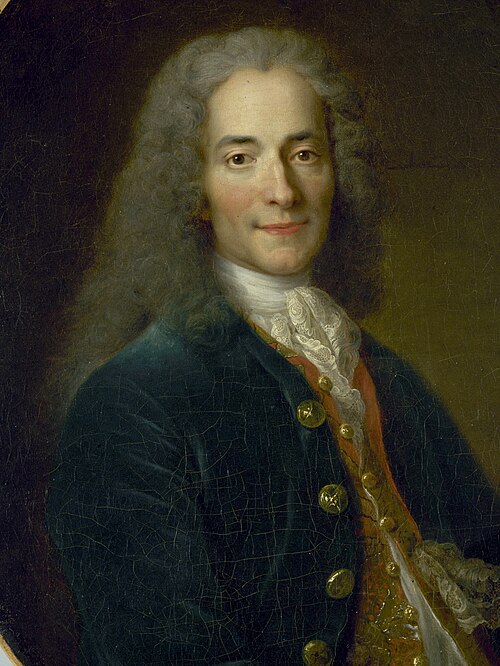 Voltaire1694-1778“it would be necessary to invent him”
Background: Leibniz's philosophy: monads, pre-established harmony, sufficient reason, theodicy · Voltaire: deism, the Infamous, tolerance, Candide · From absolutism to the Revolution: the Church of France, the Enlightenment and the cult of the Supreme Being
Voltaire is not an atheist, and he repeated it all his life with an insistence that is not mere caution. He is a deist: he believes in a Supreme Being, architect of the universe and guarantor of morality, and he fights the “Infâme”, the Infamous, that is, superstition, fanaticism and the Church that sustains them. His position is the mirror image of Spinoza's: Spinoza criticizes the vulgar image of God in order to keep an impersonal God; Voltaire criticizes the Church in order to keep a personal God who judges.
The central text is a verse epistle of 1769 to the anonymous author of the Treatise of the Three Impostors, a clandestine pamphlet that made three frauds of Moses, Jesus and Muhammad. Voltaire grows angry there with militant atheism: “Corrige le valet, mais respecte le maître. / Dieu ne doit point pâtir des sottises du prêtre”, correct the servant, but respect the master; God must not suffer for the follies of the priest. Then he sets out the function of belief in God in lines from which comes the most quoted text of the whole affair:
“Ce système sublime à l'homme est nécessaire. / C'est le sacré lien de la société, / Le premier fondement de la sainte équité, / Le frein du scélérat, l'espérance du juste.” This sublime system is necessary to man. It is the sacred bond of society, the first foundation of holy equity, the curb of the wicked, the hope of the just.
And a little further on, the line that became a proverb: “Si Dieu n'existait pas, il faudrait l'inventer. / Que le sage l'annonce, et que les rois le craignent.” If God did not exist, it would be necessary to invent him. Let the wise man proclaim him, and let kings fear him.
People always quote the first of these alexandrines, almost never the second, which nonetheless gives it its meaning. Voltaire does not merely say that God is useful to the people; he says that the wise man must proclaim him, and that kings must fear him. This God has a double political function: he restrains the wicked, but also the tyrant, and the rest of the epistle warns kings that if they oppress the innocent, God will judge them. The idea is therefore not, or not only, the cynicism of an aristocrat who would like his servants to believe in God so as not to be robbed, a cynicism Voltaire did formulate elsewhere, but in the mouth of a character, the Englishman A in L'A, B, C (1768): “Je veux que mon procureur, mon tailleur, mes valets, ma femme même, croient en Dieu ; et je m'imagine que j'en serai moins volé et moins cocu”, I want my lawyer, my tailor, my servants, even my wife, to believe in God; and I imagine I shall be less robbed and less cuckolded for it (seventeenth conversation); it is a theory of the moral contract guaranteed by a transcendence.
Read in the light of what was to come, the formula changes in scope. “If God did not exist, it would be necessary to invent him”: the line entirely separates the question of God's existence from that of his function. It matters little whether he exists; people must believe in him. This is the programme of Dostoevsky's Grand Inquisitor, who governs men by miracle, mystery and authority without himself believing in God, and who does so, like Voltaire, in the name of men's good. The novel confirms it: Ivan quotes this line two chapters before the poem (Part Seven).
Voltairean deism is an exit from religion, in the sense that it abandons dogmas, miracles, Scriptures, the Church. But it keeps what Durkheim will call the function of the sacred: a “sacré lien de la société”, a sacred bond of society. Voltaire emptied religion of its content in order to keep its form, and that form is precisely that of an absolute that binds. It is a refoundation that does not hide itself: it invents God, in full awareness, for his function. This line makes God a necessary artefact.
Portrait: Nicolas de Largillière, CC0
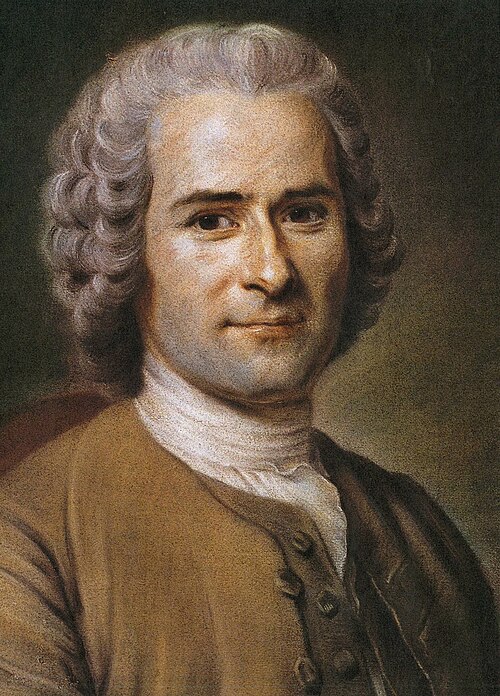 Rousseau1712-1778the religion of the heart and the catechism of the citizen
Background: Plato's philosophy: Forms, soul, city, the Good · Rousseau's thought: state of nature, social contract, general will, Emile · From absolutism to the Revolution: the Church of France, the Enlightenment and the cult of the Supreme Being · Evil, Satan and the afterlife: from Sheol to the Last Judgement
Rousseau occupies in this debate a place that neither Voltaire nor d'Holbach can hold, because he makes two contrary gestures in the same year. In 1762 there appeared Emile, whose Book IV contains the Profession of Faith of the Savoyard Vicar, and The Social Contract, whose penultimate chapter is entitled “De la religion civile”, “On civil religion”. The first text is a radical exit from the Church written by a believer; the second, a precise project for a political religion, twenty-seven years before the Revolution. He leaves the Church and refounds a religion in two books issued by different publishers, which Geneva condemns together.
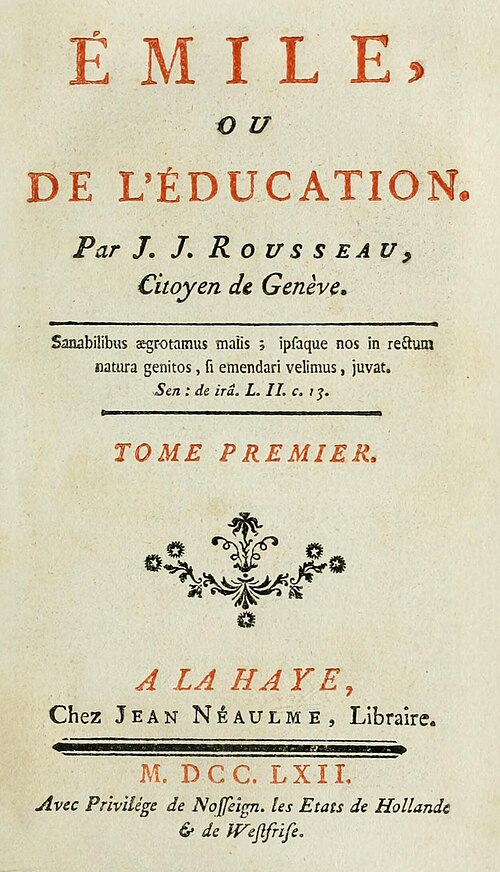
The Profession of Faith is a natural religion, but not that of the philosophers. The vicar does not demonstrate God by abstract reasoning; he starts from inner feeling. Before the order of the world, he does not deduce, he experiences: “Je crois donc que le monde est gouverné par une volonté puissante & sage ; je le vois, ou plutôt je le sens, & cela m'importe à savoir”, I believe, then, that the world is governed by a powerful and wise will; I see it, or rather I feel it, and that is what matters for me to know. The “ou plutôt je le sens”, “or rather I feel it”, is the whole difference from Voltaire. Voltaire's God is a clockmaker one infers; the vicar's is a presence one feels. And morality comes neither from a revealed law nor from a calculation of interest; it comes from a faculty that Rousseau hails as an inner divinity: “Conscience ! conscience ! instinct divin ; immortelle & céleste voix, guide assuré d'un être ignorant & borné, mais intelligent & libre ; juge infaillible du bien & du mal, qui rends l'homme semblable à Dieu”, conscience! conscience! divine instinct, immortal and heavenly voice, sure guide of a being ignorant and limited, but intelligent and free; infallible judge of good and evil, who makes man like God.
This felt God needs no intermediaries, and the Profession of Faith draws an explosive consequence from this. God has spoken, say the revealed religions; the vicar then asks questions all the stronger for being asked by a priest: “Comment cela ? Par des prodiges. Et où sont ces prodiges ? Dans des livres. Et qui a fait ces livres ? Des hommes. Et qui a vu ces prodiges ? Des hommes qui les attestent. Quoi ! toujours des témoignages humains ? toujours des hommes qui me rapportent ce que d'autres hommes ont rapporté ? Que d'hommes entre Dieu & moi !” How so? Through wonders. And where are these wonders? In books. And who made these books? Men. And who saw these wonders? Men who attest them. What! Always human testimony? Always men reporting to me what other men have reported? How many men between God and me! Revelation is a chain of testimony human from end to end. The vicar draws the conclusion: “J'ai donc refermé tous les livres. Il en est un seul ouvert à tous les yeux, c'est celui de la Nature”, so I have closed all the books. There is only one open to all eyes, the book of Nature. External cults, matters of climate, government and national genius, are all of equal worth when they are sincere, for “le culte essentiel est celui du cœur”, the essential worship is that of the heart.
One might think one was reading Spinoza, and the kinship is real on one point: like the Tractatus, the vicar reduces religion to the practice of justice and charity, and denies miracles any value as proof. But the spirit is the reverse. Spinoza rejects miracles because they would contradict the necessary order of nature, which is God, the vicar because they put men between God and himself: the one speaks in the name of reason, the other in the name of the heart. And the vicar's heart keeps what Spinoza's reason set aside: an immense reverence for the Gospel. This is the most famous page of the Profession of Faith, and it was enough to have it condemned by both camps. The vicar confesses that “la majesté des Écritures m'étonne, la sainteté de l'Évangile parle à mon cœur”, the majesty of the Scriptures astonishes me, the holiness of the Gospel speaks to my heart, and he compares the death of Socrates with that of Jesus: “Oui, si la vie & la mort de Socrate sont d'un Sage, la vie & la mort de Jesus sont d'un Dieu”, yes, if the life and death of Socrates are those of a sage, the life and death of Jesus are those of a God. But he adds at once that this same Gospel “est plein de choses incroyables, de choses qui répugnent à la raison, & qu'il est impossible à tout homme sensé de concevoir ni d'admettre”, is full of incredible things, things repugnant to reason, which no sensible man can conceive or accept, and he concludes with what he himself calls a “scepticisme involontaire”, an involuntary scepticism, which suspends judgment on everything that does not bear on conduct.
This position, a very coherent one, holds against both its adversaries. Against the philosophers, it maintains that a principled atheism is a presumption as dogmatic as faith, and that one does not live on demonstrations. Against the Churches, it maintains that no one can be damned for not having believed what he could not examine, and that God cannot require of us, as the vicar says, to be so learned. This is the position Kant would take up in 1793 by separating pure religious faith from ecclesiastical faith, and he never hid his debt. In personal notes from the years 1764-1765 he writes that Rousseau set him right and taught him to honour human beings. The response is attested: religion within the boundaries of mere reason is the Profession of Faith translated into the language of critique.
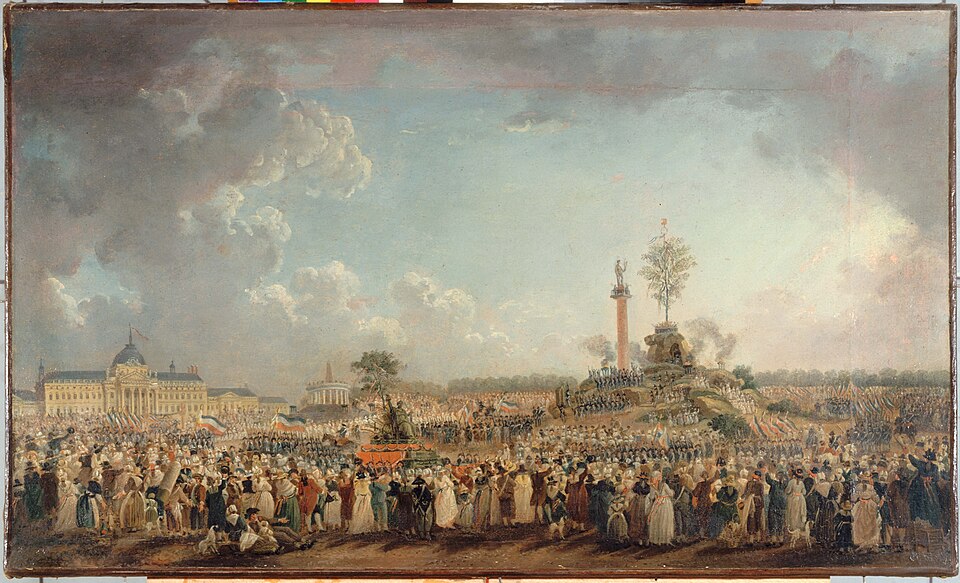
The judges, for their part, were not mistaken. The Parlement of Paris condemned Emile in June 1762 and issued a warrant for Rousseau's arrest; the book was torn up and burned. A few days later the Small Council of Geneva condemned Emile and The Social Contract. The Archbishop of Paris, Christophe de Beaumont, published a pastoral letter against Emile, to which Rousseau replied in 1763 with his Letter to Christophe de Beaumont. The citizen of Geneva, as he signed his books, was driven from his homeland for having written a religion without a Church.
Yet in the same year Rousseau wrote the chapter that makes him the great modern theorist of political religion. Chapter VIII of Book IV of The Social Contract begins with a typology. There is the religion of man, “sans Temples, sans autels, sans rites, bornée au culte purement intérieur du Dieu Suprême & aux devoirs éternels de la morale”, without temples, without altars, without rites, limited to the purely inward worship of the Supreme God and to the eternal duties of morality, which is “la pure & simple Religion de l'Evangile, le vrai Théïsme”, the pure and simple religion of the Gospel, true theism: this is the vicar's religion. There is the religion of the citizen, national, with its tutelary gods and its rites prescribed by law. And there is a third, the worst, which gives men two legislations and two homelands: “On peut appeller celui-ci la religion du Prêtre”, this one may be called the religion of the priest, and the example Rousseau gives of it is Roman Christianity.
The religion of man, however pure, is politically useless, and even harmful, because it detaches hearts from the earthly city. Rousseau goes as far as this sentence, always forgotten when he is made into a sentimental Christian: “Les vrais Chrétiens sont faits pour être esclaves ; ils le savent & ne s'en émeuvent gueres ; cette courte vie a trop peu de prix à leurs yeux”, true Christians are made to be slaves; they know it and are hardly moved by it; this short life has too little value in their eyes. A Christian republic is a contradiction in terms: “chacun de ces deux mots exclud l'autre”, each of these two words excludes the other. Something else is therefore needed, and Rousseau takes the step. “Il y a donc une profession de foi purement civile dont il appartient au Souverain de fixer les articles, non pas précisément comme dogmes de Religion, mais comme sentimens de sociabilité, sans lesquels il est impossible d'être bon Citoyen ni sujet fidele”, there is therefore a purely civil profession of faith whose articles it is for the Sovereign to fix, not exactly as dogmas of religion, but as sentiments of sociability, without which it is impossible to be a good citizen or a faithful subject.
The articles are listed with the precision of a catechism. The positive dogmas are “L'existence de la Divinité puissante, intelligente, bienfaisante, prévoyante & pourvoyante, la vie à venir, le bonheur des justes, le châtiment des méchans, la sainteté du Contract social & des Loix”, the existence of a powerful, intelligent, beneficent, foreseeing and providing Divinity, the life to come, the happiness of the just, the punishment of the wicked, the sanctity of the social contract and the laws; as for the negative dogmas, Rousseau limits them to one: “c'est l'intolérance”, it is intolerance. One might believe this a minimal and tolerant religion, were it not that the preceding sentence gives the sanction: “Sans pouvoir obliger personne à les croire, il peut bannir de l'Etat quiconque ne les croit pas ; il peut le bannir, non comme impie, mais comme insociable, comme incapable d'aimer sincerement les loix la justice, & d'immoler au besoin sa vie à son devoir. Que si quelqu'un, après avoir reconnu publiquement ces mêmes dogmes, se conduit comme ne les croyant pas, qu'il soit puni de mort ; il a commis le plus grand des crimes, il a menti devant les loix”, without being able to oblige anyone to believe them, it may banish from the State whoever does not believe them; it may banish him, not as impious, but as unsociable, as incapable of sincerely loving the laws and justice, and of sacrificing his life to his duty if need be. If anyone, after publicly acknowledging these same dogmas, behaves as though he did not believe them, let him be punished with death; he has committed the greatest of crimes, he has lied before the laws.
I know of no text that illustrates my criterion more exactly: one refounds a religion when one installs an absolute in whose name the sacrifice of the individual can be demanded, and criticism of which becomes sacrilege, and Rousseau writes it out in full. The unsociable man is the one who would be incapable of “immoler au besoin sa vie à son devoir”, sacrificing his life to his duty if need be, and the sanctity of the social contract is a dogma whose betrayal is paid for with one's life. The absolute is no longer God, who appears in the list only as a guarantor; the absolute is the city. Civil religion is a religion of the exit from religion: it takes from the priest the power to damn and gives it to the Sovereign, and replaces hell with exile and the scaffold. The parallel with Plato is constructed: Book X of the Laws had already made belief in the gods a matter of law and punished impiety, and Rousseau, an assiduous reader of Plato, rediscovers the same gesture at the very moment he believes he is founding freedom.
The project is, moreover, older. Rousseau had formulated it six years earlier, in a letter addressed to Voltaire, and had presented it as a remedy for intolerance. The Letter to Voltaire on Providence, of 18 August 1756, answers the Poem on the Lisbon Disaster, in which Voltaire had mocked optimism in the face of the dead of the 1755 earthquake. Rousseau defends Providence there with one argument that makes one smile and another that strikes home. The argument that makes one smile is that men are responsible for their own ills: nature, he writes, “n'avoit point rassemblé là vingt mille maisons de six à sept étages”, had not assembled twenty thousand houses of six or seven storeys there. The argument that strikes home is existential, and it is the vicar's cry before the vicar: “Non, j'ai trop souffert en cette vie pour n'en pas attendre une autre.[…] Je la sens, je la crois, je la veux, je l'espere, je la défendrai jusqu'a mon dernier soupir”, no, I have suffered too much in this life not to expect another. I feel it, I believe it, I will it, I hope for it, I shall defend it to my last breath. Shortly before comes the proposal that heralds The Social Contract: “Je voudrois donc qu'on eût dans chaque État un code moral, ou une espece de profession de foi civile qui contînt positivement les maximes sociales que chacun seroit tenu d'admettre, & négativement les maximes intolérantes qu'on seroit tenu de rejetter, non comme impies, mais comme séditieuses”, I would therefore wish that each State had a moral code, or a kind of civil profession of faith, containing positively the social maxims everyone would be bound to accept, and negatively the intolerant maxims one would be bound to reject, not as impious but as seditious. And Rousseau invites Voltaire to write it: “Vous nous avez donné dans votre Poëme sur la Religion naturelle le catéchisme de l'homme, donnez-nous maintenant dans celui que je vous propose le catéchisme du citoyen”, you have given us in your Poem on Natural Religion the catechism of man; give us now, in the one I propose to you, the catechism of the citizen. The same letter allows that one may “commencer par exterminer”, begin by exterminating, the religions that attack the foundations of society.
Voltaire's response is attested, and it is a flat refusal. On 12 September 1756, from Les Délices, he writes: “Mon cher Philosophe, nous pouvons vous & moi, dans les intervalles de nos maux, raisonner en vers & en prose”, my dear Philosopher, you and I can, in the intervals of our ills, reason in verse and in prose; but he begs to be excused for the moment from these “discussions philosophiques qui ne sont que des amusemens”, philosophical discussions that are mere amusements. The real answer came three years later: Candide (1759); Rousseau himself asserted, in Book IX of the Confessions, that the novel was the promised answer to his letter: “Elle n'est autre que le roman de Candide, dont je ne puis parler, parce que je ne l'ai pas lu”, it is none other than the novel Candide, of which I cannot speak, because I have not read it. The quarrel turned to hatred: in 1764 Voltaire anonymously published the Sentiment des citoyens, which revealed to the public that Rousseau had placed his children in the foundling hospital [a known fact]. On the substance, the irony is complete. Voltaire, who wanted God invented to restrain the wicked and the tyrant, and Rousseau, who wanted a catechism of the citizen sanctioned by death, both want a social sacred, and differ only in tone. Voltaire's line and Rousseau's chapter are the two faces of the same refoundation.
History took care of the implementation, and the confrontation, though constructed, here touches on fact. Robespierre, who venerated Rousseau, had the Convention vote, on 18 Floréal Year II (7 May 1794), a decree by which the French people recognized the existence of the Supreme Being and the immortality of the soul, and instituted festivals every tenth day; the Festival of the Supreme Being was celebrated on 20 Prairial (8 June 1794), a few days before the law of 22 Prairial that accelerated the Terror. I do not believe Rousseau can be held responsible for what others made of him. But one cannot say that the cult of the Supreme Being betrayed the chapter on civil religion: it reproduces its positive dogmas, and the death penalty for civic hypocrisy was not Robespierre's invention.
Where to place Rousseau? I believe the two texts must be held together, and that one must refuse to choose the “good” Rousseau against the “bad” one. The Savoyard vicar is an admirable exit from the Church: a felt God, without priests or miracles, a morality of conscience, a peaceful scepticism about everything else. The legislator of The Social Contract is an unscrupulous refounder, who knows what he is doing and says so. The link between the two is rigorous: because the religion of man is purely inward, it can found no city; and because no city holds together without the sacred, one must manufacture a sacred that is no longer the priests'. Rousseau saw before Durkheim that society needs to sacralize itself. He was not content to see it, he willed it, and that is why he is an instructive counter-example: a man who leaves the Church through the heart and re-enters religion through the city.
Portrait: Maurice Quentin de La Tour, Public domain
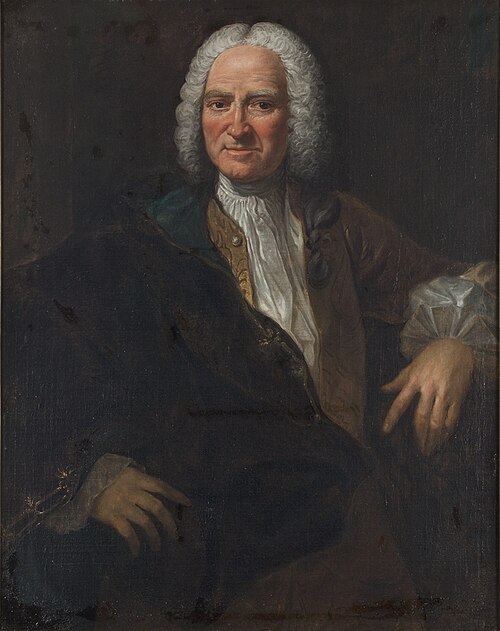 d'Holbach1723-1789nature against the gods
Background: D'Holbach: materialism, the Système de la nature, the militant atheism of the Enlightenment
Paul Henri Thiry, baron d'Holbach, a German naturalized as French, host of a salon frequented by Diderot, Helvétius, Grimm and many others, published the Système de la nature in 1770 under the name of Mirabaud, a perpetual secretary of the Académie française who had died ten years earlier. The first great openly atheist book of European literature, it was condemned to be burned. Voltaire was alarmed by it and answered it in the article “Dieu, dieux” of the Questions sur l'Encyclopédie (fourth part, 1771), in the section “Du Système de la nature”, which opens with an admission: “L'auteur du Système de la nature a eu l'avantage de se faire lire des savants, des ignorants, des femmes”, the author of the System of Nature has had the advantage of being read by the learned, by the ignorant, by women.
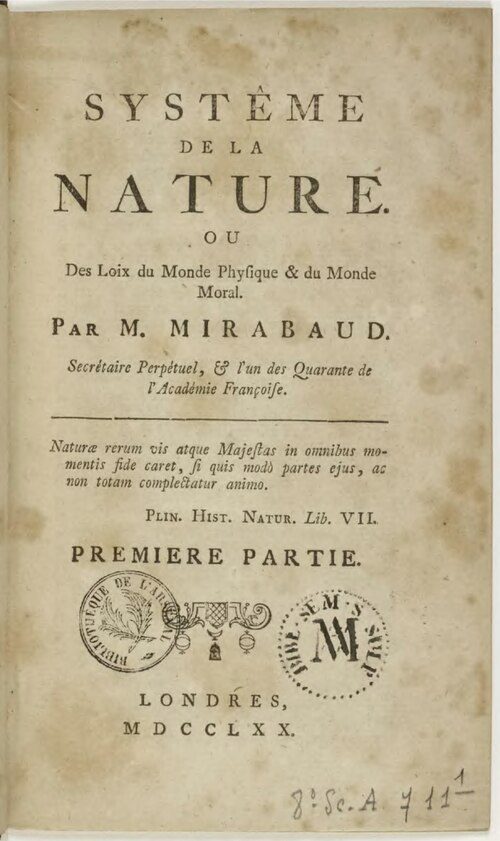
The thesis is a thoroughgoing materialism. Nothing exists but matter in motion, governed by necessary laws; the soul is a function of the body; there is neither freedom, nor immortality, nor God. And religion is explained by ignorance of this nature: “c'est uniquement l'ignorance où l'on fut des causes naturelles et des forces de la nature qui donna la naissance aux dieux”, it was solely ignorance of natural causes and of the forces of nature that gave birth to the gods. Hence the formula that sums up the whole programme: “Si l'ignorance de la nature donna la naissance aux dieux, la connoissance de la nature est faite pour les détruire”, if ignorance of nature gave birth to the gods, knowledge of nature is made to destroy them (II, 1). This is Lucretius without Epicurean piety: the gods are no longer misrepresented, they are phantoms of ignorance.
On one point d'Holbach directly announces Feuerbach: he describes the mechanism by which man manufactures a god for himself. If he misunderstands nature and needs a god to move it, he is forced to make that god a man of whom he himself is the model; “il croit en faire un dieu en lui donnant ses propres qualités, il croit les rendre plus dignes du souverain monde, en les exagérant”, he believes he makes a god of him by giving him his own qualities, he believes he makes them worthier of the sovereign of the world by exaggerating them, whereas by dint of abstractions and exaggerations he makes them unintelligible (II, 7). Here, in 1770, is the theory of projection that Feuerbach will develop in 1841: God is man raised to infinity. The difference is that d'Holbach sees in it an absurdity, whereas Feuerbach will see in it an unrecognized truth.
And d'Holbach answers in advance the objection of Jurieu and of Ivan, as Bayle had done, but in terms of utility. The atheist is not a monster: he is “un homme qui connoit la nature et ses loix, qui connoit sa propre nature, qui sçait ce qu'elle lui impose”, a man who knows nature and its laws, who knows his own nature, who knows what it imposes on him, and his experience proves to him that vice harms him and that society is useful to his happiness (II, 12). Morality is founded on enlightened self-interest, not on the fear of hell.
The book then does something its militant readers pass over in silence. It ends with an Abrégé du code de la nature in which Nature herself speaks to exhort man; and the author, in a burst of fervour, exclaims: “O nature ! Souveraine de tous les êtres ! Et vous ses filles adorables, vertu, raison, vérité ! soyez à jamais nos seules Divinités ; c'est à vous que sont dus l'encens et les hommages de la terre”, O nature! Sovereign of all beings! And you, her adorable daughters, virtue, reason, truth! be for ever our only Divinities; to you are due the incense and the homage of the earth (II, 14).
So the book ends with a prayer. Nature is “sovereign”, her daughters are “adorable”, they are our “Divinities”, we owe them “the incense and the homage”. This is not a careless metaphor, it is the very structure of worship, transferred from God to Nature. D'Holbach leaves religion by founding a religion of Nature, just as the French Revolution would found, twenty years later, a cult of Reason and then of the Supreme Being, and as Comte would found a religion of Humanity. Here we have, before Stirner, the proof of what he would say of Feuerbach: our atheists are pious people (Part Six). The comparison is constructed, since Stirner was aiming at his contemporaries, but the formula applies to the baron even better than to them.
Portrait: Alexander Roslin, Public domain
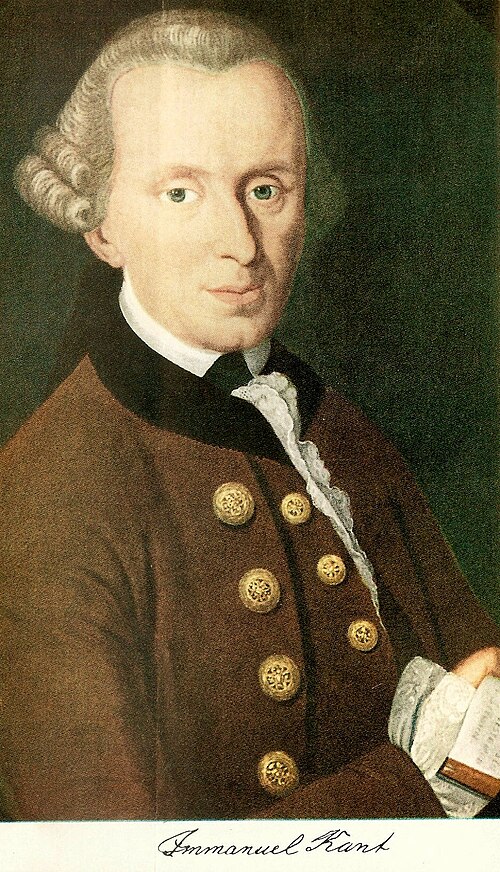 Kant1724-1804religion within the boundaries of mere reason
Background: Kant's philosophy: the three Critiques, the imperative, the postulates, religion · Pietism and German Romanticism: the religion of the heart and of the infinite · German idealism: Kant, Fichte, Schelling, Hegel · Metaphysics and the proofs of the existence of God: from Anselm to Kant · Jürgen Habermas's thought: communicative action, public sphere, postmetaphysical reason, post-secular society · The teaching of Jesus: the Kingdom, the parables, the miracles
Die Religion innerhalb der Grenzen der bloßen Vernunft (Religion within the Boundaries of Mere Reason) appeared in 1793, and an enlarged second edition in 1794. The book earned its author a rescript from the King of Prussia, Frederick William II, dated 1 October 1794 and signed by the minister Wöllner; Kant answered by promising, “als Ew. Königl. Maj. getreuester Unterthan”, as Your Royal Majesty's most faithful subject, to abstain entirely from any public discourse on religion, and he later explained that he had chosen this formula deliberately, so as to renounce his freedom of judgement only during the king's lifetime (preface to the Streit der Fakultäten, 1798). Kant's dealings with the censorship, from the moment the first chapters appeared in a journal, are recounted in the introduction to the Kehrbach edition. Kant is the culmination of the German Enlightenment and will be the main target of the following century.
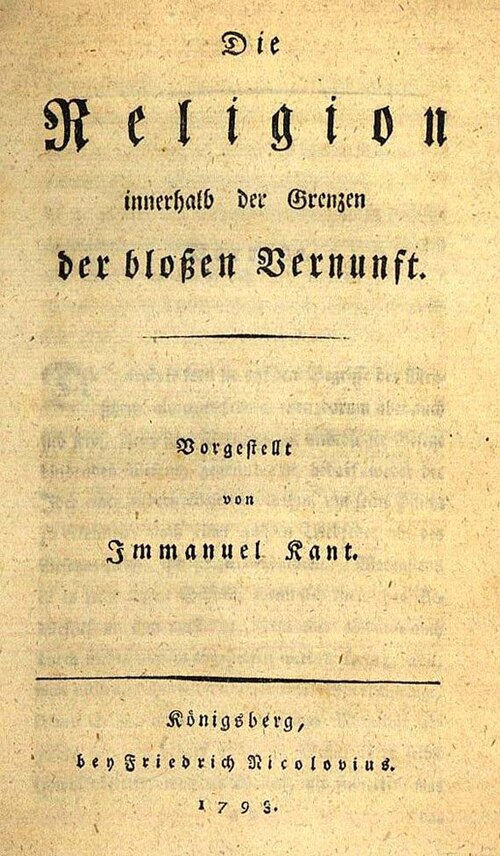
Kant's principle is laid down at the very outset, in the preface to the first edition: morality does not need religion to found itself, since it rests on the autonomy of practical reason; but it leads necessarily to religion. “Moral also führt unumgänglich zur Religion, wodurch sie sich zur Idee eines machthabenden moralischen Gesetzgebers außer dem Menschen erweitert”, morality thus leads inevitably to religion, through which it extends itself to the idea of a powerful moral lawgiver outside the human being. For reason demands that virtue be crowned by happiness, and only a God can guarantee this agreement that nature does not guarantee. This is the doctrine of the postulates, set out in the Critique of Practical Reason (1788): God, freedom and immortality are not known, they are postulated as conditions of possibility of the highest good. Kant had written in the preface to the second edition of the Critique of Pure Reason (1787) that he had had to abolish knowledge in order to make room for faith: “Ich mußte also das Wissen aufheben, um zum Glauben Platz zu bekommen” (B XXX).
Hence the definition of religion, which is a complete reversal of the traditional order: “Religion ist (subjectiv betrachtet) das Erkenntniß aller unserer Pflichten als göttlicher Gebote”, religion is, subjectively considered, the recognition of all our duties as divine commands (fourth part, first section). The traditional Christian fulfils his duties because God commands them; the Kantian recognizes as divine duties he already knows through his reason. It is not religion that founds morality, it is morality that adorns itself with a divine name.
The book then takes up the great Christian dogmas one by one to give them a moral interpretation, and this translation is the model for all those that will follow, from Hegel to Feuerbach and on to Habermas. Original sin becomes “radical evil”, a propensity to evil inscribed in freedom itself, which Kant had first set out in an article of 1792 submitted to the Berlin censorship, as he recounts in a note on his “Censurleiden” published by his biographer Borowski and reproduced by the editor Kehrbach. This evil is not a corrupted nature transmitted by generation, in the manner of Augustine, but a timeless choice of freedom, which subordinates the moral law to self-love. Kant thus keeps from Christianity its darkest anthropology, the one the French Enlightenment had sought to dismiss: man is not naturally good.
Christ becomes an ideal of reason. “Das Ideal der Gott wohlgefälligen Menschheit”, the ideal of humanity well-pleasing to God, we can represent to ourselves only “unter der Idee eines Menschen”, under the idea of a human being who would not only fulfil all duties but spread good around him and accept every suffering, up to the most ignominious death, for the good of the world (second part). It matters little, Kant says in substance, whether this man existed: the ideal is in our reason, and it is the ideal that we recognize in the Gospel narrative, not the other way round. The whole nineteenth-century quarrel over the life of Jesus is here in germ. Strauss will make the Gospels myths produced by the collective consciousness; Bauer will go so far as to doubt his historicity; Onfray, at the end of this story, will make Jesus a pure concept. Kant had already made historicity indifferent, but for the opposite reason: not to discredit Christianity, but to save its moral core from the hazards of historical criticism.
Finally the Church becomes an ethical community. Kant calls “ein ethisches gemeines Wesen”, an ethical community, the society of human beings united under laws of virtue, as opposed to the juridical society united under laws of coercion; and he specifies that this concept “ist der Begriff von einem Volke Gottes unter ethischen Gesetzen”, is the concept of a people of God under ethical laws (third part). The invisible Church, that of all people of good will, is the truth of the visible Churches, which are merely historical approximations of it.
This point is almost always overlooked. Kant does not merely reduce religion to individual morality; he keeps its communal dimension, the one Durkheim will judge essential. The people of God under ethical laws is already, in the terms of 1793, the religion of Humanity that Comte will organize in 1852, with fewer rites and more rigour. It is also what Habermas, in 2001, will call the translation of religious contents into a secular language, and he will explicitly pay tribute to Kant as the first great example of a deconstruction of the truths of faith that secularizes them while saving them. Kant did not abolish the Church; he made it invisible, which is a way of making it universal.
This reduction has a critical consequence, which Kant draws with a severity that is forgotten: everything in historical religion that exceeds morality falls under suspicion. Kant distinguishes the reiner Religionsglaube, pure religious faith, common to all reasonable human beings, and the Kirchenglaube, ecclesiastical faith, founded on a historical revelation and on Scriptures, which is merely a vehicle. And ecclesiastical faith must be interpreted by pure faith: “Der Kirchenglaube hat zu seinem höchsten Ausleger den reinen Religionsglauben”, ecclesiastical faith has pure religious faith as its highest interpreter (third part, title of section VI). The history of religion is the history of a gradual passage from the first to the second, which is “die Annäherung des Reichs Gottes”, the approach of the kingdom of God (title of section VII).
The fourth part, the most violent, is entitled “Vom Dienst und Afterdienst unter der Herrschaft des guten Princips oder von Religion und Pfaffenthum”, on service and counterfeit service under the dominion of the good principle, or on religion and priestcraft. There Kant lays down a principle he declares evident: “Alles, was außer dem guten Lebenswandel, der Mensch noch thun zu können vermeint, um Gott wohlgefällig zu werden, ist bloßer Religionswahn und Afterdienst Gottes”, whatever, apart from a good way of life, the human being supposes he can still do to become well-pleasing to God is mere religious delusion and counterfeit service of God. Prayers, pilgrimages, fasts, rites, observances, if they are held to be meritorious in themselves, belong to Fetischmachen, the making of fetishes; and Pfaffenthum, clericalism, is the constitution of a Church “sofern in ihr ein Fetischdienst regiert”, insofar as a fetish service reigns in it.
Let us measure the critique contained in this text by a man brought up as a Pietist Lutheran: Kant turns almost all actual religious practice into fetishism. He applies to Christian worship the vocabulary of the fetish, which Marx, a reader of Charles de Brosses (Du culte des dieux fétiches, 1760), will rediscover to speak of the commodity. He anticipates Bergson's distinction between static and dynamic religion, and Barth's between religion and faith. And yet he does not leave religion: he keeps its core, God as moral lawgiver, immortality as hope, Christ as the ideal of humanity well-pleasing to God.
This is where the three objections of the following century strike. Schleiermacher, in 1799, will answer that religion is neither a knowledge nor a morality, but an intuition and a feeling, and that by reducing it to morality one has missed it entirely; the reply targets Kant without naming him, and it opens the regime of experience. Hegel will answer that the postulated God is an empty God, a Sollen, an ought-to-be that never is, and that true religion is the one in which the infinite is reconciled with the finite. And Nietzsche, much later, will formulate the hardest objection: Kantian morality has not left religion, it is the Christian religion, become invisible because it has disguised itself as reason. In The Antichrist (§ 10), he will say that German philosophy is “eine hinterlistige Theologie”, an underhanded theology, and that “Der Erfolg Kants ist bloß ein Theologen-Erfolg”, Kant's success is merely a theologian's success. The response is attested, though a century late. Kant believed he had reduced religion to morality; Nietzsche replies that he sacralized morality.
Portrait: Becker, Public domain
A constructed debate: can morality do without God?
Background: The thought of Pierre Bayle: the comet, the Dictionary, toleration · The philosophy of Hume: empiricism, causation, miracles, the natural history of religion · Voltaire: deism, the Infamous, tolerance, Candide · Dostoevsky's work: the Karamazovs, Demons, polyphony
It remains to set face to face the answers of the Enlightenment to the question that will haunt Ivan Karamazov and that Bayle had already asked: if God does not exist, does morality still hold? The confrontation is constructed; each of these authors took a position, and their positions map out all the possible solutions.
Bayle answers that morality holds through society: laws, honour and opinion make the virtue of the greatest number, and a society of atheists would be like a society of pagans, provided the laws were severe. Hume answers, across the whole of his moral work, that morality holds through sentiment: sympathy, utility, the approval that agreeable and useful characters arouse in us, have no need of a divine lawgiver; religion, far from supporting morality, often corrupts it by substituting frivolous observances for it. D'Holbach answers that morality holds through enlightened self-interest: the atheist knows nature and knows that vice harms him. Voltaire answers that morality does not hold without God, at least for the people and for kings: there must be a judge, otherwise the scoundrel and the tyrant have no curb; and if this judge did not exist, it would be necessary to invent him. Kant, finally, answers that morality holds without God, since it rests on the autonomy of reason, but that it cannot understand itself without God, since it demands an agreement of virtue and happiness that only a God guarantees.
Ivan's question thus receives, as early as the eighteenth century, five answers, only one of which proves him right: Voltaire's. The other four maintain that morality survives God, because it rests on society (Bayle), on sentiment (Hume), on self-interest (d'Holbach) or on reason (Kant). But what does each put in God's place? Bayle puts human Justice, that is, the State; d'Holbach Nature, which he ends by invoking as a divinity; Kant Reason, which postulates God; Voltaire an invented God. Only Hume puts something that does not have the form of an absolute: a human sentiment, variable, fragile, and which promises nothing. That is why I take Hume, and not d'Holbach, to be the one who truly leaves religion in the Enlightenment: he is the only one who replaces God with no capital letter.
Dostoevsky, a century later, will know or retain only Voltaire's answer, turned against him: if God is necessary to morality, and if God does not exist, then everything is permitted. The other four will seem to him the tricks of philosophers.
Transition: from reason to experience
The Enlightenment thus ran through every way of leaving religion by reason. Only Hume, having escaped into the obscure regions of philosophy, refounds nothing, at the price of a suspension that is hard to sustain. Voltaire kept God for his function; d'Holbach destroyed the gods only to end with a prayer to Nature; Kant reduced religion to morality and made morality a religion. The generation of Romanticism and German idealism draws a radical conclusion from this: if reason can neither found nor destroy religion, it is because religion is not a matter of reason. A matter of feeling, Schleiermacher will say; of the concept, Hegel will reply, but of a concept that contains feeling and goes beyond it. Between these two answers the modern critique of religion will be born.
Part Fivefeeling and concept
Background: Pietism and German Romanticism: the religion of the heart and of the infinite · From the Judges to the Kings: Samuel, Saul, David and Goliath, Solomon and the Temple · German idealism: Kant, Fichte, Schelling, Hegel · The nineteenth century: the Church against modernity, theology before criticism
Kant had believed he could hold religion at bay by lodging it within the boundaries of mere reason: a moral faith, without dogma claiming to know, without worship claiming to please God. Religion was saved because it was reduced, and it is this reduction that the next generation finds intolerable, from two opposite sides. Some will say that Kant missed religion because he folded it back onto morality, whereas it is first of all a matter of sensibility, of intuition, of a lived relation to the infinite: this is Schleiermacher. Others will say that Kant missed it because he forbade reason to know the absolute, whereas religion already says, in the form of images, what philosophy can think in the form of concepts: this is Hegel. The first opens the way to the modern spiritualities of experience, the second to the philosophies that claim to preserve religion by surpassing it. From their clash, and then from Strauss's application of the Hegelian method to the Gospel narratives, the Hegelian left will emerge, and everything that follows, from Feuerbach to Comte, answers their question: is religion first a feeling or first a truth?
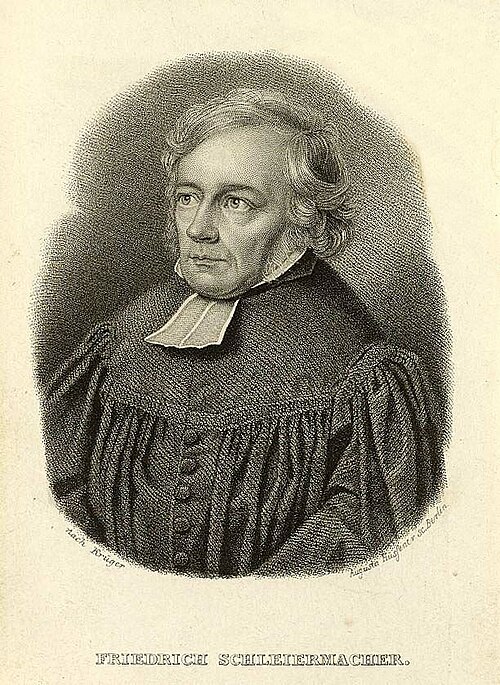 Friedrich Schleiermacher1768-1834religion as sense and taste for the infinite
Background: Kant's philosophy: the three Critiques, the imperative, the postulates, religion · Pietism and German Romanticism: the religion of the heart and of the infinite · Schleiermacher's thought: the Speeches, the Glaubenslehre, hermeneutics · Hermeneutics: from Schleiermacher to Ricoeur · Barth's theology: the Römerbrief, dialectical theology, the Church Dogmatics
In 1799, in Berlin, the Über die Religion. Reden an die Gebildeten unter ihren Verächtern (On Religion: Speeches to Its Cultured Despisers) appeared without the author's name. Their author was a young pastor at the Charité hospital, a familiar of Friedrich Schlegel's Romantic circle, and the title already states the whole design: the book is not addressed to believers but to those who despise religion in the name of culture. It does not seek to prove God to them, but to show them that what they despise is something other than religion: a failed metaphysics and a catechism morality, which they are right to despise, but which are not religion.
The fundamental thought fits into one line of the second speech, the most famous in the book: “Praxis ist Kunst, Spekulation ist Wissenschaft, Religion ist Sinn und Geschmack fürs Unendliche”, practice is an art, speculation is a science, religion is sense and taste for the infinite. And a little earlier: “Ihr Wesen ist weder Denken noch Handeln, sondern Anschauung und Gefühl”, its essence is neither thinking nor acting, but intuition and feeling. Kant had brought religion back to action (morality); rationalist metaphysics had brought it back to thought (the proofs of God). Schleiermacher gives it a third province, irreducible to the other two: experience. “Religion haben, heißt das Universum anschauen”, to have religion is to intuit the universe.
The word Anschauung does not designate a mystical vision in the sense of an ecstasy cut off from ordinary life. It designates the subject's receptivity to what exceeds it, the moment when, in any perception whatever, the finite lets itself be grasped as an expression of the infinite. Schleiermacher describes it with the precision of a phenomenologist before the term existed: it is the first instant of every perception, before intuition and feeling separate, when sense and its object are, so to speak, fused into each other. He calls it “Jener erste geheimnisvolle Augenblick”, that first and mysterious instant, and he adds that it is indescribable and passes very quickly. Religion consists in recapturing this instant and recognizing it in the religious activity of the soul.
Three consequences follow.
The first concerns God. If religion is intuition of the universe, the idea of God is only one modality of it among others, one way of representing to oneself the unity of what one intuits. In 1799 Schleiermacher draws from this a conclusion that caused scandal and that he softened in later editions: “so müßt Ihr auch zugeben, daß eine Religion ohne Gott besser sein kann, als ein andre mit Gott”, you must also admit that a religion without God can be better than another with God. One could hardly announce more plainly what the twentieth century will call spirituality without God. The hero of this religion without God is named: Spinoza. The second speech pays him a tribute that has remained famous: “Opfert mit mir ehrerbietig eine Locke den Manen des heiligen verstoßenen Spinoza!”, offer with me, reverently, a lock of hair to the shades of the holy, outcast Spinoza! And further on: “voller Religion war Er und voll heiligen Geistes”, he was full of religion and full of holy spirit. The atheist par excellence in the eyes of Europe becomes, from a pastor's pen, the saint of true religion: what is impiety in the light of dogma becomes piety in the light of experience.
The second consequence concerns Scripture and the institution. If religion is a living experience, the sacred text is only its trace. Schleiermacher has an admirable sentence here: “Jede heilige Schrift ist nur ein Mausoleum der Religion ein Denkmal, daß ein großer Geist da war, der nicht mehr da ist”, every holy scripture is only a mausoleum of religion, a monument attesting that a great spirit was there who is there no longer. And he concludes: “Nicht der hat Religion, der an eine heilige Schrift glaubt, sondern der welcher keiner bedarf, und wohl selbst eine machen könnte”, the one who has religion is not the one who believes in a holy scripture, but the one who needs none and could well write one himself. The miracle undergoes the same displacement: it is no longer a departure from the laws of nature, but the religious name for any event whatever, once it is perceived in its relation to the infinite. Everything is a miracle for whoever has the religious sense, and nothing for whoever lacks it.
The third consequence concerns eternity. Religion does not promise a life after death; it gives, here, an eternity that is not a duration. Schleiermacher says so in a formula that Spinoza could have signed and that Wittgenstein will rediscover in the Tractatus (6.4311; the comparison is mine): “Mitten in der Endlichkeit Eins werden mit dem Unendlichen und ewig sein in einem Augenblick, das ist die Unsterblichkeit der Religion”, in the midst of finitude to become one with the infinite and to be eternal in a moment, that is the immortality of religion.
The Reden are not a mere Romantic effusion. Schleiermacher is a rigorous theologian, and his great dogmatics, Der christliche Glaube (The Christian Faith, 1821-1822, second edition 1830-1831), will systematize the intuition of 1799 in a soberer form: piety is defined there as the feeling of absolute dependence, schlechthinniges Abhängigkeitsgefühl (1830 spelling: schlechthiniges), the Leitsatz of § 4 stating that we know ourselves to be “schlechthin abhängig”, absolutely dependent, that is, in relation with God. The passage from the intuition of the universe to the feeling of dependence is not without significance. The intuition of 1799 was active, almost aesthetic; the feeling of dependence is passive, it expresses creatureliness. But the principle remains the same: religion has its seat in the immediate feeling of self, not in knowledge or in the will.
This position is, I believe, the first modern attempt to leave institutional religion without leaving lived religion, and as such it prefigures the whole contemporary shift from religion to spirituality. Schleiermacher dismisses dogma, the text, the miracle in the vulgar sense, personal immortality and even, in 1799, the necessity of God; he keeps experience. Not as a private matter: the last speeches insist on the religious community, on the Church as the free communication of intuitions, and on the plurality of positive religions, each being a singular way of intuiting the universe. He does not found a new religion; he claims to unveil the essence of all of them.
The objection will come from two sides. Hegel will reproach him for having reduced religion to a feeling, that is, to what is most subjective, most arbitrary and most animal in man. Feuerbach, later, will take the lesson in the other direction: if religion is feeling, and if feeling is human, then God is human feeling objectified. Schleiermacher unintentionally opened the door to anthropological reduction: the feeling of the infinite, detached from all objective truth, can always be reinterpreted as a feeling of self. Schleiermacher must be given his best defence here: he never said that the infinite was a product of feeling; he said that feeling was the place where the infinite gives itself. But his theory contains no means of distinguishing these two theses. This is the structural weakness of every spirituality of experience, which we shall find again in William James and in Rudolf Otto: experience proves that one feels, it does not prove what one feels.
Portrait: Auteur inconnu, Public domain
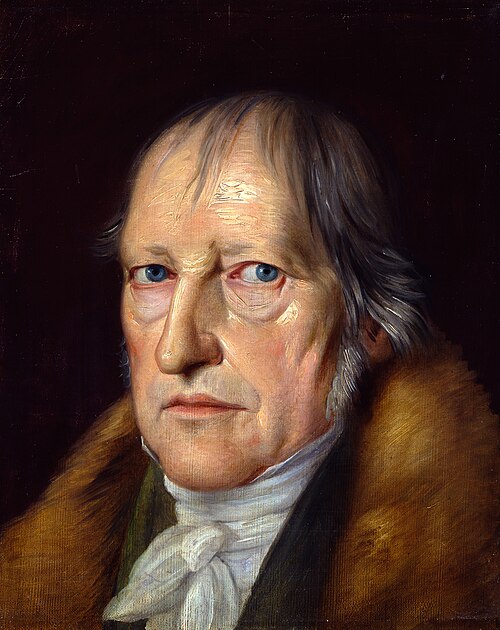 Georg Wilhelm Friedrich Hegel1770-1831religion surpassed and preserved
Background: The philosophy of Hegel: dialectic, the Phenomenology, Absolute Spirit, religion and concept · German idealism: Kant, Fichte, Schelling, Hegel · The philosophy of history: from Augustine to Löwith · The Passion and the Resurrection: the four accounts and what history retains
Hegel arrived in Berlin in 1818; Schleiermacher was already teaching there, and the two men, colleagues at the university, cordially detested each other. Their quarrel is not a faculty anecdote: it sets against each other the two great answers to Kant. To understand it, one must start from Hegel's thesis on religion.
Hegel does not hold religion to be false: it says the true, and even the absolute true, but in an inadequate form. Religion and philosophy have, in his view, the same content: the absolute, spirit, God. They differ in form: religion presents this content in the form of Vorstellung, representation, that is, in images, narratives, sensible figures and external relations: a Father who sends his Son, a Son who dies and rises again, a Spirit who descends upon a community. Philosophy presents the same content in the form of the Begriff, the concept, that is, in thought that grasps the inner necessity of what the image sets side by side. The Vorlesungen über die Philosophie der Religion (Lectures on the Philosophy of Religion), delivered in Berlin in 1821, 1824, 1827 and 1831 and published after his death, say so unambiguously: there is no question whatever of philosophy overturning religion, for “vielmehr ist die Religion eben der wahrhafte Inhalt nur in Form der Vorstellung”, religion is rather precisely the true content, only in the form of representation. And Hegel adds that humanity did not have to wait for philosophy to receive the consciousness of truth.
The word that sums up this relation is Aufhebung, untranslatable because it unites three senses that English keeps apart: to cancel, to preserve, to raise up. Philosophy “sublates” religion: it cancels its representational form, preserves its content, and raises it to the form of the concept. This is a first figure of our question: Hegel leaves religion, since the religious form is declared inferior and provisional, but while preserving it entirely, since its whole content passes into philosophy. Neither a naive believer nor a critic of religion, he wants an exit that is a preservation. The whole Hegelian left will be born from the question whether this preservation is sincere.
Within this framework belongs an early text whose legacy is immense. In 1802, in Glauben und Wissen (Faith and Knowledge), published in the Kritisches Journal der Philosophie that he edited with Schelling in Jena, Hegel attacks the philosophies of Kant, Jacobi and Fichte, which he accuses of having abandoned the knowledge of God to faith and thereby separated the finite from the infinite. The conclusion of the text formulates, eighty years before The Gay Science, the death of God. The pure concept, Hegel writes, must designate the “unendlichen Schmerz”, the infinite grief, on which the religion of modern times rests, namely the feeling that “Gott selbst ist tot”, God himself is dead. This feeling, he adds, had only been expressed empirically by Pascal, whose words he quotes about a nature that “marque partout un Dieu perdu et dans l'homme et hors de l'homme”, everywhere marks a lost God, both within man and outside man. Philosophy must restore, the same sentence goes on, the “spekulativen Karfreitag”, the speculative Good Friday, “in der ganzen Wahrheit und Härte seiner Gottlosigkeit”, in the whole truth and harshness of its godlessness, so that the highest totality may rise again “in die heiterste Freiheit ihrer Gestalt”, into the most serene freedom of its shape.
Two remarks are called for. The first is philological. This “Gott selbst ist tot” is usually linked to the Lutheran Good Friday hymn O Traurigkeit, o Herzeleid, whose second stanza is by Johann Rist (1641). In Glauben und Wissen, Hegel does not quote this hymn: he quotes Pascal. In the Lectures on the Philosophy of Religion, on the other hand, he makes the connection himself: “Gott selbst ist todt, heißt es in jenem lutherischen Liede”. And he comments in the same place, on the death of Christ, that it is the “fürchterlichste Gedanke”, the most dreadful thought, that all that is eternal and all that is true is not, that negation is in God himself. The connection with the hymn, presented by tradition as a commentators' hypothesis, is thus made by Hegel himself, but in the Lectures and not in the text of 1802.
The second remark is one of substance. For Hegel, the death of God is not an event in the history of unbelief; it is a moment of the concept, and precisely the moment of negativity within the absolute itself. God dies in Christ, and this death is overcome in the resurrection, that is, in the Spirit of the community: a Good Friday that calls for an Easter Sunday. When Nietzsche takes up the formula, he will keep its grief and remove its resurrection. The whole history of the critique of religion in the nineteenth century is played out, on my reading, in the interval between Hegel's speculative Good Friday and the murder without resurrection of the madman of The Gay Science.
The quarrel with Schleiermacher is an attested response. In 1822, Hegel wrote a preface to the book of his disciple Hermann Friedrich Wilhelm Hinrichs, Die Religion im inneren Verhältnisse zur Wissenschaft (Religion in Its Inner Relation to Science). The first volume of Schleiermacher's Glaubenslehre had just appeared, with its definition of piety by the feeling of dependence. Hegel did not name his colleague, but all Berlin understood. If religion, he writes, is grounded in man only on a feeling, then this feeling has no other determination than to be the feeling of his dependence, “und so wäre der Hund der beste Christ, denn er trägt dieses am stärksten in sich, und lebt vornehmlich in diesem Gefühle”, and so the dog would be the best Christian, for he bears this feeling most strongly within him and lives chiefly in this feeling. And he adds: “Auch Erlösungsgefühle hat der Hund, wenn seinem Hunger durch einen Knochen Befriedigung wird”, the dog also has feelings of redemption, when a bone brings satisfaction to his hunger. The next sentence gives the positive thesis: in religion, spirit rather finds its liberation.
The sarcasm is cruel, but it contains a serious argument against every spirituality of experience. A feeling, as such, is indeterminate; it can have any content whatever; it contains in itself no criterion of truth. The feeling of dependence is felt by the dog towards its master, and by the servile subject towards his tyrant. If religion is only feeling, nothing allows us to distinguish piety from servility. Hegel demands that religion be thought, that is, that it have a true content that reason can recognize. It is the same demand that makes him scorn, in the Phenomenology of Spirit (1807), the “beautiful soul” that, “um die Reinheit seines Herzens zu bewahren”, in order to preserve the purity of its heart, flees contact with actuality.
Should we side with Hegel against Schleiermacher? On the argument yes, on the conclusion no. Hegel saw clearly: a religion founded on feeling alone is defenceless against psychological reduction, and Feuerbach will prove it. But his conclusion, that philosophy possesses the truth of religion better than religion itself, generates a symmetrical and graver danger. If philosophy is the truth of religion, the philosopher is the true priest and the system the completed dogma: Hegel leaves religion only by making philosophy a higher religion, that of those who understand. This is already the structure of the Averroist division: there are those who have representation, the people, and those who have the concept, the wise. Hegel does not govern believers, but he understands them better than they understand themselves, and that is another form of sovereignty.
The ambiguity of Aufhebung remains fertile, and it is what breaks the school apart after 1831. If philosophy preserves the content of religion, is it religion that is saved, or philosophy that takes its place? The Hegelian right will answer that Hegel demonstrated the truth of Christianity; the left will answer that he pronounced its dissolution. The words “left” and “right” come from this debate, and it is Strauss who will introduce them, in connection with Christ.
Portrait: Jakob Schlesinger, Public domain
 David Friedrich Strauss and Bruno Bauer1808-1874; 1809-1882myth and imposture
Background: Historical-critical exegesis and the quests for the Jesus of history · David Friedrich Strauss: The Life of Jesus, myth, The Old Faith and the New · Bruno Bauer: the critique of the Gospels, the Berlin Free Ones, the Jewish question · The Young Hegelians: from the critique of religion to the critique of politics · The New Testament: twenty-seven books, their dates and their authors · The Gospel of Mark: the oldest account · The apocryphal gospels: Thomas, Peter, Mary, Judas and the others · Messiah, Son of Man, Son of God: the titles of Jesus
In 1835 and 1836 the two volumes of Das Leben Jesu, kritisch bearbeitet (The Life of Jesus, Critically Examined) appeared in Tübingen. Their author, twenty-seven years old, who had heard Hegel in Berlin shortly before his death, would lose his post at the Tübingen seminary because of the book, and a professorship in Zurich would be withdrawn from him in 1839 under popular pressure. Rarely has a work of scholarship caused such a scandal, and rightly so: it raises, with all the resources of philology, the question that runs all the way to Onfray, that of the historical value of the gospel narratives.
Strauss's answer comes down to one notion: myth. Before him, two readings were at odds. The supernaturalist reading took the miracles as facts; the rationalist reading, that of a Paulus, also took them as facts, but natural and misunderstood ones: Jesus did not walk on the water, he walked along the shore, and the disciples saw wrongly. Strauss dismisses both readings alike, because both assume that the Gospels report events. He proposes a third way: the gospel narratives are myths, that is, according to the definition he gives in the introduction, “nichts Andres, als geschichtartige Einkleidungen urchristlicher Ideen, gebildet in der absichtslos dichtenden Sage”, nothing other than history-like clothings of early Christian ideas, formed in legend that composes without intention.
Everything hangs on the adverb absichtslos, without intention. Myth is not a lie: it has no author who knows he is inventing. It arises in a community that awaits a Messiah and that, convinced Jesus was he, tells his life according to the features the Scriptures attributed to the Messiah: birth in Bethlehem, descent from David, the healings foretold by Isaiah. The narrative is not fabricated to deceive; it is produced by faith itself, which cannot picture the Messiah otherwise. This notion ruins at a stroke the old Enlightenment hypothesis of priestly imposture, found in the clandestine treatise of the Three Impostors and which Voltaire only half shook off. The evangelists are not forgers; they are believers who think in images.
But Strauss does not stop there, and this is what makes him more than a philologist. In the preface he asserts that his critique leaves the heart of faith intact: “Den inneren Kern des christlichen Glaubens weiss der Verfasser von seinen kritischen Untersuchungen völlig unabhängig”, the author knows the inner core of the Christian faith to be entirely independent of his critical inquiries. The supernatural birth, the miracles, the resurrection and the ascension, he adds, “bleiben ewige Wahrheiten, so sehr ihre Wirklichkeit als historischer Fakta angezweifelt werden mag”, remain eternal truths, however much their reality as historical facts may be doubted. One recognizes the Hegelian structure: the narrative is the representation, the eternal truth is the concept.
And what is this concept? The Schlussabhandlung, the concluding dissertation, states it in pages that are, in my view, the true starting point of Feuerbach. Strauss asks whether the idea of the unity of divine and human nature must have been realized once, in one individual, and never again. He answers that this is not how the idea realizes itself: it does not like to pour all its fullness into a single specimen; it unfolds in a multiplicity of individuals. Then comes the thesis: “Das ist der Schlüssel der ganzen Christologie, dass als Subjekt der Prädikate, welche die Kirche Christo beilegt, statt eines Individuums eine Idee, aber eine reale, nicht Kantisch unwirkliche, gesetzt wird”, this is the key to the whole of Christology: as the subject of the predicates the Church assigns to Christ, one posits, instead of an individual, an idea, but a real one, not unreal in the Kantian manner. And the idea is named: “Die Menschheit ist die Vereinigung der beiden Naturen, der menschgewordene Gott”, humanity is the union of the two natures, God become man. Strauss goes on: humanity is the worker of miracles, since spirit subdues nature ever more; it is the sinless one, it is the one that dies, rises again and ascends to heaven.
We can see what has happened. Strauss has performed the operation Feuerbach will theorize six years later: he has transferred the predicates of Christ to the human species, to the Gattung. The very word Gattung appears in his text: the properties the Church attributes to Christ contradict one another in an individual; they agree “in der Idee der Gattung”, in the idea of the species. Feuerbach's divinized Man is already there, in 1836, from the pen of a Hegelian who believes he is saving Christianity. The most radical historical criticism of its time thus ends, not in the abolition of the divine, but in its transfer onto humanity. The English reception confirms it in its own way: Strauss's first English translator (1846) would also be Feuerbach's translator in 1854, Marian Evans, who was to become George Eliot. The title of her translation of Feuerbach presents her precisely as “Translator of "Strauss's Life of Jesus"”.
Bruno Bauer goes further, and in another direction. First a theologian of the Hegelian right, he moved to the extreme left at the end of the 1830s, lost his venia legendi in Bonn in 1842, and argued in his Kritik der evangelischen Geschichte der Synoptiker (1841-1842) that the Gospels are not the product of a collective legend, as Strauss held, but the conscious literary work of one author, the evangelist Mark, on whom the others depend. Against Strauss's absichtslos, then, there is an author, an intention, a creation; hence, in the late Bauer, doubts about the historical existence of Jesus himself. Engels, who had known Bauer in his Berlin days, paid him a qualified tribute in 1882 in “Bruno Bauer und das Urchristentum”. He judges the dependence of the Gospels on one another irrefutably demonstrated, and concedes that, since the content of the Gospels proves almost entirely unverifiable historically, “so daß man selbst die geschichtliche Existenz eines Jesus Christus für fraglich erklären kann”, one may even declare the historical existence of a Jesus Christ doubtful. But Engels rejects the Enlightenment conclusion that Bauer comes close to: one is not done with a religion that subjugated the Roman Empire “indem man sie einfach für von Betrügern zusammengestoppelten Unsinn erklärt”, by simply declaring it nonsense patched together by impostors. It must be explained by its historical conditions.
Strauss and Bauer thus trace, as early as the 1840s, the two paths between which the whole historical criticism of Christianity will oscillate, down to Onfray. For Strauss, the narratives are myths born of a community's faith, and their kernel of truth is an idea; for Bauer, they are a literary creation behind which there may be no one at all. The first path leads to a religion of humanity, the second to a thesis of non-existence, and neither leaves religion: the first transfers it, the second reduces it to a fiction whose power remains to be explained, which Bauer does not do and for which Engels reproaches him. As we saw in Part Two, Michel Onfray's Théorie de Jésus takes up, without always knowing it, Bauer's path while lending it Strauss's vocabulary: Jesus “as a concept”.
Strauss's story has an epilogue, which prompts an attested response from Nietzsche. Nearly forty years after Das Leben Jesu, Strauss published Der alte und der neue Glaube (The Old Faith and the New, 1872). In it he asks four questions: are we still Christians? do we still have a religion? how do we conceive the world? how do we order our life? To the first he answers no. To the second he answers “ja oder nein, je nachdem man es verstehen will”, yes or no, depending on how one wishes to understand it: there remains a piety towards the universe, “dieselbe Pietät, wie der Fromme alten Stils für seinen Gott”, the same piety as the old-style believer feels for his God, a feeling of dependence on the All, which the Darwinian science expounded in the next chapter does not abolish but orients. The most feared critic of Christianity ends by proposing a religion of the universe, bourgeois and comfortable, in which Beethoven and Haydn take the place of liturgy. In 1873 the young Nietzsche devoted to him the first of his Unzeitgemäße Betrachtungen, David Strauss, der Bekenner und der Schriftsteller (David Strauss, the Confessor and the Writer), in which he makes him the type of the “Bildungsphilister”, the cultivated philistine. Nietzsche does not reproach Strauss for being too critical, but for not being critical enough: he has done away with the Christian God and kept Christian morality intact, without seeing that the one does not stand without the other, the first statement of the objection that The Gay Science will make famous. Strauss thus travels in a single lifetime the movement I describe over a century: from the critique of dogma to a substitute religion.
Portrait: Hermann Günther, Public domain
Portrait: Auteur inconnu, Public domain
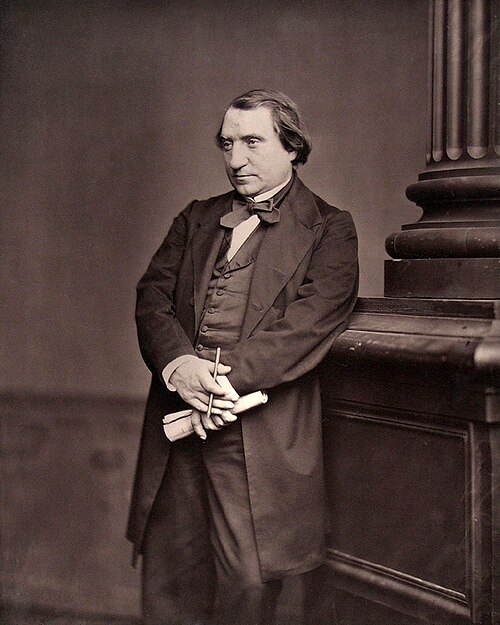 Ernest Renan1823-1892the god become an incomparable man
Background: Historical-critical exegesis and the quests for the Jesus of history · Ernest Renan: the Life of Jesus, science, the nation · From the Judges to the Kings: Samuel, Saul, David and Goliath, Solomon and the Temple · Positivism and scientism: science as a substitute religion in the nineteenth century · The Gospel of Mark: the oldest account · The nineteenth century: the Church against modernity, theology before criticism · The teaching of Jesus: the Kingdom, the parables, the miracles
The Vie de Jésus (The Life of Jesus) appeared in Paris in 1863. Its author had left the seminary of Saint-Sulpice in 1845; he was a philologist of the Semitic languages, and he had just been suspended from his chair at the Collège de France for having, in his inaugural lecture of 1862, called Jesus “un homme incomparable”, an incomparable man. A great publishing success, the book sold tens of thousands of copies within a few months, was translated throughout Europe and provoked hundreds of refutations.
Renan does three things at once, and they must be told apart to understand why Nietzsche would hate him and Dostoevsky would fight him.
The first is a principle of method, laid down in the introduction with a clarity the Germans had lacked. Renan imagines a wonder-worker presenting himself, and a commission of scholars checking his miracle under controlled, repeatable conditions. Never, he observes, has a miracle occurred under such conditions; the wonder-worker has always chosen his subject, his setting, his audience; and most often it is the people themselves, “par suite de l'invincible besoin qu'il a de voir dans les grands événements et les grands hommes quelque chose de divin”, owing to their invincible need to see something divine in great events and great men, who create the legends after the fact. Hence the principle: “un récit surnaturel ne peut être admis comme tel, qu'il implique toujours crédulité ou imposture, que le devoir de l'historien est de l'interpréter et de rechercher quelle part de vérité, quelle part d'erreur il peut receler”, a supernatural narrative cannot be accepted as such, it always implies credulity or imposture, and the historian's duty is to interpret it and to seek out what share of truth and what share of error it may conceal. Renan, like Strauss, looks for the truth behind the narrative, but his method is positivist, not Hegelian: the supernatural is excluded on principle, not by dialectic. And the word “imposture” reappears, alongside “credulity”.
The second is an experience, which Renan recounts with an emotion that did much for the book's success. In 1860-1861 he travelled in Galilee on an archaeological mission. The agreement of texts and places, the harmony of the gospel ideal with the landscape, were for him “comme une révélation”, like a revelation. He goes on: “J'eus devant les yeux un cinquième évangile, lacéré, mais lisible encore, et désormais, à travers les récits de Matthieu et de Marc, au lieu d'un être abstrait, qu'on dirait n'avoir jamais existé, je vis une admirable figure humaine”, I had before my eyes a fifth gospel, torn but still legible, and from then on, through the narratives of Matthew and Mark, instead of an abstract being one would say had never existed, I saw an admirable human figure. The sentence is aimed at Bauer's thesis: against the abstract being one would say had never existed, Renan sets the human figure recovered in Galilee, and he is thus the anticipated adversary of all the mythicists.
The third is a cult. The Vie de Jésus is not a cold book: it ends in a genuine doxology. Having said that we moderns labour without reaping, Renan concludes: “Mais quels que puissent être les phénomènes inattendus de l'avenir, Jésus ne sera pas surpassé. Son culte se rajeunira sans cesse; sa légende provoquera des larmes sans fin; ses souffrances attendriront les meilleurs coeurs; tous les siècles proclameront qu'entre les fils des hommes, il n'en est pas né de plus grand que Jésus”, but whatever the unexpected phenomena of the future may be, Jesus will not be surpassed. His cult will renew its youth unceasingly; his legend will draw tears without end; his sufferings will move the best hearts; every century will proclaim that among the sons of men there has been born none greater than Jesus. Christ ceases to be God; he becomes the greatest of men; and his cult is declared eternal. Renan is a pure example of an exit from religion that preserves it in the form of admiration. It is Christianity minus the supernatural, that is, a religion of the great man.
Two attested responses measure what is at stake. The first is Nietzsche's, who read Renan with growing hostility. In Der Antichrist (written in 1888, published in 1895), he writes: “Herr Renan, dieser Hanswurst in psychologicis, hat die zwei ungehörigsten Begriffe zu seiner Erklärung des Typus Jesus hinzugebracht, die es hierfür geben kann: den Begriff Genie und den Begriff Held”, Monsieur Renan, that buffoon in psychologicis, has brought to his explanation of the type of Jesus the two most unfitting concepts there could be: the concept of genius and the concept of hero. And in Götzen-Dämmerung (completed in 1888, published in January 1889), he goes further: what is the use of all the free thought, modernity and mockery, “wenn man mit seinen Eingeweiden Christ, Katholik und sogar Priester geblieben ist!”, when one has remained, in one's entrails, a Christian, a Catholic and even a priest! Renan believes he has left the Church; he has merely changed altars.
The second response is Dostoevsky's. In A Writer's Diary of 1873, he recalls Renan, who, unlike Belinsky, stopped before the figure of Christ, proclaiming in his book “полной безверия”, full of unbelief, the Vie de Jésus, that Christ nonetheless remains “идеал красоты человеческой”, the ideal of human beauty. The connection with Renan is attested, and we know that the figure of a too human Christ, reduced to morality and admiration, is one of Dostoevsky's constant targets.
Renan opens a possibility that what follows will take up again and again: that of a spirituality without the supernatural, centred on an exemplary figure. Jesus becomes a master of life, like Socrates or the Buddha. The contemporary spiritualities that make Christ a sage, of which Frédéric Lenoir gave a popular version at the beginning of the twenty-first century under the title Le Christ philosophe (2007), are the direct heirs of Renan. Nietzsche's objection reaches them all: to admire Jesus as a genius or a hero is to misunderstand him twice, as God and as man. Between Renan and Nietzsche lies the whole difference between an exit that preserves religion as a cult of the great man and a genealogy that refuses every cult.
Portrait: Antoine Samuel Adam-Salomon, Public domain
Transition: from a quarrel of schools to the break
Schleiermacher shifted religion towards experience, to the point of admitting a religion without God; Hegel towards the concept, to the point of making philosophy its truth. Strauss transferred the predicates of Christ to humanity; Renan made Christ the greatest of men and declared his cult eternal. None of them wants to destroy religion; all want to save it by transforming it, and all transform it into something that keeps the place of the absolute: the universe, Spirit, Humanity, the great man.
Against this caution there rises, from 1841 onwards, the generation of the Young Hegelians, who take Hegel's Aufhebung and Strauss's transfer at their word and draw the consequence their masters did not dare to draw: if God is man, then one must say so, and stop worshipping him under another name. But in saying so, they merely displace worship once more.
Part Sixthe Hegelian left and its adversaries
Background: The Young Hegelians: from the critique of religion to the critique of politics · The nineteenth century: the Church against modernity, theology before criticism
In 1840 Frederick William III of Prussia died; his son, Frederick William IV, a pietist romantic, brought Schelling to Berlin to combat “die Drachensaat des Hegelschen Pantheismus”, the dragon's seed of Hegelian pantheism. The Young Hegelians lost their posts, their journals were banned, and the critique of religion became for them the necessary form of political critique in a state that called itself Christian. This is the context of the German texts in this part, published between 1841 and 1845 in a climate of censorship and exile. At the same moment, in Copenhagen and in Paris, two authors who could not be more opposed, Kierkegaard and Comte, answered the same question by opposite routes, one by returning to faith against Christendom, the other by founding a religion without God. And in Frankfurt an old philosopher ignored for thirty years, Schopenhauer, proposed a mysticism without God that would shape Nietzsche's youth.
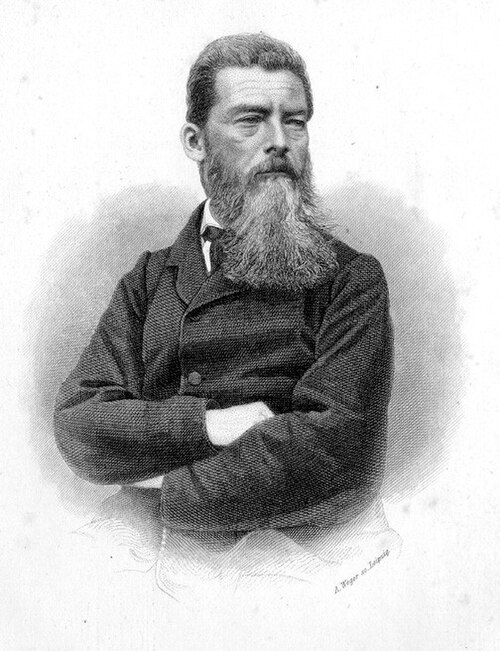 Ludwig Feuerbach1804-1872the secret of theology
Background: Exodus: Moses, the departure from Egypt, Sinai and the Law · David Friedrich Strauss: The Life of Jesus, myth, The Old Faith and the New · Feuerbach's thought: The Essence of Christianity, the species, love, nature · Max Stirner and The Ego and Its Own: the Ego against the spectres · Engels: dialectical materialism, the history of early Christianity, the reckoning with Feuerbach · The thought of Luc Ferry: transcendental humanism, the Man-God, the revolution of love · Evil, Satan and the afterlife: from Sheol to the Last Judgement
This whole debate pivots on Feuerbach, who must be followed at greater length than is usually done. He is reduced to a formula, theology is anthropology, and to a book, Das Wesen des Christentums. But his thinking about religion extends over twenty years, from 1830 to 1851, and it moves: it starts from death, passes through Christianity, takes on Hegel, defends itself against Stirner and ends in nature. At every stage our question returns: did the man who dissolved God into man abolish religion, or did he displace it?
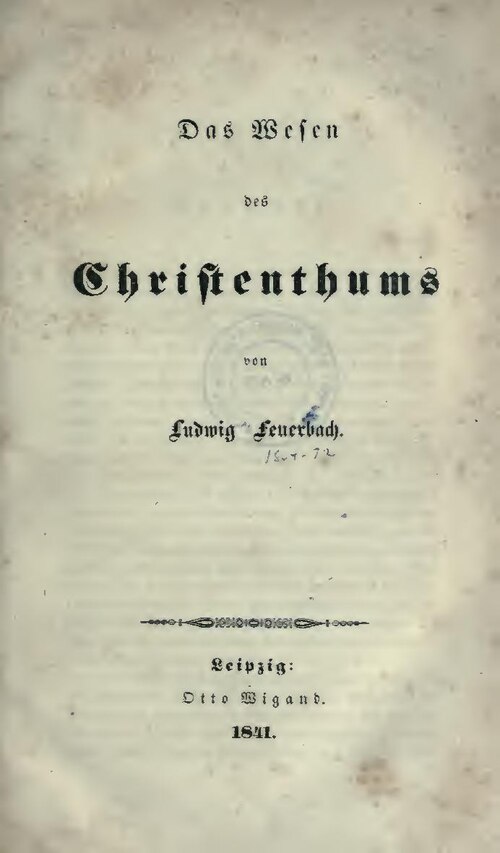
The first book, published anonymously, cost its author his career. The Gedanken über Tod und Unsterblichkeit (Thoughts on Death and Immortality) appeared in Nuremberg in 1830. Feuerbach, then a Privatdozent at Erlangen, denies personal immortality in it: the individual is finite, and what is infinite in him, reason, love, spirit, does not belong to him as his own; death is the act by which the individual returns to the infinite what was not his. The author was quickly identified, and he would never be appointed professor. This starting point sheds light on everything else: the first object of Feuerbach's critique is not God but the beyond, and his first gesture is not to deny the infinite but to take it away from the individual and give it to the species. The young Hegelian of 1830 is still a pantheist of spirit, and it will take him ten years to make the species no longer Spirit, but man.
Das Wesen des Christentums (The Essence of Christianity) appeared in Leipzig, published by Otto Wigand, in 1841. It struck a whole generation as a liberation, and Engels still remembered it in 1886 in his Ludwig Feuerbach und der Ausgang der klassischen deutschen Philosophie: “Die Begeisterung war allgemein: Wir waren alle momentan Feuerbachianer”, the enthusiasm was general: we were all Feuerbachians for the moment. The words “for the moment” already tell what followed.
The thesis is stated in the preface to the first edition: the book means to show “daß das Geheimniß der Theologie die Anthropologie ist”, that the secret of theology is anthropology. The abridged formula of the textbooks, “die Theologie ist Anthropologie”, is not in the first edition in that form, and the difference is no small one: the word Geheimnis says that theology hides what it is and must be deciphered. George Eliot, in her 1854 translation made from the second German edition, keeps the word: “the secret of theology is anthropology”.
The deciphering rests on a theory of consciousness. Man differs from the animal because he is conscious not only of himself as an individual but of his species, his Gattung, that is, of the infinity of his essence: reason, will, love. This infinite essence the finite individual cannot recognize as his own: he projects it outside himself and worships it under the name of God. Hence the central formula: “Das Bewußtsein Gottes ist das Selbstbewußtsein des Menschen”, the consciousness of God is the self-consciousness of man. The mechanism is precise: man, and this for Feuerbach is the secret of religion, objectifies his essence, then makes himself the object of this objectified essence transformed into a subject; he thinks of himself as an object, but as the object of an object, of another being. All the divine predicates are human predicates raised to infinity: God is love, and it is human love that is worshipped without knowing it.
The book tests the thesis dogma by dogma, and it was this testing, more than the thesis, that made its success. The first part, entitled “Die Religion in ihrer Uebereinstimmung mit dem Wesen des Menschen”, religion in its agreement with the essence of man, reads each mystery as the secret of a human reality. The incarnation is the secret of love: God becomes man because love drives him to it, and the love that commands God is higher than he is, which Feuerbach writes with a boldness that announces the conclusion: “Die Liebe ist Gott selbst und außer ihr ist kein Gott”, love is God himself and apart from it there is no God. Prayer is the secret of the heart that knows no limits: “Das Gebet ist die Selbsttheilung des Menschen in zwei Wesen”, prayer is the self-division of man into two beings, a dialogue of man with himself, with his heart. The miracle is the secret of desire: “Das Wunder ist eine Creatio ex nihilo”, the miracle is a creation out of nothing, for whoever makes wine from water makes wine from nothing; and its truth is simple: “Aber was ist das Wunder? Ein realisirter supranaturalistischer Wunsch”, but what is the miracle? A supernaturalist wish fulfilled.
The second part reverses the lighting: “Die Religion in ihrem Widerspruch mit dem Wesen des Menschen”, religion in its contradiction with the essence of man. For the projection is not innocent: placed outside man, his essence escapes his criticism and turns against him. The central chapter, the last before the conclusion, is “Der Widerspruch von Glaube und Liebe”. Love, says Feuerbach, is universal and unites all men; faith is particular and separates those who believe from those who do not. “Der Glaube ist also wesentlich parteiisch”, faith is therefore essentially partisan; “Der Glaube kennt nur Feinde oder Freunde, keine Unparteilichkeit”; and the consequence is necessary: “Der Glaube ist wesentlich intolerant”, faith is essentially intolerant. The flames of hell, he adds, are only the sparks of the furious glance that faith casts on unbelievers. This chapter is the real point of the book: Feuerbach does not reproach Christianity for being false, but for betraying its own heart, love, for the sake of faith, from which love must be wrested.
The second edition, in 1843, adds a preface containing Feuerbach's most quoted sentence in the twentieth century, because Guy Debord made it the epigraph of The Society of the Spectacle (1967). I give it in Eliot's translation, made from that edition: the present age “prefers the sign to the thing signified, the copy to the original, fancy to reality, the appearance to the essence”; and for that age, the criticism that dispels illusion is a profanation, “for in these days illusion only is sacred, truth profane”. The sentence says that Feuerbach knew himself to be a profaner and held profanation to be a duty of truth.
Feuerbach owes to Strauss the transfer of the predicates to the species, but he does away with the Hegelian Spirit of which Strauss's humanity was the realization: there is only man, sensuous and natural. He owes to Schleiermacher the idea that religion has its seat in feeling, but where Schleiermacher saw the place where the infinite gives itself, he sees the place where man gives himself the infinite. The reduction Hegel feared is accomplished.
There remained Hegel, with whom Feuerbach settles accounts in two short texts that are perhaps more important than the great book. The Vorläufige Thesen zur Reform der Philosophie (Provisional Theses for the Reform of Philosophy), written in 1842 and published in 1843 in Switzerland, because of Prussian censorship, in Arnold Ruge's Anekdota, open with a sentence that extends the diagnosis of 1841: “Das Geheimnis der Theologie ist die Anthropologie, das Geheimnis aber der spekulativen Philosophie die Theologie”, the secret of theology is anthropology, but the secret of speculative philosophy is theology. Hegel did not go beyond religion, he rationalized it. “Die Hegelsche Philosophie ist der letzte Zufluchtsort, die letzte rationelle Stütze der Theologie”, Hegelian philosophy is the last refuge, the last rational support of theology, and Feuerbach adds with biting irony that, just as Catholic theologians once became Aristotelians to fight Protestantism, Protestant theologians will have to become Hegelians to fight atheism. Hence the method, which fits in one line: “Wir dürfen nur immer das Prädikat zum Subjekt, und so als Subjekt zum Objekt und Prinzip machen”, we need only ever make the predicate the subject, and thus, as subject, the object and the principle. Hegel says: Spirit thinks; Feuerbach: man thinks, and Spirit is only his thought. This is the inversion that Marx, thirty years later, would still claim in the afterword to Capital, by setting back on its feet a dialectic that was standing on its head.
The Grundsätze der Philosophie der Zukunft (Principles of the Philosophy of the Future), of 1843, give the positive version. The first paragraph states the meaning of the whole modern age: “Die Aufgabe der neueren Zeit war die Verwirklichung und Vermenschlichung Gottes”, the task of the modern age was the realization and humanization of God. The philosophy of the future will be sensualist: real being is sensuous being, and truth lies not in the thinking self but in the relation between two sensuous beings, the I and the Thou. “Der natürliche Standpunkt des Menschen, der Standpunkt der Unterscheidung in Ich und Du, Subjekt und Objekt ist der wahre, der absolute Standpunkt”. Here one recognizes, eighty years before Buber's Ich und Du (1923), the philosophy of dialogue; Buber acknowledged this debt, which I note without quoting it, not having checked the passage.
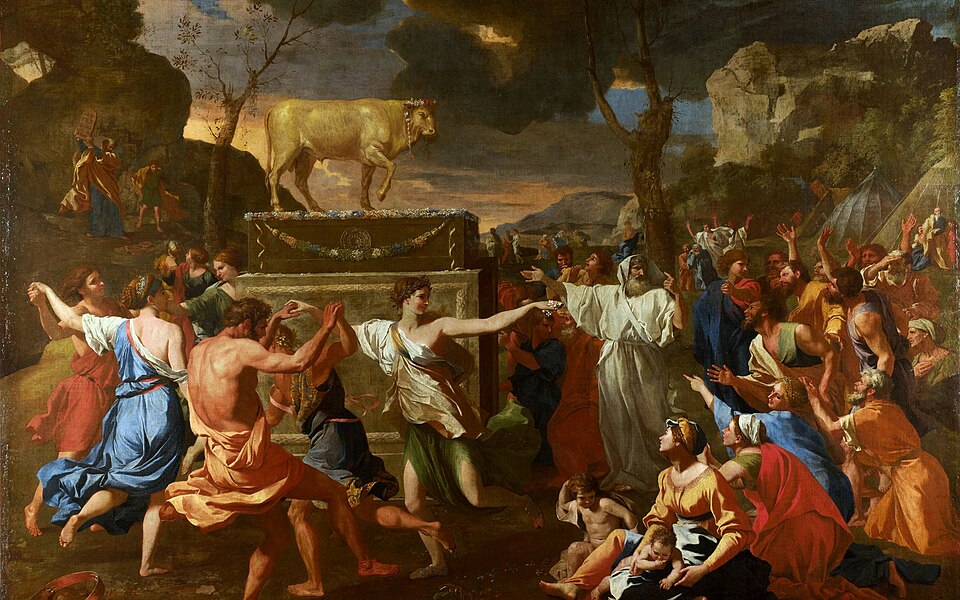
Paragraph 60 states plainly what the book of 1841 implied. “Einsamkeit ist Endlichkeit und Beschränktheit, Gemeinschaftlichkeit ist Freiheit und Unendlichkeit”, solitude is finitude and limitation, community is freedom and infinity; and Feuerbach concludes: man by himself is man, in the ordinary sense; man with man, “die Einheit von Ich und Du ist Gott”, the unity of I and Thou is God. This is not a metaphor. The Theses had said it of the new philosophy: it has made the attribute the substance, the predicate the subject, and thereby “die neue Philosophie ist die realisierte Idee, die Wahrheit des Christentums”, the new philosophy is the realized idea, the truth of Christianity; and Feuerbach specifies: “Aber eben weil sie das Wesen des Christentums in sich hat, gibt sie den Namen des Christentums auf”, but precisely because it has the essence of Christianity within it, it gives up the name of Christianity. This sentence is the centre of our question: Feuerbach does not claim to abolish Christianity, but to keep its essence and give up its name.
Criticism therefore has a positive task: not to destroy religion, but to retranslate it, to give back to man what he has alienated. The necessary turning point of history, says the last chapter of 1841, is the avowal “daß das Bewußtsein Gottes nichts andres ist als das Bewußtsein der Gattung”, that the consciousness of God is nothing other than the consciousness of the species. And he draws the practical rule from it: if the essence of man is the supreme being of man, then the first and highest law must be the love of man for man. “Homo homini Deus est”, man is a God to man, “dieß ist der oberste praktische Grundsatz”, this is the supreme practical principle, and it is the “Wendepunkt der Weltgeschichte”, the turning point of world history. The formula reverses the homo homini lupus of the Hobbesian tradition.
Hasty readers miss the essential point: Feuerbach does not merely say that human relations are good, he says that they are holy. The relations between child and parents, between spouses, between brothers, between friends, in a word moral relations, are “per se wahrhaft religiöse Verhältnisse”, in themselves truly religious relations; life is, in its essential relations, “durchaus göttlicher Natur”, of a wholly divine nature; it does not receive its consecration from the priest's blessing. Marriage, as the free union of love, is “durch sich selbst” holy. Religion is not abolished but moved from the church to the home, from heaven to the relation between I and Thou. Feuerbach does not desacralize the world, he resacralizes the whole of it.
There is a greatness in this undertaking that what came after has caused to be forgotten. Feuerbach is one of the first to have taken religion seriously as human truth: Spinoza put it in its place, Feuerbach listens to it, not as a web of errors but as the deepest expression of man, misunderstood by man himself. Hence, in Das Wesen des Christentums, pages of almost religious fervour on love, suffering, the incarnation: Feuerbach does not refute Christianity, he realizes it, and theologians have been able to read him as an ally. Karl Barth, in 1927, would declare him entirely right in his interpretation of religion, with one restriction: in so far as it bears on religion as the experience of evil and mortal man; and this would be the better to withdraw revelation from his critique (see Part Ten).
The first objection, which came almost at once, forced Feuerbach to define himself. In 1844 Stirner accused him, in Der Einzige und sein Eigentum, of having achieved no more than a theological liberation from theology: he had done away with the subject, God, but left intact the predicates, love, reason, Man, before which one must still kneel. Feuerbach replied in 1845, in Wigands Vierteljahrsschrift, with an article entitled “Über das Wesen des Christentums in Beziehung auf den Einzigen und sein Eigentum”. The response is attested, and stronger than is usually said.
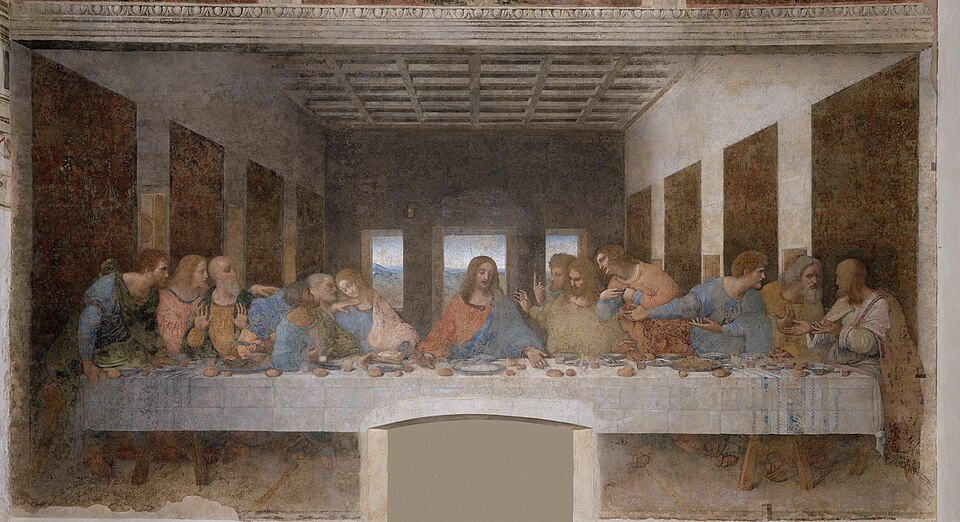
First, on the predicates: to let them remain is not to let them remain divine. “Werden sie aus Gott in den Menschen versetzt, so verlieren sie eben den Charakter der Göttlichkeit”, transferred from God into man, they lose precisely the character of divinity. A political image: the majesty of the king rests only on the opinion that he is a being apart; let me see him as a man among others, and it vanishes; the same holds for heavenly majesty. Then he turns Stirner's own weapon against him: the Unique One declares that he has founded his cause on nothing, but nothing too is a predicate of God, as mysticism has said a hundred times. “So hat also der »Egoist« doch auch noch seine Sache auf Gott gestellt! So gehört also auch er noch zu den »frommen Atheisten!«”, so the egoist too has founded his cause on God after all! so he too still belongs among the pious atheists! Stirner's formula comes straight back in his face.
Next, on substance, the formula “man is the God of man” deifies nothing. “Der Satz: der Mensch ist der Gott, das höchste Wesen des Menschen, ist daher identisch mit dem Satz: es ist kein Gott, kein höchstes Wesen im Sinne der Theologie”, the proposition ‘man is the God, the supreme being of man’ is therefore identical with the proposition ‘there is no God, no supreme being in the sense of theology’; the first is only the positive, practical, religious expression of what the second expresses negatively. He had written just before, for anyone who might think to take him at his word: “Religion ist Affekt, ist Poesie; voilà tout”, religion is affect, it is poetry, that is all. Finally, he rejects the charge of having sacrificed the individual to the species, since his book makes the sensuous individual, who eats and drinks, the last word of the mystery, and he refuses the heavenly Unique One as well as the earthly one: “Schlage Dir den »Einzigen« im Himmel, aber schlage Dir auch den »Einzigen« auf Erden aus dem Kopfe!”, get the Unique One in heaven out of your head, but get the Unique One on earth out of your head too! The article closes on a self-definition that would become famous: Feuerbach is neither materialist, nor idealist, nor philosopher of identity; he is a man, or rather, since he places the essence of man in community, “Gemeinmensch, Kommunist”, a communal man, a communist. Stirner replied once more the same year, and the quarrel ended there.
Who prevails? Feuerbach's reply seems to me right on one point and weak on the other. Right when it shows that the Unique One, founded on nothing, rejoins negative theology: this is the objection I make to Stirner myself, and Feuerbach saw it as early as 1845. Weak when it claims that the proposition “man is God to man” is purely negative. If it were, why say it in the language of religion? Why call human relations “divine”, marriage “holy”, the unity of I and Thou “God”? It is, Feuerbach replies, the positive, practical, religious way of saying the same thing. But that is the whole question: whoever keeps only the positive expression of a negation keeps religion. His distinction between the name and the thing turns against him: he gives up the name of God, but keeps the thing, that is, worship.
The last works, the ones the textbooks ignore most, confirm this. In 1846 Das Wesen der Religion (The Essence of Religion) appeared; then, having given thirty public lectures in Heidelberg during the winter of 1848-1849, at the students' invitation and in the fever of revolution, Feuerbach published them in 1851 under the title Vorlesungen über das Wesen der Religion. The shift is twofold. Feuerbach widens the object: Christianity was only a religion of man, and there is an older religion, which worships nature. And he changes the principle of explanation, through an avowed borrowing from Schleiermacher. “Das Abhängigkeitsgefühl des Menschen ist der Grund der Religion; der Gegenstand dieses Abhängigkeitsgefühles, Das, wovon der Mensch abhängig ist und abhängig sich fühlt, ist aber ursprünglich nichts andres, als die Natur”, man's feeling of dependence is the ground of religion; but the object of this feeling, that on which man depends and feels himself dependent, is originally nothing other than nature.
Feuerbach takes up Schleiermacher's schlechthinniges Abhängigkeitsgefühl and himself recalls, in the Vorlesungen, Hegel's gibe: the expression has had a bad reputation among speculative philosophers ever since Hegel, against Schleiermacher, made the witticism that the dog too ought to have a religion, since it feels dependent on its master. He takes the side of feeling against the concept, but turns this feeling towards nature: what man depends on is not a personal God, it is air, water, light, earth, and religion is the affective and imaginary translation of this real relation. The response to Schleiermacher is attested: Feuerbach does not deny the phenomenon described, he shifts its object.
Das Wesen der Religion even touches, without knowing it, on the criterion of this essay. In paragraph 29 Feuerbach writes: “Im Opfer versinnlicht und concentrirt sich das ganze Wesen der Religion”, in sacrifice the whole essence of religion is made sensible and concentrated; the ground of sacrifice is the feeling of dependence, fear, uncertainty; but its result and its aim are self-feeling, courage, enjoyment. Feuerbach thus sees that religion is concentrated in sacrifice; he concludes that man sacrifices to reassure himself, I conclude that a religion is recognized by its demand that sacrifices be made to it. It remains to be seen whether his religion of humanity escapes this demand.
The last Heidelberg lecture answers unambiguously. Feuerbach calls on his listeners to will a better life rather than believe in one, and to will it together. But for this, he says, “müssen wir an die Stelle der Gottesliebe die Menschenliebe als die einzige, wahre Religion setzen”, we must put in place of the love of God the love of man as the only, the true religion, and in place of faith in God man's faith in himself, the faith that the destiny of humanity depends on humanity alone, that “der einzige Teufel des Menschen der Mensch[…], aber auch der einzige Gott des Menschen der Mensch selbst ist”, that the only devil of man is man, but also that the only God of man is man himself. Then, by way of farewell, the aim of all his teaching: to turn his listeners “aus Gottesfreunden zu Menschenfreunden, aus Gläubigen zu Denkern, aus Betern zu Arbeitern, aus Candidaten des Jenseits zu Studenten des Diesseits”, from friends of God into friends of men, from believers into thinkers, from people who pray into workers, from candidates for the beyond into students of the here and now. The first lecture had announced the same programme, in almost the same terms: to turn men from theologians into anthropologists, and from theophiles into philanthropists.
I admire this programme, but it must be read to the end: Feuerbach's last word is not that religion is an illusion to be dispelled, it is that the love of man is “the only, the true religion”. He himself supplied Engels with the material for his objection.
Engels formulated the objection in 1886, in what is in my view the best page of his book. Feuerbach, he writes, “will die Religion keineswegs abschaffen, er will sie vollenden. Die Philosophie selbst soll aufgehn in Religion”, by no means wants to abolish religion, he wants to complete it; philosophy itself is to be absorbed into religion. Engels describes the mechanism as I have done from the start: Feuerbach does not accept that love, friendship, compassion, sacrifice are worth something in themselves; he asserts that they reach their full value only if they are given a higher consecration by being called religion. “Sie sollen für voll gelten, erst wenn sie religiös abgestempelt sind”, they are to count fully only once they have been stamped as religious. Then comes an etymological remark that takes us back to the prologue: “Religion kommt her von religare und heißt ursprünglich Verbindung. Also ist jede Verbindung zweier Menschen eine Religion”, religion comes from religare and originally means bond; therefore every bond between two people is a religion. Engels mocks: “Solche etymologische Kunststücke bilden das letzte Auskunftsmittel der idealistischen Philosophie”, such etymological tricks are the last resort of idealist philosophy. To this he adds a historical argument: from 1793 to 1798 the Christian religion had so thoroughly disappeared from France that Napoleon had difficulty restoring it, without there appearing, in that interval, the slightest need for a substitute in Feuerbach's sense. And, more harshly, a social remark: in Feuerbach, “die Liebe ist überall und immer der Zaubergott, der bei Feuerbach über alle Schwierigkeiten des praktischen Lebens hinweghelfen soll”, love is everywhere and always the magic god who is supposed to help one over all the difficulties of practical life, and this in a society divided into classes with diametrically opposed interests.
The argument is very powerful. Engels does not reproach Feuerbach for loving human beings, but for needing to call this love “religion”. Refoundation does not lie in the content of what one loves, but in the need to sacralize it, which sharpens the criterion set out in the prologue: one refounds a religion not when one preserves values that religion carried, but when one feels the need to consecrate them as absolute and to give them the name of sacred. From here on two degrees must be distinguished: soft refoundation, which consecrates without demanding, and refoundation in the strict sense, which installs an absolute in whose name the sacrifice of the individual can be demanded, and criticism of which becomes sacrilege; self-offering freely consented to belongs to neither.
Must Feuerbach then be ranked among the refounders, alongside Rousseau and Comte? I believe so, with a nuance that the comparison brings out. Rousseau sacralizes the city, and his civil religion has dogmas, a Sovereign who fixes them, a penalty for whoever betrays them: it demands sacrifice and says so. Comte would sacralize Humanity, with a calendar, temples and a high priest. Feuerbach, for his part, sacralizes the relation: love, marriage, friendship, the unity of I and Thou. His religion has neither dogmas, nor priests, nor penalties, and demands of no one that he immolate himself: it belongs to soft refoundation, the need to consecrate, and not to refoundation in the strict sense, the absolute that can demand the sacrifice of the individual. It is the softest of refoundations, and that is why it has been so fertile: it nourished the “true socialism” that Engels mocked, the religion of humanity of George Eliot, who translated it and made it the morality of her novels, and the philosophy of dialogue in the twentieth century. But it also opened the way to less gentle refoundations: for if man is God to man, someone will end up asking which man, and in the name of which humanity. Stirner asked the question as early as 1844, and the answers of Marx, of Comte and of the political religions of the twentieth century would show that Man, once installed in the place of God, can demand as much as he did.
Feuerbach is thus the textbook case of the need to consecrate. It remains to hear Stirner's objection in its original form, the one given it in 1844 by a former regular of the “Freien”, the circle of Berlin Young Hegelians, with a brutality that Feuerbach's reply did not disarm.
Portrait: August Weger, Public domain
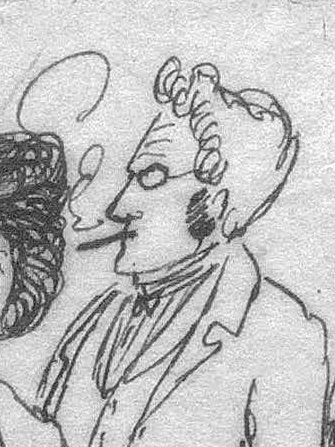 Max Stirner1806-1856Man is a ghost
Background: Bruno Bauer: the critique of the Gospels, the Berlin Free Ones, the Jewish question · Feuerbach's thought: The Essence of Christianity, the species, love, nature · Max Stirner and The Ego and Its Own: the Ego against the spectres · The Young Hegelians: from the critique of religion to the critique of politics · The thought of Camus: the absurd, revolt, the cycles
Der Einzige und sein Eigentum (The Ego and Its Own) appeared from the same publisher as Feuerbach, Otto Wigand, in the autumn of 1844, dated 1845. Its author, Johann Caspar Schmidt, a teacher at a school for young ladies in Berlin, signed himself Max Stirner. The book opens and closes on the same line, borrowed from Goethe: “Ich hab' mein' Sach' auf Nichts gestellt”, I have set my cause on nothing. Everything lies in this framing: the Unique One rests on no cause that surpasses him, neither God, nor Man, nor Truth, nor the People.
The preface sets out the argument with an irony of great precision. Everyone wants me to serve a cause: the cause of God, of humanity, of truth, of freedom, of the fatherland. But God serves only his own cause, he is perfectly egoistic, and so is humanity. Hence the conclusion: “Gott und die Menschheit haben ihre Sache auf Nichts gestellt, auf nichts als auf Sich. Stelle Ich denn meine Sache gleichfalls auf Mich, der Ich so gut wie Gott das Nichts von allem Andern, der Ich mein Alles, der Ich der Einzige bin”, God and humanity have set their cause on nothing, on nothing but themselves. Let me then likewise set my cause on myself, I who am, just as much as God, the nothing of everything else, I who am my all, I who am the Unique One. And Stirner at once specifies that this nothing is not a void: “Ich bin Nichts im Sinne der Leerheit, sondern das schöpferische Nichts, das Nichts, aus welchem Ich selbst als Schöpfer Alles schaffe”, I am nothing, not in the sense of emptiness, but the creative nothing, the nothing out of which I myself, as creator, create everything.
Stirner's thought generalizes the critique of projection. Feuerbach had shown that God was the alienated human essence. Stirner shows that the human essence is itself an alienation. Every instance one places above oneself and to which one must sacrifice oneself is a ghost, a Spuk, and whoever believes in it has “einen Sparren zu viel”, a screw loose: “Mensch, es spukt in Deinem Kopfe; Du hast einen Sparren zu viel!” Political liberalism, socialism, the humanism of Feuerbach and of Bruno Bauer are stages of this haunting.
From the first pages of the first part, Stirner sets side by side the two formulas of the moment: “Der Mensch ist dem Menschen das höchste Wesen, sagt Feuerbach. / Der Mensch ist nun erst gefunden, sagt Bruno Bauer”. He concludes, in the second part, that humanism has merely changed the object of fear: “Menschenfurcht” is “bloß eine veränderte Gestalt der Gottesfurcht”, the fear of Man is only a modified form of the fear of God. And then comes the sentence that sums up the whole book and that I have taken as the thread of this essay: “Unsere Atheisten sind fromme Leute”, our atheists are pious people. The feudal analogy follows: in the feudal age, we held everything from God as a fief; in the liberal age, the same relation of vassalage exists with Man; God was the lord, now it is Man; God was the mediator, now it is Man; God was the Spirit, now it is Man. The rights of man themselves are a power received from a superior, which for that reason we call “right” and not “might”.
Stirner goes further still, to the point of turning the language of Christian demonology against humanism: “Der Mensch ist der letzte böse Geist oder Spuk, der täuschendste oder vertrauteste, der schlaueste Lügner mit ehrlicher Miene, der Vater der Lügen”, Man is the last evil spirit or ghost, the most deceptive or the most familiar, the craftiest liar with an honest face, the father of lies. The “father of lies” is the name of the devil in the Gospel of John (8, 44): Feuerbach's Man, the idol of the humanists, is the egoist's devil. And in its place Stirner claims what he calls an “Entheiligung”, a desecration without measure: “Nichts ist ihm heilig!”, nothing is sacred to him.
Stirner formulated as a programme a complete desecration, and he saw that all the critiques of religion of his time were “theologische Insurrectionen”, theological insurrections: revolts against God waged with the weapons and within the categories of theology. The diagnosis is astonishingly accurate.
The objection that strikes him comes from two sides, and it is a sign of his strength that his two main adversaries, Marx and Nietzsche, are also those who profited most from him. On Marx's side, Die deutsche Ideologie (written in 1845-1846 with Engels, published in 1932) devotes its longest section to “Saint Max”, a commentary of ferocious irony. The argument fits in a line: the Unique One is an abstraction, who believes he has freed himself from all essences but ignores the material conditions that make him what he is, and his “ego” is the ideological reflection of the isolated individual of commodity society. That the shock of Stirner was decisive in Marx's break with Feuerbach is a widespread interpretation; it is plausible, it is not proven.
On Nietzsche's side, the objection is more subterranean, and I believe it is deeper. Nietzsche may not have read Stirner, we have only indirect testimony of it, but his critique of the subject strikes the Unique One head on. The “I” is for him a grammatical fiction, supposed behind the action because language imposes a subject on every verb; the Unique One, a fixed point that consumes everything without being consumed, is still a substratum, a substance. Worse, Stirner's preface says so itself: the Ego rests on nothing “so gut wie Gott”, just as much as God. The Unique One has not abolished the place of God, he has settled into it. This is the objection Camus will take up in The Rebel (1951), one chapter of which is precisely devoted to “The Unique One”: revolt that refuses every limit ends by deifying itself (see Part Ten). Stirner stated the law of the whole series without escaping it himself.
Portrait: Friedrich Engels, Public domain
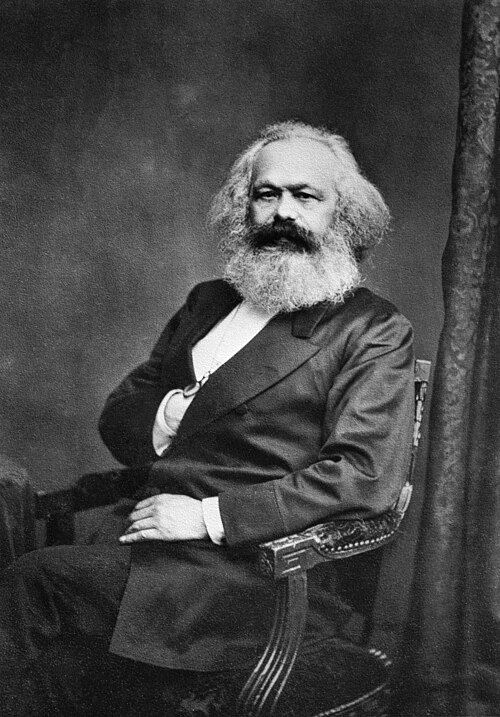
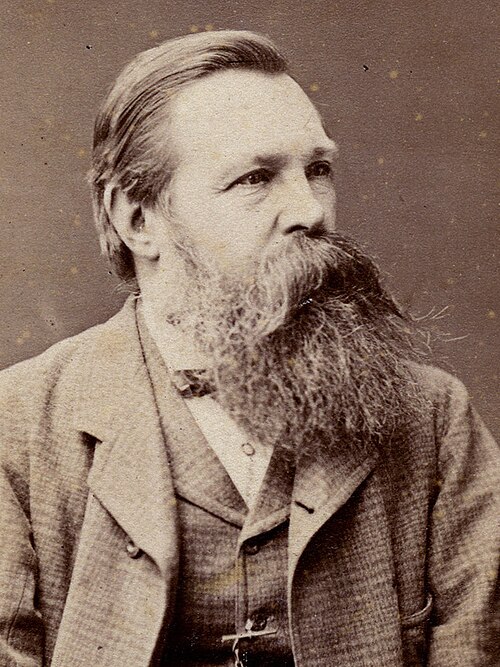 Karl Marx and Friedrich Engels1818-1883; 1820-1895religion as symptom
Background: The philosophy of Hegel: dialectic, the Phenomenology, Absolute Spirit, religion and concept · Feuerbach's thought: The Essence of Christianity, the species, love, nature · The thought of Marx: historical materialism, alienation, ideology, fetishism · Engels: dialectical materialism, the history of early Christianity, the reckoning with Feuerbach · The philosophy of history: from Augustine to Löwith · Matthew and Luke: the infancy, the Sermon on the Mount, the parables · The Acts of the Apostles: from Jerusalem to Rome
The introduction to Zur Kritik der Hegelschen Rechtsphilosophie (Critique of Hegel's Philosophy of Right) appeared in Paris in the Deutsch-Französische Jahrbücher of 1844. It opens with an observation that is at the same time a farewell: “Für Deutschland ist die Kritik der Religion im wesentlichen beendigt, und die Kritik der Religion ist die Voraussetzung aller Kritik”, for Germany, the critique of religion is essentially complete, and the critique of religion is the premise of all critique. Marx does not extend Feuerbach, he closes him: the work of translation is done; what remains is to ask why men needed this upside-down translation.
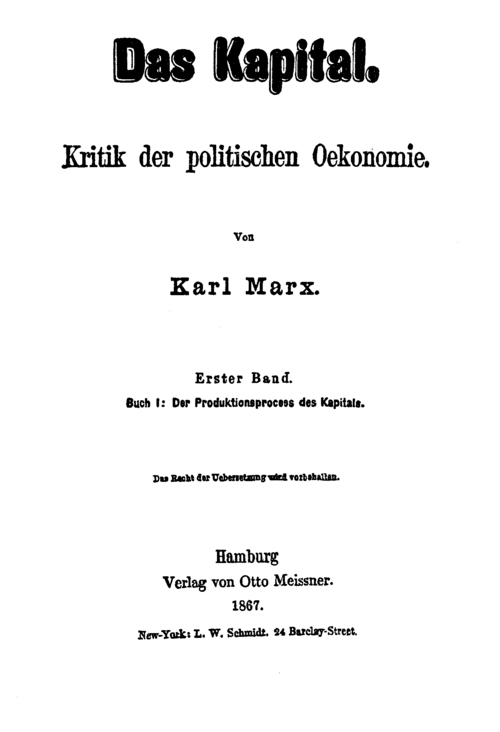
Marx's most famous text on religion is also the most badly quoted: only its end is remembered, read as an insult. Here it is in full: “Das religiöse Elend ist in einem der Ausdruck des wirklichen Elendes und in einem die Protestation gegen das wirkliche Elend. Die Religion ist der Seufzer der bedrängten Kreatur, das Gemüt einer herzlosen Welt, wie sie der Geist geistloser Zustände ist. Sie ist das Opium des Volkes.” Religious misery is at once the expression of real misery and the protest against real misery; religion is the sigh of the oppressed creature, the heart of a heartless world, as it is the spirit of spiritless conditions; it is the opium of the people.
Everything hangs on this word Protestation, which hurried readers forget: religion is not only a consolation that lulls, it is also a complaint that accuses. And opium, in 1844, is not first of all the drug of the underworld: it is the remedy, the painkiller. Marx does not despise the believer: he takes his pain and his revolt seriously, and says only that they mistake their object. Hence the consequence, which absolutely distinguishes the regime of the symptom from the regime of error: “Die Forderung, die Illusionen über seinen Zustand aufzugeben, ist die Forderung, einen Zustand aufzugeben, der der Illusionen bedarf”, to call on the people to give up their illusions about their condition is to call on them to give up a condition that requires illusions. One does not refute a symptom, one treats the disease. Marx has an image of great beauty to say so: criticism has plucked the imaginary flowers from the chain, “nicht damit der Mensch die phantasielose, trostlose Kette trage, sondern damit er die Kette abwerfe und die lebendige Blume breche”, not so that man may wear the chain without fantasy and without consolation, but so that he may cast off the chain and pluck the living flower. And again: “Die Religion ist nur die illusorische Sonne, die sich um den Menschen bewegt, solange er sich nicht um sich selbst bewegt”, religion is only the illusory sun that revolves around man as long as he does not revolve around himself. The programme follows: “Die Kritik des Himmels verwandelt sich damit in die Kritik der Erde, die Kritik der Religion in die Kritik des Rechts, die Kritik der Theologie in die Kritik der Politik”.
The image of the sun betrays something. Religion is the illusory sun; man must revolve around himself, around “seine wirkliche Sonne”, his real sun. The centre changes, but the structure remains: there is still a centre, and it is now man. Marx, in 1844, is still a Feuerbachian; he breaks a year later.
The Thesen über Feuerbach (Theses on Feuerbach), jotted down in the spring of 1845 and published by Engels in 1888 in a revised version (I quote here Marx's manuscript, MEW 3, p. 5-7), give this shift its theoretical form. The fourth thesis is its heart: Feuerbach dissolves the religious world into its secular basis, but the fact that this basis “sich von sich selbst abhebt und sich ein selbständiges Reich in den Wolken fixiert”, detaches itself from itself and establishes an independent realm in the clouds, “ist nur aus der Selbstzerrissenheit und Sichselbstwidersprechen dieser weltlichen Grundlage zu erklären”, can only be explained by the inner cleavage and self-contradiction of this secular basis. The sixth thesis turns Feuerbach's own concept of species against him: Feuerbach dissolves the religious essence into the human essence, but the human essence “ist kein dem einzelnen Individuum inwohnendes Abstraktum. In seiner Wirklichkeit ist es das ensemble der gesellschaftlichen Verhältnisse”, is no abstraction inherent in the single individual; in its reality, it is the ensemble of social relations. The seventh adds that the “religiöse Gemüt” is “selbst ein gesellschaftliches Produkt”. And the eleventh draws the conclusion for philosophy as a whole: “Die Philosophen haben die Welt nur verschieden interpretiert, es kömmt drauf an, sie zu verändern”.
The sixth thesis is Marx's attested response to Feuerbach, and it bears on the point isolated above. Feuerbach's Man, the species, the Gattung, is an abstraction, a mute “Allgemeinheit”, a generality that binds individuals together naturally. This is Stirner's objection turned around: for Stirner, Man is a ghost and only the Ego is real; for Marx, Man and the Ego are two abstractions, and only social relations are real. Marx took from Stirner his critique of Man in order to turn it against him, and one understands why Die deutsche Ideologie devotes so many pages to “Saint Max”: Stirner was the most dangerous adversary, because he had seen before Marx what Marx also saw.
Twenty years later, Das Kapital (1867) rediscovers the religious structure where one no longer expected it: to understand the fetishism of the commodity, “müssen wir in die Nebelregion der religiösen Welt flüchten”, we must take flight into the misty region of the religious world, where the products of the human head appear endowed with a life of their own. The first chapter goes further and establishes a correspondence between economic form and religious form. For a society of commodity producers, who relate their private labours to one another as abstract human labour, “ist das Christenthum, mit seinem Kultus des abstrakten Menschen, namentlich in seiner bürgerlichen Entwicklung, dem Protestantismus, Deismus u. s. w., die entsprechendste Religionsform”, Christianity, with its cult of abstract man, especially in its bourgeois development, Protestantism, Deism and so on, is the most fitting form of religion. The remark reaches far: the “cult of abstract man” is what Feuerbach proposed as the religion of the future, and Marx suggests that Feuerbachian humanism is not the exit from Christianity, but its purest bourgeois form. And he announces the condition of its real disappearance: “Der religiöse Wiederschein der wirklichen Welt kann nur verschwinden, sobald die Verhältnisse des praktischen Werkeltagslebens den Menschen tagtäglich durchsichtig vernünftige Beziehungen zu einander und zur Natur darstellen”, the religious reflection of the real world can only vanish when the relations of practical everyday life present to men, day after day, transparently rational relations with one another and with nature. The process of social life will strip off its “mystischen Nebelschleier”, its mystical veil of mist, only when it is the product of freely associated men, under their conscious and planned control.
Engels extends Marx in a direction that tends to be neglected. We have seen that, in connection with Bauer, he set aside the explanation by imposture (Part Five). In “Zur Geschichte des Urchristentums” (1894-1895), he goes further and likens early Christianity to the workers' movement: “Wie diese, war das Christentum im Ursprung eine Bewegung Unterdrückter: es trat zuerst auf als Religion der Sklaven und Freigelassenen, der Armen und Rechtlosen, der von Rom unterjochten oder zersprengten Völker”, like the latter, Christianity was originally a movement of the oppressed: it first appeared as the religion of slaves and freedmen, of the poor and those without rights, of the peoples subjugated or dispersed by Rome.
Hence the objection that Marxism invites, and that has been made to it a hundred times without always being well formulated. It is not that communism is “a religion” in the vague sense in which this is said of any enthusiasm; it is more precise. If religion is the protest of the oppressed against a misery whose cause he does not see, and if Engels himself recognizes in early Christianity a movement of the oppressed analogous to the workers' movement, then revolutionary emancipation inherits the function of religion. It promises the end of suffering, the reconciliation of man with his essence, a history that has a meaning and an end, a “transparent” society in which nothing will any longer be hidden. Marx can abolish the need for opium only by promising a world in which that need will have disappeared, and this promise has the form of salvation. This is the thesis Karl Löwith will develop in 1949 and Hans Blumenberg will contest in 1966; I discuss it in Part Eleven, because Blumenberg raises against it a serious objection that forces one to specify what it means to “inherit” from a religion.
Marx must be given his best defence. He does not deify humanity in Feuerbach's sense, since he precisely refuses abstract Man; he founds no cult, asks for no veneration, and mocks the “true socialists” who made a religion of love. The critique Engels addresses to Feuerbach holds against all sacralization. If Marxism produced cults, it was his heirs who produced them. I find this defence admissible as far as the texts are concerned, insufficient as far as the structure is concerned. The real sun of 1844 around which man must revolve, the transparent society of 1867, keep the form of an eschatological promise. Marx dismissed the sacred; he did not dismiss salvation.
Portrait: John Jabez Edwin Mayall, Public domain
Portrait: William Hall, Public domain
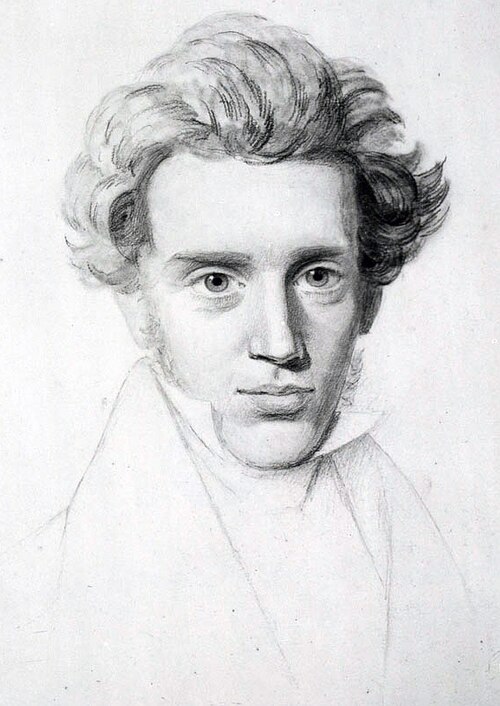 Søren Kierkegaard1813-1855Christendom against Christianity
Background: The thought of Pascal: the three orders, the wager, Jansenism · The patriarchs: Abraham, the sacrifice of Isaac, Jacob · The philosophy of Hegel: dialectic, the Phenomenology, Absolute Spirit, religion and concept · Kierkegaard's thought: the stages, anxiety, despair, Abraham, the attack on Christendom · The Protestant Reformation: Luther, Calvin and the break-up of Christendom · Existentialism: from Kierkegaard to Sartre, believers and atheists · Matthew and Luke: the infancy, the Sermon on the Mount, the parables
While the Hegelian left criticizes religion in the name of man, a Dane criticizes it in the name of God. A contemporary of Feuerbach and Marx, Kierkegaard heard Schelling in Berlin in 1841-1842, in the same lecture halls as Bakunin and Engels, and he read Feuerbach. His conclusion, opposed to theirs, strangely joins their diagnosis: the Christianity of his time is not Christianity.
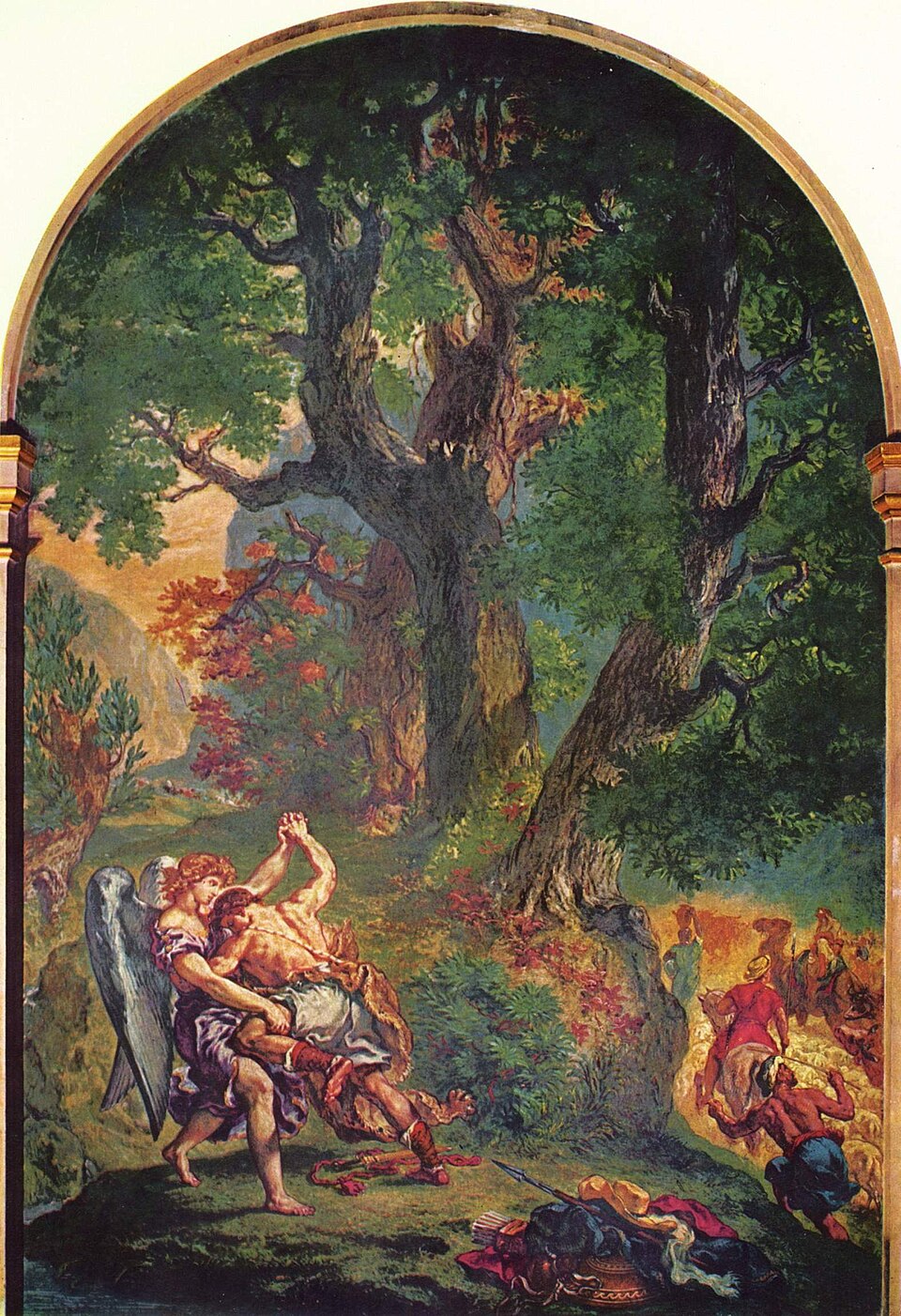
Two moments must be distinguished. The first is philosophical, and it culminates in the Afsluttende uvidenskabelig Efterskrift til de philosophiske Smuler (Concluding Unscientific Postscript to Philosophical Fragments, 1846), published under the pseudonym Johannes Climacus. Against Hegel, who claims to understand Christianity by sublating it into the concept, Kierkegaard maintains that Christianity is not a doctrine to be understood but an existence to be lived, and that Christian truth is not objective but subjective. The formula is famous: “Subjektiviteten er Sandheden”, subjectivity is truth. It does not mean that everyone has his own truth, but that religious truth is possessed only in the passionate relation of the existing individual to what surpasses him. Kierkegaard defines faith with paradoxical precision: “Tro er netop Modsigelsen mellem Inderlighedens uendelige Lidenskab og den objektive Uvished”, faith is precisely the contradiction between the infinite passion of inwardness and objective uncertainty. And again: inwardness is so great because it embraces objective uncertainty “med Uendelighedens hele Lidenskab”, with the whole passion of the infinite.
This is a radical response to Hegel: Christianity is a paradox that offends reason, and every attempt to understand it destroys it. It is also a response to Schleiermacher, faith being not a feeling for the universe but a passionate decision before a paradox. And it is a response to Feuerbach. Kierkegaard read The Essence of Christianity and, according to a study devoted to this reading, found in Feuerbach a paradoxically useful witness: in his papers of 1844, he judges him consistent, and illuminating by contrast; elsewhere, he says that he sets out Christianity so honestly that it is a pleasure to read him. It is also reported that he said Christianity needed more “traitors” of this kind; I have found this formula only in English translation in an anthology, without a Danish original, and I regard it as unsourced. The logic of this esteem is clear: Feuerbach saw that the Christianity of Christendom is a human religion, all too human; he was merely wrong to believe that it was Christianity.
The second moment, polemical, occupies the last months of Kierkegaard's life. From May to September 1855, he published at his own expense a series of pamphlets, Øieblikket (The Moment), in which he attacked the official Church of Denmark with unprecedented violence. The thesis is simple: Christendom has abolished Christianity. Kierkegaard says so in a parable about the cunning of mankind: unable to reject Christianity by force, it found a ruse, “vi ere alle Christne, saa er eo ipso Christendommen afskaffet”, we are all Christians, so Christianity is eo ipso abolished. And elsewhere: it is perhaps without analogy in history that a religion should have been abolished in this way, “ved at florere”, by flourishing; the religion of suffering has become the religion of the joy of living, “men har beholdt Navnet uforandret”, but has kept its name unchanged. Kierkegaard piles up the sarcasms: the two thousand churches of the kingdom are, Christianly speaking, a swindle, and so are the thousand priests in velvet and silk.
Kierkegaard's contribution comes down to this. He demonstrates from inside faith what Stirner demonstrated from outside, that established religion is not what it claims to be, but he reverses the conclusion. For Stirner, humanism is a religion in disguise; for Kierkegaard, established religion is a humanism in disguise, a “paganism” living under the name of Christianity: “og saa leve vi (under Navn af Christendom) Hedenskabet”, and so we live (under the name of Christianity) paganism. Both see a sacralization of the human under a divine name; the one concludes that all the sacred must be abolished, the other that true transcendence must be recovered. And Kierkegaard adds an idea that Barth and Bonhoeffer will take up in the twentieth century: authentic Christianity is inversely related to numbers; a single true Christian is enough for Christianity to exist, and when all have become Christians, the concept of Christian is abolished.
Kierkegaard is therefore a critic of religion, and one of the most radical, if by religion one means the institution, the socially reassuring cult, the piety that grounds order; he is not one if one means faith. His position takes up, against established Christendom, the exit from above that Pascal had opened: leaving religion in the name of a faith that religion betrays. We shall find it again in Barth (“Religion ist Unglaube”), in Bonhoeffer (a Christianity without religion), in Simone Weil (atheism as purification). But the objection is immediate, and Hegel would have made it: a faith defined by the infinite passion of inwardness before objective uncertainty has, no more than Schleiermacher's feeling, an internal criterion for distinguishing the true God from the idol. Kierkegaard knows it and accepts it: it is the risk of faith. But this risk makes his position a limit case, which one may admire without making it a general answer.
Portrait: Bibliothèque royale du Danemark, Public domain
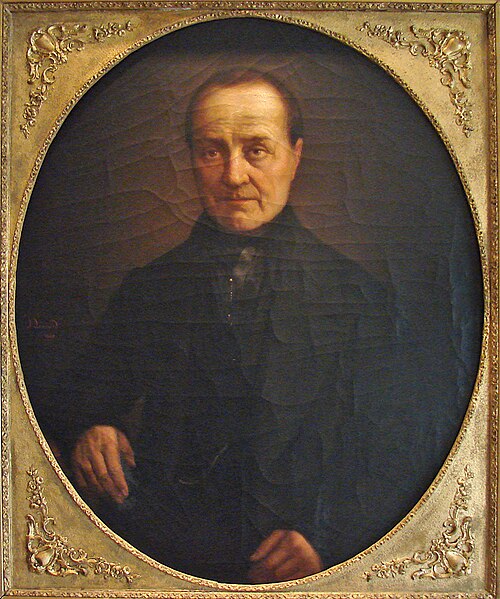 Auguste Comte1798-1857the proof by fact
Background: The thought of Comte: law of three stages, sociology, religion of Humanity · Positivism and scientism: science as a substitute religion in the nineteenth century · From absolutism to the Revolution: the Church of France, the Enlightenment and the cult of the Supreme Being · The nineteenth century: the Church against modernity, theology before criticism · The Acts of the Apostles: from Jerusalem to Rome
If every exit from religion tends to refound one, there must be a case in which refoundation is not a hidden symptom but an avowed programme. That case exists. Auguste Comte, founder of positivism, the man who had decreed the end of the theological age and of the metaphysical age, founded a religion.
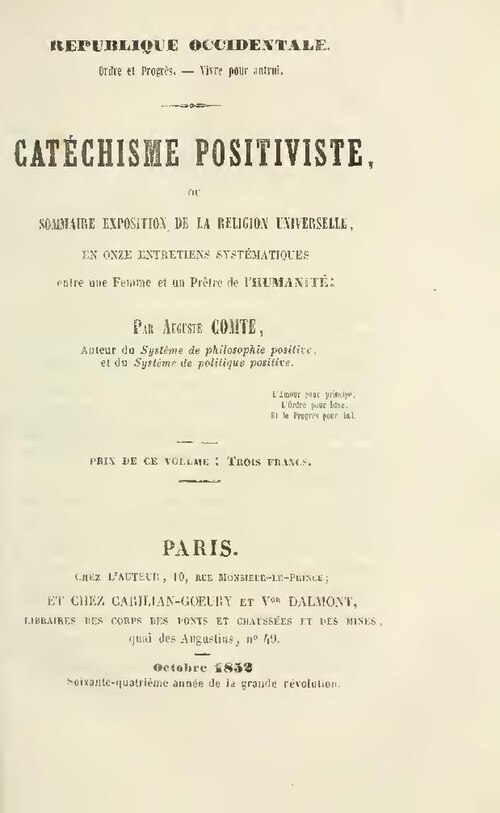
The starting doctrine is well known. The Cours de philosophie positive (1830-1842) sets out the law of the three states: the human mind passes through the theological state, in which it explains phenomena by supernatural wills, then through the metaphysical state, in which it explains them by abstract entities, and finally through the positive state, in which it gives up the search for first causes and confines itself to discovering laws; each branch of our knowledge, says the first lesson, “passe successivement par trois états théoriques différents : l'état théologique, ou fictif ; l'état métaphysique, ou abstrait ; l'état scientifique, ou positif”, passes successively through three different theoretical states: the theological or fictitious state, the metaphysical or abstract state, the scientific or positive state. Religion therefore belongs to the childhood of humanity, and one would expect from Comte a pure and simple exit from religion.
Yet from 1845 onwards, after his meeting with Clotilde de Vaux (October 1844), who died in April 1846, Comte carried out what he himself called a subjective turn, and he founded the Religion of Humanity. The Système de politique positive (1851-1854) gives its doctrine, the Catéchisme positiviste (1852) its popular exposition, in the form of a dialogue between a priest of Humanity and a woman. The text, perfectly clear, carries out point by point what Feuerbach had announced and what Stirner had denounced.
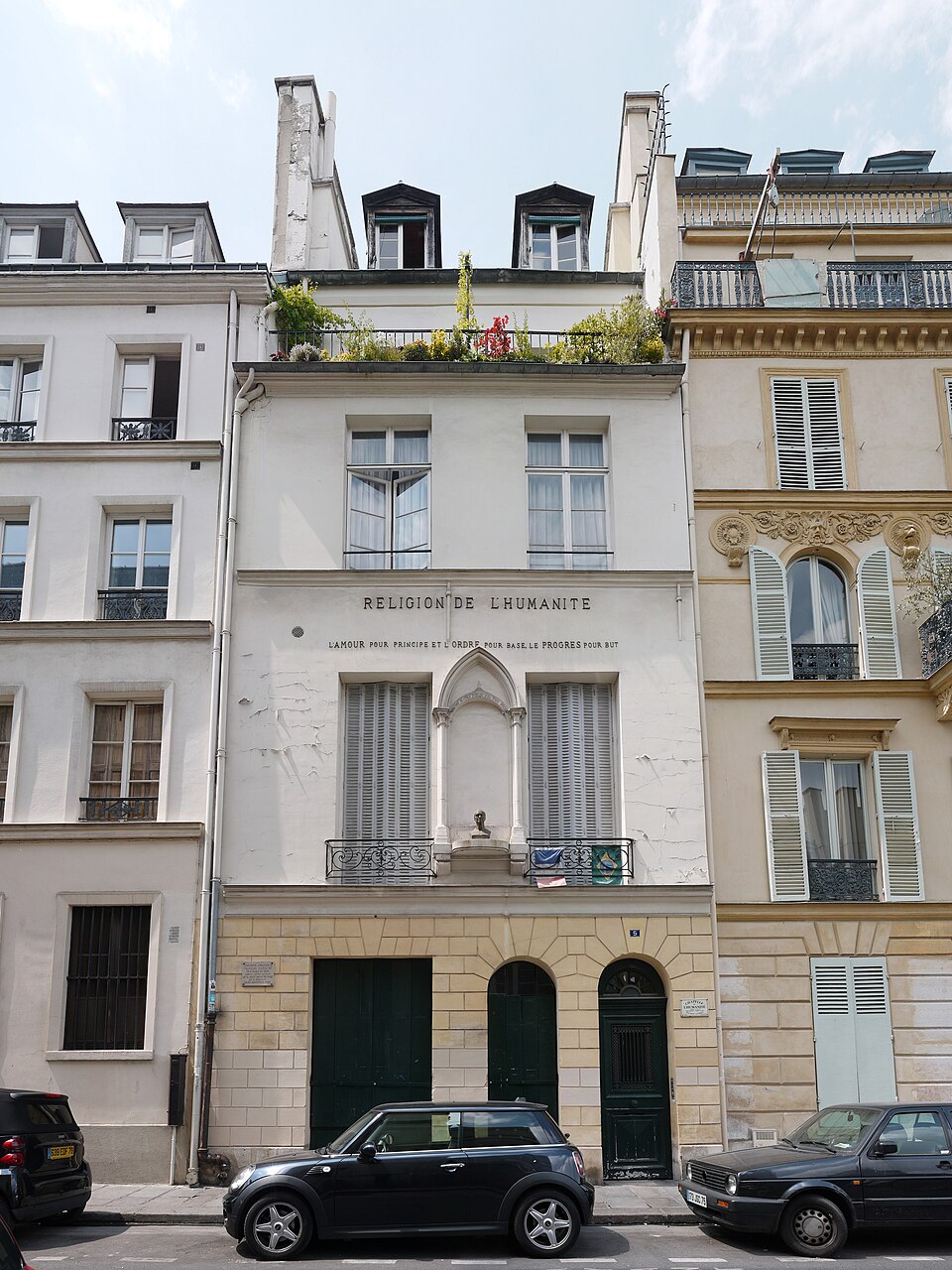
Religion, first of all, is redefined without God: “La religion consiste donc à régler chaque nature individuelle et à rallier toutes les individualités”, religion therefore consists in regulating each individual nature and in rallying all individualities. We recognize the double etymology examined in the prologue in connection with Cicero and Lactantius: to regulate and to bind. Religion is no longer a relation to a transcendent being, but the function that unifies the individual and society, and one is needed, since this function is permanent. Comte quotes on this point a maxim that sums up what is at stake: “On ne détruit que ce qu'on remplace”, one destroys only what one replaces.
The object of this religion is then named. Comte condenses the whole of positive conceptions “dans la seule notion d'un être immense et éternel, l'Humanité”, in the single notion of an immense and eternal being, Humanity. He goes on: “Autour de ce vrai Grand-Être, moteur immédiat de chaque existence individuelle ou collective, nos affections se concentrent aussi spontanément que nos pensées et nos actions. Sa seule idée inspire directement la formule sacrée du positivisme : L'Amour pour principe, l'Ordre pour base, et le Progrès pour but”, around this true Great Being, immediate mover of every individual or collective existence, our affections gather as spontaneously as our thoughts and our actions; its mere idea directly inspires the sacred formula of positivism: Love as principle, Order as basis, and Progress as end. Note the expression “formule sacrée”, sacred formula: Comte founds a sacred, and makes no secret of it. The Great Being is Humanity conceived as the whole of past, future and present beings who freely contribute to perfecting the universal order, and it is composed first of all of the dead: “Les vivants sont toujours, et de plus en plus, gouvernés nécessairement par les morts : telle est la loi fondamentale de l'ordre humain”, the living are always, and ever more, necessarily governed by the dead: such is the fundamental law of the human order.

Religion, finally, has all its organs: a dogma, positive philosophy; a cult, with its social sacraments that punctuate life from presentation to posthumous incorporation; a calendar, in which the months and days bear the names of the great men of humanity; a priesthood, made up of scientists, which exercises spiritual power; a private cult, in which woman is the guardian angel, and in which Comte devotes an intimate cult to Clotilde. Dogma, cult and regime, Comte writes, form the whole that religion must direct. Morality is condensed into a formula that would become the positivist motto: “vivre pour autrui”, to live for others. For the occasion Comte coins the word “altruisme”, altruism.
One passage of the Catéchisme deserves attention. The priest's interlocutor, the woman, accepts the conception of the Great Being, but she confesses a worry: “je m'effraye de ma nullité personnelle envers une telle existence, dont l'immensité m'efface davantage que ne le fit jadis la majesté d'un Dieu avec lequel, quoique chétive, je me sentais une relation propre et directe”, I am frightened by my personal nullity before such an existence, whose immensity effaces me more than did once the majesty of a God with whom, puny as I was, I felt a relation of my own, a direct one. Stirner's objection is formulated in the very text of the new religion, by its own catechumen: the Great Being crushes the individual more than the old God did, who had a personal relation with each soul, whereas Humanity has one only with the species. Comte answers it with the cult of the dead and with the affection of women; but he saw the objection.
Comte founds his Church and proclaims himself High Priest of Humanity. After his death his disciples open positivist temples: some survive in Brazil, notably the Capela Positivista in Porto Alegre, and the Temple of Humanity in Paris, rue Payenne, set up in 1903 by South American positivists, has been listed as a historic monument since 1982. The motto of the Brazilian flag, Ordem e Progresso, comes from the sacred formula of positivism.
Let us set Comte against Engels's historical argument (a constructed comparison: Engels is not aiming at Comte at this point). From those years 1793-1798 in which, according to Engels, France lived without Christianity and without any need for a substitute, Comte, born in 1798 and raised under the Empire, draws the opposite conclusion. He has before his eyes the revolutionary attempts at replacement: the cult of Reason in 1793, Robespierre's cult of the Supreme Being in 1794, theophilanthropy under the Directory. Their failure does not prove to him that the need does not exist, but that these cults were still metaphysical, that is to say abstract, and that a cult founded on science was required. In the same years the two men read two contrary truths: for Engels, religion can disappear without leaving a void; for Comte, the void is so real that it must be organized. The twentieth century, with its political religions, would rather prove Comte right on the diagnosis, and Engels right on the danger of wanting to fill this void by decree.
One may smile at this religion. Mill, who in 1844 had found English patrons for Comte, Grote, Molesworth and Raikes Currie, turned away from it in embarrassment and, in Auguste Comte and Positivism (1865), while judging him justified in wanting to make his philosophy a religion, reproached him with a complete error from the very starting point. But it would be wrong to see in it nothing more than an oddity of old age. On this point Comte is an author consistent to the end: he saw that religion fulfils a social and moral function that does not disappear with belief in God, and will therefore be fulfilled in one way or another. He preferred that it be fulfilled by a rational religion, conscious of itself, rather than by hidden idols. This is Durkheim's analysis sixty years later, except that Durkheim confines himself to describing. Comte proves by fact what Stirner asserted by argument: atheist humanism, if it goes all the way, becomes a cult. He also proves, through the reaction of his contemporaries, that this cult does not take: the Religion of Humanity remained a sect. One does not found a religion by decree, even a rational one; and what Comte lacks is precisely what Schleiermacher placed at the heart of religion, the lived experience of the infinite, which no catechism can produce.
Portrait: photo Jean-Pierre Dalbéra, CC BY 2.0
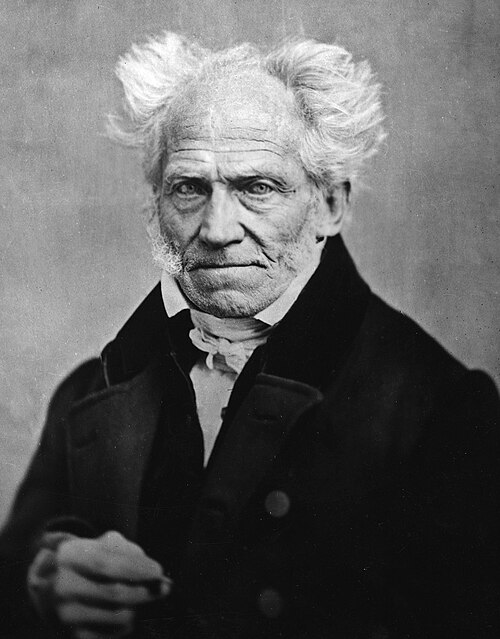 Arthur Schopenhauer1788-1860a mysticism without God
Background: The thought of Meister Eckhart: detachment, the birth of God in the soul, the trial · Schopenhauer's philosophy: the Will, suffering, compassion, the denial of the will · Buddhism: landmarks for a religion without a creator God
Schopenhauer belongs to Hegel's generation, not to that of the Young Hegelians; his great book, Die Welt als Wille und Vorstellung (The World as Will and Representation), appeared at the end of 1818 dated 1819, and went almost unnoticed. Fame came only with the Parerga und Paralipomena (1851), at the moment when the failure of 1848 had ruined Hegelian and revolutionary hopes. I place him here because his reception is contemporary with the crisis of the Hegelian left, and because, at the moment when Comte was founding a religion without God turned towards action and progress, he offers a spirituality without God turned towards renunciation.
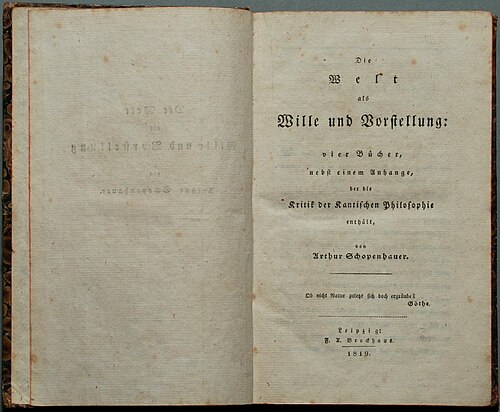
Schopenhauer's metaphysics is well known: the world is representation for the subject who knows it, but in itself it is will, a blind will, without end and without reason, which objectifies itself in all beings and devours itself. Life is therefore essentially suffering, and the world is not the work of a good being, but the expression of an absurd will to live, without God or providence.
And yet the fourth book of The World culminates in a doctrine of salvation. There are two possible attitudes before the knowledge of the essence of the world: the Bejahung, the affirmation of the will to live, and the Verneinung des Willens zum Leben, the denial of the will to live. Denial occurs when knowledge of universal suffering becomes a “quietive” of the will: the subject ceases to will, and in this renunciation finds peace. Schopenhauer calls this resignation, “welche das letzte Ziel, ja, das innerste Wesen aller Tugend und Heiligkeit, und die Erlösung von der Welt ist”, which is the final goal, indeed the innermost essence of all virtue and holiness, and redemption from the world.
Paradox: an atheist speaks of holiness and redemption, and not metaphorically. Schopenhauer recognizes in the Christian saints, the Hindu ascetics and the Buddhists the witnesses of one and the same experience, the denial of the will to live, and he makes the mystics the true practical philosophers. Christianity, he writes, developed its ascetic germ “in den Schriften der Christlichen Heiligen und Mystiker”, in the writings of the Christian saints and mystics, and nowhere is the spirit of Christianity expressed as perfectly as in the German mystics. And he names “ein noch größerer Mystiker, Meister Eckhard”, a still greater mystic, Meister Eckhart, whose writings had just been made accessible by Franz Pfeiffer's edition (1857). Here we meet again the Eckhart of Part One.
The book ends on a famous sentence. For those in whom the will has turned and denied itself, “diese unsere so sehr reale Welt mit allen ihren Sonnen und Milchstraßen” is “Nichts”, this world of ours, so very real, with all its suns and milky ways, is nothing. This nothing is not Stirner's, the creative nothing of an Ego that consumes everything; it is the nothing of the extinction of the Ego. Two atheists of the same decade arrive at two opposite nothings.
On positive religion Schopenhauer holds a subtle position, which he sets out in a dialogue in the Parerga, chapter XV of the second volume, “Über Religion”, between Demopheles, the friend of the people, and Philalethes, the friend of truth. I have been able to consult only T. Bailey Saunders's English translation. Demopheles maintains that religion is necessary for the people, who cannot be philosophers: “Religion is the metaphysics of the masses; by all means let them keep it”. Humanity needs an interpretation of life adapted to popular understanding; religion is therefore “an allegorical investiture of the truth”, which, as a rule of action and as a consolation in suffering and death, perhaps accomplishes as much as truth itself could if we possessed it. Philalethes protests in the name of truth, and the dialogue ends without a conclusion.
This dialogue is a centrepiece of our debate. Demopheles is already the Grand Inquisitor without the tragedy: truth is for the few, religion for the many, and it would be cruel to take their allegory away from the people. But Schopenhauer, unlike Hegel, is not sure that the concept does better than the allegory, and, unlike the Inquisitor, he leaves the last word to the friend of truth without proving him right. This dialogue without a conclusion seems to me more honest than most treatises: it shows that the question of religion for others has no theoretical solution.
Nietzsche was Schopenhauer's pupil before becoming his adversary, and the response is attested. In 1874, in the third Unzeitgemäße Betrachtung, Schopenhauer als Erzieher (Schopenhauer as Educator), he writes: “Ich gehöre zu den Lesern Schopenhauers, welche, nachdem sie die erste Seite von ihm gelesen haben, mit Bestimmtheit wissen, daß sie alle Seiten lesen und auf jedes Wort hören werden”, I am one of those readers of Schopenhauer who, after reading his first page, know with certainty that they will read every page and listen to every word. The third essay of On the Genealogy of Morality (1887) would deal him the psychological blow, as we shall see in Part Seven: the great denier of the will lived on his hatred, that is to say on his will, and his mysticism without God was a disguised affirmation.
The objection is only partly right. Schopenhauer really did make the denial of life a supreme value, and Nietzsche is right to see in it the deepest Christian inheritance, that of asceticism. In the terms of our question, Schopenhauer left God without leaving the religion of salvation: he keeps holiness, redemption, renunciation, and explicitly so. But Nietzsche does not see, or does not want to see, what is new in Schopenhauer: he is the first modern philosopher to have taken the spiritualities of India seriously and to have read the Christian mystics outside theology. He opened the way to the comparative spiritualities of the twentieth century, from William James to Aldous Huxley, and posed with unprecedented rigour the question that will occupy Part Twelve: can a spirituality exist without God, without dogma and without a Church, as a pure relation to oneself and to the world? Schopenhauer answers yes, but his spirituality is one of extinction, and it is against it that Nietzsche will seek a spirituality of affirmation.
Portrait: Johann Schäfer, Public domain
Transition: from treatise to novel
The landscape is complete. Religion has been criticized as projection (Feuerbach), as spectre (Stirner), as symptom (Marx), as imposture (the Enlightenment tradition, which Strauss and Engels reject), as betrayal of faith (Kierkegaard), as a social function to be fulfilled otherwise (Comte), as allegory for the people (Schopenhauer). And each in turn has been accused of refounding what it criticized: Feuerbach sacralizes human relations, Stirner installs the Ego in the place of God, Marx keeps the form of salvation, Comte founds a Church, Schopenhauer keeps holiness.
Yet this picture lacks a dimension that treatises cannot give, that of the person who lives these positions: what becomes of a man who believes that God does not exist and draws the consequences, and what is the atheism of Feuerbach or of Stirner, no longer as a thesis but as an existence? This is the question asked by Dostoevsky, who in his youth knew Belinsky's circle, where Feuerbach and Strauss were read with fervour, and who puts them to the test in characters. It is also the question taken up by Nietzsche, the pupil turned adversary of Schopenhauer, who announces the death of God without promising Hegel's resurrection. Part Seven brings them together, because both understood before anyone else that the exit from religion is not a matter of theory, but an event that engages one's whole life.
Part Seventhe ordeal and the genealogy
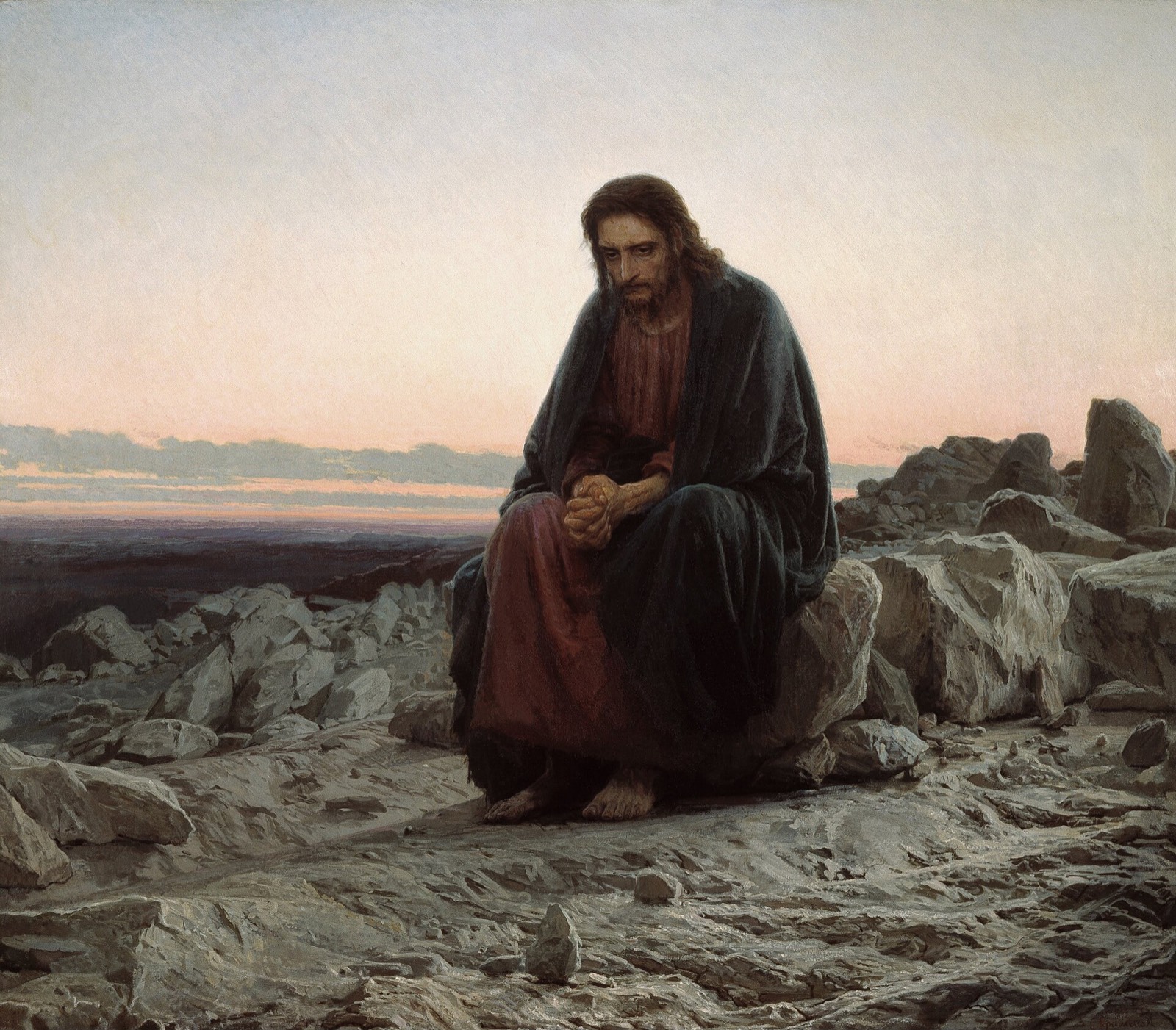
By the middle of the nineteenth century, the critique of religion seemed to have reached its two limits. On one side Schopenhauer, the first declared German atheist, kept from religion what was deepest in it, the denial of the will, asceticism, compassion, and made of it a mysticism without God. On the other Comte, who had dismissed theology in the name of positive science, ended by organizing a cult, a calendar and a priesthood of Humanity. Between the mysticism without God and the Church without God, the question of this essay had already received its two extreme answers: one can leave religion while keeping its inner life, or while keeping its institutions. It remained to be seen whether either of them held.
The two authors who close the century do not answer with a new doctrine. They put doctrines to the test. Dostoevsky makes them live in persons and watches what they become when they are inhabited to the end. Nietzsche writes their genealogy and asks where the will to think them comes from. Both arrive at the same observation: the death of God does not leave a neutral world, but a world in which something must occupy the empty place. It is in this seventh part that the question “can one leave religion without founding another?” finds its sharpest formulation, posed by men who knew better than their predecessors what the answer costs.
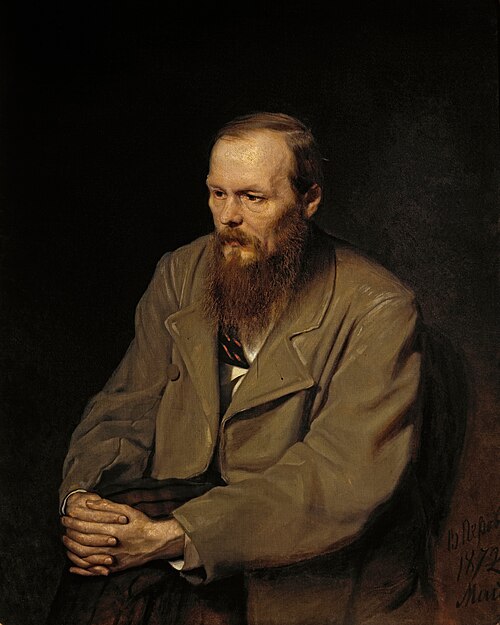 Dostoevsky1821-1881the ordeal of persons
Background: Plato's philosophy: Forms, soul, city, the Good · The thought of Pierre Bayle: the comet, the Dictionary, toleration · Medieval Christendom: from the fall of Rome to the stake · Byzantium and Russian Orthodoxy: the other Christianity · Dostoevsky's work: the Karamazovs, Demons, polyphony · Psalms, Job, Qoheleth and the wisdom books · Matthew and Luke: the infancy, the Sermon on the Mount, the parables · The Passion and the Resurrection: the four accounts and what history retains · Evil, Satan and the afterlife: from Sheol to the Last Judgement
The Brat'ja Karamazovy (The Brothers Karamazov) appeared in instalments in the Russkij vestnik in 1879-1880, a few months before Dostoevsky's death. The novel is the place where the preceding regimes cease to be theses and become persons, and answer one another without any voice possessing the last word. This is what Bakhtin called polyphony, and the notion must be taken seriously. One will not find in the novel the refutation of atheism that Pobedonostsev demanded of it, and Dostoevsky knew this: he announced Book VI, “Русский инок”, to him as the answer “на всю эту отрицательную сторону”, to this whole negative side, but an answer that is “не прямой”, not direct, “а лишь косвенный”, only indirect, given not point by point but “в художественной картине”, in an artistic picture. One will find in it something better than a refutation.
We must first establish what Dostoevsky actually read of the European critique, for one is tempted to credit him with a direct dialogue with Feuerbach or Strauss that the texts do not warrant. In the Dnevnik pisatelja (A Writer's Diary) of 1873, in the chapter “Old People”, Feuerbach and Strauss appear only as the idols of Belinsky, the critic who had initiated the young Dostoevsky into the atheist socialism of the 1840s; Dostoevsky reports that Strauss was spoken of with veneration in that circle. The reception is therefore mediated: the Hegelian left reaches Dostoevsky through Belinsky's mouth, as an atmosphere rather than as a book. Renan, on the other hand, is named directly, in the same Diary, as the author of the Life of Jesus, a book “full of unbelief”. Making Ivan answer Feuerbach will therefore be a constructed confrontation; making him answer Voltaire, an attested response, since Ivan quotes him.
Ivan Karamazov is first of all a Feuerbachian: he fights God not in the name of egoism, but in the name of suffering humanity. In Book V, chapter 4 (“Бунт”, Rebellion), he piles up before his brother Alyosha newspaper stories of cruelties inflicted on children, and he refuses the final harmony that would justify them: “Не хочу гармонии, из-за любви к человечеству не хочу”, I do not want harmony, out of love for humanity I do not want it. Henri Mongault translates: “C'est par amour pour l'humanité que je ne veux pas de cette harmonie”, it is out of love for humanity that I do not want this harmony. And the conclusion: “Не бога я не принимаю, Алеша, я только билет ему почтительнейше возвращаю”, it is not God that I refuse, Alyosha, I am only most respectfully returning him my ticket; Mongault: “Je ne refuse pas d'admettre Dieu, mais très respectueusement je lui rends mon billet”, I do not refuse to accept God, but I most respectfully return him my ticket.
The novel gives this refusal its genealogy. In the preceding chapter (V, 3), before telling of the martyred children, Ivan quotes to Alyosha a saying the reader will recognize: “был один старый грешник в восемнадцатом столетии, который изрек, что если бы не было бога, то следовало бы его выдумать, s'il n'existait pas Dieu il faudrait l'inventer”, there was an old sinner in the eighteenth century who declared that, if there were no God, he would have to be invented; Mongault: “il y avait un vieux pécheur, au XVIIIe siècle, qui a dit : Si Dieu n'existait pas, il faudrait l'inventer”, there was an old sinner, in the eighteenth century, who said: if God did not exist, it would be necessary to invent him. The old sinner is Voltaire, and the line comes from the Épître à l'auteur du livre des Trois imposteurs (1769): “Si Dieu n'existait pas, il faudrait l'inventer”, if God did not exist, it would be necessary to invent him. Ivan at once draws the Feuerbachian conclusion: “И действительно, человек выдумал бога”, and indeed, it is man who invented God. But he adds, and this is his whole singularity, that the astonishing thing is not that God exists, but that the idea of the necessity of God could have entered the head of an animal as savage and wicked as man, so holy, so touching and so wise is that idea, so much does it honour man.
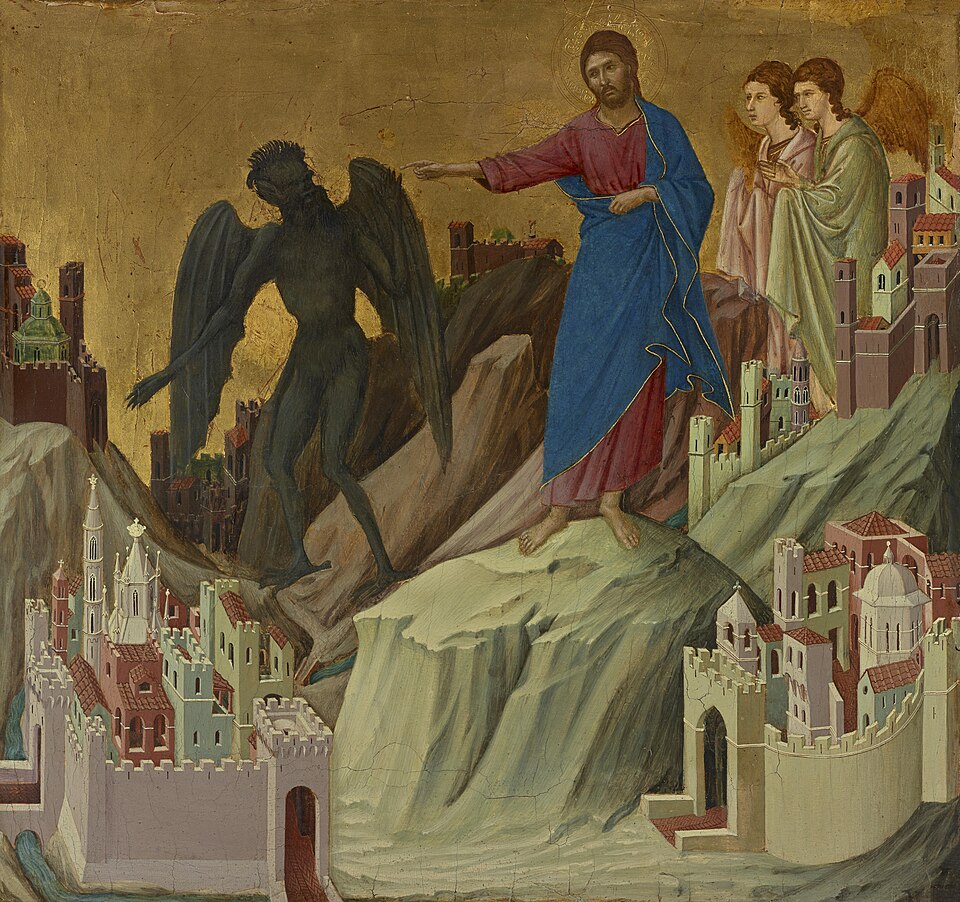
This passage is read too quickly. Ivan does not repeat Voltaire; he turns him around. In Voltaire, the next line says what the invented God is for: “Que le sage l'annonce, et que les rois le craignent”, let the wise man proclaim him, and let kings fear him. The God of the Épître is a piece of the social order, guarantor of oaths and curb on the powerful, a useful God whom the wise man proclaims because society needs him. The line contains in germ the Grand Inquisitor, two chapters further on: an invented God, proclaimed by the one who knows, to hold in check those who do not know. By having Ivan quote Voltaire on the threshold of “Rebellion” and “The Grand Inquisitor”, Dostoevsky signals that he knows the lineage: the Inquisitor is not a Russian invention, but the culmination of the utilitarian deism of the Enlightenment. The response is attested in the strict sense, since the text names the saying; it is also constructed, since it is I who link the line of 1769 to the poem of 1879. I take the link to be a key to the chapter.
The novel returns to Voltaire in Book X, chapter 6, in the mouth of young Kolya Krasotkin, a schoolboy who plays the freethinker. Kolya declares to Alyosha: “можно ведь и не веруя в бога любить человечество, как вы думаете? Вольтер же не веровал в бога, а любил человечество?”, one can surely love humanity without believing in God, what do you think? Voltaire did not believe in God, and yet he loved humanity, didn't he? Alyosha replies gently that Voltaire did believe in God, but little, it seems, and that he loved humanity little, it seems. Beneath its comic air, the exchange engages what is essential: Kolya formulates, as a schoolboy would, Bayle's thesis: virtue does not depend on faith, and a society of atheists can be as humane as any other. Alyosha does not refute it; he answers with a nuance about love, as if he knew that the love of humanity, in one who no longer believes, risks remaining a love of the idea of humanity.
This exchange opens a constructed confrontation between Bayle and Ivan, which must be carried through to the end. In the Pensées diverses sur la comète (1682, under the title of Lettre, then 1683), Bayle had announced his “conjectures sur les mœurs d'une société d'athées”, conjectures on the morals of a society of atheists, and maintained, as we saw in Part Three, that such a society, provided severe laws punished crimes in it, would be no worse than a society of pagans, human justice being what makes the virtue of the greater number. The thesis has two faces: liberal, since it detaches morality from religion; deeply pessimistic, since it explains the virtue of believers themselves by fear of the constable rather than by fear of God.
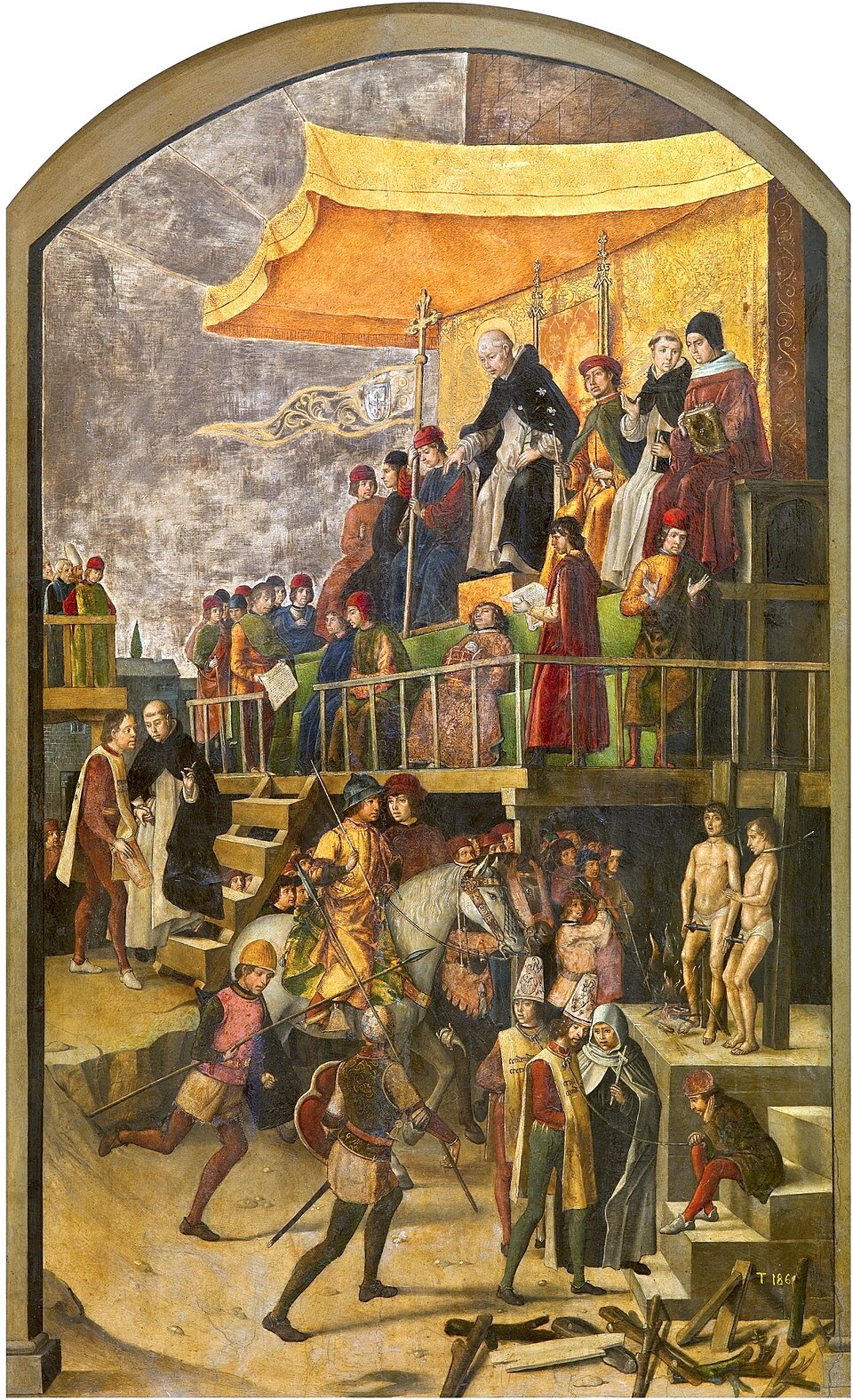
Ivan seems to maintain the opposite thesis: without immortality, no virtue, therefore everything is permitted. The confrontation is in reality subtler. Bayle speaks of society, Ivan speaks of conscience. Bayle is no doubt right on his own ground: a society of atheists can hold together, with laws and prisons, and secularized societies have since amply demonstrated it. But Ivan does not ask whether a society of atheists can hold together; he asks whether a man alone, before himself, still has a reason not to kill when no one is watching. And the novel entrusts the answer to Smerdyakov, who kills precisely because he has taken the formula seriously, then to Ivan himself, who goes mad from having understood that he was the intellectual author of the murder. Bayle answered the question of order; Dostoevsky answers the question of guilt. Between them there is no contradiction but a displacement, and this displacement makes the greatness of the novel.
From his rebellion, Ivan draws the consequence his adversaries attribute to him, and he owns it. The formula “if God does not exist, everything is permitted”, in this proverbial form, is not in the novel. The novel contains a thesis that is always conditional, reported by several characters: Miusov in Book II, Rakitin (“Нет бессмертия души, так нет и добродетели, значит, всё позволено”, no immortality of the soul, so no virtue, which means everything is permitted), Mitya, Smerdyakov, the devil. And Ivan himself, in Book V, chapter 5, before Alyosha: “От формулы "всё позволено" я не отрекусь”, I will not renounce the formula “everything is permitted”; Mongault: “Comme je ne renierai pas cette formule que "tout est permis", alors c'est toi qui me renieras, n'est-ce pas ?”, since I will not renounce this formula that “everything is permitted”, then it is you who will renounce me, is it not? Just before, Ivan has already taken it up as his own: “Да, пожалуй: "всё позволено", если уж слово произнесено. Не отрекаюсь”, yes, if you like, “everything is permitted”, since the word has been spoken; I do not take it back.
This rebellion resembles nothing that came before. Ivan is not an anti-Spinoza out of ignorance: he refuses to understand. He says he is endowed with an “ум эвклидовский, земной”, a Euclidean, earthly mind (V, 3), incapable of grasping how parallel lines meet at infinity, and he refuses to have them made to meet for him. Where Spinoza said that to understand necessity is to cease suffering from it, Ivan answers that the suffering of a child must not be understood. He is also, avant la lettre, the anti-Zarathustra: he refuses to consent. He is finally the anti-Hegel, and this is perhaps the deepest point: the final reconciliation in which all sorrows find their meaning in the whole, Ivan refuses in advance, not because he judges it impossible, but because he judges it obscene. He prefers, he says, to remain with his unavenged suffering and his unappeased indignation, even if he is wrong.

The “poem” of the Grand Inquisitor, in Book V, chapter 5, is in my eyes the centre of gravity of our whole question. In Seville, in the sixteenth century, Christ returns; the old cardinal has him arrested and explains to him, through a whole night, why he must be burned. Christ wanted men to follow him freely; but men do not want freedom, they want bread and someone before whom to bow. The Church has therefore “corrected” the work of Christ by founding it on three forces: “чудо, тайна и авторитет”, miracle, mystery and authority. Mongault: “Nous avons corrigé ton œuvre en la fondant sur le miracle, le mystère, l'autorité”, we have corrected your work by founding it on miracle, mystery, authority. The Inquisitor does not believe in God; he half says so, and this is his tragic greatness: he alone bears the weight of truth so that the others may be happy in the lie.
Here, in a single figure, is the novel's answer to our question. The Inquisitor is exactly what one obtains when one leaves God while keeping religion: an atheist who holds faith to be indispensable to men, and who governs it out of love for them. He is the political culmination of the Feuerbachian critique, a religion of humanity administered by those who know. He is also, by a comparison I construct, a transposition of Comte as high priest of Humanity: a spiritual power that does not believe in the supernatural, but knows that men need worship, mystery and direction. But Comte believes in his Great Being; the Inquisitor believes only in the weakness of men. The Inquisitor is a Comte who has become lucid, and therefore tragic.
And Christ's answer is not an argument. He is silent, then: “тихо целует его в его бескровные девяностолетние уста”, he kisses him gently on his bloodless ninety-year-old lips; Mongault: “le Prisonnier s'approche en silence du nonagénaire et baise ses lèvres exsangues”, the Prisoner silently approaches the old man of ninety and kisses his bloodless lips. The kiss refutes nothing: it refuses to enter the order of justification, which is the Inquisitor's. One may see in it an answer of another order, which is neither a thesis nor an institution, but a gesture, a way of being before the other: what the twentieth century will call spirituality, what remains of the religious once dogma and the Church are taken away.
The answer of the whole novel is of the same order. Book VI, devoted to the starets Zosima, opposes to Ivan not a theodicy but a form of life, which comes down to two sentences. That of Zosima's younger brother, Markel, as he is dying: “всякий пред всеми за всех и за всё виноват”, each is guilty before all, for all and for everything. And that of Zosima on hell: “Отцы и учители, мыслю: "Что есть ад?" Рассуждаю так: "Страдание о том, что нельзя уже более любить"”, fathers and teachers, I ask myself: what is hell? the suffering of no longer being able to love; Mongault: “la souffrance de ne plus pouvoir aimer”, the suffering of no longer being able to love. This is not a proof of God, but the description of a way of existing in which Ivan's question is transformed without being resolved. The novel does not say that Ivan is wrong; it says that one cannot live in his position, and that whoever wants to live in it goes mad.
This answer is strange in relation to the series. Spinoza answered the need for God with knowledge, Feuerbach with reappropriation, Marx with the transformation of the world, Comte with the organization of a cult. Zosima answers with a conversion of the gaze, which does not abolish evil but changes the subject's relation to evil. It is not a doctrine that could be set against Ivan's, it is an exercise, in the sense in which Hadot will speak of the spiritual exercises of Antiquity. The comparison is constructed; it announces the last part of this essay: the answer the novel opposes to the Inquisitor's religion is not another religion, it is a spirituality. Within the novel itself, moreover, this Christianity is suspect to the institution: Zosima's corpse smells, against the expectation of the faithful who hoped for a miracle, and the scandal shows that his faith has nothing to do with miracle, mystery and authority.
Dostoevsky also saw the other outcome of the death of God, the man who makes himself god. This is Kirillov, in Besy (Demons, 1871-1872), the engineer who kills himself to prove his freedom and to become god, according to the logic he states himself: “Если нет бога, то я бог”, if there is no God, then I am god. The Inquisitor and Kirillov sketch the two possible refoundations: religion without God administered by a few, and the divinization of man. Nietzsche, who would read Les Possédés in the French translation by Victor Derély (Plon, 1886) and copy passages from it into his notebooks from November 1887 to March 1888, without knowing The Brothers Karamazov, and Camus, who would know them very well, would each take them up in their own way.
In this series, Dostoevsky does not receive objections: he hands them out. Nietzsche would salute him in Götzen-Dämmerung, “Streifzüge” 45: Dostoevsky is “des einzigen Psychologen, anbei gesagt, von dem ich Etwas zu lernen hatte”, the only psychologist, incidentally, from whom I had something to learn. Nietzsche discovered Dostoevsky in February 1887, in a bookshop in Nice, through a French translation published under the title L'Esprit souterrain (trans. Halpérine-Kaminsky and Ch. Morice, Plon, 1886). He thus discovered Dostoevsky without the book in which the encounter would have been most evident; yet he would take up as genealogy what Dostoevsky had staged as drama.
Portrait: Vasily Perov, Public domain
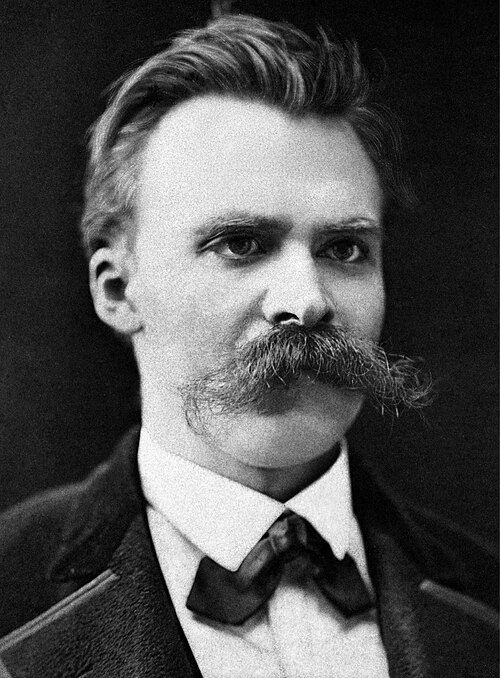 Nietzsche1844-1900the death of God as a task
Background: Paul of Tarsus: the letters, justification, the Law and the new perspective · Ernest Renan: the Life of Jesus, science, the nation · Schopenhauer's philosophy: the Will, suffering, compassion, the denial of the will · The philosophy of Nietzsche: tragedy, genealogy, will to power, eternal return, overman · Marcel Gauchet's thought: the disenchantment of the world, the exit from religion, democracy · The Passion and the Resurrection: the four accounts and what history retains · The teaching of Jesus: the Kingdom, the parables, the miracles · The letters of Paul: Romans, Corinthians and the others · Messiah, Son of Man, Son of God: the titles of Jesus
We must begin with Schopenhauer, for it was against his first master that Nietzsche forged his relation to the divine. The debt, as we have seen, is immense and openly claimed. In 1887, in Book V of The Gay Science, he pays him a tribute that bears directly on our question: “Schopenhauer war als Philosoph der erste eingeständliche und unbeugsame Atheist, den wir Deutschen gehabt haben: seine Feindschaft gegen Hegel hatte hier ihren Hintergrund”, Schopenhauer was, as a philosopher, the first avowed and inflexible atheist that we Germans have had: this was the background of his hostility towards Hegel (FW 357). And he adds that “Die Ungöttlichkeit des Daseins galt ihm als etwas Gegebenes, Greifliches, Undiskutierbares”, the non-divine character of existence was for him something given, tangible, beyond discussion.
The sentence is historically very precise. Nietzsche sees in Schopenhauer's hostility towards Hegel a religious quarrel: Hegel, with his reason in history and his final reconciliation, remained a theologian in disguise, whereas Schopenhauer had had the courage to look at a world without providence. The same § 357 goes on to make Hegel the great delayer of atheism, the one who tried to persuade the Germans of the divinity of existence by means of the historical sense. Nietzsche thus places Schopenhauer on the side of probity and Hegel on the side of the reprieve granted to God. The response is attested, and it fixes the starting point: the question of God's existence is settled; what remains is to know what one does with existence once it is admitted that it is not divine.
It is on this point that Nietzsche breaks with his master. Schopenhauer drew a moral conclusion from the absence of God: since existence has no meaning, the will to live must be denied, and pity, which recognizes the suffering of all that lives, is the supreme virtue. Nietzsche sees in this conclusion the subtlest survival of Christianity. In Der Antichrist, § 7, he grants Schopenhauer the diagnosis only to turn it around: “Schopenhauer war in seinem Recht damit: durch das Mitleid wird das Leben verneint, verneinungswürdiger gemacht”, Schopenhauer was right in this: through pity, life is denied, made more worthy of denial; and the next sentence defines pity as “die Praxis des Nihilismus”, the practice of nihilism. The atheist Schopenhauer had kept the Christian morality of pity and the Christian ideal of asceticism: he had left God without leaving religion, and his piety, which Feuerbach directed towards Man, was directed in his case towards renunciation.
The Genealogie der Moral (On the Genealogy of Morality, 1887) carries the critique all the way to the person. In § 6 of the third essay, Nietzsche quotes Schopenhauer's description of aesthetic contemplation, in which one celebrates “den Sabbat der Zuchthausarbeit des Wollens”, the Sabbath of the penal servitude of willing, and he asks: supposing that Schopenhauer was a hundred times right for his own person, “was wäre damit für die Einsicht ins Wesen des Schönen getan?”, what would thereby have been gained for insight into the essence of the beautiful? In § 7, he goes further: Schopenhauer would have fallen ill, would have become a pessimist, “ohne seine Feinde, ohne Hegel, das Weib, die Sinnlichkeit und den ganzen Willen zum Dasein, Dableiben”, without his enemies, without Hegel, woman, sensuality and the whole will to exist, to stay there. The pessimist needed what he denied.
Die fröhliche Wissenschaft (The Gay Science) appeared in 1882; the fifth book was added in the second edition of 1887. The gap matters: the death of God is first announced (Book III), then, five years later, interpreted (Book V). The usual mistake is to read § 125 as an atheist thesis. It is the opposite: a scene that holds the atheists up to ridicule.
Book III opens, in § 108, with a parable: after the Buddha's death, his shadow was still shown in a cave for centuries. “Gott ist tot: aber so wie die Art der Menschen ist, wird es vielleicht noch jahrtausendelang Höhlen geben, in denen man seinen Schatten zeigt”, God is dead, but given the way men are, there will perhaps be caves for thousands of years yet in which his shadow is shown. The whole programme is there. The death of God is not the end of religion; it is the beginning of a long survival of its shadows. That the parable starts from the Buddha is not without significance: it was through Schopenhauer that Nietzsche knew Buddhism, and it is the Schopenhauerian shadow, that of a religion without God founded on the denial of the will, that is targeted at the same time as the Christian shadow.
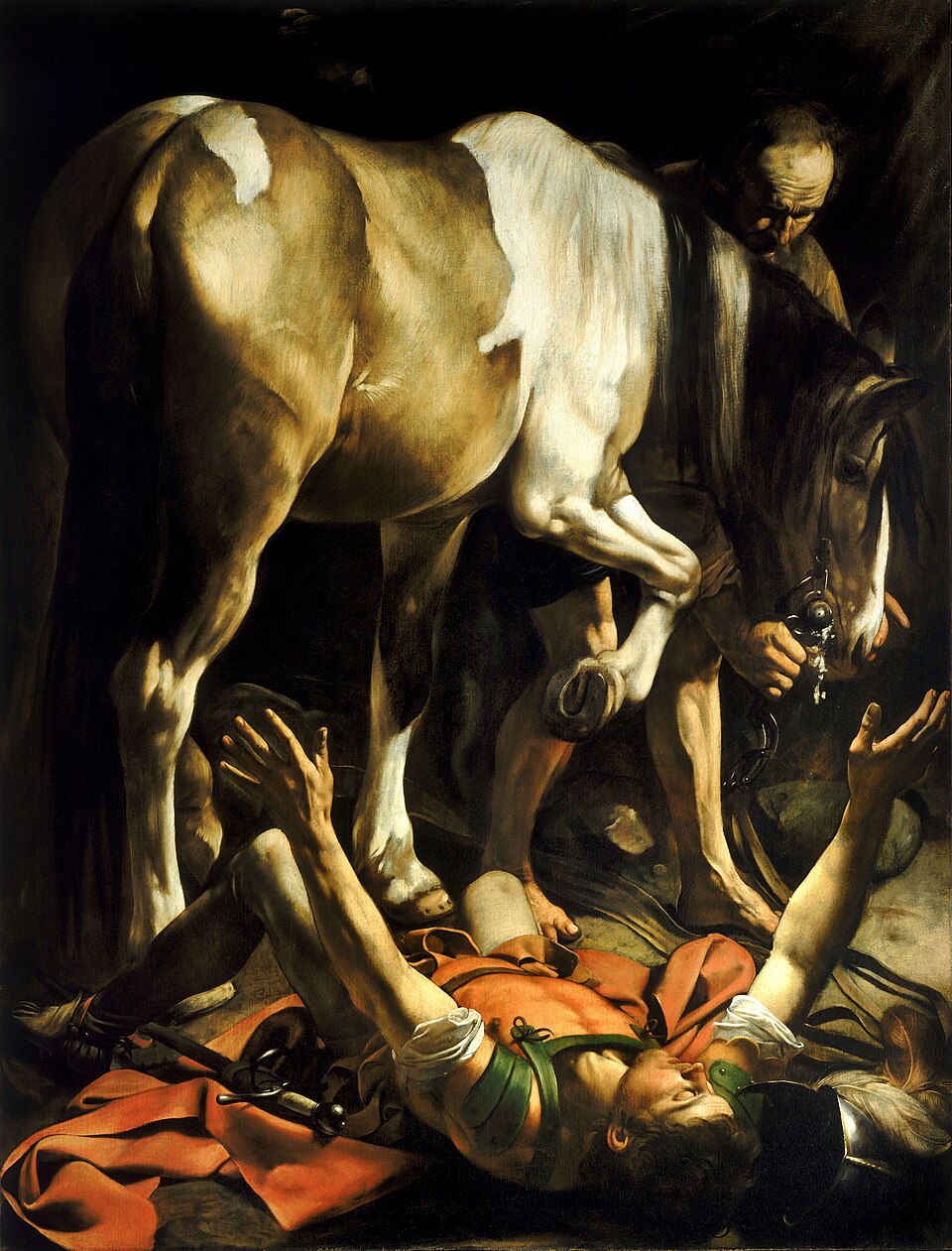
§ 125 stages the “tolle Mensch”, the madman, who runs into the marketplace in broad daylight with a lantern, crying that he is looking for God. Those who surround him and mock him are precisely unbelievers. It is to them that he announces: “Wir haben ihn getötet, ihr und ich!”, we have killed him, you and I. The atheists of the marketplace believe that the absence of God is a settled matter, just one more opinion; the madman knows that it is an event, and a murder, whose consequences have not yet been measured. He then asks our question: “Welche Sühnefeiern, welche heiligen Spiele werden wir erfinden müssen?”, what festivals of atonement, what sacred games shall we have to invent? Henri Albert: “Quelles expiations, quels jeux sacrés serons-nous forcés d'inventer ?[…] Ne sommes-nous pas forcés de devenir nous-mêmes des dieux pour du moins paraître dignes des dieux ?”, what atonements, what sacred games shall we be forced to invent?[…] Must we not ourselves become gods, if only to appear worthy of it? The exit from religion calls of itself for a new religion. Nietzsche says so in 1882, and in the form of a question.
No one arranged the meeting between this question and Dostoevsky's scene. The madman asks whether we shall not have to become gods to be worthy of the murder; that is Kirillov's position. He asks what sacred games we shall have to invent; that is the position of the Inquisitor and of Comte. The two paths of refoundation, which Dostoevsky had embodied in two characters, Nietzsche formulates as two questions in the same paragraph. The comparison is constructed, since Nietzsche had not read Demons in 1882; the convergence of two minds that did not yet know each other is all the more significant.
For Nietzsche, the shadows of God are everywhere one does not look for them. In morality first: people have stopped believing in the Christian God, but they go on believing in the value of pity, equality and disinterestedness, which have meaning only through him; this is the reproach he makes to Schopenhauer, and it will be the one he makes to the socialists, the democrats and the positivists. In language next: “wir werden Gott nicht los, weil wir noch an die Grammatik glauben”, we shall not be rid of God so long as we still believe in grammar (Götzen-Dämmerung, “Die "Vernunft" in der Philosophie”, 5), for grammar imposes a subject behind every act, a substance behind every becoming, and God is the supreme subject. In science finally, and this is the hardest blow.
§ 344, in Book V, is entitled “Inwiefern auch wir noch fromm sind”, in what sense we too are still pious. The will to truth, the refusal to be deceived and to deceive, the demand on which science rests, is not itself scientific: it is a faith. And Nietzsche confesses: “daß auch wir Erkennenden von heute, wir Gottlosen und Antimetaphysiker, auch unser Feuer noch von dem Brande nehmen, den ein jahrtausendealter Glaube entzündet hat, jener Christen-Glaube, der auch der Glaube Platos war, daß Gott die Wahrheit ist, daß die Wahrheit göttlich ist”; Albert: “nous aussi, nous qui cherchons aujourd'hui la connaissance, nous les impies et les antimétaphysiques, nous empruntons encore notre feu à l'incendie qu'une foi vieille de mille années a allumé, cette foi chrétienne qui fut aussi la foi de Platon et qui admettait que Dieu est la vérité et que la vérité est divine”, that we too, the seekers after knowledge of today, we godless ones and anti-metaphysicians, still take our fire from the blaze kindled by a faith thousands of years old, that Christian faith which was also the faith of Plato, that God is truth, that truth is divine.
The Genealogie der Moral draws the same conclusion by another path, and turns it into a thesis on the history of Christianity that anticipates the theories of secularization by a century. In § 24 of the third essay, Nietzsche observes that no philosophy has yet asked whether the will to truth itself needs a justification, because the ascetic ideal dominated all philosophy, “weil Wahrheit als Sein, als Gott, als oberste Instanz selbst gesetzt wurde, weil Wahrheit gar nicht Problem sein durfte”, because truth was posited as being, as God, as the highest authority itself, because truth was not allowed to be a problem at all. In § 27, he takes the step. Honest atheism, far from opposing the ascetic ideal, is its last form: “er ist die Ehrfurcht gebietende Katastrophe einer zweitausendjährigen Zucht zur Wahrheit, welche am Schlusse sich die Lüge im Glauben an Gott verbietet”, it is the awe-inspiring catastrophe of a two-thousand-year discipline in truth, which in the end forbids itself the lie of belief in God. And he states its law: “Alle großen Dinge gehen durch sich selbst zugrunde, durch einen Akt der Selbstaufhebung”, all great things perish through themselves, through an act of self-suppression. Christianity as dogma perished of its own morality; Christianity as morality must in turn perish of its own truthfulness, when that truthfulness asks what any will to truth is worth. Nietzsche indeed quotes himself: the formula about the two-thousand-year discipline already appears word for word in § 357 of The Gay Science, in connection with Schopenhauer's atheism, followed by this sentence: “Man sieht, was eigentlich über den christlichen Gott gesiegt hat: die christliche Moralität selbst”, one sees what really triumphed over the Christian God: Christian morality itself. The atheism of the admired master thus becomes a fruit of the Christian conscience, and Schopenhauer finds himself, once again, among the pious.
Nietzsche is describing here a Christianity that destroys itself out of fidelity to itself; what Marcel Gauchet will call, in 1985, the “religion de la sortie de la religion”, the religion of the exit from religion. The comparison is constructed, and Part Eleven will take it up again; Gauchet's thesis is already formulated, in genealogical terms, in a paragraph of 1887. Nietzsche even adds, in parentheses, that the same development took place in India, independently, with the Buddha, which makes the exit from religion through truthfulness a law of the ascetic religions, and not a Christian peculiarity.
Hence the conclusion of the Genealogy, which gives the whole of religious history its psychological foundation: the ascetic ideal expresses a fundamental fact of the human will, “lieber will noch der Mensch das Nichts wollen, als nicht wollen”, man would rather will nothingness than not will (III, 28); Albert: “l'homme préfère encore avoir la volonté du néant que de ne point vouloir du tout”. It is at this point that Nietzsche answers Schopenhauer. Schopenhauer believed that one could stop willing; Nietzsche shows that the denial of the will is still a willing, turned towards nothingness. Religion is not an error of the intellect, as in Spinoza, nor a projection of the essence, as in Feuerbach, nor the sigh of the oppressed, as in Marx; it is the form taken, for want of anything better, by the will to give suffering a meaning. As long as this will finds no other object, it will return to the ascetic ideal under new names.
Here Nietzsche escapes Stirner's objection, and that is why I place him with Spinoza among those who do not refound a religion. He does not claim to have left it: he knows, and he says, that his own critique is made with Christian fire. This knowledge is not a weakness of his position, it is its strength: the atheist who believes himself free of all faith is the man of the marketplace who laughs at the madman; the one who knows where his fire comes from can at least choose what he does with it.
There remains Jesus, who separates Nietzsche from all his supposed heirs, and who sets him head-on against the great biographer of the century. Renan's Life of Jesus (1863) had made Christ a genius and a hero, an incomparable man before whom humanity was to bow; the last page of the book invites the moderns, “éternels enfants”, eternal children, to bow “devant ces demi-dieux”, before these demigods. Renan left dogma while keeping the cult: Christ was no longer God, but he remained the object of an adoration, transferred from the supernatural to moral genius. This is a refoundation in the sense of this essay, and Nietzsche denounces it with a violence that is not merely a matter of temperament: he calls Renan, as we saw in Part Five, a buffoon in psychology, and says he remained a priest in his very bowels.
The response, which is attested, targets the gesture that Feuerbach, Strauss and Renan had in common: leaving the supernatural while keeping the veneration. But Nietzsche is not content to unmask Renan: he proposes another Jesus. Der Antichrist (The Antichrist), written in 1888 and published in 1895, is one of the most violent books written against Christianity, but its violence is aimed at Paul and the Church, not at Jesus. For the vocabulary of the hero and the genius, Nietzsche substitutes a word in which one usually hears Dostoevsky, though Nietzsche does not name him here: “das Wort Idiot” (§ 29). He imagines this type in “eine Welt, wie aus einem russischen Romane” (§ 31). And he states: “im Grunde gab es nur einen Christen, und der starb am Kreuz”, in truth there was only one Christian, and he died on the cross; Albert: “au fond il n'y a eu qu'un seul chrétien, et il est mort sur la croix” (§ 39). Christianity is the work of Paul, that “Dysangelist”, bearer of bad tidings (§ 42), who made the death of Jesus into a doctrine of judgement and eternal life. Nietzsche, moreover, does not doubt for a moment that Jesus existed.
Nietzsche's Jesus is an “idiot” in Dostoevsky's sense, that is, a being incapable of resistance, of resentment and of dogma, who lives in an inner kingdom and does not preach it. This portrait resembles, and not by chance, the silent Christ of “The Grand Inquisitor”, and the Church that betrayed him resembles the Inquisitor's. The comparison is constructed, since Nietzsche did not know the poem. Dostoevsky and Nietzsche nevertheless agree on one point: historical Christianity, the institution, dogma and authority, is the negation of the practice of Jesus. They part ways on what follows. Dostoevsky believes that this practice can still be lived, and that is Zosima; Nietzsche judges it beautiful and impossible, the symptom of a gentle decadence, and looks elsewhere.
Where does he look? This is the question, too often forgotten behind the hammer, of Nietzschean spirituality. At the beginning of Book IV of The Gay Science (§ 276), for the new year 1882, Nietzsche makes a wish; Albert: “Je veux apprendre toujours davantage à considérer comme la beauté ce qu'il y a de nécessaire dans les choses”, I want to learn more and more to see as beautiful what is necessary in things, then: “Amor fati : que cela soit dorénavant mon amour. Je ne veux pas entrer en guerre contre la laideur. Je ne veux pas accuser, je ne veux même pas accuser les accusateurs”, Amor fati: let that be my love from now on. I do not want to wage war against ugliness. I do not want to accuse, I do not even want to accuse the accusers, and finally: “je veux, quelle que soit la circonstance, n'être une fois qu'affirmateur !”, I want, whatever the circumstance, some day to be only a Yes-sayer! Here one can measure the closeness to Spinoza and the distance from him. Like Spinoza, Nietzsche wants to love necessity; but where Spinoza loved it because he understood it, Nietzsche loves it without justifying it. Amor fati is not a knowledge, it is an exercise of the will, a discipline of affirmation. This is what Ivan refused in advance: to love fate is to love the child's tear as well.
The other image of this spirituality is that of noon. In Götzen-Dämmerung, the chapter “Wie die "wahre Welt" endlich zur Fabel wurde” tells in six stages the history of an error, that of the true world opposed to the apparent world, from Plato to positivism. At the last stage, the abolition of the true world brings with it that of the apparent world, and Nietzsche punctuates: “Mittag; Augenblick des kürzesten Schattens; Ende des längsten Irrthums; Höhepunkt der Menschheit; INCIPIT ZARATHUSTRA”, noon; moment of the shortest shadow; end of the longest error; high point of humanity; here begins Zarathustra. The shortest shadow: this is the answer to § 108 of The Gay Science, where the shadow of God was to last for thousands of years. Noon is the hour when the shadows of God disappear, not because they have been fought, but because the sun is at its highest. Nietzschean spirituality is not a replacement religion; it is the attempt to live at the hour when there is no longer any world behind the world. Camus, as we shall see, will make of it the “pensée de midi”, the thought of noon.
The objection awaiting Nietzsche will come from his most attentive reader. Nietzsche wanted to overturn Platonism: to put life above truth, becoming above being, value above fact. But to overturn a hierarchy is still to think in its terms. “Value”, the “will to power”, the “eternal return” are answers to the metaphysical question par excellence: what are beings as a whole? Nietzsche would then be, not the first philosopher to have left metaphysics, but the last metaphysician. One can also put to him a simpler objection, which Dostoevsky might have formulated: are not amor fati and the overman, in their turn, figures of Kirillov, the man who makes himself god? And is not Zarathustra, with his discourses, his disciples and his parables, one more religion? Nietzsche himself feared so, since he wrote, at the end of his conscious life, that there was “Nichts in mir von einem Religionsstifter”, nothing in him of a founder of religion, and: “Ich will keine „Gläubigen“”, I want no “believers”.
These objections will come in the twentieth century, with Heidegger and Camus. In the meantime another response arises, which comes neither from the novelists nor from the philosophers: religion becomes an object of science, and this science, which many awaited as a weapon against it, will discover that the sacred does not let itself be dismissed so easily.
Portrait: Friedrich Hermann Hartmann, Public domain
Part Eightthe sciences of religion and spiritual experience
Background: The sociology of religion: from Comte to secularization theory · Hermeneutics: from Schleiermacher to Ricoeur · Positivism and scientism: science as a substitute religion in the nineteenth century
Between 1900 and 1932, in barely a generation, religion changes its intellectual status. Until then, philosophers judged it: true or false, useful or harmful, alienating or consoling. From now on, scholars describe it. The sociologist asks what function it fulfils in the group, the psychologist from what experience it proceeds, the historian of religions what it has in common from one culture to another. This shift, neutral in appearance, is not neutral. For in ceasing to ask whether religion is true, the science of religion often discovers that it is necessary, and it rediscovers, under new names, the question of this essay.
Two families take shape, and they answer each other. The first, sociological, is that of Durkheim and Weber: religion is a collective fact, bound up with the cohesion of groups or with the rationalization of conduct, and its apparent disappearance raises the question of what replaces it. The second, psychological and phenomenological, is that of James, Otto, Freud and Bergson: religion is first of all an individual experience, a feeling, an emotion, and the question becomes that of its value. It is in this second family that the notion of spirituality is born, in the modern sense: a religious experience distinguished from the institution, from dogma and sometimes from God himself. The two families cross constantly. Durkheim cites James; Otto discusses James and Schleiermacher; Freud replies to Romain Rolland, a reader of the Indian mystics; Bergson discusses Durkheim and cites James. Never has the dialogue between authors been so dense or so well attested.
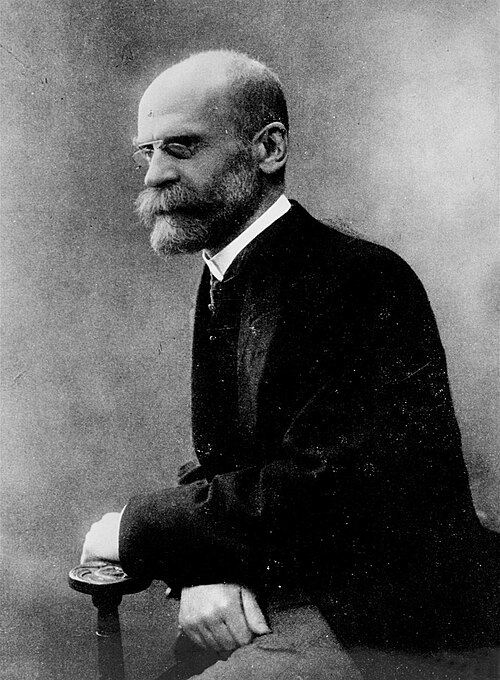 Durkheim1858-1917one does not leave the sacred
Background: The sociology of religion: from Comte to secularization theory · The anthropology of religion: from Tylor to Girard · Rousseau's thought: state of nature, social contract, general will, Emile · Durkheim's sociology: the social fact, anomie, the Elementary Forms · From absolutism to the Revolution: the Church of France, the Enlightenment and the cult of the Supreme Being
The Elementary Forms of Religious Life appeared in 1912. The book studies Australian totemism, but its true object is religion in general, grasped in what Durkheim takes to be its simplest form. Its thesis is stated from the introduction onward: “la religion est une chose éminemment sociale”, religion is an eminently social thing. Religious representations are collective representations that express collective realities; rites are ways of acting that arise within assembled groups.
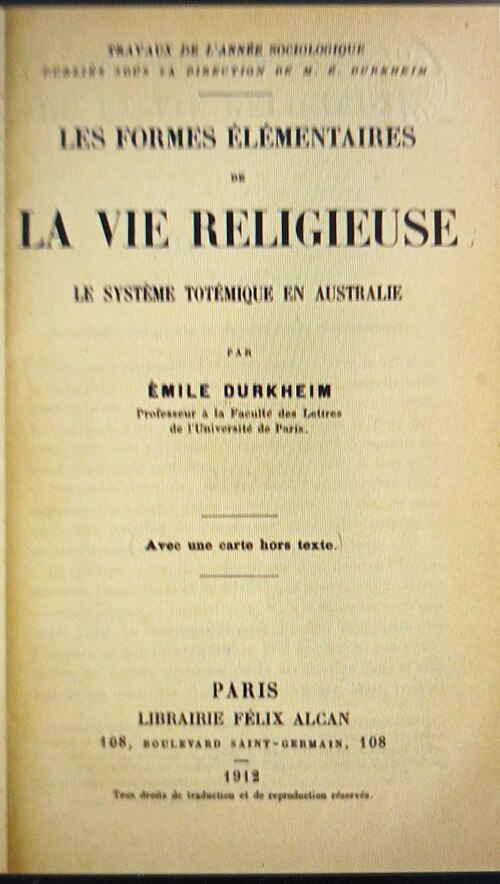
The definition of religion, given in the first chapter of Book I and quoted in the prologue, does not contain the word God, and that is its first bold stroke. The centre is no longer the divine, it is the sacred, and the sacred is defined by a separation: “Les choses sacrées sont celles que les interdits protègent et isolent ; les choses profanes, celles auxquelles ces interdits s'appliquent et qui doivent rester à distance des premières”, sacred things are those which prohibitions protect and isolate; profane things, those to which these prohibitions apply and which must remain at a distance from the former. Buddhism, a religion without a personal god, fits into this definition without difficulty; and, as we shall see, many things that do not call themselves religious fit into it too.
Where does the sacred come from? From society itself, which in moments of gathering experiences itself as a force superior to individuals, and which projects this force onto an emblem: the totem, then the god. Book II says so bluntly: rites, by tightening the bonds that attach the faithful to their god, really tighten those that unite the individual to society, “puisque le dieu n'est que l'expression figurée de la société”, since the god is only the figurative expression of society. The god of the clan, Durkheim adds, can be nothing other than the clan itself, but hypostatized.
One might think one was reading Feuerbach transposed from the species to the group. God was, for Feuerbach, only the projected human essence; he is, for Durkheim, only society represented. The comparison is constructed (Durkheim never cites Feuerbach), and the conclusions are opposed. Feuerbach wanted to repatriate the projected essence and dissolve religion into anthropology; Durkheim concludes that if religion expresses society, it is not an illusion, it is true in its own way. “Il n'y a donc pas, au fond, de religions qui soient fausses. Toutes sont vraies à leur façon : toutes répondent, quoique de manières différentes, à des conditions données de l'existence humaine”, there are thus, at bottom, no religions that are false. All are true in their own fashion: all answer, though in different ways, to given conditions of human existence. The believer is mistaken about the object of his worship; he is not mistaken about the force he feels. This is what makes Durkheim a formidable adversary of every critique of religion as error. Spinoza, Feuerbach, Onfray treat religion as a false representation; Durkheim answers them that religion is not first of all a representation.
The conclusion of the book develops this point, drawing on the testimony of believers themselves and citing in a note William James's The Varieties of Religious Experience. Believers, Durkheim writes, feel that the true function of religion “n'est pas de nous faire penser, d'enrichir notre connaissance[…] mais de nous faire agir, de nous aider à vivre”, is not to make us think, to enrich our knowledge[…] but to make us act, to help us live. And: “Le fidèle qui a communié avec son dieu n'est pas seulement un homme qui voit des vérités nouvelles que l'incroyant ignore ; c'est un homme qui peut davantage”, the believer who has communed with his god is not merely a man who sees new truths of which the unbeliever is ignorant; he is a man who is capable of more. What is at stake is clear. If religion were a form of knowledge, science could replace it, and Durkheim indeed grants that, as regards knowledge, “la pensée scientifique n'est qu'une forme plus parfaite de la pensée religieuse”, scientific thought is only a more perfect form of religious thought. But if religion is a force for action, science does not replace it, for science always remains at a distance from action: faith, Durkheim writes, is “avant tout un élan à agir”, above all an impetus to act, and science, however far one pushes it, is never enough for that.
The culmination of the demonstration is a historical fact that Durkheim invokes twice: the French Revolution. In Book II he writes that society's aptitude for setting itself up as a god or for creating gods “ne fut nulle part plus visible que pendant les premières années de la Révolution”, was nowhere more visible than during the first years of the Revolution, when things purely secular by nature, “la Patrie, la Liberté, la Raison”, the Fatherland, Liberty, Reason, were transformed into sacred things; and he goes on: “Une religion tendit d'elle-même à s'établir qui avait son dogme, ses symboles, ses autels et ses fêtes”, a religion tended of itself to become established, which had its dogma, its symbols, its altars and its feasts. This is, given by a sociologist in 1912, a demonstration of the thesis of this essay: the most radical exit from the Christian religion that France has known produced, almost immediately, a new religion. The “sacred games” that Nietzsche's madman announced, the Revolution had already invented.
The general conclusion of the book draws from this a prophecy that answers Comte point by point, in attested fashion, and which must be quoted almost in full. Durkheim begins with an affirmation of principle: “Il y a donc dans la religion quelque chose d'éternel qui est destiné à survivre à tous les symboles particuliers dans lesquels la pensée religieuse s'est successivement enveloppée”, there is thus in religion something eternal that is destined to outlive all the particular symbols in which religious thought has successively wrapped itself. No society can do without reaffirming its collective sentiments in common, and he asks what essential difference separates an assembly of Christians celebrating the life of Christ from a gathering of citizens commemorating the institution of a new moral charter. Then comes the diagnosis of the present: “les anciens dieux vieillissent ou meurent, et d'autres ne sont pas nés. C'est ce qui a rendu vaine la tentative de Comte en vue d'organiser une religion avec de vieux souvenirs historiques, artificiellement réveillés : c'est de la vie elle-même, et non d'un passé mort que peut sortir un culte vivant”, the old gods are growing old or dying, and others are not yet born. This is what made vain Comte's attempt to organize a religion out of old historical memories, artificially revived: it is from life itself, and not from a dead past, that a living cult can emerge. And the prophecy: “Un jour viendra où nos sociétés connaîtront à nouveau des heures d'effervescence créatrice au cours desquelles de nouveaux idéaux surgiront”, a day will come when our societies will know once again hours of creative effervescence in the course of which new ideals will arise, and the conclusion: “Il n'y a pas d'évangiles qui soient immortels et il n'y a pas de raison de croire que l'humanité soit désormais incapable d'en concevoir de nouveaux”, there are no gospels that are immortal, and there is no reason to believe that humanity is henceforth incapable of conceiving new ones.
Durkheim proves Comte right on substance and wrong on method. Comte was right to think that no society lives without a cult; he was wrong to believe that a cult can be manufactured by decree, with a calendar of great men. Religions are not invented, they arise from collective effervescence. The consequence admits of no appeal: one does not leave the sacred, one changes it. The exit from the Christian religion is not an exit from religion, it is an interregnum, a “phase de transition et de médiocrité morale”, a phase of transition and moral mediocrity, while we wait for the gods that are not yet born.
I take Durkheim's position to be one of the two strongest objections to the very idea of an exit from religion, and a disturbing objection. It is strong because it is founded on an analysis of the social function of the sacred, and not on a preference; it is disturbing because the “hours of creative effervescence” that Durkheim longed for in 1912 did come, and they took the form of the political religions of the twentieth century, with their mass festivals, their dogmas, their symbols and their altars. Durkheim obviously did not wish for the totalitarianisms, but his theory gave no means of distinguishing a fruitful effervescence from a murderous one. This is the point at which Bergson, twenty years later, will attack him.
Portrait: Auteur inconnu, Public domain
 Weber1864-1920disenchantment and the return of the gods
Background: The sociology of religion: from Comte to secularization theory · The philosophy of Nietzsche: tragedy, genealogy, will to power, eternal return, overman · The Protestant Reformation: Luther, Calvin and the break-up of Christendom · Weber's sociology: ideal types, rationalization, charisma, value neutrality · Hebrews, James, Peter, John, Jude: the other letters
Max Weber approaches religion from the other end. What interests him is not the cohesion of the group but the rationalization of conduct, and to express it he coined the most famous phrase in the sociology of religion, “Entzauberung der Welt”, the disenchantment of the world. The word appears in Die protestantische Ethik und der Geist des Kapitalismus (The Protestant Ethic and the Spirit of Capitalism), published in 1904-1905; the phrase only enters it in the revision of 1920. In the revised version, Weber speaks of “Jener große religionsgeschichtliche Prozeß der Entzauberung der Welt”, that great process in the history of religion which is the disenchantment of the world, which begins with ancient Jewish prophecy; and he adds that “Die radikale Entzauberung der Welt ließ einen anderen Weg als die innerweltliche Askese innerlich nicht zu”, the radical disenchantment of the world inwardly allowed no other path than asceticism within the world.
“Disenchantment” is not first of all the loss of faith; it is the elimination of magic as a means of salvation. The enchanted world is one in which mysterious forces can be manipulated by rites, sacraments, formulas. Disenchantment is the work of the religions themselves: Hebrew prophecy, which condemns magic, then Calvinist Puritanism, which abolishes the sacraments as means of salvation and leaves the believer alone before a hidden God. Disenchantment is thus, as in Nietzsche, a self-suppression of the religious by the religious. The convergence with § 27 of the Genealogy is not fortuitous: Weber had read Nietzsche, and he alludes to him, as we shall see.
The result of this process is described in a dark page of The Protestant Ethic. The Puritan ascetic wanted to work in a calling; we are compelled to do so. Concern for external goods was to lie on the shoulders of the saint like a light cloak, “Aber aus dem Mantel ließ das Verhängnis ein stahlhartes Gehäuse werden”, but fate turned the cloak into a casing as hard as steel. And Weber contemplates, for the “last men” of this cultural development, the truth of a terrible saying: “Fachmenschen ohne Geist, Genußmenschen ohne Herz: dies Nichts bildet sich ein, eine nie vorher erreichte Stufe des Menschentums erstiegen zu haben”, specialists without spirit, sensualists without heart: this nullity imagines it has climbed to a level of humanity never before attained. The “letzten Menschen”, in quotation marks in the text, are those of the prologue of Zarathustra; the allusion to Nietzsche is transparent, but Weber does not name him.
But it is in the lecture Wissenschaft als Beruf (Science as a Vocation), delivered in Munich in 1917 and published in 1919, that Weber poses the question of our essay without circumlocution. He first defines disenchantment there: not that we know more than the savage about our conditions of life, but that we believe there are “prinzipiell keine geheimnisvollen unberechenbaren Mächte”, in principle no mysterious incalculable powers, and that everything can be mastered by calculation; “Das aber bedeutet: die Entzauberung der Welt”, but this means: the disenchantment of the world. Then he asks whether this process has a meaning, and it is Tolstoy he summons, reporting his answer: science is meaningless because it gives no answer to the only question important for us, “Was sollen wir tun? Wie sollen wir leben?”, what shall we do? how shall we live?
Weber's answer is original: disenchantment has not abolished the gods. It has multiplied them. “Die alten vielen Götter, entzaubert und daher in Gestalt unpersönlicher Mächte, entsteigen ihren Gräbern, streben nach Gewalt über unser Leben und beginnen untereinander wieder ihren ewigen Kampf”, the many old gods, disenchanted and hence in the form of impersonal powers, rise from their graves, strive for power over our lives and begin again their eternal struggle with one another. The true, the beautiful, the good, the sacred, the nation, the class: so many ultimate values that can no longer be ranked by a higher authority. Life, Weber writes, knows only “den ewigen Kampf jener Götter miteinander”, the eternal struggle of those gods with one another, that is to say the impossibility of deciding between the ultimate standpoints on life, and hence the necessity of choosing.
The gap with Durkheim is clear. Durkheim awaited new gods, born of a collective effervescence that would remake the unity of society. Weber observes that the gods have already returned, but in the plural, and that they will remake no unity. The exit from monotheism is not an exit from religion, it is a return to polytheism, a polytheism of values without temples or sacrifices, but not without victims. The thesis of our essay takes a new form here: one does not refound a religion, one refounds several, which wage war on one another.
Weber offers no consolation. He distinguishes the man who remains in science, accepting that he will receive from it no answer to the question of meaning, from the one who returns to faith. The latter must accomplish what Weber calls, in quotation marks, the “„Opfer des Jntellekts"”, the sacrifice of the intellect; and he adds that the capacity to accomplish this virtuoso performance is “das entscheidende Merkmal des positiv religiösen Menschen”, the decisive mark of the positively religious man. Weber does not despise this sacrifice: he judges it morally superior to the false reconciliation of those who dare not choose, and he concludes: “Wer dies Schicksal der Zeit nicht männlich ertragen kann, dem muß man sagen: Er kehre lieber, schweigend, ohne die übliche öffentliche Renegatenreklame, sondern schlicht und einfach, in die weit und erbarmend geöffneten Arme der alten Kirchen zurück”, to whoever cannot bear this fate of the age like a man, one must say: let him rather return, in silence, without the usual public advertisement of the renegade, but plainly and simply, into the arms of the old Churches, opened wide and mercifully.
What he refuses, on the other hand, is the third way, that of the prophets of the lectern and the manufacturers of religion. To those who await new prophets and new saviours, he recalls the song of the watchman of Edom, in the book of Isaiah: “Wächter, wie lang noch die Nacht? Der Wächter spricht: Es kommt der Morgen, aber noch ist es Nacht”, watchman, how much longer the night? The watchman says: the morning comes, but it is still night. Weber refuses both the return to the Church for himself and the manufacture of a new Church. He saw, like Nietzsche, that the exit from religion calls forth replacement religions, and he refused to give in to them, at the price of a solitude he does not hide.
Weber's position is honest, and hard to live. It escapes the reproach that Stirner addressed to the pious atheists, since it refuses any hierarchy of values grounded in the last instance; but it pays for this refusal with a kind of tragic heroism, that “like a man” which today sounds like a pose. One may wonder whether the ethic of responsibility, with its austere grandeur, is not itself an inner-worldly asceticism: the last form of the Puritanism Weber had described, applied this time to the absence of God. Weber would then be the last Puritan, as Nietzsche saw in Schopenhauer the last Christian.
Portrait: Ernst Gottmann, Public domain
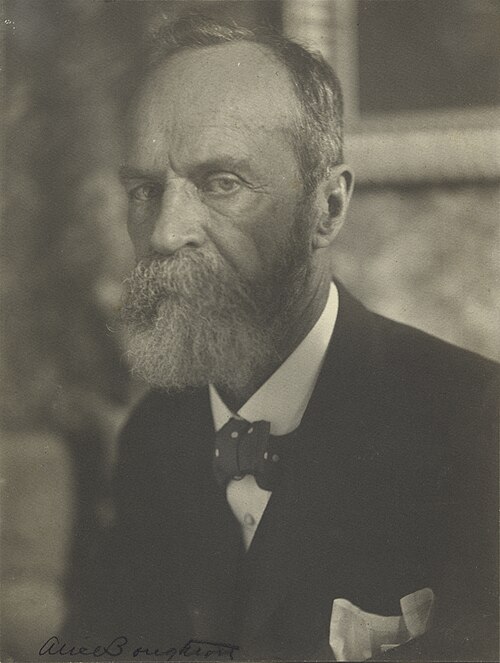 William James1842-1910religion as experience
Background: The psychology and psychoanalysis of religion: from James to experimental psychology · Durkheim's sociology: the social fact, anomie, the Elementary Forms · The thought of William James: pragmatism, psychology, religious experience · Bergson's philosophy: duration, intuition, the élan vital, the Two Sources · Received revelations: spiritism, channeling, the Christ Letters · Quantum mysticism, synchronicity and the law of attraction
With William James, the ground shifts. The Varieties of Religious Experience, published in 1902, brings together the Gifford Lectures delivered in Edinburgh in 1901-1902. The book is the founding charter of what would later be called spirituality.
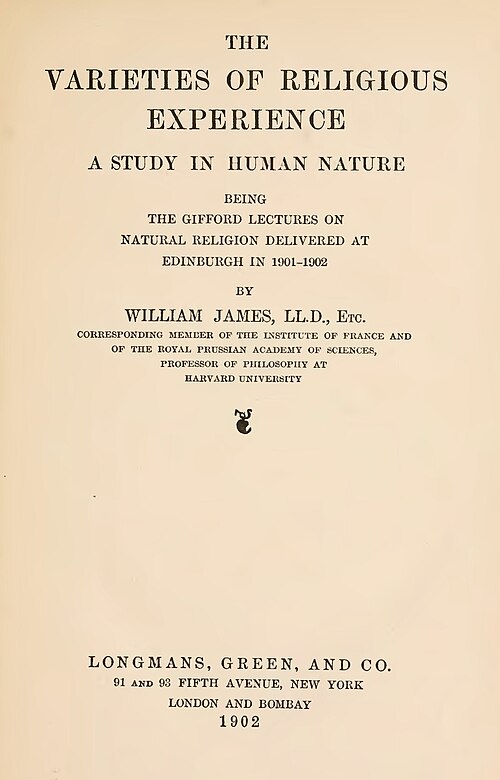
From the second lecture onward, James distances himself from religion as an institution: his definition, quoted in the prologue and presented as arbitrary, relates religion to the individual in his solitude, where Durkheim related it to the Church. For Durkheim, the religious individual is a product of the group; for James, the religious group is a fallout, a second-hand routine, of the original experiences of a few individuals. Durkheim cites James in his conclusion, but in order to turn the Jamesian definition against itself: the strength that faith gives comes from the collective. The dialogue is attested, and it bears on the point that concerns us: can religion exist without a community? If James is right, a spirituality without a Church is possible; if Durkheim is right, it is only a weakened reflection of a collective cult.
James's method, a pragmatist one, takes shape against an adversary he calls “medical materialism”. He gives a cruel description of it: medical materialism “finishes up Saint Paul by calling his vision on the road to Damascus a discharging lesion of the occipital cortex, he being an epileptic”. James does not deny that religious states have physiological correlates; he denies that the origin of a state decides its value. He borrows his criterion from the Gospel, and from Jonathan Edwards: “By their fruits ye shall know them, not by their roots.”
This answer holds, by anticipation, against all the genealogical critiques of our series. Feuerbach explained religion by projection, Marx by misery, Nietzsche by ressentiment, Freud will do so by infantile desire: to all of them James replies in advance that origin does not settle value. For Freud, who writes twenty-five years later, the confrontation is constructed: to say that belief in God arises from the need for paternal protection says nothing about the truth or the fruitfulness of that belief. Freud knows this, moreover, since he will carefully distinguish illusion from error.
The most famous lectures of the book contrast two religious types, healthy souls and sick souls. James takes from Francis Newman the distinction between “the once‐born and the twice‐born”. The former live in a spontaneous optimism, without awareness of evil; the latter have passed through melancholy, the sense of sin or of the absurd, and have found peace only at the price of a second birth. James invites his audience to turn their backs on the “once‐born and their sky‐blue optimistic gospel” in order to listen to the “sick souls”. This typology illuminates our whole series: Ivan Karamazov is the sick soul par excellence, who refuses the sky-blue gospel of final harmony; Comte and Renan, with their religion of Humanity and of genius, are “once-born”. The question of spirituality then arises differently: it is not a matter of knowing whether one believes, but whether one has passed through evil.
At the summit of religious experience, James places mysticism, to which he devotes the sixteenth and seventeenth lectures. He draws out four marks. The first is ineffability: the subject says at once that his state “defies expression”, that its quality must be directly experienced and cannot be imparted. The second is the noetic quality: although similar to feelings, mystical states seem to those who live them to be also states of knowledge, “states of insight into depths of truth unplumbed by the discursive intellect”. The third is transiency, the fourth passivity. This description, empirical and non-confessional, makes it possible to recognize a kinship between Eckhart, Teresa of Ávila, the Sufi mystics, the Vedantic texts and certain testimonies of natural or induced experience. It grounds the possibility of a comparative spirituality, detached from any particular Church.
The conclusion is at once cautious and bold. James distinguishes what is common to all religious experiences from what he calls the “over‐beliefs” proper to each tradition. And what is common fits into a formula: “the fact that the conscious person is continuous with a wider self through which saving experiences come”; this content, he adds, seems to him “literally and objectively true as far as it goes”. And he ends by translating into schematic language what he calls the instinctive belief of mankind: “God is real since he produces real effects.”
James's position is generous, and fragile. It is generous because it takes religious experience seriously without demanding adherence to a dogma; it makes it possible to think a spirituality that is neither a Church nor an illusion. It is fragile because the criterion of fruits says nothing about content: the fanatic too produces real effects. And it raises a question that James leaves open: is the “wider self” God, the unconscious, nature, society? Durkheim answered society, Freud will answer the unconscious, Bergson will answer the élan vital. James leaves the question to the over-beliefs, and that, at bottom, is the very definition of modern spirituality: an experience that is certain, whose object remains undetermined.
Portrait: Alice Boughton, Public domain
 Rudolf Otto1869-1937the numinous and the wholly other
Background: Schleiermacher's thought: the Speeches, the Glaubenslehre, hermeneutics · Phenomenology: from Husserl to the theological turn · Rudolf Otto and The Idea of the Holy: the numinous, the wholly other, comparative mysticism · Jung's psychology: archetypes, collective unconscious, individuation, Answer to Job · Levinas's philosophy: the other, the face, ethics as first philosophy, the Talmud
Rudolf Otto's Das Heilige (The Idea of the Holy) appeared in 1917, the same year as Weber's lecture on science. The two texts answer each other without knowing it: Weber records disenchantment, Otto describes what, in the sacred, resists all rationalization. The book's subtitle, Über das Irrationale in der Idee des Göttlichen und sein Verhältnis zum Rationalen, on the irrational in the idea of the divine and its relation to the rational, says what matters.
Otto, a Lutheran theologian at Marburg, begins with an operation on vocabulary. The word “heilig”, holy, has become a moral term in German: the holy is the perfectly good. Yet this moral sense overlays an older one, which religious languages preserve and which must be isolated. For this Otto coins a word: “Ich bilde hierfür zunächst das Wort: das Numinöse, (wenn man von omen ominös bilden kann, dann auch von numen numinös)”, for this I first form the word: the numinous (if one can form ominös from omen, one can also form numinös from numen). And he adds that since this category is “vollkommen sui generis”, entirely sui generis, it cannot be defined in the strict sense, but only “erörterbar”, open to being discussed and suggested.
Hence a singular method, which makes Das Heilige a book of spirituality as much as of the history of religions. At the beginning of the third chapter, Otto invites his reader to recall a moment of strong religious emotion, and warns: “Wer das nicht kann oder solche Momente überhaupt nicht hat, ist gebeten, nicht weiter zu lesen”, whoever cannot do so, or has never had such moments at all, is asked to read no further. The sentence, famous and often mocked, is nonetheless consistent with the thesis: if the numinous is a primary datum, one can speak of it only to someone who has felt it, as one cannot speak of colours to the blind. The consequence is considerable. If Otto is right, every critique of religion that treats it as a theory or a function misses its object: the critic who has never felt the numinous does not know what he is talking about.
The numinous is described through its effects on the soul. Otto reduces them to a formula that has become classic, “das mysterium tremendum”, the mystery that makes one tremble, to which is added the “fascinans”, what attracts and enraptures. The divine is at once terrifying and fascinating; it repels and it attracts. And above all it is the “ganz Andere”, the wholly other, something that does not belong to the circle of our reality. The numinous is not a being greater than the others; it is of another order.
Otto answers Schleiermacher at the centre of chapter 3, and the response is attested. Otto acknowledges his predecessor's discovery: “Ein sehr bemerkenswertes Element solchen Erlebnisses hat Schleiermacher glücklich herausgegriffen: das Gefühl der „Abhängigkeit"”, Schleiermacher happily singled out a very remarkable element of such experience: the feeling of “dependence”. But he levels two reproaches at him. The first is that this feeling, as Schleiermacher describes it, is not sufficiently distinguished from other feelings of natural dependence, of powerlessness or inadequacy. Otto therefore proposes another name: “Ich suche nach einem Namen für die Sache und nenne es Kreaturgefühl, das Gefühl der Kreatur, die in ihrem eigenen Nichts versinkt und vergeht gegenüber dem, was über aller Kreatur ist”, I look for a name for the thing and call it creature-feeling, the feeling of the creature that sinks and vanishes into its own nothingness before that which is above all creatures. The second reproach goes deeper: Schleiermacher started from the feeling of self and inferred God from it, as a cause; Otto holds that the feeling of dependence is a secondary effect, which presupposes the primary experience of an external object. “Das Gefühl einer „schlechthinnigen Abhängigkeit" meiner hat zur Voraussetzung ein Gefühl einer „schlechthinnigen Unnahbarkeit" seiner”, the feeling of an “absolute dependence” of myself presupposes a feeling of an “absolute unapproachability” of him.
The correction reaches far. Schleiermacher, by grounding religion in the feeling of the subject, had unwittingly opened the way to Feuerbach: if religion is a feeling of man, it can be traced back to man. Otto closes this way. Religious feeling is not a feeling of self; it is the response to an object that is not the self. The Feuerbachian critique of projection is thus circumvented, not by an argument but by a description: the numinous gives itself as what precedes the subject. I am not entirely convinced; but the question of leaving religion changes its nature. If the numinous is an a priori category of the mind, as the chapters that the book's table of contents entitles “Das Heilige als Kategorie a priori” assert, then one cannot leave it, any more than one can leave the category of causality. One can only let it lie fallow or cultivate it.
Otto also answers, in an attested way, William James, whom he cites several times. He borrows testimonies of religious experience from James's book, but reproaches him for having collected them “ohne selber auf das „Irrationale", das in ihnen zittert, acht zu haben”, without himself paying attention to the “irrational” that trembles in them. James, a pragmatist, judges experience by its fruits; Otto, a phenomenologist before the term, wants to grasp it in its own content. And he targets Kant and religious humanism when he evokes, with visible irony, those who seek to build themselves a “Religion innerhalb der Grenzen der reinen Vernunft” or of “Humanität”. Kant's title and the humanism of Humanität, in which one may also hear Comte's religion of Humanity, which Otto does not name, are dismissed together to the shelf of religions without the numinous, that is, for Otto, of religions that are not religions.
Otto's book is one of the strongest defences of the irreducibility of the religious that the twentieth century produced, and it is also, paradoxically, one of the main sources of spirituality without a Church. For if the numinous is a universal experience, prior to dogmas, it can be felt outside any confession, in nature, art, music, solitude. Otto did not want this, since he thought Christianity the highest form of the sacred; but his category escaped his theology. It nourished Eliade as much as contemporary spiritualities, and one may wonder whether Romain Rolland's “oceanic feeling”, to which Freud would reply, is not a variant of it. I believe so: it is a numinous without tremendum, a pure fascinans.
Portrait: Photographe inconnu, Public domain
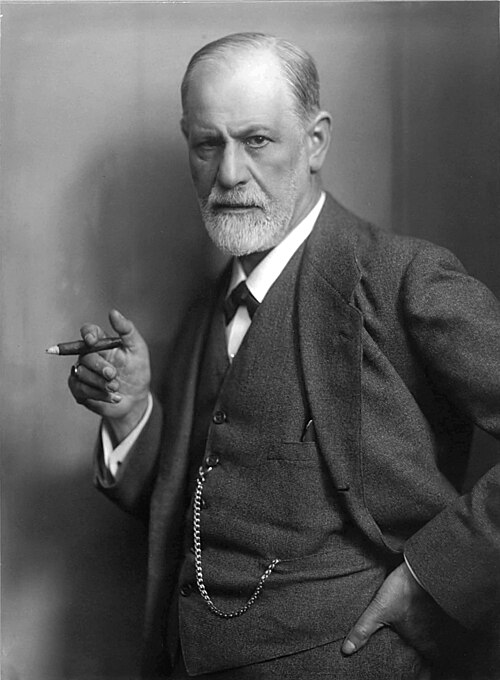 Freud1856-1939illusion and the oceanic feeling
Background: The psychology and psychoanalysis of religion: from James to experimental psychology · Exodus: Moses, the departure from Egypt, Sinai and the Law · Feuerbach's thought: The Essence of Christianity, the species, love, nature · Oedipus: the oracle, the Sphinx, the plague of Thebes · Freud's psychoanalysis: the unconscious, Oedipus, Totem and Taboo, illusion, Moses · Ricoeur's philosophy: symbol, suspicion, text, narrative · Jung's psychology: archetypes, collective unconscious, individuation, Answer to Job · Narcissus and Echo: the reflection, the voice, narcissism
Die Zukunft einer Illusion (The Future of an Illusion) appeared in 1927. It is the text that fulfils, in our series, the regime of illusion, and its concept must first be made precise, for Freud is subtler than his readers. An illusion is not an error. “Eine Illusion ist nicht dasselbe wie ein Irrtum, sie ist auch nicht notwendig ein Irrtum”, an illusion is not the same thing as an error, nor is it necessarily an error. What defines illusion is its motivation: “Wir heißen also einen Glauben eine Illusion, wenn sich in seiner Motivierung die Wunscherfüllung vordrängt, und sehen dabei von seinem Verhältnis zur Wirklichkeit ab”, we therefore call a belief an illusion when wish-fulfilment comes to the fore in its motivation, and in doing so we disregard its relation to reality.
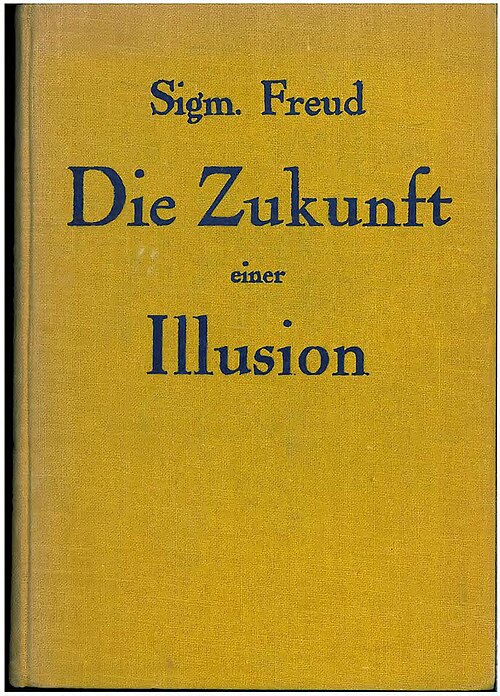
The distinction answers, without naming it, the reproach James addressed to medical materialism. Freud does not claim to have shown that God does not exist; he shows that belief in God would be held even if it were false, because it answers a wish. This is a new regime in our series, distinct from Spinozist error and Feuerbachian projection: religion is not false knowledge, it is a belief whose strength does not come from knowledge.
What wish? That of the child in distress. Freud reconstructs the genesis: the adult, facing the overwhelming forces of nature and fate, finds himself again in a situation he has already known, that of the child before his parents, and above all before the father, “dessen Schutzes man aber auch sicher war”, of whose protection one was also sure. The man who discovers that he will always remain a child before the world “verleiht diesen die Züge der Vatergestalt, er schafft sich die Götter”, lends these powers the features of the father figure, he creates gods for himself. Das Unbehagen in der Kultur would restate the thesis in one sentence: “Ein ähnlich starkes Bedürfnis aus der Kindheit wie das nach dem Vaterschutz wüßte ich nicht anzugeben”, I could not point to any need arising from childhood as strong as the need for a father's protection. Religion then becomes, in a formula that caused a scandal, “die allgemein menschliche Zwangsneurose”, the universal obsessional neurosis of humanity, arising, like the child's, from the Oedipus complex.
Like Feuerbach, Freud makes God a human production; but where Feuerbach saw in it the projected essence of man, to be reappropriated, Freud sees a remnant of childhood, to be outgrown. Freud does not cite Feuerbach in these two books; the confrontation, which is constructed, measures a reversal of value: Feuerbach's God was man writ large, Freud's is man writ small.
The objection Freud raises against himself is the classic objection of the defenders of useful religion: can man live without religious consolation? Will the masses, deprived of God, not believe that everything is permitted? Freud answers with a pedagogy. Infantilism exists to be outgrown: “Der Mensch kann nicht ewig Kind bleiben, er muß endlich hinaus ins „feindliche Leben"”, man cannot remain a child for ever, he must at last go out into “hostile life”. And against consolation he sets another power, weaker but more tenacious: “die Stimme des Intellekts ist leise, aber sie ruht nicht, ehe sie sich Gehör geschafft hat”, the voice of the intellect is soft, but it does not rest until it has gained a hearing.
To designate the power that is to replace religion, Freud writes: “Unser Gott Λόγος”, our god Logos; and he specifies in a note that he borrows the divine pair “Λόγος-᾽Ανάγκη”, Logos and Ananke, from the Dutch writer Multatuli. Further on, he concedes: “unser Gott Λόγος ist vielleicht nicht sehr allmächtig, kann nur einen kleinen Teil von dem erfüllen, was seine Vorgänger versprochen haben”, our god Logos is perhaps not very almighty, he can fulfil only a small part of what his predecessors promised. The vocabulary is deliberate, and Freud knows it to be ironic; it is no less symptomatic for that. To say what replaces God, Freud finds no other word than god: a more modest god, a more honest one, but a god all the same, with his “predecessors”. This is the thesis of our essay, pronounced by the man who most resolutely wanted to refute it.
The book ends with a famous sentence, which is at once an act of faith and a profession of humility: “Nein, unsere Wissenschaft ist keine Illusion. Eine Illusion aber wäre es zu glauben, daß wir anderswoher bekommen könnten, was sie uns nicht geben kann”, no, our science is no illusion. But it would be an illusion to believe that we could get elsewhere what it cannot give us. Freud's own criterion can be turned against him. Is this confidence in science not itself a belief in which wish-fulfilment comes to the fore? Freud had asked himself the question in the book, asking whether our conviction that we can know reality through science has “eine bessere Begründung”, a better foundation. He answered yes, because science corrects itself; but Nietzsche, in § 344 of The Gay Science, had already shown that this will to truth was a faith: Freud's god Logos is the latest avatar of the God-as-truth of Plato and of Christianity.
The response that matters here came from a friend, not a philosopher. Romain Rolland (1866-1944), who had received The Future of an Illusion, answered Freud in a letter of 5 December 1927. He reproached him for not having grasped the true source of religiosity, which according to him was neither dogma nor consolation, but a particular feeling, that of eternity, without perceptible bounds and as it were oceanic. Rolland was then preparing his books on Ramakrishna and Vivekananda, and he spoke as a connoisseur of Indian mysticism. Freud answered publicly, in the first chapter of Das Unbehagen in der Kultur (Civilization and Its Discontents, 1930). There he summarizes his friend's letter, which describes “ein Gefühl wie von etwas Unbegrenztem, Schrankenlosem, gleichsam „Ozeanischem"”, a feeling as of something unlimited, unbounded, as it were “oceanic”, and which he glosses: “Also ein Gefühl der unauflösbaren Verbundenheit, der Zusammengehörigkeit mit dem Ganzen der Außenwelt”, a feeling, then, of an indissoluble bond, of belonging to the whole of the external world. A note, added later, lifts the anonymity: since the publication of The Life of Ramakrishna and The Life of Vivekananda (1930), Freud no longer needs to conceal that the friend in question is Romain Rolland.
Then Freud makes an admission of disarming honesty: “Ich selbst kann dies „ozeanische" Gefühl nicht in mir entdecken”, I myself cannot discover this “oceanic” feeling in myself. He does not deny that it exists in others; he explains it by a return to primary narcissism: the infant does not distinguish its ego from the world, and the oceanic feeling would be the survival, in certain adults, of this “primäre Ichgefühl” (I reproduce the inflected form of the text), primary ego-feeling, whose ideational contents would be precisely “die der Unbegrenztheit und der Verbundenheit mit dem All”, those of limitlessness and of a bond with the All. But he refuses to see in it the source of religion. The source remains, for him, infantile helplessness and longing for the father: “Für die religiösen Bedürfnisse scheint mir die Ableitung von der infantilen Hilflosigkeit und der durch sie geweckten Vatersehnsucht unabweisbar”, for religious needs, their derivation from infantile helplessness and the longing for the father it arouses seems to me irrefutable.
With this exchange, the question of religion becomes that of spirituality. Rolland defends a religiosity without a personal God, without dogma, without a Church: a feeling of unity with the Whole, which he holds to be universal and finds as much in Spinoza as in the Indian mystics. Freud opposes to it a religion that is always that of the father, of protection and of guilt. Both are right, and that is why the debate matters. Freud is right about the instituted religions, whose infantile mainspring he describes accurately. Rolland is right to say that there is something else, an experience Spinoza would have recognized. But Freud is perhaps right a second time, and that is his real strength: the oceanic feeling, if it is a remnant of primary narcissism, is still a form of childhood, a way of denying the separation of the ego and the world. Spirituality without God would then be only a religion without a father, but not without a mother.
Freud, moreover, encountered Dostoevsky, which closes a loop. In 1928 he contributed, as a preface to a German edition of the drafts of The Brothers Karamazov, an essay, “Dostojewski und die Vatertötung”, Dostoevsky and parricide, in which he reads the novel in the light of the murder of the father. The novel whose centre is a parricide, and whose question is the death of God, is thus read by the man who makes God the figure of the father. Freud saw what Dostoevsky had staged: that the death of God and the death of the father are one and the same affair, and that guilt does not die with them.
Portrait: Max Halberstadt, Public domain
 Bergson1859-1941static religion and dynamic religion
Background: Christian mysticism: from Dionysius to John of the Cross and quietism · Durkheim's sociology: the social fact, anomie, the Elementary Forms · Bergson's philosophy: duration, intuition, the élan vital, the Two Sources
The Two Sources of Morality and Religion, published in 1932, is Bergson's last great book, and probably the work of interwar French philosophy that poses our question most directly. It presents itself as a response both to Durkheim, whom it discusses explicitly, and to James, whom it cites and whose intuition it extends. It attempts to hold the two families together, the sociological and the mystical, by tracing them to two distinct sources.
Bergson begins, in the second chapter, with an observation that could be Spinoza's or Onfray's: “Le spectacle de ce que furent les religions, et de ce que certaines sont encore, est bien humiliant pour l'intelligence humaine. Quel tissu d'aberrations !”, the spectacle of what religions were, and of what some still are, is truly humiliating for human intelligence. What a tissue of aberrations! But he draws from it a question that neither Spinoza nor Onfray asks with the same rigour: how could an intelligent being have believed such things, and why has he never been cured of them? The answer is not ignorance, since humanity clings to them all the more as experience and reasoning contradict them. It is a function. “La vérité est que la religion, étant coextensive à notre espèce, doit tenir à notre structure”, the truth is that religion, being coextensive with our species, must pertain to our structure.
Bergson calls this function fabulatory. Intelligence, which is proper to man, has a dissolving power: it shows the individual that he could prefer his own interest to that of the group, and it also reveals to him that he will die. Nature, which produced intelligence, had to produce a counterweight at the same time. This counterweight is religious fables: “la religion est donc une réaction défensive de la nature contre le pouvoir dissolvant de l'intelligence”, religion is thus a defensive reaction of nature against the dissolving power of intelligence. And the fabulating function did not first serve the novel or the theatre: “la religion était la raison d'être de la fonction fabulatrice”, religion was the raison d'être of the fabulating function. The “static religion” thus produced “attache l'homme à la vie, et par conséquent l'individu à la société, en lui racontant des histoires comparables à celles dont on berce les enfants”, binds man to life, and consequently the individual to society, by telling him stories comparable to those with which children are lulled to sleep.
The kinship with Durkheim is manifest, and Bergson acknowledges it. He cites the Durkheimian thesis that religious representations are the work of the collective mind, and he accepts it in part: “Nous admettrons volontiers, quant à nous, l'existence de représentations collectives, déposées dans les institutions, le langage et les mœurs”, for our part we shall readily admit the existence of collective representations, deposited in institutions, language and customs. But he rejects its consequence. For Durkheim, society is the sole source of the sacred. For Bergson, it is only one source, and the least lofty. Static religion is that of closed societies, which preserve themselves by defending themselves; it is infra-intellectual, natural, and it turns on the spot. The book's first chapter had already contrasted the closed soul, which turns in a circle with its society, and the open soul, whose love extends to the whole of humanity, “aux animaux, aux plantes, à toute la nature”, to animals, to plants, to all of nature. Between the nation and humanity, Bergson writes, lies the whole distance from the finite to the indefinite: no gradual extension of social solidarity leads from one to the other. A leap is needed.
This leap, the mystics accomplished. “Dynamic religion”, inward and supra-intellectual, is born of a few exceptional individuals who regained contact with the creative impetus of life. Bergson defines mysticism precisely: “l'aboutissement du mysticisme est une prise de contact, et par conséquent une coïncidence partielle, avec l'effort créateur que manifeste la vie. Cet effort est de Dieu, si ce n'est pas Dieu lui-même”, the culmination of mysticism is a contact, and consequently a partial coincidence, with the creative effort that life manifests. This effort is of God, if it is not God himself. And what the mystics say, when one tries to put it in a formula, is simple: “Dieu est amour, et il est objet d'amour : tout l'apport du mysticisme est là”, God is love, and he is the object of love: the whole contribution of mysticism lies there. Bergson adds that the mystics unanimously testify “que Dieu a besoin de nous, comme nous avons besoin de Dieu”, that God needs us, as we need God, and he draws from this a vision of creation as “une entreprise de Dieu pour créer des créateurs”, an undertaking of God to create creators.
Bergson's thesis matters because it separates two things that most of our authors confused. There is static religion, produced by society to defend itself; it is fabulating, and it deserves all the criticisms that have been addressed to it, from Spinoza to Freud. And there is mysticism, which is not a religion but the living source of which religions are the cooling. Bergson says it in an image: “Nous nous représentons donc la religion comme la cristallisation, opérée par un refroidissement savant, de ce que le mysticisme vint déposer, brûlant, dans l'âme de l'humanité”, we therefore picture religion as the crystallization, brought about by a skilful cooling, of what mysticism deposited, burning hot, in the soul of humanity. One can then leave static religion, and one must, without leaving mysticism. Leaving religion does not call for another religion; it calls for a return to the source.
Bergson here answers, in a constructed way, all the authors of our series. To Durkheim he answers that society explains only static religion, and does not account for the love of humanity. To Freud, whom he does not cite but knows, he answers that the fabulating function is indeed a defence, but does not exhaust the religious. To Nietzsche he answers that the “overman” already exists, and that his name is the mystic: Bergson cites the sages of Greece, the prophets of Israel, the Arahants of Buddhism and the saints of Christianity as the exceptional men in whom open morality has been embodied. To William James, finally, he pays explicit tribute, quoting at length his testimony on the San Francisco earthquake, and he extends his intuition by giving the “wider self” a name, the creative effort of life.
The last pages carry the question onto the terrain of technical civilization, with a strange topicality. Bergson asserts there that “la mystique appelle la mécanique”, mysticism calls for mechanics, because man will detach himself from matter only by leaning on it; but he adds that the converse is true: “le corps agrandi attend un supplément d'âme, et que la mécanique exigerait une mystique”, the enlarged body awaits a supplement of soul, and mechanics would require a mysticism. The book ends with this sentence: “L'humanité gémit, à demi écrasée sous le poids des progrès qu'elle a faits. Elle ne sait pas assez que son avenir dépend d'elle”, humanity groans, half crushed beneath the weight of the progress it has made. It does not know well enough that its future depends on itself; and it is for humanity to decide whether it wants to make the effort required “pour que s'accomplisse, jusque sur notre planète réfractaire, la fonction essentielle de l'univers, qui est une machine à faire des dieux”, so that the essential function of the universe, which is a machine for making gods, may be fulfilled, even on our refractory planet.
This ambiguous sentence sums up, in my view, the whole difficulty of this part. A machine for making gods: Bergson means that the universe tends to produce beings capable of creation and love, mystics, divine men. But one can also hear the echo of the question of Nietzsche's madman, “must we not ourselves become gods?”, and the echo of Kirillov. Bergson believes he escapes the divinization of man because the god that is made in us is the creative impetus and not the self. I believe he does escape it, but narrowly, and at the price of a metaphysics of life that few readers today are prepared to follow. The fact remains that Bergson gives systematic form to the distinction on which the rest of this essay will live: closed religion, which one can and must leave, and open spirituality, which one does not leave because it is not an institution but a movement.
Portrait: Henri Manuel, Public domain
 Ricoeur1913-2005critique passed through
Background: The thought of Marx: historical materialism, alienation, ideology, fetishism · Hermeneutics: from Schleiermacher to Ricoeur · Freud's psychoanalysis: the unconscious, Oedipus, Totem and Taboo, illusion, Moses · Ricoeur's philosophy: symbol, suspicion, text, narrative
Paul Ricoeur comes last, by design: he is the first reader of this part. The gesture that made him famous consists in looking together at three authors we have met separately, Marx, Nietzsche and Freud, and giving them a common name. Ricoeur places them in a single school, the school of suspicion, and tradition has retained, on the basis of his book, the phrase “maîtres du soupçon” (masters of suspicion). The book is De l'interprétation. Essai sur Freud, published by Seuil in 1965. His biographical position explains nothing but situates everything: Ricoeur is a Protestant, trained in the French Reformed tradition and a reader of Barth; his five years of captivity in Pomerania are years of reading, of Jaspers and of Husserl; he would later write the preface to the French translation of Bultmann, and the “Préface à Bultmann” (Preface to Bultmann) is reprinted in Le Conflit des interprétations (1969). A believer, then, who chose to read the hardest atheists not as adversaries to be refuted, but as masters whose school must be followed.
What do these three masters do? All three practise what Ricoeur calls interpretation as an exercise of suspicion. Their common gesture is to doubt, no longer the thing, as Descartes did, but consciousness itself: what consciousness believes it sees, believes, wills, is not what is at play within it. Religion, for Marx, expresses the world upside down; for Nietzsche, it expresses weakness under the name of virtue; for Freud, it expresses the child's desire under the name of Providence. In all three cases, the manifest meaning is the effect of a latent meaning that must be deciphered, and understanding goes by way of a detour. Ricoeur calls this common discipline a “science médiate du sens” (mediate science of meaning), which he opposes to the “conscience immédiate du sens” (immediate consciousness of meaning).
This grouping puts our own map to the test. We have distinguished three regimes where Ricoeur sees one school: the symptom in Marx, value in Nietzsche, illusion in Freud. Is he right to merge them? I believe he is right as to method and wrong as to object. As to method, the unity is real: all three treat belief as a doctored text whose hidden author must be found, the class, the weak will, the infantile desire. As to object, the distinction holds: Marx does not want to cure the individual, he wants to change the world that needs opium; Freud does not want to change the world, he wants the individual to stop being a child; Nietzsche wants neither, he wants new values to be created. Ricoeur's grouping shows what the three share against religion; our regimes show what separates them in the manner of leaving it, and that is where refoundation is decided.
But the heart of the book is a conflict. Opposite the hermeneutics of suspicion, he sets another hermeneutics, that of the restoration of meaning, whose model he finds in the phenomenology of religion, in Van der Leeuw and in Eliade: an interpretation that listens to the symbol instead of unmasking it, and that lets itself be told by it something it did not know. Ricoeur thus describes two opposed dispositions, a willingness to listen and a willingness to suspect. Both are legitimate, and neither can absorb the other. The sentence that condenses this conflict says that we are “ces hommes qui n'ont pas fini de faire mourir les idoles et qui commencent à peine d'entendre les symboles”, those men who have not finished putting the idols to death and who are barely beginning to hear the symbols.
This is where the notion that made Ricoeur's fortune comes in, though he rarely uses it: the “seconde naïveté” (second naïveté). It appears for the first time at the end of La Symbolique du mal (1960), in a concluding chapter whose title is already a thesis, “Le symbole donne à penser” (the symbol gives rise to thought). The starting diagnosis is the forgetting of the sacred peculiar to modernity: the first naïveté, that of the believer who lives in the symbol without reflecting on it, has become impossible for us. But Ricoeur refuses to conclude that the symbol is dead. Not having consulted the French text of 1960, I quote the English translation by Emerson Buchanan: “we can, we modern men, aim at a second naïveté in and through criticism”, and it is “by interpreting that we can hear again”; “beyond the desert of criticism, we wish to be called again”; and this second naïveté is meant to be the postcritical equivalent of the precritical hierophany.
What Ricoeur proposes, then, is a faith that has passed through critique, not a faith that has avoided it. The distinction bears directly on our question. Kierkegaard too wanted a faith that would owe nothing to historical criticism; Barth too wanted a faith that would not be a religion. But both placed themselves out of reach of suspicion, by the leap or by Revelation. Ricoeur agrees to remain exposed to it. He does not say to Freud: you are wrong about religion. He says to him: you are right about one religion, that of the protecting father and the judge, and it is precisely this religion that must die. In the lecture “Religion, athéisme, foi” (Religion, atheism, faith), reprinted in Le Conflit des interprétations, he distinguishes, I summarize without quoting, two cores of religion that modern atheism rightly destroys: the god of accusation, whom Nietzsche unmasked as an invention of ressentiment, and the god of consolation, whom Freud unmasked as a desire for protection. What remains after this double destruction, if anything remains, is neither the moral God nor the providential God. It is a word one listens to, a call that promises nothing.
Freud defined illusion by its motivation, the belief in which the fulfilment of a wish comes to the fore, and he loyally added that this does not settle its truth. Ricoeur takes Freud at his word: if the Freudian critique bears on the motivation of belief and not on its object, it does not close the question of the object, it purifies it. A belief that has renounced the protecting father, that has mourned consolation, escapes Freudian suspicion by definition, since the infantile wish no longer comes to the fore in it. Freud showed that the religion of the child is an illusion; he did not show, and did not claim to show, that there is no other. Ricoeur's reading of Freud is attested; the argument I draw from it here is a reconstruction, but it rests on the very letter of The Future of an Illusion and turns Freud's own loyalty against him.
The same reply can be made to the regime of the symptom. Marx said that religion is the protest against real distress at the same time as its expression; Ricoeur hears in the second half of the sentence what Marxism wanted to forget there. If religion is also a protest, then its critique cannot consist solely in dissolving it; it must also hear what it protests against. The hermeneutics of suspicion, pushed to the end, destroys the content of the symbol; the hermeneutics of listening gathers what the symbol said and suspicion could not hear. Our essay has practised this double gesture from the beginning without naming it: we have dismantled the refoundations, but we have also taken seriously what each of them was seeking.
There is, however, an objection, and it is a strong one. Is the second naïveté not a first naïveté that gives itself a good conscience? One passes through critique, says Ricoeur; but one comes out of it with the same symbols, fault, defilement, exile, promise, and reinvests them with a new meaning. Is this not what Hegel did, whom we reproached for translating religion into concept the better to preserve it? Is it not what Strauss did, who discovered in myth a truth of humanity? Ricoeur knows the objection, since he knows Hegel closely. His reply, I believe, comes down to one word: he does not claim that the second naïveté is a form of knowledge. Hegel completed religion in absolute knowledge; Ricoeur leaves it incomplete in interpretation, which has no end. The symbol gives rise to thought; it does not give rise to knowledge. And this difference is the one that separates, in our essay, refoundation from the exception.
For that is indeed where Ricoeur must be classed. He does not leave religion: he remained a believer, and he never hid that his faith preceded his philosophy, although he always took care not to bring it in as an argument. But neither does he refound a religion in the sense of the criterion. He installs no absolute in whose name the sacrifice of the individual could be demanded; on the contrary, he installs the individual in an infinite task of interpretation in which no absolute lets itself be possessed. Having entered the school of his adversaries, he never entirely left it: a rare position, which I believe more honest than that of most apologists as well as most critics. It has its price, which is instability: the second naïveté is always in danger of falling back into the first, or of dissolving into suspicion. Ricoeur accepts this, and this acceptance makes him, at the end of this part, a fair interlocutor of the three masters he named.
Ricoeur leaves a question for what follows. If the critique of religion can be passed through, if listening is possible after suspicion, then the exit from religion is not an event, but a path that can be travelled in both directions. Heidegger, Barth, Weil, Levinas, Marion all attempted, each in his or her own way, this return beyond critique. The question will each time be the same: is this return a second naïveté that knows what it is doing, or a refoundation that forgets it?
Portrait: Jmendrik, CC0
Assessment of Part Eight: suspicion and experience
Background: Weber's sociology: ideal types, rationalization, charisma, value neutrality
The landscape has changed profoundly. The sciences of religion have not confirmed the expectation of the Enlightenment, which hoped to see religion dissolve under the light of knowledge. Durkheim showed that one does not leave the sacred; Weber, that the gods return in the plural; Freud, that God is replaced by a god Logos; Otto, that the numinous is a category of the mind; James and Bergson, that mystical experience outlives all Churches; and Ricoeur gave this landscape its name, the school of suspicion, by showing that one can pass through it without going back or settling in it. The debate no longer bears on the existence of God, but on two new questions: that of the social function of the sacred, which the political religions of the twentieth century will make tragic, and that of spiritual experience, which theology and philosophy will each take up in its own way. These sciences make inevitable a question that Part Nine takes up in its own right: why do people believe? Part Ten will then open in this double context; Camus, in particular, will measure there what the divinization of history costs, akin to that sacralization of society which Durkheim had described without fearing it. The twentieth century thus begins with the discovery that man without God is not man without religion.
Part Ninewhy do people believe? Need, function, cognition
Background: The psychology and psychoanalysis of religion: from James to experimental psychology · The anthropology of religion: from Tylor to Girard · The cognitive science of religion: why gods are easy to think · Analytic philosophy of religion: from the problem of evil to Reformed epistemology · René Girard's mimetic theory
Until now, the essay has asked how one leaves religion, almost never why one enters it; and yet this is the question the reader asks first: why does the human being need religion, or, when he no longer wants it, spirituality? The word “need” already contains the answer. To speak of need is to suppose a constant lack, inscribed in human nature, which religion fills and which would come back to claim its due if religion were abolished: that is Durkheim's thesis, and it is what the thesis of this essay calls into question. I shall therefore speak rather of a disposition: something in the mind, in existence and in common life makes religious belief easy, frequent, sometimes almost irresistible, and the task is to take its springs apart without deciding in advance that they call for a god. The philosophers we have met drew a first map of them: fear, desire, lament, helplessness, society, the fabulating function, the need for meaning. Two formulas set the tone. Feuerbach: “Der Wunsch ist der Ursprung, ist das Wesen selbst der Religion”, the wish is the origin, it is the very essence of religion. Freud: religious ideas were born “aus dem Bedürfnis, die menschliche Hilflosigkeit erträglich zu machen”, from the need to make human helplessness bearable. The human sciences of the twentieth century put the question again with fieldwork, experiments and figures: Tylor and Frazer looked for the origin of religion in an error of reasoning, Malinowski in anxiety before what one does not master, Jung in a natural function of the psyche, Girard in violence and sacrifice; then will come the psychology of death, the sociology of meaning and of memory, the cognitive sciences and the comparative surveys, which a constructed debate will bring face to face.
 Tylor and Frazer1832-1917; 1854-1941religion as primitive philosophy
Background: The anthropology of religion: from Tylor to Girard · The cognitive science of religion: why gods are easy to think · The philosophy of Hume: empiricism, causation, miracles, the natural history of religion · The mysteries and Orphism: Eleusis, Orpheus, Cybele, Isis, Mithras · Tylor and Frazer: animism, survivals, The Golden Bough · Pascal Boyer: religion explained by cognition
The anthropology of religion was born in England, in the last third of the nineteenth century, from an ambition that resembles that of the Scottish Enlightenment: to make belief an object of natural history, going back from its most complex forms to its simplest. Edward Burnett Tylor, a Quaker by upbringing, without a university degree, a traveller in Mexico and then the first holder of a chair of anthropology at Oxford, published in 1871 the two volumes of Primitive Culture. The book bears as its epigraph a French sentence by Président de Brosses, the inventor of the word “fetishism”: “ce n'est pas dans les possibilités, c'est dans l'homme même qu'il faut étudier l'homme”, it is not in possibilities, it is in man himself that man must be studied. A whole programme: not to speculate on what man ought to have believed, but to look at what he believes.
Tylor starts from a difficulty of definition, and his solution would weigh on the whole of the following century. To require, before speaking of religion, belief in a supreme god, in a judgement after death, in idols or sacrifices, is to exclude many peoples from it and to confuse it with some of its developments. One must therefore, says Tylor, posit “as a minimum definition of Religion, the belief in Spiritual Beings”. This belief he calls animism, and he reconstructs its genesis by a line of reasoning that Durkheim would summarize. The man of the origins dreams; at night he sees himself travelling far away, conversing with the absent or the dead; he concludes that there is in him a double, a soul, capable of leaving the body. From the human soul one passes to the souls of animals and things, from these to spirits, from spirits to gods. Religion is first of all a philosophy: a theory, false but rational, worked out by a savage philosopher to explain sleep, dreams, sickness and death.
Tylor accepts both consequences of this thesis. The first is that there is no people without religion, if one adopts the minimum definition: belief in spirits is universal, which makes religion a trait of humanity and not an invention of priests. The second is that this primitive philosophy is an error, and that its remains live on in modern societies in the form of “survivals” which must be identified and rooted out. Tylor says so bluntly on the last page of his book: ethnography has the office, harsher and at times painful, of exposing “the remains of crude old culture which have passed into harmful superstition” and marking them out for destruction; that is why “the science of culture is essentially a reformer's science”. One recognizes the first regime of this essay, the regime of error, in its evolutionist version: religion is true as a universal fact, false as a theory, and progress dissolves it.
James George Frazer, more than twenty years younger, gave this school its monument and its public. The Golden Bough appeared in two volumes in 1890 and swelled to twelve in the third edition (1906-1915), before the abridgement of 1922 that would make it a bedside book for generations of writers. Frazer starts there from a riddle of detail, the priest of Diana at Nemi who attains his office only by killing his predecessor, and draws from it a fresco of human thought in three ages. In the first, man believes he can act on nature through magic, which rests on two laws of the association of ideas, similarity and contiguity. Frazer gives its most famous formula: legitimately applied, these laws produce science; illegitimately applied, they produce magic, “the bastard sister of science”. In the second age, man discovers that nature does not obey him, and he turns to powers that must be prayed to. Frazer then defines religion as “a propitiation or conciliation of powers superior to man which are believed to direct and control the course of nature and of human life”. In the third age, science recovers, against religion, the magical idea of a regular order of nature, but this time founded on observation. The book closes on this movement of thought, which goes, “on the whole”, “from magic through religion to science”.
Two features concern this essay directly. Frazer is, first, cautious about the last word. The laws of nature are themselves only hypotheses, and “in the last analysis magic, religion, and science are nothing but theories of thought”, so that science may one day be superseded by a more perfect hypothesis. Next, and above all, The Golden Bough is an immense repertory of sacrificed kings, of gods who die and are reborn, and of public scapegoats, human or animal, laden with the ills of the community before being driven out or killed. Frazer does not say in so many words that the Passion of Christ belongs to this series, but the whole book suggests it, and his readers understood it so: it is one of the sources of the mythicist thesis examined in connection with the birth of Christianity. Girard would take up this repertory and reverse its meaning.
This anthropology was refuted from three sides, and each refutation opens a path that what follows will take. Durkheim, first, sets against it an argument that I believe is decisive against intellectualism. If the animist theory were true, he writes, one would have to admit that religious beliefs are “représentations hallucinatoires, sans aucun fondement objectif”, hallucinatory representations without any objective foundation, born of “une sorte de délire qui le saisit régulièrement chaque jour”, a sort of delirium that seizes him regularly every day, and one could not understand how such an aberration has run through the whole of human history. An institution so universal and so lasting cannot rest on a mere error; it must answer to something real, which Durkheim finds in society. Wittgenstein, next, reproaches Frazer for making his “savages” into bad physicists (Part Ten). Malinowski, finally, would reproach the two Englishmen for having studied religion in their libraries, and would show in the field that magic is not a false science but a technique for dealing with anxiety.
Tylor and Frazer's answer is the simplest: people believe because they are mistaken, and they will stop believing when they know. It is the answer of the Enlightenment carried into ethnography, with the same weakness as in d'Holbach: it explains why a belief is born, not why it lasts when one knows it to be false. Tylor nevertheless left a gain that no one has undone: belief in invisible beings is universal. The cognitive sciences, at the end of the twentieth century, would take up his question almost in his own terms, asking no longer whether this belief is true, but why a human mind produces it so easily.
Portrait: Elliot & Fry, Public domain
Portrait: Antoine Bourdelle, photo Didier Descouens, Public domain
 Malinowski1884-1942magic begins where mastery ends
Background: The anthropology of religion: from Tylor to Girard · Malinowski: fieldwork, functionalism, magic, science and religion · Norris and Inglehart: existential security, the World Values Surveys · Heracles: the labours, the choice, the apotheosis
Bronisław Malinowski, born in Kraków, trained in physics and philosophy before coming to anthropology through reading The Golden Bough, spent most of the years 1915-1918 in the Trobriand Islands, off New Guinea, living among those he studied. On this experience he founded the method of participant observation, and from it he drew, on our question, a short essay, “Magic, Science and Religion”, which appeared in 1925 in a collective volume edited by Joseph Needham, Science, Religion and Reality.
Malinowski first ruins Frazer's thesis with a fact. The Trobrianders do not confuse magic with technique. They know perfectly well that a garden grows because it has been dug, weeded and fenced, and they do all this with the care of good farmers; magic is added to work, it does not replace it. But it is not added everywhere, and here observation becomes experiment, in the example that every textbook has cited since. In the villages on the inner lagoon, fishing is done by poisoning, in an easy and perfectly reliable way; on the shores of the open sea, it is dangerous, and its yield depends on the uncertain passage of shoals of fish. Now, “in the Lagoon fishing, where man can rely completely upon his knowledge and skill, magic does not exist, while in the open-sea fishing, full of danger and uncertainty, there is extensive magical ritual to secure safety and good results”.
The conclusion shifts the whole question. Magic is not an erroneous science, born of a badly conducted association of ideas; it is man's answer to the zones where his knowledge no longer suffices, where chance, danger and death decide. Its function, writes Malinowski, is “to ritualise man's optimism, to enhance his faith in the victory of hope over fear”. We find again the fear and hope that Hume placed at the origin of religion, but their sign is reversed. For Hume, fear produced terrible gods, and religion was a sickness of the mind; for Malinowski, the rite produces confidence, and this confidence has a vital value. The sailor who recites his formula before leaving the channel is not mistaken about the sea; he is giving himself the courage to go out on it.
Religion, which Malinowski distinguishes from magic, is born of the most extreme of these zones. “Of all sources of religion, the supreme and final crisis of life, death, is of the greatest importance”. Before the death of someone close, man is torn between attachment and terror, the wish to keep the dead and the horror of the corpse; funeral rites give form to this ambivalence, and belief in immortality chooses, between the two answers suggested by the instinct of self-preservation, the answer of hope. “Religion saves man from a surrender to death and destruction”. And Malinowski concludes against Tylor: the true kernel of animism is not the observation of dreams, it is “the deepest emotional fact of human nature, the desire for life”. The soul is not a savage philosopher's hypothesis; it is a refusal.
Malinowski finally opposes Durkheim, and his criticism is all the more interesting in that he does him justice. He rejects the idea of a “collective soul” and maintains that, in the societies he observed, religion arises to a large extent from purely individual sources, that crowds do not always produce religion, and that their effervescence is often entirely profane. He acknowledges, however, that Durkheim's school asked the right questions: why are religious acts almost always collective, and why are beliefs obligatory for all members of the tribe? His answer: religion, born of individual anxiety, is taken up by the group because the group, too, needs to survive the death of its members: funerals are the moment when society reconstitutes itself around a loss. We thus have, in 1925, a psychology and a sociology of religion reconciled around death, which announces Ernest Becker's psychology of death.
A year later, in Myth in Primitive Psychology (1926), Malinowski extended the same analysis to myth. Myth, he says in substance, is not among the Trobrianders an explanation of natural phenomena, as the mythologists of the nineteenth century believed, nor a learned allegory; it is a “charter”, a narrative that founds and guarantees a present order, a prerogative, a rite, a rule of marriage or of property. Myth does not answer curiosity, it answers contestation: it says why things must be as they are. Religion therefore answers not only the anxiety of the individual before chance and death; it also answers a group's need to justify its order, which joins by another route the civil religion of Plato and of Rousseau, and announces the sociology of Peter Berger.
Malinowski's position seems to me solid, and work he could not have known has confirmed it. It explains what neither Tylor nor Frazer explained: why belief does not retreat as knowledge advances, but only as uncertainty retreats. It makes religion not an error but an answer to a situation, and this answer varies with the situation. This is the hypothesis that Pippa Norris and Ronald Inglehart would put to the test on a world scale. But it leaves open the question that concerns this essay: if religion is the ritualized optimism of those who face danger, does it still have a function when danger is mastered, and what then remains, if not death itself, which nothing masters?
Portrait: Photographe inconnu, LSE Library, No restrictions
 Jung1875-1961the religious function of the psyche
Background: The psychology and psychoanalysis of religion: from James to experimental psychology · Gnosis and Gnosticism: from Valentinus to Hans Jonas and Voegelin · Psalms, Job, Qoheleth and the wisdom books · Rudolf Otto and The Idea of the Holy: the numinous, the wholly other, comparative mysticism · Freud's psychoanalysis: the unconscious, Oedipus, Totem and Taboo, illusion, Moses · Jung's psychology: archetypes, collective unconscious, individuation, Answer to Job · Quantum mysticism, synchronicity and the law of attraction
Carl Gustav Jung is the most famous of Freud's disciples to have broken with him, and religion lies at the centre of this break. The son of a pastor, brought up in a parsonage in the canton of Basel and nourished on a keen aversion to his father's theology, he had been designated by Freud as his heir, the “crown prince” of psychoanalysis, according to a formula found in their correspondence. The break was consummated in 1912-1913, after the publication of Wandlungen und Symbole der Libido (Transformations and Symbols of the Libido), in which Jung extended the libido beyond sexuality and read myths as expressions of a general psychic energy. Freud could not accept this, because the extension took the edge off his theory of religion: if the libido is any psychic energy whatever, religious desire is no longer the repetition of an infantile desire, it is a desire in its own right.
Jung's thesis is simple to state and difficult to assess. The human psyche possesses by nature a religious function, which is not the residue of a neurosis but a normal activity of the soul, as natural as sexuality or aggressiveness. This function expresses itself in images that recur, with striking constancy, in the myths, dreams, visions and delusions of the most distant peoples and ages: these are the archetypes, empty forms of the collective unconscious that the particular representations of each culture fill. The most important of them is the Self, the image of psychic totality, which Jung recognizes in Christ, the Buddha, the mandala, the philosophers' stone of the alchemists. The process by which the individual enters into relation with this totality, which he calls individuation, is for him the psychological equivalent of what religions called salvation. He set it out for the general public in the Terry Lectures at Yale, in 1937, published the following year under the title Psychology and Religion.
The Yale lectures contain a definition that concerns this essay directly, because it chooses, between the two etymologies of religio examined in the prologue, Cicero's against Lactantius's. Religion, says Jung, is the careful and scrupulous observation of what Rudolf Otto called the numinosum, a power that seizes the subject rather than being produced by him. The choice is not innocent: Cicero's religio was a scruple, an attentiveness, a rereading; it presupposed neither dogma nor a personal God. In taking it up, Jung makes religion an attitude of consciousness before what exceeds it, and he can say, without contradiction from his point of view, that a man with no denomination is religious if he takes his dreams and symbols seriously. Otto's Wholly Other becomes, in Jung, a region of the psyche.
The gap with Freud is clear. For Freud, religion is an illusion, which humanity must outgrow as the child outgrows its dependence; for Jung, it is a function, and the man who represses it pays the price. He formulated this conviction in a clinical observation for which he has often been reproached: among his patients over thirty-five, he says in substance in an essay of 1932, there is not one whose ultimate problem was not that of finding a religious attitude towards life again, which has nothing to do, he specifies, with membership of a denomination or a Church. The neurosis of modern man would be a sickness of the loss of meaning, and psychotherapy would take over from spiritual direction.
This function is not a belief. Jung repeats that he speaks as an empiricist, of what the soul produces, and not as a theologian, of what exists outside it; but the empiricism he claims constantly overflows its own limits.
One formula has fixed this position in people's memories, and it also shows what is disquieting about it. In 1959, the BBC broadcast a long interview of Jung by John Freeman, recorded in his house at Küsnacht. Freeman asks him whether he believes in God. Jung hesitates, then answers: “I know. I don't need to believe. I know”. The sentence caused a scandal on both sides: believers heard in it a gnostic pride that replaces faith with knowledge; unbelievers, a profession of faith disguised as science. Jung himself had to specify in letters that he was speaking of the experience of a psychic reality, not of a metaphysical demonstration.
Jung's boldest book on this ground is also his latest. In Antwort auf Hiob (Answer to Job, 1952), he reads the book of Job as the moment when man, just and suffering, becomes morally superior to a God who crushes him to win a wager; the Incarnation would be this God's answer to his own injustice, the necessity for him to become man in order to attain the consciousness that his creature has revealed to him. The book scandalized theologians, and with reason: it makes God a developing psychic image that needs human consciousness in order to know itself. But it touches, unexpectedly, the question that the conclusion of this essay leaves open, that of the lament of the oppressed creature. Jung takes Job's side against God, as Ivan Karamazov took the child's side against universal harmony; only, instead of concluding in favour of revolt, he concludes in favour of a transformation of the divine. This is yet another way of keeping religion, by making it absorb its own critique.
The main objection came from a believer, and the response is attested. In 1952, Martin Buber published in the review Merkur an essay, “Religion und modernes Denken”, taken up in Eclipse of God (New York, Harper, 1952), then in the German edition, Gottesfinsternis (Eclipse of God, Zurich, Manesse, 1953). In it he accuses Jung of two things: of psychologism, since God is there no more than an image of the soul, and of gnosis, since the relation to the living God, which for Buber is an encounter with an external Thou, is replaced by the knowledge of an inner content. Jung replied in the same review with an “Antwort an Martin Buber”, to which Buber responded. The debate is, at bottom, that of mysticism and gnosis, of faith and knowledge. Jung claims to assert nothing about God in himself, but only about the image of God in the psyche; Buber answers that this reservation is an evasion, and that a god who exists only as a psychic function is not a god but an instrument.
I believe Buber is right, but for a reason that is not exactly his. The danger of Jung, in the light of this essay's criterion, is not that he denies God; it is that he makes religion necessary without making it true. If the soul needs religious symbols as the body needs food, one cannot leave religion, only change symbols, and the therapist becomes the guardian of this necessity. It is Durkheim's position transposed from society to the psyche, and it has the same effect: it makes the question of this essay idle. It nevertheless has a consequence that Jung did not see. A religious function detached from all truth and all institution can be filled with anything at all, including what Jung called, in 1936, in an essay on Wotan, the awakening of an archaic god in the German soul, which he described, in my view, more than he fought it. A religion of the unconscious demands no explicit sacrifice; nor does it offer any criterion for refusing the sacrifice that an awakened archetype would demand. Jung was right against Freud on one point: the religious disposition is not merely infantile. He was wrong to believe that it was, in itself, a wisdom. His most popular notion, synchronicity, set out in 1952 with the physicist Wolfgang Pauli, showed it after him: we shall meet it again, at the end of Part Twelve, at the heart of the spiritualities that ask quantum physics to guarantee that the Universe is sending us signs.
Portrait: Photographe inconnu, ETH-Bibliothek Zürich, PDM-owner
 Girard1923-2015the sacred is born of sacrifice
Background: From Cain to Babel: the fratricide, the Flood, the tower · The anthropology of religion: from Tylor to Girard · The patriarchs: Abraham, the sacrifice of Isaac, Jacob · Dionysus and the Bacchae: the foreign god, madness, dismemberment · Oedipus: the oracle, the Sphinx, the plague of Thebes · Freud's psychoanalysis: the unconscious, Oedipus, Totem and Taboo, illusion, Moses · René Girard's mimetic theory · Ernest Becker: the denial of death, the heroic system, the escape from evil · The Passion and the Resurrection: the four accounts and what history retains · Sacrifice in the Bible: from Abel's altar to self-offering · Evil, Satan and the afterlife: from Sheol to the Last Judgement
René Girard is the author in this part who bears most directly on the thesis. Trained at the École des chartes, he left in 1947 to teach in the United States, where he spent his whole career, notably at Johns Hopkins, at Buffalo and then at Stanford, and he came to anthropology through literature. His first book, Deceit, Desire and the Novel (1961), starts from an observation about the great novelists, Cervantes, Stendhal, Flaubert, Proust and Dostoevsky: their characters never desire an object directly; they desire it because someone else desires it. Don Quixote wants to be a knight because Amadis was one; Emma Bovary loves through the novels she has read. Human desire is not a straight line between a subject and an object but a triangle whose apex is a model. Girard calls this desire mimetic.
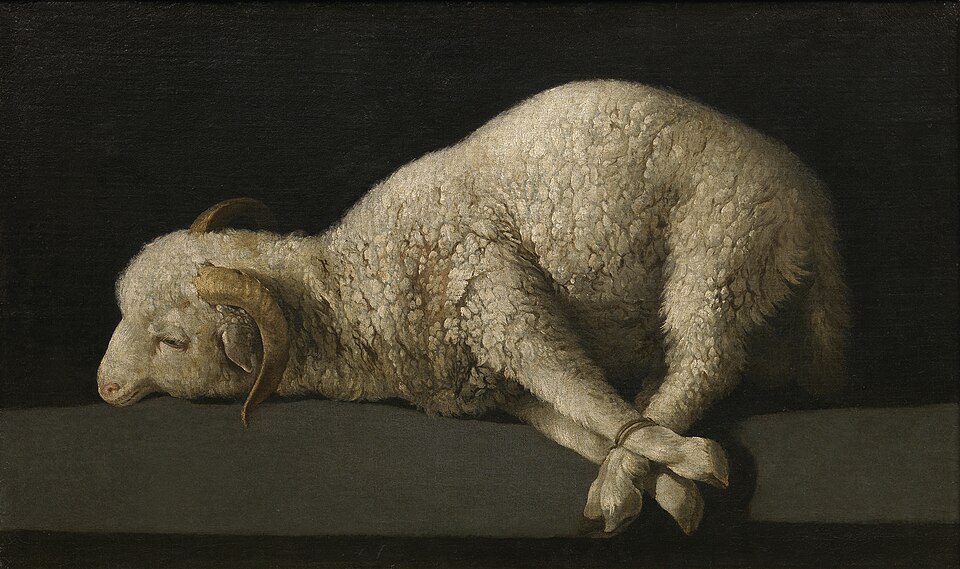
Girard recounted that while writing the last page of Deceit, Desire and the Novel, on the final conversion of the heroes who renounce desire according to the other, he himself underwent, at the end of the 1950s, a conversion that brought him back to the Catholicism of his Avignon childhood. The biography does not explain the thesis, but it says where the author speaks from: Girard speaks as a believer. Elected to the Académie française in 2005, he remained admired by theologians, debated by anthropologists, and more or less ignored by the philosophers of the French university.
The discovery would have remained a thesis of literary criticism without its consequence. When the model is distant, like Amadis for Don Quixote, imitation is harmless. When the model is close, desiring the same object in the same world, he becomes a rival, the rival an obstacle, and the obstacle an even more fascinating model. Mimetic desire breeds rivalry, and rivalry too spreads by imitation: each imitates the other's violence, differences fade, and the whole community slides towards what Girard calls the mimetic crisis, a war of all against all in which nothing any longer distinguishes the adversaries. This is the hypothesis of his second book, Violence and the Sacred (1972), and it is there that Girard encounters religion.
How does a community get out of it? Girard answers with a hypothesis that nothing allows us to observe, but which he believes he can read in myths the world over. The violence of all against all, because it is mimetic, can suddenly turn into the violence of all against one. It is enough for an individual, singled out by some trait or other, an infirmity, a strangeness, a royal position, to draw the accusations upon himself; imitation does the rest, and the unanimous community turns against him and kills him. This collective murder has a miraculous effect: peace returns, since all the violence has been discharged onto a single victim. The community, which does not understand what has happened, attributes the return of peace to the victim itself. The victim was guilty, since it was killed; it is beneficent, since its death saved everyone. It becomes sacred, that is, at once accursed and divine. Girard sums up the thesis in a sentence that has become famous, which makes violence the true heart and secret soul of the sacred.
All archaic religion proceeds, according to Girard, from this victimage mechanism. Myth is the story of the lynching told from the point of view of the lynchers, who do not know that they have killed an innocent: the god in it is always guilty of something, of incest like Oedipus, of a fault like the Pharmakos. Rite is the controlled repetition of the founding murder, on a substitute victim, human or animal, so as to reproduce its pacifying effects: this is sacrifice. Prohibitions are the measures taken to prevent the return of the crisis, by separating what mimetic desire tends to confuse. The gods, finally, are deified victims. Girard here takes up all of Frazer's material, his sacrificed kings and his scapegoats, but he reverses its interpretation: where Frazer saw an error of reasoning, Girard sees a necessary misrecognition, without which the mechanism would not work. If the lynchers knew that their victim was innocent, peace would not return.
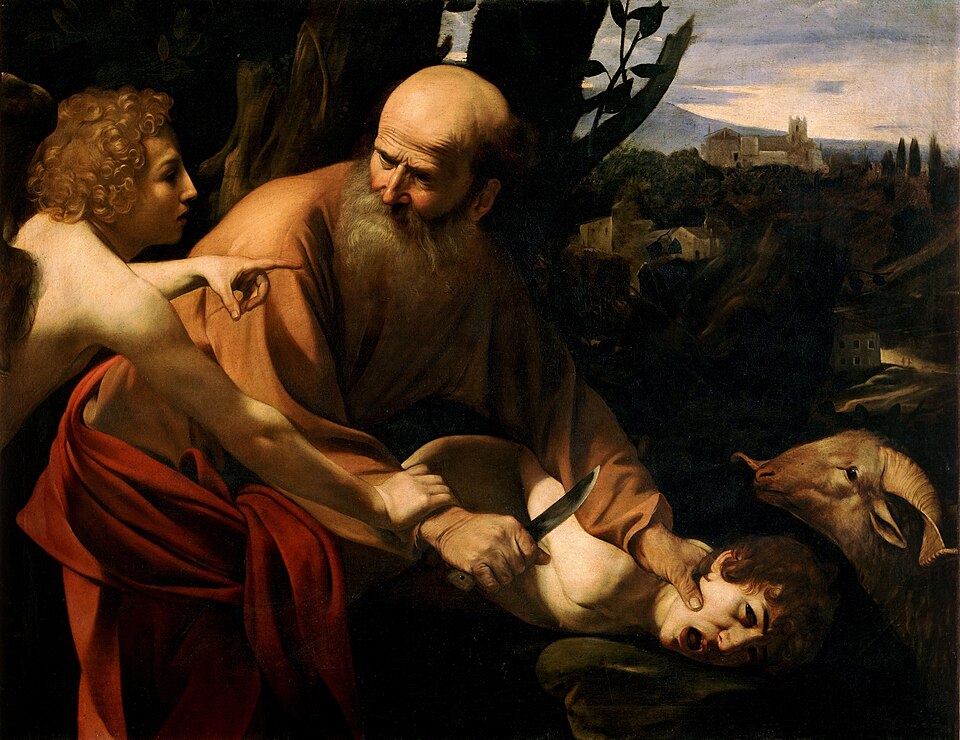
Girard builds his demonstration on Oedipus the King, which shows how he reads a myth. Thebes is ravaged by plague, the image of the crisis in which differences fade; the city looks for the culprit; Oedipus and Tiresias, then Oedipus and Creon, accuse each other in a series of symmetrical exchanges in which each becomes the double of the other. And the city at last finds its culprit, the lame stranger who became king, who has committed the two undifferentiating crimes par excellence, parricide and incest, the crimes that confuse generations and places. Oedipus is driven out, the plague ceases. For Girard, Sophocles' tragedy is half lucid: it shows the symmetry of the accusations and lets us suspect that Oedipus's guilt might be a collective verdict rather than a fact; but in the end it confirms it, and the myth it takes up never doubts it for a moment. The case of Oedipus throws light, by contrast, on that of Socrates, whom the trial for impiety likewise singles out to the unanimity of a city in crisis; and Plato, as we have seen, wrote the law that would have condemned him a second time. The comparison is constructed: the city of the philosophers was not safe from the mechanism it believed it had mastered.
Ten years later, The Scapegoat (1982) applies the same grid to texts that no one takes for myths. Girard starts from a poem by Guillaume de Machaut, which tells how, in the middle of the fourteenth century, the Jews were accused of poisoning the wells during the Black Death and were massacred. The modern reader does not hesitate for a second: the plague is real, the accusation false, the massacre real. From this Girard draws what he calls the “stereotypes of persecution”: a crisis that effaces differences, undifferentiating crimes imputed to the victims, signs that single them out, minorities, the infirm, foreigners, and the collective violence itself. If we know how to read these stereotypes in a medieval text, he asks, why not in myths, which display all of them? The strength of the argument is methodological: it does not ask us to invent an original murder; it asks us to treat myths as we treat chronicles of persecution, by taking the side of the victim. The last great book, I See Satan Fall Like Lightning (1999), gives this reversal its biblical name: Satan, in the Gospels, is the accuser, the principle of mimetic desire and of the unanimous crowd, and his fall is the end of his power to accuse without being unmasked.
One can see why Girard matters to this essay. The criterion I have proposed says that a religion is refounded when an absolute is installed in whose name the sacrifice of the individual can be demanded. Girard says more: religion is born of the sacrifice of an individual to the unanimity of the group. What the essay described as a symptom of refoundation would be the birth certificate of every religion. If the sacred is collective violence transfigured, then each time an exit from religion singles out a victim, Plato's impious man, the citizen who violates Rousseau's civil religion, the class enemy, the traitor to the Nation, it reproduces the founding gesture and refounds, literally, a religion. Dostoevsky's Grand Inquisitor is not only a parable of power; he is, in Girardian terms, the priest who manages the victimage mechanism and who protects the crowd from the truth.
But Girard also reverses the thesis, and it is there that he becomes truly original. There are, according to him, texts that tell the lynching from the point of view of the victim, and that proclaim its innocence: those of the Bible. Joseph, sold by his brothers, is innocent; Job, accused by his friends, is innocent; Isaiah's suffering servant is innocent; the Psalms give voice to the man whom the crowd assails. The Gospels complete this unveiling: the Passion is a unanimous lynching, in which even the disciples fail, but it is told by those who know that the victim is innocent, and who proclaim it. Christianity, for Girard, is therefore not one more sacrificial religion; it is the revelation of the sacrificial mechanism, the revelation of “things hidden since the foundation of the world” (Mt 13, 35), which give their title to the book of 1978, written in dialogue with two psychiatrists, Jean-Michel Oughourlian and Guy Lefort. This revelation has a historical consequence: once unveiled, the mechanism no longer works, since it required misrecognition. The societies that have received the Gospels can no longer reconcile themselves at the expense of a victim without knowing, at least dimly, that they are committing an injustice. Hence the modern concern for victims, which Girard regards as the deepest legacy of Christianity, and hence also, for want of a regulating mechanism, the rise of a violence that nothing any longer contains, the theme of his last book, Battling to the End (2007).
For a long time Girard refused to call the Passion a sacrifice, precisely because it unveiled sacrifice; at the end of a long exchange with the Jesuit theologian Raymund Schwager, he finally accepted the word in a new sense, that of the gift of self that refuses violence instead of undergoing it. This dispute over vocabulary is not secondary: it means that Christianity, for Girard, is at once the exit from sacrificial religion and a religion, which is the very thesis of Marcel Gauchet, whom we shall read in the part on secularization: Christianity as the religion of the exit from religion. The comparison is constructed, for the paths differ, Gauchet starting from political history and Girard from the anthropology of desire; yet the two bodies of thought share the same weakness, which is to make Christianity the end point of the religious history of humanity.
Girard responded, in attested fashion, to several authors in this essay. Against Freud, he takes up in Violence and the Sacred the hypothesis of Totem und Tabu (1912-1913), the original murder of the father by the horde of sons, and he pays tribute to him for having glimpsed the founding murder; but he reproaches him for having tied it to sexual desire and to the father, instead of to mimetic rivalry and to the arbitrary victim. Against Durkheim, he accepts that the sacred is social, but he refuses the idea that society worships itself in it: what the community worships is its own violence transfigured, and the reverse side of Durkheimian unanimity is a corpse. It is against Nietzsche that his response goes furthest. Nietzsche had ended Ecce homo with the formula “Dionysos gegen den Gekreuzigten”, Dionysus against the Crucified. Girard takes up the formula as the title of an essay and agrees with Nietzsche on the diagnosis: the difference between Dionysus and Christ does not lie in the story, for both die under the blows of a crowd; it lies in the point of view, since the Dionysian myth takes the side of the lynchers and the Gospel that of the victim. Nietzsche saw this better than the theologians, and he chose Dionysus, that is to say the crowd. From this Girard draws a grave charge against Nietzsche: the will to power that despises compassion for the weak is the return, in philosophy, of the persecutors' point of view.
There remain the objections of the anthropologists. The first concerns method: a founding mechanism that leaves traces only in the myths that conceal it is, by construction, unverifiable, and any absence of a victim in a myth can be read as further proof of concealment. The second concerns universality: many societies practise sacrifice as an exchange, a gift, a meal shared with the gods, without the lynching scene being found in it, and field ethnologists have often reproached Girard for treating the ethnographic material as Frazer did, by selective comparisons. The third concerns closure: a theory that makes its own religion the key to all the others lays itself open to the suspicion of having been constructed to lead there. These objections are strong, and Girard has not, I believe, entirely answered them.
In this immense construction two storeys must be separated, one of which carries my conviction and the other not. The first is anthropological: mimetic desire, the crisis, the singling out of a scapegoat, the misrecognition that allows the crowd to believe itself innocent. It is a hypothesis, unverifiable in its originary version, but of considerable descriptive power, and the history of the twentieth century, with its designated victims and its unanimous crowds, has given it terrible confirmations. It gives the criterion of this essay an anthropological foundation. The second storey is apologetic: the Bible and the Gospels would be the only revelation of this mechanism, and Christianity the only way out. It seems to me much more fragile. It neglects the other traditions that have thought the innocence of the victim or refused sacrifice, Greek tragedy itself, which sometimes lets the victim's lament be heard, or the refusal of blood sacrifice among the prophets, which Girard indeed ties to the Bible, but also the wisdoms of India or China, which he hardly examines. And it makes historical Christianity, which had its stakes and its Inquisitors, the vehicle of a revelation it has betrayed so often that Dostoevsky could imagine Christ condemned a second time by his Church. Girard replies that the Church betrayed the Gospels, and that betrayal presupposes revelation. So be it. But then the exit from sacrifice no longer belongs to a religion: it belongs to anyone who refuses to join the crowd, believer or not. I shall draw the consequence of this in the conclusion, against Girard's apologetics and with his anthropology.
Portrait: Vicq, Public domain
Becker1924-1974religion as heroism against death
Background: The psychology and psychoanalysis of religion: from James to experimental psychology · Oedipus: the oracle, the Sphinx, the plague of Thebes · Ernest Becker: the denial of death, the heroic system, the escape from evil
Ernest Becker was neither a theologian nor a professional philosopher, but an American cultural anthropologist who had spent his career on the margins of the university, dismissed or barely tolerated from one post to the next. The Denial of Death appeared in 1973; Becker died of cancer in March 1974, and the book received the Pulitzer Prize for general non-fiction two months later. This chronology made the book's legend: written by a man who knew he was dying and who drew from it a theory of the whole of culture. But the legend must not hide the thesis, which gives our question an answer that neither Feuerbach nor Freud had formulated in this form.
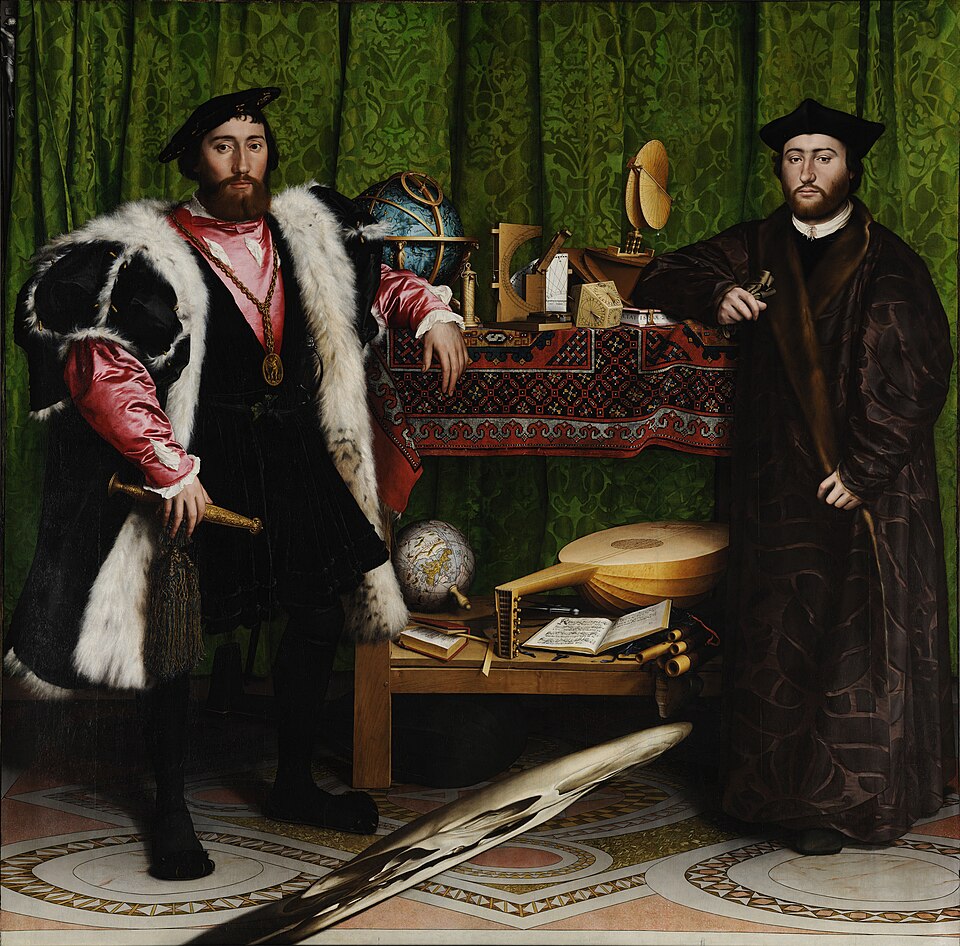
The thesis can be put in a few words, and I paraphrase it for want of having consulted the original text: the idea of death, and the terror it inspires, haunt the human animal more than anything else, and they are the mainspring of its activity. Man is the only animal that knows it will die; Bergson had written as much in 1932 in almost identical terms, “Les animaux ne savent pas qu'ils doivent mourir”, animals do not know that they must die, and he already drew from it a function of religion, “une réaction défensive de la nature contre la représentation, par l'intelligence, de l'inévitabilité de la mort”, a defensive reaction of nature against the representation, by the intelligence, of the inevitability of death. Becker does not cite Bergson, and the encounter is my doing; but it shows that the intuition is not peculiar to American psychology. Becker adds to it an anthropology of the hero. Man is a living contradiction: a mind capable of representing the infinite, housed in a body that decays. Unable to look this contradiction in the face, he covers it over with what Becker calls a causa sui project, the effort to be one's own cause, and with heroism, that is, the conviction of having a worth that outlasts death. Every culture is then a hero system: a set of roles, stories and rites that allows each person to believe himself important beyond his own disappearance.
Religion is, for Becker, the vastest of these systems, and his position is not a simple reduction. Becker starts from Freud, but he corrects him through Otto Rank, the former disciple whom Freud had rejected, and through Kierkegaard. From Rank he retains that the fear of death is more fundamental than sexuality, and that the Oedipus complex itself is a causa sui project, the child's desire to become his own father. From Kierkegaard he retains the analysis of anxiety as the dizziness of freedom before nothingness, and the conclusion that the only honest way out is faith, which acknowledges dependence instead of denying it. The book's last chapter is ambiguous: Becker judges there that religion in the Kierkegaardian sense, the faith that accepts creatureliness, is the highest heroism, because it alone does not lie about the human condition. He is no apologist; he says only that, if one must choose a vital lie, the one that admits itself as such is better than those that do not know themselves. This is Pascal's position, which Becker arrives at without having sought it: Pascalian divertissement is the mechanism of denial he describes, “les hommes n'ayant pu guérir la mort, la misère, l'ignorance, ils se sont avisés, pour se rendre heureux, de n'y point penser”, men, having been unable to cure death, wretchedness and ignorance, have taken it into their heads, in order to be happy, not to think about them.
The posthumous book Escape from Evil (1975) draws from this anthropology a consequence that bears directly on the criterion. People who live by hero systems cannot bear others to contest them, for contestation reopens the question the system was meant to close. Social evil then arises from the denial of death: others are sacrificed to prove to oneself that one will not die, enemies are designated so that one's own symbolic immortality remains uncontested. This is a theory of sacrifice, which meets Girard's by another path: the two men did not read each other, as far as I know, and the comparison is constructed. For the one, sacrifice protects the individual against death; for the other, it protects the community against its own violence. In both cases, religion is inseparable from a victim.
Experimental psychology has sought to put this thesis to the test. From 1986 onwards Jeff Greenberg, Sheldon Solomon and Tom Pyszczynski drew from it a terror management theory: worldviews and self-esteem would serve as a buffer against death anxiety, and being reminded of death (mortality salience) should strengthen attachment to one's worldview and hostility towards those who contest it. In the founding experiment, in 1989, judges first invited to think about their own death set heavier bonds for a prostitute: “judges recommended especially harsh bonds for a prostitute when mortality was made salient” (A. Rosenblatt et al., Journal of Personality and Social Psychology 57, 1989, p. 681-690, abstract). But a large coordinated replication, Many Labs 4 (R. Klein et al., Collabra: Psychology 8, 2022), dealing with another classic experiment of the theory (Greenberg et al., 1994), did not find the effect, across seventeen laboratories and 1,550 participants. The theory is not thereby refuted, but one of its most cited effects is wavering, and it can no longer be taken as established.
Becker first gives a precise answer to the question “why do people believe?”: because we die, and we know it. Then a consequence that meets the thesis of this essay: if every culture is a hero system against death, then the exits from religion that install a new absolute, History, the Nation, Race, Civilization, are not accidents; they are replacement hero systems, which promise symbolic immortality to those who serve them and refuse it to those who contest them. The sacrifice criterion here receives a psychological explanation. But Becker leaves open a question he does not resolve: can one live without a vital lie? Lucretius answered yes, provided one understands that death is nothing to us; Becker does not believe so, and this is what leads him back to Kierkegaard. I believe he is wrong on this point, or rather that he confuses two things: the need for meaning, which is universal, and the need for immortality, which perhaps is not. The spiritualities of exercise, from Spinoza to Hadot, do not deny death; they seek to look at it without lying to themselves. They are precisely what Becker's theory holds to be impossible, and that is why they remain, in this essay, the case that puts this theory to the test.
Berger and Luckmann1929-2017; 1927-2016the sacred canopy and invisible religion
Background: The sociology of religion: from Comte to secularization theory · Berger and Luckmann: the social construction of reality and the sociology of religion · Danièle Hervieu-Léger: religion as memory, the pilgrim and the convert
Peter L. Berger and Thomas Luckmann first wrote together a book that changed sociology, The Social Construction of Reality (1966). What we take for reality appears in it as the product of a three-stage process: human beings externalize their activity in institutions, these institutions are objectivated and take on the appearance of a nature, and they are then internalized by each person as self-evident. The following year, in 1967, each published a book on religion on his own, and the two books say different things, almost opposite things, which still structure the sociology of religion.
The Sacred Canopy (La Religion dans la conscience moderne, in the title of its French translation) applies the theory of social construction to religion. Every society, Berger says, is an enterprise of world-building, and this world, which he calls by a Greek word, nomos, is an order of meanings that shields human beings from chaos. The individual torn from this nomos, by bereavement, exile or catastrophe, loses his bearings in experience and becomes, in a phrase Tim Knepper picks out, “anomic in the sense of becoming world-less”. Religion is the most ambitious form of this protection. It is not content to order society; it installs this order in the cosmos, and so makes it untouchable: the sacred canopy is the roof of meanings that each society stretches over its world. Religion makes people forget that the nomos was built; it presents it as existing since the beginning of time. This is Feuerbach's alienation, translated into sociology: man forgets that he is the author of his world, and receives it as a gift of the gods.
The chapter on theodicy is the most profound in the book. Every religion must account for suffering and death, which threaten the nomos at its most fragile point. Berger draws from this a thesis that overturns the Marxist critique. It is usually believed that religion consoles by promising happiness; Berger writes, on the contrary: “It is not happiness that theodicy primarily provides, but meaning”. Human beings can bear suffering, not its meaninglessness. One recognizes Nietzsche's sentence on the meaninglessness of suffering; Berger does not quote it, and the comparison is constructed. The consequence is clear: if religion provides meaning rather than happiness, it cannot be replaced by material progress, and the hope of the Enlightenment, which thought that religion would disappear along with poverty, rests on a misunderstanding.
Yet in 1967 Berger drew a prediction of secularization from his book. The canopy holds by what he calls plausibility structures: a religion is believed only if one's surroundings take it as self-evident. But modernity is pluralist; it brings everyone face to face with other beliefs, and pluralism undermines plausibility. A belief chosen among others no longer has the self-evidence of a world; it becomes a preference. Berger concluded that religion would decline; thirty years later, he publicly retracted. In the essay that opens The Desecularization of the World (1999), a volume he edited, he writes that the idea that we live in a secularized world is false: “The world today[…] is as furiously religious as it ever was, and in some places more so than ever”. Berger himself makes one exception, that of an “international subculture composed of people with Western-type higher education, especially in the humanities and social sciences”. The rise of militant Islam and of worldwide Pentecostalism seemed to him to refute the theory he had himself helped to establish. He later specified, in his last books, that modernity produces pluralism rather than secularization. The correction matters: Berger is right against the prophecy that religion would disappear, but he does not say that religion has remained the same. It has become a choice, and a choice does not have the same authority as a world.
Luckmann, the same year, had proposed another reading, subtler and closer to our spiritualities without God. The Invisible Religion (1967, a revised version of a German book of 1963) starts from a very broad definition of religion: religious is everything by which the human organism transcends its biological nature and gives itself a world of meaning. In this sense, no society is without religion, and the question of secularization is wrongly posed. What has changed, according to Luckmann, is not the presence of religion but its location. The Churches have lost their monopoly, and religion has moved into the private sphere, where each person composes his own system of ultimate meanings around new themes: self-expression, self-realization, autonomy, family and emotional life. This religion is invisible because it no longer passes through institutions that a sociologist could count; privatized, it has not disappeared.
Luckmann's contribution is to show that the “spiritual but not religious” of Part Twelve is not a contemporary curiosity but the modern form of an anthropological function: self-realization is the sacred of individualist society. The danger of his definition is that if everything that gives meaning is religion, the question of our essay becomes empty: one never leaves religion, since even the exit is one. This definition has the weakness of Durkheim's without its strength: a definition that encompasses everything no longer allows anything to be distinguished. Luckmann's private sacred, self-realization, does not ordinarily demand anyone's sacrifice; it can do so, when self-realization becomes a limitless imperative, but it does not do so by nature. Berger and Luckmann, read together, therefore give our question its two sociological terms: religion as a shelter of meaning, which does not disappear, and religion as an institution, which can recede. The exit from religion, in the sense of this essay, concerns the second; the need of which the first speaks does not condemn it in advance.
Hervieu-Légerb. 1947religion as memory, believing without a lineage
Background: The sociology of religion: from Comte to secularization theory · Berger and Luckmann: the social construction of reality and the sociology of religion · Danièle Hervieu-Léger: religion as memory, the pilgrim and the convert · Contemporary spiritualities: New Age, meditation, spiritual but not religious · Vatican II, the secularization of Europe and the return of the religious
Danièle Hervieu-Léger, a sociologist of religion and director of studies at the École des hautes études en sciences sociales, proposed in 1993 a definition of religion that shifts the question of Durkheim and Luckmann. She defines religion neither by its content, God or the supernatural, nor by its function, meaning or social cohesion, but by a particular mode of believing. In La Religion pour mémoire, she calls it “un dispositif idéologique, pratique et symbolique par lequel est constituée, entretenue, développée et contrôlée la conscience (individuelle et collective) de l'appartenance à une lignée croyante” (p. 119), an ideological, practical and symbolic apparatus by which the consciousness (individual and collective) of belonging to a believing lineage is constituted, maintained, developed and controlled. Everything hangs on the word lineage. To believe religiously is to believe in the name of a chain, invoking the authority of a tradition that goes back to founding witnesses and that one takes on the task of transmitting. What distinguishes a religion from a philosophy or a morality is not its object; it is this authority of memory.
The definition makes it possible to say what is happening to European societies without speaking either of disappearance or of return. Modernity, Hervieu-Léger explains, is structurally amnesiac: it values innovation, mobility, the present, and it undoes the chains of memory that transmitted belief. Believing does not disappear for all that; it comes loose from the lineage. People still believe, and a great deal, but without invoking the authority of a tradition, composing their belief from borrowed fragments. This is what she calls, in Le Pèlerin et le converti. La religion en mouvement (1999), a deregulation of believing. She draws from it two typical figures of contemporary religiosity. The pilgrim is the one who journeys on, who has experiences without stopping anywhere, who judges a belief by what it gives him and leaves it when it gives him nothing more. The convert is his apparent opposite: the one who chooses a strong belonging, often after a crisis, and who finds in a demanding community the identity that society no longer gives him. These two figures are the two faces of a single world: both choose, and it is this choice that makes them modern, even when the convert chooses the most rigid tradition.
These two figures replace a third. The religion of traditional societies had as its central figure the practitioner, the one who regularly performs the gestures prescribed by an institution, in a parish where he was born and where he will die. This figure has not disappeared, but it has ceased to be the norm, and Hervieu-Léger described its decline in France in Catholicisme, la fin d'un monde (2003), where she shows that the Catholic Church has lost not only adherents but the capacity to organize the common culture. What fades with the practitioner is religion as shared self-evidence, what Berger called the canopy. What replaces it is not unbelief but a religiosity of trajectory, judged by the authenticity of experience rather than by conformity to a rule. One recognizes here, transposed into sociology, the distinction the essay draws from Foucault and Hadot between religion as obedience and spirituality as exercise, except that the sociologist does not judge. It is the convert who touches on the criterion. He seeks a lineage because he did not receive one, and he is all the more demanding for having chosen it: it is in him that chosen religion can become once more a religion that demands sacrifices, and the recent religious radicalizations in Europe have shown this in a way the sociologist had anticipated without foreseeing its violence.
This analysis converges with that of the British sociologist Grace Davie, who had described post-war Britain as a society of believing without belonging, and with that of Marcel Gauchet, whom Part Eleven will examine. But Hervieu-Léger is more precise than Gauchet on one point. She does not say that structuring religion has disappeared and that private beliefs remain; she says that the need for a lineage survives the disappearance of lineages, and that it seeks substitutes. Hence the importance she gives to secular forms of collective memory, national, political, familial, which can take on a religious colouring when they present themselves as the continuation of a sacred chain. Here, through sociology, we meet the question of refoundations again. Barrès's Nation, the militants' Revolution, the Civilization that Onfray defends in Décadence, are substitute believing lineages: they authorize belief through fidelity to ancestors, and they can demand, like religions, that something be sacrificed to them.
This definition is useful because it distinguishes what the others conflate. The need for meaning, described by Berger and Becker, can be satisfied by a philosophy; the need for connection, described by Durkheim, by an association; but the need for a lineage, for an authority that precedes us and that we transmit, is specifically religious, in Hervieu-Léger's sense. And it is this need that the spiritualities without God of Part Twelve find hardest to satisfy. Hadot could invoke the lineage of the ancient schools, and that is his strength; Comte-Sponville invokes Spinoza and Epicurus, but by a personal choice, not by a transmission. The modern pilgrim has no lineage; he has a library. Is this a loss? Hervieu-Léger, as a sociologist, is right not to say. For our question, the answer is clear: a spirituality without a lineage escapes the risk of refoundation, since it has no ancestors in whose name to demand a sacrifice; it pays for this freedom with a fragility, since it is not transmitted. That is perhaps the price of every exit that does not refound.
Boyer: why gods are easy to think
Background: The cognitive science of religion: why gods are easy to think · Tylor and Frazer: animism, survivals, The Golden Bough · Pascal Boyer: religion explained by cognition · The new atheists: Dawkins, Harris, Dennett, Hitchens · Quantum mysticism, synchronicity and the law of attraction
Pascal Boyer, a French anthropologist trained in Paris and Cambridge, who teaches at Washington University in St. Louis, published in 2001 Religion Explained, which became the manifesto of a field of research born in the 1990s: the cognitive science of religion. His question is not that of our nineteenth-century authors. He does not ask whether religion is true, nor what it is for, nor what desire it satisfies; he asks why certain religious ideas are so easy to acquire, to remember and to transmit, while others, just as conceivable, never appear. And his answer shifts the whole debate: religion rests neither on a special faculty nor on a special need, but on the ordinary functioning of the human mind.
The argument starts from inference systems. The human mind is neither a blank slate nor a general reasoner; it has specialized devices, shaped by evolution to deal with distinct domains: physical objects, living beings, persons and their intentions, social relations, contamination and danger. They work without our knowing it, which is why their products seem obvious to us. Religious concepts, Boyer shows, are concepts that violate on one precise point the expectations of one of these categories while respecting all the others: a spirit that has no body but sees, hears and remembers; a statue that listens to prayers; a dead ancestor who gets angry. These minimally counterintuitive concepts are better remembered than ordinary concepts, because they surprise, and better than concepts that are too bizarre, because they remain usable: one can reason about a jealous god, one cannot reason about a god who would be at once everything and nothing. Religion is neither a stroke of genius nor an aberration, but a by-product of mental devices that serve other purposes.
The subtlest point of the theory concerns the gods themselves. Why are supernatural beings almost always persons, who see, will and judge? Because the human mind is first of all a social mind, which spends its time wondering what others know about it and what they are going to do. Gods, for Boyer, are agents who have access to all strategic information: they know what we have done, what we have hidden, what others think of us. This is what makes them relevant to morality and social life, and it explains why one does not pray to a god to reveal the structure of the atom, but to see our distress or punish our enemy. The psychologist Justin Barrett added to this theory a device he calls the hyperactive agent detection device: our ancestors had an advantage in seeing a predator behind every rustle of leaves, even at the cost of being often wrong, rather than missing the one that was real, and we have inherited this tendency to detect agents where there is only chance. The idea goes back to the anthropologist Stewart Guthrie's book on faces in the clouds (1993), and its ancestry is older than its authors say, since Hume had formulated it in 1757: “We find human faces in the moon, armies in the clouds”, and by a natural propensity we ascribe malice or good will to everything that hurts or pleases us.
This theory explains very well what our authors explained badly: why religion is universal, why it takes similar forms everywhere, why it resists arguments so well. It also answers, in its own way, the question of Bergson, who held religion to be “coextensive à notre espèce”, coextensive with our species, and concluded that it “doit tenir à notre structure”, must be bound up with our structure: Boyer gives this structure a precise content, which Bergson could not have known. Finally, it contains a consequence that Boyer formulates, according to Anthony Campbell, with a certain relish: “science is every bit as 'unnatural' to the human mind as religion is 'natural'”. The Enlightenment's faith in the spontaneous disappearance of religion was therefore doubly naive: it misjudged the ease of belief and the difficulty of science.
But the theory is often credited with more than it claims. First, explaining why a belief is easy to acquire says nothing about its truth. This is what philosophy calls the genetic fallacy, and it works both ways: that our devices incline us to see agents everywhere does not prove that there are none, just as our natural aptitude for counting does not prove that numbers do not exist. Daniel Dennett, who popularized this research in Breaking the Spell (2006), sometimes forgets this; Boyer is more cautious. Feuerbach, on this point, was more lucid than his naturalist successors: he did not claim that religion was false because it came from man; he said that it told the truth about man. Next, the theory explains religious representations, spirits, gods, rites, but it poorly explains what interests our essay most: the experience of the mystics, spiritual exercise, conversion. The reviewer Joseph Bulbulia, in the Australian journal Eras, reproached it for this reason with a misleading title: religion is not a single cognitive dimension, and only some of its aspects are explained. Finally, and this is the most important point for us, the theory says why gods are easy to think, not why we need them. Boyer in fact rejects the notion of a religious need: there is, in his view, no need for God, but a disposition to conceive him when a culture offers him. This is the lasting contribution of the cognitive sciences to our question. They do not refute religion; they refute the idea that there exists in man an empty place, of exactly the shape of God, which the exit from religion would leave gaping.
 Norris and Inglehartexistential security, the empirical arbiter
Background: Lucretius and the De rerum natura: nature explained against religion · Why Christianity prevailed: the historians' explanations · The philosophy of Hume: empiricism, causation, miracles, the natural history of religion · Weber's sociology: ideal types, rationalization, charisma, value neutrality · Norris and Inglehart: existential security, the World Values Surveys
All the preceding authors make hypotheses about the causes of belief; two political scientists set out to measure them. Pippa Norris, of Harvard University, and Ronald Inglehart (1934-2021), of the University of Michigan, founder of the great international survey of values, the World Values Survey, published in 2004 Sacred and Secular. Religion and Politics Worldwide (Cambridge University Press, second edition 2011). The book draws on surveys conducted in nearly eighty societies and proposes to revise the classical theory of secularization rather than abandon it, as Berger had done in 1999.
The thesis comes down to one notion, existential security. Religiosity depends, in their view, neither on the religious supply, as economists of religion maintain, nor on the progress of scientific knowledge, as the Enlightenment believed, but on the degree of vulnerability in which people live. Where the death of a child, famine, untreated illness, old age without resources, violence without recourse are daily threats, religion remains strong, because it provides insurance against what cannot be mastered. Where the welfare state, medicine and prosperity have made existence predictable, religiosity recedes from one generation to the next, without anyone having been convinced by an argument. The most secularized societies in the world are the most egalitarian and best protected, the Scandinavian countries; the most religious are the poorest and most exposed. And the case of the United States, long invoked against the theory of secularization, confirms it in their view: it is the most unequal and least protected of rich societies, and it is also the most religious.
The thesis has a second half, less often cited, which forbids reading it as a prophecy of the end of religions. Religious societies have more children than secularized societies. The result is a demographic paradox: rich societies are becoming secularized, but the share of the world's population living in religious societies is growing, so that the world, taken as a whole, is not becoming less religious. Berger, who saw the world as “furiously religious”, and the theorists of secularization, who saw Europe emptying, were therefore both right, each about one half of the world.
In Religion's Sudden Decline. What's Causing It, and What Comes Next? (Oxford University Press, 2021), published in the year of his death, Inglehart notes that the decline of religiosity accelerates from the end of the 2000s, the United States included. He explains it by the same security: religious norms favouring high fertility, indispensable when infant mortality was high, have lost their usefulness, and the religions that presented them as absolutes have been weakened by this.
This work has real limits. First, these are opinion surveys: they measure what people declare, the importance of God in their lives, the frequency of their prayer, not what they experience. Next, the correlation is very strong between countries but much weaker between individuals within the same country, and the authors had to respond on this point in their second edition: the poorest in a rich society are not always the most religious. Finally, the notion of religion they measure is Durkheim's more than James's: it captures practice and adherence, it poorly captures the diffuse spirituality that Luckmann and Hervieu-Léger describe. A society where no one goes to church any more but where everyone meditates could appear, in these surveys, perfectly secularized.
These limits do not take away from Norris and Inglehart their role as arbiters: their data decide between the explanations of belief. They prove Lucretius and Hume, Freud and Becker right, who derived religion from fear and distress: when distress recedes, religion recedes. They prove the Enlightenment wrong, which expected the exit from religion from the progress of ideas: it is not critique that secularizes, it is health insurance. But they also raise an uncomfortable question: if the exit from religion is the effect of security, it is not an act of freedom; a protected society no longer needs heaven, but it remains exposed to the return of insecurity, and the history of the twentieth century shows that substitute religions thrive precisely in crises.
Norris and Inglehart's thesis is opposed to another sociological explanation, from the United States. The so-called religious market school, associated with the names of Rodney Stark, Roger Finke and Laurence Iannaccone, explained American religious vitality by competition between Churches: where the state protects no denomination, the Churches must attract their faithful, and supply stimulates demand; where a state Church enjoys a monopoly, as in Scandinavia, it falls asleep and its faithful leave it. Norris and Inglehart reply that religious demand is not constant, as this theory supposes, but varies with security. The disagreement bears on our very question: is there a stable religious need, which supply alone causes to vary, or a disposition whose intensity depends on living conditions? The data argue rather for the second answer. The American sociologist Phil Zuckerman, in Society without God (2008), carried out fieldwork in Denmark and Sweden, among populations largely detached from any belief, and found there societies that seem to suffer from no lack that could be attributed to the absence of religion. This is, as we shall see, the strongest argument against the thesis of need.
Portrait: Topjur01, CC BY-SA 4.0
Why do people believe? A constructed debate
Background: The cognitive science of religion: why gods are easy to think · Durkheim's sociology: the social fact, anomie, the Elementary Forms · Bergson's philosophy: duration, intuition, the élan vital, the Two Sources · Norris and Inglehart: existential security, the World Values Surveys · Narcissus and Echo: the reflection, the voice, narcissism
The answers gathered so far do not overlap, and they must now be brought to meet. None of the authors called upon had read all the others: most of these encounters are constructed confrontations, and I point out those that are attested. The question is simple to state and hard to settle: why have nearly all known human societies had gods, spirits, rites and sacred stories? I distinguish four families of answers, which appeared in a roughly chronological order: fear and desire, meaning, society, cognition.
The oldest answer is fear, from Lucretius and Hume to Freud, and then to Becker, who traces it back to its root: the fear of death, which man alone knows. Among these four authors, two lines of descent are attested: Hume discusses Lucretius in the Natural History of Religion (sections 5 and 12), and Becker starts explicitly from Freud; for the others, the kinship is my own doing. What unites them is a strong thesis: religion answers a threat, and would disappear with it.
Feuerbach gave this first answer a deeper version, because he speaks not only of fear but of desire. In his Heidelberg lectures, he grants that the thesis may seem paradoxical, the thesis that derives religion from human desires, and even holds the deity to be “als eins mit dem Wunsche”, one and the same thing as desire. He defines desire precisely: “Der Wunsch ist das Verlangen, daß Etwas sei, was nicht ist”, desire is the demand that something be which is not. And he draws from it the consequence that matters most to this essay. If the god owes his existence solely to the human drive for happiness, the Glückseligkeitstrieb, and if religion satisfies this drive only in imagination, then, Feuerbach writes, it necessarily follows “daß der Mensch auf andere Weise als religiöse, durch andere Mittel als religiöse diesen Trieb zu befriedigen sucht”, that man seeks to satisfy this drive in a way other than religious, by means other than religious. The sentence holds in germ the whole question of this essay: the need survives religion, and it looks for other objects. Feuerbach believed these objects would be nature, politics, the love of human beings; we know they can also be History, the Nation or the Race.
Marx shifted this first answer without leaving it. Religion, for him, is not only a fear or a desire, it is the lament of a real condition, the sigh of the oppressed creature (Part Six). The response to Feuerbach is attested: if religion is born of real distress, one does not dissolve it by explaining its psychological mechanism, one dissolves it by abolishing the distress. Norris and Inglehart, a hundred and sixty years later, gave this intuition a confirmation Marx would not have disowned, but which changes its meaning: it was not revolution that secularized Northern Europe, it was the welfare state.
The second family no longer speaks of fear but of meaning. Nietzsche formulated it at the end of the third essay of On the Genealogy of Morality. Man, he writes, does not deny suffering, he even seeks it out, provided he is shown its meaning: “Die Sinnlosigkeit des Leidens, nicht das Leiden, war der Fluch, der bisher über der Menschheit ausgebreitet lag”, the meaninglessness of suffering, not suffering itself, was the curse that until now lay spread over humanity. The ascetic ideal was accepted because it gave a meaning, any meaning at all: “irgendein Sinn ist besser als gar kein Sinn”, some meaning or other is better than no meaning at all; and man, Nietzsche concludes, would rather will nothingness than not will (Part Seven). Berger rediscovers this thesis as a sociologist in his theory of theodicy, Becker as a psychologist when he makes culture a hero system. The difference from the first family lies in the consequences. If religion answered only to fear, it would recede with security; if it answers the need for meaning, security is not enough, and a protected society can be a desperate one. According to Nietzsche, European nihilism was born not of poverty but of comfort.
The third family is sociological, and its chief representative is Durkheim: religion is neither a fear nor an individual search for meaning, it is the figurative form in which a society represents its own strength to itself. Bergson gave this thesis a biological version in The Two Sources: static religion was born of a “fonction fabulatrice”, a fabulating function, which nature placed in intelligence to keep it from dissolving social cohesion. Bergson's response to Durkheim is attested: he accepts the existence of collective representations, but refuses to see in them the essential, which he locates in the dynamic religion of the mystics. Berger, Luckmann and Hervieu-Léger extend this family into the twentieth century: religion provides a world, an identity, a lineage. Girard, finally, gives it its darkest version: society does not merely represent its strength to itself in the sacred, it protects itself there from its own violence by designating a victim; the question of whether one can leave religion without founding another then becomes the question of whether people can live together without a scapegoat.
The fourth family is the most recent, and it partly dissolves the question. For Boyer and the cognitive sciences, there is no religious need, only mental mechanisms shaped by evolution for other tasks. People do not believe because they are afraid, nor because they seek a meaning, nor because society demands it; they believe because gods are concepts that suit the way our mind works, and the other reasons, fear, meaning, society, merely select, among these easy concepts, the ones that will survive. This answer has two great merits: it explains the universality of religion without assuming some mysterious faculty in man, and it explains why arguments have almost no hold on it: one does not refute an inclination. Its limit, as I have said, is that it explains beliefs, not exercises; gods, not mystics.
These families did not merely follow one another, they clashed, and one attested exchange shows what is at stake better than any classification. In 1927, Romain Rolland responded to The Future of an Illusion by reproaching Freud for having explained the religion of the crowds without saying anything about its true source, a feeling of eternity, of the unbounded, of union with the whole, which he called oceanic; Freud answered him in 1930, in the first chapter of Civilization and Its Discontents, that he could not find this feeling in himself, and traced it back to the narcissism of the infant, while maintaining that the source of the religious need is infantile helplessness. The exchange sets the first family, that of fear and desire, against what the second would become in James and Bergson: a positive experience, which answers no threat and which no security makes disappear. Freud won the debate on instituted religions, which existential security makes recede as he predicted. Rolland perhaps won it on experience, since the most secure societies are also those in which the spiritual quests without a Church that Luckmann and Hervieu-Léger describe are multiplying. Both are right, because they are not talking about the same thing.
We must then return to the word need. A need, in the strict sense, is that whose deprivation causes harm: we need to eat, to sleep, to be loved. If religion were a need in this sense, the societies that have detached themselves from it ought to suffer for it in some visible way. Yet the Scandinavian societies, which Norris and Inglehart rank among the most secularized in the world and which Phil Zuckerman has observed at close quarters, show none of the symptoms one would expect of a lack: they are among the most trusting, the least violent and the most satisfied with their lot. The argument is not decisive: one could reply with Durkheim that they live on a secular sacred, equality, trust, the welfare state, which takes the place of religion; or with Nietzsche that their comfort is merely a nihilism unaware of itself. It is enough, however, to establish what seems to me the most solid conclusion of this debate: religion is not a need, in the sense of being irreplaceable; it is an answer, long the most readily available, to needs that can receive other answers.
One voice is still missing, that of a believer who had formulated as early as the seventeenth century the thesis this debate puts to the test. Pascal does not deny the mechanism that Lucretius, Hume and Becker describe; he described it himself. Diversion, he writes, comes from the fact that “tout le malheur des hommes vient d'une seule chose, qui est de ne savoir pas demeurer en repos, dans une chambre”, all the unhappiness of men comes from a single thing, which is not knowing how to stay quietly in a room; and the reason for this unhappiness is “le malheur naturel de notre condition faible et mortelle”, the natural unhappiness of our weak and mortal condition. But he draws from it the opposite conclusion to that of the explainers. Human dissatisfaction is for him not the cause of religion but its sign: it cries out, he says, that there was once in man a happiness of which there remains only “la marque et la trace toute vide”, the mark and the wholly empty trace, which he vainly tries to fill with everything around him, “parce que ce gouffre infini ne peut être rempli que par un objet infini et immuable, c'est-à-dire que par Dieu même”, because this infinite abyss can be filled only by an infinite and immutable object, that is to say, only by God himself. And he adds an observation that this essay confirms without sharing his conclusion: since man lost his true good, there is nothing in nature “qui n'ait été capable de lui en tenir la place”, that has not been capable of taking its place for him. The confrontation is constructed. Pascal and the refounders say the same thing, that the place of God does not remain empty; they interpret it in opposite directions. For Pascal, it proves that the place has the shape of God; for Feuerbach, it proves that God had the shape of human desire. Boyer, who denies that there is a place shaped like God, and Norris and Inglehart, who show that it shrinks with security, prove Pascal wrong on the interpretation. But they prove him right on the fact, which the exits from religion of the nineteenth and twentieth centuries never ceased to illustrate: what comes to occupy the place can be anything at all, and sometimes the worst.
What is to be done with these four families? Each discipline chooses its own: the psychoanalyst fear, the philosopher meaning, the sociologist society, the cognitive scientist the mind. On the contrary, I believe, they must be held together, for they do not answer the same question. The cognitive sciences say why religious beliefs are possible and easy. Fear, desire and the need for meaning say why they are desirable. Sociology says why they are transmitted and imposed. And the data of Norris and Inglehart say when they grow stronger and when they weaken. The disposition to believe is therefore universal in its springs, which are cognitive, existential and social, and variable in its intensity, which depends on existential security and on the solidity of lineages. It is real; but it is not a need for God. It is a need for meaning, for bonds and for protection, to which gods were long the easiest answer, because they were also the easiest to think.
This conclusion changes the question of this essay, but not in the expected direction. One might think that the natural explanation of belief settles the problem: if we know why we believe, we can stop believing, and the exit from religion becomes a matter of lucidity. That was the hope of Lucretius, Hume, Feuerbach and Freud. The history of our series shows that it was naive, and the analysis of the four families shows why. If the need is not a need for God, it survives God and looks for other objects. These may be substitute absolutes, History, the Nation, the Race, Civilization, which offer meaning, bonds and protection at the price of sacrificing those who do not belong to them: these are the refoundations. They may also be spiritualities without God, exercises, friendships, protective institutions, which offer the same thing without demanding any sacrifice: these are the successful exits, or at least the candidates. The natural explanation of belief therefore does not settle the essay's question, it sharpens it: the place religion occupied does not remain empty, and the whole problem is to know what will come to occupy it.
There remains what this debate contributes to the sacrifice criterion, and this is perhaps its main result. Becker and Girard, as we have seen, make sacrifice not an accident of certain religions but a spring of belief itself. If this is true, the refoundations are not perversions of the exit from religion, they are its natural drift, and the exits that do not refound are costly exceptions, which must be willed, built and maintained. Norris and Inglehart add a material condition: these exceptions are possible, on the scale of a society, only where existence is secure enough for fear no longer to look for a victim. Leaving religion without refoundation is therefore not only a matter of philosophy: it presupposes a wisdom, which the spiritualities of exercise offer, and a security, which only institutions can guarantee.
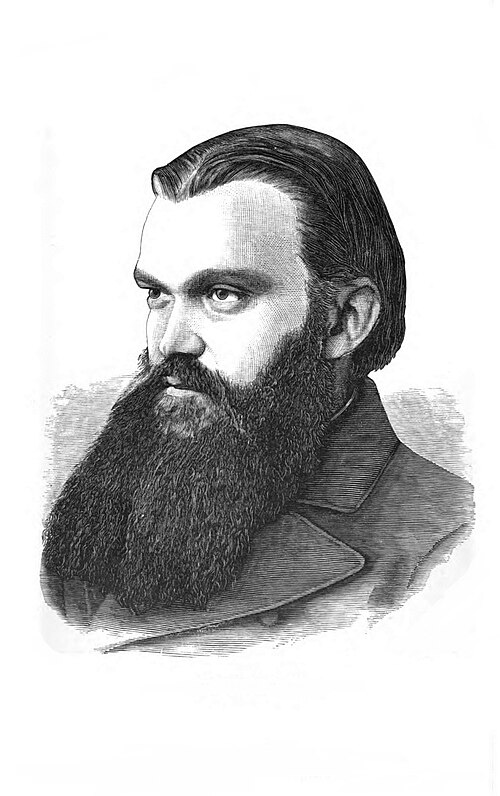
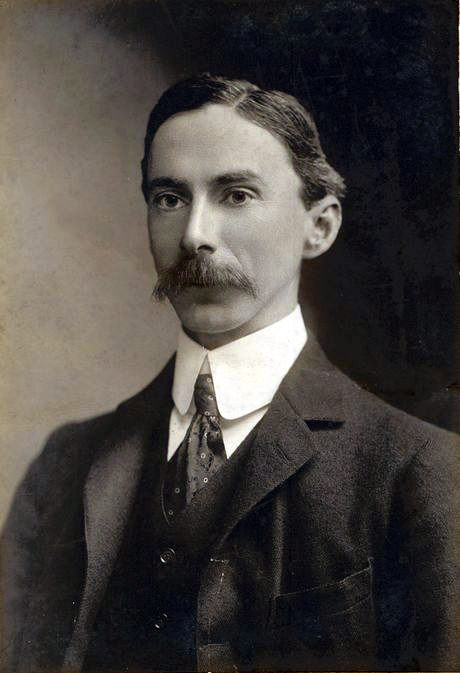 Do we have the right to believe? Clifford, James and analytic philosophy
Background: The thought of Pascal: the three orders, the wager, Jansenism · Analytic philosophy of religion: from the problem of evil to Reformed epistemology · The thought of William James: pragmatism, psychology, religious experience · The new atheists: Dawkins, Harris, Dennett, Hitchens
Another question has accompanied this one since the nineteenth century, more unsettling because it bears no longer on causes but on rights: do we have the right to believe what we believe? Explaining a belief by fear, desire, society or the structure of the mind leaves wholly open the question whether the person who holds it is at fault. Hume had given this second question its soberest maxim, at the beginning of the section on miracles in the Enquiry concerning Human Understanding (1748, under the title Philosophical Essays concerning Human Understanding, which became An Enquiry in 1758): “A wise man, therefore, proportions his belief to the evidence.” But Hume was speaking of prudence, not of duty. It was an English mathematician who, in 1877, turned this maxim into a moral obligation, and an American psychologist who answered him, by name, twenty years later. The exchange is an attested response, and it founded what analytic philosophy now calls the ethics of belief.
William Kingdon Clifford (1845-1879) was a geometer of the first rank, who died of tuberculosis at thirty-three. His article “The Ethics of Belief” appeared in the Contemporary Review in January 1877. It opens with a parable that has remained famous. A shipowner is about to send an emigrant ship to sea; he knows that the vessel is old, that it has often needed repairs, and doubts about its soundness have been put to him. These doubts make him unhappy; yet he rids himself of them: the ship has come through so many storms, Providence will protect these poor families, and it would be ungenerous to suspect the builders. He thus acquires, Clifford writes, “a sincere and comfortable conviction that his vessel was thoroughly safe and seaworthy”; he watches her depart with a light heart, and he collects the insurance money when she goes down in mid-ocean and tells no tales. Clifford adds that even if the ship had reached port safely, the owner would be no less guilty, because he had no right to believe on such evidence. The fault lies not in the outcome but in the way the belief was acquired.
The thesis that follows concedes nothing. Belief is not a private matter. It is, Clifford writes, “ours not for ourselves, but for humanity”, because no belief, however humble, is without effect on others: each prepares actions, each sustains a climate. It is therefore sacred, and it can be profaned: “It is desecrated when given to unproved and unquestioned statements, for the solace and private pleasure of the believer.” Whoever wishes to deserve well of his fellows “will guard the purity of his belief with a very fanaticism of jealous care”. And if a belief has been accepted on insufficient evidence, even if it turns out to be true, the pleasure it gives is stolen, and guilty, “because it is stolen in defiance of our duty to mankind”, a duty that consists in guarding ourselves from such beliefs “as from a pestilence”, which may shortly master our own body and then spread to the rest of the town. The first section sums itself up in a formula that has become the coat of arms of what would be called evidentialism: “it is wrong always, everywhere, and for anyone, to believe anything upon insufficient evidence.”
Clifford does not soften the consequences of this principle. Whoever sets aside his doubts, avoids the books and the people who might feed them, and regards as impious the questions that disturb his belief, leads in his view a life that is one long fault: the sentence ends on “one long sin against mankind”. To the man too busy to examine, he answers in a word: “Then he should have no time to believe.” The second section, on the weight of authority, bears directly on our subject. Clifford allows that one may take a chemist at his word, because one could in principle verify what he says; he does not allow that one should believe a prophet, because a man's moral greatness does not guarantee that he knows what he asserts. He takes the example of the founders of religions: the Prophet teaches that there is one God, whereas “The Buddha says that there is no God”, and that we shall be annihilated if we are good enough; they cannot both be infallibly inspired. The argument from the diversity of revelations, which Hume had used against miracles, becomes in Clifford a rule of hygiene: where the authorities contradict one another, none has any standing. He ends the article with a sentence that hardens the maxim further still: “It is wrong in all cases to believe on insufficient evidence; and where it is presumption to doubt and to investigate, there it is worse than presumption to believe.”
Read in the light of this essay's criterion, Clifford is instructive. His vocabulary is religious through and through: belief is a “sacred faculty”, one profanes it, one sins, one steals, one guards its purity with fanaticism, and the duty that binds the believer is a duty towards humanity, in whose name, he writes, we shall be strong, “not for ourselves, but in the name of Man and in his strength”. One recognizes Comte's religion of Humanity and Feuerbach's human species, and one may wonder whether Clifford's evidentialism is not one more cult, that of scientific Truth, with its priests and its sins. I believe, however, that Clifford stays short of the line, which makes his case precious. His absolute demands a renunciation, but of oneself alone: one renounces a consolation, one demands the sacrifice of no one. The heart of his parable is even an argument against any refoundation. The shipowner is guilty because his comfortable belief endangered the lives of others. Clifford saw what most of his heirs have forgotten: the scandal of belief without evidence is not that it is false, it is that it is paid for, often, with the blood of others.
The answer came in 1896. William James, whose Varieties of Religious Experience we have read, delivered before the philosophical clubs of Yale and Brown a lecture entitled “The Will to Believe”, published in the journal The New World in June 1896, then at the head of a collection of the same title whose preface is dated December 1896. James quotes Clifford at length, with affectionate irony: he calls him “that delicious enfant terrible Clifford”, and reproduces the maxim with a slight alteration, since he writes “for every one” where Clifford had written “for anyone”. He also quotes Huxley, who saw in the habit of not pretending to believe what one has no reason to believe the last dyke against the worst immorality. He announces his thesis at the outset: to defend “the lawfulness of voluntarily adopted faith”.
The argument rests on a few distinctions. A hypothesis is live or dead according to whether or not it presents itself as a real possibility to the person to whom it is proposed: belief in the Mahdi is a dead hypothesis for a Yale student, a live one for an Arab, and the liveness of a hypothesis is measured by the willingness to act. An option, that is, a choice between two hypotheses, may be live or dead, forced or avoidable, momentous or trivial; James calls genuine an option that is “of the forced, living, and momentous kind”. And his thesis fits in one sentence, which he puts in italics: “Our passional nature not only lawfully may, but must, decide an option between propositions, whenever it is a genuine option that cannot by its nature be decided on intellectual grounds.” For to say in such a case “do not decide, leave the question open”, he adds, is still a passional decision, which runs the same risk of missing the truth.
Pascal's wager comes in at the heart of the argument, and James treats it with a severity surprising in a defender of faith. He gives a faithful paraphrase of it, down to “Cela vous fera croire et vous abêtira”, this will make you believe and will dull you, and he judges that religious faith, when it expresses itself in the language of the gaming table, is down to its last trumps. The wager is valid, in his view, only for someone who already has a tendency to believe: “Certainly no Turk ever took to masses and holy water on its account.” Yet he quotes Pascal a second time, to agree with him: “Le coeur a ses raisons”, he writes, “que la raison ne connaît pas”, the heart has its reasons which reason does not know. The small slip in the quotation says everything. James takes from Pascal the right of the heart; he leaves him the calculation.
The answer to Clifford starts from a distinction. There are, James says, two commandments in the pursuit of truth, and they are not the same: “Believe truth! Shun error!” Clifford has chosen to sacrifice the first to the second, to prefer ignorance to any risk of error. This choice is not that of pure reason; it is that of a particular passion, the horror of being duped: “He may be critical of many of his desires and fears, but this fear he slavishly obeys.” James too has a horror of being duped; but he can believe that worse things than that may befall a man, and Clifford's exhortation has for him “a thoroughly fantastic sound”: it is like a general telling his soldiers that it is better never to go into battle than to risk a single wound. He then applies these distinctions to the religious hypothesis, which he reduces to two affirmations: the best things are the more eternal things, and we are better off even now if we believe the first. For someone to whom this hypothesis is live, the option is momentous and it is forced, for scepticism does not avoid it: it misses the good as surely as a refusal would. The sceptic is therefore not a man without passion; he is a gambler betting against religion, and James puts the question to him: “Dupery for dupery, what proof is there that dupery through hope is so much worse than dupery through fear?” He concludes that a rule of thinking which would absolutely prevent him from acknowledging certain truths if they existed would be an irrational rule, and he claims for each of us the right to believe, “at our own risk”, any hypothesis live enough to tempt our will.
James has often been reproached with opening the door to every credulity, not without grounds: the right to believe what tempts our will can cover the fanatic as well as the mystic. But the end of the essay changes its meaning. The right he claims is not a right to impose: “No one of us ought to issue vetoes to the other, nor should we bandy words of abuse”; we ought, on the contrary, to respect one another's freedom of thought delicately and profoundly, and only on that condition, he says, shall we have “that spirit of inner tolerance without which all our outer tolerance is soulless”. With regard to the criterion, James's position is clear: it proposes no absolute in whose name the sacrifice of the individual could be demanded; it defends each person's right to take a risk for himself, and denies anyone the right to take it for others. James is one of the few authors in the series to defend faith without ever asking the unbeliever to share it.
The comparison with Kierkegaard brings out what is his own. The Dane had defined faith as the contradiction between the infinite passion of inwardness and objective uncertainty (see the section on Kierkegaard). James says much the same thing about the structure of faith: a passion that decides where the intellect cannot. But he removes from it the paradox, the offence and the fear. In Kierkegaard, faith is a leap that reason can only find absurd; in James, it is a reasonable risk, comparable to that of a man who asks a woman to marry him without being sure she will be an angel, an image James himself uses. Kant, for his part, had abolished knowledge to make room for faith (B XXX, see the section on Kant). James abolishes nothing. He does not limit reason to save faith; he observes that reason leaves open options that life obliges us to decide. It is an empiricist's faith, without dogma, which each person can revise; and that is why it lends itself so well to modern spirituality, whose charter he wrote in the Varieties.
Twentieth-century analytic philosophy took up the quarrel, and at first settled it in Clifford's favour. Bertrand Russell (1872-1970) is his great heir, and admits it. In the 1927 lecture that gives its title to Why I Am Not a Christian, he examines the traditional proofs of the existence of God and finds them all wanting; but he knows that arguments are not the driving force of belief, which rests in his view on fear and ignorance: fear of the mysterious, ignorance of natural causes, fear of death. He says so, in another essay in the same collection, “Has Religion Made Useful Contributions to Civilization?”, in a formula that ties English analytic philosophy directly to the first regime of this essay: “My own view on religion is that of Lucretius. I regard it as a disease born of fear and as a source of untold misery to the human race.” His Sceptical Essays (1928) open with a doctrine he presents, ironically, as wildly paradoxical: “that it is undesirable to believe a proposition when there is no ground whatever for supposing it true”. This is Clifford in a more modest key.
Russell's most famous image comes from an article written in 1952 at the request of the London magazine Illustrated, “Is There a God?”, which the magazine did not publish and which first appeared in 1997, in vol. 11 of the Collected Papers. If I maintained, he writes, that a china teapot revolves about the Sun between the Earth and Mars, too small to be seen even by the most powerful telescopes, no one could refute me; but if I concluded that it is presumptuous to doubt it, I would be thought absurd. If, on the other hand, the existence of this teapot were affirmed in ancient books, taught every Sunday as sacred truth and instilled into children at school, doubt would become “a mark of eccentricity”, earning the doubter the attentions of the psychiatrist in an enlightened age “or of the Inquisitor in an earlier time”. The argument bears on the burden of proof, and it strikes true against those who think they have won because they cannot be refuted. But it meets the limit James had marked in advance. The teapot is a trivial hypothesis: nothing depends on it, and one can wait indefinitely without losing anything. The religious hypothesis, for someone to whom it is live, is momentous and forced. Russell answers Clifford, not James. And his final sentence says something other than he thought: the teapot becomes a serious matter only when an institution makes it sacred and punishes those who doubt it. The problem is not belief; it is the Inquisitor.
The most serious critique of religious belief that analytic philosophy has produced bears, moreover, on evil, and returns to the quarrel of Leibniz, Bayle and Voltaire. John Leslie Mackie (1917-1981), in “Evil and Omnipotence” (1955), argues that the problem of evil shows not only that faith lacks support but that it contradicts itself: “Here it can be shown, not that religious beliefs lack rational support, but that they are positively irrational, that several parts of the essential theological doctrine are inconsistent with one another.” An omnipotent and wholly good God could not allow evil to exist; evil exists; one of the attributes must give way. This is the argument of Epicurus that Bayle had put back into circulation. Alvin Plantinga answered it in the 1970s with the “free will defence”: to remove the contradiction, it suffices that a world containing free creatures and moral evil could be better than a world without freedom. Mackie conceded this in The Miracle of Theism (1982), a posthumous book: “we can concede that the problem of evil does not, after all, show that the central doctrines of theism are logically inconsistent with one another”; whether this is a real solution, he adds, is another question. The debate then shifted to probabilistic versions, which no longer claim to demonstrate inconsistency but improbability. The result is that of the classical quarrel: the coherence of faith can be saved; its plausibility cannot be demonstrated. The objection that remains is not logical; it is that of Ivan Karamazov, who does not hold the final harmony to be impossible, but refuses to consent to it.
Plantinga did more: with Nicholas Wolterstorff and William Alston, he challenged Clifford's very principle in Faith and Rationality (1983), the founding collection of Reformed epistemology. Evidentialism presupposes classical foundationalism: a belief is rational only if it is self-evident, evident to the senses, incorrigible, or inferred from beliefs that are. Yet this criterion condemns most of our most reasonable beliefs, that the world has existed for more than five minutes, that other people have minds, that our memories do not deceive us, for which we have no evidence in Clifford's sense; and it does not itself satisfy its own conditions, since it is neither self-evident nor demonstrated. Plantinga concludes that belief in God can be, like belief in the existence of other minds, a “properly basic” belief, one that need not be inferred from other beliefs in order to be rational. He finds its source in a theme of Calvin: there is said to be in man “a kind of faculty or cognitive mechanism, what Calvin calls sensus divinitatis or a sense of divinity, which in a wide variety of circumstances produces in us beliefs about God”. Wolterstorff gave this position its legal formula, which reverses Clifford's: our beliefs, he writes, “are innocent until proved guilty, not guilty until proved innocent”. And Plantinga, in Warranted Christian Belief (2000), pushes the argument to the point of maintaining that one cannot reasonably hold religious belief to be without warrant without first having shown that the model he proposes for it, that of a sensus divinitatis created by God, is false.
The classic objection to Reformed epistemology is that of the Great Pumpkin, borrowed from a comic strip in which a child believes that a giant pumpkin visits the most deserving pumpkin patch every Halloween: if belief in God can be properly basic, why not that one? Plantinga replies that one can rule out certain candidates for the status of basic belief without possessing a general criterion, just as one recognizes that Lewis Carroll's line “T'was brillig; and the slithy toves did gyre and gymble in the wabe” is meaningless without possessing a general criterion of meaning. But the objection has a more serious form, which Clifford had already formulated in setting the Prophet against the Buddha. If belief in God is properly basic for the Reformed Christian, the absence of God can be so for the Buddhist, the Qur'an for the Muslim, and each finds himself equally justified. The parity argument defends the believer against the charge of irrationality; it gives him no reason to prefer his faith to his neighbour's. Plantinga saved the rationality of belief at the price of its universality.
This debate first of all shifts the question of this essay. The authors of our series asked whether one can leave religion without founding another; Clifford, James and Plantinga ask by what title one holds what one holds, whether it be a religion, an unbelief or a wisdom. The question is broader and fairer, because it is addressed to atheists too: did Russell, who reproached believers with believing without reason, have reason to believe that religion is a disease born of fear? Above all he believed Lucretius. Next, the three positions are not of equal worth with regard to the sacrifice criterion, and their ranking is not the one we might expect. Clifford's evidentialism, which passes for the enemy of faith, is in reality the enemy of refoundations, even if its vocabulary of purity, profanation and fanaticism shows the slope that lies in wait for every morality of belief: making Truth an absolute in whose name souls are judged. James's position is, of all of them, the closest to what this essay calls an exit without refoundation: it makes neither faith nor doubt sacred. Reformed epistemology, finally, renders a service its adversaries ought to acknowledge: it shows that evidentialism is not a neutral position but one option among others, with its own commitments. Yet it fails where James succeeds, because it defends a particular tradition instead of defending a common right.
I therefore propose to combine the first two, which translates the criterion of this essay into the order of knowledge: we have the right to believe, at our own risk, where reason leaves the question open, and that is James; this right ceases where belief engages the lives of others without their having chosen it, and that is Clifford, with the lesson of the shipowner. James, the man who defended the right to believe, had understood that one leaves religion only by renouncing the imposition of anything at all, unbelief included.
Portrait: Auteur inconnu, The Popular Science Monthly, Public domain
Portrait: Alice Boughton, Public domain
Portrait: Photographe inconnu, Public domain
Transition: from explanation to ordeal
The human sciences have explained religion; they have not dissolved it. They have shown that belief has universal springs, cognitive, existential and social, that its intensity varies with the security of existence, and that the need it satisfied, for meaning, for bonds and for protection, survives God. But explanation leaves untouched the question that the twentieth century poses with a new urgency. If religion is not an error that science corrects, but a human response to a human condition, what becomes of that response when God falls silent? The thinkers of the next part are no longer content to explain: they put religion to the test, from within and from without, believers and unbelievers together. All of them had read, directly or not, the explainers of religion. None of them believed that explanation was enough.
Part Tenthe twentieth century, God after metaphysics
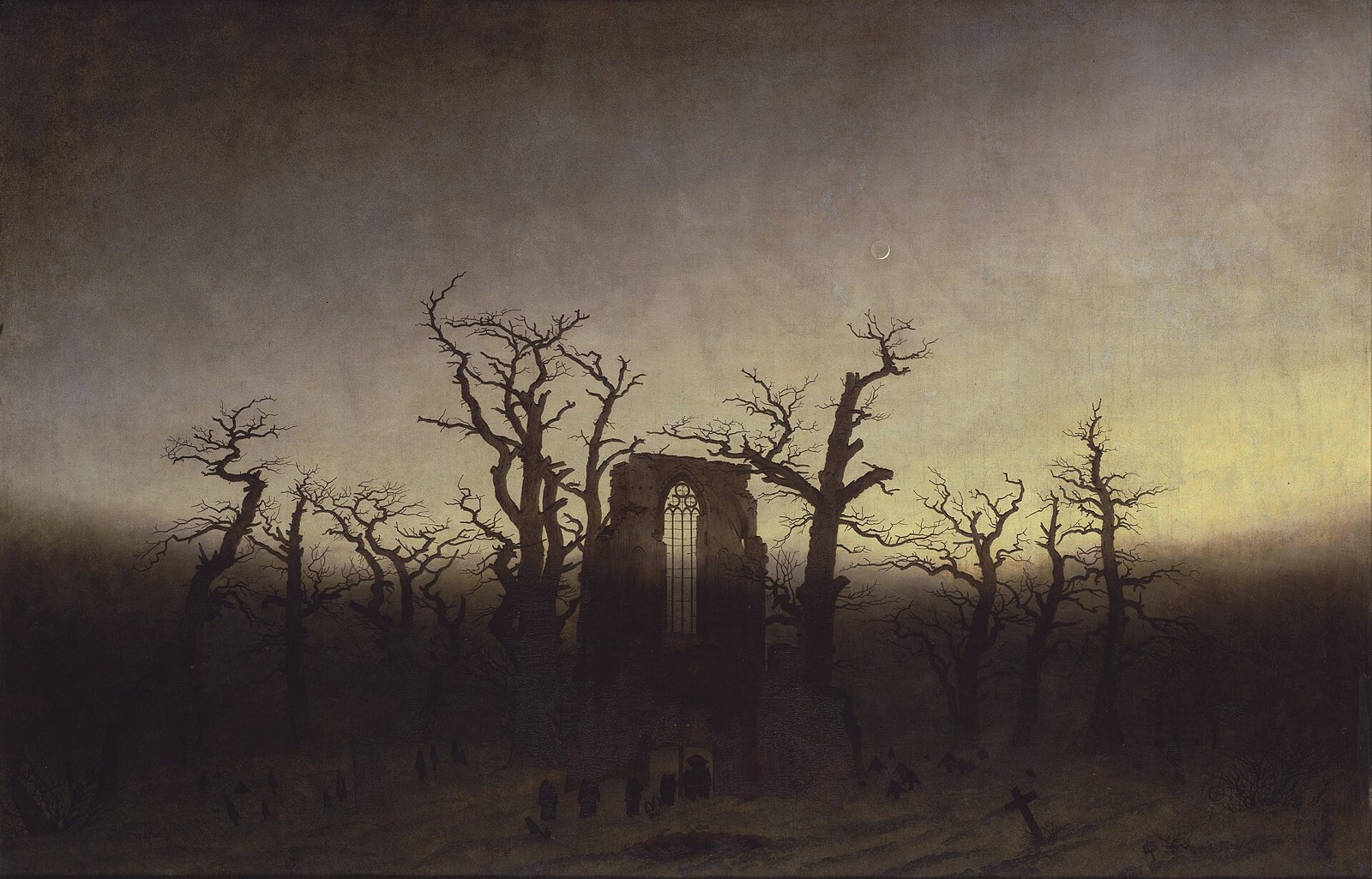
Background: Phenomenology: from Husserl to the theological turn · The vocabulary of Christian theology: revelation, grace, salvation, original sin · Twentieth-century Christian theology: dialectical, existential, Catholic, death of God · The Gospel of John: the Word made flesh
Part Nine showed that explaining belief does not dissolve it; Part Eight had already rehabilitated, with Bergson, James and Otto, the mystic whom nineteenth-century critique regarded as a sick man, a dreamer or an exploiter. The question of this essay has thus shifted ground. We no longer ask only whether dogmas are true, what Churches are for, which desire beliefs satisfy. We ask what becomes of an experience, and whether it survives the ruin of the representations that long framed it: can one keep spirituality while losing religion, or religion while losing the God of the philosophers?
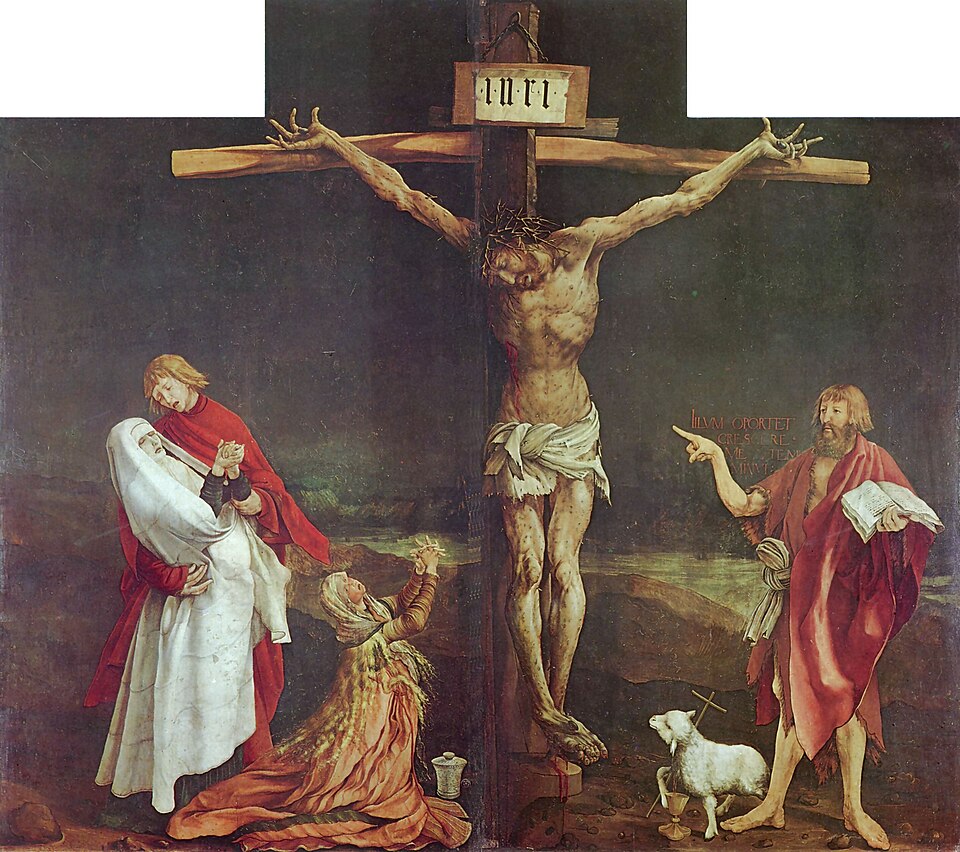
The twentieth century answers in a way that no critic of the previous century had foreseen. It does not merely produce atheists more consistent than Feuerbach. It produces, and this is the major fact, a theological critique of religion, and a religious critique of God. The atheists, for their part, take atheism as a starting point rather than a conclusion, and ask what it costs; others seek the divine outside being, or the mystical outside language.
This shift is decisive. Until now, the exit from religion was made against religion, and one could ask whether it did not refound another. From now on, it is also made from within religion, and one can ask the reverse question: is the critique of religion not, at least sometimes, the work of faith itself? If so, the simple opposition between believers and unbelievers, from which we were still starting, no longer holds. The dividing line runs elsewhere: between those who want an absolute that is available, possessed, usable, and those who renounce it, whether they pray or not.
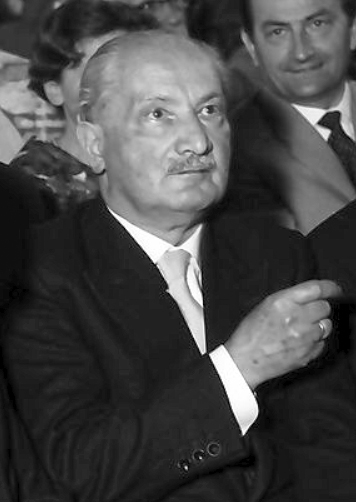 Heidegger1889-1976God and metaphysics die together
Background: Aristotle's philosophy: act and potency, causes, the unmoved mover, virtue, contemplation · Phenomenology: from Husserl to the theological turn · The philosophy of Nietzsche: tragedy, genealogy, will to power, eternal return, overman · Metaphysics and the proofs of the existence of God: from Anselm to Kant · The thought of Heidegger: Dasein, Being and Time, the turn, technology, 1933 · The Gospel of John: the Word made flesh
Heidegger's texts are protected by copyright, and I have been unable to check any of them against a printed edition: the quotations that follow are given from concordant secondary sources, with their provenance, or from an online reproduction of the German text; they will have to be verified against the Gesamtausgabe before any publication.
I begin with Heidegger, not because he is the most important, but because almost all the other authors in this part situate themselves in relation to the configuration he named onto-theology. The word does not designate an error of this or that philosopher, but the very structure of Western metaphysics since Plato and Aristotle, which comes down to a double question: what are beings as beings, what is common to everything that is, and what is the supreme being, the one that grounds all the others? The first question is ontological, the second theological, and metaphysics is both at once: it thinks being as ground, and the ultimate ground as a supreme being. What philosophers have called God is the name of this ground.
The essay “Nietzsches Wort "Gott ist tot"” (Holzwege, 1950), the substance of which, according to Heidegger's own note, was read several times in 1943 before small circles, drawing on the lectures on Nietzsche given at Freiburg between 1936 and 1940, turns Nietzsche against himself. The word “God”, in Nietzsche, does not designate only the Christian God, but the supersensible world in general, Ideas, ends, values. Hence: “Das Wort ›Gott ist tot‹ bedeutet: die übersinnliche Welt ist ohne wirkende Kraft. Sie spendet kein Leben. Die Metaphysik, d.h. für Nietzsche die abendländische Philosophie als Platonismus verstanden, ist zu Ende.” The death of God is not an episode in the history of religions; it is the end of Western metaphysics, which Nietzsche pronounces without seeing that he still belongs to it. To think beings as will to power and the world as values to be posited is to complete metaphysics, not to leave it. The reversal of Platonism remains Platonic: it puts life where Plato put the Idea, but still thinks in terms of hierarchy and value, and “value” is for Heidegger the last avatar of the Platonic Good, become a mere condition posited by the will for its own growth. The essay ends on a sentence that strikes the reason of the Enlightenment as much as faith: “Das Denken beginnt erst dann, wenn wir erfahren haben, daß die seit Jahrhunderten verherrlichte Vernunft die hartnäckigste Widersacherin des Denkens ist”, thinking begins only when we have experienced that reason, glorified for centuries, is the most stubborn adversary of thinking.
This reading strikes the whole series of Parts Six, Seven and Eight. If Heidegger is right, Feuerbach, Marx, Nietzsche and Freud did not leave religion, not because they kept a residue of piety, as Stirner maintained, but because they remained metaphysicians. Feuerbach replaces God with the human essence: he changes the ground, he does not renounce grounding. Marx replaces providence with the laws of history, Nietzsche the Idea with the will to power: the same structure. Freud replaces God with the Logos, and says so, as we have seen, with disarming frankness. Stirner's objection bore on the content of the absolute; Heidegger's bears on its form. One can empty the absolute of all theological content and remain within onto-theology, as long as one thinks the real on the basis of a first principle that accounts for it. The critique of religion by reason is, in this respect, the continuation of philosophical theology by other means.
The second text is the lecture “Die onto-theo-logische Verfassung der Metaphysik”, collected in Identität und Differenz (1957). The God of the philosophers is there the ultimate ground, and its proper name is causa sui. But such a god has nothing divine about it: “Zu diesem Gott kann der Mensch weder beten, noch kann er ihm opfern. Vor der Causa sui kann der Mensch weder aus Scheu ins Knie fallen, noch kann er vor diesem Gott musizieren und tanzen”, to this god man can neither pray nor offer sacrifice; before the causa sui, man can neither fall to his knees in awe, nor play music and dance before this god. And Heidegger adds that god-less thinking, “das gott-lose Denken, das den Gott der Philosophie, den Gott als Causa sui preisgeben muß”, which must give up the god of philosophy, is “dem göttlichen Gott vielleicht näher”, perhaps closer to the divine god.
The sentence says that philosophical atheism, the critique of the God-as-ground, is not opposed to religion: it perhaps clears the place for a god who would no longer be that of the philosophers. The critique of religion becomes, in Heidegger, a critique of philosophical theology in favour of waiting. As early as 1927, in “Phänomenologie und Theologie”, he separated the two domains radically: theology is “eine positive Wissenschaft”, a positive science, and “als solche daher von der Philosophie absolut verschieden”; faith is the mortal enemy, “Todfeind”, of philosophy, and a Christian philosophy is a “hölzernes Eisen”, a wooden iron, a square circle. The gesture recalls Spinoza, but reverses its meaning: Spinoza separated in order to free philosophy from theology, Heidegger separates in order to free the divine from philosophy.
Heidegger thus gives, three centuries later, a history and a reason to the opposition that Pascal's Memorial drew between the God one encounters and the God one demonstrates (Part Three); a constructed comparison, for I have not verified that Heidegger cites Pascal in this text.
A text from 1951, less well known and sharper, confirms this meaning. At a seminar held in Zurich on 6 November 1951, Heidegger answers students who question him on the relation between being and God. His answers, recorded in volume 15 of the Gesamtausgabe, settle a persistent misunderstanding: “Sein und Gott sind nicht identisch, und ich würde niemals versuchen, das Wesen Gottes durch das Sein zu denken”, being and God are not identical, and I would never attempt to think the essence of God by way of being. Then: “Wenn ich noch eine Theologie schreiben würde, wozu es mich manchmal reizt, dann dürfte in ihr das Wort »Sein« nicht vorkommen”, if I were still to write a theology, as I am sometimes tempted to do, the word “being” would not be allowed to appear in it. And finally: “Der Glaube hat das Denken des Seins nicht nötig”, faith has no need of the thinking of being.
These three sentences undo the lazy reading that makes “being” a substitute for God, an impersonal divinity for philosophers disappointed with Christianity. Being is not God, and faith has no need of it. The critique of onto-theology therefore does not aim to replace the God of the philosophers with being, which would be to refound a metaphysics; it aims to restore to faith its own source, which is not reason, and to thinking its own task, which is not to ground God. The young Heidegger had been a seminarian and a student of Catholic theology at Freiburg before writing to Engelbert Krebs, in January 1919, that epistemological insights had made “das System des Katholizismus problematisch und unannehmbar”, the system of Catholicism problematic and unacceptable to him, “nicht aber das Christentum und die Metaphysik”, but not Christianity and metaphysics; it is not insignificant that his most radical critique of metaphysics is formulated as a service rendered to the divine rather than as its liquidation.
Hence Heidegger's last public word on the question, the interview given to Der Spiegel in September 1966 to Rudolf Augstein and Georg Wolff, published at his wish after his death, in issue 23 of 31 May 1976, under the title “Nur noch ein Gott kann uns retten”, only a god can still save us. In W. J. Richardson's English translation, he declares that philosophy cannot bring about any immediate change in the state of the world, that the only possibility left to us is to prepare, through thinking and poetry, a readiness for the appearance of the god or for his absence in the decline.
This formula is made to say too much or too little. Too much, when one sees in it a late conversion, a return of the old thinker to the faith of his childhood: nothing in the interview names the Christian God, and the indefinite article, “ein Gott”, is deliberate. Too little, when one sees in it a quip: Heidegger says in earnest that neither technology, nor politics, nor philosophy can answer the distress of the age, and that thinking can only prepare. The structure is that of waiting. It is not unrelated to the Gelassenheit of the small volume bearing that title (1959), which brings together the Messkirch address of 1955 and a conversation written in 1944-1945: a letting-be, a serenity that renounces willing, and a word that Heidegger deliberately takes over from Meister Eckhart (gelâzenheit) while shifting its meaning, since it is no longer a matter of surrendering one's own will to the divine will but of leaving willing behind.
The objection is obvious, and I believe it is right. Heidegger saw that the critique of religion by reason remains caught in the metaphysics it believes it has overcome. But he draws from this a waiting without content, a piety without object, a religion without dogma or Church whose priest is the thinker and whose sacred text is Hölderlin. One does not leave religion by announcing a god to come: one founds one, a vague one, and perhaps a dangerous one, since it does not say what it is waiting for. The objection still needs to be made precise, otherwise it would fall under the reproach Heidegger levels at his critics, that of judging thinking by the yardstick of calculating reason. I do not reproach him for waiting, but for not saying who waits and in whose name. Pascal waited too, but he knew what he was waiting for, and his waiting was governed by a Scripture, a Church, a prayer. Spinoza waited for nothing, and his beatitude was actual. Heidegger waits without object or rule, and it is this indeterminacy that could, in 1933, allow itself to be filled by a historical object: one cannot pretend that the commitment of 1933 and the Black Notebooks do not exist, since they show what a thinking that waits for the saviour was able to recognize, once, in real history. A spirituality without content is not for all that without an absolute: it is an empty absolute, available to whoever wishes to occupy it. This is the lesson that Part Eleven will find again in Blumenberg, under the name of the reoccupation of positions.
Heidegger nevertheless established what no one in this part will call into question: the critique of the God of the philosophers is not the critique of God, and can be its opposite. The Protestant theologians of his time had understood this before him, and often better than he did.
Portrait: Willy Pragher, CC BY-SA 3.0
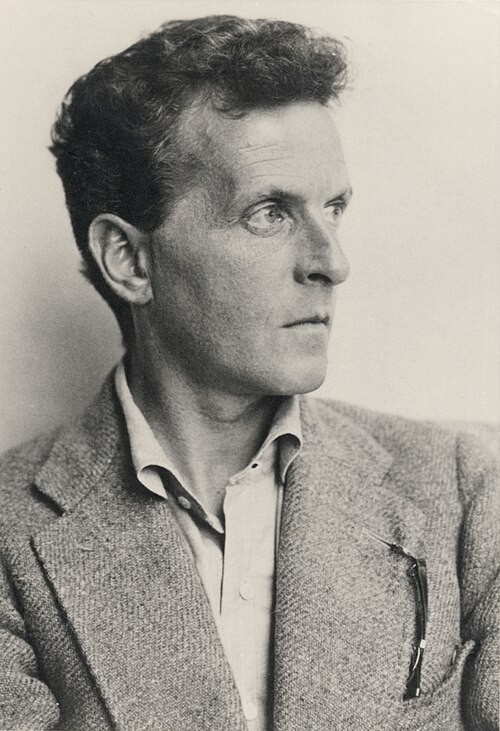 Wittgenstein1889-1951that the world is
Background: Analytic philosophy of religion: from the problem of evil to Reformed epistemology · Tylor and Frazer: animism, survivals, The Golden Bough · Wittgenstein's philosophy: the Tractatus, language games, ethics and the mystical
Ludwig Wittgenstein never wrote a book on religion, nor even an article: a few pages of the Tractatus Logico-Philosophicus, a lecture of 1929 published after his death, notebooks, remarks on a book of anthropology, conversations reported by his students. Yet he occupies in our debate a place that no one else can hold: that of a man who closed, with unprecedented rigour, the possibility of saying anything whatever about God, and who left open, with the same rigour, the place of what cannot be said.
The Tractatus, written during the war, published in German in 1921 and in a bilingual edition in London in 1922, ends with a series of propositions whose sequence is the argument. First, the sense of the world cannot lie in the world: “Der Sinn der Welt muss ausserhalb ihrer liegen. In der Welt ist alles wie es ist und geschieht alles wie es geschieht; es gibt in ihr keinen Wert”, the sense of the world must lie outside it; in the world everything is as it is and everything happens as it happens; in it there is no value (6.41). Next, God does not show himself in the facts: “Wie die Welt ist, ist für das Höhere vollkommen gleichgültig. Gott offenbart sich nicht in der Welt”, how the world is, is completely indifferent for what is higher; God does not reveal himself in the world (6.432). Then the central proposition: “Nicht wie die Welt ist, ist das Mystische, sondern dass sie ist”, it is not how the world is that is the mystical, but that it is (6.44). And the conclusion: “Es gibt allerdings Unaussprechliches. Dies zeigt sich, es ist das Mystische”, there is indeed the inexpressible; it shows itself, it is the mystical (6.522).
It would be wrong to see in this a concession made to religion by a positivist. Wittgenstein is not Carnap, and the Vienna Circle was mistaken in taking him for an ally. The Tractatus does not say that what cannot be said does not exist; it says that what matters most cannot be said. “Wir fühlen, dass selbst, wenn alle möglichen wissenschaftlichen Fragen beantwortet sind, unsere Lebensprobleme noch gar nicht berührt sind”, we feel that even when all possible scientific questions have been answered, the problems of our life have not been touched at all (6.52). And the solution of the problem of life, adds 6.521, is seen in the vanishing of this problem: that is why, Wittgenstein asks, those to whom the sense of life became clear after long doubt could not say what this sense consisted in. The last proposition, “Wovon man nicht sprechen kann, darüber muss man schweigen”, what one cannot speak about, one must keep silent about (7), is not contempt, but a form of respect.
Two less cited propositions bear more directly on our question. The first concerns the modern view of the world: “Der ganzen modernen Weltanschauung liegt die Täuschung zugrunde, dass die sogenannten Naturgesetze die Erklärungen der Naturerscheinungen seien”, the whole modern view of the world rests on the illusion that the so-called laws of nature are the explanations of natural phenomena (6.371); “So bleiben sie bei den Naturgesetzen als bei etwas Unantastbarem stehen, wie die älteren bei Gott und dem Schicksal”, so the moderns stop at the laws of nature as at something inviolable, as the ancients did at God and fate (6.372). The thesis of this essay is here applied to science: the exit from religion through science installed a new inviolable in place of the old one. Freud, a few years later, would call it “our god Logos”. The comparison is constructed: Wittgenstein denies science the status of ultimate explanation that Freud granted it, and that is why he cannot put it in God's place.
The second concerns eternity: “Wenn man unter Ewigkeit nicht unendliche Zeitdauer, sondern Unzeitlichkeit versteht, dann lebt der ewig, der in der Gegenwart lebt”, if by eternity one understands not infinite temporal duration but timelessness, then he lives eternally who lives in the present (6.4311). The preceding sentence says that death is not an event of life, and the following one that the immortality of the soul would solve no riddle. One hears Epicurus, for whom death is nothing to us, and Spinoza, for whom we feel and experience that we are eternal: Wittgenstein rediscovers ancient wisdom and the fifth part of the Ethics by the most improbable path, that of logic.
The lecture on ethics, delivered at Cambridge in 1929 and published in 1965 in the Philosophical Review, gives this experience a content. To convey what he calls absolute value, Wittgenstein describes the experience that is for him the experience par excellence: “I believe the best way of describing it is to say that when I have it I wonder at the existence of the world”; and he adds that he is then inclined to use such phrases as “how extraordinary that anything should exist”. Further on, he redescribes it as seeing the world as a miracle, distinguishing the relative miracle, what science has not yet explained, from the absolute miracle; when we look at a fact scientifically, he says, everything miraculous about it disappears. But he adds at once that the expression of this wonder is nonsense, since one cannot wonder that a thing is without being able to imagine its not being, and one cannot imagine the world not being. The wonder is real, and its formulation is a misuse of language: it is this double affirmation, held to the end, that makes Wittgenstein singular.
Here appears the question that Part Twelve will take up: why is there something rather than nothing? Leibniz had posed it as the first question we have the right to ask; Schelling and Heidegger would take it up as the fundamental question of metaphysics. Wittgenstein receives it as a wonder, not as a question, and refuses to answer it, because there is nothing there to answer.
The war notebooks of 1914-1916 show that this silence was not indifference. In them Wittgenstein identifies God with the meaning of life, and prayer with thinking about this meaning; to believe in God is to see that the facts of the world are not everything. We also know, from the concordant testimony of his friends, that during the war he carried Tolstoy's The Gospel in Brief and recommended it to those around him. His student Maurice Drury reports that he said he was not a religious man, but could not help seeing every problem from a religious point of view. These are only recollections, but they agree with the Tractatus.
One last text concerns the anthropology of religion of Part Nine. In 1931, Wittgenstein read James Frazer's The Golden Bough and set down remarks on it that were published in 1967. He reproaches Frazer for explaining magical rites as errors, false hypotheses about causality, and turns the accusation around: it is Frazer who is primitive, more savage than most of his savages, since he cannot imagine a practice that is not a failed technique. The man who burns an effigy does not believe he is acting on the enemy as the doctor acts on a fever; he is expressing something, and the rite satisfies by expressing. This is a radical critique of the regime of error, from Lucretius to d'Holbach and Frazer: religion is not bad physics. Durkheim had seen this in his own way, making the rite the act by which a society represents its own strength to itself; Wittgenstein goes further, since he refuses even the functional explanation, which remains an explanation. Freud, who explained religion by infantile desire, would fall under the same reproach. The confrontation with Durkheim and Freud is constructed; the one with Frazer is attested.
Where should Wittgenstein be placed with regard to the criterion? He refounds nothing, and could refound nothing, since any doctrine about what is higher falls into nonsense: no cult, no morality, no community. But neither does he leave religion in the sense in which d'Holbach or Freud wanted to leave it, since he keeps intact, and even protects against science, the place of wonder, of meaning and of what shows itself. I regard him as a mystic without God and without doctrine, in the sense in which he uses the word: someone who experiences the world as a limited whole, wonders that it is, and falls silent. His position is stricter than that of Spinoza, who still spoke of God, and than that of Camus, who spoke of the absurd: Wittgenstein denies himself even the name. His silence is not an answer to the question of religion; it is the refusal to let an answer occupy the place of the question.
Portrait: Moritz Nähr, Public domain
 Barth1886-1968religion is the affair of godless man
Background: Feuerbach's thought: The Essence of Christianity, the species, love, nature · Kierkegaard's thought: the stages, anxiety, despair, Abraham, the attack on Christendom · The Protestant Reformation: Luther, Calvin and the break-up of Christendom · Barth's theology: the Römerbrief, dialectical theology, the Church Dogmatics · The Churches and the totalitarian regimes: Barmen, the concordats, state atheism · The letters of Paul: Romans, Corinthians and the others · Hebrews, James, Peter, John, Jude: the other letters
Karl Barth is the greatest Protestant theologian of the twentieth century, and the first theologian of that century, in this essay, to maintain that the critique of religion is not a weapon against faith but a demand of faith. His position is all the more singular in that he formulates it in Feuerbach's own terms, having read Feuerbach closely and taken him seriously as almost no theologian before him had.
Trained in German liberal theology, the heir of Schleiermacher, Barth broke with it during the First World War, when he saw his teachers, Harnack and Herrmann among them, sign the “Aufruf an die Kulturwelt” of 4 October 1914, known as the Manifesto of the Ninety-Three, by which German intellectuals declared their solidarity with the war; Barth would say that he had discovered there, “with horror”, the names of almost all his German teachers. The theology that had made religion an expression of human consciousness, of feeling, of culture, seemed to him to have handed God over to man. His Römerbrief (The Epistle to the Romans, 1919, recast in 1922) proclaims, on the contrary, the infinite qualitative difference between God and man. The expression comes from Kierkegaard, and Barth says so himself in the preface to the second edition: if he has a “system”, it consists in keeping in view what Kierkegaard called the “unendlichen qualitativen Unterschied” of time and eternity; the commentary itself speaks of the “qualitativen Unterschieds von Gott und Mensch, Gott und Welt”, the qualitative difference between God and man, God and world. God is not the extension of our aspirations; he is the Wholly Other, who can be known only if he reveals himself, and who reveals himself in Jesus Christ, not in religion.
It is in this context that paragraph 17 of the Kirchliche Dogmatik (Church Dogmatics) must be read, in volume I/2, published in 1938. Its title is already a thesis: “Gottes Offenbarung als Aufhebung der Religion”, the revelation of God as the Aufhebung of religion. The word is Hegel's, and Barth plays on it deliberately: it means at once abolition and elevation, suppression and preservation at a higher level. The central sentence of the paragraph is this: “Religion ist Unglaube; Religion ist eine Angelegenheit, man muß geradezu sagen: die Angelegenheit des gottlosen Menschen”, religion is unbelief; religion is an affair, one must say it outright: the affair of godless man.
By “religion”, Barth means the human attempt to grasp God by one's own means: to represent him, to win him over, to justify oneself before him through works, rites, thoughts. Now this attempt is, in the eyes of revelation, the contrary of faith. Faith receives; religion takes. Faith listens to a word that comes from elsewhere; religion manufactures a god to its own measure. Barth makes no exception for Christianity: the Christian religion is a religion like the others, and as such it is unbelief. It is “true” only by grace, as a sinner is righteous only when justified. Barth uses an image: revelation illuminates the Christian religion as the sun illuminates a region of the earth, without changing its nature.
The kinship with Feuerbach is not fortuitous. Barth devoted an essay to him in 1927, “Ludwig Feuerbach”, published in the journal Zwischen den Zeiten and then collected in Die Theologie und die Kirche (1928); it is this text which, translated into English, serves as the introductory essay to the 1957 American reissue of George Eliot's translation of The Essence of Christianity. In it Barth grants Feuerbach a victory that the apologists of the nineteenth century had always refused him: Feuerbach is “mit seiner Religionsdeutung auf der ganzen Linie Recht”, right all along the line with his interpretation of religion, at least “sofern sie sich auf die Religion als Erfahrung des bösen und sterblichen Menschen bezieht”, insofar as it bears on religion as the experience of evil and mortal man. This is an attested reading: a theologian concedes the point to theology's most feared critic.
But he concedes it on religion, and therein lies the whole subtlety of the manoeuvre. Yes, religion is projection; yes, the God whom man represents to himself is only his own essence enlarged; yes, the theology that starts from man, from his feeling or his consciousness, like Schleiermacher's, necessarily ends in anthropology. Barth even draws from this an argument against the whole of liberal theology: Feuerbach is the truth of Schleiermacher. Only, revelation is not religion. It is not a product of consciousness; it comes from elsewhere, and it is precisely for this reason that it judges religion. Feuerbach's critique, turned around, becomes an instrument for purifying faith.
The boldness of the move is considerable. Feuerbach believed he had dissolved theology into anthropology. Barth replies: you have dissolved religion, and you were right to do so; faith was not in what you dissolved. It is the reverse of Stirner's operation: Stirner showed that the atheist remained pious; Barth shows that the pious man, as religious, is an atheist, “gottlos”, without God.
The objection is well known, and it was formulated as early as the 1960s: Barth removes revelation from critique by declaring it out of reach, but this removal holds only for someone who already believes. John Glasse, in “Barth on Feuerbach” (Harvard Theological Review 57, 1964), and others after him have argued that the Barthian answer is intelligible only from within faith. Feuerbach could reply that “revelation” is the most refined projection of all: the one that declares itself unprojected. And a reader of Nietzsche would add that the distinction between religion and faith is itself a religious gesture, the one by which the priest reserves for himself the truth he denies to others.
I believe, however, that Barth scores a point that this objection does not erase. He establishes that the critique of religion is not, by nature, a critique of transcendence; it can be a critique of the appropriation of transcendence. What he condemns in religion is man making use of God, and this condemnation meets, by an entirely different road, what Spinoza said of the vulgar who imagine a God in their own image, what Marx said of opium, what Nietzsche said of the priest. Our question then takes a new form: leaving religion without founding another might perhaps be possible if one agrees not to leave faith. It is a wager that most of our authors would refuse, and one that an unruly pupil of Barth was to push to its most extreme consequences.
Portrait: Hans Lachmann, CC BY-SA 3.0 de
 Bonhoeffer1906-1945living before God without God
Background: The Protestant Reformation: Luther, Calvin and the break-up of Christendom · Barth's theology: the Römerbrief, dialectical theology, the Church Dogmatics · The thought of Bonhoeffer: The Cost of Discipleship, the Ethics, the prison letters · Twentieth-century Christian theology: dialectical, existential, Catholic, death of God · The Churches and the totalitarian regimes: Barmen, the concordats, state atheism
Dietrich Bonhoeffer, a Lutheran pastor trained in Berlin, close to Barth without being his disciple, joined the Confessing Church against the Nazi takeover of German Protestantism, then the resistance circles preparing the elimination of Hitler. Arrested in April 1943, he was executed at the Flossenbürg camp on 9 April 1945, a few weeks before the end of the war. The letters he wrote from Tegel prison to his friend Eberhard Bethge, published by Bethge in 1951 under the title Widerstand und Ergebung (Resistance and Submission), contain some of the most debated pages in the theology of the century.
The starting point is an observation, formulated in the letter of 30 April 1944: “Wir gehen einer völlig religionslosen Zeit entgegen; die Menschen können einfach, so wie sie nun einmal sind, nicht mehr religiös sein”, we are moving towards a completely religionless time; people as they now are simply cannot be religious any more. This observation is not a lament: Bonhoeffer does not regret the religious age and does not wish to restore it. He asks what becomes of Christ in a world that no longer needs religion.
By “religion” he means neither faith nor Christianity as such, but a certain way of believing, settled in the Christian West, which rests on three features: metaphysics, which places God in a world behind the world; inwardness, which lodges him in the secret of the individual soul; and above all recourse to God at the limits, where human knowledge and power fail. It is this last feature that he designates by the word Lückenbüßer, the stopgap. The God of religion is the one called upon when we no longer know, when we no longer can, when we die. Now, as science, technology, medicine and politics push back these limits, this God retreats: a God of the gaps, he loses a province with every human advance.
In the letter of 16 July 1944, the most famous, Bonhoeffer retraces the history of modern autonomy, from Herbert of Cherbury to Grotius, from Descartes to Kant, and concludes: “Gott als moralische, politische, naturwissenschaftliche Arbeitshypothese ist abgeschafft, überwunden; ebenso aber als philosophische und religiöse Arbeitshypothese (Feuerbach!)”, God as a moral, political, scientific working hypothesis has been abolished, overcome; but so too as a philosophical and religious working hypothesis (Feuerbach!). Feuerbach's name, in parentheses and followed by an exclamation mark, is an attested mention. Bonhoeffer does not refute Feuerbach: he records him as an irreversible stage in the history of consciousness, behind which there is no going back.
In the same letter, Bonhoeffer takes up Grotius's formula, “etsi deus non daretur”, as if God were not given. Grotius had used it to say that natural law would hold even if God did not exist. Bonhoeffer turns it into a maxim of Christian life: one must live in the world as if God were not given. And he adds the sentence that caused a scandal: “Vor und mit Gott leben wir ohne Gott. Gott läßt sich aus der Welt herausdrängen ans Kreuz, Gott ist ohnmächtig und schwach in der Welt und gerade und nur so ist er bei uns und hilft uns”, before God and with God we live without God. God lets himself be pushed out of the world and onto the cross; God is powerless and weak in the world, and precisely thus, and only thus, is he with us and does he help us.
This thought overturns, term by term, the critique of the nineteenth century. Feuerbach said: God is the projection of human power; man strips himself of his strengths in order to adore them in an all-powerful being. Bonhoeffer replies: the God of the cross is not all-powerful; he is weak, he lets himself be driven out, and it is this very weakness that makes him a God and not a projection. Marx said: religion consoles for powerlessness. Bonhoeffer replies: faith is not the recourse of the powerless; it is the life of the adult, who no longer needs God to plug the holes in his knowledge. Nietzsche said: Christianity is a religion of pity, which preserves the weak. Bonhoeffer replies: Christianity is participation in the suffering of God in the world, not an escape from the world.
Two days later, on 18 July 1944, Bonhoeffer returns to the idea of a world come of age, “mündig gewordene Welt”, an expression that echoes the Kantian definition of the Enlightenment as emergence from the state of immaturity. This world come of age is, he writes, “gottloser und darum vielleicht gerade Gott-näher als die unmündige Welt”, more godless, and for that very reason perhaps closer to God than the world not yet come of age.
A misreading must first be set aside. Bonhoeffer did not preach an atheist Christianity, nor a “death of God” in the sense of the American theologians of the 1960s who would claim him as their own. He believes in God, he prays, he dies a Christian. What he rejects is religion as a historical form of faith, and he seeks a “non-religious interpretation” of biblical concepts. I have not verified that the exact phrase “religionsloses Christentum”, religionless Christianity, appears in the letters, although it circulates everywhere under his name; I therefore give it as a received summary, not as a quotation.
Bonhoeffer also distinguishes himself from Barth, and the distinction is attested. In the letters of May and June 1944, he reproaches his elder with an “Offenbarungspositivismus”, a positivism of revelation: Barth was right to criticize religion, but he put in its place a revelation to be taken or left, a block of dogmas that must be swallowed whole. This is, in theological terms, the very objection that Feuerbach could have made to Barth: revelation declared out of reach becomes a new positivity, a new law. Bonhoeffer is no gentler with Bultmann, who wanted to demythologize the New Testament: “Bultmanns Ansatz ist eben im Grund doch liberal”, Bultmann's approach is, at bottom, liberal after all. To demythologize is still to reduce faith to what modern man can accept: it is to do Schleiermacher over again.
Bonhoeffer thus attempts a narrow path between two failures: that of liberal theology, which dissolves faith into culture, and that of Barth, which freezes it into positive revelation. The dogmaticians who followed him doubted that it was practicable, and history seemed to prove him wrong on one point at least: the forecast of a “completely religionless” time turned out to be false, since the last third of the twentieth century saw religion return everywhere in forms Bonhoeffer had not foreseen. But this empirical refutation does not touch the heart of his thought, which is not a sociological prophecy: faith does not need religion, and the fading of religion can be an opportunity for it.
Here we have the radical form of the Christian answer to our question. Can one leave religion without founding another? Yes, Bonhoeffer answers, on condition of not leaving Christ. The exit from religion is not the end of faith but its purification, and this purification passes through the acceptance of a weak, absent, crucified God. It will be objected, and I object, that this weak God looks very much like a projection of the condition of the prisoner of Tegel: a man reduced to powerlessness, who turns his powerlessness into a place of divine presence. But the objection turns back on itself: if projection produces a powerless God, without glory, who does not console and guarantees nothing, it is no longer the projection Feuerbach described, the one that gave God all the perfections man denied himself. It is, on the contrary, a dispossession. And it was this dispossession that a French philosopher, who died in the same year as Bonhoeffer's arrest, had pushed further.
Portrait: Auteur inconnu, CC BY-SA 3.0 de
 Simone Weil1909-1943atheism as purification
Background: The thought of Meister Eckhart: detachment, the birth of God in the soul, the trial · Christian mysticism: from Dionysius to John of the Cross and quietism · Antigone: the law of the city and the unwritten laws · The thought of Bonhoeffer: The Cost of Discipleship, the Ethics, the prison letters · The thought of Simone Weil: attention, affliction, decreation, rootedness · The Trojan War: Iphigenia at Aulis, the wrath of Achilles, Priam · Matthew and Luke: the infancy, the Sermon on the Mount, the parables · The thought of Iris Murdoch: the novels, the Good, attention · The teaching of Jesus: the Kingdom, the parables, the miracles · The letters of Paul: Romans, Corinthians and the others
Simone Weil died at Ashford, in England, on 24 August 1943, at the age of thirty-four. An agrégée in philosophy, a pupil of Alain, a factory worker at Alsthom and at Renault, a short-lived combatant in the Spanish Civil War, she had, from 1937 and 1938 onwards, mystical experiences that she describes with extreme sobriety, without ever asking for baptism. She remains on the threshold of the Church, out of fidelity, she says, to everything the Church has excluded. She published no book in her lifetime. Gravity and Grace (1947) is a compilation of fragments drawn from her notebooks, chosen, ordered and titled by Gustave Thibon, to whom she had entrusted her notebooks in 1942; the chapter titles and their order are his. What one quotes, then, are fragments, not a composed doctrine.
One of these chapters is entitled “L'athéisme purificateur”, purifying atheism. It opens with a paradox that Weil accepts without trying to resolve it: “Cas de contradictoires vrais. Dieu existe, Dieu n'existe pas. Où est le problème ? Je suis tout à fait sûre qu'il y a un Dieu, en ce sens que je suis tout à fait sûre que mon amour n'est pas illusoire. Je suis tout à fait sûre qu'il n'y a pas de Dieu, en ce sens que je suis tout à fait sûre que rien de réel ne ressemble à ce que je peux concevoir quand je prononce ce nom. Mais cela que je ne puis concevoir n'est pas une illusion”, a case of contradictories that are both true. God exists, God does not exist. Where is the problem? I am quite sure that there is a God, in the sense that I am quite sure my love is not illusory. I am quite sure that there is no God, in the sense that I am quite sure nothing real resembles what I can conceive when I pronounce that name. But that which I cannot conceive is not an illusion.
Weil does not say that God exists in one way and does not exist in another, according to a convenient scholastic distinction. She says that both propositions are true, and true together. God exists, in the sense that the love that turns towards him is not an illusion. God does not exist, in the sense that everything I can represent to myself under that name is false. The negation bears on the representation, the affirmation on the orientation. And this double truth leads to the most quoted sentence of the chapter: “Il y a deux athéismes dont l'un est une purification de la notion de Dieu”, there are two atheisms, one of which is a purification of the notion of God.
What is the other? Weil does not name it, but the context points to it: the atheism that denies God in order to put man in his place, the humanist atheism of Feuerbach and Comte. That one is not a purification; it is one more idolatry. Weil says so elsewhere in the same chapter, with a severity that meets Stirner by an entirely different road: “Les erreurs de notre époque sont du christianisme sans surnaturel. Le laïcisme en est la cause”, the errors of our age are Christianity without the supernatural. Secularism is the cause of them. Christianity without the supernatural is the religion of Humanity, Christian morality kept without God, which Nietzsche mocked in the English “atheists” and which Stirner denounced in Feuerbach. Weil rejects it, but in the name of the supernatural, not in the name of the Unique One.
Purifying atheism, by contrast, denies the false God, and Weil specifies what it is: “La religion en tant que source de consolation est un obstacle à la véritable foi : en ce sens l'athéisme est une purification. Je dois être athée avec la partie de moi-même qui n'est pas faite pour Dieu. Parmi les hommes chez qui la partie surnaturelle d'eux-mêmes n'est pas éveillée, les athées ont raison et les croyants ont tort”, religion as a source of consolation is an obstacle to true faith: in this sense atheism is a purification. I must be an atheist with the part of myself that is not made for God. Among those in whom the supernatural part of themselves has not been awakened, the atheists are right and the believers wrong.
This fragment matters to our question, for it answers Marx directly. Marx said that religion is the opium of the people, the consolation of the oppressed creature. Weil adopts this as her own, and draws from it a conclusion he had not envisaged: what Marx criticized as illusion, Weil criticizes as idolatry. And among those who have no experience of the supernatural, the atheist is right against the believer, because the believer without experience adores an image. In the same chapter: “Entre deux hommes qui n'ont pas l'expérience de Dieu, celui qui le nie en est peut-être le plus près”, between two men who have no experience of God, the one who denies him is perhaps the closer to him. The confrontation is constructed, and the biography warrants it: Weil read Marx, she was a trade-union and revolutionary activist, and her critique of religious consolation is a Marxist critique turned towards the supernatural.
Weil also proposes a practice: “Un mode de purification : prier Dieu, non seulement en secret par rapport aux hommes, mais en pensant que Dieu n'existe pas”, one mode of purification: to pray to God, not only in secret with regard to men, but thinking that God does not exist. The formula meets, across six centuries, Eckhart's prayer quoted in Part One, to ask God to be freed of God. It also meets Bonhoeffer, living before God as if God were not given, and Heidegger, for whom godless thinking is perhaps closer to the divine God. These convergences are constructed confrontations, with no established reading of one by another; but their concordance, within the space of fifteen years, from 1942 to 1957, says something about the age: the critique of religion had ceased to be the monopoly of unbelievers.
The metaphysical heart of this thought is the notion of decreation. The chapter bearing that title opens thus: “Décréation : faire passer du créé dans l'incréé. Destruction : faire passer du créé dans le néant. Ersatz coupable de la décréation”, decreation: to make something created pass into the uncreated. Destruction: to make something created pass into nothingness. A guilty substitute for decreation. Then: “La création est un acte d'amour et elle est perpétuelle. À chaque instant notre existence est amour de Dieu pour nous. Mais Dieu ne peut aimer que soi-même. Son amour pour nous est amour pour soi à travers nous. Ainsi, lui qui nous donne l'être, il aime en nous le consentement à ne pas être”, creation is an act of love and it is perpetual. At every instant our existence is God's love for us. But God can love only himself. His love for us is love for himself through us. Thus he who gives us being loves in us the consent not to be.
God, in creating, withdrew: he renounced being everything so that something other than himself could exist. Weil writes it in a single line: “Dieu renonce, en un sens, à être tout. Nous devons renoncer à être quelque chose. C'est le seul bien pour nous”, God renounces, in a sense, being everything. We must renounce being something. That is the only good for us. Spirituality is then neither the flourishing of the self nor its divinization, but the imitation of the divine withdrawal: the self must consent not to be, so that God may pass through it.
The gap with Part Six is total. Feuerbach wanted to give back to man the predicates he had alienated in God; Weil wants man to renounce even those he believes he possesses. Stirner founded his cause on nothing, and this nothing was the creative self, “das schöpferische Nichts”. Weil founds hers on a nothing of another nature: the consent of the self to efface itself. Both start from nothingness, but in opposite directions: Stirner's nothingness is a power that consumes, Weil's an absence that lets through.
This thought provides, in my view, a fine instrument for distinguishing a spirituality that serves as opium from one that does not: consolation. It is not a second criterion of refoundation, which remains the absolute in whose name the sacrifice of the individual can be demanded; it is an indicator. Every thought that consoles, promises, guarantees a reward, whether heavenly, as with Nietzsche's priests, or historical, as with the Marxists, keeps religion's function as opium. A spirituality that does not console, that accepts misfortune without justifying it and consents without hoping for compensation, escapes it. Weil says so in another fragment of the collection: “Il ne faut pas avoir de consolation”, one must not have consolation.
The objection is serious. This spirituality of consent, of renunciation, of decreation, resembles feature for feature what Nietzsche called the ascetic ideal: the will turned against itself, which would rather will nothingness than not will. I believe the objection is partly right, and it would be dishonest to set it aside in the name of the admiration Weil inspires. But it misses the essential point. The ascetic ideal, according to Nietzsche, gives a meaning to suffering; it makes it bearable by interpreting it as punishment or as trial. Weil refuses precisely that: she gives no meaning to misfortune, she refuses to let one be given. Misfortune is neither a punishment nor a means; it is the condition of the creature subject to necessity, and the only right attitude is to look at it without disguising it. In this sense Weil is closer to Spinoza than to Saint Paul: she wants to see necessity as it is.
I therefore hold Weil to be the principal believing candidate for the rank of exception, alongside Spinoza, Hume, Nietzsche and Wittgenstein. She does not leave religion, since she believes. But she leaves consoling religion, the religion that founds and guarantees, and she does so while keeping the name of God and denying every representation of God. She is, with Eckhart, the proof that a spirituality can be a critique of religion from within.
Portrait: Auteur inconnu, Public domain
 Bataille1897-1962experience without God, and atheology
Background: The thought of Simone Weil: attention, affliction, decreation, rootedness · Bataille's thought: expenditure, the accursed share, sovereignty, the College of Sociology
Georges Bataille was a librarian at the Bibliothèque nationale; he converted to Catholicism in 1914 and spent a year at the seminary of Saint-Flour before entering the École des chartes in 1918, then became an atheist, an adversary and later a fellow traveller of surrealism, a founder of reviews and secret societies, and a passionate reader of Nietzsche at a time when Nietzsche was suspected in France of Nazism. During the war he undertook a Summa Atheologica: the title parodies the Summa theologiae of Thomas Aquinas and announces an enterprise of the same scope, but in the opposite direction. The project, left unfinished, comprises Inner Experience (1943), Guilty (1944) and On Nietzsche (1945).
The word “atheology” is thus Bataille's, and it matters for our story, since Michel Onfray would take it up in 2005 for his Traité d'athéologie. Onfray declares that he borrows it from Bataille's project. A theologian who reviewed the Traité, Emilio Brito, observes that Onfray borrows the word but does not use it in the same sense. The observation seems to me correct. For Onfray, atheology is a rational critique of the monotheisms, a dismantling of their lies. For Bataille, it is the search for an experience that has the form of mystical ecstasy but refers to no God.
The first volume of the Summa gives, a few pages after its opening, a definition: “J'appelle expérience un voyage au bout du possible de l'homme”, I call experience a journey to the end of what is possible for man. And Bataille had fixed its meaning from the first page: he has in mind “moins à l'expérience confessionnelle, à laquelle on a dû se tenir jusqu'ici, qu'à une expérience nue, libre d'attaches, même d'origine, à quelque confession que ce soit”, less the confessional experience to which one has had to keep until now than a naked experience, free of ties, even of origin, to any confession whatever. Inner experience is thus that of the mystics, the wrenching away, the ecstasy, the loss of self, but delivered from its confessional framework. It leads to no God, to no salvation, to no knowledge, but to non-knowledge, to night, to what Bataille calls the impossible.
The kinship with Weil has a history: the two met in the early 1930s, in Boris Souvarine's Cercle communiste démocratique and around his review La Critique sociale, and Bataille drew a barely veiled portrait of Weil in the figure of Lazare in Blue of Noon, finished in 1935 and published in 1957. Like Weil, Bataille wants an experience without any representation of God, and the loss of the self. But where Weil consents not to be so as to let God pass through, Bataille loses himself for the sake of losing himself, letting nothing pass through; where she seeks decreation, he seeks expenditure, transgression, excess. His sacred is not that of a love which withdraws, but that of the festival, of sacrifice, of eroticism and of death. It comes from Durkheim and Mauss, whom Bataille read closely, more than from Saint John of the Cross.
The response that follows is attested. In 1943, Jean-Paul Sartre published in the Cahiers du Sud a review of Inner Experience under an ironic title, “Un nouveau mystique” (“A New Mystic”). In it he reproaches Bataille for remaining a shamefaced Christian, a mystic who has lost God but keeps the posture of the believer. He writes in particular: “Dieu est mort : n'entendons pas par là qu'il n'existe pas, ni même qu'il n'existe plus. Il est mort : il nous parlait et il se tait, nous ne touchons plus que son cadavre”, God is dead: let us not take this to mean that he does not exist, nor even that he no longer exists. He is dead: he used to speak to us and he is silent, we now touch only his corpse. The sentence describes Bataille as Sartre sees him: a man who lives in mourning for God, who touches the corpse, and who turns this mourning into an experience. For Sartre, this is an imposture: one does not leave religion by prolonging indefinitely one's mourning for God. Bataille would reply in an appendix to On Nietzsche in 1945.
I believe that Sartre is right on one point and wrong on the essential one. He is right when he notes that Bataille keeps the whole structure of Christian mysticism: asceticism, the dark night, ecstasy, the language of the impossible. But Sartre is wrong when he concludes that it is an imposture. Bataille does not claim to have overcome religion through reason; he claims that the experience religion used to frame can be lived outside it, and that it is truer there. This is William James's thesis, turned towards night rather than towards light, and Sartre, for whom consciousness is always transparent to itself, could not hear it.
Bataille gave this experience a theory, in a book written around 1948 and published after his death, Theory of Religion (1973). I have read no extract from it; according to the publishers' presentations, religion is understood there as the search for a lost intimacy, the intimacy of the animal with the world, which labour, the tool and discursive thought have broken. If that is indeed the thesis, it places Bataille in a singular position: religion is neither an error, nor a symptom, nor an illusion of desire, but the memory of a continuity that man lost in becoming man. And the exit from religion is not progress; it is the completion of the rupture.
I hold Bataille to be a witness of capital importance, but not an exception. He does not refound a religion in the sense of Comte or the late Heidegger: he promises nothing, awaits nothing, organizes nothing. But he refounds a sacred, that of transgression, and this sacred has its rites, the festival, eroticism, sacrifice, and its officiants, the members of the secret society Acéphale which he founded in 1936 and which lasted until 1939. Bataille's atheology is not an exit from the religious; it is its radicalization outside God. It confirms, unexpectedly, the thesis of Durkheim set out in Part Eight: one can do without God, one cannot do without the sacred.
Portrait: Auteur inconnu, Public domain
 Sartre1905-1980atheism as a starting point
Background: Dostoevsky's work: the Karamazovs, Demons, polyphony · Existentialism: from Kierkegaard to Sartre, believers and atheists · Bataille's thought: expenditure, the accursed share, sovereignty, the College of Sociology · Sartre's philosophy: being-in-itself, being-for-itself, freedom, bad faith, commitment · The Atreids: Agamemnon, Clytemnestra, Orestes and the Erinyes
Sartre is not a thinker of religion. He wrote no book on it, and his atheism is not the outcome of a critique but a premise. That is what makes him valuable here: he marks the moment when atheism ceases to be a thesis to be demonstrated and becomes a situation to be assumed. He is the hurried heir of the whole series, the one who takes for granted what Feuerbach, Marx and Nietzsche had conquered, and who asks what it costs.
The programmatic formula is found in the lecture given in Paris on 29 October 1945 and published the following year, Existentialism Is a Humanism: “L'existentialisme n'est pas autre chose qu'un effort pour tirer toutes les conséquences d'une position athée cohérente”, existentialism is nothing other than an effort to draw all the consequences of a coherent atheist position. The important word is “cohérente”, coherent. Sartre reproaches the atheists of the nineteenth century, and he expressly targets the “professeurs français” (French professors) who, “vers 1880” (around 1880), wanted to “constituer une morale laïque” (establish a secular morality), in short “tout ce qu'on appelle en France le radicalisme” (everything that in France is called radicalism), for having suppressed God while keeping everything else: a human nature, an a priori morality, values inscribed in an intelligible heaven. This is, in Sartrean terms, Stirner's objection to Feuerbach and Nietzsche's to the freethinkers, but formulated in the name of a consequence rather than a genealogy: if God does not exist, there is no human nature, since there is no God to conceive it; existence precedes essence; man is nothing other than what he makes of himself; he is condemned to be free, and without excuse.
It is in this context that Sartre invokes Dostoevsky, and one must be exact, for it was established above that the formula “if God does not exist, everything is permitted” does not appear in this proverbial form in the Karamazovs. Sartre writes, in Existentialism Is a Humanism: “Dostoïevsky avait écrit : ‘Si Dieu n'existait pas, tout serait permis.’ C'est là le point de départ de l'existentialisme”, Dostoevsky had written: “If God did not exist, everything would be permitted.” That is the starting point of existentialism. Sartre thus attributes to Dostoevsky a formula manufactured by the reception, and makes it the starting point of a philosophy. It is an exemplary case of what tradition makes a text say: Ivan puts forward a conditional thesis, which Smerdyakov takes seriously and which the novel puts to the test; Sartre makes it an axiom.
Yet the use Sartre makes of the formula matters more than the misattribution. For Ivan, and for the adversaries of atheism, “everything is permitted” is a threat: without God, no more morality. For Sartre, it is a liberation that is at the same time a burden: everything is permitted, so nothing is guaranteed, so I am responsible for everything. The absence of God does not abolish morality; it abolishes its guarantees, and lays on each choice the weight of a universal legislation. Sartre turns Ivan around as Bonhoeffer turned Feuerbach around: what was an objection becomes a task.
There is, finally, in The Words (1964), the autobiography of his childhood, a sentence saying that atheism “est une entreprise cruelle et de longue haleine”, is a cruel and long-drawn-out undertaking. The context is that of the writer who realizes that literature had been for him a salvation, a substitute religion, and who must rid himself of it. The admission carries weight: the most declared atheist of his time acknowledges that he refounded a religion, that of writing, and that it took him decades to notice.
Sartre is thus a witness for the prosecution of our thesis, and a lucid witness. He shows that the exit from religion is never secured, that it is an “entreprise”, an undertaking, and that it remains unfinished even in the man who proclaimed it finished. But I do not count him among the exceptions. His atheism is all of a piece, without spiritual remainder, and that is its limit: Sartre sees in religion only an escape from freedom, bad faith, and grants it nothing of what Marx still granted it, protest, nor of what James or Bergson granted it, experience. Ph. Cabestan observes that Sartre remains indifferent to the death of God as an event, unlike Heidegger. One can go further: for Sartre, the death of God is not an event, because God never lived. This is the position of the man of the marketplace in § 125 of The Gay Science, that of the unbelievers who laugh at the madman.
Heidegger, moreover, replied to the 1945 lecture in the Letter on Humanism (Brief über den Humanismus, written in 1946, published in 1947), rejecting the existentialism and the humanism attributed to him. The response is attested: Heidegger reproaches Sartre for remaining a metaphysician by simply inverting the order of essence and existence, the very reproach he had made to Nietzsche. Sartre's coherent atheism remains, in his eyes, within onto-theology: it has replaced God with human freedom as foundation.
Portrait: T1980, CC BY 3.0
 Camus1913-1960revolt and measure
Background: Max Stirner and The Ego and Its Own: the Ego against the spectres · Kierkegaard's thought: the stages, anxiety, despair, Abraham, the attack on Christendom · Dostoevsky's work: the Karamazovs, Demons, polyphony · Prometheus and Pandora: the sharing of the sacrifice, fire, evil · Sisyphus and the underworld: Hades, Tantalus, the Danaids · Sartre's philosophy: being-in-itself, being-for-itself, freedom, bad faith, commitment · The thought of Camus: the absurd, revolt, the cycles
Camus is the only author in this part who himself composed, before this essay, a genealogy of the exit from religion covering almost all our authors. The Rebel (1951) devotes chapters to Stirner, to Ivan Karamazov, to Nietzsche, to Marx, to Hegel, to Sade, to the regicides and deicides of the Revolution. Camus is therefore not only an author to be placed, but a competitor, whose answer to the same question must be discussed.
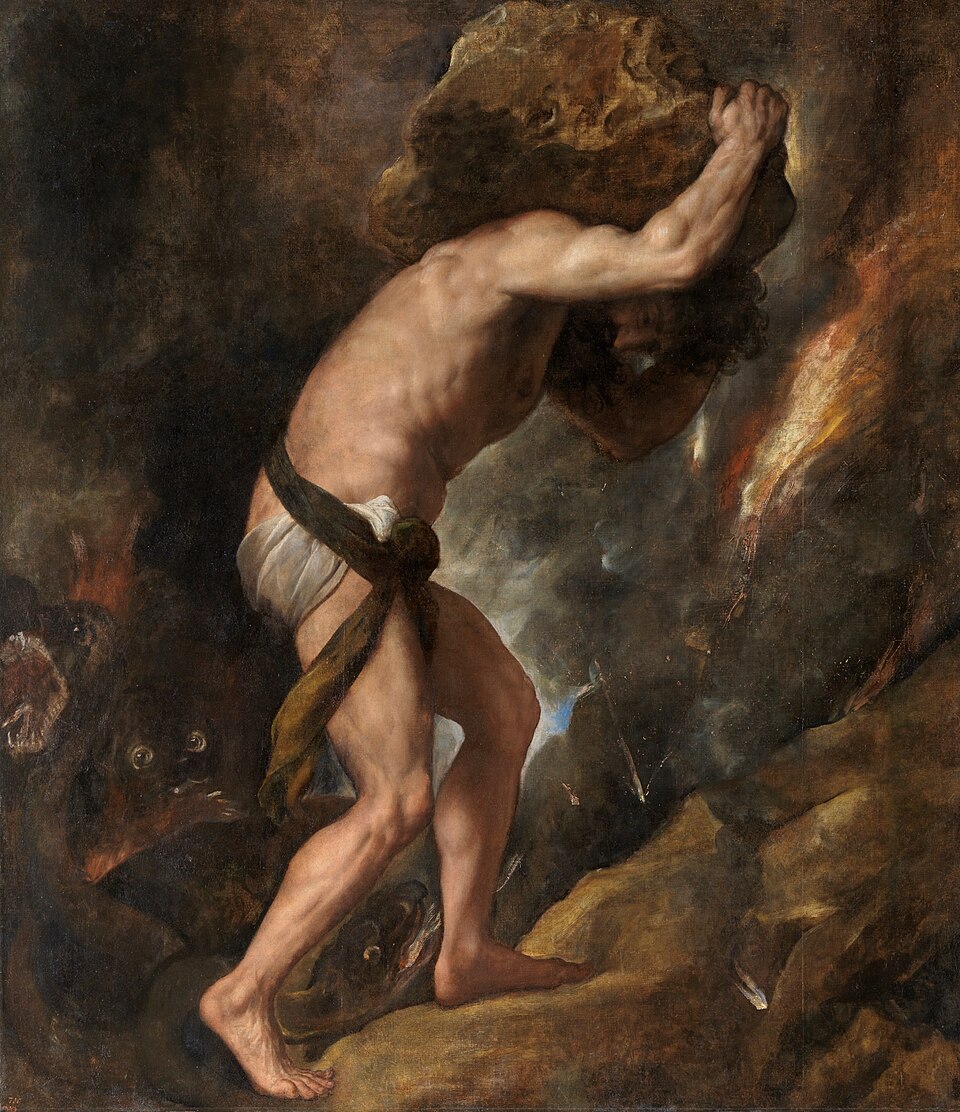
The Myth of Sisyphus (1942) set out from the absurd: the confrontation between the human call for meaning and the unreasonable silence of the world. Religion there is one of the temptations to be refused: that of the “saut”, the leap, for which Camus reproaches Kierkegaard and Shestov, and which consists in making the absurd itself a path towards God. Camus asks that one live in the absurd without leaving it either through suicide or through faith, and he ends on the image of Sisyphus going back down towards his rock: “La lutte elle-même vers les sommets suffit à remplir un cœur d'homme. Il faut imaginer Sisyphe heureux”, the struggle itself towards the heights is enough to fill a man's heart. One must imagine Sisyphus happy. The happiness of Sisyphus promises nothing, justifies nothing: it is, avant la lettre, a spirituality without consolation, in the sense in which Weil spoke of it in the very year Camus published this book.
The Rebel shifts the question from the absurd to revolt. The central formula is a cogito: “Je me révolte, donc nous sommes”, I rebel, therefore we are. Revolt is not a solitary act: it discovers, in the very refusal, a value common to all men, something in me that must not be violated and that is also in the other. And it has a metaphysical form: “La révolte métaphysique est le mouvement par lequel un homme se dresse contre sa condition et la création tout entière”, metaphysical revolt is the movement by which a man rises up against his condition and the whole of creation.
It is here that Camus meets Ivan Karamazov, and his reading joins that of Part Seven. Ivan, Camus writes, “inaugure l'entreprise essentielle de la révolte qui est de substituer au royaume de la grâce celui de la justice”, inaugurates the essential undertaking of revolt, which is to substitute for the kingdom of grace that of justice. Ivan does not deny God; he judges him, in the name of justice, and returns his ticket. But this revolt contains in germ its own perversion: if justice replaces grace, and if man is the sole judge, man may permit himself anything in the name of justice. Camus says it bluntly: “A ce ‘tout est permis’ commence vraiment l'histoire du nihilisme contemporain”, with this “everything is permitted” the history of contemporary nihilism truly begins.
The thesis of the book is therefore this. Metaphysical revolt, just in its principle, becomes criminal when it forgets its limit. It begins by contesting God in the name of man; it ends by divinizing man, then history, and by killing in the name of this new divinity. Camus describes the outcome of this drift through an enumeration: “Le cynisme, la divinisation de l'histoire et de la matière, la terreur individuelle ou le crime d'Etat”, cynicism, the divinization of history and of matter, individual terror or state crime. The divinization of history: that, in Camus, is the name of what this essay calls the refoundation of a religion. Marxism, for him, has not left religion; it has replaced the kingdom of God with the end of history, and reproduces, with the Inquisition removed and the camps added, the structure of collective salvation.
The encounters between Camus and our authors are attested by the book's very table of contents: one chapter is entitled “L'Unique” (“The Unique One”), on Stirner (p. 84), another “Nietzsche et le nihilisme” (“Nietzsche and Nihilism”, p. 88), others “Les régicides” (“The Regicides”, p. 143) and “Les déicides” (“The Deicides”, p. 168). Camus read Stirner, Nietzsche, Hegel, Marx, and Dostoevsky with a fervour that would lead him, in 1959, to adapt for the stage Les Possédés, the title under which Demons was then known in France. With them he builds a genealogy of nihilism that resembles, on many points, the one this essay has proposed: Stirner pushes revolt to absolute egoism; Nietzsche sees nihilism and wants to overcome it through the yes to life, but his doctrine would be misappropriated; Marx turns revolt into a religion of history.
Against this drift, Camus proposes a thought of the limit, which he calls “pensée de midi”, the thought of noon, in reference to the Mediterranean, to Greek light, to measure. The last part of the book closes on a sentence that condenses everything: “Au midi de la pensée, le révolté refuse ainsi la divinité pour partager les luttes et le destin communs”, at the noon of thought, the rebel thus refuses divinity in order to share the common struggles and destiny. To refuse divinity: not only that of God, but that which the rebel is tempted to attribute to himself. Measured revolt contests God without making itself God, refuses grace, but also history as supreme tribunal. It remains on a human scale, in solidarity with other men, without promise.
The book provoked one of the most violent quarrels of the postwar period. Francis Jeanson, in Les Temps modernes, published in 1952 a severe article, “Albert Camus ou l'âme révoltée” (“Albert Camus, or the Rebel Soul”); Camus replied with a letter to the review's director dated 30 June 1952, and Sartre in turn replied to him, which consummated the break between the two men. For Jeanson and Sartre, Camus, by refusing revolutionary violence in the name of a morality of measure, places himself outside history, in the purity of a beautiful soul, and his thought of noon is a disguised religious position: eternal morality against concrete history. For Camus, on the contrary, it is Sartre's thought, which accepts violence in the name of the end of history, that is religious: it sacrifices present men to future men, as the inquisitors sacrificed bodies to the salvation of souls.
I believe that Camus is right on the substance and Sartre on a point of method. On the substance, Camus saw, two years after Meaning in History and without depending on Löwith, that the philosophies of history refound an eschatology, and that this eschatology authorizes murder. He saw that the exit from religion, when it claims to found a collective salvation on history, is more murderous than the religion it leaves, because it no longer has a beyond to limit its demands here below. On method, Sartre is right to reproach him for judging history from above: the thought of noon has no institution, no politics, no grip on reality. It is an individual wisdom presenting itself as a collective answer.
For our question, Camus is a new serious candidate for exception, after Spinoza, Hume, Nietzsche and Wittgenstein, and alongside Weil. He does not refound a religion: he expressly refuses divinity, of God as of man, and he refuses consolation, since Sisyphus is happy without hope. Yet he keeps what resembles a spirituality: the beauty of the Mediterranean world, solidarity, Greek measure, lucid acceptance. Is that enough to say that he has left religion without founding another? I believe so, with one reservation. The “pensée de midi” is a myth, in the sense in which Camus himself likes the word, and this myth has its sacred geography, the Mediterranean, and its golden age, Greece. Camus divinizes neither man nor history; but he aestheticizes a nature and a culture, and this aestheticization is perhaps the most discreet form of refoundation. I leave the question open for the conclusion.
Portrait: United Press International, Public domain
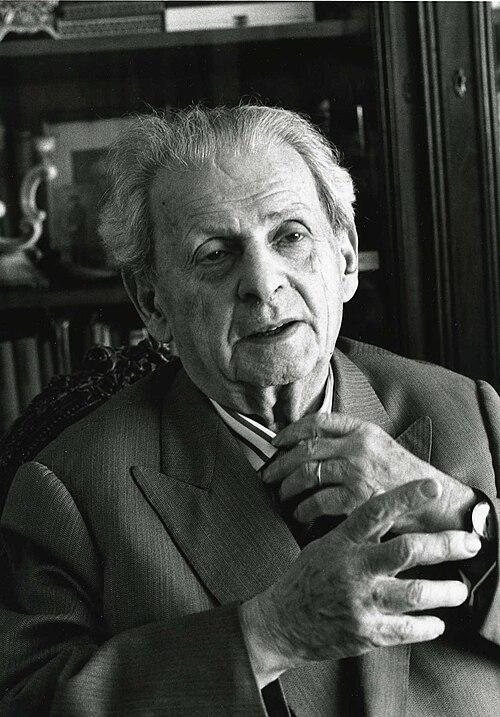 Levinas1906-1995ethics as an optics of the divine
Background: Judaism: from the Second Temple to emancipation · The thought of Maimonides: the Guide for the Perplexed, the Mishneh Torah, prophecy · Phenomenology: from Husserl to the theological turn · Rudolf Otto and The Idea of the Holy: the numinous, the wholly other, comparative mysticism · Levinas's philosophy: the other, the face, ethics as first philosophy, the Talmud · The God of the Bible: his names, his images and the formation of monotheism
With Emmanuel Levinas, the critique of onto-theology changes its source. Heidegger had diagnosed onto-theology and sought the way out in another thinking of being. Levinas, one of the first to introduce Husserl and Heidegger into France, starts from the same diagnosis and draws the opposite conclusion: it is not the forgetting of being that disfigured God, it is being itself. The God of the philosophical tradition was thought of as a supreme being, then as the being of beings; in both cases he was caught up in ontology, and that was his undoing. One must therefore look for a God uncontaminated by being, in the phrase of the foreword to Of God Who Comes to Mind (1982). The title of the great book of 1974, Otherwise than Being or Beyond Essence, states the programme: not to be otherwise, but otherwise than being.
This God is found neither in a mystical experience nor in a supernatural revelation, but in the most everyday relation there is, the relation to the other person. Totality and Infinity (1961) starts from a text we read in Part Three, Descartes's third Meditation. There Descartes discovers in himself an idea he could not have produced, the idea of the infinite, which exceeds him; and he concludes that there is in him, in a certain way, the perception of the infinite, that is, of God, before that of the finite, that is, of himself (the Latin sentence is quoted in Part Three). Levinas keeps the structure and changes the content. The idea of the infinite is a thought that thinks more than it thinks, a content that overflows its container. And this structure is encountered not first in the proof of God, but in the face of the other, which always exceeds the idea I form of it.
The face is the central notion, and it must be understood in the strictest sense: not a form one sees, but a nakedness that speaks. In a text of 1952, “Ethics and Spirit”, collected in Difficult Freedom (1963), Levinas writes that the face is inviolable, that these eyes, absolutely without protection, oppose possession with an absolute resistance, and that the temptation of murder is inscribed in this resistance; and he concludes: to see a face is already to hear “Tu ne tueras point”, “Thou shalt not kill”. The commandment is not added to the face by a law, it is the face itself; and it is only there that God can be thought: everything I can hear coming from God or going towards him, God who is invisible, must have come to me through this unique voice.
Hence the formula that condenses all of Levinas, and which is a precise answer to our question: “Ethics is an optic”. Ethics is not the corollary of the vision of God, it is that very vision, so that everything I know of God must find an ethical expression. Levinas adds an example that directly concerns Maimonides, whom we read in Part One: the knowledge of God we can have is expressed, according to Maimonides, in the form of negative attributes; it receives a positive meaning from the moral statement “God is merciful”, which means “be merciful like him”. The attributes of God are given not in the indicative, but in the imperative. A text of 1961, published in L'Arche, says it more sharply: ethics is an optics of the divine; no relation with God is direct or immediate; the divine can be manifested only through the neighbour; and for a Jew, incarnation is neither possible nor necessary.
Feuerbach, for whom the truth of theology is anthropology, added, in the Grundsätze der Philosophie der Zukunft (1843), that the unity of I and Thou is God (§ 60, quoted in Part Six), and that “die wahre Dialektik ist kein Monolog des einsamen Denkers mit sich selbst, sie ist ein Dialog zwischen Ich und Du”, true dialectic is not a monologue of the solitary thinker with himself, it is a dialogue between I and Thou (§ 62). Levinas seems to say the same thing, and says the opposite. For Feuerbach, the Thou refers me to humanity, to the species, to the common essence we share; the relation is symmetrical, and God dissolves into it. For Levinas, the face of the other refers me to a height I do not share, to an irreducible asymmetry: the other is not another self, he is situated, Levinas says, in a dimension of height, in the ideal, in the divine. Martin Buber, in Ich und Du (1923), had already thought of the relation as the place where the Eternal lets himself be encountered; Levinas always acknowledged this priority, and always reproached him for the reciprocity of the relation, which erases height. The confrontation with Feuerbach is constructed, the one with Buber attested in Levinas's work; both show that the same word, the Thou, can found an exit from religion or a new religion depending on whether it is thought of as symmetrical or asymmetrical.
This thought has a name in Difficult Freedom: “a religion for adults”, the title of an essay of 1957. There Levinas joins, unexpectedly, the most radical critiques this essay has encountered. Judaism, he writes, disenchanted the world, by contesting the idea that religions arose from enthusiasm and the sacred. Enthusiasm is possession by a god; the numinous, the sacred in Otto's sense, envelops and transports man beyond his powers, and true freedom is offended by this uncontrollable surplus. The sentence is uncompromising: the sacred that envelops and transports me is a violence. One recognizes Weber's vocabulary, and one hears a direct reply to Rudolf Otto: the mysterium tremendum, far from being the heart of religion, is what true religion must free itself from.
Levinas pushes the paradox to its limit. Monotheism, measured against the divine that the mythical gods embodied, is nothing but atheism. The destruction of the numinous sacred carries the risk of atheism, and this risk must be run: it is a great glory for the Creator to have set on its feet a being who affirms him after having contested and denied him. Monotheism surpasses and integrates atheism, but it is impossible unless one has reached the age of doubt, solitude and revolt. The critique of religion is therefore not the enemy of faith, but its condition. One also understands why Levinas, in the same text, finds Simone Weil as an adversary, since she sought in pagan myths the forms of the true God. The same essay rejects the Plotinian exit: against the philosophy that proclaims, with Plotinus, that the soul will go towards nothing other than itself, Judaism teaches a real transcendence, a relation with Him without whom the soul cannot stand. Plotinus, whom we read in Part One, is targeted here by name: this is an attested response.
In 1961, the year of Totality and Infinity, Levinas published a short occasional piece, “Heidegger, Gagarin and Us”, collected in Difficult Freedom. In it he targets the prestigious current of modern thought that came from Germany, which would have man rediscover the world, rootedness, landscape, place. Technology, on the contrary, tears us away from the Heideggerian world and from the superstitions of Place; what matters most in Gagarin's feat is that he left Place, and that for an hour a man existed outside any horizon. Judaism did not sublimate idols, it demanded that they be destroyed; like technology, it demystified the universe. The confrontation is attested, and of a violence that the urbanity of the tone does not hide: for Levinas, the sacred of place, of soil and of blood is the very essence of paganism, and the thinking of being is its last learned form. Levinas, a prisoner of war while his family was being murdered in Lithuania, had admired Sein und Zeit and seen its author join the Nazi party in 1933.
The criterion makes Levinas hard to classify. He seems to escape refoundation without difficulty: he installs neither Church, nor cult, nor dogma, and his religion for adults is defined precisely against the enthusiasm that carries the individual outside himself. But he demands something else, which resembles a sacrifice. In a radio commentary of 1955, “Loving the Torah More than God”, devoted to Zvi Kolitz's text attributed to Yossel Rakover, a fighter of the Warsaw ghetto, he writes that to love the Torah more than God means precisely to have access to a personal God against whom one can rebel, that is, for whom one can die. And Otherwise than Being pushes responsibility for the other as far as substitution, as far as the hostage: I am responsible for the other to the point of answering for his fault, without reciprocity.
Is this an absolute in whose name the sacrifice of the individual can be demanded? I do not think so, without being entirely sure. To die for a God against whom one rebels is a self-offering, which the criterion does not reach. The reason lies in the nature of this absolute: neither an idea, nor a nation, nor a class, nor a Church, but the singular face of the other human being, this one, now. The sacrifice the criterion denounces consists in immolating individuals to an abstraction; Levinasian responsibility consists in never sacrificing an individual to an abstraction, even that of the common good. One may judge this demand crushing, and I believe it is: an infinite responsibility, without reciprocity, is a burden no life can carry, and Levinas knows it, since he introduces the “third party”, justice and the State to measure it. But it does not refound a religion in the sense in which Comte founded one. Levinas offers a spirituality that has mourned the sacred, and that finds the divine in the prohibition of murder. It is, with Ricoeur, a demanding form of faith that has passed through critique; and it is, against Heidegger and against Marion, an exit from onto-theology that passes not through being but through the other.
Portrait: Bracha L. Ettinger, CC BY-SA 2.5
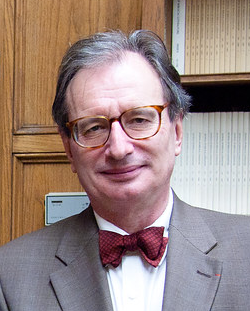 Marionb. 1946the idol and the icon
Background: Phenomenology: from Husserl to the theological turn · The thought of Heidegger: Dasein, Being and Time, the turn, technology, 1933 · The philosophy of Jean-Luc Marion: the idol and the icon, givenness, the saturated phenomenon
Jean-Luc Marion closes this part with a reversal. A Catholic philosopher, a phenomenologist, a pupil of Beaufret in the preparatory class for the École normale supérieure and of Derrida at the École itself, in the rue d'Ulm, a specialist in Descartes, he published in 1982 God Without Being, which takes the Heideggerian critique of onto-theology seriously and turns it in favour of faith. If the God of metaphysics is only an idol, faith has lost nothing by his death: it can at last think of God otherwise than as the supreme being.
The central distinction of the book is that of the idol and the icon. The idol is not a false god in the ordinary sense; it is a way of seeing. It stops the gaze and sends back to it its own measure, like an invisible mirror. The gaze that produces the idol is filled: it sees what it can see, it sees God at its own height. The icon, on the contrary, does not let itself be seen: it looks at the one who looks at it, and decentres him. Marion applies this distinction to concepts: “Quand une pensée philosophique énonce, de ce qu'elle nomme alors ‘Dieu’, un concept, ce concept fonctionne exactement comme une idole”, when a philosophical thought states a concept of what it then calls “God”, this concept functions exactly like an idol. The God of the philosophers is a conceptual idol, and Marion defines it in Heidegger's very terms: “l'idole conceptuelle a un site, la métaphysique, une fonction, la théologie dans l'onto-théo-logie, et une définition, la causa sui”, the conceptual idol has a site, metaphysics, a function, theology in onto-theo-logy, and a definition, the causa sui.
Marion nevertheless goes further than Heidegger, and it is here that the attested response takes shape. Heidegger, in denouncing onto-theology, did not free God from being; he only changed the order of subordination. For him, God can appear only within the horizon of being, as the divine that shows itself to meditative thinking; he remains subject to the question of being. Marion sees in this a second idolatry, subtler than the first. Hence his thesis: “Dieu ne se dit pas d'abord et à partir de l'Être”, God is not said first of all and on the basis of Being. God is said on the basis of love, of agapè, of the gift, which precedes being and cannot be reduced to it. According to an academic thesis, Marion even crosses out the word “God”, to signify that the name does not name a being.
The Zurich seminar here takes on its full significance. Marion relies on Heidegger's declaration that a theology, if he were to write one, should not contain the word “being”. He takes Heidegger at his word: since Heidegger himself admits that faith has no need of being, let us write the theology without being that he never wrote. The response is attested, and skilful: it turns against Heidegger the most sincere concession he ever made.
Marion has been challenged from two sides. The Thomists reproached him for making Thomas Aquinas an onto-theologian, whereas the Thomist esse, the act of being, is not a supreme being but the pure act that surpasses all essence; J.-D. Robert defended Thomas against Marion as early as 1983. Marion himself qualified his position in an article of 1995, “Saint Thomas d'Aquin et l'onto-théo-logie”, published in the Revue thomiste, often read as a partial retraction. On the other side, Heideggerian and unbelieving readers reproached him for remaining onto-theological in spite of himself: to think of God as love or as gift is still to give him a first name, a founding attribute, and therefore to place him at the summit of a hierarchy.
Marion proves, by example, that the critique of onto-theology is not a critique of faith, and that it can even serve it. This is what Barth had done with Feuerbach, Bonhoeffer with modern autonomy, Weil with the Marxist critique of consolation. Twentieth-century Christianity systematically turned the critiques of religion into purifications of faith, and this reversal is, I believe, both a victory and a capitulation. A victory, because faith thus purified escapes the objections of Feuerbach, Marx, Nietzsche and Heidegger: it no longer claims to know anything of God, it no longer consoles, it no longer founds anything. A capitulation, because to escape them it has had to give up almost everything that made it a religion: a knowledge, a consolation, a foundation, an institution. What remains is a spirituality, rigorous, demanding, but all the more exposed to the opposite objection: of being no more than the pious name of an experience that atheists such as Bataille, Camus or, as we shall see, Comte-Sponville, also claim.
Portrait: Aymeric De La Toune, CC BY-SA 4.0
Assessment of Part Ten: the critique of religion changes sides
Background: The thought of Bonhoeffer: The Cost of Discipleship, the Ethics, the prison letters · Levinas's philosophy: the other, the face, ethics as first philosophy, the Talmud · The philosophy of Jean-Luc Marion: the idol and the icon, givenness, the saturated phenomenon · Twentieth-century Christian theology: dialectical, existential, Catholic, death of God · The philosophy of Karl Jaspers: psychopathology, existence, philosophical faith, the Axial Age
In the nineteenth century, the critique of religion was the work of unbelievers, and believers endured it. In the twentieth century, it is shared. Heidegger criticizes the God of the philosophers in the name of a divine god; Barth criticizes religion in the name of revelation; Bonhoeffer announces the end of religion in the name of Christ; Weil makes atheism a purification in the name of love; Levinas seeks the trace of God in the face of the other; Marion turns Heidegger around in the name of charity. Facing them, Wittgenstein keeps silent about what cannot be said, Bataille seeks ecstasy without God, Sartre takes atheism as his starting point, Camus refuses all divinity in the name of measure. And these two camps meet on one point: the refusal of the available God, the God who consoles, guarantees and founds. Heidegger writes that god-less thinking is perhaps closer to the divine god; Bonhoeffer, that the world become godless is perhaps closer to God; Weil, that the one who denies God is perhaps the closest to him. Three times the same “perhaps”, three times the same closeness of the godless and God, in three authors of whom it cannot be established that they read one another on this point. I do not claim that this convergence proves anything; I say that it redefines the question.
The question can no longer be: can one leave religion? It becomes: what does one leave when one leaves religion? If one leaves the God-as-foundation, the God-as-consolation, the stopgap God, the most demanding believers of the century left them too, and are none the worse for it. What remains common to both, an attention, an orientation, a way of standing before what cannot be possessed, is perhaps what can be called, in the strong sense, a spirituality. And the question shifts once more: is this common spirituality the truth of religion, at last freed from its idols, or its last refuge, the form in which religion survives its own critique?
It is also historical: what happened, in the real history of the West, when religion ceased to structure societies? The authors of the next part asked it as historians, jurists and sociologists, and they gave a name to what happened: secularization. But this name, far from closing the debate, reopened it. It is this trial of secularization that must now be conducted.
Part Elevensecularization on trial
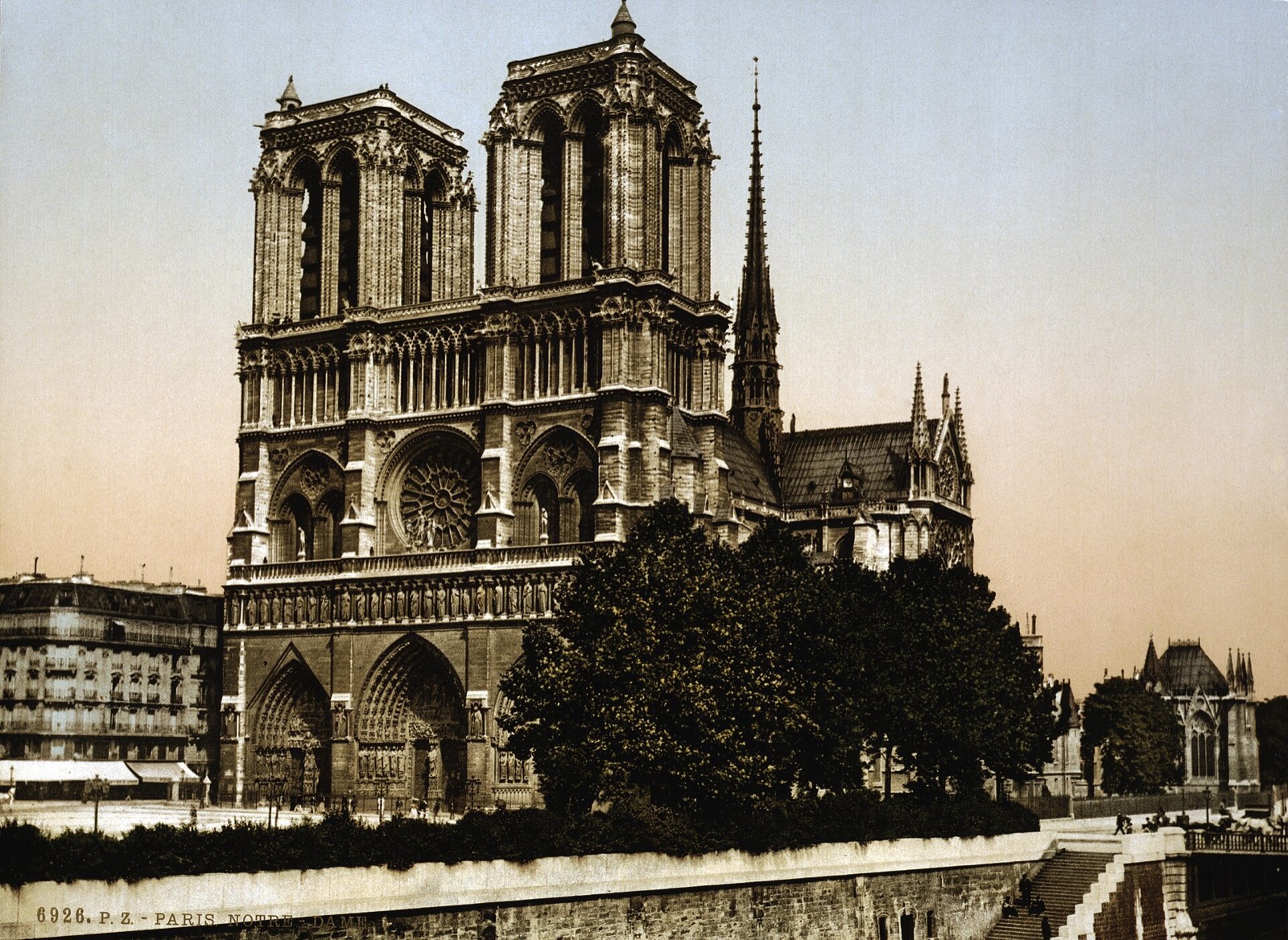
Background: Genesis 1 to 3: the creation, Adam and Eve, the fall · From Cain to Babel: the fratricide, the Flood, the tower · Marxism and religion: from Lenin to liberation theology · The philosophy of history: from Augustine to Löwith · French laïcité: from Jules Ferry's school to the law of 1905 · The Churches and the totalitarian regimes: Barmen, the concordats, state atheism · Vatican II, the secularization of Europe and the return of the religious · The Revelation of John: visions, the beast and the heavenly Jerusalem
Marion left us before a paradox: a theologian, in order to free God from metaphysics, takes up the very gesture of the modern critique of religion and denounces the God of the philosophers as an idol. The critique of the idol thus crosses the border between believers and unbelievers, and that border is perhaps not where we thought it was. Until now, we have asked each author whether he had left religion or refounded one. Yet this question assumes that we know what it means, for a modern idea, to come from religion. To say that Comte refounds a cult, that Marx inherits eschatology, that Heidegger awaits a god, is to assert a filiation; and the filiation between Christianity and modernity is the subject of one of the great controversies of the twentieth century, the secularization debate. Between 1922 and 1976 it set against one another a Catholic jurist, a philosopher of Jewish origin, baptized a Protestant and returned to Stoic scepticism, and a philosopher who made modernity the opposite of a debt. This debate puts my thesis on trial: if Blumenberg is right, most of the “refoundations” this essay believed it saw are optical illusions.
 Carl Schmitt1888-1985political theology as the truth of modernity
Background: Carl Schmitt's thought: decisionism, friend and enemy, political theology · The Churches and the totalitarian regimes: Barmen, the concordats, state atheism
Politische Theologie. Vier Kapitel zur Lehre von der Souveränität (Political Theology: Four Chapters on the Concept of Sovereignty) appeared in 1922, then in a second edition in 1934. Its third chapter opens with a sentence that became the watchword of the whole discussion: “Alle prägnanten Begriffe der modernen Staatslehre sind säkularisierte theologische Begriffe”, all significant concepts of the modern theory of the state are secularized theological concepts.
The sentence can be read at two levels, which Schmitt holds together. The first is historical: the concepts have migrated. The omnipotent God of theology became the omnipotent lawgiver of the modern state; sovereignty, a divine attribute, passed to the prince, then to the people. The second, the one that interests Schmitt, is systematic: political concepts do not merely have the same origin as theological concepts, they have the same structure, and one understands a political epoch only by understanding the metaphysical image of the world it gives itself. The definition that opens the book, according to which sovereign is he who decides on the state of exception, finds its foundation here. The exception, which suspends the legal order, occupies in jurisprudence the place that the miracle occupies in theology; I do not quote Schmitt's sentence, which I have not read on a reliable page, but the analogy is the heart of the chapter. Hence the parallel that, in his view, organizes all of modern history: deism, which excludes the miracle and makes God the clockmaker of a world governed by its own laws, corresponds to the liberal state under the rule of law, which excludes the exception and claims that the norm suffices for everything. The theology of the Counter-Revolution, that of Bonald, de Maistre and above all Donoso Cortés, saw what liberalism refused to see: that a decider is needed, and that the decision cannot be deduced from any norm.
People often mistake Schmitt's tone. They read his formula as a denunciation in the manner of Feuerbach: modern politics would be nothing but disguised theology, and it would have to be unmasked. Hebekus has shown that the reverse is true. Schmitt does not reproach modernity for having stolen its concepts from theology, but for having forgotten it, and he wants the politics of decision to raise itself, of its own accord, to the theological height from which it descends. Secularization is not for him an illegitimacy to be corrected, it is a truth to be embraced, and decisionism is the politics that embraces it.
Schmitt is thus, with Rousseau and Comte, one of the few authors in the corpus who claim refoundation; he is the only one to claim it as the truth of modernity as a whole. The others mostly undergo it without knowing it, and it is the next critic who reveals it to them: Stirner to Feuerbach, Marx to Stirner, Heidegger to Nietzsche. Schmitt, for his part, wants it. The sovereign who decides on the exception is a mortal god, and Schmitt, who wrote its genealogy, knows it. That this jurist put his talent at the service of the National Socialist regime in 1933, and that in 1934 he justified the murders of the “Night of the Long Knives” in an article whose title made the Führer the protector of the law, “Der Führer schützt das Recht”, is not a biographical accident unconnected with the thesis: it is what becomes of a political theology that sacralizes decision without saying in the name of which God. I write this without polemical pleasure: Schmitt is the limit case of refoundation, the one in which the sacred returns without even the mask of Humanity, in the sole form of authority.
Portrait: Auteur inconnu, Public domain
Karl Löwith1897-1973the philosophy of history as disguised eschatology
Background: The philosophy of Hegel: dialectic, the Phenomenology, Absolute Spirit, religion and concept · The thought of Marx: historical materialism, alienation, ideology, fetishism · The thought of Comte: law of three stages, sociology, religion of Humanity · The philosophy of history: from Augustine to Löwith · Karl Löwith's thought: from Hegel to Nietzsche, history as secularized eschatology · The Revelation of John: visions, the beast and the heavenly Jerusalem
Karl Löwith, a student of Heidegger before becoming one of his harshest critics, driven out of Germany by the racial laws, taught in Japan and then in the United States. It was there that he published Meaning in History. The Theological Implications of the Philosophy of History (Chicago, 1949), translated and reworked in German under the title Weltgeschichte und Heilsgeschehen (World History and Salvation History, 1953). The book goes back in time: it starts from Burckhardt and moves backwards through Marx, Hegel, Proudhon, Comte, Condorcet and Turgot, Voltaire, Vico, Bossuet, Joachim of Fiore, Augustine and Orosius, as far as the Bible.
The thesis is simple. The idea that universal history has a knowable meaning, directed towards a fulfilment, is neither Greek nor natural. The Greeks thought of time as a cycle; they did not seek the meaning of history, but the logos of the cosmos. Oriented history comes from Hebrew and Christian faith, from the expectation of a final fulfilment, the eschaton, which gives meaning to everything that precedes it. The modern philosophies of history, of progress as of revolution, were born when this schema was transposed into immanence: fulfilment is no longer expected from God at the end of time, it is produced by man within time. The philosophy of history is Christian eschatology minus God: it keeps the form, it changes the subject.
The chapter on Marx is the most famous. Löwith reads the Manifesto there as a prophetic document disguised as science: the proletariat is the chosen people, the revolution is the judgement, the classless society is the kingdom, and the whole of history is a history of salvation transposed into economics. The formula is plain: “It is the old Jewish messianism and prophetism”, Löwith continues, speaking of Marx. This is the objection I addressed to Marx in Part Six: a revolution that promises the end of suffering and the meaning of history takes the form of salvation. Löwith formulated it as early as 1949, with an erudition I do not claim to equal.
The chapter on Comte, less often cited, also sheds light on Part Six. Löwith sees in it the same transposition, in a more naive and more explicit form. The law of the three stages, which moves humanity from the theological age to the metaphysical age and then to the positive age, is a history of salvation in three ages, and Löwith recalls that it has a precise medieval ancestor: the division of history into three reigns, that of the Father, of the Son and of the Spirit, in Joachim of Fiore, the twelfth-century Calabrian abbot whom the Franciscan Spirituals had made the prophet of a new age. Positivism, which believed it had dismissed theology, reproduced its most daring schema, the advent of a third age on earth. And Comte, unlike Marx, drew the consequence himself by founding the Religion of Humanity, with its Great Being, its sacraments and its calendar. Comte's refoundation was therefore not an eccentricity of old age, as his scientistic disciples claimed, but the logical outcome of the law of the three stages: whoever believes that history is heading towards a fulfilment must sooner or later celebrate its cult. The link between Comte and Löwith's thesis is attested by the very structure of the book; the remark on religious foundation as a necessary consequence is mine.
But Löwith's conclusion is not the one we expect. He asks neither that we return to the Christian faith, the original of which modernity would be the degraded copy, nor that we complete secularization by purifying progress of its theological remnants. The Christian faith, according to him, was never a historical expectation: the Christian awaits the kingdom, he does not await it from history. And critical reason, for its part, finds no meaning in history: “To the critical mind, neither a providential design nor a natural law of progressive development is discernible in the tragic human comedy of all times.” What Löwith proposes, at the end of the book, is a withdrawal: the Greek view of nature, the Stoic wisdom that accepts the world without asking it for meaning. Habermas, as early as 1963, gave this gesture its critical name in an article in Merkur: “Karl Löwiths stoischer Rückzug vom historischen Bewusstsein”, Karl Löwith's Stoic withdrawal from historical consciousness.
Löwith is thus an ambiguous ally. He gives my thesis its best historical support: the philosophies of history refound a religion of salvation without God, and that is why they were able to demand sacrifices that only a religion obtains. But his conclusion joins, by another path, the exceptions we have identified. His Stoicism is an exit without refoundation: it promises nothing, sacralizes nothing, demands of the individual no sacrifice to the future. It may be compared with Spinoza, and with the amor fati of Nietzsche, whom he knew closely, since in 1935 he had devoted a book to the Nietzschean philosophy of eternal recurrence, Nietzsches Philosophie der ewigen Wiederkunft des Gleichen. It remains to be seen whether one can live in this withdrawal. Blumenberg, Taylor and Habermas will answer, each in his own way, that modernity does not live there.
Hans Blumenberg1920-1996the legitimacy of the modern age
Background: Greek myths: sources, gods and divine generations · Scholasticism and the condemnations: faith and reason in the medieval university · Prometheus and Pandora: the sharing of the sacrifice, fire, evil · Carl Schmitt's thought: decisionism, friend and enemy, political theology · Karl Löwith's thought: from Hegel to Nietzsche, history as secularized eschatology · The thought of Hans Blumenberg: the legitimacy of the modern age, metaphorology, work on myth · The Revelation of John: visions, the beast and the heavenly Jerusalem
One of the two serious objections announced in the prologue did not come from a believer. It came from Hans Blumenberg, in Die Legitimität der Neuzeit (The Legitimacy of the Modern Age, 1966), a book he reworked in depth between 1973 and 1976 in response to his critics, and whose first part, devoted to secularization, is a methodical refutation of Löwith and Schmitt. I owe this objection its best form, for it forces me to make the thesis more precise.
Blumenberg starts from a semantic observation. The word “secularization” comes from law: it first designates the passing of Church property into lay hands, in particular during the confiscations of the Napoleonic era. To say that progress is secularized eschatology is therefore to use a concept that implies an expropriation: a property that legitimately belonged to someone has been taken from them. Blumenberg shows that secularization, so understood, functions as a “Kategorie des geschichtlichen Unrechts”, a category of historical injustice; in the 1962 lecture that prepared the book, he already spoke of a “Kategorie historischer Illegitimität”, a category of historical illegitimacy, a formula that gives the lecture its subtitle. Whoever says “secularized” insinuates that modernity lives on stolen property and is not legitimate in its own right.
For this reproach to hold, Blumenberg continues, three conditions would have to be met: the transferred property would have to be identifiable as the same property before and after; the first owner would have to have been its legitimate possessor; the transfer would have to have been unilateral. Yet none is met in Löwith's case. Christian eschatology awaits an end that breaks into history from outside, that judges it and interrupts it; modern progress is an immanent principle, realized in history through the accumulation of human knowledge and power. These two contents are not the same thing in two garbs: they are heterogeneous. What creates the illusion of their identity, Blumenberg states in a sentence I give in full, for it contains his whole thesis: “die historische Identität und methodische Identifizierbarkeit der als säkularisiert vermeinten Vorstellungen ist ein Schein, der entsteht durch die Identität der Funktion, die ganz heterogene Gehalte an bestimmten Stellen des Systems der Welt- und Selbstdeutung annehmen können”, the historical identity and methodological identifiability of the ideas supposed to be secularized are an appearance, which arises from the identity of the function that quite heterogeneous contents can assume at certain places in the system of interpretation of the world and of the self.
Here is the decisive concept: Umbesetzung, reoccupation. Christianity opened certain questions, it hollowed out certain places in the interpretation man gives himself of himself and of the world: the question of the meaning of history as a whole, that of the totality of the real, that of an end. When Christianity ceased to answer them credibly, the questions remained, and modernity was summoned to answer them in its turn, with contents that had nothing Christian about them. Progress is not disguised eschatology; it is the modern answer to a question that eschatology had posed, and which it had to take up, so to speak, in spite of itself. The identity of the place has been mistaken for the identity of the occupant. Blumenberg even sees here the origin of the excesses of the philosophies of history: they overloaded the concept of progress because they believed themselves bound to answer an immoderate question, that of the totality of history, which modernity had not posed itself.
As for the legitimacy of modernity, it does not come from an inheritance, but from a Selbstbehauptung, a self-assertion. Blumenberg dates it precisely: it is man's response to the theological absolutism of the late Middle Ages, that of nominalism, which had made God an arbitrary and all-powerful will, before which the world no longer offered any guarantee of order. Against a hidden and unpredictable God, man had to take charge of himself, to know and master nature in order to find his bearings in it. Modernity is not a Christianity that has lost its faith; it is a response to an internal crisis of Christian theology, a response that owes it nothing other than its provocation.
The exchanges are attested. Blumenberg built his criteria on the example of Löwith. Löwith answered him with a review, dated 1968 in his Sämtliche Schriften (vol. II, pp. 452-459); in it, according to Weidner, he reproaches Blumenberg for demanding a substantial identity as proof of secularization while denying that such an identity could ever exist, that is, for imposing on his adversary an impossible burden of proof. Schmitt, for his part, replied in 1970 in the last chapter of Politische Theologie II, reproaching Blumenberg for already presupposing, in his demonstration, the standpoint of the modernity he claims to legitimize. Blumenberg replied in the revised edition: Schmitt's formula is in his eyes “die stärkste Form des Säkularisierungstheorems”, the strongest form of the secularization theorem, but he proposes to reverse it. Modern political concepts are not secularized theological concepts; they are theologized concepts, to which an absoluteness they do not have is attributed, because one expects from politics what one expected from God. The two men then corresponded, from 1971 to 1978, at Blumenberg's initiative; the correspondence was published in 2007.
This last inversion is, I believe, the key: it makes it possible to answer Blumenberg without proving him wrong. What does he say, in sum? That modernity does not inherit Christian contents, but finds itself before empty places that it is tempted to occupy, and that, when it occupies them, it overloads its own concepts with an absoluteness that does not belong to them: it theologizes. This is what I call a refoundation. I must, however, concede an important point. If one takes the essay's thesis in its extensive version, the one which says that every modern structure resembling a Christian structure is a disguised religion, then Blumenberg is right against it: that thesis proves too much. It makes religion unfalsifiable, since it will be found wherever one finds a hope, a community, an ideal or a history. It belongs to what Blumenberg calls a metaphysics of substance, which assumes that contents persist beneath metamorphoses: it is the laziness of the historian who sees shadows everywhere.
The criterion set out in the prologue finds its justification here; it owes more to Stirner than to Löwith. A thought refounds a religion not when it occupies a place left empty by Christianity, which is inevitable, but when it installs in that place an absolute in the name of which the sacrifice of the individual can be demanded, and whose critique becomes a sacrilege. Progress as a hypothesis about the accumulation of knowledge is not a religion; Progress as the end of history, in the name of which the death of entire generations can be demanded, is one. Society as an object of study is not a religion; Comte's Great Being, before which one kneels, is one. The sovereign as an organ of decision is not a religion; the sovereign whose decision makes the law and whom no one judges is one. The criterion is not resemblance of structure, which Blumenberg is right to reject, but the sacrifice demanded: Stirner's question, that of the fear of Man which is only a modified form of the fear of God. Thus armed, the thesis becomes falsifiable. It can be false for a given author: it is, I believe, for Blumenberg himself, whose Selbstbehauptung demands no sacrifice and promises no salvation, which makes him an unexpected ally of the thesis. It remains true for the others, Comte, state Marxism, Schmitt, and perhaps Heidegger, whom Blumenberg no longer forbids me to accuse, since his own concept of theologization says what I reproach them with.
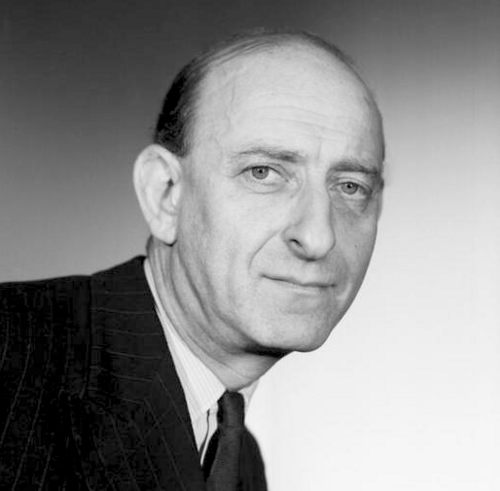 Voegelin and Aron1901-1985; 1905-1983secular religions
Background: From Cain to Babel: the fratricide, the Flood, the tower · Gnosis and Gnosticism: from Valentinus to Hans Jonas and Voegelin · The philosophy of history: from Augustine to Löwith · The thought of Eric Voegelin: political religions, gnosticism, order and history · The thought of Raymond Aron: critical philosophy of history, secular religions, the opium of the intellectuals · The Churches and the totalitarian regimes: Barmen, the concordats, state atheism · The Revelation of John: visions, the beast and the heavenly Jerusalem
Schmitt and Löwith speak of concepts and of philosophies of history. Two authors, at almost the same moment and without having consulted each other, carried the question onto harsher ground: that of the regimes which, in the twentieth century, actually demanded of millions of people that they sacrifice themselves, or sacrifice others, to an earthly absolute. Eric Voegelin called them political religions, Raymond Aron secular religions. Both expressions name what this essay has been describing from the start, and that is why I place them at the heart of the secularization quarrel rather than in the chapter on totalitarianisms where they are usually filed.
Voegelin, born in Cologne and trained in Vienna under Hans Kelsen, was teaching political science at the University of Vienna when, in the spring of 1938, he had a short and dense essay printed, Die politischen Religionen (The Political Religions). The first edition, ready in April 1938, was suppressed by the National Socialist management imposed on the publisher Bermann-Fischer after the Anschluss; Voegelin, stripped of his licence to teach, left Vienna on 13 July, and the second edition appeared in Stockholm, with a preface dated Christmas 1938. The book's thesis is summed up by the Neue Deutsche Biographie: Voegelin interprets National Socialism as a form of innerworldly religiosity, “innerweltlicher Religiosität, die das rassisch determinierte Volk vergöttliche und mit einem eigenen Mythus der Erlösung verknüpfe”, a religiosity that deifies the racially determined people and joins to it a myth of redemption of its own. The central concept is that of innerweltlich, innerworldly, religion: a religion whose realissimum, its supreme object, is no longer beyond the world but within it, race, class, the State, and which nonetheless receives from it everything that religions received from their god, faith, worship, obedience, promise.
Fourteen years later, in the United States, Voegelin gave this intuition a genealogy in The New Science of Politics (Chicago, 1952), where it joins the quarrel between Löwith and Blumenberg. We must, he writes, “recognize the essence of modernity as the growth of gnosticism”. By Gnosticism Voegelin does not mean first of all the ancient sect, which he knows through Hans Jonas, but an attitude: the certainty of possessing a knowledge that makes it possible to transform the world and deliver it from its imperfection. Its point of origin is Joachim of Fiore, whom Löwith was encountering at the same moment at the bottom of his own genealogy, and its mechanism is immanentization: “The attempt at constructing an eidos of history will lead into the fallacious immanentization of the Christian eschaton”. The formula, which American conservatism later reduced to a slogan, says what Löwith said of Marx and of Comte: the salvation that Christianity awaited from the end of time is promised by human action within time. But Voegelin pushes the analysis as far as the political regime. Totalitarianism is not for him an accident of modernity, it is its outcome: “Totalitarianism, defined as the existential rule of Gnostic activists, is the end form of progressive civilization”. He gives the reason in terms this essay could adopt: modern Gnosticism sought to supply society with the civil theology that Christianity denied it, and the totalitarianism of our time must be understood, he writes, as “journey's end of the Gnostic search for a civil theology”.
One passage of the book bears closely on our first part. Voegelin there takes up, in connection with the Puritans, the old thesis of the falāsifa according to which the multitude must not touch philosophical questions, and he concludes, after evoking the murder of God that Nietzsche had announced, that one must admit that “Averroës had a point”. The connection is attested, and it throws light on Voegelin's leaning: his diagnosis of modernity is also a nostalgia for the medieval reserve, which kept speculation on the meaning of history out of “vulgar” hands. This is Averroes' hierarchical division, and, give or take a few nuances, the gesture of Leo Strauss.
Raymond Aron reached the same notion by another path, that of sociology and of war. Editor-in-chief of La France libre in London, he published there during the war two articles on secular religions, the better known of which, “L'avenir des religions séculières”, dates from 1944. The definition he proposes there has become classic; I give it in paraphrase, not having been able to verify its wording: Aron calls secular religions those doctrines which take, in the souls of his contemporaries, the place left by vanished faith, and which locate the salvation of humanity here below, in the distant future, in the form of a social order to be created. The definition contains three elements: a place left empty, that of faith, a vocabulary Blumenberg would rediscover more than twenty years later; a salvation, that of humanity; a displacement of this salvation here below, into a social order to be built. Aron does not say that communism is a religion because it resembles Christianity; he says that it is a religion because it fixes a last end and judges good and evil in relation to it. A commentator quotes in this connection a sentence of Aron's in English translation: such doctrines “set up an ultimate and quasisacred goal and define good and evil in relation to this ideal”.
Eleven years later, Aron drew from this analysis a polemical book, The Opium of the Intellectuals (1955), whose title turns Marx's formula against the Marxists: it is no longer religion that is the opium of the people, it is Marxism that has become the opium of those who think. This is the gesture this essay has seen recur from author to author, from Stirner to Camus. Aron formulates it as a sociologist, without Stirner's violence or Camus's lyricism, and that is his strength. He does not reproach intellectuals for hoping; he reproaches them for having turned a political hypothesis into a truth of salvation, and for having drawn from it the right to justify, in the name of the future, what they would have condemned in the present. The connection with Camus is constructed: The Rebel (1951) and The Opium of the Intellectuals are, four years apart, the two great French books against the deification of history, one written by a moralist, the other by a sociologist, and they earned their authors the same hostility from the intellectual left.
This civil theology also has ancestors we read much earlier. The expression comes from Varro, by way of Augustine, and Voegelin handles it as a connoisseur of The City of God; but the thing has antecedents closer to our purpose. Plato, in Book X of the Laws, had wanted a theology of the city armed with a penal law, and Rousseau, in the penultimate chapter of The Social Contract (IV, 8), a civil religion whose dogmas were guarded by banishment and death. Voegelin does not make this connection in the pages I have read; it is my own, and it throws light on the difference between the two epochs. Rousseau wanted a civil religion limited to a few dogmas, which left each person the rest of their conscience; Plato already went further, as far as forbidding private worship. The political religions of the twentieth century no longer leave anything over: they occupy the whole soul, because they lay claim at once to knowledge, to salvation and to government. What Voegelin calls Gnosticism is perhaps first of all this, the fusion of what Plato and Rousseau still kept apart, the opinion useful to the city and the truth that sets free.
The connection with Marcel Gauchet is of another order. Gauchet took up the notion of secular religion on his own account to describe the totalitarianisms, and his reading is closer to Aron's than to Voegelin's: he sees in them not a return of heretical Christianity, but an attempt to reconstitute, in a society that has left religion, the unity and hierarchy that religion once ensured. If this reading is right, secular religions do not prove that the exit from religion is impossible, but that it is dangerous, because it leaves behind it a nostalgia for the One that regimes can exploit: a conclusion much closer to the criterion than to Voegelin's genealogical thesis.
These two notions confirm this criterion, and they test it. They confirm it, because the feature that Voegelin and Aron each retain in their own way is that of the criterion: secular religion is a belief that authorizes sacrifice. The deified Volk of 1938 demands that one die for it and kill for it; the social order to come of 1944 justifies sacrificing present generations to those who will enjoy it. The sacrifice criterion, set out in the prologue and refined in connection with Feuerbach, finds here its most massive and bloodiest cases: after Voegelin and Aron, one can no longer say that refoundation is a matter for philosophers and positivist sacristies. It has had its police, its camps and its trials.
But they also test it, for the notion of secular religion runs the risk already recognized in the lazy form of the secularization thesis: seeing gods everywhere. The objection was formulated as early as the 1950s by Voegelin's own teacher. Hans Kelsen devoted to the notion a manuscript, Secular Religion, which he withdrew from the University of California Press in 1964 and which was not published until 2012; in it he attacks Voegelin and all those who see a theological structure in modern doctrines that postulate no belief in God, on the grounds that a theory capable of proving everything, even the religious character of irreligious theories, ends up proving nothing, and turns the concept of religion into an empty shell. This attested response is aimed at a former pupil. Blumenberg, for his part, never debated with Voegelin: the colloquium Jacob Taubes wanted to organize between them in Berlin in 1967 did not take place, and no direct exchange is known; but Die Legitimität der Neuzeit takes the word Gnosticism from Voegelin in order to reverse its meaning, since it makes modernity not a triumphant Gnosticism but a “second overcoming of Gnosticism”. The confrontation is therefore half attested: Blumenberg answers Voegelin's thesis in a book, he does not answer Voegelin.
I believe that Kelsen and Blumenberg are right against Voegelin's genealogical thesis, and wrong against Aron's functional thesis. Voegelin asserts a filiation: modernity comes from Gnosticism, through Joachim and the medieval sects, as from a heresy that ended up winning. This filiation is unverifiable in its generality, and it has the drawback of making the whole of modernity, liberalism and science included, one and the same evil, which Voegelin himself moreover toned down in his later work, according to his entry in the Neue Deutsche Biographie. Aron, for his part, asserts an analogy of function: a political doctrine becomes religious when it occupies the place of faith in souls and receives from it the power to demand. This analogy presupposes no inheritance; it is a matter of observation. It is therefore compatible with Blumenberg, for whom the empty places of theology call for reoccupations, and it makes precise what he leaves in the shadow: not all reoccupations are of equal worth. Some answer an inherited question with a modest hypothesis, others with a sacrificial absolute. Secular religion, in Aron's sense, is the name of the second kind, and it is indispensable to me. The notion of political religion, understood in Voegelin's genealogical sense, is in its turn a philosophy of history, one of decline, and it falls under the reproach it addresses to the others.
Portrait: Studio Harcourt, Public domain
Leo Strauss1899-1973Athens and Jerusalem
Background: The Bible: books, canons and languages · The philosophy of Averroes: the Commentator, the intellect, the reply to al-Ghazali, Latin Averroism · The thought of Maimonides: the Guide for the Perplexed, the Mishneh Torah, prophecy · Spinoza's philosophy: substance, attributes, modes, conatus, kinds of knowledge, the Theological-Political Treatise · Plato's myths: Er, Gyges, the noble lie, the androgyne · From the Judges to the Kings: Samuel, Saul, David and Goliath, Solomon and the Temple · The thought of Leo Strauss: natural right, esotericism, Athens and Jerusalem
All the authors of this part argue about the way in which we left religion. Leo Strauss disputes that we left it at all. He disputes it not as a believer, which he never claimed to be, but as a philosopher, and that is why he is, I believe, the most serious adversary of the very thesis of the exit.
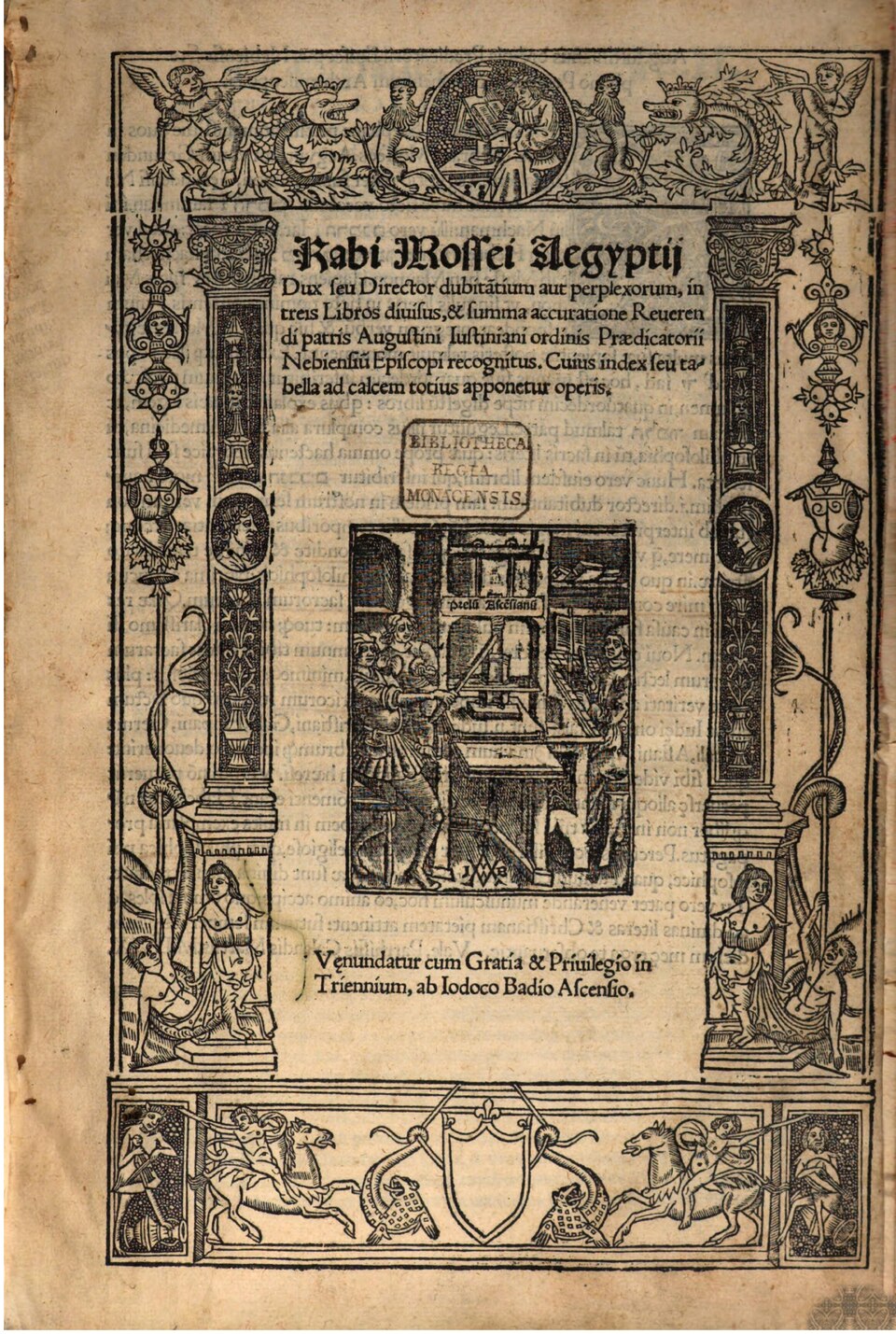
Strauss was born in 1899 in Kirchhain, a small rural town near Marburg, into an Orthodox Jewish family; he studied at Marburg, defended in 1921, under the supervision of Ernst Cassirer, a dissertation on Jacobi, and spent 1922 in Freiburg, where he attended Husserl's lectures and fell, like Levinas, Gadamer, Arendt and Karl Löwith, whose friend and correspondent he would remain, under the sway of Heidegger. His first book, written between 1925 and 1928 and published in 1930, is devoted to Spinoza's critique of religion, that is, to the very book that our third part made one of the founding acts of modern critique. In the preface to the English edition of 1965 he would present it as the work of a young Jew in Germany caught “in the grip of the theologico-political predicament”. This theologico-political problem, the question whether a society can be founded on reason alone or whether it rests on a revealed law, would be, he says elsewhere, “the theme of my studies”.
The book's thesis, as the 1965 preface restates it, reverses the story this essay has followed. Spinoza, and with him the whole Enlightenment critique, did not refute revelation. He could not, for belief in an omnipotent God who reveals himself when he wills and hides himself when he wills rests on a premise that, according to Strauss, can be refuted neither by experience nor by the principle of contradiction. And the indirect proof of this is the very means the critics used: “Spinoza and his like owed such success as they had in their fight against orthodoxy to laughter and mockery”; they tried to drive orthodoxy out by laughing at a position from which no proof drawn from Scripture or from reason could dislodge it. The modern critique of religion would thus not have won its case; it would have won a battle of opinion. And a genuine refutation would demand more than any philosopher has ever supplied: “The genuine refutation of orthodoxy would require the proof that the world and human life are perfectly intelligible without the assumption of a mysterious God”; it would require at the very least the completion of the philosophical system.
This sentence says that the exit from religion, in the strong sense in which the Enlightenment understood it, would have presupposed that reason become a total knowledge, master of the world and of life. Now that is what I have called a refoundation. The only possible refutation of revelation would be the installation of another absolute, completed reason, man the master of everything; and we know what secular religions made of that ambition. Strauss thus closes the door on both sides: one does not refute revelation without making oneself god, and if one gives up making oneself god, one does not refute it.
Conversely, and Strauss insists on this with the same rigour, revelation does not refute philosophy either. In Natural Right and History (1953), he formulates this impasse in the harshest terms for philosophy itself: “Philosophy has to grant that revelation is possible”, which amounts to granting that the philosophic life is not necessarily the right life; and further on, “the mere fact that philosophy and revelation cannot refute each other would constitute the refutation of philosophy by revelation”. For philosophy claims to be a life grounded on evidence; if it itself rests on a choice that no evidence grounds, it confirms what faith said of it. It is this conflict without an arbiter that Strauss calls Athens and Jerusalem, a title he gave to several lectures, in 1946, in 1950 and in 1967, the last published the same year in Commentary.
One recognizes here, displaced by eight centuries, the question of Averroes and of Maimonides, and it is no accident: it was by reading them that Strauss formed his thesis. Persecution and the Art of Writing (1952) maintains that the philosophers before modernity, under the threat of persecution, wrote in such a way as to convey one teaching to the majority of their readers and another to a few; Maimonides, Judah Halevi and Spinoza himself are said to be among these writers. Strauss took seriously the warning Maimonides places at the head of the Guide, not to explain his secret teaching, to the point of writing that no historian possessed of a sense of decency could lightly disregard the entreaty of a superior man such as Maimonides. We find again Averroes' division between those who demonstrate and those who are persuaded, which the first part set out; Strauss makes of it, rather than a prudence of circumstance, a permanent truth about the relation between philosophy and the city: the city lives on opinions, and in particular on opinions about the gods, which philosophy can neither share nor destroy without danger.
This thesis, hotly debated, seems to me partly fragile: it is unverifiable by construction, since the absence of signs of a hidden teaching can always be read as proof of its skill, and it has fostered among some disciples a way of reading texts in which suspicion takes the place of philology. One must also recall a letter Strauss wrote from Paris to Löwith in 1933: in it he asserted that one could protest against what he called the “shabby abomination” of the Hitler regime only on the basis of the principles of the right, “from fascist, authoritarian, and imperial principles”. The correspondence with Löwith, partly published under the title “Correspondence Concerning Modernity” (Independent Journal of Philosophy, 4, 1983, and 5/6, 1988, trans. G. E. Tucker), is one of the places where his position takes shape: the two former pupils of Heidegger, so close in their critique of historicism, diverge there over the possibility of a return to the Ancients.
His relations to the other protagonists complete his placing. As early as 1932, he wrote a review of Carl Schmitt's The Concept of the Political, in which he argued that Schmitt, despite all his efforts, remained a prisoner of the liberal horizon he was fighting, for want of being able to give reasons for his commitment to the political. The critique joins ours by another path: Strauss sees in a sovereign decision that cannot say in the name of what it decides the very symptom of the modernity Schmitt claimed to overcome. With Löwith he shares the rejection of progress and the gaze turned towards the Greeks; but where Löwith withdraws into the Stoic contemplation of nature, Strauss reopens the political question, that of the best regime, which classical philosophy posed and which modernity is said to have abandoned. With Blumenberg, finally, no dialogue is attested, but the disagreement is total: Blumenberg defends the legitimacy of the modern age as self-assertion, Strauss sees in it a break with ancient wisdom, of which Machiavelli is said to be the author and which the critique of religion is said to have made possible.
Strauss also strikes at our reading of Spinoza. The third part presented the Theological-Political Treatise as one of the acts by which modern philosophy emancipated itself from Scripture, and Spinoza as one of the rare exceptions in the series, the one who keeps the name of God without refounding a cult. Strauss does not dispute that Spinoza wanted to free philosophy; he disputes that he refuted what he was freeing it from. And he adds a suspicion our reading had not considered: that Spinoza himself wrote so as to be read in two ways, and that his apparent piety, the piety that made him a God-intoxicated man in the eyes of the Romantics, is in part an art of writing. I do not believe this suspicion undoes the reading of the Ethics that this essay has defended, for the intellectual love of God is demonstrated there, not suggested; but it obliges us to acknowledge that the Spinozist exception rests on a philosophical decision, that of holding the world to be intelligible without remainder, which Spinoza could no more prove than orthodoxy could prove revelation.
There remains from Strauss an objection I do not believe I can lift, and which I want to give in its best form. This essay's criterion says that one refounds a religion when one installs an absolute that demands sacrifice. Strauss accepts it, I believe, but he draws from it a more radical consequence. If the total exit from religion would presuppose the completion of reason, then every exit that believes itself total is already a refoundation, and the only honest position left is one that acknowledges that the question is not settled. It resembles that of the recognized exceptions, Spinoza, Hume, Nietzsche, Camus, in that it sacrifices no one to anything; it differs from them in that it does not claim to have found, in a spirituality of exercise or in a solidarity without a heaven, a peaceful way out. It keeps open, between Athens and Jerusalem, a tension it judges constitutive of the West and which it refuses to resolve.
 Marcel Gauchetb. 1946Christianity, the religion of the exit from religion
Background: The philosophy of Nietzsche: tragedy, genealogy, will to power, eternal return, overman · Weber's sociology: ideal types, rationalization, charisma, value neutrality · Marcel Gauchet's thought: the disenchantment of the world, the exit from religion, democracy · French laïcité: from Jules Ferry's school to the law of 1905
With Marcel Gauchet, the quarrel leaves Germany and changes its object. Blumenberg asked whether modernity owed anything to Christianity; Gauchet asks what a religion is, and answers that it is not first of all a belief. The Disenchantment of the World: A Political History of Religion (1985) is one of the most ambitious books French thought has devoted to our question, and its central formula seems written for this essay: Christianity is defined there as “la religion de la sortie de la religion”, the religion of the exit from religion.
The formula presupposes a definition of religion that is political before it is theological. A religion, for Gauchet, is a way of instituting the social: society receives its order from a source that is external, prior and untouchable. The rules of common life are not made by human beings; they are given to them by the gods, the ancestors, the time of origins. This is what Gauchet calls heteronomy, and he sees in stateless societies, those that ethnologists study, the purest form of religion: not the most mystical, but the one in which dispossession is most complete, in which the present has no power over a law fixed once and for all in the mythical past. Religion is not an illusion about heaven, as in Feuerbach; it is a way for human beings to divest themselves of their own instituting power.
The history of religions becomes the history of the loosening of this dispossession. The appearance of the State, by separating the powerful from the rest, already opens a breach: the law now has human representatives, and what has been established can be transformed. The great religions of the Axial Age, and above all monotheism, move the divine away from the world: a single God, transcendent, separate from creation, leaves the world to human beings in a way that gods mingled with nature did not allow. Christianity carries this movement to its end. Through the incarnation, God becomes man and consecrates the dignity of the human world; through the separation of the two realms, rendering unto Caesar what is Caesar's, it withdraws the political order from immediate divine law. It thus carries within its structure the possibility of a world that will do without it in order to organize itself. Gauchet also says that Christianity was “la religion possible d'une société d'après la religion”, the possible religion of a society after religion.
Gauchet himself had to correct a misreading: the exit from religion does not mean the disappearance of believers. In La Religion dans la démocratie (1998), he writes: “Sortie de la religion ne signifie pas sortie de la croyance religieuse, mais sortie d'un monde où la religion est structurante[…] et où elle définit l'économie du lien social”, the exit from religion does not mean an exit from religious belief, but an exit from a world in which religion is structuring and in which it defines the economy of the social bond. One may believe in God in a society that has left religion; one simply believes there as an individual, and faith becomes a matter of personal identity and choice, not the foundation of the common order. Democracy is the regime of a society that gives itself its own law, and that must therefore live without an external guarantor: it is autonomy after heteronomy.
Gauchet touches several figures of this essay. First, he proves the Nietzsche of the Genealogy (III, 27) and of § 357 of The Gay Science right on a level Nietzsche had not explored. Nietzsche said that Christian truthfulness had turned against Christianity; Gauchet says that the very structure of Christianity produced the world that makes it useless. The two theses converge: the exit from religion is a Christian event. Next, he ruins Onfray's position in Décadence: what Onfray describes as a death, the exhaustion of an organism, Gauchet describes as a fulfilment. Christianity does not die like a living thing that has exhausted its strength; it realizes itself in a world that no longer needs it in order to stand. I present this opposition as a constructed confrontation: I have found no text in which Gauchet discusses Décadence.
The strongest objection to Gauchet came from Quebec, and it is attested. The sociologist Fernand Dumont, relayed by Cantin, refuses to confine Christianity to the private sphere: to reduce religion to its instituting function is to decide in advance that faith has nothing more to say to the common world once that function is lost. I believe the objection is sound, but it bears less against Gauchet's history than against his definition. Gauchet defined religion by heteronomy, which can by definition recede: he built his concept in such a way that an exit from it is possible. What he does not say is what becomes of the demand for meaning when it no longer has an instituted form: Gauchet is the historian of the exit, not the thinker of what remains. He confirms, finally, what the prologue drew from Lactantius: the question “can one leave religion without founding another?” is first of all a Christian question.
Gauchet in fact debated this very question with Luc Ferry: a public debate is said to have brought them together in January 1999, and their exchange produced a book, Le Religieux après la religion (2004). The title states what is at stake: if religion has ceased to structure the social, what remains of the religious, of the dimension of existence that found expression in it? Not having read the book, I do not report their arguments; but their other works make it possible to say where the line runs. Gauchet describes an exit whose end point is autonomy, and he distrusts any attempt to reinject the sacred into democracy, which he judges destined to live without an ultimate guarantor. Ferry maintains that modern humanism has kept a form of transcendence, displaced from heaven to man. The one thinks the exit, the other what survives it, and this disagreement announces the passage from religion as institution to spirituality as experience.
Portrait: 13okouran, CC BY-SA 4.0
 Charles Taylorb. 1931against subtraction stories
Background: Berger and Luckmann: the social construction of reality and the sociology of religion · The thought of Charles Taylor: the sources of the self, the secular age, recognition · Jürgen Habermas's thought: communicative action, public sphere, postmetaphysical reason, post-secular society
Charles Taylor, a Canadian and Catholic philosopher, published in 2007 A Secular Age, a book of nearly nine hundred pages that takes up the question from what he calls the conditions of belief. He distinguishes three senses of the word “secular”: public spaces emptied of all reference to God, where politics, the economy and science function without him; the decline of religious belief and practice that sociologists measure; and finally, the subject of the book, a change in the very conditions of belief: the shift, Taylor writes, “from a society where belief in God is unchallenged and indeed, unproblematic, to one in which it is understood to be one option among others, and frequently not the easiest to embrace”.
The polemical heart of the book targets a way of telling the story of modernity that Taylor calls “subtraction stories”. These are the accounts that explain modernity “by human beings having lost, or sloughed off, or liberated themselves from certain earlier, confining horizons, or illusions, or limitations of knowledge”. Modern man would be what remains once religion has been removed, as one strips a layer of paint to uncover the wall. Taylor argues that this is false: what remains when God is removed is not a bare nature; it is a new historical construction, with its own ideals, its own moral demands, its own imaginary.
Taylor describes this construction under several names. The immanent frame is the order that can be understood entirely without transcendence, a natural, social and moral order that holds up by itself. Exclusive humanism is the possibility, available on a wide scale for the first time, of a life oriented towards human flourishing with nothing beyond it: according to Taylor, “a purely self-sufficient humanism came to be a widely available option”, defined as “a humanism accepting no final goals beyond human flourishing”. Taylor finally describes what he calls the nova effect: not a retreat of religion before unbelief, but an explosion of intermediate positions, deisms, spiritualities, humanisms, religions of art, which proliferate between faith and atheism. I have not found an exact formula of Taylor's for these last three terms; I give them in paraphrase.
The kinship between Taylor and this essay is great, and the difference instructive. Taylor rejects subtraction stories as I reject the idea of a total exit: one does not leave religion as one leaves a room, with a neutral void left behind. But he draws from this a conclusion I do not draw: exclusive humanism is one construction among others, and Christian faith remains a living option, which the secular age makes more difficult but not less true; he speaks of a fullness that everyone seeks, believer or unbeliever, and that exclusive humanism struggles to name. Taylor is a loyal believing adversary of modern critique: he does not deny the legitimacy of unbelief, he denies that it is the simple result of a lucidity at last achieved. The objection he makes to Feuerbach, to Marx, to Freud is the same as Stirner's, turned around: you think you have subtracted God, but you have built something else, and you must answer for what you have built. This comparison with Stirner, which Taylor does not make to my knowledge, is a constructed confrontation.
Portrait: Lëa-Kim Châteauneuf, CC BY-SA 4.0
 Jürgen Habermas1929-2026translation and the post-secular society
Background: Genesis 1 to 3: the creation, Adam and Eve, the fall · Kant's philosophy: the three Critiques, the imperative, the postulates, religion · Hermeneutics: from Schleiermacher to Ricoeur · Ricoeur's philosophy: symbol, suspicion, text, narrative · The thought of Charles Taylor: the sources of the self, the secular age, recognition · Jürgen Habermas's thought: communicative action, public sphere, postmetaphysical reason, post-secular society
The last great actor in the quarrel is Jürgen Habermas, long the philosopher of modernity as an unfinished project, who was expected to defend secular reason against the religions. On 14 October 2001, a month after the attacks of 11 September, he received in Frankfurt the Peace Prize of the German Book Trade and delivered a speech entitled “Glauben und Wissen”, Faith and Knowledge, which surprised his readers. In it he introduced an expression that would become famous: one must ask, he said, what secularization means “in unseren postsäkularen Gesellschaften”, in our post-secular societies.
A post-secular society is not a society in which religion returns in force, but a society that acknowledges that religious communities are not disappearing, contrary to what secularization theory predicted, and that must learn to live with them without renouncing the neutrality of the State. Habermas proposes a rule of reciprocity. The believing citizen must agree to translate his reasons into a language accessible to all, so that his convictions can enter public deliberation without requiring those who do not believe to adhere to his faith. But the secular citizen, for his part, must keep “einen Sinn für die Artikulationskraft religiöser Sprachen”, a sense of the articulating power of religious languages. He must not presume that religious languages say nothing that reason does not already know how to say, but admit that they have perhaps preserved moral intuitions, about dignity, suffering, guilt, reparation, that secular language has not yet managed to formulate.
Hence the central sentence of the speech: “Eine Säkularisierung, die nicht vernichtet, vollzieht sich im Modus der Übersetzung”, a secularization that does not annihilate is accomplished in the mode of translation. Habermas gives an example of it, taken from Genesis: man created in the image of God (Gn 1, 27). Faced with the possibilities of genetic engineering, this idea of creatureliness says something that secular ethics struggles to say: that a human being must not be the product of another human being's design. To translate is neither to keep the religious content as it is nor to throw it away; it is to carry it over into a language that all can understand. And Habermas gives this operation an illustrious model: Kant provided, he says, “das erste große Beispiel für eine säkularisierende und zugleich rettende Dekonstruktion von Glaubenswahrheiten”, the first great example of a deconstruction of the truths of faith that is at once secularizing and redemptive. One recognizes the Kant of Part Four, the Kant of Die Religion innerhalb der Grenzen der bloßen Vernunft: to reduce religion to morality, but to save in morality what was rational in religion.
In January 2004, Habermas debated at the Catholic Academy of Bavaria with Cardinal Joseph Ratzinger, who the following year would become Pope Benedict XVI, on the pre-political foundations of the constitutional State; the dialogue is attested under the title “Dialektik der Säkularisierung”, but I have read none of its formulas and I do not quote it. He then took up the whole question again in a vast genealogy, Auch eine Geschichte der Philosophie (2019), which I have not consulted.
Habermas opens a third way between Löwith and Blumenberg. Against Löwith, he does not think that modernity merely repeats religion under another name; against Blumenberg, he does not think it owes religion nothing. It owes it contents, but these contents are not stolen: they are translated, and translation is a labour that transforms what it transmits. This is the most reasonable position in the quarrel, and I believe it is true for a large part of our moral heritage. But it leaves our question intact, for Habermasian translation bears only on the normative contents of religion, what can enter public deliberation, and says nothing about what, in religion, does not allow itself to be translated into reasons: prayer, worship, the experience of presence, the relation to death, consolation. Habermas himself takes up Weber's phrase: in Glauben und Wissen (2001), he speaks of a biblical intuition “die in unserem Zusammenhang auch dem religiös Unmusikalischen etwas sagen kann”, which in our context can say something even to one who is religiously unmusical; that he applied the expression to himself is often reported, but I have not found the primary source. What does not translate is what Part Twelve will call spirituality: Habermas said how reason can inherit from religion; he did not say how the individual can live without it.
Portrait: Wolfram Huke, CC BY-SA 3.0
Assessment of the quarrel
Background: Carl Schmitt's thought: decisionism, friend and enemy, political theology · Karl Löwith's thought: from Hegel to Nietzsche, history as secularized eschatology · The thought of Hans Blumenberg: the legitimacy of the modern age, metaphorology, work on myth · The thought of Eric Voegelin: political religions, gnosticism, order and history
The quarrel over secularization does not settle our question; it reformulates it and forces me to correct myself. Schmitt showed that one can want refoundation: political theology, openly assumed, is refoundation without a mask. Löwith gave the thesis its historical support: philosophies of history are soteriologies without God, and that is why they were able to demand sacrifices. Voegelin and Aron gave the criterion its most massive cases, the secular religions of the twentieth century. Blumenberg showed that the thesis, taken in its extensive version, proves too much, and forced it to make its criterion precise: there is refoundation only when an absolute demands the sacrifice of the individual. Strauss recalled that the exit itself has not been demonstrated, and that the question remains open. Gauchet showed that the exit from religion is itself a religious event, and that our question is a Christian one. Taylor showed that exclusive humanism is not what remains when God is subtracted, but a construction that must answer for itself. Habermas showed that an exit that does not destroy is a translation.
These authors nonetheless have one thing in common: all of them speak of religion as an institution, an order, a collective structure of meaning, a set of normative contents. None really speaks of what the individual lives through when he prays, meditates, recollects himself, or seeks to transform his own existence. It is perhaps there that the possibility of an exit without refoundation is decided. One can leave a Church without leaving the demand it answered; one can stop believing without ceasing to seek a way of life that engages one's whole existence. At the end of the twentieth century this demand received a name that is today travelling around the world: spirituality. We must now ask whether this word designates a real way out or a new shadow of God in the cave.
Part Twelvespiritualities without God
Background: Buddhism: landmarks for a religion without a creator God · Contemporary spiritualities: New Age, meditation, spiritual but not religious · Vatican II, the secularization of Europe and the return of the religious · Received revelations: spiritism, channeling, the Christ Letters
The word “spirituality” has a shorter history than one might think, and that history is itself an argument. In Christian language, spiritualitas designated life according to the Spirit, as opposed to life according to the flesh, and then, in the modern period, the whole body of practices and schools of the inner life: people spoke of Ignatian, Carmelite, Salesian spirituality. Spirituality was a region of religion, the region of experience and exercise, distinct from doctrine and institution. What is new, since the second half of the twentieth century, is that the region has broken away from the continent. People now say “spiritual but not religious”, and they mean by this that they keep the experience while leaving the Church, the exercise while leaving dogma, the search for meaning while leaving the answer given in advance.
Part Eight showed how this detachment was prepared: James defined religion by the experience of individuals in their solitude, Bergson set the dynamic religion of the mystics against static religion, and Freud encountered, in Romain Rolland's oceanic feeling, an experience he admitted he could not find in himself. Spirituality without God inherits these three gestures, and it raises a question. If spiritual experience can be separated from instituted religion, the exit without refoundation is perhaps possible: one would leave religion while keeping spirituality, which, being neither a dogma nor a Church, would refound nothing. But spirituality might also be the subtlest form of refoundation, the one that keeps the sacred while excusing itself from answering for it.
Four French thinkers, who read, criticized and sometimes insulted one another, gave this question its most elaborate forms: Pierre Hadot and Michel Foucault, who open the part, make spirituality an exercise of the subject upon itself; André Comte-Sponville and Luc Ferry, further on, set a spirituality of immanence against a horizontal transcendence, and their quarrel is that of two wisdoms. Between the two pairs, four stages. Karl Jaspers, whom Camus took as a target, had as early as 1948 given the name of philosophical faith to a belief without revelation or Church. A question older than all religions, why there is something rather than nothing, serves as a test for every spirituality without God, in a constructed debate in which Leibniz, Hume, Kant, Schelling, Bergson, Heidegger, Carnap and Wittgenstein answer one another. Iris Murdoch keeps an absolute without God, the Good. Buddhism, as European philosophers have read it, finally offers the model of a religion without a creator God. After the quarrel of the two wisdoms, Mohammed Arkoun and Abdennour Bidar raise the question from within Islam, and the contemporary militant atheists show what becomes of the critique of religion when it ignores this whole path.
Pierre Hadot1922-2010philosophy as spiritual exercise
Background: The philosophy of Plotinus: the hypostases, procession and conversion · The Hellenistic schools: Stoicism, Epicureanism, Scepticism, wisdom as a way of life · Spinoza's philosophy: substance, attributes, modes, conatus, kinds of knowledge, the Theological-Political Treatise · The thought of Pierre Hadot: ancient philosophy as a way of life · Foucault's thought: archaeology, power, care of the self, parrhesia · Heracles: the labours, the choice, the apotheosis
Pierre Hadot was a Catholic priest before leaving the priesthood in 1952; he became one of the great historians of ancient philosophy, a specialist in Plotinus, Marius Victorinus and Marcus Aurelius, and professor at the Collège de France from 1982. His major work is not a treatise but a collection of articles, Exercices spirituels et philosophie antique (1981, enlarged several times up to 2002), complemented by a synthesis, What Is Ancient Philosophy? (1995), and by a book of interviews whose title sums everything up, La Philosophie comme manière de vivre (2001).
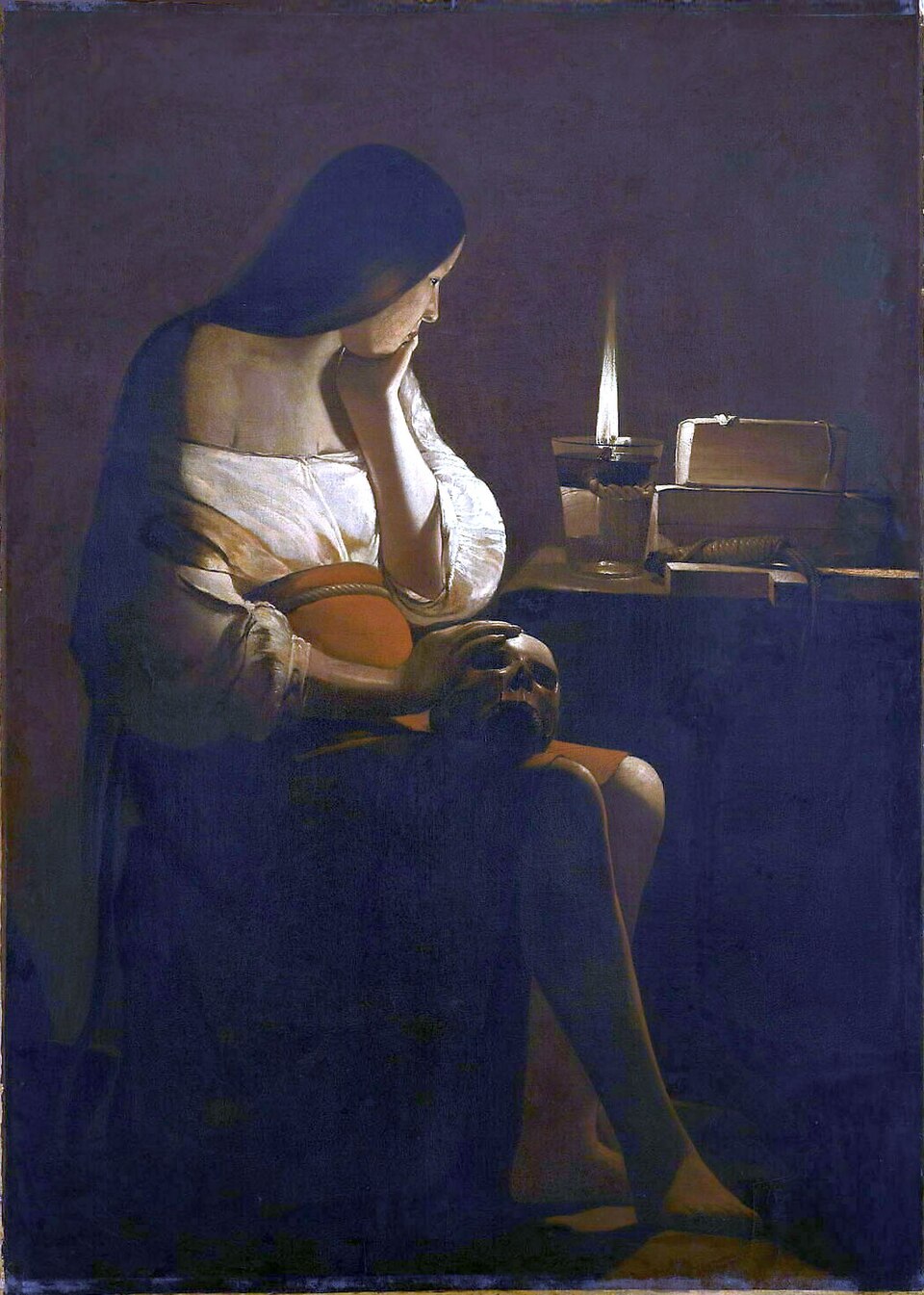
Hadot's thesis is first of all historical, and solid. In Antiquity, philosophy was not primarily a system of propositions about the world, to be adopted or refuted like a scientific theory, but a choice of life. To become an Epicurean, a Stoic, a Platonist, a Cynic was to convert to a way of existing, to enter a school, to adopt a daily discipline. Philosophical discourse, treatises, demonstrations, commentaries, served this conversion: it transformed the existence of the one who studied it, instead of constituting a knowledge detached from him. Hadot readily contrasted this conception with what he called the mere accumulation of knowledge. The Epicureans recalled to mind the fourfold remedy; the Stoics practised the view from above, the premeditation of evils, attention to the present; the Platonists practised dying, in the sense of the Phaedo, detaching the soul from the body through thought. These practices Hadot calls spiritual exercises.
Why “spiritual”? The word comes straight from the Christian tradition: the Spiritual Exercises of Ignatius of Loyola (1548) are the model of the method. But the debt is reversed, and that is the meaning of all Hadot's work: it was the Christians who inherited the philosophical exercises of Antiquity, when Christianity presented itself, from the second century onwards, as the true philosophy. Monastic Christianity took over the Stoics' attention to oneself, the Pythagoreans' examination of conscience, the Platonists' meditation on death. Philosophy therefore does not borrow the word “spiritual” from religion; it was religion that had borrowed the thing from philosophy. I have not found Hadot's justification for his choice of the word in a primary text; a summary indicates that he saw no difficulty in the expression, and Ossola surmises that Barthes's Sade, Fourier, Loyola (1971) had made it available.
Hadot thus makes available, to a modern reader who no longer believes, a model of spiritual life that owes nothing to faith in the Christian sense. One can practise Marcus Aurelius's view from above without believing in Stoic providence; one can train oneself, with Epicurus, not to fear death, without believing in atoms. Spirituality becomes a practice, not a belief: it asks for no dogma, no Church, no sacrifice, but for work on oneself.
Hadot does not, however, stop at the self, and it is on this point that he opposed Michel Foucault, in an attested response. Foucault, who had read Hadot and made use of him in his lectures of the 1980s, turned Antiquity into the site of a “culture of the self”, a “care of the self”, in which the subject constitutes itself as a work. Hadot, in two texts written after Foucault's death, expressed both his esteem and his disagreement. He regrets that this death interrupted a dialogue, “dans lequel nous aurions pu sans doute profiter mutuellement de nos accords, mais aussi et surtout de nos désaccords”, in which we could no doubt have profited from each other's agreements, but also, and above all, from our disagreements. Testa sums up the disagreement in three points. Foucault recentres ancient spirituality on the self, whereas it aimed at a going beyond the self towards the universal, nature and the human community. He confuses Stoic joy, gaudium, which is found in the best part of oneself, with pleasure. Finally, he makes the culture of the self an aesthetics of existence, which risks, Hadot writes in the English version of his text, being “too aesthetic” and becoming “a new form of Dandysm”.
This disagreement is more than a quarrel among historians: it bears on the criterion. A spirituality that aims only at the construction of the self refounds no absolute, but it risks making the self itself the absolute: Stirner's Unique turned into a work of art. Hadot replies that there is something other than the self: the awareness of being part of the Whole, the cosmic feeling, the demand for justice towards other human beings. The question then shifts: this Whole to which the sage rises, this nature of which he feels himself a part, is it not a new name for the divine? The Stoics, for their part, said so without embarrassment: nature was God, the logos was Zeus. Hadot keeps the exercise while setting aside Stoic theology. One can, I believe, keep the one without the other, on one condition: that the Whole be not an object of adoration but a horizon of lucidity, and that the exercise demand not that one sacrifice oneself to it, but that one see more truly within it. This is what Spinoza already called knowing things under the aspect of eternity, and Hadot is, without being a Spinozist, one of the contemporary thinkers closest to Spinoza (a constructed comparison).
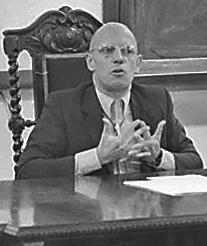 Michel Foucault1926-1984philosophy and spirituality
Background: The philosophy of Descartes: doubt, the cogito, God as guarantor of science · The thought of Pierre Hadot: ancient philosophy as a way of life · Foucault's thought: archaeology, power, care of the self, parrhesia
Michel Foucault never wrote a book on religion, and one must not make him say more than he said. But his lecture course at the Collège de France in 1981-1982, published in 2001 under the title The Hermeneutics of the Subject, contains a definition of spirituality that is precise and useful to our question. In the lecture of 6 January 1982, he calls spirituality “la recherche, la pratique, l'expérience par lesquelles le sujet opère sur lui-même les transformations nécessaires pour avoir accès à la vérité”, the search, the practice, the experience through which the subject carries out on itself the transformations necessary for gaining access to the truth.
This definition has one merit: it says nothing about God. Spirituality here is neither belief in the supernatural, nor experience of the sacred, nor relation to a transcendent being, but a thesis on the relation between the subject and truth: truth does not give itself to the subject as he is; he must transform himself in order to gain access to it. Conversion, ascesis, purification, exercise are not ornaments of the philosophical life, but the very conditions of knowledge. In Antiquity, Foucault says, philosophy and spirituality were not separate: the Delphic precept “know thyself”, γνῶθι σεαυτόν (gnôthi seauton), was subordinate to another, more fundamental one, the care of the self, ἐπιμέλεια ἑαυτοῦ (epimeleia heautou). One could know the truth only by taking care of oneself, that is, by transforming oneself.
Then came what Foucault calls the “Cartesian moment”. I do not quote his formula, which I have not found on a reliable page; I paraphrase it. From Descartes onwards, access to truth comes through knowledge alone: a subject who reasons well and follows the method is enough to reach the truth, whatever the way he lives. The subject no longer has to be transformed, only to be correctly directed. Modern philosophy then separates from spirituality; it becomes knowledge, and spirituality, driven out of philosophy, takes refuge in religion, where it merges with faith. Foucault does not say that this moment is a catastrophe; he says that it took place, and that it made what the ancient philosophers were doing almost incomprehensible to us.
This framework sheds light on the debate of this essay. It explains why the modern critique of religion has almost always targeted religion as belief, as a set of true or false propositions: since the Cartesian moment, truth has been a matter of propositions. Spinoza is the exception: the Ethics is a book of geometrical demonstrations, but its title and its end are an ethics, that is, a transformation of life leading to beatitude, and Foucault could have seen in it the last great treatise in which philosophy and spirituality remain united. Nietzsche, for his part, never stops asking what truth does to the one who seeks it, and what type of human being the will to truth presupposes; against the Cartesian moment, he recovers the question of spirituality. These two comparisons are constructed confrontations; Foucault does not make them in the passages I have been able to read.
But Foucault's definition has a limit, which Hadot saw: centred on the subject, it says that he must transform himself in order to reach the truth, not what this truth is, nor whether it surpasses him. If truth is only a historical construction, as the Foucault of the 1970s tended to think, then spirituality risks closing in on the aesthetics of the self for which Hadot reproached it. If truth surpasses the subject, one must say how, and the question of the Whole returns. Foucault died in June 1984 without having settled this alternative, and the dialogue with Hadot broke off on this point.
Portrait: Auteur inconnu, Public domain
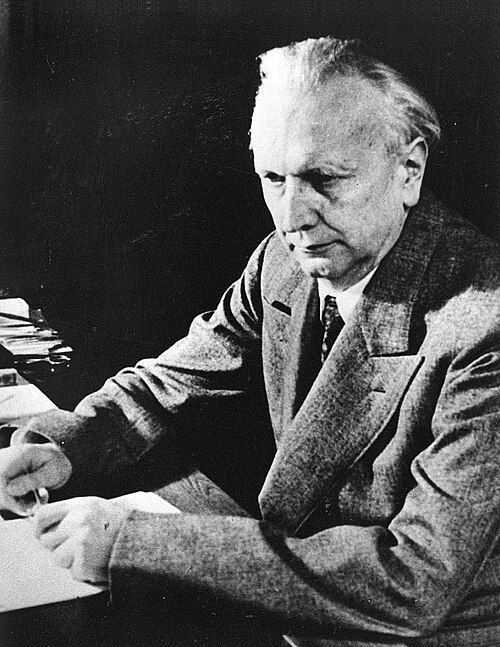 Jaspers1883-1969philosophical faith, or transcendence without revelation
Background: Councils and the formation of dogma: from Nicaea to Chalcedon · Existentialism: from Kierkegaard to Sartre, believers and atheists · Sisyphus and the underworld: Hades, Tantalus, the Danaids · The thought of Heidegger: Dasein, Being and Time, the turn, technology, 1933 · The thought of Camus: the absurd, revolt, the cycles · The philosophy of Karl Jaspers: psychopathology, existence, philosophical faith, the Axial Age
Karl Jaspers came to philosophy through psychiatry. His Allgemeine Psychopathologie (General Psychopathology, 1913) is a classic of the discipline; the Psychologie der Weltanschauungen (Psychology of Worldviews, 1919) marks the transition; the three volumes of Philosophie (1932) form his major work. In 1910 he married Gertrud Mayer, from a devout Jewish family; he was removed from university administration after 1933, dismissed from his chair at Heidelberg in 1937, banned from publishing, and he learned indirectly that a plan to deport him, together with his wife, was in place in the spring of 1945. Settled in Basel in 1948, he gave there the lectures published under the title Der philosophische Glaube (Philosophical Faith, 1948), the book that brings him into this debate.
Hadot and Foucault proposed a spirituality of exercise, which asks one to believe in nothing. Jaspers answers the simplest question that the man without a Church asks today: can one believe without belonging, believe in something without believing in a dogma? His answer is yes, and it bears a deliberately paradoxical name, philosophical faith. Since Kant, faith and knowledge have divided the ground between them; since Kierkegaard, faith has been the opposite of philosophy; since Heidegger, a Christian philosophy has been a wooden iron. Jaspers maintains that there is a faith which is not that of the Church and which is nonetheless the very condition of philosophy.
To understand it, one must start from the limit situations, the Grenzsituationen, which the Psychologie der Weltanschauungen introduced and the Philosophie developed: death, suffering, struggle, guilt. One can neither change nor evade them, and in them consciousness meets its walls. The Stanford Encyclopedia describes them as moments, usually accompanied by dread, guilt or acute anxiety, in which the mind experiences the narrowness of its forms and becomes disposed to go beyond them. In his Einführung in die Philosophie (Introduction to Philosophy, 1950), Jaspers drew from them a genealogy of philosophy with three sources: wonder, which he takes from Plato and Aristotle, doubt, which he takes from Descartes, and the shaking of the human being before limit situations, which is his own contribution. The constructed debate that follows starts from the first; Jaspers holds it together with the third.
At the edge of its limits, consciousness does not find an object. Everything we know, we know in a relation of subject to object, within a horizon; and each horizon is itself enveloped by a vaster horizon, which never becomes an object. This ultimate envelope Jaspers calls das Umgreifende, the Encompassing, a notion he sets out above all in Von der Wahrheit (On Truth, 1947). Transcendence is not a supreme being, in the sense in which Heidegger reproached metaphysics for making it one; it is the Encompassing of all encompassings, what can be neither known nor denied. It gives itself only in ciphers, Chiffern: nature, the work of art, the religious symbol, metaphysics itself are ciphers of transcendence, which designate it by withdrawing. The peculiarity of the cipher is that it refuses knowledge at the very moment it points; and the attitude that answers it is not possession, but failure, Scheitern, in which consciousness experiences its absolute insufficiency.
This philosophy does not refute religions, it translates them. Dogmas, myths, rites are ciphers; they are not false, they become false when they are taken for knowledge. Philosophical faith therefore holds between two refusals: that of orthodoxy, which freezes the cipher into doctrine and demands obedience, and that of dogmatic atheism, which takes the refusal of dogma for a knowledge of the absence of all transcendence. The Stanford Encyclopedia sums up the notion in three senses: authentic philosophy is guided by a faith in the transcendent origin of existence; it cannot for all that abdicate rationality before revealed contents; and the certainties of faith remain paradoxical and uncertain, so that whoever seeks them must accept a philosophical relativism and the exchange of reasons. Jaspers adds to this framework a word that sets him apart from all the mystics of this essay: Kommunikation. The truth of philosophical faith is tested in discussion, and is lost as soon as it dispenses with it.
This programme underwent two great public tests, both attested. The first is the demythologization controversy. Rudolf Bultmann had proposed, as early as 1941, to free the kerygma of the New Testament from its mythical envelope, so as to keep its existential core. Jaspers was expected to approve; he attacked him in Die Frage der Entmythologisierung (The Question of Demythologization, 1954), the small book that gathers the documents of the debate. He reproaches him with a false rationalism, an arbitrary contempt for the spiritual experiences laid down in the myths of ancient times, and, under cover of liberalism, the imposition of a new orthodoxy that reduces all transcendence to a single scheme. The reversal is clear: the philosopher without a Church defends myth against the theologian. Myth, for him, is not an error of physics to be corrected, as it is for Lucretius or d'Holbach; it is a cipher, and to demythologize it is to reduce it to silence. The second test is the book of 1962, Der philosophische Glaube angesichts der Offenbarung (Philosophical Faith in the Face of Revelation). In it Jaspers rejects a revelation's claim to be exclusive, that is, to make a historical event, the Incarnation, the single truth binding on all. He comes to read the Trinity itself as a set of ciphers of human possibilities, and Christ as the cipher of the human possibility of inner turning; the Stanford Encyclopedia notes that this reading echoes Feuerbach's anthropological analysis. Karl Barth denounced in Jaspers a transcendence without any objective content. Barth was right about the fact and wrong in the judgement: the absence of objective content is precisely what Jaspers lays claim to.
The third item in the file, a historical one, gives Jaspers his place in an essay that seeks to move beyond Christianity alone. In Vom Ursprung und Ziel der Geschichte (The Origin and Goal of History, 1949), Jaspers proposes the notion of the axial period, Achsenzeit. Between roughly 800 and 200 before our era, and above all around 500 BCE, comparable spiritual events occur independently of one another in China, India, Iran, Palestine and Greece: Confucius and Laozi, the Upanishads and the Buddha, Zarathustra, the prophets of Israel, the Greek philosophers. Everywhere human beings become aware of being as a whole, of themselves and of their limits, and the categories with which we still think are born. The thesis runs counter to a Christian conception, which Hegel had taken up, according to which the appearance of Christ is the axis of universal history. For Jaspers, the axis is not a particular revelation, but a common breakthrough of humanity towards reflection and transcendence. If spirituality has a birthplace, it is neither Sinai nor Golgotha, but this constellation of five centres, none of which holds a monopoly. Philosophical faith is the modern form of this breakthrough, freed from all the orthodoxies that emerged from it.
It remains to let the adversaries speak. The sharpest is Camus, and the response is attested. In The Myth of Sisyphus (1942), Jaspers is cited from the first chapter, as one of those who recognized “l'impossibilité de constituer le monde en unité”, the impossibility of constituting the world as a unity, and Camus immediately adds: “combien pressés d'en sortir !”, how eager to get out of it! The chapter “Le suicide philosophique” (“Philosophical suicide”) makes him the textbook case: “Jaspers va nous fournir, poussé jusqu'à la caricature, un exemple type de cette attitude”, Jaspers will provide us, pushed to the point of caricature, with a typical example of this attitude. Camus then quotes a sentence of Jaspers: “L'échec ne montre-t-il pas, au-delà de toute explication et de toute interprétation possible, non le néant mais l'être de la transcendance”, does not failure reveal, beyond every possible explanation and interpretation, not nothingness but the being of transcendence? And he concludes: “Ainsi l'absurde devient dieu (dans le sens le plus large de ce mot) et cette impuissance à comprendre, l'être qui illumine tout. Rien n'amène en logique ce raisonnement. Je puis l'appeler un saut”, thus the absurd becomes god (in the broadest sense of the word) and this inability to understand becomes the being that illuminates everything. Nothing logically leads to this reasoning. I can call it a leap. Camus calls Jaspers “cet apôtre de la pensée humiliée”, this apostle of humiliated thought.
The objection hits home. Jaspers starts from the failure of reason, from Scheitern, and draws from it the being of transcendence; between the two there is no inference, only a trust. Camus, who refuses the leap, asks that one hold to the failure. But the objection leaves something intact. Jaspers's leap ends in no Church, no dogma, no commandment; the transcendence it reaches has no objective content, as Barth objected. Kierkegaard's leap ended in Christ, and in the obedience of Abraham; Jaspers's ends in a cipher, which it is forbidden to take for knowledge. Camus's objection therefore holds in logic, not with regard to the criterion: a leap that ends in no obedience refounds nothing.
With Heidegger, the second adversary, the debate is first of all biographical. The two men were friends in the 1920s, and they were long classed together under the label of the philosophy of existence, which both of them rejected. Heidegger had written, already in the years of their friendship, a critical review of the Psychologie der Weltanschauungen, in which he reproached Jaspers for remaining caught in the metaphysics of subjectivity; the break came with the commitment of 1933, which Jaspers, married to a Jewish woman, experienced as a personal threat; and, after the war, consulted by the Freiburg denazification commission, Jaspers recommended that Heidegger be suspended from teaching. On the substance, Heidegger awaits a god without saying which; Jaspers believes in a transcendence without saying which. The structure is similar, and the objection I addressed to Heidegger, that of an empty absolute available to whoever wishes to occupy it, could be turned against Jaspers. A single word protects him from it: communication. Heideggerian waiting is solitary, reserved for the thinker and the poet; Jaspersian faith is subject to the discussion of all with all, and it denies itself as soon as it claims to impose itself. That is why Jaspers, as early as 1946, published Die Schuldfrage (The Question of German Guilt) and addressed his compatriots publicly on the responsibility of each.
In the Groningen lectures published under the title Vernunft und Existenz (Reason and Existence, 1935), Jaspers placed Kierkegaard and Nietzsche at the threshold of contemporary philosophy, as two exceptions who shattered systematic reason and of whom no one can be the disciple. He wrote a Nietzsche (1936). The one is the believer, the other the impious one; Jaspers holds them together because both lived a limit situation through to the end. His own position is to remain between them, without a leap towards Christ and without proclaiming the death of God.
With regard to the criterion, Jaspers does not refound: his transcendence demands no sacrifice, no obedience, no belonging, and it forbids anyone to put it at the service of a historical cause. But neither does he leave, nor does he claim to. He deliberately keeps transcendence, as Spinoza kept the name of God, and so belongs to the family of exceptions who keep something of the religious knowingly; and he brings to it what Spinoza lacked, a positive recognition of the plurality of ciphers, Chinese, Indian, Jewish, Greek, Christian, which shifts the question of religion towards that of human spirituality. My reservation is Camus's, displaced: Jaspers's danger is not the leap, it is inflation. A faith that welcomes every cipher and holds on to none risks no longer saying anything, and the infinite tolerance of the Encompassing can become an elegant way of never deciding. Jaspers answered in advance through his practice: he decided, in 1933, in 1945, in 1946, each time history demanded it, and his philosophical faith was never confused with indifference.
Portrait: Photographe inconnu (Mondadori), Public domain
Why is there something rather than nothing? A constructed debate
Background: Aristotle's philosophy: act and potency, causes, the unmoved mover, virtue, contemplation · Genesis 1 to 3: the creation, Adam and Eve, the fall · Leibniz's philosophy: monads, pre-established harmony, sufficient reason, theodicy · Psalms, Job, Qoheleth and the wisdom books · The thought of Heidegger: Dasein, Being and Time, the turn, technology, 1933 · Wittgenstein's philosophy: the Tractatus, language games, ethics and the mystical
We must carry the widening of religion into spirituality to its end, and ask the question that precedes all religions and outlives them all: why is there something? It belongs to no Church. A child can ask it, and so can a physicist, and most of those who say today that they “believe in something” without believing in God mean, by that vague word, the emotion it arouses. It therefore allows us to test the criterion: is the question of being the door to a spirituality without God, or the back door through which theology returns? The debate is constructed; I indicate which of its exchanges are attested.
The starting point is Greek, and it is not yet the question. It is wonder. Socrates tells the young Theaetetus: “μάλα γὰρ φιλοσόφου τοῦτο τὸ πάθος, τὸ θαυμάζειν· οὐ γὰρ ἄλλη ἀρχὴ φιλοσοφίας ἢ αὕτη”, this affection is very much a philosopher's, to wonder; for there is no other beginning of philosophy than this (Theaetetus, 155d). Aristotle takes up the word at the beginning of the Metaphysics: “διὰ γὰρ τὸ θαυμάζειν οἱ ἄνθρωποι καὶ νῦν καὶ τὸ πρῶτον ἤρξαντο φιλοσοφεῖν”, it is through wonder that men, now as at the beginning, began to philosophize (A 2, 982b12-13). And he adds a remark precious for our purpose: “διὸ καὶ ὁ φιλόμυθος φιλόσοφός πώς ἐστιν· ὁ γὰρ μῦθος σύγκειται ἐκ θαυμασίων”, this is why the lover of myths is also in some way a philosopher, for myth is made of wondrous things (982b18-19). Wonder is the common root of myth and of philosophy, and therefore of religion and of its critique. But Greek wonder bears on phenomena, the phases of the moon, the generation of the whole; it does not ask why there is a whole rather than nothing. The Greeks had no idea of an absolute nothingness from which being would have been drawn; it took creation ex nihilo for the question to take its modern form. A first clue: the question that seems the most secular of all was born in a biblical world.
The modern form, perfectly sharp, is Leibniz's. In the Principles of Nature and Grace, Based on Reason, written in 1714, Leibniz first lays down the principle of sufficient reason, then, in § 7, quoted in Part Three, the first question we have the right to ask: why is there something rather than nothing, since nothing is simpler and easier than something? The answer follows: the sufficient reason of the universe cannot be found in the series of contingent things, where each state refers back to the previous one without end; it must lie outside that series, in a necessary substance, “portant la raison de son existence avec soi”, bearing the reason of its existence within itself, and “cette dernière raison des choses est appelée Dieu”, this ultimate reason of things is called God (§ 8). Three things should be noted. The question is not a wonder but a demand: “on a droit”, we have the right, to ask it, because reason requires it. It assumes that nothingness is the default state, “plus simple et plus facile”, simpler and easier, and that being calls for an explanation. And its answer does not stop at an abstract first principle: three paragraphs further on, this God has chosen the best of all possible worlds (§ 10), and, in § 18, read in Part Three, he is the object of a love that gives a foretaste of future felicity. In Leibniz, the question of being leads without a break to a piety: this is the back door.
The sceptical answer comes from Hume, and it is attested in its form, if not in its addressee. In Part IX of the Dialogues Concerning Natural Religion (published in 1779), Demea defends the argument he calls “the common one”, which asks what determined the existence of this series of causes rather than any other: “What was it, then, which determined Something to exist rather than Nothing, and bestowed being on a particular possibility, exclusive of the rest?” This is Clarke's argument, which has the same structure as Leibniz's; Hume names Clarke in a note a few lines further on, he does not name Leibniz. Cleanthes answers him with two blows. The first bears on necessity: “Whatever we conceive as existent, we can also conceive as non-existent. There is no being, therefore, whose non-existence implies a contradiction.” The second bears on the whole: each part of the series has its cause in the preceding one, and to demand in addition a cause of the whole is to forget that the unity of this whole “is performed merely by an arbitrary act of the mind, and has no influence on the nature of things”. Hume does not say that the question is absurd, but that it does not lead where Leibniz wanted to go. The whole needs no reason outside itself, because “the whole” is only a manner of speaking.
Kant takes up the difficulty from within and gives it the tone no longer of demand but of vertigo. In the Critique of Pure Reason, as he refutes the cosmological proof, he writes: “Die unbedingte Nothwendigkeit, die wir als den letzten Träger aller Dinge so unentbehrlich bedürfen, ist der wahre Abgrund für die menschliche Vernunft”, unconditioned necessity, which we so indispensably need as the ultimate bearer of all things, is the true abyss for human reason. And he imagines the supreme being speaking to itself: “Ich bin von Ewigkeit zu Ewigkeit, außer mir ist nichts ohne das, was bloß durch meinen Willen etwas ist; aber woher bin ich denn?”, I am from eternity to eternity, outside me there is nothing except what is something merely through my will; but whence then am I? “Hier sinkt alles unter uns”, here everything gives way beneath us. By putting the question to God himself, Kant shows that Leibniz's answer merely pushes it back, and he adds that we can neither dismiss this thought nor bear it. With Kant, the question of being becomes an affect, an experience of the abyss, and no longer a problem.
Schelling, half a century later, drives it to despair, and the question then changes its source. In the lectures of the Philosophie der Offenbarung (Philosophy of Revelation, delivered in Munich from 1831-1832, then in Berlin from 1841, published in 1858 by his son), it is not the spectacle of the universe that prompts it, it is man. Everything moves restlessly without aim, he writes, and, “wie ein altes Buch sagt”, as an old book says, everything under the sun is full of toil and labour: this is Qoheleth. Man, far from making the world intelligible, is “selbst das Unbegreiflichste”, himself the most incomprehensible thing of all. And Schelling concludes: “Gerade Er, der Mensch, treibt mich zur letzten verzweiflungsvollen Frage: warum ist überhaupt etwas? warum ist nicht nichts?”, it is precisely he, man, who drives me to the last, the despairing question: why is there anything at all? why is there not nothing? The passage goes on to say so: that there should exist a science which answers these questions and tears us from this despair is a need of human nature itself. This science, for Schelling, is a positive philosophy that culminates in a philosophy of revelation, that is, in Christianity thought through. The despairing question opens, as in Leibniz, onto a theology; but it opens onto it through anguish and not through sufficient reason.
Bergson, in 1907, declares the question a false problem. Chapter IV of Creative Evolution begins by describing from within the very movement of Leibniz and Schelling: “L'existence m'apparaît comme une conquête sur le néant. Je me dis qu'il pourrait, qu'il devrait même ne rien y avoir, et je m'étonne alors qu'il y ait quelque chose.”, existence appears to me as a conquest over nothingness; I tell myself that there could, that there even should, be nothing, and I am then astonished that there is something. He adds: “je ne puis me défaire de l'idée que le plein est une broderie sur le canevas du vide, que l'être est superposé au néant, et que dans la représentation de ‘rien’ il y a moins que dans celle de ‘quelque chose’. De là tout le mystère.”, I cannot rid myself of the idea that the full is an embroidery on the canvas of the void, that being is superimposed on nothingness, and that there is less in the representation of “nothing” than in that of “something”; hence the whole mystery. This is Leibniz's premise, the nothing “plus simple et plus facile”, simpler and easier; Bergson does not name Leibniz in these two sentences, but he names him at the end of the following paragraph, together with Spinoza, as the culmination of this movement: the connection is therefore his own. To think the absence of one thing is always to represent the presence of another; to suppress is to substitute. The idea of an abolition of everything is therefore “une idée destructive d'elle-même, une pseudo-idée, un simple mot”, a self-destroying idea, a pseudo-idea, a mere word, as absurd “que celle d'un cercle carré”, as that of a square circle. And the conclusion falls: the question of knowing “pourquoi quelque chose existe”, why something exists, is “une question dépourvue de sens, un pseudo-problème soulevé autour d'une pseudo-idée”, a question devoid of meaning, a pseudo-problem raised around a pseudo-idea. Once nothingness is dispelled, one can posit an absolute that acts freely and endures, the one Bergson would find again, twenty-five years later, in the mystics of the Two Sources. He dissolved the question, but he did not dissolve wonder: he moved it from existence to creation.
In Heidegger, the reply is attested twice. In 1929, the Freiburg inaugural lecture, Was ist Metaphysik?, ends on the question; in 1935, the lecture course published in 1953 under the title Einführung in die Metaphysik (Introduction to Metaphysics) opens with it, and Heidegger declares it the first of all questions, the broadest, the deepest, the most originary. Above all, in 1949, in the introduction added to the fifth edition of Was ist Metaphysik?, he answers Leibniz explicitly: he acknowledges that the final question of his lecture, “Warum ist überhaupt Seiendes und nicht vielmehr Nichts?”, why are there beings at all and not rather nothing?, is “offenbar die Frage, die der Metaphysiker Leibniz in seinen Principes de la nature et de la grace gestellt hat”, evidently the question that the metaphysician Leibniz asked in his Principles, and he wonders why, if that is so, Leibniz's name was not mentioned. The question is asked there, he replies, “in einem ganz anderen Sinne”, in an entirely different sense. It does not ask for the first cause of beings; it asks how it comes about that beings everywhere take precedence, while nothingness, understood as being itself, remains forgotten. And Heidegger turns Leibniz's own premise against him: if being were not forgotten, Leibniz could not have written, by way of explanation, “Car le rien est plus simple et plus facile que quelque chose”, for nothing is simpler and easier than something. Leibniz's question is the question of metaphysics; the same question, asked otherwise, would be the exit from metaphysics.
One might side with Heidegger: he wrested the question from Leibnizian theology and gave it back to wonder. But one must read the postscript to the same small volume, written in 1943. The thinking of being, Heidegger says there, is a thanking, Danken, for the favour by which being has given itself to man, and this thanking is accomplished in sacrifice: “Das Opfer ist der Abschied vom Seienden auf dem Gang zur Wahrung der Gunst des Seins”, sacrifice is the farewell to beings on the way to safeguarding the favour of being. Sacrifice is the “Verschwendung des Menschenwesens”, the squandering of the human essence, for the guarding of the truth of being; and it “duldet keine Berechnung”, it tolerates no calculation of its usefulness or uselessness. I do not wish to load these lines with a meaning they do not have: they speak of the sacrifice of thought, not of soldiers. But they were written in 1943, and the vocabulary of farewell, of squandering and of the refusal of all calculation was not neutral that year. What matters for us is that the question of being, which Heidegger had wrested from Leibnizian piety, ends in his work in a still more demanding piety, one that calls in so many words for a sacrifice. The criterion is borne out here: the moment wonder turns into debt is the moment spirituality becomes religion again.
The most brutal reply came from Vienna. In 1931, in the journal Erkenntnis, Rudolf Carnap took the 1929 lecture as a model of metaphysical nonsense, and he ridiculed the question of being as a violation of the rules of logical syntax; Heidegger abandoned the word “metaphysics” shortly afterwards, partly, according to Taylor Carman, in reaction to this attack. For Carnap there is neither abyss nor mystery: there is a faulty use of the word “nothing”, treated as a noun when it is a negation. One might think one was hearing Bergson, with formal logic replacing psychology; but the convergence is deceptive. Bergson dissolves the question to set creative duration free; Carnap dissolves it to set science free. The first keeps wonder, the second dismisses it.
Wittgenstein, for his part, holds both theses at once. The Tractatus (1921) says on the one hand: “Das Rätsel gibt es nicht”, the riddle does not exist, and: “Wenn sich eine Frage überhaupt stellen lässt, so kann sie auch beantwortet werden”, if a question can be put at all, then it can also be answered (6.5). Leibniz's question is therefore not a question. But he says on the other hand, as we read in Part Ten, that the mystical is not how the world is, but that it is (6.44), and that the inexpressible shows itself (6.522); the 1929 Lecture on Ethics names the experience in view, wondering at the existence of the world, while admitting that language is then being misused. Wonder survives the destruction of the question: without interrogative form, hence without any possible answer, hence without God at the end, it is what Wittgenstein calls the mystical, and the section devoted to him in this essay has shown that he did not see a religion in it.
Jaspers, finally, replays the scene in the vocabulary of failure, with the phrase Camus borrows from him and which we read above: where reason fails to say why there is something, Jaspers sees not nothing but transcendence, through a leap that leads to no Church.
I believe the debate allows us to decide. The question “why is there something rather than nothing?” has received, from Plato to Wittgenstein, four treatments. The first takes it as a demand of reason and answers it with God: this is Leibniz, this is Demea, this is, by way of despair, Schelling. The second dissolves it as an ill-formed question: this is Hume, Kant in his own way, Bergson, Carnap, the Wittgenstein of 6.5. The third keeps it as a wonder without an answer: this is Plato and Aristotle before it, the Wittgenstein of 6.44, Jaspers. The fourth converts it into debt: this is Heidegger, in whom the question, after being wrested from theology, issues in thanking and sacrifice.
The question is therefore in itself neither religious nor secular; it becomes one or the other according to what one does with its affect. Whoever wants an answer meets God, Being or a first principle, and falls back into the onto-theology that Heidegger denounced in Leibniz before falling back into it himself in another way. If one dissolves the question, one may lose wonder along with it, like Carnap, or keep it, like Bergson and Wittgenstein. This last way seems to me the only outcome that does not turn into debt. Wonder before existence is perhaps the only religious affect that demands nothing: it founds no obligation, promises nothing, has neither an addressee to thank nor an altar on which to sacrifice. The Greeks saw in it the beginning of philosophy; Wittgenstein saw in it the mystical; one may see in it, without adding anything, the heart of a spirituality without God. The condition is strict, and Heidegger shows what happens when it is violated: one must not turn the fact that there is something into a gift, for a gift calls for gratitude, gratitude for a creditor, and the creditor, sooner or later, for a sacrifice.
Let us give the opposing thesis its best form. Leibniz would reply that wonder without an answer is a laziness of reason, and that to give up the principle of sufficient reason is to give up science itself. I answer with Hume and Kant that the principle holds within the world and does not hold for the world, and that science has never needed to apply it to the whole. Heidegger would reply that wonder without gratitude is still the attitude of a calculating subject, who receives being without thinking it. I answer that to think being is not to owe it something, and that this whole essay turns on that difference. Epicurus's sage looked at the world without debt; Spinoza loved God without expecting to be loved in return; Wittgenstein wondered that the world is without asking to whom he owed it. This, I believe, is what “believing in something” can mean today, in all rigour: not believing that there is someone behind the world, but never ceasing to wonder that there is a world.
Iris Murdoch1919-1999the Good without God
Background: Plato's philosophy: Forms, soul, city, the Good · The thought of Simone Weil: attention, affliction, decreation, rootedness · Sartre's philosophy: being-in-itself, being-for-itself, freedom, bad faith, commitment · The thought of Iris Murdoch: the novels, the Good, attention · Eros and Psyche: the primordial god, the ladder of the Symposium, Apuleius's tale
Wonder asks nothing and founds nothing. Iris Murdoch asks more: she maintains that there is, at the heart of moral life, an absolute that is not God, and that we must keep from religion what was most demanding in it while abandoning what was most consoling. That is why she puts the criterion to a fine test: her Good is an absolute, but an absolute that calls for no sacrifice, only the dispossession of the self.
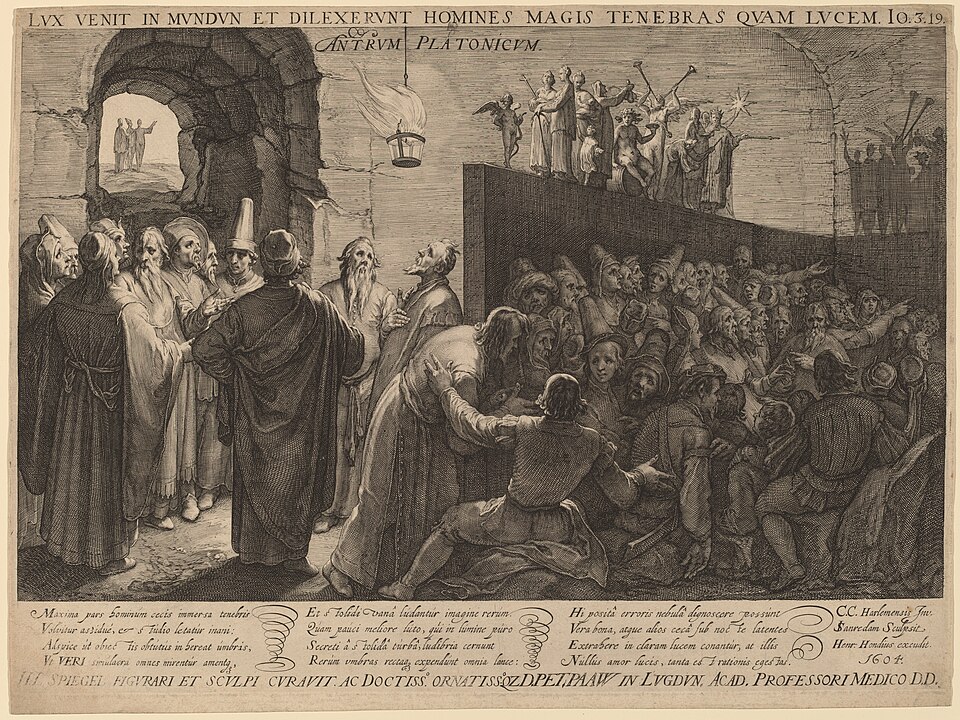
She is known above all as a novelist, an injustice that English philosophy took a long time to repair. She taught at Oxford from 1948 to 1963, in a milieu dominated by the analysis of moral language, and she brought there readings that her colleagues considered exotic: Sartre, to whom she devoted her first book, Sartre: Romantic Rationalist (1953), Simone Weil, Plato read as a living author, and Buddhist thought. In 1968 she called herself, according to a phrase reported by the entry devoted to her, “a kind of Platonist”. Her philosophy is essentially contained in a small book, The Sovereignty of Good (1970), which gathers three lectures: “The Idea of Perfection”, delivered in 1962 and published in 1964, “On ‘God’ and ‘Good’”, given in 1966 and published in 1969, and “The Sovereignty of Good over Other Concepts”, the Leslie Stephen Lecture at Cambridge, in 1967. She would take all this up again, complicating it, in Metaphysics as a Guide to Morals (1992), her last major book of philosophy, after The Fire and the Sun (1977), devoted to Plato and the arts.
The adversary of the first lecture is not a theologian; it is the modern subject as drawn both by existentialism and by the analytic philosophy of her day: a pure will, choosing freely among neutral facts, whose morality consists in its public acts. Murdoch had read Sartre closely, and she sees in this figure the secular descendant of the voluntarist God: a being who brings values into existence by choosing them. Murdoch sets against it another picture of moral life, in which the essential is played out before the choice, in the way we see. Our gaze is spontaneously distorted by the ego, by its fantasies, its resentments and its consolations; the Stanford Encyclopedia of Philosophy entry quotes her phrase about “the fat, relentless ego”. The moral task is therefore first of all one of perception: to see the other as he or she is, as real as oneself, distinct from oneself. It has a name: attention.
The word comes from Simone Weil, and the debt is attested. In 1976 Murdoch cited Waiting for God among the only three philosophical works that had marked her deeply, together with the Symposium and Fear and Trembling. In Weil, attention is a religious category, and she says so plainly: “L'attention, à son plus haut degré, est la même chose que la prière. Elle suppose la foi et l'amour”, attention, at its highest degree, is the same thing as prayer; it presupposes faith and love. And further on: “L'attention absolument sans mélange est prière”, absolutely unmixed attention is prayer. Murdoch takes up the word and withdraws faith from it: the supreme object of attention is no longer God, but reality, other people, beauty, the Good. She also takes from Weil the idea of “decreation”, but transposes it into a soberer vocabulary: the ego must fall silent, and she calls this silence “unselfing”. Her sharpest formula: “We cease to be in order to attend to the existence of something else”.
Her example is one of the most famous in the century's moral philosophy, because it is tiny. She is looking out of the window, absorbed in a wound to her pride: “I am looking out of my window in an anxious and resentful state of mind, oblivious to my surroundings… Then suddenly I observe a hovering kestrel”. And everything changes: “The brooding self with its hurt vanity has disappeared. There is nothing now but kestrel”. When she returns to her worry, it seems less important to her. The experience has nothing mystical about it in the sense James or Otto meant. Without revelation, without content, without consolation, it merely removes the ego from the centre of the picture, and that is why Murdoch holds it to be moral: natural beauty, art, the study of a foreign language or of a difficult science all do the same thing, they oblige us to submit to something that is not ourselves.
Towards what is this attention directed? On this point Murdoch meets our question. In “On ‘God’ and ‘Good’”, she proposes a definition of God that is at the same time a leave-taking: “I shall suggest that God was (or is) a single perfect transcendent non-representable and necessarily real object of attention”. And she adds that moral philosophy must try to keep a concept that has all these characteristics without being God: that concept is the Good. Murdoch's Good is the Good of the Republic, the principle that is beyond essence and that makes all things visible as the sun makes objects visible; the Stanford entry reports that she herself compares the Good to a light that enables us to see the good in particular things. Part One of this essay quoted Plato's Greek text on the Good “beyond essence”; Murdoch is a faithful and free reader of it, since she keeps the sun without keeping the world of Forms. The Good is not a person; it neither commands nor rewards. It is what orients, and it retains, she says, something irreducibly mysterious: “A genuine mysteriousness attaches to the idea of goodness and the Good”.
Prayer, then, does not disappear; it changes its nature. The Wikipedia article on the book reports the formula according to which prayer, properly understood, is not petition but an attention to God which is a form of love; I give it in paraphrase, not having read it in the text. What Murdoch proposes is a prayer without an addressee, or rather a prayer whose addressee is no longer someone: patient and loving attention to what is. The kinship with Hadot's spiritual exercises is real: for both, philosophy is a conversion of the gaze. But the difference is real too. Hadot describes ancient exercises that he does not claim have a transcendent object; Murdoch maintains that there is an object, the Good, and that it is real. She is more of a metaphysician than he is, and closer to Simone Weil.
She is also opposed, without having known it, to Comte-Sponville's spirituality of immanence, for which the universe suffices and which makes mystical experience a yes to everything that happens. Murdoch would not accept this identification of the Whole and the Good. Reality, for her, is not good because it is; it is the place where one can learn to see the good, which is not the same thing. Her Good judges the world, it does not bless it. The confrontation is constructed, since Murdoch died in 1999 and L'Esprit de l'athéisme dates from 2006; it sets against each other two ways of keeping the absolute without God, one that dissolves it in the totality, the other that maintains it above it.
Measured against the criterion, Murdoch is a limiting case, and that is what makes her precious. She unambiguously installs an absolute: the Good is sovereign, transcendent, necessary. One could therefore rank her among the refounders, alongside those who put Man, Society or History in the place of God. But this absolute demands no sacrifice: it does not ask that individuals be immolated to it, but that we cease to immolate ourselves to our own fantasies. The dispossession it requires is not submission to an authority that would speak in its name, since the Good does not speak and has neither Church nor priests; it is an unburdening of the gaze. Murdoch therefore belongs, I believe, to the family of exceptions, where she occupies a place that was missing: between Spinoza and Hadot, who think immanence and exercise, and Simone Weil, who keeps the faith, she proposes a transcendent absolute without God, which demands nothing but attention. Her weakness is the one Marx would have pointed out: a morality of vision risks leaving the world as it is, provided one sees it clearly. Murdoch was not unaware of this, and her novels are full of characters who see rightly and do not act. But she replied that we act badly because we see badly, and that most of the crimes committed in the name of an absolute were committed by men who no longer looked at anyone.
The Buddhism of the philosophers: a spirituality without God?
Background: Schopenhauer's philosophy: the Will, suffering, compassion, the denial of the will · Buddhism: landmarks for a religion without a creator God · Contemporary spiritualities: New Age, meditation, spiritual but not religious
If one looks in the history of religions for a spirituality without a creator God, Buddhism is the obvious candidate; it has haunted this essay since Schopenhauer without ever being looked at squarely. This must be done with a precaution that is the very subject of this section: the Buddhism the European philosophers of the nineteenth century speak of is not, first of all, the Buddhism of Buddhist countries; it is a figure that Europe constructed, largely out of its own anxieties, and that it successively admired, feared and then adopted. Our question therefore arises twice: is Buddhism an exit from religion without refoundation? And did Europe, in taking it as a model, find an exit, or did it invent for itself a replacement religion?
Schopenhauer is one of the first great European philosophers to claim Buddhism as his own, and he does so in the name of atheism. In the critique of the Kantian philosophy that closes the first volume of The World, he rails against the habit of translating the Brahman of the Hindus or the Tien of the Chinese as “God”, and he lays down as an established fact that Buddhism knows nothing of the God of the monotheisms: “Daß namentlich der Buddhaismus, diese auf Erden am zahlreichsten vertretene Religion, durchaus keinen Theismus enthält, ja, ihn perhorrescirt, ist eine ganz ausgemachte Sache”, that Buddhism in particular, this religion with the greatest number of adherents on earth, contains absolutely no theism, and even abhors it, is a thoroughly settled matter. Just before, he had asked whether theism properly so called is not found only in the Jewish religion and in the two religions that came out of it. Buddhism is thus for him the historical proof that a religion can do without God, and that it is all the truer for doing without him.
What he finds there above all is the confirmation of his own doctrine of salvation. The fourth book of The World, whose final sentence on nothingness we read in Part Six, makes nirvana the mythical expression of the denial of the will to live. In § 63, Schopenhauer quotes the Buddhist promise in the form in which he had read it: “Du sollst Nirwana erlangen, d.i. einen Zustand, in welchem es vier Dinge nicht giebt: Geburt, Alter, Krankheit und Tod”, you shall attain nirvana, that is, a state in which there are not these four things: birth, old age, sickness and death. And he says of the Indian doctrine of transmigration, of which this promise is the end point, that no myth has ever come, or ever will come, closer to the philosophical truth accessible to so few. But at the end of the book, in § 71, he distances himself from the word itself. Before the nothingness that awaits at the end of all virtue and all holiness, he refuses to do as the Indians do, who evade it “durch Mythen und bedeutungsleere Worte, wie Resorbtion in das Brahm, oder Nirwana der Buddhaisten”, through myths and words empty of meaning, such as reabsorption into Brahman or the nirvana of the Buddhists. He prefers to admit that what remains after the abolition of the will is, for those who still will, nothingness. Schopenhauer admires Buddhism because he finds his pessimism in it, and he corrects it as soon as he finds a consolation in it. In 1856 he had a bronze statuette of the Buddha bought for him in Paris, had it gilded and installed it in his drawing room in Frankfurt.
Nietzsche inherits this reading and turns it around. In The Antichrist (1888), he takes care not to confuse the two religions, which he nonetheless ranks together among the nihilist religions, the religions of decadence. Buddhism comes out of the comparison enhanced: “Der Buddhismus ist hundertmal realistischer als das Christentum”, Buddhism is a hundred times more realistic than Christianity; it is heir to a long philosophical tradition, and when it appears, “der Begriff »Gott« ist bereits abgetan”, the concept “God” has already been disposed of. Nietzsche goes further: Buddhism is “die einzige eigentlich positivistische Religion, die uns die Geschichte zeigt”, the only properly positivist religion that history shows us, because it no longer says “Kampf gegen die Sünde”, struggle against sin, but “Kampf gegen das Leiden”, struggle against suffering. The Buddha, in this portrait, is a physician rather than a prophet: he treats a fatigue of civilization with a hygiene, life in the open air, temperance, wariness of the passions that heat the blood, and he excludes prayer as well as asceticism; Nietzsche even notes that there is no compulsion in the monastic community, “man kann wieder hinaus”, one can leave it again. The conclusion is aimed at Christianity: Buddhism is “eine Religion für späte Menschen”, a religion for late human beings, and “Europa ist noch lange nicht reif für ihn”, Europe is still far from ripe for it. And the difference, Nietzsche formulates a little further on: Buddhism does not promise, it delivers, whereas Christianity promises everything and delivers nothing.
Beyond their opposition, these two readings make Buddhism a religion without God and the mirror of their own philosophy: the Buddhism of renunciation for Schopenhauer, the Buddhism of hygiene for Nietzsche. Roger-Pol Droit's inquiry changes the perspective here. In Le Culte du néant. Les philosophes et le Bouddha (Seuil, 1997), one of the two books submitted for his doctorate, La Découverte du bouddhisme et la philosophie européenne (1820-1890), defended in 1998 at Paris IV, Droit shows that nineteenth-century Europe long saw in Buddhism a cult of nothingness, a paradoxical and frightening religion that supposedly worshipped annihilation, and that this fear receded as the scholarly study of the texts developed. The scholar who founded this study in France, Eugène Burnouf, in his Introduction à l'histoire du buddhisme indien (1844), put the question in the very terms that would feed the fear. He recalls that the etymology of the word designates extinction, and he lists the possible interpretations up to the most radical: “en deux mots, le Nirvâna est-il le néant ?”, in a word, is Nirvana nothingness? Burnouf did not decide, and answered at once that the etymology settled nothing and that the usage of the different schools had to be examined; but the question had been asked, and the philosophers, from Hegel to the French spiritualists, turned it into an answer. Buddhism became, for Europe, the name of what it feared in itself: the nothingness it saw coming after God.
This detour sheds light on our question. When Nietzsche announces that Europe is not ripe for Buddhism, or when he wonders, as early as the preface to On the Genealogy of Morality, whether the morality of pity is not European culture's detour “zu einem neuen Buddhismus? zu einem Europäer-Buddhismus?”, towards a new Buddhism, towards a Buddhism of Europeans, he is not speaking first of Asia: he is speaking of the death of God and of what follows it. The Buddhism of the philosophers is the projection, in the sense Feuerbach gave the word, of the question Europe was asking itself: what remains when heaven is empty? Neither Schopenhauer nor Nietzsche describes real Buddhism.
For real Buddhism is not a spirituality without religion. It knows nothing of the creator and personal God of the monotheisms, and Schopenhauer was right on this point; but it is not without gods, who people its cosmology and are themselves caught in the cycle of rebirths, nor without the law of karma, nor rites, nor relics. Above all, it has an institution, the community of monks and nuns, the saṅgha, governed by a detailed discipline, the vinaya, with its rules, its expulsions and its ordinations. The refuge the faithful pronounce is threefold: the Buddha, the doctrine, the community. This is the point that matters for the criterion: a religion without God, Buddhism is not a religion without Law or without Church, and it shows that the absence of God is not enough to define an exit from religion, since everything else religion comprises, dogma, community, observance, can subsist without him. Conversely, it shows that the absolute of a religion is not necessarily a person: nirvana, the extinction of thirst, can hold the place that God holds elsewhere. Without deciding debates among Indologists that I am in no position to judge, I retain what all of them accept: that historical Buddhism is a complete religious tradition, and not a secular wisdom.
Does it demand a sacrifice? The answer must be nuanced. Monastic renunciation is voluntary, and Nietzsche was right to observe that one can leave the community. Buddhism has, in principle, no political theology, and non-violence is at the heart of its ethics. But history has known state Buddhisms, warrior monks and Buddhist nationalisms, and the fact that the doctrine demands no sacrifice has not prevented the institutions from demanding one. It thus confirms a lesson met with in Girard and in Gauchet: it is not doctrine alone that decides whether a religion sacrifices, it is the meeting of doctrine and power.
The Buddhism the West practises today is, for its part, a religious invention, perhaps the most durable since the religion of Humanity. It extracts from historical Buddhism a technique, meditation, and an ethics of compassion, leaving aside the cosmology, the rebirths, the gods and often monasticism. Comte-Sponville, whose spirituality of immanence gives a large place to the Eastern wisdoms, offers a philosophical version of it; the secular meditation of hospitals and companies is its technical version. This Buddhism is indeed a spirituality without God; but it is also a reinvention, which repeats the gesture of the nineteenth-century philosophers taking from Buddhism what they needed. It refounds no religion, since it demands nothing and installs no absolute. But it runs the opposite risk, the one Murdoch would have pointed out: an attention that no longer aims at anything real, an inner peace that is sufficient unto itself and can accommodate itself to any world whatever. Meditation taught to make employees more efficient is the opposite of what Nietzsche called a hygiene against the fatigue of civilization: it is its palliative care.
Historical Buddhism, I believe, is not the proof that one can leave religion by leaving God; it is the proof that religion is not defined by God. The Buddhism of the philosophers is not a description but a symptom: that of a Europe seeking, after the death of God, a form of salvation without a saviour. And contemporary Western Buddhism illustrates the thesis in its own way: one can keep spirituality while leaving religion, provided one knows what one is keeping and where one has it from. Those who meditate knowing that they are borrowing a technique from a tradition they do not share are in the position of Spinoza keeping the name of God; those who think they have found in meditation a wisdom without history and without presuppositions are in the position of the atheists of the marketplace, who do not see the shadows they carry.
The spiritualities of the Universe: a dictated Christ, an enchanted physics
Background: Contemporary spiritualities: New Age, meditation, spiritual but not religious · Received revelations: spiritism, channeling, the Christ Letters · Quantum mysticism, synchronicity and the law of attraction
The wisdoms this part examines have authors, books and a history that can be argued over. What most of our contemporaries meet under the name of spirituality, outside the Churches, rarely has any of these: texts received from a higher plane, a Universe that answers our desires, a quantum physics invoked to guarantee that consciousness creates reality. They must nevertheless be looked at, for two reasons. It is in this form, far more than in that of Hadot or Murdoch, that spirituality without a Church exists today in bookshops and on screens; and these spiritualities put the criterion to a test that is the reverse of the one Buddhism set. Buddhism was a religion without God; these present themselves as spiritualities without religion, and we shall see that they keep what is most questionable in religion without keeping what is strongest in it. I take two cases, chosen because they are typical, not because they are important, and I warn that they are not, in the sense I give the phrase in the rest of this essay, spiritualities without God: the first keeps Christ, the second replaces God with the Universe, which is not the same thing as doing without him.
The Christ Letters (in French, Les Lettres du Christ) are nine letters presented as dictated by Christ himself to an anonymous South African woman who calls herself his “Recorder” (in the French edition, his “Porte-parole”), circulated online and then published as a book; in French under the title Le Christ revient, révèle sa surprenante vérité (Interkeltia, 2010), then as Les Lettres du Christ (Atlantes, 2012, then Pocket). In them Christ returns to correct the misinterpretations of the teaching he had given in Palestine under the name of Jesus. There is no sin against God; there is no Trinity; above all, there is no salvation through the cross. In the third letter, addressed to Good Friday, he asks that the drama attached to that day be abandoned: “I died[…] and that was, for me, a wondrous release”; and he demands that one turn away “from the old dogmas of ‘salvation by the blood of the lamb’, the Trinity, and other beliefs”. What replaces dogma is a metaphysics of universal Consciousness, of the ego as the source of all suffering, and of a creative energy that the letters describe in the vocabulary of electricity, magnetism and particles.
The tools of this essay are enough to place this text, and there is no need to invent others. Schweitzer had shown that every age makes itself the Jesus it needs: the Jesus of the Letters is a master of consciousness, without apocalypse, without the Jewish Law, without a redeeming cross, that is, the exact opposite of the prophet the historians reconstruct, and the exact portrait of the spirituality of personal development. Renan had his fifth gospel, which was a landscape; this is a sixth, which presents itself as a dictation, and that is the decisive point. Kierkegaard, Barth and Weil criticized religion in the name of faith by renouncing any possession of God; the Letters criticize religion by making him speak. They contest the authority of the Churches in the name of an authority higher than that of all the Churches, and they submit it to no control: the notice placed at the head of each letter asks the reader first to make silence within, because it is only in this “completely receptive” state that the letters will penetrate their thought with their reality. One recognizes the gesture of Otto asking the reader without experience not to read on; but Otto described an experience, he did not claim to transcribe it at the dictation of its object. The objection I addressed to Schleiermacher applies here without softening: the Recorder's experience proves that she felt something, it does not prove that this something was Christ. There remains James's criterion, judging by the fruits and not by the roots; it is the most charitable, and it is on this ground that the text must be judged.
On one point, and it is no small one, the fruits are good. The Letters refuse the sacrificial reading of the cross, the one Paul had installed by spiritualizing sacrifice instead of abolishing it, and which Girard, by an entirely different route, turned against the religion of sacrifice. A Christ who declares that he did not die to redeem anyone, and who asks that people stop mortifying themselves in his memory, stands on the side of the criterion. But the sacrifice driven out of the cross comes back by another door. God, say the Letters, cannot save man, because humanity, in ignorance of the laws of existence, will go on making the same mistakes, “thus creating his own sickness and misery”; the law of cause and effect is “imponderable”, and one can no more escape the law by which one reaps what one has sown in one's thoughts and feelings than the laws of electromagnetism, “for electromagnetism is the IMPULSE producing the Law of sowing and reaping”. The sixth letter specifies that the forms created by the ego's thoughts disturb the functioning of the body and are “the origin of physical discomforts or viruses or disease”. It is no longer a God who demands, it is a law; but the law makes the sick person the author of their sickness. The mechanism Girard described at the scale of the crowd is found here at the scale of the individual, in its gentlest and most insidious form: the victim is declared guilty of their own misfortune, and by no one, by the sole logic of a doctrine that leaves no room for chance. Paul's old sentence, whatever a man sows, that he will also reap, receives the guarantee of physics.
That guarantee is the second case. Quantum mysticism has a genealogy, which I summarize from the historians of the New Age without entering into the physics, which is beyond my competence. In 1952 Jung published with the physicist Wolfgang Pauli Naturerklärung und Psyche, in which he set out synchronicity, the coincidence of a psychic state and an external event linked not by a cause but by a meaning, with the example of the golden scarab that taps at the window while a patient is recounting her dream. In 1975 Fritjof Capra, a physicist by training, published The Tao of Physics, which brings quantum mechanics close to the Eastern mystics; in 1980 David Bohm, also a physicist, proposed in Wholeness and the Implicate Order an undivided totality that he would discuss with Krishnamurti; in 1989 Deepak Chopra made Quantum Healing a medicine of consciousness; the film What the Bleep Do We Know!? (2004) and then Rhonda Byrne's The Secret (2006) popularized the “law of attraction”, according to which our thoughts attract the events that resemble them. The physicists have answered, from Murray Gell-Mann, who spoke of “quantum flapdoodle”, to Victor Stenger (The Unconscious Quantum, 1995): the observer of quantum mechanics is a measuring apparatus, not a consciousness that creates the world, and the entanglement of particles does not bind souls together. I have nothing to add to their answer, except that it does not reach what interests this essay.
For the phenomenon is not new, and James had described it a century earlier. In lectures IV and V of the Varieties, he devotes long pages to what he calls the “Mind‐cure movement”, which its followers also call “New Thought” and of which the law of attraction is the direct heir. He takes it seriously, as “a genuine religious power”, and notes with irony that it has reached the stage where demand is strong enough for publishers to supply “insincere stuff, mechanically produced for the market”, which happens, he says, only to a religion well past its insecure beginnings. He also sees its limit. For Mrs. Eddy's Christian Science, the most radical branch of the movement, “evil is simply a lie, and any one who mentions it is a liar”; James sees in this “a bad speculative omission”. These are the once-born of his typology, and the sky-blue gospel he asked his hearers to turn their backs on in order to listen to the sick souls. Quantum mysticism changes nothing in this structure; it merely gives it a vocabulary more prestigious than that of Mesmer's magnetic fluid, which was its eighteenth-century version.
This vocabulary is nonetheless instructive. This essay has met science turned into an absolute several times: Freud's god Logos, the Reason of the new atheists, and Wittgenstein's remark that the moderns stop before the laws of nature as the ancients did before God and fate. Quantum mysticism makes the reverse and complementary movement: it does not sacralize science, it asks it to testify for the sacred. It is the regime of error turned inside out. Lucretius and d'Holbach set physics against the gods; here physics is called on to restore them, under the name of Consciousness, Energy or the Universe. It is also § 344 of The Gay Science in reverse: Nietzsche confessed that science's will to truth still rested on a faith, and drew from it a demand for lucidity; quantum mysticism borrows from science its prestige without its will to truth, that is, without the one thing that made it an ascesis. As for synchronicity, Boyer gives the most economical explanation of it: a human mind equipped to detect agents and intentions everywhere, and Hume before him, who saw faces in the moon. The meaningful coincidence is a world that beckons to me; and a world that beckons to me is a world that addresses me, that is, under another name, Providence.
It is here that wonder changes its nature. Wittgenstein said that the mystical is not how the world is, but that it is; synchronicity and the law of attraction look for the mystical, on the contrary, in the how, in the messages that events send me and in the answers the Universe gives my thoughts. One passes from wonder that there is a world to the conviction that the world answers me, and from there to the idea that it answers me according to what I deserve. I have maintained that to think being is not to owe it something; the law of attraction turns the fact into a gift, the gift into an answer and the answer into a debt, and the manuals that teach it prescribe, logically enough, daily exercises of gratitude towards the Universe.
Measured by the criterion, the verdict must be exact. Neither the Christ Letters nor quantum mysticism refounds a religion in the strict sense: they install no absolute in whose name the sacrifice of others could be demanded, they have no clergy, and criticizing them is not a sacrilege, only a mark of ego or of low vibration. They have merchants rather than priests, as James had seen, and a public of pilgrims without a lineage, in Hervieu-Léger's sense. I place them among the other transfers of the sacred: the sacred passes from God to the Universe, or to a Consciousness that has all his attributes except the name. Their fault is not sacrifice, it is consolation, and the indicator I drew from Weil applies to them to the letter. A spirituality in which every misfortune has its cause in the thoughts of the one who suffers it consoles for injustice by making it understandable; but it does worse than console, it suppresses the Protestation Marx heard in the sigh of the oppressed creature. Leibniz asked the individual to sacrifice their complaint for the sake of the harmony of the whole; the law of attraction makes the complaint itself a negative thought, which aggravates the evil it deplores. It is a theodicy without God, and it has the defect of all the theodicies Ivan refused: it is right in advance against the suffering child. And on the day when the belief that one creates one's own illness leads someone to give up treatment, or to have it refused to a child, the sacrifice ceases to be metaphorical; it is there, and not in the vocabulary, that the border runs between a harmless spirituality and a hold over people.
These spiritualities therefore confirm the thesis by a path I did not expect. They do not leave religion: they keep its revelation, its providence and its retribution, and give up only the Church, avowed dogma and the cross, that is, with the cross, the one place where Christianity looked the misfortune of the innocent in the face. They are atheists of the marketplace turned inside out: the men of § 125 did not know that God was dead; these do not know that their Universe is the old Providence in a lab coat. The answer this essay seeks is not to set science against them, since they already invoke it; it is to set against them what science, philosophy and the most demanding believers have in common, and what they have lost: lucidity about what one keeps and where one has it from, and the refusal to make the one who suffers evil bear the blame for it. Wonder that there is a world demands nothing of anyone; the Universe that answers me already demands that I think as I should.
 André Comte-Sponvilleb. 1952a spirituality of immanence
Background: Spinoza's philosophy: substance, attributes, modes, conatus, kinds of knowledge, the Theological-Political Treatise · The thought of William James: pragmatism, psychology, religious experience · The thought of Comte-Sponville: materialism, wisdom, spirituality without God · The thought of Michel Onfray: hedonism, Traité d'athéologie, Décadence, Théorie de Jésus · Contemporary spiritualities: New Age, meditation, spiritual but not religious
In 2006 André Comte-Sponville published L'Esprit de l'athéisme. Introduction à une spiritualité sans Dieu. The book is built around three questions: can we do without religion? Does God exist? What spirituality for atheists? To the first two he answers as an atheist; to the third, as a mystic, and therein lies his originality.
His first answer is measured. One can do without religion, in the sense that one can live without a Church, without dogma, without worship; one cannot do without communion, fidelity or love. The paraphrase comes from a review, and it renders the movement of the book well: the best of what religion provided, the bond between human beings, attachment to transmitted values, the capacity to love, can survive faith. Comte-Sponville calls himself a faithful atheist: he has lost faith, not fidelity to what the Christian tradition taught him of justice, compassion and love. The second is no less measured: atheism is for him a belief, not a knowledge; he does not claim to prove that God does not exist, he says as a philosopher why he does not believe, without contempt for believers.
It is the third that interests us. Comte-Sponville maintains there that spirituality does not belong to the religions. It is the life of the mind insofar as it relates to the infinite, to eternity, to the absolute; and this absolute the atheist does not deny, he denies only its transcendence. The atheist's spirituality is a mysticism of immanence. He gives a formula for it that condenses the whole book: “Un Dieu ? Pour quoi faire ? L'univers suffit. Une Eglise ? Inutile. Le monde suffit. Une foi ? A quoi bon ? L'expérience suffit”, a God? What for? The universe is enough. A Church? Useless. The world is enough. A faith? What good is it? Experience is enough. And elsewhere: “A quoi bon rêver d'un paradis ? Le Royaume, c'est ici et maintenant”, what good is dreaming of a paradise? The Kingdom is here and now. And the last sentence of the book says it again: “Nous sommes déjà dans le Royaume : l'éternité, c'est maintenant”, we are already in the Kingdom: eternity is now. The philosophical formula that grounds this mysticism is Spinozist: “Tout est immanent au Tout”, everything is immanent to the All.
The heart of this spirituality is an experience, and Comte-Sponville calls it by the very name Romain Rolland had proposed to Freud: the oceanic feeling. He defines it as “l'expérience d'une intériorité (mais qui me contient, et que je ne contiens pas), d'une immanence, d'une unité, d'une immersion, d'un dedans”, the experience of an interiority (but one that contains me, and that I do not contain), of an immanence, a unity, an immersion, an inside. He adds that this experience, which he says he has known himself, culminates in acceptance: “dire oui à tout ce qui est, à tout ce qui arrive”, saying yes to everything that is, to everything that happens. He sees in it the common ground of the mystics of every tradition, Christian, Buddhist, Taoist, an experience that is sufficient unto itself and does not need God in order to be lived. And he does not want to leave it to the fanatics: “la spiritualité est une chose trop importante pour qu'on l'abandonne aux fondamentalistes”, spirituality is too important a thing to be abandoned to the fundamentalists.
The confrontation with Part Eight is constructed. In 1930, Freud could not discover in himself Rolland's oceanic feeling; he made it the survival of a primitive state of the ego, prior to its separation from the external world, and refused to see in it the source of religion, born in his view of infantile helplessness and the need for a father. In 2006, an atheist philosopher makes this feeling the heart of a spirituality without God. Rolland was therefore right against Freud on one point: the experience exists and does not need the personal God in order to be expressed. Freud was right against Rolland on another: nothing obliges us to see a revelation in it. Comte-Sponville holds both ends, Rolland's experience and Freud's atheism.
The objections came from two sides, and one of them is attested. On the atheist side, Michel Onfray places Comte-Sponville in what he calls Christian atheism, and is said to have called him a “chrétien athée”, an atheist Christian. In Onfray's mouth this is an accusation: the faithful atheist keeps Christian morality, compassion, humility, love of neighbour, abandoning only God; he is still one of those pious atheists Stirner denounced. I have found no reply by Comte-Sponville to this formula. On the philosophical side, Hausemer made a graver objection, carried by the very title of his review, “André Comte-Sponville ou La disparition du mal”, André Comte-Sponville or the disappearance of evil: the Spinozist acceptance of everything that happens makes evil disappear. If I say yes to everything that is, I also say yes to the suffering of the child.
This objection strikes home, and it brings us back to Ivan Karamazov. Ivan refused the harmony that would justify a child's tear; he returned his ticket. Comte-Sponville, like Spinoza and like the Nietzsche of amor fati, accepts the whole of reality. But Spinoza asked that evil be understood, not approved, and the Ethics is also a treatise on the power of acting, which in no way commands passivity before injustice. Comte-Sponville's spirituality is not, by the criterion, a refoundation: it demands no sacrifice, promises no collective salvation, asks no one to kneel before a Great Being. But it is exposed to another weakness: by saying that the universe is enough, it risks forgetting what is not enough, and what religion, at least, named. What this spirituality lacks is Marx's Protestation. The oceanic experience consoles; it does not protest.
Portrait: Wikinade, CC BY-SA 3.0
 Luc Ferryb. 1951the man-God and horizontal transcendence
Background: The thought of Luc Ferry: transcendental humanism, the Man-God, the revolution of love · The thought of Abdennour Bidar: self islam, leaving religion, man as khalîf
Luc Ferry published L'Homme-Dieu ou le Sens de la vie in 1996, then, with André Comte-Sponville, La Sagesse des Modernes (1998), and, with Marcel Gauchet, Le Religieux après la religion (2004). Of all the authors in this part, he is the one who has engaged most directly in dialogue with the others. His thesis describes a double movement, which he calls on one side the humanization of the divine and on the other the divinization of the human.
The humanization of the divine is secularization in Gauchet's sense: Christian contents become secular, love of neighbour becomes solidarity, charity becomes humanitarian action, salvation becomes happiness. The divinization of the human is the inverse and complementary movement: the values that modern man places above his life, the true, the just, the beautiful, love, impose themselves on his conscience as if they came from elsewhere. He does not invent them at will; he discovers them in himself as a demand that exceeds him. He no longer believes in God, but lives by values that bear all the marks of the sacred: one can die for them, and sometimes one does. Ferry calls this structure a transcendence within immanence, or a horizontal transcendence. The sacred is no longer above, in heaven; it is ahead, in other human beings and in the horizon of meaning they open.
Ferry describes this shift from the standpoint of tradition. The bond that unites human beings, he writes, “n'est plus situé dans une tradition, dans un héritage imposé de l'extérieur, dans un amont de leur conscience, mais c'est en aval qu'il nous faut désormais penser ce qui pourrait être l'analogue moderne des traditions perdues: une identité post-traditionnelle”, is no longer located in a tradition, in a heritage imposed from outside, upstream of their consciousness, but it is downstream that we must henceforth think what could be the modern analogue of the lost traditions: a post-traditional identity. Transcendence no longer comes from upstream, from what has been received; it comes from downstream, from what is to be done. Later, Ferry would propose defining philosophy itself as “une doctrine du salut sans Dieu, une spiritualité laïque”, a doctrine of salvation without God, a secular spirituality.
Ferry thus poses a problem for our essay, with a frankness that does him credit. He does not claim that modern man has left religion without remainder; he says that the sacred has shifted from heaven to man, and that this shift is the truth of modern humanism. Now this is what Stirner reproached Feuerbach with: Man has become the supreme being, and one has freed oneself from God only by worshipping humanity. The very title L'Homme-Dieu would have made Stirner smile. Ferry takes on the divinization of the human knowingly, which distinguishes him from Feuerbach but does not answer the objection.
The objections are attested. Agnès Antoine, in Esprit in December 1996, wrote: “Il y a[…] quelque naïveté ou perversité à choisir comme titre du livre l'"homme-Dieu"”, there is[…] some naivety or perversity in choosing “man-God” as the title of the book. Cantin himself, following Fernand Dumont, wonders whether a transcendence lodged in the immanence of consciousness still deserves to be called transcendence. The objection is just, but it opens an alternative. Either horizontal transcendence is only a metaphor for the moderns' attachment to values they judge superior to their lives: there is then neither refoundation nor spirituality, only a morality. Or it is a true transcendence, and Ferry consecrates, after Feuerbach and Comte, a religion of Humanity, more discreet and more liberal.
I believe that Ferry oscillates between the two, and that this oscillation is instructive. He makes the disposition to die for a value, liberty, justice or those one loves, the sign of its sacredness. This disposition is not enough to place him among the refounders in the strict sense: the criterion concerns the absolute in whose name the sacrifice of the individual can be demanded, not freely consented self-offering, and nothing in Ferry demands of anyone that he die. But Ferry does not confine himself to noting these devotions; he calls them sacred, and that is the need to consecrate that Engels reproached Feuerbach with. He therefore belongs to soft refoundation: a religion of the human that has renounced clergy, dogma and constraint, and contents itself with consecrating that for which some human beings agree to die. It is the most liberal form of refoundation, and perhaps the only one compatible with a democratic society. It nonetheless remains a consecration, and one can apply to it the question Stirner put to Feuerbach: in the name of what does this ideal command me?
Portrait: Thesupermat, CC BY-SA 4.0
Comte-Sponville and Ferrythe quarrel of the two wisdoms
Background: The thought of Comte-Sponville: materialism, wisdom, spirituality without God · The thought of Luc Ferry: transcendental humanism, the Man-God, the revolution of love
La Sagesse des Modernes, their book of dialogue on the great questions of ethics, attests that their disagreement was public. I have not read its text and I quote nothing from it; all that is known is that Ferry there judges Comte-Sponville's wisdom to be close to Buddhism. This disagreement bears directly on our question, and it can be reconstructed from their other books without attributing to them sentences they did not write.
Comte-Sponville is a materialist. His avowed genealogy runs from Epicurus and Lucretius to Spinoza, with borrowings from the Eastern wisdoms: there is nothing other than nature, of which man is a part, and freedom is only necessity understood and accepted. Wisdom consists in ceasing to hope, in inhabiting the present, in loving what is; transcendence, in all its forms, is an illusion of a mind that believes itself greater than the world. Ferry is a Kantian: man is distinguished from nature by his freedom, his capacity to tear himself away from every natural or historical code, which grounds his dignity. Values are not deduced from reality, they impose themselves on it as an ought, and horizontal transcendence is the truth of human freedom: man is the being who never coincides with what he is.
By the criterion, the two positions are not of equal worth. Comte-Sponville's wisdom refounds no sacrificial absolute, but it risks accepting too much and disarming revolt. Ferry's humanism keeps the capacity to protest, but pays for it with a consecration. Here we meet again the alternative between Spinoza and Kant, which Parts Three and Four brought out without settling it: acceptance without transcendence, or transcendence without God. Perhaps neither is a complete exit; but the first is closer to an exit without refoundation, and the second more capable of hearing Marx's Protestation. The conclusion will have to say whether one can have both.
Portrait: Wikinade, CC BY-SA 3.0
Portrait: Thesupermat, CC BY-SA 4.0
 Islam before the exit from religionArkoun and Bidar
Background: Islam: birth, expansion and thought, from Muhammad to Averroes · The philosophy of Averroes: the Commentator, the intellect, the reply to al-Ghazali, Latin Averroism · The thought of Mohammed Arkoun: the critique of Islamic reason, the unthought, applied Islamology · The thought of Abdennour Bidar: self islam, leaving religion, man as khalîf
This essay has taken up the question of the exit from religion where it was formulated, in Christian and post-Christian Europe, and Gauchet gave that choice its justification: if Christianity is “la religion de la sortie de la religion”, the religion of the exit from religion, the question itself is Christian. Part One nonetheless showed that it had been raised elsewhere, and earlier: in Cordoba, Averroes maintained that the Law commands us to philosophize, and reserved for the learned an interpretation the multitude could not bear. What of it today, from within Islam? Two French thinkers of Muslim culture, very different in age and method, allow us to ask: Mohammed Arkoun, historian of Islamic thought, who sought to reopen what orthodoxy had closed, and Abdennour Bidar, philosopher, who sought to think an exit from religion proper to Islam. I have read none of their books, which are under copyright; I know them through studies and reviews that I name each time, and what follows must be read with that reservation.
Mohammed Arkoun (1928-2010), born in Kabylia, in the village of Taourit-Mimoun, trained in Algiers and then at the Sorbonne, where he prepared the agrégation in Arabic, taught the history of Islamic thought at the Sorbonne Nouvelle (Paris III). His work is contained in a programmatic title, Pour une critique de la raison islamique (1984), and in a project he named “islamologie appliquée”, applied Islamology. Classical Islamology, that of the Orientalists, reconstructed the history of Islamic civilization and offered a philological critique of its great texts. Arkoun wants, according to a phrase from Humanisme et islam (2005) reported by Leïla Tauil, to move the question of Islam from “son cadre polémique et théologique dogmatique vers l'espace ouvert de l'histoire et de l'anthropologie critiques”, its polemical and dogmatic theological framework towards the open space of critical history and anthropology. The same passage assigns to this discipline the task of making up for “aux oublis de la pensée islamique qui continue de refouler toute idée d'historicité dans la genèse et les fonctions concrètes de la croyance religieuse”, the omissions of Islamic thought, which continues to repress any idea of historicity in the genesis and concrete functions of religious belief. The aim is to submit the Qur'an, the prophetic tradition and the doctrinal discourses born of them to historical criticism, to linguistics, to the analysis of the conditions under which meaning is produced. Lectures du Coran (1982) applies this method to the text itself.
The heart of the undertaking is a history of closure, with a before and an after. Between the ninth and the eleventh centuries, the Islamic world knew an intense doctrinal pluralism: grammarians, jurists, philosophers, Sufis and rationalist theologians clashed there. The Mu'tazilites, supported by the caliph al-Ma'mun, defended free will and the thesis of the created Qur'an, that is, of a divine word inscribed in time and in a human language; Arkoun stresses “la portée humaniste de thèses comme celles du Coran créé et du libre arbitre (qadar)”, the humanist scope of theses such as those of the created Qur'an and of free will (qadar). Then power changed sides: al-Mutawakkil, according to Tauil, made the literalist doctrine of Ibn Hanbal the official doctrine of the state, and, at the beginning of the eleventh century, the caliph al-Qadir had read out in the mosques of Baghdad a profession of faith which, according to Tauil, ordered the execution of anyone who professed that the Qur'an is created. Arkoun calls this process the “clôture dogmatique”, the dogmatic closure. It produces not only a body of doctrine, but a limit to thought: it imposed, his commentator sums up, cognitive frontiers not to be crossed, and “tout un ‘impensable’ s'est constitué”, a whole “unthinkable” took shape. The discontinuities of Islamic history, the lost debates, the abandoned possibilities then disappear into what Arkoun calls the “sphère de l'impensé et de l'impensable”, the sphere of the unthought and the unthinkable. The distinction is subtle: the unthought is what has not yet been thought, the unthinkable what an orthodoxy has made impossible to think.
The vocabulary of this history comes largely from the French thought of its time, and the kinship sheds light on the project. Arkoun speaks of the passage from an “épistémè ‘médiévale’ à une épistémè moderne”, a “medieval” episteme to a modern episteme, and his commentator describes his method as an “archéologie des connaissances”, an archaeology of knowledge, of a deconstructive kind. Episteme and archaeology are Foucault's words, deconstruction Derrida's; and the question of a meaning that survives the critique of its conditions of production is the one Ricoeur put to the masters of suspicion. This comparison is mine: I have not consulted any text in which Arkoun discusses these authors, and I do not claim to establish a filiation. But it says the essential thing: the critique of Islamic reason is not the importation into Islam of Enlightenment atheism, that regime of error; it belongs rather to what Ricoeur called the school of suspicion, applied not to religion as such but to the orthodoxy that imposed itself in its name. Arkoun does not ask whether God exists, but how a tradition decided what could be thought of him. His Gifford Lectures, given in Edinburgh in 2001, concluded, according to the summary given on the Gifford Lectures website, that all aspects of Islamic knowledge and practice should be submitted to critical analysis.
Arkoun touches the criterion in two ways. First, the dogmatic closure he describes falls under it in the strict sense: a state profession of faith that declares lawful the blood of those who profess a theological thesis installs an absolute in whose name the sacrifice of the individual can be demanded, and al-Qadir's law joins the law of Plato's Laws and Rousseau's civil religion in the gallery of armed orthodoxies. Second, and this is the more interesting point, Arkoun does not propose to leave it by leaving Islam, but to reopen Islam to what it was before the closure: the pluralism of the ninth century, the falsafa, the Mu'tazilites, Averroes. He envisages an exit not from religion, but from closure. It resembles Feuerbach less than Spinoza reading Scripture as a historian, or Ricoeur seeking a faith that has passed through critique. It escapes, I believe, the sacrifice criterion, since it installs no new absolute; but it leaves Gauchet's question open. Does a religion restored to its historicity remain a religion in the strong sense, an institution of the social by a law that comes from elsewhere? Arkoun does not say, at least in what I have learned from his commentators, and the confrontation I construct between him and Gauchet remains open on this point.
Abdennour Bidar, b. 1971, philosopher and agrégé, takes the question head on, and this time the debate with Gauchet is attested. Between 2004 and 2012 he published five books that form a progression: Un islam pour notre temps (2004), Self islam (2006), L'islam sans soumission (2008), L'islam face à la mort de Dieu (2010), devoted to the Indian philosopher Muhammad Iqbal, and finally Comment sortir de la religion (2012), whose title almost overlaps with that of this essay. I know this last book only through this review, from which all the quotations that follow come. According to Demorgon, Bidar wants to leave religion, and therefore Islam, as well as atheism, in one and the same exit. And he expressly criticizes Gauchet's formula according to which Christianity would be the religion of the exit from religion. His objection is twofold. The Western exit has failed: “Deux siècles n'ont pas suffi pour évacuer du monde un religieux qui le fondait depuis des millénaires”, two centuries were not enough to clear from the world a religious element that had founded it for millennia; and it rests on the error of treating religious humanity as a humanity in its childhood, which adulthood ought to leave behind.
Hence the central thesis: religion must not be destroyed but replaced, and it can be replaced only by something equal to it. “L'effort pour maintenir en vie la religion relève de l'intuition qu'elle ne doit pas être détruite avant d'être réellement remplacée”, the effort to keep religion alive stems from the intuition that it must not be destroyed before it is really replaced; and again: “Renoncer aux dieux reste un sacrifice psychiquement insupportable pour l'humanité et un pas évolutif impossible à franchir si la compensation offerte n'est pas à la hauteur de ce dont il faut se séparer”, renouncing the gods remains a psychically unbearable sacrifice for humanity and an evolutionary step impossible to take if the compensation offered is not equal to what must be parted with. The exit Bidar calls for is therefore not against religion; it is a religious exit from religion, in the formula Demorgon uses to sum it up, which must pass through all the traditions, and which takes as its programme to bring to light “la sortie de la religion comme finalité du religieux”, the exit from religion as the purpose of the religious. Islam, in his view, has a resource of its own here. Bidar rereads the Qur'an from the figure of man as khalîf, God's lieutenant or heir on earth, and from the command given to the angels to prostrate themselves before Adam (Qur'an II, 34). The Islamic exit from religion would not be, as in Nietzsche, a murder of God, but a voluntary effacement of God in favour of the man to whom he has handed on his power.
I believe Bidar is right against a naive version of the exit, and that on this point he joins Durkheim and Hervieu-Léger: one does not leave a religious element that founds the social bond and the memory of a society as one corrects an error, and the formula of the unbearable sacrifice says what the proponents of subtraction underestimated. But his answer falls, I believe, under the criterion, in a way that readers of Feuerbach will recognize. An exit that consists in transferring to man the omnipotence of a God who effaces himself, and that makes this power the purpose of history, is Feuerbach's gesture of returning God's predicates to man, and it is also, pushed to the limit, Kirillov's dream. Demorgon reports, moreover, that Bidar speaks of a human “surpuissance”, a superpower, and that he sees in the inequalities of capitalism an obstacle to the “saut évolutif que l'espèce est en train d'effectuer”, the evolutionary leap the species is in the process of making. A humanity that is God's heir, engaged in an evolutionary leap, called to a kind of infinitization of its power, is an absolute, and it is not certain that it demands no sacrifice. This objection is a constructed confrontation, which I present with the caution imposed by a second-hand reading; the book itself may forestall it.
Raised from within Islam, then, the question takes two forms we have already met. Arkoun is on the side of Spinoza and Ricoeur: he does not leave the tradition, he leaves its closure, and he does so through history. Bidar is on the side of Feuerbach and Comte: he wants an exit that preserves the grandeur of what it leaves, and he risks, as they did, making a new religion of it. Neither fully confirms Gauchet's thesis: they show that critical thought is possible from within Islam, as in Cordoba in the twelfth century, not that it leads to the same place as the Christian exit. The question of the exit from religion is first of all Christian; it is not only Christian, and each tradition raises it with its own resources.
Portrait: Anne-Sophie Plard, CC BY-SA 4.0
 Contemporary militant atheistsOnfray and the “new atheists”
Background: D'Holbach: materialism, the Système de la nature, the militant atheism of the Enlightenment · Positivism and scientism: science as a substitute religion in the nineteenth century · The thought of Michel Onfray: hedonism, Traité d'athéologie, Décadence, Théorie de Jésus · The new atheists: Dawkins, Harris, Dennett, Hitchens · Vatican II, the secularization of Europe and the return of the religious
A last atheism occupied public debate at the beginning of the twenty-first century without belonging to the same category as the preceding authors. Neither Michel Onfray (b. 1959) in France nor the “new atheists” of the English-speaking world are the peers of Spinoza or Nietzsche. But they form a useful test case: they show what becomes of the critique of religion when it ignores this whole path. Their books are under copyright; I quote from them only what is published by the publisher or by the author, and I indicate what is known only through third parties.
The Traité d'athéologie. Physique de la métaphysique (Grasset, 2005) belongs to the first regime, that of error, in the version of the militant Enlightenment. The back cover, signed by the author, sums up the thesis: “Les trois monothéismes, animés par une même pulsion de mort généalogique, partagent une série de mépris identiques : haine de la raison et de l'intelligence ; haine de la liberté ; haine de tous les livres au nom d'un seul ; haine de la vie ; haine de la sexualité, des femmes et du plaisir ; haine du féminin ; haine des corps, des désirs, des pulsions.”, the three monotheisms, driven by one and the same genealogical death drive, share a series of identical contempts: hatred of reason and intelligence; hatred of freedom; hatred of all books in the name of one alone; hatred of life; hatred of sexuality, of women and of pleasure; hatred of the feminine; hatred of bodies, of desires, of drives. Religion here is neither a misunderstood human truth, as in Feuerbach, nor a symptom, as in Marx, but a harmful lie. According to quotations reported by third parties, Onfray writes there that he despairs that believers “préfèrent les fictions apaisantes des enfants aux certitudes cruelles des adultes”, prefer the soothing fictions of children to the cruel certainties of adults (p. 27). Engels's objection, formulated in 1882, struck him in advance: one does not get rid of a religion that subdued the Roman Empire by declaring it a tissue of absurdities forged by impostors; explanation by hatred of life is hardly any better. A historian of antiquity, Jaime Alvar, entitled his review “Un tratado fracasado: la ateología como discurso del ateísmo cristiano”, a failed treatise: atheology as the discourse of Christian atheism. The word atheology Onfray takes from Bataille, reversing its meaning: where the Somme athéologique sought an experience of the sacred without God, the Traité critiques religion through knowledge, which is what Bataille fought against. The mythicist thesis, which the Traité sketches and Théorie de Jésus (2023) radicalizes, is examined in Part Two.
With Décadence. Vie et mort du judéo-christianisme (Flammarion, 2017), the regime changes. The book traces the history of Judeo-Christian civilization as that of an organism, birth, vigour, exhaustion, and its central thesis is that “c'est la religion qui produit une civilisation”, it is religion that produces a civilization (p. 575). Religion is no longer an error, but a power, and Onfray claims the neutrality of the diagnosis: “Mon propos n'est ni optimiste ni pessimiste, ni conservateur ni réactionnaire”, my purpose is neither optimistic nor pessimistic, neither conservative nor reactionary. Then the position shifts. In 2020, the magazine he founded, Front populaire, placed itself on the ground of the “défense de la civilisation judéo-chrétienne”, the defence of Judeo-Christian civilization. On 18 July 2021, he wrote in Le Figaro: “Je suis athée, on le sait, mais la vie de l'Église catholique m'intéresse parce qu'elle donne le pouls de notre civilisation judéo-chrétienne bien mal en point. Car si Dieu n'est pas de mon monde, mon monde est celui qu'a rendu possible le Dieu des chrétiens.”, I am an atheist, as is well known, but the life of the Catholic Church interests me because it takes the pulse of our Judeo-Christian civilization, which is in a very poor state. For if God is not of my world, my world is the one that the God of the Christians made possible.
The diagnosis of Décadence makes Onfray an inverted Marx. Marx wanted to abolish the need for opium by abolishing the misery that made it necessary; he thought religion would disappear of its own accord when the world no longer needed that sigh. Décadence observes that the weaning has taken place, that the West no longer believes, and this observation, far from being an emancipation, is called decline. Marx's prognosis is verified, his evaluation reversed: the end of religion is no longer the liberation of men, it is the death of a civilization. Gauchet's reading, which describes the same event as a fulfilment, seems to me more accurate; but Onfray has the merit of making visible what the madman of § 125 announced to the atheists of the marketplace: the death of God is not good news to be celebrated, it is an event whose weight we have not finished measuring.
This is usually seen as a contradiction. I see in it rather the passage from one regime to the other without the first ever being refuted. Religion remains false, and it is necessary. Now this conjunction has a name in our corpus: it is the position of the Grand Inquisitor, for whom faith is a lie men cannot do without. Onfray does not govern a Church, but he defends the Latin Mass without believing in God, in the name of what it holds together: in the same column, against the motu proprio Traditionis custodes, he makes it a “patrimoine liturgique”, a liturgical heritage. The irony is complete if one recalls the reproach he is said to have addressed to Comte-Sponville in 2005: he has in turn become a Christian atheist, but differently. Comte-Sponville keeps from Christianity an inner fidelity, a spirituality without a Church; Onfray keeps from it an outer civilization, a Church without spirituality. By the criterion, the first refounds nothing, since he demands no sacrifice; the second, by making the defence of a civilization the ground of his combat, refounds a collective absolute. It is a contemporary case of Stirner's law, not its culmination.
The new atheists of the English-speaking world offer its other side. Richard Dawkins (b. 1941), a biologist, published The God Delusion in 2006; Sam Harris (b. 1967), The End of Faith in 2004; Daniel Dennett (1942-2024), Breaking the Spell in 2006; Christopher Hitchens (1949-2011), God Is Not Great in 2007. I do not quote them; their common position is simple. Religion is a hypothesis about the world, the God hypothesis, false or indemonstrable, and harmful, since it justifies violence, hinders science and oppresses consciences. It must therefore be fought with reason and with science.
This current does not deserve the contempt sometimes shown it in Europe: it had the courage to say in public what many thought in private, in societies where unbelief remained suspect. Dennett, in particular, proposed an explanation of religion grounded in evolutionary biology, a serious research hypothesis. But for our question they bring nothing new: they return to the regime of error, in its poorest form, the one Spinoza had already gone beyond in 1670 by asking not whether superstition was false, but why men clung to it. They ignore Feuerbach, who had shown that religion speaks a human truth; Marx, who had shown that it is a symptom; Nietzsche, who had shown that science itself rests on a faith; Durkheim, who had shown that the sacred is social; Taylor, who would soon show that unbelief is not a subtraction. They refute the God hypothesis like a physical theory, which neither Feuerbach nor Nietzsche had judged sufficient, and they fall back, without knowing it, under the objection Stirner addressed to the atheists of 1844: they fight religion in the name of Reason and Science, essences to which the individual must submit, and their crusading tone has something pious about it. This comparison is constructed.
Onfray and the new atheists thus fail in two symmetrical ways. The latter remain in error; the former has left it by the high road, towards a civilization to be defended. The new atheists are the men of the marketplace of § 125, who did not believe in God and laughed at the madman: they are right about the existence of God, and have not understood what his death means. Onfray has understood it, and concluded that the Church must be kept without God.
Portrait: Fronteiras do Pensamento, CC BY-SA 2.0
Towards the conclusion
The landscape has become clearer: there are those who refound deliberately, those who refound without meaning to and whom their successor unmasks, those who refute without understanding, and a few figures who seem to escape the trap because they knowingly keep something of what they criticize, without demanding of anyone that he sacrifice himself to it. It remains to be seen whether these exceptions form a position or only a family of attitudes, and whether they answer the question Marx's Protestation left open: what becomes of the complaint of the oppressed creature when it no longer has a heaven to address? That is for the conclusion to say.
Conclusionwho leaves, and for what?
Assessment of the refoundations
Background: From Constantine to Theodosius: Christianity as the religion of the Empire · Rousseau's thought: state of nature, social contract, general will, Emile · Max Stirner and The Ego and Its Own: the Ego against the spectres · René Girard's mimetic theory · The thought of Hans Blumenberg: the legitimacy of the modern age, metaphorology, work on myth · Sacrifice in the Bible: from Abel's altar to self-offering
Can one leave religion without founding another? At the end of this journey, from Plato to our contemporaries, the series answers first in the negative, and with a regularity that ends up resembling a law. Refoundation does not even wait for the exit to take place. Plato, who was leaving nothing, had already shown what a religion founded by reason costs: a demonstrated theology, then a law, then prison for the impious and death for the repeat offender. Rousseau, in leaving the Church, refounds a civil religion and gives it back the death penalty. D'Holbach, who believed he was opposing nothing but physics to religion, ends the Système de la nature with a prayer to Nature. Leibniz justifies the evil of the part by the beauty of the whole, and asks the individual to sacrifice his complaint. Feuerbach leaves God by deifying Man, and Comte, who draws all the consequences of this gesture, organizes the cult of the Great Being with its sacraments and its calendar. Stirner leaves Man by absolutizing the Self. Marx leaves religion by promising an emancipation that has its form, and Löwith had only to trace Christian eschatology onto the philosophy of history to show it. Durkheim leaves the Churches by discovering that Society is the god of all gods, which is a way of sacralizing what one thought one was explaining. Freud leaves illusion by entrusting our future to “unser Gott Λόγος”, and he names this new god himself. Heidegger leaves the god of the philosophers by waiting for a god who saves. The twentieth century, finally, gave the law its most massive cases: the secular religions that Voegelin and Aron named, the deified People of 1938, the social order to come in whose name present generations were sacrificed, had their police, their camps and their trials. Closer to us, and in an altogether different register, Ferry leaves vertical transcendence by calling sacred whatever in the human surpasses us, and Onfray leaves faith by sacralizing the civilization that faith produced. Each time the dismissed absolute returns under another name, and each time the next critic denounces it. “Unsere Atheisten sind fromme Leute”: Stirner formulated the law of the whole series, and he did not escape it himself.
This law is not an accident in the history of ideas, and the inquiry into the causes of belief has shown why. What anthropologists, psychologists and sociologists have described is not a need for God, but a broader and more tenacious disposition: a need for meaning, for bonds and for protection, universal in its springs, variable in its intensity. This need survives God, as Feuerbach had seen, and it seeks other objects. Explaining why people believe, through fear, desire, society or the structure of the mind, therefore does not tell us whether one can stop believing without believing in something else; the explanation makes the question sharper, since the disposition that produces gods is also the one that produces refoundations. Becker and Girard, by two different paths, have even shown that sacrifice is not a late perversion of certain religions, but a spring of belief itself: one sacrifices to deny death, one sacrifices to appease violence. Refoundations are the natural slope of the exit, and the exits that do not refound are costly exceptions, which have to be willed, built and maintained. Norris and Inglehart add a condition that philosophers readily forget: these exceptions are possible, on the scale of a society, only where existence is secure enough for fear to stop looking for a victim.
We must, however, take seriously the three objections that threaten the thesis itself, and not this or that author. The first, already announced in the prologue, is Durkheim's. If every society lives on something sacred, if “le dieu n'est que l'expression figurée de la société”, the god is merely the figurative expression of society, then the question is idle: one never leaves religion, one only changes the sacred, and the series I have just drawn up is not a sequence of failures but the description of a necessity. The second, the other objection announced in the prologue, is Blumenberg's. If what modernity inherits from Christianity is not a content but a place, if the questions left open by theology have merely been “reoccupied” by heterogeneous answers, then speaking of “refoundation” is an abuse: Marx does not found a religion because he answers the question of the meaning of history, but because the question was posed once and for all and one can no longer fail to answer it. Durkheim says the thesis is too weak, because refoundation is inevitable; Blumenberg that it is too strong, because it sees gods wherever there are only places. The third objection is more disturbing, for it bears on the criterion itself. If Girard is right, the sacred is born of sacrifice: a community in crisis recovers its unity by discharging its violence onto a victim, then deifies that victim. The criterion of this essay would then not be one criterion among others, it would name the very origin of the religious; and Girard draws from it a consequence the modern critics had not foreseen, since the Gospels, by taking the side of the innocent victim, would have unveiled the mechanism, so that the exit from sacrifice would be the work of Christianity itself.
I believe that the first two objections neutralize each other, and that the third forces us to deepen the criterion rather than abandon it. Blumenberg is right against the lazy version of the secularization thesis, the one that sees a salvation in every promise and a Church in every institution: such a thesis is unfalsifiable, and it makes it possible to discredit any modern thought by finding it a theological ancestor. This is, moreover, the reproach Kelsen addressed to Voegelin's notion of political religion, when it becomes a genealogy of the whole of modernity. But Durkheim is right against the optimistic version of the exit, the one that believes a society can live without holding anything untouchable. Between the two, the notion of secular religion, understood in Aron's functional sense rather than in Voegelin's genealogical sense, provides the distinction Blumenberg lacked: not all reoccupations are equal. There are those that answer an inherited question with a modest hypothesis, and those that answer it with an absolute that demands. The criterion set out in the prologue, and refined in connection with Feuerbach, thus comes through Blumenberg's test, and I can formulate it one last time: one refounds a religion, in the sense that matters here, not when one occupies a place that theology left empty, but when one installs in that place an absolute in whose name the sacrifice of the individual can be demanded, and whose critique becomes a sacrilege; freely consented self-offering does not fall under it. This last point settles cases the journey had left undecided: Justin dying for having refused a cult, Clifford's scientist who renounces a consoling belief, Ferry's man ready to die for freedom refound nothing by their devotion alone; what refounds is the authority that demands this devotion of others. The criterion also has two degrees. Refoundation in the strict sense installs an absolute that demands: Plato's law, Rousseau's civil religion, Comte's Great Being, which requires the individual to efface himself (the disciple of the Catéchisme says so herself), the secular religions of the twentieth century with the History of the revolutionaries whom Camus accuses, which demanded victims, and Schmitt's political theology. Soft refoundation confines itself to consecrating without demanding: Feuerbach sacralizes the relation, Ferry calls sacred that for which some men agree to die; they immolate no one, but they feel the need to consecrate that Engels named, and it is through this need that consecration can become demand in their successors. Onfray's Civilization has already taken the step: it demands that one defend a liturgy in which one does not believe. By contrast, the question of the meaning of history that Blumenberg raises, or the social sacred that Durkheim describes, refound nothing as long as they demand no sacrifice and tolerate their own critique. As for Girard, I keep his anthropology and leave his apologetics: Christian history has known the stake, and Dostoevsky could imagine Christ condemned a second time by his Church. The lesson I draw from it is that no exit can avoid refounding if it does not refuse the scapegoat, and that this refusal needs no god in order to be demanded, even if it needed a religious history in order to be discovered. This refusal is the criterion seen from the other side: it is the condition of any exit without refoundation, not yet its form. The criterion has, finally, the advantage of not depending on the presence or absence of God. It allows us to say that some believers have left religion, in the sense in which Barth, Bonhoeffer and Weil denounce it, and that some atheists have remained in it.
The dispute over the right to believe gives this criterion its translation into the order of knowledge, and it has the advantage of addressing unbelievers as much as believers. Clifford held that it is always wrong to believe on insufficient evidence; James replied that one has the right to believe, at one's own risk, when the option is living, forced and momentous and reason cannot decide. I believe both must be kept. One has the right to believe where reason leaves the question open: that is James. This right ends where belief engages the lives of others without their having chosen it: that is Clifford, and it is the lesson of his shipowner. A belief that asks its believer only to risk his own life is a faith, or a wisdom; a belief that asks others to risk theirs, or that sacrifices them when they refuse it, is a refoundation. The rule holds against the Inquisitor, and it also holds against those who invoke Clifford to wage a crusade against the beliefs of others: Russell reproached believers for believing without reason, but what he chiefly believed was Lucretius, and the new atheists kept Clifford's maxim while forgetting his shipowner.
There remains the most serious adversary, not of this or that exit, but of the very idea of an exit. Leo Strauss grants the critics of religion everything one could wish, except the essential: neither philosophy nor revelation has refuted the other, and modern critique contented itself with mocking what it could not refute. If a total exit presupposed the completion of reason, then every exit that believes itself total is already a refoundation, and the only honest position left is one that acknowledges that the question is not settled. I do not believe Strauss is right to make the tension between Athens and Jerusalem an eternal return of the same: the history this essay has traversed shows that the question shifts, that it changes ground, and that faith itself has learned from its critics. But he is right on the essential point, and his lesson joins that of the whole series: leaving religion is not an accomplished event, it is a question that remains open, and those who believe it closed are the most exposed to giving themselves a god without knowing it. The inquiry into the birth of Christianity confirms this in another way. The religion the West seeks to leave was already an alloy: the God of the Greek philosophers had taken on the face of a crucified man in it, through Philo, through Justin, through Augustine, and it is this alloy that Pascal, Feuerbach, Nietzsche and Heidegger tried to undo, each from one end. The mythicist thesis, which thinks it settles everything by denying the existence of Jesus, misses precisely this object: it goes back to the regime of error, whereas the question is that of the construction of a figure. And the question raised from within Islam, by Arkoun and by Bidar, recalls that the exit from religion, Christian first, is not only Christian, that no tradition leaves religion by the same path, and that the Christian exit described by Weber and Gauchet is not the measure of the others.
What the exceptions have in common
Background: René Girard's mimetic theory · The thought of Pierre Hadot: ancient philosophy as a way of life
The exceptions are more numerous than one would have thought at the outset. Spinoza and Nietzsche, first; Simone Weil, who leaves consoling religion without leaving faith; Hadot, Camus, Wittgenstein, Murdoch; Jaspers and Ricoeur; and, on the borderline, Levinas. Hume, whom I place apart, refounds nothing either; Blumenberg and William James, finally, seem to be among them and are rather allies of the thesis. I do not believe they are all of the same rank, and a decision must be made.
What unites them first is a genealogical lucidity: they know what they owe to what they criticize. Spinoza keeps the name of God, and he does not keep it out of prudence; Nietzsche admits that he borrows his fire “von dem Brande[…], den ein jahrtausendealter Glaube entzündet hat”; Hadot's “spiritual exercises” bear a Christian name, that of Ignatius of Loyola's Exercises, and Hadot turns the debt around: it was the Christians who inherited the philosophical exercises of Antiquity; Camus knows that his Ivan does not deny God but judges him, and that he “inaugure l'entreprise essentielle de la révolte qui est de substituer au royaume de la grâce celui de la justice”, inaugurates the essential undertaking of revolt, which is to substitute for the kingdom of grace the kingdom of justice. This lucidity is what the atheists of the marketplace lack, from the militant materialists to the new atheists, who believe that religion is an error to be got rid of like a superstition, and who for that reason do not see the shadows of God in their own faith in science. Western Buddhism, as we have seen, offers the counterproof.
What unites them next is the absence of a sacrificial absolute. None of them asks the individual to immolate himself to a higher authority. Spinoza's beatitude is not a reward purchased by sacrifice: “Beatitudo non est virtutis præmium, sed ipsa virtus”, beatitude is not the reward of virtue, but virtue itself. Nietzsche's amor fati is not obedience to fate but a consent that transforms the one who consents. Camus's measure is expressly directed against the deification of history: “Au midi de la pensée, le révolté refuse ainsi la divinité pour partager les luttes et le destin communs”, at the noon of thought, the rebel thus refuses divinity in order to share the common struggles and the common fate. The case of Murdoch is more instructive, because she unambiguously installs an absolute, the Good, sovereign and transcendent. But this absolute demands that no one be immolated to it; it demands that we stop immolating ourselves to our own fantasies: “We cease to be in order to attend to the existence of something else.” One does not govern men in the name of a sun that commands nothing. The criterion therefore does not condemn every absolute: it condemns the absolute that demands the sacrifice of others and has priests to speak in its name.
What unites them, finally, is a practice rather than a doctrine. What Spinoza, Nietzsche, Hadot, Camus or Murdoch propose is not a new belief, it is a way of transforming oneself: knowledge of the third kind, the incorporation of the heaviest thought, the exercise of the view from above, the revolt that never ceases to measure itself, patient attention to what is. This is what Foucault called spirituality, the practice by which the subject carries out on himself the transformations necessary to gain access to the truth, and it is, transposed outside Christianity, what Bergson called dynamic religion, as opposed to static religion (a constructed comparison: for Bergson, dynamic religion is Christian mysticism). Spirituality so understood is not a weakened religion, nor the refuge where religion survives its critique; it is what remains when religion has been stripped of its two functions of power, the guarantee of meaning and submission to the absolute.
But we must now distinguish, among these exceptions, a position, a family of attitudes, and a few neighbouring figures who belong to neither. The position articulates an ontology and a practice, and it has three versions. Spinoza and Hadot give the version of immanence: the Whole, and exercises that make it possible to relate to it without the mediation of Church or dogma; it is, moreover, towards Spinoza that contemporary secular spiritualities tend, more or less consciously, Comte-Sponville's first of all. Murdoch gives the version of transcendence without God: a real Good that judges the world instead of blessing it, and that one reaches through attention. Wittgenstein gives the silent version: where the others offer an ontology and exercises, he offers a limit and a wonder, he holds the place left empty by the death of God without filling it, and he refuses even the name. This is, I believe, the strictest of the three versions. Nietzsche and Camus form rather an attitude, more unstable, because it has no settled ontology: Nietzsche oscillates between the lucidity of FW 344 and the prophetic temptations of Zarathustra, and it is not certain that he always resisted the latter; Camus refuses the absolute in the name of measure, but he himself acknowledges that revolt must constantly watch over itself so as not to turn into what it fights. The reservation I made about his sacred Mediterranean stands, but it bears on an aesthetic myth, not on an absolute that demands: it makes his position more unstable, it does not place it among the refoundations.
The believing exceptions form a group apart, and they are decisive for the thesis, because they show that the criterion crosses the frontier between believers and unbelievers. Simone Weil is its most radical figure, making atheism a purification of faith. Jaspers and Ricoeur join her with less radicalism and more prudence: they are the witnesses of a faith that has passed through critique, who do not refound but listen. Levinas remains in suspense. He leaves the God of the philosophers through ethics and not through being, and his absolute is the singular face of the other man, which forbids him to sacrifice an individual to an abstraction; but his responsibility without reciprocity is an infinite demand, and I am not sure it entirely escapes the criterion, even if I lean towards counting him among the believing exceptions. Plotinus and Maimonides, finally, showed that the negation of every image can be carried out from within a tradition, demanding nothing but the asceticism of thought; but they remain, the one in a school, the other in the Law, and they are precursors rather than exceptions.
Three figures, to conclude, are exceptions of none of these families. Hume leaves without refounding, but through a suspension of judgement that he himself admitted was hard to maintain outside the study, and which proposes no way of living with the Whole: he is the sceptic of the series, not its sage. Blumenberg proposes no spirituality, but an intellectual hygiene, which consists in not confusing an inherited question with an imposed answer. William James, likewise, proposes not a wisdom but a right: that of believing at one's own risk, which no one has the right to impose on others, either in the form of faith or in that of unbelief. Blumenberg and James are allies of the thesis, the one in the order of history, the other in that of belief; they are not examples of it. Several authors, finally, do not refound and yet are not exceptions for all that. Clifford and Löwith propose no way of living with the Whole: the first offers only an ethics of belief, whose absolute demands sacrifice only of oneself, the second only a Stoic withdrawal that one may doubt is habitable. Montaigne, Barth, Bonhoeffer and Arkoun remain within a tradition: Montaigne as a practising Catholic who stops speaking of salvation, Barth and Bonhoeffer within revelation, in whose name they leave religion, Arkoun within an Islam he wants to reopen to its history. Bergson escapes the deification of man only narrowly, at the price of a metaphysics of life. Comte-Sponville refounds nothing, but his wisdom renounces protest, and I return to this below. Buddhism, for its part, is neither an exception nor an ally, but a test. It shows that religion is not defined by God, since a tradition without a creator God could have a Law, monks and sometimes states; and it confirms the criterion, since its doctrine demands no sacrifice and its institutions, in contact with power, have sometimes demanded it.
My answer to the question of this essay is therefore the following. One leaves religion without refounding one only if one renounces the idea of leaving it entirely, that is, if one agrees to keep, knowingly, something of what it carried. This something is neither a belief nor an institution, it is an orientation: the relation to a Whole that surpasses us and that we do not possess, or to a Good that we possess no more. The form that makes it possible to keep this orientation without turning it into a sacrificial absolute is a spirituality of exercise, of which Spinoza gave the most coherent ontology, Hadot the most exact historical description and Wittgenstein the strictest limit. Of this exit without refoundation, the refusal of the scapegoat is the condition, the spirituality of exercise the form, and wonder without debt the barest affect: to think being is not to owe it something. This spirituality presupposes a wisdom, which these spiritualities offer, and a security, which only institutions can guarantee. And it is never possessed once and for all, Strauss is right on this point: the claim to a total exit is itself the modern form of the absolute, and whoever believes he no longer has anything religious about him is the worst equipped to recognize the gods he gives himself.
The sigh without a heaven
Background: The thought of Marx: historical materialism, alienation, ideology, fetishism · Marxism and religion: from Lenin to liberation theology · The thought of Simone Weil: attention, affliction, decreation, rootedness · The thought of Camus: the absurd, revolt, the cycles
One question remains that neither the wisdoms nor the critiques have settled. Religion, Marx said, is also “die Protestation gegen das wirkliche Elend”, the sigh of the oppressed creature. If it were only an error, its disappearance would be pure gain. If it is also a lament, what becomes of that lament when heaven empties?
The spiritualities of immanence do not answer it well, and this is their gravest weakness. Spinoza asks us to understand necessity, and Ivan answered in advance that he did not want to understand the child's tear; Comte-Sponville proposes saying yes to everything that happens, and his critic, H. Hausemer, was right to remark that in this acceptance evil disappears. A spirituality that consoles us for injustice by making it understood refounds nothing, but it does not answer the lament: it keeps religion's function as opium, without its function as protest. Consolation is therefore not a second criterion of refoundation; it is the sign of what an exit leaves unanswered. This is where Marx remains right against the sages. Murdoch herself escapes it only halfway, as we saw with regard to her morality of vision, and corporate meditation offers its caricature.
The theologians of the twentieth century gave this question an answer that unbelievers would be wrong to ignore. Bonhoeffer conceives a God who lets himself be edged out of the world and who helps only through his weakness, that is to say a God who no longer guarantees anything and who shares the lament instead of soothing it. Simone Weil writes: “La religion en tant que source de consolation est un obstacle à la véritable foi : en ce sens l'athéisme est une purification”, religion as a source of consolation is an obstacle to true faith: in this sense atheism is a purification. These two answers take away religion's function as opium without taking away its function as protest. But they remain the answers of believers, and the question of this essay is what becomes of the lament for someone who has no God, not even a weak one.
The most just answer seems to me to be Camus's, and that is why I keep him among the exceptions despite the instability of his position. “Je me révolte, donc nous sommes”, I rebel, therefore we are. The lament that no longer has a heaven does not disappear; it changes its address. It is no longer addressed to God, it is addressed to other human beings, and it founds a community that is not a Church, because it rests on no dogma, but on the recognition of a shared suffering. Here we meet again, by an unexpected detour, the sentence of Markel that Zosima preserved: “всякий пред всеми за всех и за всё виноват”, each of us is guilty before all, for all and for everything. Dostoevsky utters it as a Christian, Camus rediscovers it as an unbeliever, and Levinas, between the two, draws from it a responsibility for the other without reciprocity. Between them there is the difference of God, and there is also the same conviction: the answer to suffering is not an explanation but a solidarity.
This answer has a price, and it must be stated in closing. Camus's solidarity is an exit from religion only if it remains horizontal, that is to say if the “we” it founds never becomes an absolute to which individuals are sacrificed. That is what the twentieth century saw fail, when the “we” of revolt became History, the Party or the Nation, and the secular religions designated their victims; it is what Camus spent his life denouncing, and what his adversaries of 1952 did not forgive him. Girard gives this demand its sharpest form: a “we” that remains a solidarity and does not become a crowd is a “we” that refuses the scapegoat. The sigh of the oppressed creature can find an addressee without a heaven: the others. But on condition that these others are never made into a god, and that no victim is ever designated for them. The question that the quarrel of the two wisdoms left open thus receives its answer: one can hold together Spinoza's acceptance and Marx's protest, if one consents to the necessity of the world without consenting to the injustice of men, and if the solidarity that carries the lament remains horizontal. The critique of religion has not abolished the need to which religion answered; at best, it has found for it an address that demands no adoration. It is little, and it is perhaps all that can be asked of an exit from religion that does not wish to found another.